On the fourth of July in 1870, a man named Joseph Etienne pushed a bateau off the bank and into the flooded Penobscot above a stretch of white water the river drivers called the Heater. It was the last thing he ever did. The boat caught the pitch wrong and rolled, and Etienne went into the river and did not come back up. He was forty years and seven months old, born on Christmas day, and he was a governor of the Penobscot Nation.
He had guided Henry David Thoreau through these same North Woods years earlier, and on the water he was one of the finest rivermen in the state of Maine. That same season, more than one hundred thousand logs came down this stretch of river to the sawmills below. The company that owned them counted every single one. It never kept account of the men the river took.
The man who ran that drive was John Ross, known throughout the Maine Woods as the king of the river. He has been described as the most famous river driver who ever lived, and he was on the bank the day Joseph Etienne drowned. He saw the whole of it. When the crew turned on the young bowman who had frozen at the wrong second and could not swing the boat, Ross told them the man had only done what he was ordered to do, and he let it end there.
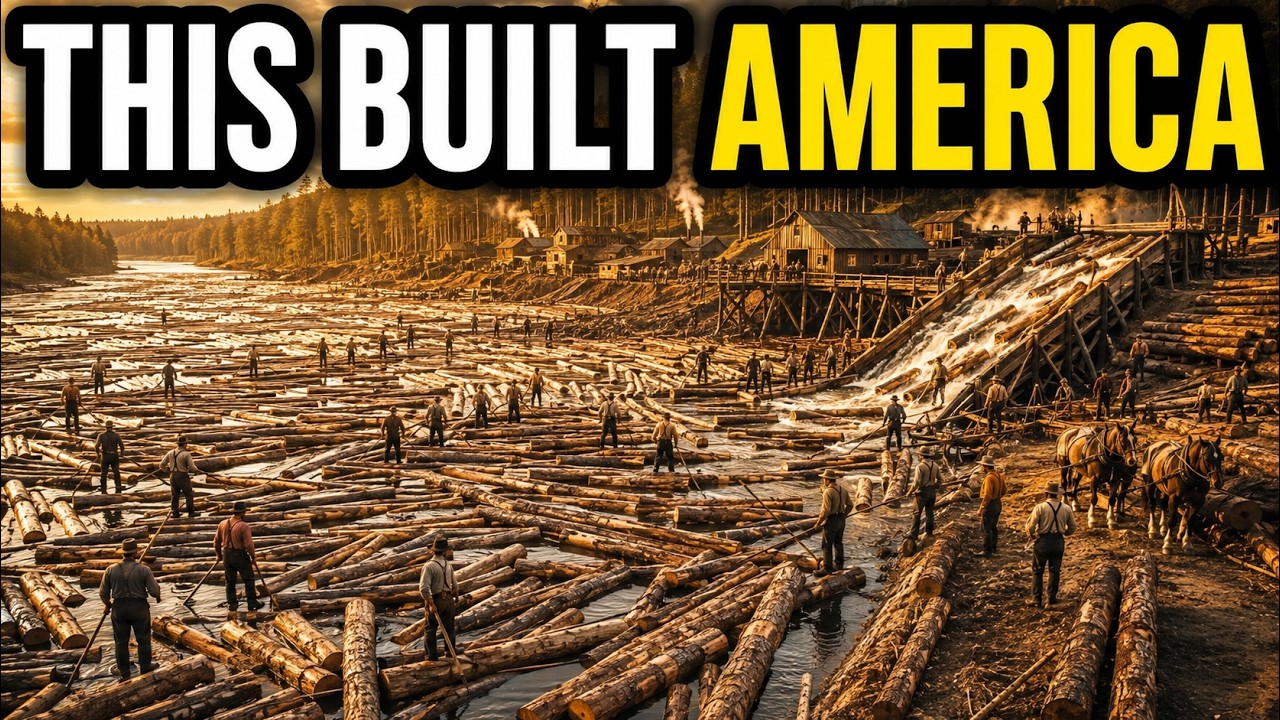
Ross buried a great many men across his years on the water. He kept driving logs anyway, because that was the work, and the work did not stop for the dead. Here is what that work actually was. Every winter, crews went up into the North Maine Woods and cut pine and spruce by hand with axes and long two-man saws in the snow.
They hauled the logs by ox and horse sled to the frozen banks of the West Branch and stacked them there in great decks on the ice. Into the end of every single log they hammered an iron stamp, a private mark cut into the wood the way a rancher brands a steer. A hundred miles downstream, that mark was the only thing that told one company’s timber from another’s. Then the crews came out of the woods, and everyone waited for spring.
The scale of that winter work is hard to picture now. A single logging operation could put dozens of men into one camp for an entire season, cutting from before dawn until dark, and there were hundreds of camps scattered through the North Woods in a good year. The logs were hauled to the ice on sleds pulled by oxen and horses over roads the crews iced on purpose, pouring water to build a hard slick surface that let one team drag a load of timber that would have been impossible on bare ground. Thousands of separate log marks were registered along the Penobscot, each one a small combination of axe cuts belonging to a single owner, hammered into both ends of the log so it could still be read after a hundred miles of grinding downstream.
A log without a readable mark was a log nobody could claim. The entire business of floating that many logs down a shared river owned by dozens of different companies all mixed together in one flood ran on nothing more than those little hatchet marks in the wood. When the ice let go and the river came up hard on the snowmelt, they rolled the whole winter’s cut off the banks and into the flood and followed it down. That was the drive.
Floating a forest down a wild river on the spring freshet through water violent enough to break a boat into kindling, all the way to the great booms above Old Town where the logs were sorted by their marks and rafted to the mills. A single winter’s cut could run to more than one hundred thousand logs, and every one of them had to be walked, pried, floated, and fought down the river by men standing on the logs themselves. The river did not make it easy. The West Branch of the Penobscot falls out of the high country in a long staircase of pitches and falls, and the drivers knew every one of them by name, the way you know the bad corners on a road you have driven your whole life.
Ripogenus, So-wadnehunk, Grand Pitch, the Heater. At each one the current went from fast to violent, and a calm run of floating logs turned into a grinding wall of timber. Most of the men who worked that water could not swim a single stroke. It did not much matter whether they could.
A man who went into the Penobscot in flood, in a soaked wool coat and boots weighted with iron, was not usually coming back out to try again. Joseph Etienne’s life tells you what kind of men these were. The Penobscot people had run this river for a very long time before the lumber companies ever existed, and their skill in a boat was recognized by everyone who saw it. When Thoreau came north in 1853 to see the Maine woods, the guide he hired was Etienne, and Thoreau filled pages of his book with the younger man’s ease on the water and his knowledge of the country.
Etienne was elected a governor of the Penobscot Nation. He moved between two worlds, the older life of the river and the new industry of the drive, and he was respected in both. And he still spent his spring standing in a bateau in white water for wages, because that was the work he was the best in the state at doing. When a man like that drowns, it is not because he was careless.
It is because the Penobscot in spring flood did not care how good he was. The whole craft came down to staying on top of the logs, and that started with the boat and the boots. The boat was called a bateau. It was a long, heavy, flat-bottomed craft with flared sides and high pointed ends, built to ride up over rough water instead of knifing into it, and to turn fast in a current that wanted to throw it.
It carried a crew of men with long spiked poles, and it was the one place on the river that was not a floating log, which made it the thing everyone wanted to reach, and the thing that drowned the most men when it went over. The best boatmen on the whole Penobscot were Penobscot Indians out of Old Town, and their reputation was so trusted that when John Ross took his famous drive down the Connecticut River in 1876, he brought eighteen Indians from Old Town along just to handle the bateaux through the bad water. One of the great ones was a man the rivermen called Big Sebatt, whose name was Sabbatus Mitchell. The story they told about him was that he ran Sowadnehunk Falls standing up in a bateau straight down a pitch that most men portaged around on foot, and came out the bottom having shipped only a little water.
A wall of falling white water, a heavy boat, a crew, a set of rocks that will end you if you touch them, and a man reading all of it in real time and steering through with a pole and his own nerve. For Big Sebatt, that was simply the work on an ordinary day. John Ross took that same reputation and staked everything on it in 1876 in what became the most famous single drive of his life, and it did not even happen on the Penobscot. A company had a fortune in logs stranded on the headwaters of the Connecticut River, hundreds of miles to the southwest, and no local crew could get them out.
They sent for Ross. He came down out of Maine with a crew of Bangor men and eighteen Penobscot boatmen from Old Town, and he took on twenty million feet of timber that had to travel three hundred and twenty miles down the Connecticut River to reach the mills at Hartford. The men left Bangor in the middle of April. Gamblers in Hartford were offering five to one odds that the drive would fail, that the Maine men could not do on a strange river what no crew there had ever managed.
Ross drove those logs the entire length of the Connecticut through low water that had to be raised with stored floods and blasted open with powder. The first of them reached the Hartford booms around the first of September. He won the wager, and he won it on the skill of Maine rivermen working a river not one of them had ever seen before. On the logs themselves, a man needed to be able to stand, and the river was doing everything it could to prevent that.
The answer was on his feet. River drivers wore corked boots, spiked boots, and one pair could carry as many as sixty-three iron spikes driven through the soles, some a quarter inch long and some closer to three quarters of an inch. Those spikes bit into wet bark and let a man run across floating, rolling, half-submerged logs the way you or I would cross a room. When you see an old photograph of a driver balanced on a single log in the middle of a rapid, apparently defying good sense, you are really looking at those boots doing their job.
In his hands he carried one of two tools, and the more important of the two was invented right there in Maine. In 1858, a Maine blacksmith named Joseph Peavey built a better tool for rolling logs. He took a stout wooden handle, fixed a sharp spike in the end, and hung a hinged iron arm with a hook on the side of it. The hook grabbed the log, the spike gave leverage, and suddenly one man could roll and turn a piece of timber that three men could barely budge before.
It was called the Peavey after him, and it is still called the Peavey today, still made and sold and used. The other tool was the pike pole, a long shaft with a spike and a hook on the end for reaching out and pulling or shoving a log in the water without going in after it. A peavey and a pike pole and a pair of spiked boots. That was the entire toolkit for moving a winter’s worth of timber down a mountain river, and it had almost nothing in it that Julius Caesar would not have recognized.
With those three simple things, a driver went to work on the moving river, and the work was constant motion. The front crew rode the main body of the drive downstream, running out onto the logs to break up small snarls before they could grow, leaping from log to log to keep the whole mass moving together and centered in the current. A good driver could cross a river on floating logs without wetting a foot, stepping from one to the next as they rolled, reading in a fraction of a second which log would hold his weight and which would turn under him. When the timber bunched at a narrow place, he waded straight in with his peavey and pried the logs apart one at a time before the bunch could set and lock into a jam.
It never stopped, and it was all done in and over water still cold enough to kill, and a single slip at the wrong place put a man under the very logs he was steering. The moment every driver feared, and every driver eventually faced, was the jam. It happened when a single log caught on a rock, on a ledge, on the head of a falls, and stopped. The logs behind it stopped too, and then the whole river’s worth of timber piled up on top of that one snag, driving in end over end under the full weight of the flood, until you had a jam that could stand twenty feet high and more, stretching back up the river, a mountain of shifting timber under enormous stored pressure.
It did not come apart on its own. To break it, a man had to climb out onto the face of the jam, find the one log that was holding all the others, the key log, and cut it or pry it free. The instant he freed it, the entire mountain of timber let go at once, and the river came through, and the man who had just freed it had a few seconds to get off and get to the bank before the entire released mass of the jam ran over the spot where he was standing. Some of them made it every time for thirty years.
Some of them did not make it once. There was a driver named Larry Connors who was killed doing exactly this at a place on the Ripogenus called the Dryway sometime around the middle of the 1870s. By the account that came down, Connors swore he would break that jam if it took him to hell to do it, and he went out onto the face of it, and a log struck him, and the river took him. His body was never recovered from the Ripogenus.
Years later, two men out bear hunting in the spring found a human skull wedged in the rocks at the Big Eddy, three miles downstream, with a front tooth missing. That was how the men who had known Larry Connors got him back. The same kind of death was happening at every bad pitch on every drive year after year. On the Nahmakanta, a driver trying to set a charge of dynamite to loosen a twenty-foot jam was crushed when the key log shifted under him before he could get clear.
At Stair Falls, a driver named Tommy Knowles went over a drop of ten to fifteen feet on a raft that swamped under him, and the men on the bank watched him spin in the whirlpool below, going under and coming back up for a full five minutes before the current finally threw him to the shore, barely alive. Knowles got a name and a story only because the river happened to give him back. The dams were their own kind of danger and their own kind of genius. Because the West Branch did not always carry enough water to float the logs over the shallow stretches, the companies built dams up in the headwaters at Chesuncook and elsewhere to store the spring water and then let it out in a controlled flood when the drive needed it.
Each dam had a gate, a sluice, and the logs were run through the open sluice in a roaring shoot of released water. It was efficient and it was clever, and it was lethal. A man could be swept into an open sluice gate and shot through it like a log himself. At a roll dam at Seboomook Falls, one account tells of four men going into the water together in the churn below the gate.
Two of them came out alive. The record does not give the names of the other two. It simply notes that they went in, and that two came out. Everything the drive needed to keep going, the food, the blankets, the tools, the cook, traveled with it in a floating outfit the rivermen called the wangan.
It followed the crew down the river, and it was the closest thing to home that a man had for the two or three months the drive lasted. The days were fourteen hours long, in and out of water that had been snow a week earlier. The men slept in wet wool blankets on the ground and ate what the cook could put together on an open fire on a riverbank, and then they got up in the dark and did it again. Even the cook was not safe.
On one drive, a cook named Joe Parish drowned when his canoe capsized on the way back from placing a supply order, and he was recorded as the only death on that particular drive that season, which tells you something about what a normal season was expected to cost. For all of that, the pay was the best in the North Woods, and the men knew it. Around the turn of the century, an ordinary lumberman might make somewhere between seventeen and thirty dollars a month depending on his skill, but the river drivers stood at the very top of the scale, because the river drivers were the ones with the skill that could not be faked, and the job that could get you killed. The elite Penobscot rivermen even had a name.
They were called the Bangor Tigers, and they were known as the best in New England, and later the best out west when the drives moved on. A driver could come off a full spring drive with two or three hundred dollars in his pocket, which in that era was real money, earned in the hardest and wettest way a man could earn it. As the main body of the drive moved downstream, thousands of logs got hung up along the way. They stranded on gravel bars, they wedged into the banks, they slid off into quiet backwaters and dead eddies where the current would not carry them.
And every single one of those logs had a mark on the end, and belonged to somebody, and had to be recovered. Behind the main drive came the rear crew, the last men on the river, wading and rolling and prying every stranded log back into the current by hand, mile after mile, working in the coldest and wettest conditions on the whole drive, sweeping the river clean behind everyone else. The rear could run for weeks after the head of the drive had already reached the mills. On the West Branch, a drive that started at ice out in April could still have men working the rear well into the summer.
Joseph Etienne drowned in the first week of July, which tells you the drive he died on had already been running for more than two months. The men on the rear had a name for what they did. They called it sacking the river, going back over every mile the drive had already run and digging out the logs the flood had left behind, off the gravel bars, out of the alders, up from the bottoms of dead pools where they had waterlogged and started to sink. It was cold and endless and unglamorous, and it was essential, because a log left behind was money left behind, and the company had already paid to cut it.
And where was all of it going? It was going to the booms. Above Old Town, the Penobscot Company had strung the river with a system of floating log booms, chains of connected timbers that reached out across the water and caught the entire flood of logs coming down. The sorting works there stretched for something like ten miles.
Here every one of those logs was pulled in, read by the private mark stamped into its end the winter before, separated out by owner, and rafted together to be floated down to the right mill. Long strings of squared timbers were chained end to end and anchored out into the river on piers, forming floating fences the men called sheer booms, angled to steer the running logs where the company wanted them, into holding grounds, and then into narrow sorting gaps. At the gap, boom men stood out on the floating logs and read the mark on each one as it came through, shunting it toward its owner’s pocket. A man called a scaler measured the timber and tallied the board feet, because every stick of it was bought and sold by the board foot.
Ten miles of river worked like a machine with no engine anywhere in it, run on current, chain, and the eyes of men who could read a hatchet mark at a glance. At the peak, there were something like three hundred sawmills in the towns around Bangor, and they turned the river’s timber into boards and shipped it out of Bangor to the world. In a single peak year, more than two hundred and fifty million board feet of lumber went out of that one river system. In 1872, Bangor, on the strength of this, called itself the lumber capital of the world, and for a while the claim was simply true.
As late as 1902, thirty years after the best year, a single downriver boom at Argyle rafted one hundred and forty-two million board feet of logs in one season. There was a reason one company came to run all of this. In the early days, before 1846, every outfit drove its own logs down the West Branch and fought its own way through everyone else’s timber, and the result on a shared river in flood was chaos. So the operators did something radical for the time.
They chartered a single company, the Penobscot Log Driving Company, and gave it authority over the entire flow of logs from the headwater dams down to the booms. One master driver now commanded the whole drive, every owner’s timber together, and the cost was divided among them by the board foot. The companies that ran these drives were careful, disciplined, professionally managed operations, and they counted everything. We still have their ledgers.
One year’s records for the Penobscot Log Driving Company put the total cost of the drive at $13,572. 57, down to the penny. They valued their storage dam at $35,000. They valued their wangan, their boats, their canoes, and their scow together at $1,000.
Every log had a mark. Every mark had an owner. Every board foot was measured and sorted and billed. The paperwork was immaculate.
And the men. When a driver drowned, there was often no paperwork at all. There was a pair of caulked boots nailed to a tree at the spot where the river took him, which is a thing the rivermen actually did. They hung the dead man’s boots in the branches over the water.
There was a wooden cross cut into the bark of a pine. In the case of Joseph Etienne, a pair of boots hung in a tree that the men said stayed there for years. And in the case of Larry Connors, there was a skull found by hunters three miles downstream with a tooth missing. The logs were counted to the last stick.
The men were remembered by their friends in the trees until their friends were gone, too. Joseph Etienne did not have to die that day. He was a governor of his nation and one of the most respected rivermen alive, and he had run harder water than the Heater more times than anyone could count. The account his own men gave afterward was that the boat went wrong, and that Etienne could have gotten himself clear and would not do it, because there were men in that bateau with him who could not swim, and he stayed with them.
Whether that is exactly how it happened, no one can now prove. But it is what the men who were there believed, and they were not men who handed out that kind of story lightly. John Ross stood on that bank and watched the finest boatman he had lose the river, and defended the living crew, and went back to work. They hung Joseph Etienne’s boots in a pine tree above the water.
His people said the boots stayed there always. The drives went on for another hundred years after Etienne drowned. The long saw logs gave out, and the mills that wanted them gave way to paper mills that wanted spruce cut into short four-foot sticks. By the early 1900s, the whole operation on the West Branch had been folded into the Great Northern Paper Company and its mills at Millinocket.
The bateau and the peaveys and the corked boots did not change at all. Short logs floated the same river the long logs had, past the same killing pitches, driven by the same kind of men for another seventy years. The men in the boats kept coming down the West Branch every spring until 1971, which was the last log drive in the state of Maine. In 1976, the state banned log driving on its rivers for good, because the sunken bark and the rotting wood were fouling the water.
The booms are gone. The great sorting works above Old Town are gone. Two of the old riverside boom houses still stand at Chesuncook and at Ambajejus, and they are small museums now, kept by people who do not want this forgotten. We know the exact cost of the drive to the penny, because the company wrote it down.
We know a storage dam was worth $35,000 and a scow was worth part of a thousand, because the company wrote that down too. What we do not have anywhere is the number of men the Penobscot drowned across a full century of drives, because no one was ever assigned to write that down. We have a handful of names, because a few people, a writer here, a hunter there, a grieving crew, took the trouble to save them. Joseph Etienne, Larry Connors, Big Sebatt who lived.
For every one of those, the ledger of the river gives no name, only a number, and often not even that. The American log drive may well have been the most dangerous ordinary job this country ever produced, more dangerous day in and day out than the mines or the rails, and the men who did it were among the most skilled watermen the continent has ever seen. We know that at all only because a very few of their names slipped through before the record closed.
The least we can do, a hundred and fifty years on, is say the ones we have out loud.






