The rivalry between Ford and Chevrolet began more than a century ago, at the dawn of the American auto industry, and it has defined the business of selling cars in the United States ever since. The two brands have traded blows over the decades, responding to each other’s innovations with competing models designed to capture the same customers. While the contest has produced countless products, five episodes capture the pattern most clearly: Ford created something revolutionary, and Chevy followed with a comparable answer. The opening move came in 1908, when Ford introduced the Model T.
Before that, cars were largely toys for the wealthy. The Model T changed everything through its simplicity and its pioneering use of assembly techniques, making it possible to mass-produce a vehicle at a price ordinary Americans could afford. Henry Ford famously noted that customers could have a Model T in any color they wanted, so long as it was black. The car made automobiles popular and turned Ford into a dominant force.
A few years later, a competing project took shape. In 1912, Louis Chevrolet, a Swiss-born auto engineer and race car driver, teamed up with William Durant, a businessman who had previously built General Motors into a major company before losing control of it. Together they released the first Chevrolet, the Classic Six. It was a refined, fancier automobile aimed at wealthier buyers, and it never caught on with the general public.
The Model T completely overshadowed it. The two founders quickly disagreed over the company’s direction. Louis Chevrolet was passionate about engineering exciting, high-performance cars. Durant, however, understood that the future of the business lay in following Henry Ford’s approach: building something simple, affordable, and broadly appealing.
The clash ended with Chevrolet leaving the company that bore his name to start a new venture building race cars. Durant stayed, and in 1915, Chevrolet released the Series 490, a mass-market car named for its $490 price tag, which was slightly cheaper than the base price of the Model T. For the first time, Ford had real competition. The Series 490 sold well enough that Durant used the profits to regain control of General Motors, where Chevrolet became the brand for lower-priced, widely appealing vehicles.
By the 1920s, the industry had evolved. Chevy moved on to newer models, while Ford kept producing the same Model T for years beyond what many considered reasonable. In May 1927, Ford shut down all of its plants to retool for the upcoming Model A, which would not be introduced until December of that year. With Ford effectively out of production for half the year, 1927 marked the first time Chevrolet outsold Ford and became America’s best-selling car brand.
Ford reclaimed the lead briefly by selling millions of Model A’s, but Chevy pulled ahead again in the early 1930s. In this first round, Ford was clearly the innovator, but Chevrolet showed how effective a well-executed alternative could be. The second major contest involved pickup trucks. Farmers had long modified Model T’s and other vehicles into makeshift trucks, but Ford gets credit for selling the first factory-assembled pickup in 1925 and for popularizing the term itself.
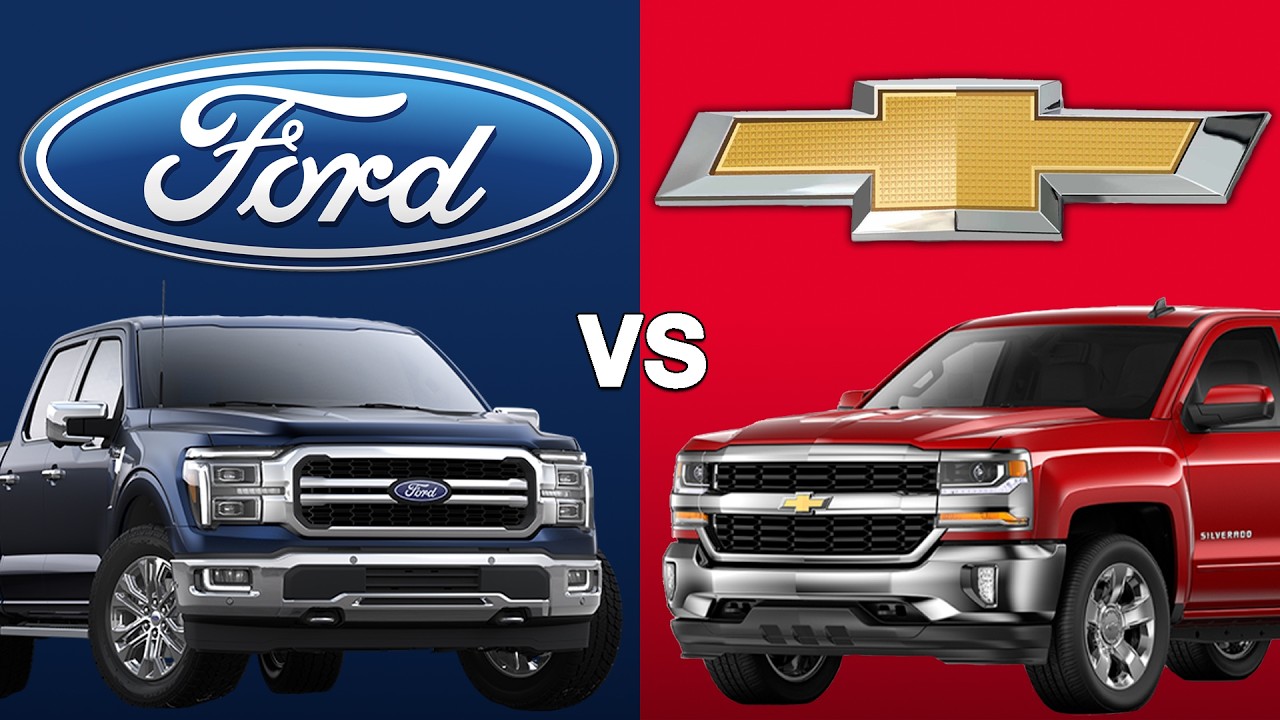
In 1948, after World War II, Ford introduced the iconic F-Series. The F-150, launched in 1975, quickly became the flagship, and Ford later claimed the F-Series had been America’s best-selling truck for nearly fifty consecutive years, selling more than 800,000 units in 2025, well ahead of the second-place Chevy Silverado. Chevy entered the truck market in 1960 with its long-running C/K series, the C standing for two-wheel drive and the K for four-wheel drive. It was the company’s answer to the F-Series, which had gained massive popularity during the 1950s.
In 1975, the same year the F-150 debuted, Chevy introduced the Silverado as the top trim level of the C/K series. Near the end of the 1990s, it became a standalone model and replaced the older series, partly as a response to Ford redesigning the F-Series for greater everyday comfort. The F-Series always outsold it, though General Motors also produced the GMC Sierra, and combined sales of the two GM trucks technically outpaced Ford. Still, the pattern held: Ford led, Chevy followed.
A more complicated duel played out in the sports car market. Both brands had built their reputations on simple, affordable vehicles, reserving their luxury offerings for separate divisions, with GM acquiring Cadillac in 1909 and Ford picking up Lincoln in 1922. As highways spread across the country and demand exploded during the 1950s, room opened for new categories. In 1953, Chevy released the Corvette, a two-seat sports car heavily inspired by European designs.
The following year, Ford introduced the Thunderbird, not necessarily as a direct response to the Corvette, but recognizing the same opportunity. Ford positioned the Thunderbird as a personal luxury car, justifying its higher price with a V8 engine, leather seats, power windows, and ample space. It began as a two-seater, but Ford soon added a four-seat version that proved far more practical and successful, especially since the Thunderbird cost about $500 less than the Corvette. Chevy offered the Impala as an alternative through the 1960s, but in 1970, it released the Monte Carlo as a direct challenger in the personal luxury market.
The Monte Carlo outsold the Thunderbird nearly three to one in its first year. Time, however, favored the Corvette. The Thunderbird, Monte Carlo, and Impala all eventually left production, while the Corvette survived. This round was a genuine back and forth: Chevy created the first sports car, Ford responded with something different and more broadly appealing, and Chevy answered again with a comparable product.
The most famous exchange came in the pony car segment. In 1964, Ford launched the Mustang, one of the most successful vehicle debuts in company history. It combined price, performance, style, and practicality in a way that attracted younger buyers, and it was heavily marketed to them. The Mustang was so successful that it essentially created a new category of automobile, and it sold more than a million units within a few years.
Chevrolet responded directly with the Camaro, aimed at the same customers and priced similarly. In its first year, the Camaro sold less than half as many units as the Mustang, and it took until 1977 before it outsold its rival even once. The Mustang, which never left production, remained the greater success. Once again, Ford struck first, and Chevy produced a respectable imitation.
The final contest took place in the SUV market, where both companies had strong claims to pioneering. Chevy traced its SUV heritage back to the Suburban in the 1930s, while the Ford Bronco, released in the 1960s, was widely recognized as the first vehicle marketed as an SUV designed primarily for off-roading. Ford tied the Bronco to the Mustang by naming both after horses, and it followed the Mustang by about a year and a half. Chevy responded within a few years with the K5 Blazer, a larger and more powerful SUV that outsold the Bronco early on.
In the 1980s, Chevy introduced the smaller S10 Blazer, nicknamed the Baby Blazer. Ford answered with the Bronco II, the Baby Bronco, but the Blazer remained more popular. As the 1990s arrived, families increasingly bought SUVs for ordinary daily use. Chevy redesigned the S10 Blazer with more doors and family-friendly features, while Ford began selling the Explorer.
By 1996, Ford discontinued the Bronco altogether, reviving it twenty-five years later. The Blazer also returned after a long absence from the market. In the SUV category, the leadership shifted back and forth far more than in any other segment. Across all five comparisons, a consistent story emerges.
In four of them, Ford came first and ultimately proved more iconic. The pattern was always the same: Ford released a revolutionary vehicle, and Chevrolet followed with a competitive, sometimes more practical alternative. The results varied by market, but the rivalry itself never stopped shaping the American car industry.