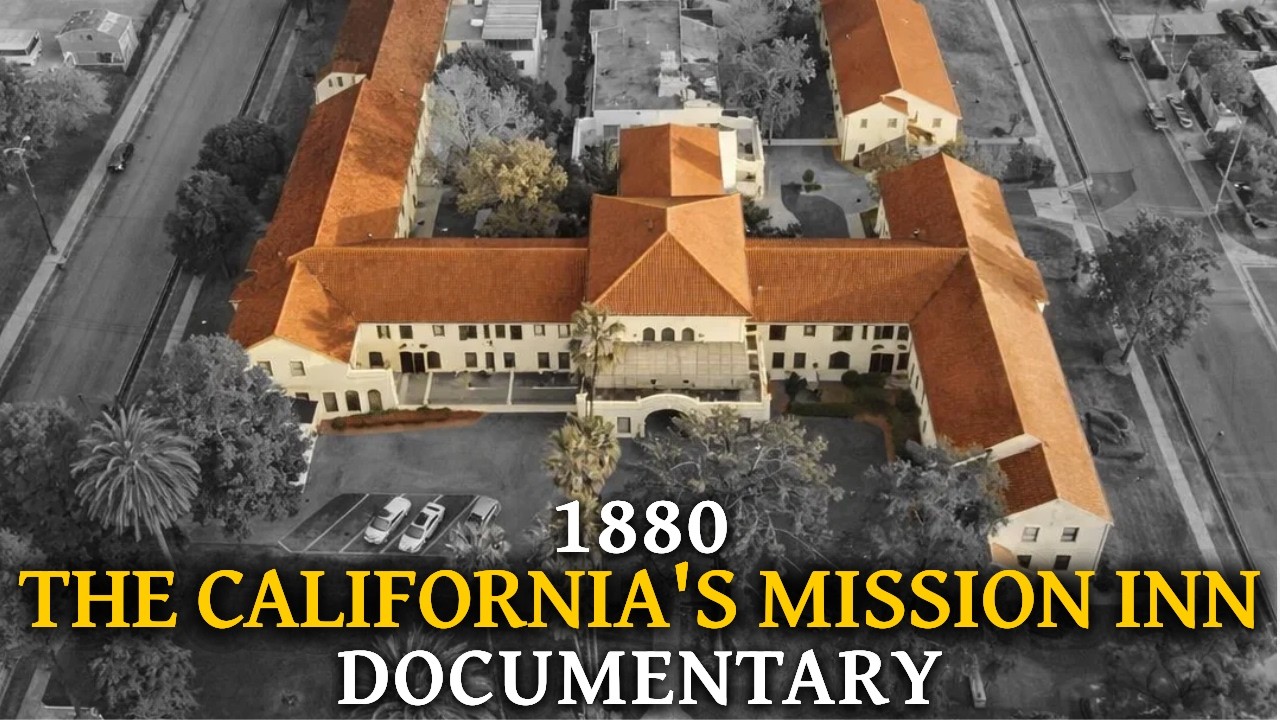
In the center of Riverside, California, a building stretches across an entire city block, its roofs bristling with domes, bell towers, gargoyles, and turrets borrowed from five centuries and six nations. Catacombs run beneath its floors. In its chapel, a golden altar shipped from Mexico in 32 pieces has been pieced back together like an enormous jigsaw puzzle. Over 800 bells hang from its walls and courtyards, among them one dated 1247, thought to be the oldest bell in Christendom.
Presidents have slept within its walls. Movie stars have exchanged vows there. Aviators are commemorated on its walls. And yet this astonishing structure started out as little more than a 12-room adobe boarding house beside a dusty road in a town that hardly existed.
This is the Mission Inn, and the man behind it was no architect, no heir to a fortune, and no one anyone would have predicted would create one of the most extraordinary buildings in American history. His name was Frank Augustus Miller, and his obsession almost ruined him. The story starts with the land. In 1874, a civil engineer named Christopher Columbus Miller reached the tiny settlement of Riverside, California.
He had traveled west from Wisconsin to survey canals for a new agricultural colony. The town was barely four years old, its streets unpaved and its population small, but the soil was fertile and water from the Santa Ana River held the promise of prosperity. C. C.
Miller purchased an entire city block in the middle of town and put up a modest adobe home, then sent for his wife Mary and their four children, including a seventeen-year-old boy named Frank. In 1876, the Millers started taking in boarders. Travelers were coming through more often, pulled by the growing citrus industry reshaping Southern California. The adobe had twelve bedrooms, and Mary Miller filled every one with guests.
Two years later, the family added a small wooden wing and named the place Glenwood Cottage, a simple boarding house run by the family. But young Frank Miller saw more than that. In 1880, at only twenty-two, his father sold him the property and the business for $5,000. Frank had no formal training in architecture or business.
He had pleaded with his parents to let him remain in Riverside rather than go to college in Ohio, vowing to live an exemplary life. They consented on one condition: he would be tutored by the town’s only teacher, a boarder at the Glenwood named Isabella Hardenbergh. Over months of study, Frank and Isabella fell in love. They wed that same year, and Frank Miller began the work that would absorb him for the rest of his life.
At first, the changes were modest. Frank added rooms, improved the grounds, and in 1888 renamed the place the Glenwood Tavern. But Riverside was changing around him. The citrus industry was booming, and wealthy Easterners and Europeans were arriving by train, lured by orange groves and mild winters.
Riverside was becoming one of the richest cities per capita in the United States. Frank grasped what these visitors wanted: not merely a place to sleep, but an experience, a destination that made them feel they had stepped into another world. By the late 1890s, Frank’s vision reached far beyond a country tavern. He dreamed of a grand hotel that captured the romance of California’s Spanish mission past.
The Mission Revival movement sweeping the state had deeply influenced him, inspired by the old Franciscan missions along the coast. Frank felt a spiritual connection to the Franciscans and their tradition of hospitality. He saw his hotel as a secular mission, a place of beauty, culture, and welcome. In 1902, he secured financing, with his largest investor being Henry Huntington, the railroad tycoon who owned the Pacific Electric Company.
The architect he selected was Arthur Burnett Benton, a founder of the Landmarks Club dedicated to preserving California’s historic missions. Benton designed a U-shaped Mission Revival structure with 84 new rooms, arched walkways, clay tile roofs, and a bell tower modeled after the one at San Gabriel Mission. The building opened in January 1903 as the Glenwood Mission Inn, later shortened to the Mission Inn. Then Frank kept building.
One of the first famous guests was President Theodore Roosevelt, who arrived by train on May 7, 1903. Before leaving the next morning, Roosevelt planted one of Riverside’s two original navel orange trees in the hotel courtyard. The navel orange was the foundation of the city’s economy, launched by two trees brought from Brazil in the 1870s. Frank sent the president a box of oranges every Christmas for the rest of Roosevelt’s life, a small gesture that captured who he was: a showman, a host, and a man who understood that personal connections mattered more than marble and stone.
But Frank was never satisfied. No sooner would one wing be finished than he began sketching plans for the next. He traveled the world obsessively, visiting Europe, Asia, and Latin America, absorbing architecture and art wherever he went. He walked through Moorish palaces in Spain, Buddhist temples in Japan, Gothic cathedrals in France, and churches in Mexico.
Everything that moved him, he brought back to Riverside. The Mission Inn became a living museum of his obsessions. He collected bells from churches across the globe, eventually amassing more than 800. He acquired the Reyes altar, a massive Mexican baroque altar carved from cedar and covered in 18-karat gold leaf, standing 25 feet tall and 16 feet wide, delivered in 32 interlocking pieces with no assembly instructions.
He purchased stained glass windows created by Louis Comfort Tiffany in 1906, rescued from New York’s demolished Madison Square Presbyterian Church. To house these treasures, he hired architect G. Stanley Wilson to design the Saint Francis Chapel, which became the spiritual heart of the hotel. Over the next three decades, Frank added wing after wing.
The Cloister Wing, designed by Arthur Benton and completed around 1911, featured a soaring music room, the Carmel Tower and dome rising from the corner of Sixth and Orange streets, and massive buttresses inspired by San Gabriel Mission. Beneath it, Frank built catacombs, dark winding passageways lined with artifacts and religious iconography. The Spanish Wing, designed by Myron Hunt, added guest rooms, an outdoor courtyard, and Author’s Row, where writers and intellectuals stayed. The final addition, the Rotunda Wing designed by G.
Stanley Wilson, was completed in 1931, featuring a six-story rotunda with a spectacular circular staircase and the Saint Francis Chapel. The rotunda was inspired by Frank’s dedication to world peace, its walls decorated with the insignia of nations from around the globe. By the time it was finished, the Mission Inn filled an entire block with more than 200 guest rooms and one of the most eclectic collections of art and architectural curiosities in the Western United States. The guest list read like a history book.
Presidents Benjamin Harrison, William McKinley, Theodore Roosevelt, William Howard Taft and Herbert Hoover all passed through its doors. When Taft checked in back in 1909, the hotel is said to have commissioned an extra-large chair to fit his three-hundred-pound build; the president took no pleasure in the gesture. Early on came performers such as Lillian Russell, Sarah Bernhardt and Harry Houdini, and later Hollywood names like Clark Gable, Bette Davis, Cary Grant and Ginger Rogers. It was in the Saint Francis Chapel that Bette Davis wed in 1945.
Richard Nixon and Pat Ryan were married at the Mission Inn. Ronald and Nancy Reagan chose it for their honeymoon. This was far more than a hotel; it served as a stage for American power, glamour and romance. Yet beneath all the splendor, Frank Miller was fighting to stay afloat.
The Mission Inn was never run like an ordinary business. To Frank it was closer to a civic trust, and he sank every dollar back into building, collecting and community endeavors. He was instrumental in founding the Citrus Testing Station, which grew into the University of California, Riverside. He also helped launch the local trolley system.
He gave land for a YMCA. He arranged Easter sunrise services on nearby Mount Rubidoux that attracted crowds in the thousands. He founded the Institute of World Affairs to promote the study of international peace. In many respects, he was the pulse of Riverside itself.
But passion and generosity do not reconcile a balance sheet. The Mission Inn was always short of money, and Frank borrowed heavily to finance each new wing and acquisition. The Great Depression of the 1930s struck Riverside hard. Visitors dwindled, income fell, and the unending construction turned into an unbearable weight.
Still he pressed on, raising the rotunda wing between 1929 and 1931 in the midst of the gravest economic collapse America had ever known. Frank Miller’s first wife, Isabella, had died years before, and he had since married Marion Clark. Come the 1930s, his health was deteriorating. On June 15, 1935, Frank Augustus Miller passed away just shy of his seventy-eighth birthday.
Word of his death spread through Riverside and the whole city came to a halt. For fifteen minutes, everything went still in tribute. He was laid to rest at Evergreen Cemetery, a short distance from the hotel that had absorbed his life. Following Frank’s death, his daughter Alice and her husband DeWitt Hutchings assumed management, yet the hotel’s money problems only grew worse.
When both of them died in the early 1950s, their children sold the Mission Inn in 1956 to Benjamin Swig, a hotelier from San Francisco. What came next was a long, painful decline. Eager to modernize and compete with showier destinations such as Palm Springs, Swig sold off close to 1,000 pieces from Frank Miller’s collection. Invaluable paintings, antique furnishings and religious relics went under the hammer to strangers.
He redid the interior in mid-century modern fashion, walling over arches and swapping out handcrafted fixtures. He set out to make the Mission Inn resemble every other hotel in California. It failed. The building’s spirit had been stripped away, and travelers could sense it.
The hotel kept bleeding money, passing through one owner after another. Some rooms were turned into apartments and student dormitories. By the 1970s, there was real talk of tearing it down. But a group of concerned residents would not let that happen.
In 1969 they founded the Friends of the Mission Inn, committed to safeguarding the hotel’s history. Their efforts helped win a pivotal status: on May 5, 1977, the Mission Inn was designated a National Historic Landmark. The city of Riverside ultimately bought the hotel to keep it from being destroyed. In 1985 it was sold to a private development company that shuttered the building for an extensive restoration, but the developers went bankrupt before finishing the $55 million undertaking.
For years the Mission Inn stood empty, locked and quiet. Then in 1992 a man named Duane Roberts stepped forward. Roberts was a Riverside native who had grown up in awe of the Mission Inn, recalling as a boy riding past its towers and arches with his family. He had built his fortune in frozen foods, creating a company that turned out a million burritos a day and brought in $80 million in yearly sales before he sold it in 1980.
When the Mission Inn came up for sale, he viewed it as a rescue mission. Roberts bought the hotel and saw the restoration through. In the fall of 1992, the Mission Inn opened its doors again for the first time in seven years. Under Roberts and his wife Kelly, the hotel came back to life.
Kelly introduced new traditions, among them the annual Festival of Lights, which brings in hundreds of thousands of visitors every holiday season. Today the Mission Inn Hotel and Spa ranks among the most celebrated historic hotels in the United States. USA Today has named it the number one historic hotel in the country. It holds 265 rooms, no two of them alike.
The bells still ring in the courtyards. The Tiffany windows still shine in the Saint Francis Chapel. The golden Reyes altar still glows in the candlelight. The Flyers Wall still honors 151 aviators, their signatures etched into copper wings, Amelia Earhart’s among them, dedicated as the International Shrine of Aviators in 1932.
Three hundred weddings are held there each year, and staff and guests insist that Frank Miller’s ghost still roams its corridors. The Mission Inn is too vast, too odd, too many things at once, Spanish and Gothic and Moorish and Asian and American, woven together across a jumble of domes and arches and concealed stairways. It was the work of a man who never studied architecture, who began with a twelve-room adobe and finished with a city-block-sized fantasy that all but ruined him.
Standing in its courtyard today, you can still sense it: the heft of 800 bells, the warmth of California sun on aged tile, the echo of presidents and movie stars and aviators who walked through these arches, and somewhere underneath it all, the quiet, unyielding heartbeat of a man who held that beauty was worth any price, even if that price was everything he ever owned.
