In the winter of 1944, Soviet infantry advancing through the forests near Nova Sakuliki noticed something strange. German soldiers were not retreating. They were hesitating. These were men who had survived years of blood and artillery, veterans of the eastern front hardened by combat, yet now they were slowing their advance, scanning tree lines, refusing to step into open ground.
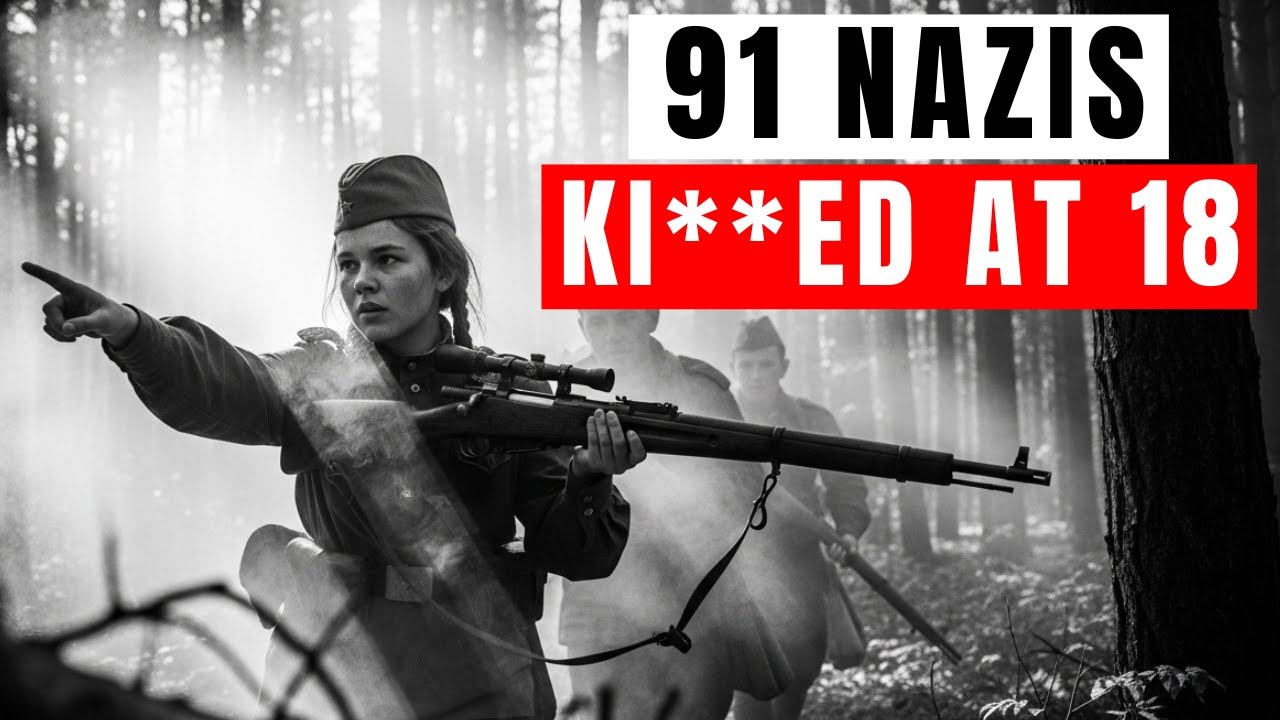
Something had changed. Shots were coming from places that made no sense. Single shots, perfect shots, men collapsing midstep, mid command, mid breath. Officers whispered that a new sniper had arrived.
But no one believed the truth when it reached them. The sniper hunting them was not a seasoned veteran, not a man hardened by years of combat, not even an adult. She was 18 years old, small, quiet, barely visible beneath her winter cloak. Her name was Aliyia Mulakulovva.
And before the war ended, she would become one of the youngest elite snipers in World War II. Her final battle turned her into a martyr, remembered not for survival, but for how fiercely she refused to retreat. Aliyia was born in 1925 in a remote region of the Kazakh Soviet Socialist Republic. Her early life was defined not by comfort but by absence.
Orphaned at a young age, she moved between relatives before eventually being sent to Leningrad to live with an uncle. It was there, long before the war, that Aliyia learned endurance. She lived through hunger, even before siege conditions made it legendary. She learned discipline in Soviet schools, where duty to the state was taught not as ideology, but as survival.
When Germany invaded the Soviet Union in 1941, Aliyia was still a teenager. But she did not flee. She endured the siege of Leningrad. She saw starvation hollow out entire neighborhoods.
She watched children disappear from classrooms, replaced by empty desks. She saw adults collapse in the streets and learned early that war was not something that arrived suddenly. It crept in slowly and never left. When evacuation finally came, Aliyia did not view it as rescue.
She viewed it as preparation. By 1942, the Soviet Union was bleeding soldiers faster than it could train them. Entire divisions were being rebuilt from scratch. The Red Army needed infantry, but it also needed specialists, snipers.
Women were already proving themselves in this role across the eastern front. Patience, discipline, observation—these were traits not taught quickly, but honed through necessity. Aliyia volunteered. Not once, not twice, but repeatedly.
At first, she was rejected. She was too young, too small, too frail. She was told she could serve in support roles—communications, logistics, clerical work. She refused.
Aliyia wrote letters. She argued. She trained on her own. She practiced marksmanship whenever she could.
She learned fieldcraft by watching veterans, memorizing their movements, studying the terrain. Eventually, persistence wore down resistance. In 1943, Aliyia was accepted into the Central Women’s Sniper Training School, one of the most demanding and unforgiving programs in the Soviet military. She did not celebrate.
She prepared. Sniper school was not romantic. It was isolation, repetition, and failure. Recruits learned to lie motionless for hours in freezing conditions.
They learned to calculate wind drift without instruments. They learned camouflage, not just visually, but behaviorally. Aliyia struggled at first, not with accuracy, but with endurance. She was smaller than most trainees.
Her body tired faster. The cold affected her severely. But she adapted. She trained longer than required.
She repeated drills after dismissal. She learned to ignore hunger and numbness. Instructors noticed something unusual. Not raw talent, but unshakable focus.
When Aliyia aimed, her hands did not tremble. Her marksmanship improved. She learned to relocate quickly after firing, a critical skill that separates the living sniper from the dead one. She also learned restraint.
Snipers were taught not to fire unless the shot mattered. Aliyia absorbed this lesson completely. By the time she graduated, she was no longer a student. Aliyia was assigned to the 54th Separate Rifle Brigade, operating in some of the most dangerous contested zones of the northwestern front.
This was not static trench warfare. This was forests, marshlands, shifting lines, and brutal infantry clashes at close range. Her first days at the front were quiet. Too quiet.
She observed. She learned enemy patrol patterns. She memorized terrain features. She studied how German soldiers moved when relaxed and how they moved when afraid.
Then came her first confirmed kill. There was no celebration, no announcement, just a quiet note in the log. Aliyia did not hesitate after that. Her confidence grew, not from pride, but from confirmation.
She had proven she could function under real fire. More importantly, she had proven she could kill and remain composed. Veteran soldiers began to notice her presence. Officers assigned her increasingly complex observation tasks.
She was paired with spotters and given independence. By the end of her early missions, Aliyia was no longer considered a trainee. She was considered reliable. And on the eastern front, reliability was everything.
Her early missions were not designed for glory. They were designed to test whether she could survive the rhythm of frontline warfare: long hours of silence broken by sudden violence, the constant threat of artillery, and the psychological weight of knowing that every mistake could be fatal. She was first assigned to observation-heavy sectors, where her primary responsibility was not killing, but watching. She tracked German patrols, counted numbers, noted patterns, identified habitual routes and resting points.
Many snipers failed here, not because they lacked accuracy, but because they lacked patience. Aliyia excelled. Her ability to remain still for hours became legendary even among veterans. She did not fidget.
She did not rush. She waited until the battlefield revealed itself. Only then did she act. Her first confirmed kills came not in dramatic duels, but in controlled, disciplined engagements.
A German soldier stepping out of cover too confidently. A machine gunner exposing himself for a fraction too long. A sentry who believed the forest was empty. Each shot was deliberate.
After every kill, Aliyia relocated immediately, sometimes crawling for long distances through snow and mud to avoid detection. She understood early what many learned too late: a sniper’s survival depended on movement as much as marksmanship. There was no hesitation afterward, no visible shock, no emotional collapse. She recorded the details and prepared for the next mission.
This composure unsettled some of the infantry around her. She was young, quiet, unassuming, but her results were undeniable. Training had taught Aliyia technique. Combat taught her reality.
Battlefield conditions rarely matched theory. Wind shifted unpredictably between trees. Sound carried differently in snow. Smoke and debris obscured vision without warning.
She adapted by simplifying. She reduced unnecessary movement. She shortened engagement windows. She trusted instinct where calculation failed.
Her accuracy did not drop. It improved. Veteran soldiers began requesting her presence during defensive operations, not because of superstition, but because casualties were consistently lower when she was watching key approaches. She was no longer just a sniper.
She was a deterrent. It did not take long for German forces to realize a capable sniper was operating in the area. Patrols changed routes. Movement slowed.
Observation posts were reinforced. German snipers were introduced to hunt the hunter. This marked a turning point. Aliyia was now operating in contested sniper territory, facing opponents trained specifically to find and eliminate her.
The risk increased exponentially, but so did her focus. She began studying enemy snipers, not just their shots, but their behavior. She learned to anticipate where they would set up, how they would scan terrain, how long they would wait before moving. Her patience became a weapon.
Her early sniper duels were not cinematic. They were tense, silent, sometimes lasting hours. She learned to read subtle disturbances: branches moved unnaturally, snow compressed in ways that betrayed human presence, shadows that did not belong. When she fired in these engagements, it was decisive.
German snipers began disappearing from sectors she covered. Not always confirmed immediately, but enough to change enemy behavior. By now, Aliyia was no longer treated as a junior or temporary asset. Commanders trusted her judgment.
Spotters deferred to her instincts. Infantry altered movements based on her warnings. She was given greater autonomy, allowed to choose firing positions, to operate independently, to plan extended missions. Her kill count continued to rise steadily.
But more important than numbers was influence. Where Aliyia operated, the battlefield slowed. And slowing the enemy on the eastern front often meant survival. At some point during this phase, Aliyia stopped thinking of herself as someone proving her place.
She belonged. The rifle felt natural. The danger felt familiar. The battlefield, chaotic as it was, made sense in ways civilian life never had.
She was no longer reacting. She was controlling space. And the war had begun to notice. By the next phase, the battlefield around her had changed.
The Red Army was no longer merely holding ground. It was pushing forward, often blindly, often at enormous cost. Forests that once served as defensive cover became zones of constant advance. Trenches were abandoned and retaken within days.
Positions shifted so quickly that maps were outdated before the ink dried. This kind of warfare demanded more than patience. It demanded aggression. And Aliyia adapted.
Her missions were no longer limited to observation and selective fire. She was now embedded directly with advancing infantry units, tasked with clearing enemy resistance ahead of assaults, suppressing machine gun nests, and eliminating officers before engagements began. This was no longer safe sniper work. This was close, violent, unforgiving combat.
Aliyia began operating forward of main infantry positions, sometimes alone, sometimes with a single spotter. This placed her in extreme danger. If discovered, there would be no backup, no fallback trench, no immediate rescue. But it also placed her where she was most effective.
She identified enemy firing positions before attacks began. She neutralized observers directing artillery. She eliminated machine gun crews moments before they could pin down advancing Soviet troops. Entire assaults succeeded because resistance collapsed before it could organize.
Aliyia’s rifle was shaping the battlefield. Her most intense missions during this period were not measured by distance, but proximity. She engaged targets at ranges far closer than standard sniper doctrine recommended. In dense forests and ruined villages, shots were taken under constant risk of immediate discovery.
Once, after eliminating multiple enemy soldiers in quick succession, she was forced to relocate under fire, crawling through debris while bullets struck the ground around her. Another time, German infantry advanced so closely that Aliyia remained motionless for hours, concealed beneath camouflage, while enemy boots passed within meters. She did not fire. She waited.
When the moment came, she struck decisively. These engagements hardened her. She no longer hesitated between targets. She no longer second-guessed her decisions.
The war had stripped her actions down to instinct and discipline. Something fundamental changed. Earlier she had been careful, almost cautious. Now she was relentless.
She volunteered for the most dangerous assignments. She moved where resistance was strongest. She did not withdraw unless ordered. Her commanders noticed.
So did her comrades. Aliyia began leading by example, not through rank, but through action. Infantry followed routes she cleared. Soldiers advanced with greater confidence, knowing she was ahead.
She was no longer just a sniper. She was an assault enabler. As Soviet forces pressed forward, battles increasingly collapsed into brutal close-quarters fighting. Snipers were no longer guaranteed distance.
Aliyia adapted again. When engagements closed, she fought alongside infantry—rifle, grenades, sheer will. She did not retreat to safer positions. She advanced with the line.
Witnesses later recalled her calm under fire, her refusal to break, even when wounded or exhausted. Her presence stabilized units that might otherwise have faltered. Word of Aliyia spread rapidly within the brigade. Not exaggerated, not mythologized, simply factual.
She was effective. She was fearless. She did not step back. German forces too began responding.
Resistance stiffened in sectors she approached. Enemy fire intensified. Countermeasures increased. She had become a known threat.
This phase marked her final transformation. Aliyia was no longer fighting to prove herself. She was no longer fighting for recognition. She was fighting because retreat was unacceptable, because her unit depended on her, because the mission demanded it, and because somewhere along the way, the war had taken everything else from her.
What remained was purpose. By late 1944, the eastern front had become a chaotic, fluid battlefield. German forces retreating strategically fortified every forest clearing, village, and ridge. The Red Army was advancing relentlessly, but the cost was high.
Casualty numbers mounted with each engagement, and soldiers faced near constant artillery fire, machine gun nests, and concealed enemy positions. Aliyia, now recognized as an exceptionally skilled sniper, was no longer confined to rear observation posts. She moved with the first wave of assaults, her role evolving from sniper to active forward operative. She scouted enemy positions, suppressed machine gun nests, and guided infantry movement, all while under fire.
Where before she had waited and calculated, now she acted swiftly, decisively, and with deadly precision. Her position at the front lines was perilous. Every step could reveal her to the enemy. Every pause might be her last.
Yet she pressed on with the discipline she had cultivated since her first missions. The soldiers around her began to rely not just on her accuracy, but on her instinctive ability to sense danger and assess the battlefield. During this phase, she was embedded in forward operations that required continuous movement. Each day presented a new challenge: an enemy sniper waiting in a ruined barn, machine gun fire from a concealed trench, or the unpredictable chaos of a forested battleground.
She advanced under constant bombardment, crawling through mud, snow, and debris, always maintaining cover, and never exposing herself unnecessarily. Her first action of the day often determined the outcome of an entire infantry movement. She would identify enemy positions, pick targets with extreme precision, and relocate immediately after firing. This mobility kept her alive while keeping the enemy disoriented.
In one notable engagement, a squad of German soldiers attempted to halt a Soviet advance by establishing a crossfire along a narrow ridge. Aliyia, spotting the pattern, eliminated key personnel and disrupted the squad’s coordination before they could inflict casualties. The infantry pushed forward successfully and the ridge was secured. Wherever she operated, the momentum shifted in favor of the Soviets.
Her observations, decisions, and rapid execution of plans made her a natural point of guidance for the infantry. Younger soldiers followed her movements instinctively, trusting her judgment, even in chaotic, life-threatening scenarios. She did not command verbally. Her position and her actions dictated how troops advanced.
In several instances, units reported that her presence at the front lines stabilized their movement and minimized unnecessary exposure to danger. Commanders began giving her more autonomy, allowing her to select vantage points and patrol routes. By now, the Germans had recognized her effectiveness. Counter-sniper teams were dispatched specifically to hunt her.
Every engagement became a duel of wits and patience. Aliyia learned to anticipate enemy patterns, watching for subtle disturbances: a broken branch, a shadow shifting in the snow, a reflection in a puddle. Her skill at remaining undetected, combined with her lethal accuracy, allowed her to eliminate threats before they could locate her. These duels tested her endurance, often forcing her to remain motionless for hours, waiting for the perfect moment to strike.
Through these confrontations, she developed a deeper understanding of battlefield psychology. She knew when to act, when to remain still, and when to retreat strategically—not out of fear, but as a calculated tactic. The intensity of forward operations took a toll. Aliyia endured exhaustion, physical injuries, and relentless mental pressure.
Sleep was scarce. Food was minimal. The snow and mud of the eastern front were unyielding. Every day demanded that she operate at the peak of her abilities with zero room for error.
Yet she pressed on. Each mission reinforced her mastery of the battlefield, sharpened her instincts, and cemented her reputation. Her extraordinary composure under fire inspired confidence throughout the unit. Forward operations frequently collapsed into brutal close-quarters combat.
Snipers were forced to operate where lines blurred: trenches merged with forests, villages became kill zones, and artillery bombardments obscured visibility. Aliyia adapted seamlessly. She carried grenades and bayonets alongside her rifle, prepared for sudden enemy encounters. She moved through smoke, snow, and debris, neutralizing threats with precision and decisiveness.
Where once she observed from afar, now she fought within the chaos, directly impacting the success of entire assaults. Units reported fewer casualties and higher success rates in sectors she covered. Her actions demonstrated that courage, discipline, and adaptability could compensate for age, size, and experience. Her reputation spread rapidly, both among Soviet soldiers and German forces.
Troops inspired by her courage pushed further than they might have otherwise. Enemy forces recognized her presence, altering movement and tactics to avoid her sector. This psychological edge amplified her effectiveness. The battlefield shifted where she moved, not just by her kills, but by the fears she instilled and the confidence she inspired.
By early 1944, Aliyia’s brigade was tasked with a critical assault near the fortified village of Kazachika. German forces, aware of the Soviet advance, had reinforced trenches, machine gun nests, and sniper positions. Previous attempts to breach this sector had failed, leaving it as a stubborn, deadly obstacle. Commanders knew that this operation could determine the momentum for the surrounding campaigns, making success crucial.
Aliyia, now an established and revered sniper, volunteered for the forward assault. Unlike her earlier assignments, this mission demanded more than sniping skill. She would operate with the first wave, engaging enemy targets directly, clearing paths for advancing infantry, and maintaining pressure under the most extreme conditions. There would be no fallback positions, no safe distance, and every second carried immense risk.
Her comrades, already inspired by her courage, knew this mission would test her beyond anything they had witnessed. Yet she pressed forward, her focus unwavering. The assault began at dawn. Artillery roared overhead, smoke curled across the snow-covered ground, and machine gun fire erupted from every direction.
Infantry units advanced cautiously, scanning for hidden threats. Aliyia moved with them, but slightly ahead, her eyes scanning every shadow, her rifle ready for immediate action. Enemy soldiers attempted ambushes from ruins and forested edges. Aliyia identified each threat with near-perfect accuracy, neutralizing key targets before they could inflict serious damage.
Her presence allowed infantry to advance steadily, reducing casualties and maintaining momentum. The battlefield was a blur of motion, snow, and smoke. Yet Aliyia moved with calm precision. During the advance, she was struck by shrapnel from a nearby artillery explosion.
Many soldiers, even seasoned veterans, would have sought cover. Not her. She continued to move forward, using every ounce of strength to maintain position and protect advancing comrades. Her training, discipline, and sheer determination kept her on the battlefield despite pain and exhaustion.
Close combat became unavoidable. German soldiers were now only meters away, and Aliyia engaged directly, firing, repositioning, and when necessary, using grenades to suppress enemy resistance. Her youth was no longer relevant. She had become the embodiment of courage in action.
Witnesses later described her movements as both calculated and relentless, a force that seemed almost unstoppable. The attack reached its peak intensity as Aliyia approached a key enemy trench. German forces, sensing imminent defeat, fought with desperation. Machine gun nests opened fire.
Riflemen emerged from concealed positions. Counter-sniper teams sought her specifically. Aliyia, despite her wounds, pressed forward. She eliminated enemy personnel threatening the assault and continued to direct her comrades through action alone.
In one defining moment, she engaged a German officer attempting to rally resistance. Her movements were swift, deliberate, and precise. Tragically, during this engagement, Aliyia was fatally wounded. She fell forward, not away from the fight, but into the very ground she had risked everything to secure.
Within hours, Soviet forces captured the German position. The mission succeeded, but Aliyia would never see its completion. She was only 18 years old. Her death was a shock to her unit, but also a source of profound inspiration.
Soldiers who had followed her remembered her fearlessness, discipline, and unwavering commitment. Officers reported that her actions directly influenced the success of the operation, saving countless lives in a sector previously considered almost impossible to take. She was posthumously awarded the title Hero of the Soviet Union, the highest honor for bravery. Military ceremonies, monuments, and commemorations ensured that her sacrifice would not be forgotten.
Schools and streets were named in her honor, and her story was recorded for posterity. Yet these honors only partially convey the true impact of her life. Aliyia’s legend extends beyond medals. It resides in the courage she inspired, the tactical advantage she created, and the example she set for soldiers and civilians alike.
Teenage recruits, soldiers facing impossible odds, and even commanders drew lessons from her example. She proved that one determined individual could influence entire engagements, shift the momentum of operations, and instill confidence in others. Her final stand on the battlefield became a defining moment, not only for the Red Army, but for history itself. Aliyia Mulakulovva did not survive the conflict.
Yet her courage, precision, and unwavering determination immortalized her as one of the most extraordinary snipers in history and one of the youngest heroes of World War II.






