In the autumn of 1932, a Catholic priest entered a farmhouse in the mountains of northern Romania to perform what he believed would be his forty-seventh exorcism. He emerged three nights later carrying a leather satchel of notes, a broken rosary, and the certainty that everything he had been taught about God, about evil, and about the age of the human race was a lie. His name was Imeric Vasilay. He had been ordained as a priest for nineteen years.
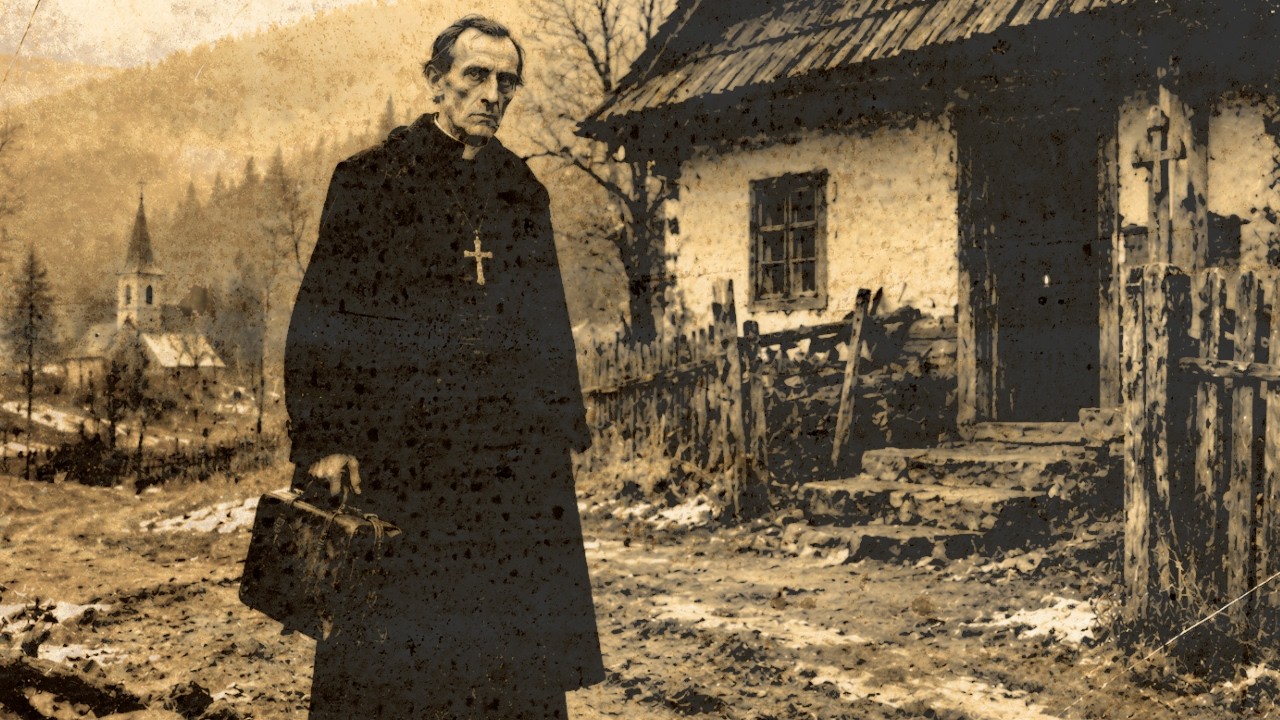
He had trained under the Vatican committee on diabolical phenomena. Those who knew this line of work considered him one of the most reliable men in his profession. By the end of that week, he had written his letter of resignation. He never entered another Catholic church for the remaining thirty-one years of his life.
And what he saw on that farm, in a village called Poiana Neagră in the Apuseni Mountains, was documented in seven leather notebooks that were eventually confiscated, catalogued, and buried inside a room in the Vatican archive that no researcher has ever been permitted to enter. Tonight, we open those notebooks. Father Imeric Vasilay was born in the town of Cluj in 1891. His father was a schoolteacher.
His mother was the daughter of a minor nobleman whose fortune had faded with the collapse of the Austro-Hungarian system. He was, by every account that survives, a serious child. He read Latin at age nine. He read Greek at twelve.
By the age of sixteen, he was already writing letters to the Archbishop of Alba Iulia requesting instruction in the old liturgical rites, those no longer used by the modern church. He entered the theological institute at eighteen. He was ordained at twenty-two. Within four years of his ordination, he was quietly transferred to a small department of the diocese dealing with what the church, in its official documents, calls extraordinary spiritual phenomena.
He was, in the language of the simple villagers who sought him out, an exorcist. He performed his first rite in 1915 on a soldier who had returned from the Eastern Front unable to speak any human language. He performed his second that same year on a woman in the mining town of Baia Mare who had begun describing, in precise and disturbing detail, the interiors of houses she had never entered. By 1925, he had overseen more than thirty cases.
By 1930, he had exceeded forty. He kept a special record of each case, written in precise Latin with cross-references to older cases in the Roman files. He was not by nature a man inclined to believe things easily. His notes from those years were precise, skeptical, almost forensic.
In the margins, he wrote observations that would not have been out of place in a medical journal. He recorded heart rates. He recorded body temperatures. He described the behavior of dogs and horses in front of the afflicted.
He was, in every relevant respect, exactly the kind of man the church wanted in that role. Rational, educated, slow to conclude, and slower to judge, which is what makes what happened in 1932 so astonishing. The letter arrived at his home in Cluj on the ninth of September. It was written in the trembling hand of an old man, sent from a village he had never heard of, a place called Poiana Neagră, high in the Apuseni Mountains, in a valley that appeared on none of the military maps he was accustomed to consulting.
The letter was signed by the local parish priest, an elderly man named Father Nicolae Toma, who wrote that he had been the priest of that valley for forty-one years, and that in all that time he had never seen what was now happening in his church, in his homes, and in the fields surrounding his village. Father Toma wrote that six villagers were now afflicted: three women, two children, and one man. He said their symptoms were not the symptoms he had been trained to expect. They did not curse the sacred mysteries.
They did not recoil before the cross. They did not speak in the tongues indicated by the old manuals. Rather, they spoke in a language none of the elderly villagers recognized. And yet, and this was the detail that made Father Vasilay set the letter aside and reach for his coat, the oldest woman in the village, a shepherd’s widow named Elena Radu, recognized certain words: not from any ecclesiastical text, not from any prayer she had ever learned, but from stories her grandmother had told her in the last winter of that grandmother’s life, in 1849.
The letter mentioned stories about people who had lived in the valley before the arrival of the church. Before the Romans, before the Dacians, before, Elena Radu insisted, there was any name for the mountains they now stood upon. Father Vasilay packed a small bag that same evening. He carried with him the leather satchel he had used for every rite he had ever performed.
It contained the usual instruments: a stole, a vessel of holy oil, a cross of dark polished wood that had belonged to his uncle, a bishop in Sibiu, and a small copy of the Roman Ritual, its edges worn from twenty years of use, and in a separate compartment he had sewn himself, a small hand-bound notebook with which he began every case. He left Cluj on the morning train of the tenth of September. He traveled first to Turda, then along a slower branch line to the mining town of Zlatna; from there, after two smaller carts and a horse-drawn wagon driven by a man who refused to speak the village’s name aloud, he was walking by noon of the eleventh, cutting the final three kilometers along a mountain path toward a town that seemed, as he later wrote, to have been built into the shoulder of the mountain rather than upon it. Stone houses, slate roofs, wood smoke rising in thin gray lines from chimneys repaired again and again across generations.
At the far end of the village, above the sheep pastures, a small wooden church with a bell tower leaning slightly toward the east, as if the ground beneath it had once given way and been imperfectly repaired. Father Toma met him at the church door. The old priest was thinner than expected, much older. His hands trembled when he shook Father Vasilay’s hand.
Father Vasilay wrote that his eyes carried the look of a man who had not slept well in several weeks. And the first words he spoke, after the usual greetings, were the words Father Vasilay would repeat verbatim on the opening pages of his first notebook. Father Toma said: “I do not believe that what is here is a demon. I believe it is something the church has never given a name to.
”
Father Vasilay did not answer at first. He was a man trained not to react to such statements, regardless of who made them. So he set down his bag, loosened his stole, and asked, in the manner he had learned to use with village priests, to be shown where the afflicted were kept. Father Toma led him first to the church.
It was smaller and older than Father Vasilay had expected. The wooden beams above the nave were dark with the smoke of two hundred winters. The floor was uneven, sloping very slightly, and Father Vasilay noticed, without speaking, that the slope corresponded to the same tilt toward the east he had observed in the bell tower. Whatever had moved beneath this church had moved all of it, and it had been so long ago that the villagers no longer noticed.
Behind the altar, in a small room once used as a vestry, four of the afflicted were being kept. Father Toma explained that they had been brought there, believing that proximity to the sacrament might calm them. It had not. “On the contrary,” he said, “they were louder inside the church than they had been in their homes,” and he began to suspect that whatever was inside them was reacting to something in the walls of the church itself.
The four, in order of affliction, were a thirty-four-year-old woman named Maria Suciu, who had been silent for two days, then on the third day began speaking in a low, continuous flood of sounds resembling no known language. Her nineteen-year-old daughter Ileana, who had fallen into the same state four days after her mother. An eleven-year-old boy named Petru Vlad, found in the woodshed staring at the wall, who had not spoken his own name since that afternoon. And an old man named Grigore Munteanu, a woodcutter whose wife had died two summers before, now sitting in the corner of the room drawing patterns on the floor with his finger.
Patterns, Father Toma said quietly, that corresponded to no letter or symbol in any alphabet he had ever seen. Father Vasilay examined each of them in turn. He took their pulses. He held a small candle near their eyes to observe pupil response.
He listened at length to the sounds Maria and Ileana Suciu were making. And in his notebook that first night, he wrote three observations, underlined in ink for himself. First, the sounds the two women were making were not random. They repeated.
They formed phrases. There was unquestionably meaning. Whatever they were speaking, they were speaking a language. Second, the language matched nothing he had encountered in twenty years of ecclesiastical work.
It was not Aramaic. It was none of the Semitic languages listed by the old manuals. It was not the archaic Latin that some cases had included. It was not, as far as he knew, an Indo-European language at all.
The consonant clusters were wrong. The vowel order was wrong. He wrote that it was closest in rhythm to certain recordings he had heard of Caucasian languages, but even those did not match. And third, this observation he circled twice, all four afflicted, when he approached them with the cross, did the same thing.
They did not scream. They did not curse. They did not turn away. They looked at the cross, then looked at him.
And their expressions were expressions of puzzlement. As if they did not fully understand what he was offering. As if the thing itself meant nothing to them at all. Father Vasilay had performed forty-six exorcisms before this one.
In every single one, without exception, the cross provoked a reaction. Anger, fear, avoidance of the gaze. In some cases, violent physical reaction. He had never, in all those cases, met a being that simply did not recognize the cross as a threatening object.
That first night, he did not perform the rite. Instead, he asked Father Toma to walk with him through the village. He said he wanted to see the place, to speak with the unafflicted, to understand, if possible, the context in which this had begun. Father Toma agreed.
And so, in the last light of evening, the two men walked the length of Poiana Neagră’s single stone street. And Father Toma told him what had happened in the valley during the six weeks before the first affliction. He said it began with plowing. In mid-July, two brothers named Andrei and Vasile Popa had begun plowing a strip of the upper pasture on the slope above the sheep meadows that had never been cultivated in living memory.
It was thin land. It was rocky. But the village population had grown by three families since the war. The brothers saw that a modest potato field was better than nothing at all.
They plowed for two days without any hindrance. On the morning of the third day, the plow struck a stone. This alone was not remarkable in that country. Rocks were everywhere.
But when the brothers dug down to remove the obstacle, they found not an ordinary stone, but a polished block. Square, smooth-faced, set into the earth with a mortar of a type neither recognized. When they cleared the soil around the block, they discovered it was the top of a wall. A wall running north to south.
A wall of dressed stone buried half a meter under grass in a place where no wall should be. As far as the villagers knew, there was no trace of any structure on that mountain slope in the entire history of Poiana Neagră. The village itself was no more than three hundred years old. The oldest graves in the churchyard dated to 1649.
Before that, according to the old stories, the valley had been used only for summer grazing, and no one had ever built on that upper pasture in the memory of any of the ancestors. The Popa brothers reported the discovery to Father Toma. Father Toma, not lacking in curiosity, went to see it himself. And what he saw, he now told Father Vasilay, had deeply unsettled him.
Because the stone was not Roman. It was not medieval. It was not, as far as he knew, of any style he had ever been taught. The blocks were larger than any Roman construction he had seen in the region.
The mortar was of a composition he could not identify, and engraved on the top course of the wall, in markings faint and nearly erased by the weather of ages, a repeating pattern of shapes that resembled, more than anything else, the crest of a wave, or a coiled serpent, or, this was Father Toma’s own suggestion, the outline of something falling from the sky. The Popa brothers continued digging for two more days. Father Toma had initially asked them to stop, but the brothers were possessed of curiosity, and in their honest village way, saw no reason to leave a half-discovered mystery in their field. They uncovered, before they stopped, about six meters of the wall.
They told him it ran north to south, and at its southern end turned at a right angle and headed west, disappearing again under the grass. Those were the outlines of a place, a very large place, larger, based on the two exposed wall segments alone, than any site in the village or in any of the neighboring villages. And it was buried entirely under the pasture at a depth suggesting it had not been covered by the slow accumulation of soil over ages, but by something faster. Something, Father Toma said, that had come down on it all at once.
Father Vasilay, walking beside him now in the fading light of that first evening, asked what Father Toma meant by that. The older priest was silent for a long moment. Then he said that in the past few weeks he had begun remembering something his father had told him when he was a small boy. His father had told him that in 1792, the valley had been hit by a great flood of mud.
Not water. Mud. It had come down from the high slopes without warning in the middle of a summer that had seen no rain, and had completely buried three of the village’s older buildings, killing a man and a horse in the pasture. The villagers of that time had rebuilt.
They had rebuilt on top of the mud, and had not spoken much about it afterward, as is the way of villagers, because there was no explanation for it, and no one wanted to think about things that had no explanation. Father Toma had not thought much of the story, until the Popa brothers had begun plowing. He had always assumed it was one of those exaggerations passed down by the old. But now, standing at the edge of the pasture looking at a wall of squared stone buried half a meter under soil in a place where no wall should be, he had begun to wonder whether the flood of 1792 was not the first event of its kind, but the most recent.
He had begun to wonder whether the ground beneath his church, and beneath his village, and beneath the entire valley was not natural ground at all, but the top layer of something much older that had been buried in the same way at some time in the past that no one now knew. Father Vasilay listened to all of this without interruption. He was, as noted, a man who did not rush to conclusions. But he did make a note that evening in the margin of the first page of what would become his second notebook.
The note read, in Latin: “The earth itself is a witness. ”
The affliction began ten days after the Popa brothers found the wall. The first to fall ill was not Maria Suciu, then in the vestry. It was one of the Popa brothers himself, Andrei, the younger, aged twenty-eight.
He returned home from the pasture on the evening of the twenty-second of July complaining of a headache. He ate his dinner. He went to bed, and in the night his wife woke to find him sitting in the dark whispering rapidly and faintly in a language she did not know. She lit a candle.
He turned to look at her. And she said he smiled a smile that was not his usual smile. Andrei Popa died four days later. The village doctor who came from Zlatna diagnosed it as brain fever.
But Father Toma, who sat with him in his final hours, told Father Vasilay that Andrei had spoken to him clearly and calmly on the afternoon of his last day, and told him something he had not repeated to anyone until this moment. Andrei Popa said on the afternoon of his last day that there was something beneath the pasture. And that it had been waiting for a very long time. And that it was not quite alive, but not quite dead either.
And that he, Andrei, was very sorry, because he had not meant to wake it. Then he closed his eyes and died. Father Vasilay did not sleep that first night in Poiana Neagră. He sat in the small parish house room that had been assigned to him and wrote for six uninterrupted hours in his second notebook.
He recorded everything Father Toma had told him. He recorded his own observations from the church room. And in the margins, in his precise hand, he began asking questions. Was the language of the afflicted, he wondered, a language at all?
Or was it a memory of a language surfacing in minds that had never learned it? Was there a mechanism by which such a memory could be forcibly transferred to unrelated people? Could the earth itself, as he had already written, be a witness? And if so, in what sense?
What was that mechanism? Was it possible that the stone of the wall the Popa brothers had found had somehow, across an unknown number of ages, retained an imprint of the language that had once been spoken around it? That first night, he had answers to none of these questions. But at the bottom of the page he wrote a sentence in Romanian, in a hand noticeably less steady than the Latin above it.
The sentence read: “I am beginning to think that Father Toma may be right. I am beginning to suspect that this is something the church has never found a name for. ”
On the morning of the second day, Father Vasilay went first to see the wall. With him were Father Toma and the surviving Popa brother, Vasile, recovered enough from his grief to make the climb to the pasture.
The morning was cold. The fog had not yet lifted from the mountain’s shoulder. When the three men reached the trench the brothers had dug, Father Vasilay knelt at its edge and studied at length what had been found. The stones were, as Father Toma had said, larger than any Roman remains he had seen in the region.
Each block was about a meter and a half long and half a meter high, and they appeared to have been fitted together, as far as he could see, without any visible mortar in the joints. What was called mortar was merely a layer placed on the top course, which seemed not to have been added by the original builders but by a later hand, perhaps as an attempt to seal the top of the wall against water. The stones themselves were not local. Father Vasilay knew this because he had spent his youth wandering these mountains.
The wall’s stone was a fine-grained gray granite of a type that did not, as far as he knew, appear anywhere in the Apuseni range. It had been brought here from somewhere, and placed here by someone, at a time no one now knew. The engravings. Father Toma had described them as resembling a wave, or a serpent, or something falling from the sky.
Father Vasilay, kneeling at the edge of the trench, saw all three things in them. And he saw a fourth thing he did not at first name to himself. The engraving was worn so smooth. It ran in a continuous band along the top course of the wall.
And after studying it for minutes, he realized it was not a decorative pattern at all. It was writing. He had seen enough writing systems in his life to recognize script when he saw it. There were symbols, regular groupings, and what appeared to be spacing between those groupings.
It was, without any doubt, writing. But it was writing in a script he had never encountered in twenty years of ecclesiastical work and thirty-eight years of reading. Not in any book, not in any catalogue of ancient languages, not in any of the specialized volumes on the pre-Christian religions of the region that he had studied as a young priest. It was, as far as he knew, entirely unknown.
He asked Vasile Popa whether the villagers had seen the engraving. Vasile Popa said his brother Andrei had traced it with his finger the day before he fell ill. He himself had not touched it. He said quietly that he would not touch it now.
Father Vasilay did not touch it either. But he took from his bag a folded sheet of paper and a charcoal pencil. With careful work, he copied a section of the engraving about a meter long. He folded the copy.
He placed it carefully inside the front cover of his second notebook, and returned with the other two men to the village. That afternoon, in the wooden church’s vestry, Father Vasilay attempted his first rite. He performed it on Maria Suciu, the mother who had been first among the four in the room to fall ill. Father Toma assisted.
He followed the standard order of the Rituale Romanum without deviation. He read the opening prayers. He recited the litanies. He made the sign of the cross over the woman’s head, and anointed her forehead with holy oil.
Maria Suciu did not resist him. She did not writhe. She did not curse. She did not react in any of the ways he was accustomed to expecting from the sacred words.
She sat upright on her chair, hands folded in her lap, looking at Father Vasilay with the same simple expression of puzzlement he had noted the night before. Throughout the rite, without stopping, she continued to speak in that low, continuous murmur in a language he did not know. When Father Vasilay reached the point where he was required to command the entity within her to reveal its name, saying, “In the name of the church, in the name of Christ, in the name of the God of Israel,” Maria Suciu stopped for the first time. She looked at him.
She held his gaze, and then, in perfectly clear, unaccented Romanian, in a tone that was recognizably her own, she said: “We were named before your God was named. ” Then she resumed her stream of words, and the rite continued. It had no further effect. Father Vasilay finished the rite as prescribed.
He left the vestry. He went alone to the small room in the parish house assigned to him. He sat on the edge of the narrow bed. And in his second notebook, in a hand less controlled than usual, he wrote a single sentence, underlined twice.
The sentence read: “They were named before my God was named. ”
Elena Radu was, at the time Father Vasilay met her, seventy-nine years old. She lived alone in the last of the stone houses at the northern end of the village, in a small kitchen warmed by a wood stove her father had built in the year of her birth. Her eyesight was failing.
Her hearing was not. And when Father Vasilay came to her door on the evening of his second day in Poiana Neagră, she was expecting him. She said she had been expecting a priest from outside for six weeks, since the day the Popa brothers had first found the wall. She sat him at her kitchen table.
She poured him a small glass of plum brandy. And in the unhurried manner of an old woman who had kept something in her breast all her life and had finally decided the time had come to speak it, she began to tell Father Vasilay the stories her grandmother had told her. She said her grandmother was born in 1781. She had lived in the valley all her life.
She had died in the last winter Elena spent with her, in 1849, at the age of sixty-eight. In the last three months of her life, when she realized she was dying, she insisted on telling Elena certain things so that they would not be lost, as she put it, when she departed. Elena said the things her grandmother told her were not the kind of things a woman ordinarily tells her granddaughter. They were much older.
They were, as her grandmother insisted, older than the church, older than the Romans, older than the Dacians whose kings the schoolmaster spoke of in the town below. They were stories told to her by her grandmother, who in turn had heard them from her grandmother, and so on in a chain of grandmothers that Elena’s grandmother insisted stretched back without interruption to a time so remote that no one in the valley today had any conception of its length. Elena said the stories were all about the same thing. They were about the people who had lived in the valley before the people who lived there now.
They were about those whom the grandmothers called, in the old language, those who came down from above. Father Vasilay set down his glass. He asked Elena carefully to repeat that phrase. Elena repeated it.
She said it first in Romanian, then, hesitantly, in the older word her grandmother had used. Father Vasilay recorded both versions in his notebook. The Romanian phrase was “cei care au coborât de sus. ” The older word, as far as Elena could pronounce it, struck Father Vasilay as a disyllabic structure beginning with a strong consonant with a long vowel in the middle.
As far as he could tell, it matched no Romanian word, and no word in any of the neighboring Slavic or Hungarian dialects. Elena said: “Those who came down from above, they built the great place whose wall the Popa brothers have now found. ” “They built it long before the mountains took their present shape. ” They lived in it for many generations, and then at a time no one now knows, a great fall from the sky occurred and the place was buried and those who came down went underground with it.
Her grandmother had insisted they had not all died. Some had gone deep into the mountain and remained there. Her grandmother said: “They were sleeping, but they were not quite asleep. ” They were dreaming, and in their dreams they sometimes spoke.
And a person who came too close to the places where they slept could, if unlucky, catch a fragment of that dream and carry it home in his head. Elena said: “The village has known this for a very long time. ” That was why, until the Popa brothers came, no one had ever plowed the high pastures. The old ones knew.
Plowing was forbidden there, not by order of any priest or by any law, but by a custom so old that its reason had been forgotten. Elena said that when she was a small child, her grandmother had taken her to the edge of that pasture and shown her with a stick exactly where the boundary of the forbidden land began. She could not explain why it began there. All she knew was that it was so, and that no member of the Radu family, as far back as they went, had ever set foot on that place.
Elena said the Popa brothers had not known this. They were newcomers to the region. Their family had come to the valley only three generations before, from a village to the west, and they had never learned that old boundary. They had plowed where no one should have plowed, and now their brother was dead, and four people were in the parish church, and Father Toma had been forced to summon a priest from outside.
Father Vasilay asked Elena then whether her grandmother had told her anything about how to persuade those who came down to stop dreaming. Elena was silent for a long moment. Then she said her grandmother had told her only one thing on this subject. Her grandmother told her that those who came down could not be told anything.
They could not be driven out with incantations. They could not be dismissed with any prayer known to anyone living in this age. Her grandmother said they needed only to be asked politely, by someone with the courage to enter the place where they slept and speak with them face to face. Father Vasilay did not sleep that night either.
He returned to the parish house. He placed his notebook on the small desk. He lit the oil lamp and sat for a long time studying the engraving he had folded inside the front cover of the notebook the previous morning. He had come to Poiana Neagră as a Catholic exorcist.
He had come to perform a rite that was, in his experience, largely mechanical. He had come, in his own quiet assessment, to help and to mend and to close what had been opened. And in less than forty-eight hours, he had been forced to consider three things his training, at any stage, had not prepared him for. The first was that the language of the afflicted was not the language of any nation of the Christian era.
The second was that the entity inhabiting Maria Suciu, when addressed directly in the language of the rite, had not replied with denial or evasion, but with a claim concerning the antiquity of its naming. A claim that placed it before the God Father Vasilay had invoked, and thereby above him. And the third was that the widow Elena Radu, who was not mad, not an illiterate peasant, but in fact one of the sharpest and most precise minds Father Vasilay had encountered in twenty years of rural work, believed on the basis of her grandmother’s account that what was happening in the village was not demonic possession at all. She believed it was communication.
And it was coming not from any place the church had placed on its maps, but from beneath the pasture that the Popa brothers had opened with their plow. He sat thinking about these three things for a long time. Then, in the early hours of the morning, he made his decision. He decided that he would enter that wall.
Not the wall itself, of course. He meant that he would find, if finding was possible, the thing of which that wall was a part. If this was truly the outline of a place, and that place was truly buried beneath the pasture, then there must be an entrance to it somewhere. A door, or stairs, or a crypt, or something else.
He would find it, and he would enter it, and he would see with his own eyes what Elena Radu’s grandmother had told her lay beneath the earth of that valley. He knew this decision would not meet with the approval of his superiors in the church. It was not part of any rite the church had ever sanctioned. But he was no longer certain, at this point, that the rites sanctioned by the church were the appropriate response to what was happening in Poiana Neagră.
Indeed, he was no longer certain that the church as an institution knew the truth about what was in Poiana Neagră at all. He rose at dawn. He walked to Father Toma’s house. He explained what he intended to do.
Father Toma, who had by that time surrendered to many things outside the usual practice of his priesthood, did not object. He offered instead to accompany Father Vasilay. Father Vasilay declined. He said, and Father Toma later recorded this in a letter of his own, that if what he was about to do was a kind of blasphemy, he preferred to be the only priest carrying that guilt.
Then he climbed alone to the pasture. He worked at the site all that day and most of the next. He had brought a shovel. He had brought a lantern.
He had brought a long rope. He worked slowly and methodically, following the line of the wall north and then east, digging small test pits every few meters to see how deep the wall went and whether there was any break in it. By the evening of the second day, he was exhausted. His hands were blistered.
His back could no longer straighten. But he had established three facts for himself. The wall enclosed a rectangle. The rectangle was roughly thirty meters by eighteen meters.
The wall was at its shallowest about two meters below the current surface of the pasture, and at its deepest, at the eastern end of the enclosure, more than four meters down. And on the third day, while digging at the eastern end where the wall was deepest, his shovel struck a piece of dressed stone that was not part of the wall itself, but was set into the ground perpendicular to it. It was flat. It was smooth.
And when he cleared the soil away, he saw that it was a slab, a nearly square slab about two meters across, laid flush with the ground, weathered, with a mark at its center consisting of a shallow rectangular depression that might have been made by a hand. He knew when he saw it what it was. It was a capstone. He did not open it that day.
He was too exhausted even to think about it. He covered the slab loosely with dirt. He walked back to the village. He ate.
He slept for eleven hours. And on the morning of the fourth day, with the first light, he returned to the pasture with a longer rope, a second lantern, a bottle of water, and, at the last moment, on an instinct he did not fully register, he slipped into his pocket a small wooden cross that had belonged to his uncle. The slab, when he lifted it, moved more easily than expected. It was heavy, but it was balanced on an edge.
Once he got the tip of his shovel under one corner and lifted, it swung upward, thanks to an ancient counterweight arrangement that still worked after all those ages. Air came out from beneath it. Air that was cold and dry, carrying a faint smell of stone and something else, something older, something for which he did not at first have a name. Beneath it was a deep shaft.
The shaft had been cut straight down through the soil and into the bedrock, and its walls were lined with the same polished stone that clad the buried wall above. At the edge of the shaft, a series of iron steps was set into the rock. The steps were black with age, but when Father Vasilay put his weight on the top one, it held. He tied his rope to a fence post.
He lit his lantern. He murmured a short protective prayer he had learned as a young priest and had not spoken in fifteen years. Then he began to descend, hand over hand, holding the lantern between his teeth by its wire handle. The shaft was, by his best estimate, twelve meters deep.
It ended in a chamber. The chamber was rectangular, high-ceilinged, larger than he had expected. The walls were of the same fine gray granite as the upper wall, polished and fitted with the same unsettling precision. There was no mortar in the joints.
There were no decorations on the walls of the chamber itself. At the far end, there was an entrance. The entrance was tall. It was framed by two standing stones.
And above it, spanning between them, a single carved lintel. Father Vasilay crossed the chamber slowly. He raised the lantern toward the lintel. He looked at the carving on it for a long time.
The carving on the lintel was not in the same script as the engraving on the buried wall above. It was, instead, a single figure. The figure was carved in shallow relief. It was roughly the size of a man’s two outstretched hands.
And it was not, as far as Father Vasilay knew, any form from any tradition he had ever studied. It was tall and slender. The head was smooth and featureless, except for two large oval depressions where the eyes should have been. The body was thin and wore no visible clothing.
The arms were long, the hands long, and there were what appeared to be the remnants of folded wings extending from the shoulders and flowing down the back to a point behind the figure. They were not the feathered wings of the angels Father Vasilay had studied in the icons of the Eastern church, and they were not the leathery wings of the demons in the Western books. They were something else. Something that looked, if he was honest with himself, like the membrane of a moth.
He stood before the lintel for perhaps five minutes. He did not know precisely what he was looking at. He knew only that whatever he was seeing, it was not something his training had prepared him for. It was not, by any standard he knew, a Christian image.
It was not, by any standard he knew, a pre-Christian image of any of the old Mediterranean gods. It was, as far as he could tell, an image from a tradition that had been entirely lost from the historical record at some point. He passed beneath the lintel and entered the second chamber. The second chamber was smaller than the first.
It was oval, with curving walls, and along the curve of the walls at head height ran a continuous band of paintings. The paintings were made with a pigment that had proved astonishingly durable across the years they had lain buried. The colors were faded but legible, and they presented, in sequence read from left to right as one walked the room, a series of images that Father Vasilay spent two hours studying by the light of his single lantern in the silence of that place beneath the pasture. The first image showed a scene.
The scene was recognizable as a landscape. There were mountains, rivers, and in the middle distance a town of low, curving buildings resembling nothing Father Vasilay had seen in any archaeological record of the region. The second image showed the same scene, but with something falling from the sky. The falling objects were depicted as long, slender ovals.
They appeared in flight. They appeared in the same image settling to the ground. The third image showed figures emerging from those fallen ovals. The figures were the same as the one on the lintel above the door.
Elongated, smooth-headed, long-limbed, with the remnants of folded wings. The fourth image showed the figures teaching. That was the only word Father Vasilay found for what was being depicted. The figures appeared standing before groups of smaller figures.
The smaller figures were human, beyond any doubt. And the taller figures were showing them things. In one panel, the taller ones were teaching the humans how to cultivate grain. In another, how to work stone.
In a third, how to make fire in a way involving striking two objects together, which Father Vasilay noted was not in itself remarkable, but was depicted in a manner suggesting it had at some point in the sequence been something new. The fifth image showed the great place, the place whose wall the Popa brothers had found. It appeared in the same scene, in a spot recognizable from the shape of the surrounding mountains, this very valley. It appeared intact.
It appeared in the image with people entering and leaving it, and it appeared at its top with a great symbol carved above its main entrance, which Father Vasilay recognized immediately as the same wave, or serpent, or falling thing that Father Toma had noted on the top course of the buried wall. The sixth image was the one that stopped him. The sixth image showed the sky above the valley opening. It was depicted as a great tearing.
And from that tearing came rain. Not rain of water. The rain was, as far as Father Vasilay could interpret the pigment, mud. Vast quantities of it falling in a solid dark sheet, filling the valley from the mountains inward, covering the low curving buildings, and finally covering the great place itself.
The seventh image showed the valley after the mud. It was flat. It was featureless. The mountains were still there, but the town was gone.
The great place was gone. And there was in the whole scene, as it appeared in that panel, nothing alive to be seen, no humans, no animals, no trees, only the mud and above it the sky, empty and gray. The eighth image showed, after a lapse of time the series did not specify, the first blades of grass beginning to grow through the mud. And it showed, in the far distance, two very small figures walking along the edge of what had been the buried valley, carrying between them what appeared to be a plow.
The ninth and final image, on the last panel of the series, showed a single tall figure. It was standing in the mud. It was facing the viewer. And it had both hands raised, palms outward, in a gesture Father Vasilay had seen in his life in only one other place.
It was the gesture of the icons of Christ Pantocrator that hung in every Orthodox and Catholic church he had ever entered. It was a gesture of blessing. But the figure was not Christ. The figure was the same one, tall, slender, smooth-headed, long-limbed, with folded wings, that had been on the lintel above the door.
Father Vasilay stood before the ninth panel for a very long time. He did not record in his own account of that afternoon how long it took. Long enough that the light of his lantern began to fail. Long enough that the cold of the chamber seeped through the wool of his coat into his back.
Long enough, at any rate, that he stumbled when he finally moved and had to steady himself against the wall. Beyond the oval chamber lay the third and final chamber. Access was through a low arch at the far end of the oval room, and Father Vasilay had to bend almost double to pass beneath it. The third chamber was small.
It was square, and in its center, on a low platform of the same gray granite, was something. The thing was at first difficult to describe. It was roughly the size and shape of a human torso. It was made of a material Father Vasilay could not identify by sight.
It was not stone. It was not metal, at least not any metal he had ever known. It was smooth and slightly warm to the touch when he approached it, though the chamber itself was cold. And there was, as far as he could see, no source of heat in the room at all.
It was, as he later wrote, not carved. It had not been shaped by carving tools. It appeared to have been made in one piece, whatever process had formed it. And it was, as he noted with a care that was noticeable even in the language of his notebook, shaped like the figures on the wall of the oval chamber.
Elongated, smooth-headed, long-limbed, with the remnants of folded wings stacked on its back. It was, though he did not at first allow himself to use the word, a statue. He did not touch it. He stood before it for the second time that afternoon for what may have been an hour, or perhaps much longer.
He raised his cross before its face. He recited quietly the usual protective prayer he had recited at the top of the shaft. He waited to see whether the thing would respond in any way to the presence of the cross. It did not respond.
It remained on its platform, warm, silent, and, as far as his senses could detect, completely inert. But there was, as he wrote, in the space surrounding the thing a sensation for which he had no ecclesiastical term. It was not the sensation of demonic presence he had faced throughout his career. It was not exactly the sensation of divine presence he had felt at certain moments of his life, before certain relics, at certain altars.
It was, as he wrote, a third thing, something that fell under neither of the two categories his training had supplied him with, something that was, in his own words, watching him. Not with hostility, not with love, but with interest. And with patience, as he wrote. He did not remain long in that third chamber.
He backed slowly out of it. He walked back through the oval chamber. He climbed the twelve meters of iron steps. He replaced the capstone as best he could.
He walked back down to the village. He said nothing to Father Toma. He said nothing to Elena Radu. He went to his room in the parish house, and wrote for eight uninterrupted hours everything he had seen.
He recorded it all in his third notebook. He made small drawings of the figure on the lintel and of the thing in the third chamber. He copied, as best he could, the nine panels of the oval chamber. And at the end of all of it, at the bottom of the last page he wrote that day, he recorded in Romanian a single sentence.
The sentence read: “If what I have seen is what I think I have seen, then the story we have been telling ourselves about the age of the human race is not the whole story. ”
On the morning of the next day, he did the thing that would end his career in the church. He returned to the vestry of the wooden church. He asked Father Toma to leave him alone with the four afflicted.
He closed the door. And he did not that morning perform the Rituale Romanum. He sat instead on a plain wooden chair before Maria Suciu. He opened his notebook.
He said in Romanian: “I have been beneath the pasture. I have seen the chambers. I have seen the paintings on the wall of the oval chamber. I have seen the thing in the third chamber.
” Maria Suciu stopped speaking. She stopped her low, continuous flow of sounds for the first time since he had entered the vestry three days before. She looked at him. Then, in the same clear, unaccented Romanian she had used the previous day, she said: “Then you have seen us.
What do you wish to ask? ” Father Vasilay did not answer at first. He was not, at that moment, certain that it was Maria Suciu who was speaking to him. He was not certain that there was anything, in the sense he understood the word, present in the room at all.
He was certain only that something was speaking through her. And that he had, if he chose to accept it, an invitation. He accepted it. Over the next four hours in the vestry of the wooden church in Poiana Neagră, Father Imeric Vasilay of the diocese of Alba Iulia conducted what he would later refer to in his own papers as an interview.
He asked questions. Maria Suciu, or whatever entity was speaking through her, answered. He recorded the answers. And what he recorded in that fourth notebook, in his small precise hand that he had trained himself to keep steady under pressure, was a body of information that, when it eventually reached the files in Rome, was reviewed by three separate commissions, declared unacceptable for reasons never fully published, and sealed in 1939, according to the last known note on it in any Vatican papers.
He asked first who they were. The answer, according to his notes, came in this form: “We are not a species that has a name in your languages. Your elders in this valley called us ‘those who came from above,’ and that is close enough to what we are. We came down from a place that is not, in the sense you understand it, another place.
It is above. It is not above in the way your stars are above. It is above in a way that your languages, as they now exist, have no adequate word for. ” He asked when they came.
The answer was: before the mountains took their present shape. This valley was at that time lower than it is now. The mountains rose during a period of earth movement that took, in your reckoning, tens of thousands of years. We were here at the beginning of that rising.
And we are still here at its end. He asked what they did here. The answer was: “We taught. There were humans in this valley when we arrived.
They were human in their kind, but they were not the same people who live here now. Their descent after the catastrophe was not entirely broken. It is weaker. It survives in scattered parts.
And what they learned from us survives in scattered parts as well. Some of your prayers in this valley, in the older parts of your rites, are our prayers, translated through many mouths. ” He asked what the catastrophe was. The answer was: “The sky broke.
It did not break of its own accord. It was struck, in a way you know well. What struck it was not a natural body. It was, in the terms of your theology, an act, though not by the agent your theology names.
It was, if you insist on a phrase, an act of the above against the below. ” He asked: “Are you gods? ” The answer was: “No. We are not gods.
There are no gods in the sense your traditions have used that word. There is something. It is not us. We know no more of it than a hand knows of the arm to which it is attached.
We are older than the version of the world you have been told. We are not older than the world. ” He asked finally what they wanted from him. The answer was: “We want nothing from you.
Your people plowed above a place that had been marked, and the marking was old enough to have been forgotten, so the plow went where it should not have gone. This is not your fault. It is not the fault of the two who plowed. It is, if it is anyone’s fault, the fault of forgetting.
What has happened in this village in the past few weeks has been an echo of our dreams, heard by people whose ears the plow accidentally opened. It will settle. Give the earth time. Ask your congregation to leave the pasture alone from now on.
Ask them in the old way, to walk around it. ” That was the last complete exchange in the interview. He wrote that after that answer, Maria Suciu closed her eyes, sat for perhaps thirty seconds in silence, and then returned to consciousness. She blinked.
She looked around the vestry. She recognized Father Vasilay. She asked, in the confused voice of a woman waking from a very long sleep, how long she had been in this room. The other three afflicted, in the hours following that afternoon, returned to consciousness in the same way.
Ileana Suciu came to herself at dinner. The boy Petru Vlad returned the following morning. The old man Grigore Munteanu, the last of them, returned late in the evening of the second day, and on waking asked about his wife, and had to be told again that she had died two summers before. Word of the healings spread through the village within hours.
Father Toma rang the church bell for the first time in six weeks. The villagers came out into the street. There was a celebration of a muted kind, the kind a village holds when it has survived an ordeal it does not fully understand, and every instinct it possesses tells it not to inquire too closely. But Father Vasilay did not celebrate.
He sat for a long time in the front pew of the small wooden church. The bell was silent. The four afflicted had been fed and put to sleep. The brothers who had plowed the field had returned to their farm.
The old grandmother had left the valley with a gesture, without speaking a word. And Father Imeric Vasilay sat in the dim red light of the lamp above the altar, and did not pray. He could not pray. He tried, but the words would not come.
And when he closed his eyes, he did not see his God. He saw the painting in the oval chamber. He saw the birds on the wall. He saw those tall, slender beings with their long thin arms and their wide dark eyes.
He saw the mud rising in the ninth panel of the mural to cover the world of men. And he saw the small figures in the last frame of that panel, those who were left, and those who went on. And he realized, in a way he had not realized before that hour, that he was one of those small figures. And that his whole life, his church, his rites, his God, had been made by people who came after the fall, who built on the graves of something older, and who wove a story to keep out the dark.
He sat until the lamp died. He sat until the birds began to sing outside. Then he rose and walked out of the church, and never returned to it. He went back to the parish house.
He gathered the four notebooks he had filled in Poiana Neagră. He wrapped them in waxed cloth. He placed them at the bottom of his satchel under folded clothes. He said goodbye to everyone the following morning.
He walked back over the mountain pass. And on the twenty-third of September 1932, he arrived again in the city of Cluj. He did not go to his home. He went to the house of the Archbishop of Alba Iulia, his ecclesiastical superior in that region.
He requested an urgent audience. It was granted to him at midday the same day. And in the archbishop’s office, in a session lasting three hours with two other senior priests present, Father Imeric Vasilay gave a complete oral report of everything he had seen and heard in the village of Poiana Neagră between the eleventh and the twenty-second of September. The archbishop did not interrupt him at any point during the report.
When he finished, the archbishop was silent for a long time. Then he asked Father Vasilay whether he had brought any physical evidence. Father Vasilay produced his rubbing of the engraving on the buried wall. And he produced his four notebooks.
He placed them on the desk between them. The archbishop looked at the rubbing. He turned it over in his hands. He looked at the notebooks.
But he did not open them. He said, in the same slow, careful voice he used when hearing confessions, that he needed to consult his superiors before taking any further action. He asked Father Vasilay to leave the notebooks and the rubbing in his keeping. He also asked Father Vasilay not to speak of the events of Poiana Neagră to anyone, under any circumstances, until he received further instructions.
Father Vasilay agreed. He left the notebooks and the rubbing on the desk. And he returned to his home in Cluj. He heard nothing for the next six weeks.
He performed no exorcisms in that period. He simply carried out his ordinary pastoral duties. He had begun writing a fifth notebook upon his return from Poiana Neagră, containing an extended reflection on the theological implications of what he had seen. This fifth notebook is the one that was later published, posthumously, in a modified and partial form, in a limited edition by a Romanian publisher of philosophical works in 1968.
It is the only one of the seven notebooks that any member of the public has ever read. In early November 1932, Father Vasilay received a letter. The letter was on official stationery bearing the seal of the Vatican itself. It was signed by a monsignor whose office was attached to the Congregation for the Doctrine of the Faith, which was at that time the successor body to the old Holy Office of the Inquisition.
The language of the letter was polite. The letter thanked Father Vasilay for his service. It informed him that his notebooks had arrived in Rome and were being reviewed by a competent commission. It informed him that his rubbing had been sent to a specialist in ancient inscriptions.
And it instructed him, in the clearest possible language, to consider the Poiana Neagră case closed. The letter further stated that he was not to return to the village. He was not permitted to correspond with Father Toma. He was not permitted to discuss the case with any of his colleagues, or with his congregation, or indeed with anyone at all for as long as the review in Rome continued.
The letter did not say when the review would end. It did not say what would happen to his notebooks. It did not say what the specialist had concluded about the rubbing. Father Vasilay wrote a reply.
In that reply, he posed three specific questions. He asked whether the entities mentioned in his interview had been known to the church before. He asked whether the site buried beneath the pasture in Poiana Neagră was unique, or whether other similar sites had been noted elsewhere. And he asked, in a paragraph that, according to a note in the margin of his draft, took him three separate attempts to write, whether the church still believed, as a matter of doctrine, that the age of the human race on earth corresponded to the chronology given in the book of Genesis.
He mailed the reply. He waited. The reply came six weeks later. It was on the same letterhead.
It was signed by the same monsignor. The letter thanked him again for his services. It informed him that his three questions, in the commission’s judgment, were questions whose answers were not deemed appropriate for public or private discussion at the present time. And it reminded him, in the same polite language used previously, that his instructions to close the case, to cease all correspondence with the village, and to speak of the matter to no one remained in force.
Father Vasilay did not write a second reply. He read the letter once in his small office in his home in Cluj. He folded it. He placed it inside the front cover of his sixth notebook, which was still blank at that time.
He walked out into the garden. He sat on the stone bench under the walnut tree. And for the first time in nineteen years since his ordination, he allowed himself to consider, at length and without distraction, the possibility that the institution to which he had given his life did not, in fact, know more than he did about the nature of the world. Or, worse, that it knew more than he did, but had decided, at some point in a past that had not been disclosed to him, that what it knew should not be spoken of.
He wrote his letter of resignation the following morning. It consisted of three sentences. He submitted it the same day to the Archbishop of Alba Iulia. He was formally released from his duties on the first of January 1933.
In the spring of that same year, he returned to the Apuseni Mountains. He did not return to Poiana Neagră. He had promised in his letter to Rome and in his final conversation with Father Toma that he would not. Instead, he settled in a small stone house in a village called Dumbrava, twelve kilometers south of Poiana Neagră, in the same mountain range but in a different valley.
He supported himself by teaching Latin to the children of the local schoolmaster. He later supported himself by translating small theological books from Latin into Romanian for a publisher in Sibiu. He lived in that stone house for all of the remaining thirty-one years of his life. He never married.
He never held another ecclesiastical post. As far as his neighbors could tell, he never attended any form of religious service after his return to the mountains. But he did write. He wrote in his sixth and seventh notebooks for the rest of his life.
He recorded in detail everything he could remember of the four notebooks the Vatican had taken from him. He supplemented that memory with his fifth notebook, the one he had kept after his return to Cluj. He wrote extended commentaries. He wrote translations of fragments of the language he had heard in the vestry, using the few words Elena Radu had been able to supply from her grandmother’s tales, and using whatever comparative work he had been able to do in the years since.
He wrote to Father Toma once, in 1937, in violation of the orders he had received from Rome. In that letter he asked only one question. He asked whether anyone in Poiana Neagră had plowed the upper pasture again in the years since his departure. Father Toma’s reply, preserved in the seventh notebook, consisted of a single line.
It read: “No one has plowed it. And no one will. ” The pasture has not been plowed to this day, and all indications are that it never will be. It still lies there on the mountain’s shoulder above the village, above the buried wall, above the shaft, above the three chambers, above the thing in the third chamber.
The Popa family, two of whose direct descendants still live in Poiana Neagră, do not go up to that pasture. Father Imeric Vasilay died in the winter of 1963. He was seventy-two years old. He died in the stone house in Dumbrava of a stroke in his sleep.
The woman who had for years brought him bread found him in the morning. Beside him, on the small table next to his bed, his seven notebooks were stacked one on top of the other, with a short handwritten note in Romanian reading: “These are not to be delivered to any institution. ” That note was not heeded. Within twenty-four hours of the discovery of his death, the parish priest of the neighboring town of Zlatna was summoned to Dumbrava.
The parish priest examined the notebooks. The parish priest took possession of them. Within seventy-two hours, the parish priest had conveyed them via a courier to the diocesan office in Alba Iulia. From there, according to the last traced document relating to them, they were sent to Rome, where they were received, catalogued, and deposited in the same archive section where the original four notebooks had been placed in 1932.
That was the last verifiable movement of Father Imeric Vasilay’s seven notebooks. The fifth notebook, and only it, escaped this deposition. It had been given years earlier to a personal friend of Father Vasilay, a former fellow seminarian who, like Vasilay, had left the priesthood and settled in the city of Sibiu. That friend, a man named Andrei Popescu, kept the fifth notebook in a locked drawer of his desk throughout that period, in accordance with Father Vasilay’s instructions to publish it only after his death.
Popescu copied it in 1967 and printed it in the small, edited edition already mentioned in 1968. That edition was suppressed within four months of its appearance. Every copy the diocesan authorities could find was bought up and destroyed, but nearly forty copies, according to the best surviving records, escaped confiscation. Six of those forty are known to still exist.
Two are in private collections in Romania, three are held by university libraries in the western half of Europe. And one exists, unexpectedly, in the general collection of a small public library in the American Midwest, where it arrived in 1971 among the personal effects of a Romanian immigrant. Everything we know today about what happened in Poiana Neagră between the eleventh and the twenty-second of September 1932 comes from that fifth notebook. The fifth notebook is a strange document.
It is not, on its surface, a direct narrative of events. It is a meditation on certain events, written for an audience of one, by a man trying to understand what the events he lived through meant on the pages of the record. In one of its longest passages, Father Vasilay writes about the catastrophe panel on the wall of the oval chamber. He notes that the catastrophe in that panel is not a flood of water, but a flood of mud.
And he observes that in the traditional account of Noah’s flood in the book of Genesis, the flood is also not referred to as a flood of ordinary water. He notes that the Hebrew word used is a specific word that appears in only one other context in the entire Hebrew scriptures. And in that other context, the word refers to a collapsed, chaotic mass, whose exact nature commentators have never agreed upon. He adds that the panel in the oval chamber, in which blades of grass sprout through the mud and two small figures walk at the edge of the buried valley carrying a plow, matches no known iconography of the post-Genesis flood, but matches very closely what he later found, when he was able, in the years after his resignation, to read more widely in the ethnographic literature of the region, and in the flood traditions of the pre-Christian Slavic peoples, and in the flood traditions of the peoples of the Caucasus, and, most surprisingly, in the flood traditions of a number of indigenous peoples of North and South America.
He came to believe that the catastrophe he had seen depicted on the wall of the oval chamber was not a local catastrophe. It was the very catastrophe that peoples in every part of the inhabited world had known, but in fragmentary form and under different names. And the great place whose wall the Popa brothers had found was not a unique site. He came to believe that it was one of a very large number of similar sites buried beneath similar quantities of what had once been a collapsed chaotic mass, in valleys and plains and forests across every continent that had been inhabited at the time of the catastrophe.
He did not in his fifth notebook use the word “Tartary. ” That word was not in common use in his lifetime to describe what he was describing. He used instead the phrase “the former world. ” And he wrote that the former world had been in the process of teaching the new world when the catastrophe occurred.
And he wrote that that teaching had not been entirely completed. He wrote that its fragments, which had survived the catastrophe and been preserved in the ancient oral traditions of the surviving peoples, were the source of what we today call by different names: religion, myth, folklore. And he wrote that the institution to which he had devoted his life had decided, at some point in a past he could not date, that those fragments would be more useful if their origin were forgotten, and that their formulation would be more controllable if they were consolidated into a single, unified, closely guarded narrative. And he wrote that this decision, whatever the intentions behind it, had produced one very serious consequence.
It had made it impossible for the institution afterward to truthfully announce the existence of a place like the chambers buried beneath the pasture in Poiana Neagră. And he wrote that to truthfully announce the existence of those chambers would have meant admitting that the narrative had never been the complete narrative. And by the time he wrote these words, that narrative had been the complete narrative for so long that the institution no longer possessed the mechanisms to correct its course. In the years since Father Vasilay’s death, an increasing number of sites around the world have emerged with discoveries of a broadly similar kind.
Sites buried in unexpected places and at depths not easily explained by natural deposition. Star-shaped fortresses at latitudes where no known culture had the technology to build them. Cities whose foundations are older than the cities currently standing above them. Cathedrals in major European capitals whose lower floors reveal courses of stone in styles attributed by no surviving records to any known builder.
This evidence exists. It is being found. It is not generally being discussed publicly. Whether any of that material is related to what Father Vasilay saw beneath the pasture at Poiana Neagră is a question that cannot be answered with certainty at the present time.
The seven notebooks, six of which remain in the files in Rome, would, if released, constitute a very significant body of comparative evidence. There is at present no expectation that they will be released within the lifetime of anyone now living. What can be said with reasonable confidence is this. A Catholic priest, by the testimony of all his colleagues one of the most precise and rational men in his profession, entered a village in the mountains of Romania in the autumn of 1932, spent eleven days there, and emerged believing that the age of the human race on this earth was far longer than he had been taught.
That the institutions of the Christian era were not the first on earth to concern themselves with the teaching of humans. And that a few of the teachers who preceded those institutions were, in a sense he could not entirely define, still present beneath the earth of that valley, patient, unhurried, waiting to be asked. He left the church because he thought about these things. He wrote them down because he believed them to be true.
He left them behind in his seventh notebook, in a passage his friend Andrei Popescu transcribed as the final entry in the published edition of 1968. The passage reads, in translation from the Romanian: “They are not evil. They are not good. They are older than the words we have for either.
And when we finally learn how to enter the places where they wait, and to ask them as my grandmother in the valley asked me to do, we will discover that the world we thought we were living in is only the latest of many worlds. ” The entry was signed with his first name only, Imeric. Then he closed the notebook and placed it on the table beside his bed, and finally went to sleep.






