In the fall of 1865, a traveling physician named Coren Latham was summoned to a hollow in the mountains of western Carolina to examine a boy who would not stop trembling. The boy was eleven years old, the second-youngest of six children in the Alderly family. By the time Latham reached the cabin, the boy had been shaking for nine straight hours. His eyes stayed open the whole time, and he repeated the same four words over and over.
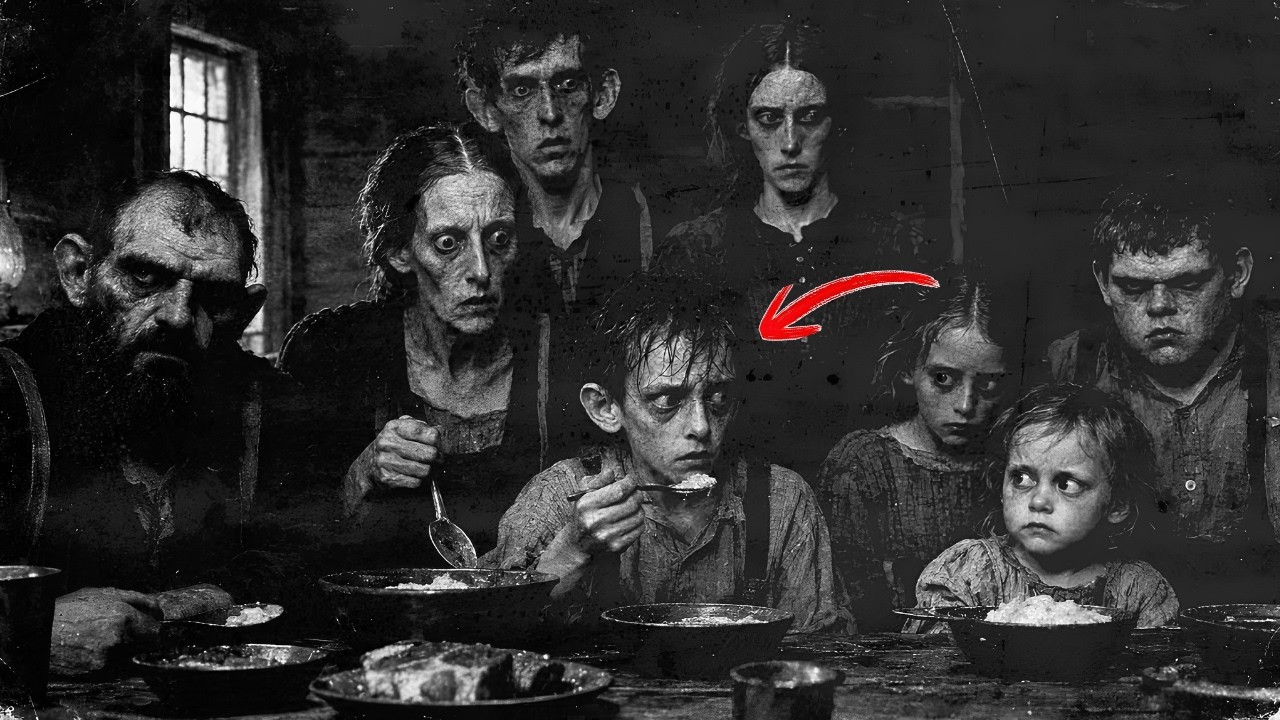
He was not calling for his mother. He was not calling for God. In a flat, monotonous voice, he said: “I ate before Lark. ”
Lark was his little sister.
She was three years old. In the Alderly home, no one—not the father, not the mother, not any child, no matter how hungry or sick or small—was allowed to eat before Lark ate. That rule had held in the family for eleven years without a single exception. On the night Latham arrived, the rule had been broken for the first time, accidentally, by a boy weakened by fever until he could no longer wait his turn.
Latham wrote in his journal that he expected to find a case of nervous shock brought on by guilt. He did not expect that three days later the boy who broke the rule would be dead, and that the family would tell him, calmly and without tears, that they had known it would happen. The Alderlys lived in a hollow the locals called Cold Water, set beneath a limestone ledge in what was then Garnett County in the far northwestern mountains of North Carolina. That county no longer appears on any modern map.
It was absorbed into two neighboring counties in 1907, and most of its records burned in the courthouse fire of 1931. That is part of why this story sat unread for so long, buried in boxes with three tin lids, until a records researcher named Pearl Hartzell pieced its fragments together in the early 2000s. The rule the family followed did not begin with Ezra Alderly. It began with his grandfather, a man named Obadiah Alderly, who settled in Cold Water Hollow in 1789 after a brutal winter in which three families on the other side of the ridge lost every child under six.
Obadiah’s own diary, of which only five folded pages survive inside a Bible kept by a descendant in Tennessee, describes a spring behind the cabin that never ran dry, even in the worst drought years. He recorded a strange understanding he claimed to have reached with that spring, though he never explained how the understanding was made or exactly who he had dealt with. His words, faithfully transcribed by Hartzell in 2004, read: “The spring will keep this family fed as long as this family keeps its own order. Feed the youngest first, until he is entirely full before any other mouth touches food, and food will always be there.
Break this order once, and the land will take back what you owe it. ”
For seventy-six years, the Alderly family kept that order without deviation. Whoever was the youngest in the house ate first at every meal, as much as they wanted, before anyone else—including both parents—touched a dish. When a new child was born, the rule simply passed to them, and the child who had been youngest the week before quietly moved one place back in the rotation without ever complaining.
By 1865, the rule was no longer superstition to them. It was something closer to a law of physics. Ezra Alderly, forty-four that autumn, had grown up under the rule. His wife Naomi, thirty-nine, had married into it and obeyed it without question for twenty years.
Their six children—Solomon, eighteen; Ruth, sixteen; Caleb, fourteen; Hosea, eleven; Delphia, eight; and baby Lark, three that October—had never known any other way of eating. The hollow itself was poor, but it never knew hunger, even in the worst war years, something the neighbors on both sides of the ridge noted with a kind of wary respect. Crops failed everywhere else while they somehow thrived at Cold Water. Livestock sickened everywhere else while the Alderly barn stayed healthy.
Dr. Coren Latham, the itinerant physician who served four counties on horseback, had written in an earlier entry dated spring of 1863 that in his eleven years of practice he had never treated a single member of the Alderly family for anything resembling malnutrition, in a hollow where he treated that condition constantly in every other family. He noted it as a point of professional curiosity, nothing more, at the time. The night the rule was broken was an ordinary Tuesday in late October, three days before Latham was summoned.
Naomi prepared a pot of cornmeal mush and a small piece of salt pork, not much but enough, and set the table as she always did, with Lark’s bowl filled first and placed before her before any other bowl left the pot. Hosea, the second-youngest, had been feverish since morning, the kind that makes a child’s hand shake before he can control it. According to the account his sister Delphia later gave to the minister Micah Sennet, recorded in the church register the following spring, Hosea reached across the table while Lark still sat in her chair, took a spoonful of the mush meant for his own not-yet-filled bowl, and ate it standing up a full three seconds before Lark took her first bite. Naomi’s face went pale, by every account.
Ezra did not shout. He did not strike the boy. He simply set down his spoon, looked at his son, and said, according to Delphia, only this: “Now we wait to see what he asks for in return. ” The family finished the meal in complete silence, Hosea included, and the children were put to bed at their usual hour.
A little after midnight, Hosea woke screaming that something was standing at the foot of the attic ladder, looking up. By the time Naomi lit a lamp, he had stopped screaming and started trembling, and he did not stop for nine hours: through the whole trip Ezra made down the hill to fetch Dr. Latham, through the examination, through everything, repeating the same four words in an endless loop until Latham finally stopped trying to interrupt him. I ate before Lark.
Latham’s journal records a careful examination that found nothing conclusive. No fever high enough to justify it. No wound, no poison, no sign of a seizure disorder in the boy’s medical history. He gave instructions for rest and returned the next morning, expecting the tremor to pass on its own.
It did not. Three days later, Ezra Alderly came down to Latham’s house alone and asked him to return, not because the boy’s condition had worsened, but because the boy had died in the night, sitting upright at the edge of his bed with his eyes open, and the family wanted a death certificate before word spread through the hollow that something else had happened there. What Latham found on that second visit is the part of his journal that Hartzell says she read four times before she believed she had transcribed it correctly. Hosea’s body showed no sign of violence and no trace of the fever that had finally taken him.
Latham wrote that the boy’s stomach was sunken in a way he had only seen in men who had spent weeks without food, though the boy had eaten a full dinner the night before and, according to his mother, had not lost his appetite in the days between breaking the rule and dying. His lips were cracked as if from long thirst. His hands, when Latham lifted them, were clenched the way old working men’s hands clench from years of tools, not like the hands of an eleven-year-old boy. Latham wrote that he had a distinct impression, one he was ashamed to record but recorded anyway, that something had kept eating the boy from the inside for three straight days after the boy himself had stopped being able to eat anything.
Ezra buried his son on the family plot above the spring, not in the church cemetery in the village, a decision the minister noted with some unease. When Sennet came to offer a burial service, Ezra told him plainly that Hosea now belonged to “the hollow” in a way the church grounds could not contain, and that the family would speak their own words over him. Sennet described standing at the edge of the small, bare plot and feeling, in his words, that the ground itself was listening with unusual attention to every word spoken over the grave, and that Naomi Alderly, who had remained dry-eyed through the whole ceremony, said only one sentence after the last word. “He knows now.
He was not supposed to be the first. ”
After Hosea’s death, the family clung to the rule the way a hand grips something about to fall. Naomi began weighing portions before every meal to make sure there was no confusion about what belonged to Lark and what belonged to the others. Ezra built a second, smaller table reserved for Lark alone, separate from the main table, so that the sight of a shared dish could not cause any confusion in a moment of hunger.
Delphia did only what she could: she took to standing behind Lark’s chair at every meal like a small guard, watching everyone’s hands, ready to speak the moment anyone moved too early. For over a year, it worked. The spring kept flowing. The crops survived a dry summer that finished three neighboring farms.
Latham, who visited the following spring on unrelated business, only noted that the family seemed unusually quiet and extremely careful with one another, which he attributed to ordinary grief. The second breach came in March of 1866, five months after Hosea’s death, and it was not the family’s fault in any way that could be called negligence. Solomon, the eldest son, had left with a Confederate cavalry unit in 1863 and came home that spring on foot, gaunt and sick with something that had been spreading through the camps, having walked most of two hundred miles alone. He reached Cold Water after dark, an hour past the family’s usual mealtime, and Naomi, overcome with joy and half-convinced she was seeing a ghost, set bread and gravy before her eldest son before she had even finished waking Lark to bring her to the table.
It was an honest mistake made in the confusion of a return no one had expected him to survive. Solomon ate two full bites before Naomi realized what she had done and snatched the bowl away, but by then it no longer mattered. Delphia’s later account, recorded by Sennet again, says the whole family simply stood in the kitchen for a long moment looking at one another, understanding without saying it that the order had been broken a second time. Nothing happened to Solomon.
That was the detail that disturbed Latham more than any other when he heard the full story years later from Sennet, who had heard it from Delphia, who by then was the only sane daughter willing to talk about any of it. Solomon recovered from his illness within a week and lived, according to every surviving record, into old age, dying in 1911 in another county of nothing stranger than a stroke at seventy-one. The debt from his rule-breaking meal did not fall on him. It fell six weeks later on Ruth.
Ruth was sixteen, the second-eldest, and by every account the family member least connected to the rule that was broken that March night. She was not in the room when Solomon took his two bites. She was at the spring house fetching milk at the exact moment it happened. Sennet’s account describes her death in language almost identical to Hosea’s: found sitting upright at the edge of her bed on a late April morning, no sign of violence, stomach sunken as if from weeks of hunger despite the full dinner the night before, lips cracked, hands twisted like an old woman’s.
Naomi said to Sennet at the grave a sentence Hartzell believes is the most important line in the entire record, because it is the moment the family realized what kind of debt they were really paying. “It does not take the one who broke it. It takes them in order, starting from the top, until it reaches the one it was always owed to. ”
The family spent most of the year trying to understand what Naomi meant at Ruth’s grave, and they only finally understood because Solomon gave them the missing piece without meaning to.
Within three weeks of Ruth’s death, Solomon left Cold Water Hollow for good, telling his father only that he could not sleep another night on that land and did not intend to try. He walked out with one bag and never came back, not for a visit, not for a funeral, not once in the next forty-five years. Nothing ever happened to him again. No illness, no early death, no second payment.
Ezra, trying to process his grief with the kind of grim arithmetic a man reaches for when explanations run out, came to believe that his son’s departure had removed him from whatever account the land was keeping. Ezra told Sennet that winter: “The debt only reaches as far as the land itself. Leave the land, and you leave the debt behind. Stay, and your place in line stays with you.
”
If that was true, it explained everything that followed in the worst possible way, because the family had a choice they did not realize they were making, and most of them, out of loyalty or stubbornness, chose to stay. Caleb, fourteen, was next in line after Ruth, and he died in September 1866, five months after his sister, in the same position, with the same sunken stomach, the same cracked lips, found sitting at the foot of his bed as if he had simply sat down there sometime in the night and stopped breathing. Latham, summoned for the third time in less than a year, wrote in his journal that he no longer had any medical language to describe what he was seeing, and that he had secretly begun keeping an unofficial second page at the end of the notebook to record details he had no intention of putting in any official report, including the fact that on each of his three visits he had noticed the spring behind the house running louder than usual for several days afterward, as if something in it had been fed and was, in his own words, digesting. Delphia, eight when Hosea died and ten when Caleb followed, was the only family member besides Lark who survived that whole ordeal.
She survived because Naomi made a decision that cost her more than Sennet’s account can convey. In late 1866, three months after burying Caleb, with only Solomon gone, Ruth and Caleb and Naomi and Ezra and the two little girls left alive on the land despite everything, Naomi sent Delphia away to live with a cousin two counties over, on the pretext that the girl needed an education the hollow could not provide. Sennet’s account makes clear that everyone involved knew the real reason. Delphia was next in line after Caleb, and removing her from the land was the only way anyone could find to break the rotation without dying to do it.
It worked. Delphia lived a full life in the neighboring county, married, had four children, and was the source, decades later, of everything Sennet eventually wrote. She was the only survivor willing to talk about what she remembered. That left Naomi and Ezra on the land with only Lark.
According to the family’s grim understanding of the arrangement, one of them was next in line. It was Naomi. She died in February 1867, sixteen months after Hosea, and Ezra found her himself, sitting at the low small table built for Lark’s separate meals, in the same position the other three had died in, her own bowl of breakfast mush untouched and still warm on the table before her. Because on that last morning, by every account, she fed Lark first, watched her finish, and then simply never picked up her own spoon.
Ezra buried his wife beside his three dead children on the hill above the spring and lived alone with Lark, who had not yet turned five, for two more years. Neighbors who checked on him during that time, according to Sennet’s later notes gathered from several families in the hollow, described a man who had almost completely stopped speaking except to his daughter, feeding her first at every meal with a precision bordering on ritual, weighing and measuring portions as Naomi once had, and telling at least two visitors nearly the same sentence: “I am the last one who owes. When I go, it will have taken all of us except her, and it will stop. ”
Ezra Alderly died in the spring of 1869, found the same way the others had been, on the same hill, and a passing neighbor found six-year-old Lark sitting quietly beside her father’s body, apparently having sat with him all night without coming to any harm, and by every remaining account she was calm.
Lark Alderly went to live with her sister Delphia in the neighboring county and grew up, by every account, as an ordinary child carrying no troublesome memories of her early years. She married in 1884 and had five children, and according to Hartzell’s research, she kept one habit for the rest of her life that none of her children ever understood. At every meal in every house she lived in, the youngest at the table ate first, fully, before anyone else touched their plate. And Lark herself would not sit down until she had watched that child finish.
Her grandchildren remembered it as a kindly old custom. None of them were ever told the reason, as far as Hartzell could determine. Cold Water Hollow did not stay empty for long. Another family, the Turleys, bought the land cheaply in 1871, apparently without asking too many questions about why an entire family had died out on it in under four years, and lived there through the 1890s.
Church records from the receiving parish two ridges over show the family transferred their membership out of the hollow in 1893, and a single surviving letter from the Turleys’ eldest daughter, kept by a descendant and shared with Hartzell in 2007, mentions in passing that her mother refused to let any child at their table touch food until the youngest had been served first and eaten her fill, a habit the daughter assumed was simply her mother’s way and never questioned until she read, decades later, what had happened to the family who came before them. The letter ends with a single line the daughter herself seemed unable to explain, written and underlined twice: “We never asked why we kept it. We only knew what happened when the food ran out in that house. ”
A government surveyor named Alden Criss passed through in 1911 to draw boundary lines for the reorganization that would eventually erase Garnett County from the map, and his eleven-page field report, lost for years before Hartzell found it, contains a strange half-page note unrelated to boundary lines.
Criss wrote that the spring behind the old Alderly cabin, abandoned again by that time, ran unusually loudly on the evening he camped near it, and that he woke twice in the night with a distinct feeling that something very close by was hungry and waiting, not for him specifically, and that he packed up his camp before dawn rather than spend a second night on that particular hill, a decision he described with obvious embarrassment even on paper as having nothing to do with logic and everything to do with an instinct he did not wish to argue with. Hartzell visited the site herself in 2006. The cabin is long gone. The five graves above the spring remain, now unmarked, though the ground above them, as she noted, stays noticeably greener than the surrounding slope even in dry years, a detail she photographed but could never get an explanation for from any local historian.
The spring still flows, cold and steady, and local people who fish the creek it feeds still repeat an old hollow saying with no context at all. Feed the little one first, and never forget why.






