The iron gate of the dog yard swung open with a screech that silenced every dog within fifty yards. Twelve-year-old Naomi felt Mr. Callaway’s hand close around her thin wrist like a shackle as he dragged her toward the kennels where the hunting dogs lived. Her eyes glowed in the Louisiana dusk like scattered embers.
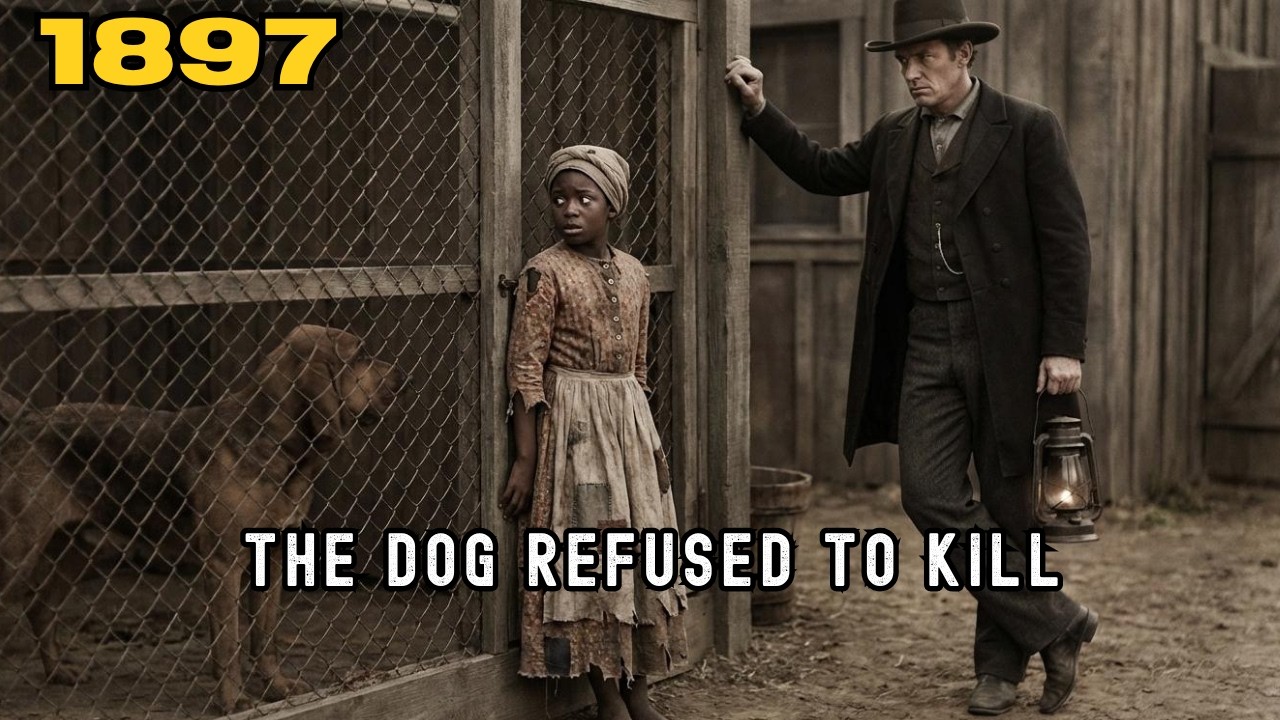
With the terrible clarity that children sometimes possess in moments of crisis, she understood she was about to be thrown to the dogs as punishment for something she had not done, for a missing silver flask that Richard, the master’s wayward son, had actually stolen. The only sound louder than her racing heart was the muffled roar coming from the largest kennel at the far end, the one nobody dared approach. It was the massive bloodhound Brutus, who had mauled two overseers and was scheduled to be put down by the end of the week. He waited while Callaway pushed her stumbling toward that very kennel, under the horrified gaze of the enslaved workers gathered near the cotton shed.
As her mother screamed from somewhere she could not see, Naomi realized she had perhaps five minutes left to live. Unless something impossible happened. Unless the beast in that kennel, for reasons no one could predict or explain, decided that a terrified girl deserved protection instead of being torn apart. But we are getting ahead of events.
To understand how Naomi ended up in that yard with death breathing down her neck, you must understand the Callaway plantation in St. Landry Parish, Louisiana, in the summer of 1897, and the particular kind of cruelty that festered there like an unhealed wound. The Callaway plantation sat on eight hundred acres of fertile land along Bayou Teche, where the water ran dark as coffee and twice as bitter. The main house was a huge, resentful structure with its white columns and pretensions, built by Nathaniel Callaway’s grandfather when cotton was king and human suffering was the currency that bought the South’s prosperity.
Spanish moss hung from the oak trees like the beards of ancient prophets, and the air itself seemed heavy with secrets and sins that the soil had drunk in over generations. Nathaniel Callaway himself was forty-three, with a face like an axe blade and eyes that carried the coldness of a January frost. He had inherited the plantation at twenty-five when his father had the wisdom to die of a stroke during an argument over crop prices, and he had been running it toward ruin ever since through a combination of brutal management and appalling incompetence. The crops shrank every year.
Debts mounted, and Callaway’s response was always the same: make the people work harder, feed them less, squeeze every drop of profit from human misery until nothing remained but bones and despair. He had a wife named Charlotte who spent most of her time in New Orleans pretending her husband did not exist. She took the train monthly, stayed at her sister’s house in the Garden District, and only returned when her money ran out and she needed to extract more from Nathaniel’s dwindling accounts. They had one child, a son named Richard, who at seventeen had already developed his father’s taste for cruelty without any of the constraints that running a working plantation imposed.
Richard Callaway was the sort of young man who pulled the wings off flies in childhood, then graduated to larger prey as he grew older. He rode his horse at night through the slave quarters shooting at shadows. He set fire to the little church the enslaved workers had built just to watch it burn. He found particular pleasure in tormenting the young girls who worked in the big house, inventing excuses to punish them for real or imagined infractions.
The overseers looked the other way because Richard was the owner’s son, and because some of them shared his base appetites. The enslaved workers learned to become invisible when Richard was around, to move through the house like ghosts, never meeting his eyes, never speaking unless spoken to. Naomi had worked in that house for six months, ever since her twelfth birthday, tasked with polishing the silver, sweeping the floors, and being invisible, the most important skill for any enslaved person near the Callaway family. She was small for her age, with a thin body and prominent joints, skin the color of walnut wood, and eyes that saw more than they should.
Her hair was wrapped tightly in a cloth. Her dress was patched calico that three girls had worn before her, and her hands were already developing the calluses of constant labor. Her mother, Celia, worked in the laundry, standing over pots of boiling water and lye for twelve hours a day until her hands cracked and bled. Her father had been sold and sent to Texas three years earlier when Callaway needed cash to pay gambling debts.
Naomi remembered him now only in fleeting flashes: the sound of his laughter, the way he carved little animals from scraps of wood, the song he sang while working to make the day pass more easily. She had two younger brothers, eight-year-old Samuel and six-year-old Joshua, both already working in the fields when they were not hired out to neighboring plantations during harvest season. The family lived in a cabin at the edge of the quarters: one room with a dirt floor and a fireplace that smoked when the wind came from the east. They shared the space with another family, the Washingtons, separated only by a curtain made from old flour sacks.
Privacy was a luxury they could not afford. Safety was something they dreamed about but never expected. Naomi had learned early to keep her head down, to move quietly, never to meet the eyes of any of the Callaway men. She learned which floorboards in the big house creaked and which were silent.
She learned to anticipate needs before they were spoken. She learned to make herself unnoticeable, unremarkable, until she could move through rooms like smoke. But on the fourteenth of August, 1897, keeping her head down was not enough. She was in the dining room that morning polishing the silver service that Charlotte Callaway had inherited from her mother.
The set included a tea service, candlesticks, serving platters, and various tableware, all of which required weekly polishing whether they were used or not. It was tedious work that made her fingers ache and her nose burn from the fumes of the polish. But it was better than working in the fields, better than the laundry where her mother’s hands were being slowly destroyed by caustic soap and boiling water. Richard walked in around ten o’clock smelling of whiskey, though it was not yet noon.
His eyes were bloodshot, his shirt untucked, and he moved with the deliberate slowness of someone trying hard not to appear drunk. He watched her work for a few minutes with a look that made her skin crawl and made her want to run. But running was impossible. Running was suicide.
So she kept polishing, kept her eyes down, kept breathing as quietly as she could. Richard stumbled forward, bumping into the sideboard hard enough to rattle the china. He cursed, muttered to himself, then pulled open one of the drawers. She heard him rummaging through its contents, heard the clink of metal against wood.
Then he left, staggering toward the stairs to sleep off the whiskey, and Naomi resumed her work, thinking nothing more of it. She had learned not to concern herself with the Callaways’ private affairs, and that seeing too much or knowing too much was dangerous. But that evening, when Nathaniel Callaway went to the sideboard to pour himself a drink before dinner, he discovered that his father’s silver flask was missing. The flask was an object that might have been worth thirty dollars, but its sentimental value was incalculable.
It was engraved with the Callaway family crest, and his father had carried it through the war. Callaway treasured it more than most of his material possessions. He summoned Naomi immediately. His voice rang through the house.
Bring that girl here now. She came running, her heart pounding with terror, knowing that being summoned never boded well. That big house was a place of constant danger, where your life could change in an instant based on the whim of an angry white man. She stood in the dining room with her hands trembling while Callaway loomed over her, demanding to know where the flask was.
She answered that she did not know, and this was the truth. She said she had been alone in the room, and that was also true. But she made a fatal mistake when she hesitated before answering, trying to decide whether mentioning Richard’s presence would make things better or worse, whether the truth would protect her or destroy her. Because everyone on the plantation knew that accusing a white person of anything, even if it was true, especially if it was true, was grounds for severe punishment or death.
The truth did not matter in a place like this. Power was what mattered, and Naomi had none of it. Callaway noticed the hesitation and interpreted it as evidence of guilt. His face contorted, then turned purple.
A vein in his temple began to pulse, as it did when he was preparing for violence. “Are you accusing my son of theft? ” He said it in a deceptively calm voice, the kind of calm that precedes an explosion. “No, sir.
” Naomi whispered. But the denial came too late. Her hesitation had already condemned her. Callaway grabbed her arm, his fingers digging into her flesh hard enough to leave bruises that would last for weeks.
He dragged her out of the house, down the porch steps, across the yard, while the enslaved workers scattered before him like birds before a storm. Everyone knew what was coming. Everyone had witnessed this before. The dog kennels, the dogs, the screaming.
The kennels were located at the eastern end of the property: a series of long, low buildings and outdoor pens where Callaway kept his hunting dogs. He was famous in three parishes for his dogs, especially the trackers he bred and trained to follow runaway slaves. The business of returning human property to its owners was profitable, and Callaway prided himself on his dogs’ success rate. He charged fifty dollars for each recovery, more if the runaway had been gone longer than a week.
His dogs could track a three-day-old scent through swamp and forest, distinguish one person’s smell from another, and run for hours without tiring. He kept fifteen hunting dogs in total, housed in individual pens with metal fencing and concrete floors. The dogs were well fed, better than the enslaved workers in some cases, because they were valuable assets. Each one represented an investment of money and training time.
But the jewel of his collection was a massive bloodhound he had paid two hundred dollars for at an auction in New Orleans, a dog with a legendary sense of smell and an equally legendary temperament. The dog’s name was Brutus, and he had been trained from puppyhood to track human scent, to follow old trails through swamp and forest, and never to give up once he had fixed on a target. He was brilliant at his work, tireless, with a success rate that made him worth his weight in gold, but he was also unpredictable and violent in ways that made him dangerous even to the people who worked with him. He had attacked his first handler when the man tried to take his food bowl, breaking the man’s arm in three places.
The bones healed crooked, and the handler could no longer do heavy work, so Callaway sold him downriver to a sugar cane plantation, where damaged goods go to die slowly. He had mauled his second handler so badly that the man lost the use of his left hand. Three fingers were torn out at the roots, and the thumb was mangled beyond repair. That man was relegated to lighter duties, his value diminished, his future destroyed.
The current kennel manager, a wiry man named Pike, kept Brutus isolated in the largest pen at the far end of the complex, feeding him by throwing raw meat through a slot in the fence. He never opened that gate unless the dog was muzzled and leashed, and even then only when absolutely necessary. Pike had worked with dogs for twenty years and dealt with every temperament from gun-shy to aggressive. But Brutus frightened him in ways he could not quite articulate.
It was not just the violence; it was the intelligence behind it. The calculation. The feeling that Brutus was always thinking, always waiting for an opening to strike. Callaway had been planning to get rid of the dog, to kill him.
The violence had become a liability, and several neighboring planters had suggested Brutus might be more trouble than he was worth. But Callaway kept putting it off because Brutus was too valuable, too skilled at his primary function to be killed just yet. The dog had brought back seventeen runaways in the past two years. Seventeen people who risked everything for freedom, only to be returned in chains because of Brutus’s nose.
That represented eight hundred fifty dollars in recovery fees. You do not kill an asset like that. As Callaway dragged Naomi across the yard toward the kennels, she understood with sickening clarity what he intended to do. He was going to throw her to Brutus.
It was his preferred punishment for serious infractions, a way to terrorize without actually killing, though the dogs did kill sometimes. Then Callaway would shrug and say the slave should not have stolen or run or talked back, whatever excuse he needed to justify the death. The other dogs barked and growled, but they were trained to respond to commands. They were frightening but rarely attacked.
But Brutus, Brutus was different. Celia, Naomi’s mother, appeared from somewhere, screaming. “Please, sir, please, she didn’t take anything. Please don’t do this.
” But one of the overseers, a thick-necked man named Dutch, grabbed Celia and pulled her back, clamping his hand over her mouth to muffle her cries, while Callaway ignored her completely, as if she mattered no more than a bird singing in the trees, as if her anguish was just background noise to be disregarded. Pike, the dog keeper, stood by the gate of Brutus’s pen, his face completely expressionless. He knew better than to interfere with Callaway’s punishments, knew that objecting would get him beaten or sold. His hands trembled slightly as he worked the heavy lock, a lock that required two keys: one Pike wore around his neck, the other Callaway kept with him.
That was how dangerous Brutus was: locked with two keys like a prisoner in a maximum-security facility. The other dogs fell silent, sensing the tension. Except for Brutus, who began a low, continuous growl that seemed to shake the ground itself, a sound from deep in his chest, primitive and threatening. A sound that said he knew something was happening, and he was ready for it.
Naomi could see him now through the metal fence. A huge dog, easily one hundred forty pounds, with a broad head, drooping jowls like curtains, and eyes that held an anger she recognized because she had felt it herself every day of her life on this plantation. Brutus’s coat was dark brown with black markings, his ears long and drooping, his body dense with muscle built from constant running and the occasional violent outburst. Scars covered his muzzle where chains had rubbed, where he had thrown himself against fences, where he had fought and won and lost and survived.
Callaway pushed her forward, and she fell sprawling on the dirt, her hands scraped raw by the sharp gravel, blood welling up. Pike opened the gate. The hinges screamed like a dying thing. “Get in.
” Callaway’s voice was calm now, almost pleasant, as it was when he was enjoying himself. Naomi looked at him, then at the dog, then back at Callaway. “Please,” she whispered. The word came out broken.
“Get in. ” He no longer shouted. He did not need to. The threat was clear.
The rest of the enslaved workers had gathered at a distance, close enough to witness, not close enough to be blamed for watching. Close enough to see what happened when you were accused of theft. Close enough to learn the lesson Callaway wanted them to learn. Her mother was sobbing, the sound muffled by Dutch’s hand but still audible.
An old man named Abraham pressed his hat to his chest as if he were already at her funeral. A woman named Ruth turned away, unable to watch. But most of them stood frozen, witnessing because that was all they could do. Naomi got to her feet, her legs barely holding her weight.
She took one step toward the gate, then another. Each step felt like walking through deep water, as if her body were moving against her will. Then she was inside, and Pike slammed the gate behind her, the lock clicking into place like the sound of a coffin closing. The finality of it made her knees buckle.
Brutus stood thirty feet away, head lowered, shoulders tense. The growl rose in his chest like distant thunder, growing and growing until it filled the air, filled her head, filled the space between her heartbeats. His eyes were fixed on her, unblinking, weighing and measuring. Naomi pressed her back against the fence, her breath coming in short, sobbing gasps.
Her hands found the metal ring behind her and gripped it hard enough to hurt. The metal bit into her palms, but she did not let go. It was the only solid thing in a world that had turned to liquid terror. The dog took a step toward her, then another.
His lips peeled back from his teeth, yellowed fangs designed to tear flesh from bone. Teeth that had ripped through skin and leather and human hide. He tilted his head down, his nose working, inhaling her scent. The smell of fear and sweat and the lavender soap she had used that morning in the big house.
Naomi squeezed her eyes shut, waiting for the attack, waiting for the pain, waiting for those jaws to close on her neck or arm or leg. She thought of her mother, her brothers, her father somewhere in Texas who would never know what happened to her. She thought of all the things she would never do, never see, never become. But the attack did not come.
Instead, she heard a different sound: a sharp, agitated whine, as if the dog could not understand what he was experiencing. She opened her eyes. Brutus had stopped ten feet away, his head tilted slightly. The growl had faded into something that looked more like confusion.
His ears, which had been pinned back against his skull, came forward slightly. His tail, which had been stiff, relaxed a little. They stared at each other, the girl and the dog. And something passed between them, something with no name in any human language.
Something older than words. A recognition of shared circumstances, of being caged and threatened and exploited, of having violence done to them and having violence expected of them, of being trapped in systems they did not make and could not escape. Brutus took another step forward, but slowly this time, carefully, as if approaching something fragile that might break. He stretched his nose toward her, his nostrils flaring as he inhaled her scent more deeply.
It was not a quick assessment of prey but something longer, more deliberate. He was reading what was inside her. Reading her fear, yes, but reading something else too, something beneath the fear. Naomi held her breath.
She did not move, did not speak, just stood with her back against the fence, watching this massive creature approach her with something like curiosity instead of rage. The dog came closer, closer, until his enormous head was inches from her face. Close enough to feel his hot breath on her cheek. To smell the blood and meat on his breath from the morning meal.
To see the scars on his muzzle up close, the places where skin had torn and healed, the places where chains had worn away fur. The evidence of all the violence that had been done to him under the pretense of making him useful. Then, with incredible gentleness, he pressed his head against her shoulder and made a sound that was almost a whimper. A sound of loneliness, of recognition, of finding something unexpected.
Naomi’s hand rose without conscious decision, moving on pure instinct, the way you reach out to steady yourself when falling, and settled on the dog’s head. Her fingers found the spot between his ears, his warm soft fur, the hardness of the skull beneath her palm. Brutus leaned into the touch, the way a dog leans into tenderness, the way a creature starved for kindness responds when it is finally given. He closed his eyes halfway, and his breathing deepened.
The last remnants of that growl faded into silence. Behind her, outside the fence, she could hear confused murmurs. Callaway’s voice rising: “What in the hell is going on? ” Pike’s quieter response: “I don’t know, sir.
I’ve never seen him do that. Never. ”
But Naomi was not listening to them. She was entirely focused on this moment, on this impossible connection, on the fact that this creature everyone feared had chosen not to hurt her, had chosen instead something that almost resembled comfort, almost resembled companionship.
She stayed there, frozen in her position for what seemed like hours but was probably only minutes. Her hand on Brutus’s head, the dog’s weight pressing against her, both breathing in rhythm, both present in this small pocket of peace that should not have been possible in a place like this. Finally, Callaway’s voice cut through the silence. “Get her out.
”
The words were clipped, angry, but also uncertain. This was not how things were supposed to go. This was not the lesson he had wanted to teach. Pike fumbled with the lock, his hands trembling more than before.
He opened the gate and gestured urgently for Naomi to come out. She moved slowly, carefully, her hand sliding away from Brutus’s head. The dog watched her leave with eyes that held something that might have been confusion or might have been recognition. Perhaps it was the beginning of understanding that there was someone in this place who saw him as something other than a weapon or a threat.
Naomi stumbled out of the kennel. Callaway grabbed her arm again, his fingers digging into the same bruises he had made earlier. His face was red with anger and something else, something that looked like fear or perhaps humiliation. “You got lucky,” he said, his voice charged with emotion she could not identify.
“Next time you won’t be. ” He pushed her toward her mother, who caught her and held her, trembling, against her chest. Celia’s hands moved over Naomi’s body, checking for wounds, for blood, making sure her daughter was still whole and breathing and alive. “Thank God,” Celia whispered.
“Thank God. Thank God. Thank God. ”
As Callaway stalked away, his steps kicking up dust from under his boots, his shoulders tight with frustrated violence, Pike, the dog keeper, caught Naomi’s eye and gave her a slight nod.
It was a gesture of acknowledgment, of recognition. He had seen what happened. He did not understand it any more than anyone else, but he had seen it with his own eyes. Brutus stood at the fence watching her leave, his eyes never leaving her until she disappeared around the corner of the laundry, out of sight, but not out of mind, somehow.
That night, Naomi lay on the pallet she shared with her brothers in the cabin that housed her family. Samuel and Joshua were already fast asleep, their small bodies pressed against her for warmth despite the August heat. Her mother sat by the fireplace, though it was cold, staring into space. The Washington family, on the other side of the flour-sack curtain, was silent, pretending not to listen while eavesdropping on everything.
Naomi could not sleep. Her mind kept replaying the moment when Brutus rested his head on her shoulder, when every instinct and his training should have driven him to attack. When the smart, expected thing to do was to tear her apart and prove once again that he was the monster everyone believed him to be. She had grown up around dogs her whole life.
The plantation was full of hunting dogs, guard dogs, and strays that wandered the quarters looking for scraps. She was good at reading their body language, knowing when to approach and when to stay away, knowing the difference between a dog that was playing and a dog that was hunting. But she had never seen anything like what happened in that pen. It felt like recognition, like Brutus saw something in her that made him hesitate, saw past the fear and the circumstances to something deeper and more essential.
Or maybe she thought he saw himself: a creature trained to hunt and hurt and intimidate, who found in that moment a choice, an opportunity to be something different from what people had made him. She thought about the scars she had seen on his muzzle, the marks of chains and whips, and thought about the isolation he lived in, kept away from any living thing because he was too dangerous, and thought about the violence he had committed and the violence that had been done to him. She understood it because that was exactly what they were trying to do to all of them. Separate, control, break.
Turn them into weapons against each other, or make them nothing at all. Frighten them of each other so they could not unite. Make them desperate enough to do anything, to hurt anyone just to survive another day. But Brutus had chosen something different.
In that moment when he could have killed her, when he was expected to kill her, when killing her was the easier path, he had chosen something else. He had chosen connection. And maybe that mattered. Maybe that meant something.
The next morning, Naomi woke before dawn as usual. She helped her mother prepare the thin cornmeal mush that served as breakfast. She dressed her brothers and got them ready for their day in the fields. She walked to the big house as the sun began to burn off the night fog, and tried to focus on her work, on staying invisible, on surviving.
But she could not stop thinking about the dog, about those dark eyes that had looked at her with something other than anger, about the weight of his head on her shoulder, about the choice he had made. She made excuses to pass by the kennels, carrying laundry, fetching water, delivering messages anyone could have delivered. Every time she looked, Brutus was at the fence of his pen, watching and waiting, as if he knew she would come back, as if he hoped she would. Pike noticed.
On the third day, he approached her as she passed with an armful of clothes. He looked around to make sure no one was listening, then spoke quietly. “That dog,” he said, “keeps looking for you. Stands at that fence every morning now.
Won’t eat until he’s watched the yard for an hour. ”
Naomi did not know what to say to that. She clutched the clothes tighter, feeling the rough fabric against her arms. Pike continued.
“I’ve worked with dogs for twenty years. Never seen anything like what happened in there. That dog has killed prey smaller than you. Mauled two men badly.
But he looked at you and simply stopped. ”
He paused, choosing his words carefully. “Brutus was supposed to be shot. Callaway finally made the decision.
But after what happened with you, he’s hesitating. Says he wants to see if the dog can be controlled after all. Maybe if there’s something in him that can be used. ”
Naomi felt something clench in her chest.
A mixture of relief and dread. Relief that Brutus would not be killed. Dread at what being useful might mean for him. Pike moved closer.
“I was thinking,” he said cautiously, “maybe you’d like to come to the kennels early tomorrow, before anyone else wakes up. Bring him something. Some scraps if you can find them. Let him see you again.
Because if Callaway thinks the dog can be controlled, he’ll want to test it. And if the test goes wrong, Brutus dies. But if you can show that he responds to you, that he can be calm around at least one person, that might be enough to keep him alive. ”
“Why are you telling me this?
” Naomi asked. Why do you care what happens to him? Pike looked toward Brutus’s pen, his expression unreadable. “Because I worked with that dog for two years and I’ve seen what he can do.
I’ve seen him track people through ten miles of swamp. I’ve seen him refuse to give up even when he was exhausted. I’ve seen him be smart and loyal and everything a working dog should be. ” He paused.
“But I’ve also seen what was done to him. Seen him beaten for being slow, starved for being aggressive, chained and muzzled and treated like a monster. And maybe he is a monster now. Maybe they made him that way, and maybe they didn’t.
Maybe what I saw three days ago was his truth underneath all of it. ”
He straightened up. “Just think about it. Come tomorrow if you want.
I’ll make sure the place is clear. ” Then he left, leaving Naomi standing there with her arms full of laundry and her head full of impossible thoughts. That night, she lay awake again, listening to her brothers’ breathing and her mother’s restless movements in the dark, thinking about Pike’s offer, thinking about what it meant to seek the dog out deliberately, to form a bond with him, to risk everything on the chance that what had happened in that kennel was not an accident but something real. It was dangerous.
Everything about it was dangerous. If Callaway found out, he would see it as defiance, an enslaved girl overstepping her bounds, something deserving of punishment. The punishment would be severe, public, designed to break not just her body but her spirit. But if she did not go, if she let this opportunity slip away, Brutus would die, would be shot in his kennel like a rabid animal, and would never get a chance to be anything other than what fear and violence had made him.
And something inside her could not accept that. Could not allow another living creature to be destroyed just because it had been hurt too much, pushed to its limits, turned into something people feared. Because that was what they were doing to all of them, in the end. That was what this place did.
It took people and broke them, then punished them for being broken. Before dawn the next morning, while the quarters were still dark and quiet, Naomi slipped out of the cabin. She had saved a piece of cornbread from her dinner and hidden it in the pocket of her dress. It was not much.
It was not the raw meat Brutus was used to, but it was something, an offering, a gesture. The air was cool and damp, heavy with the smell of the swamp. Mist hung low over the ground, turning the world into something ghostly and indistinct. She moved quietly, hugging the shadows, her bare feet silent on the packed earth.
Every sound seemed magnified: a distant owl call, the rustle of something moving in the underbrush, her own breathing. The kennels were dark. Pike had left a single dim lantern near the gate, a signal that he had kept his word, that the way was clear. Naomi approached Brutus’s pen slowly, her heart beating so hard she thought it might wake the entire plantation.
Brutus was awake. Of course he was. He stood at the fence, his massive head silhouetted against the sky that was just beginning to lighten, waiting as if he knew she would come. Naomi stopped a few feet from the fence.
For a long moment, they simply looked at each other. Then she took out the cornbread and held it out. “I brought you something,” she whispered. “It’s not much, but it’s all I have.
”
Brutus’s nose twitched. He took a step toward the fence, then another. When he reached the wire mesh, he pushed his nose through one of the openings, sniffing. Naomi moved closer, close enough to break off a piece of cornbread and push it through the fence.
Brutus took it gently, his teeth barely brushing her fingers. He chewed slowly, his eyes never leaving her face. Then he swallowed and pushed his nose through the fence again, not asking for more food but simply touching, confirming that she was real. Naomi’s hand rose and found that spot between his ears again.
The same spot she had touched three days before. And Brutus made that sound again. That soft whine that did not match his size or his reputation. The sound of loneliness finally finding a companion.
They stayed like that until the sky began to lighten in the east. Until Naomi realized she had to return before anyone noticed her absence. “I’ll come back tomorrow,” she whispered. “If I can, I’ll keep coming as long as they let me.
” Brutus watched her leave, and she felt the weight of his gaze all the way back to the quarters. This became a routine over the following weeks. Every morning before dawn, Naomi would slip away to visit Brutus. She would bring whatever scraps she could find: sometimes cornbread, sometimes a bit of pork fat, and on one lucky day, chicken bones with some meat still clinging to them.
And each time, Brutus would take the food gently, then press his body against the fence for the touch more than the food. Pike facilitated these visits, keeping watch to make sure no one saw them. He never explained why he was taking the risk, or why he protected this secret relationship between an enslaved girl and a dangerous dog. But Naomi thought he understood what it meant to be trapped, to have your nature used against you, to want something better even when the impossible seemed like the only reality.
Word began to spread through the quarters. Whispered conversations in the evenings. That girl, Celia’s daughter, who Callaway threw to the monster dog. The dog did not hurt her.
The dog is gentle around her now. She visits him before dawn, feeds him like a pet instead of a killer. Some people thought she was blessed, touched by something divine. Others thought she was a fool, bringing danger that would eventually catch up with her.
But most of them watched and wondered and hoped. Hoped that if impossible things could happen in the dog kennel, maybe they could happen in other places too. Callaway heard the rumors eventually. Everything that happened on the plantation reached the master’s ears sooner or later.
There was always someone talking, always someone trading information for protection or privileges, or because making trouble was the only power they had. He appeared at the kennels one morning in late September. Naomi was already there, her hand through the fence, Brutus leaning into her touch. She heard the sound of boots on gravel and turned to find Callaway standing ten feet away, with Pike beside him looking apologetic and frightened.
“So,” Callaway said, in that deceptively calm voice of his. “I hear you’ve been visiting my dog. Befriending him. ”
Naomi pulled her hand back from the fence and lowered her eyes.
“Yes, sir. I didn’t mean any harm, sir. Just, he seemed lonely. ”
Callaway laughed.
A harsh sound with no humor in it. “Lonely. You think that animal gets lonely? He’s a dog, girl.
A tool. A weapon. He doesn’t have feelings. ”
But even as he spoke, Brutus moved toward the fence closest to Naomi and positioned himself between her and Callaway.
Not aggressively, but protectively. He had declared with his body that his loyalty, whatever it was, had shifted. Callaway saw it. His eyes narrowed.
“Show me,” he said. “Go in there. Let’s see this magic you claim to have. ”
Naomi felt cold form in her stomach.
This was a test, a trap. But refusal was not an option. Pike opened the gate, his hands trembling. Naomi stepped inside.
Brutus came to her immediately, pressing his shoulder against her leg. She placed her hand on his head. Callaway’s face went through several expressions: surprise, calculation, something that might have been grudging respect. “Well,” he said finally.
“It seems you’ve done what three handlers couldn’t. Made that monster controllable. ” He paused. “There might be use in this.
A dog that responds to commands might be worth keeping alive after all. ” He looked at Pike. “Don’t shoot him. Not yet.
Let’s see if this arrangement can be made profitable. ” Then he looked at Naomi. “You’ll continue these visits every morning. You’ll work with Pike to train the dog, make him useful.
If you succeed, you might just save both your lives. If you fail, well, we’ll deal with that when it happens. ”
He walked away, leaving Naomi standing in the kennel with a responsibility she never asked for and a bond she did not fully understand. Over the following months, Naomi learned to work with Brutus in ways that surprised everyone, including herself.
Pike taught her the basics of dog handling: how to use voice commands, reward good behavior, set boundaries without violence. But what actually worked was something simpler: trust, consistency, treating Brutus as a living being with thoughts and feelings rather than just a tool. The dog responded in ways that seemed almost miraculous to people who had only known him as violent and unpredictable. He learned to sit and stay, to come when called, to walk calmly on a leash instead of lunging.
He was still wary around men, still prone to aggression when he felt threatened. But with Naomi, he was gentle, patient, almost tender. Callaway, seeing the potential, began to think of new uses for the dog. A tracker that could follow a scent but also be controlled, that could work near people without the constant fear of attack.
That was valuable. That was profitable. But there was something Callaway did not know. Something Naomi and Pike and a growing number of the enslaved workers were beginning to understand.
Brutus was not just responding to training. He was choosing, choosing who to trust, choosing who to protect. And that choice was beginning to mean something. Winter settled over Louisiana, bringing colder temperatures and shorter days.
The work on the plantation continued at its brutal pace, but something had changed. There was a feeling in the air, a sense of possibility. People watched Naomi walk to the kennels every morning and saw proof that the rules they had learned were not absolute, that bonds could form across impossible divides, that even in a place designed to break spirits, resistance could take unexpected forms. On a January morning in 1898, everything changed.
Naomi arrived at the kennels before dawn as usual, but instead of finding Pike waiting for her, she found Richard Callaway, drunk and angry, holding a rifle. “Where’s Pike? ” Naomi asked, her voice barely above a whisper. “I gave him the morning off,” Richard said, his words slurred.
“Thought I’d do the feeding myself. Check on this famous dog everyone’s talking about. ” He swayed slightly. “See what makes him so special.
”
Naomi’s heart began to race. This was wrong. This was dangerous. Richard, drunk, was unpredictable at the best of times, and these were not the best of times.
He had been growing more resentful of the attention Brutus was receiving, and of the way people talked about the dog and the girl, as if they were something exceptional, something that mattered. Richard approached Brutus’s pen. The dog stood at the back, watching, his body tense, his eyes tracking Richard’s every movement. “I think this dog needs to remember who owns him,” Richard said.
“Needs to remember his place. ” He raised the rifle, not pointing it directly at Brutus, but the threat was clear. “I could shoot him right now. Right here.
I’d be doing everyone a favor. A dangerous animal like that doesn’t deserve to live. ”
“Please,” Naomi said. “Please don’t.
He hasn’t done anything wrong. He’s been good. He’s been working. ”
Richard turned to her, his eyes unfocused.
“Oh, has he? Has he been a good dog for you? Is that what you think makes something valuable? Being good?
” He laughed. “You people never learn. Being good doesn’t matter. It doesn’t change what you are.
It doesn’t give you rights. It doesn’t make you human. ”
He turned back toward the kennel. “I’m going in there.
I’m going to show this dog who’s in charge. Remind him what happens when animals forget their place. ”
“Don’t,” Naomi said, her voice stronger now, more urgent. “He doesn’t know you.
He’ll think you’re a threat. ”
“Good,” Richard said. “Let him try something. Give me a reason.
”
He fumbled with the lock, his drunken fingers making the process take longer than it should, but the lock finally clicked open. He swung the gate wide and stepped inside. Brutus did not move. He did not attack.
He stood watching with those dark intelligent eyes, assessing the situation, calculating the odds. Richard walked toward him, holding the rifle loosely in one hand. “Come here, dog. Come show me what you’ve got.
” Brutus remained still. Richard closed to ten feet, then five. Then he raised the rifle and aimed it directly at the dog’s head. “Not so tough now, are you?
Just another dumb animal that needs to be put down. ”
His finger moved toward the trigger. And Brutus lunged forward, not toward Richard, but past him, toward the open gate, toward freedom. He moved like lightning, like something released, covering the distance in three powerful strides.
Richard spun, trying to bring the rifle around, but he was too slow, too drunk. Brutus hit him hard enough to knock him to the ground. The rifle flew from his hands and discharged, the shot echoing across the plantation. The dog kept running.
Naomi stood frozen for a moment, watching Brutus disappear into the pre-dawn darkness. Then she heard Richard screaming, heard the sound of running feet, heard the plantation coming alive with panic, and she made her decision. She ran, not toward the quarters, not toward safety, but toward where she knew Brutus would go: the swamp. The same swamp the runaway slaves fled to when they could no longer bear to live.
The same swamp Brutus had been trained to track people through. He knew that territory better than anyone. The swamp at dawn was a gray, featureless world. Water merged with land.
Cypress trees rose like ancient guardians, their roots jutting out above the waterline. Spanish moss hung everywhere, forming curtains that obscured the view. The air smelled of decay and life mixed together: mud and flowers and rot. Naomi had been in the swamp before.
Everyone who lived on the plantation knew it to some extent. It was both refuge and threat, a place where you could hide but also a place where you could die. Quicksand and alligators and cottonmouth snakes made it dangerous for those who did not know its secrets. She found Brutus a quarter mile in, standing in shallow water beside a fallen log.
He was panting, his sides heaving, but he did not look afraid. He looked free. When he saw her, he wagged his tail slowly. Not the frantic wag of a pet, but something more measured, a greeting between equals.
Naomi waded into the water toward him, feeling it cold around her ankles. “You can’t stay here,” she said quietly. “They’ll come looking for you. They’ll bring other dogs.
They’ll hunt you until they catch you. ” Brutus wagged his tail slightly. She reached him and placed her hand on his head. “You have to run,” she said.
“Run far and fast. Get away from this place. Find somewhere they can’t reach you. ”
But even as she said it, she realized it was impossible.
Brutus was too well known, too valuable. Callaway would pay any price to get him back. He would send teams with dogs and guns. He would search until he found Brutus or confirmed him dead.
Behind them, in the distance, she could hear the sounds of men organizing, dogs barking. The hunt had begun. “We have to move,” she said. “We can’t stay here.
” She began to wade deeper into the swamp, and Brutus followed. They moved through water up to her knees, mud clinging to her feet, between palmettos that scraped her arms and face. Behind them, the sounds of the pursuers grew louder, more organized. They were bringing the other hunting dogs, the ones trained to track.
It was only a matter of time. Thoughts raced through Naomi’s head. There was nowhere to go, nowhere to hide. The swamp stretched for miles, but Callaway owned or controlled most of the land around it.
And even if they managed to escape the immediate area, where would they go? A small enslaved girl and a runaway dog would not survive a week. They reached a place where the water deepened, where an old cypress had fallen and formed a natural bridge across the channel. Naomi climbed over the trunk and turned to help Brutus up.
He jumped, his claws scrabbling for purchase on the wet wood. They crossed to the other side just as she heard a splash behind them. They were close now, very close. She looked around desperately and saw a dense tangle of vegetation ahead.
A place where swamp plants had grown over each other, creating a nearly impenetrable wall of vines and thorns and hanging moss. She plunged into it, ignoring the scratches, ignoring the pain. Brutus followed, his massive body struggling through the narrow gaps, but they managed to reach a small clearing that was completely hidden from view. They crouched there in the mud, Naomi’s arm around Brutus’s neck, both breathing hard.
The sounds of the pursuers grew louder: men calling to each other, dogs barking, water splashing. Then the sounds began to fade, moving away from them, deeper into the swamp. They had missed their hiding spot, at least for now. Naomi let out a breath she did not realize she had been holding.
“We got lucky,” she whispered to Brutus. “But luck doesn’t last forever. ”
They stayed hidden for hours, waiting and listening. The sun rose fully, turning the swamp from gray to green.
Birds began to sing, insects to buzz. Life continued around them, indifferent to their plight. Eventually, Naomi realized they had to move. She had to make a decision.
They could not stay in the swamp forever. And what did going back to the plantation mean? Punishment for her. Death for Brutus.
But what did running mean? Where could they even go? She was twelve years old. She had never been more than ten miles from the plantation.
She had no money, no resources, no connections, and she had a massive dog that everyone would recognize at a glance. The odds of survival were so bad she could not even calculate them. But going back meant accepting that nothing could change. That the moment of hope in that kennel had been a passing thing, an exception.
That resistance was futile, that connection meant nothing in a world built on power and cruelty. She thought of her mother, her brothers, what would happen to them if she ran. Callaway would punish them in her place, make them suffer for her choice. That was how it worked.
That was how they kept people under control, by making sure every act of resistance hurt not just you but everyone you loved. The weight of it crushed her. This impossible choice between self-preservation and family, between freedom and responsibility, between the life she might have and the people she would destroy in trying to get it. Brutus leaned against her, as if sensing her distress.
She buried her face in his fur. And for the first time since this all began, she allowed herself to cry. Deep, shaking sobs that came from somewhere older and darker than her twelve years. Crying for everything that had been taken from her, for every choice she had never had the chance to make, for every dream that had died before it was even born.
For the sheer injustice of being born into a system that saw her as property rather than a person. But crying did not solve anything. It did not change anything. Eventually she stopped, wiped her face, and began to think.
She looked at Brutus. His dark eyes watched her with that same intelligence, that same understanding that had saved her life weeks ago in his kennel. What if we think? What if there is another way?
What if it was not just running forever or returning defeated, but something else? A third option no one had considered because it was too audacious, too impossible. She thought of Pike, who had helped her, who had risked his safety to facilitate their connection. She thought of her mother and the other enslaved workers who had seen her walk to the kennels every morning and had seen hope in that simple act.
She thought of Richard Callaway, the violent drunk, the arrogant tormentor. And she thought of his father, Nathaniel, who valued profit above all else. An idea began to form in her mind. Dangerous, possibly suicidal, but possible.
Maybe if she was very lucky and very careful, and if Brutus stayed calm, there was a small chance. Small odds were all she had. She waited until the afternoon, until she was sure the search teams would be exhausted and dispersed. Then she and Brutus made their way back toward the plantation, not to the quarters, not to the kennels, but to the big house itself.
They emerged from the swamp, covered in mud and scratches and exhaustion. The plantation was in chaos: people running everywhere, overseers shouting orders, dogs barking. Naomi walked directly up the front path to the big house with Brutus at her side. She climbed those front steps that enslaved people were never allowed to use, and knocked on the front door.
The house servant who opened the door took one look at her and tried to close it in her face, but Naomi pushed the door forward. “I need to see Mr. Callaway now. Tell him I found his dog.
Tell him I have information about what happened. ”
The house servant, a woman named Sarah who had always been kind to Naomi, hesitated. Then she nodded. “Wait here.
” She disappeared inside. Moments later, Nathaniel Callaway appeared, his face red with anger and exhaustion from organizing the search. “You,” he said. “You’re supposed to be… where the hell have you been?
Where did you find my dog? ”
“In the swamp,” Naomi said. She was terrified, but she kept her voice steady. “He ran there after your son tried to shoot him.
After your son went into his kennel drunk and threatened him with a rifle. ”
Callaway’s face went through several expressions: confusion, anger, then calculation. “My son wouldn’t do that. ” He paused, because Richard would of course do that.
They both knew it. “Richard Callaway! ” he shouted toward the house. “Get out here now.
”
Richard appeared, sullen and defensive. The rifle incident had already been described as an accident, and the dog had attacked him unprovoked. But Naomi pressed on. “That’s not true and you know it.
I was there. I saw him drunk. I saw him threaten Brutus. I saw him try to shoot him.
The dog ran to save himself. ”
Richard’s face went pale. “She’s lying,” he said quickly. “She’s a thief and a liar.
”
But Callaway raised his hand to silence him. He looked at Naomi with those cold calculating eyes. “And why,” he said slowly, “should I believe you over my own son? ”
Naomi took a breath.
“Because your son just cost you a lot of money. That’s what this comes down to, isn’t it? Money. Brutus is valuable.
Worth two hundred dollars plus all the money he makes tracking runaways. Your son almost destroyed that asset because he was drunk and angry. And if you let him keep doing things like this, he’ll destroy more. He’ll destroy this whole plantation, as everyone says.
”
Silence fell. No enslaved person spoke to a white man that way. No child spoke to an adult that way. Naomi had just crossed every line there was.
She had just signed her own death warrant. Unless Callaway’s greed was stronger than his pride. Callaway’s jaw worked. He clenched his fist and unclenched it.
Then he looked at Richard. “Go to your room. ” Richard started to object. “Go,” Callaway repeated.
Richard left, slamming the door behind him. Callaway turned back to Naomi. “You have nerve. I’ll give you that.
Stupid nerve, but nerve. ” He paused. “That dog, he still obeys you? ” “Yes, sir,” Naomi said.
“We came back together. I could have run, I could have disappeared into the swamp and maybe survived. But I came back because I know you need him, and he needs me. We work together or not at all.
”
Callaway studied her for a long moment. “What exactly are you proposing? Some kind of arrangement? ”
Naomi’s heart was beating so hard she thought it would burst, but she kept her voice steady.
“I work with Brutus. Train him, keep him calm and useful. In return, you don’t punish my family for what happened today. You keep your son away from the kennels.
And you teach me to read. ”
The last request came out before she could stop it. A request so audacious and impossible that she could not believe she had said it. Teaching enslaved people to read was illegal in Louisiana, punishable by law, and one of the fundamental rules of the system.
Callaway’s eyebrows rose. “Teach you to read? Girl, do you know what you’re asking? ”
“I know what I’m asking,” Naomi said, “and I know it’s worth it.
Because this dog is the best tracker in three parishes, and I’m the only one who can handle him. You need both of us. That’s my price. ”
The silence stretched.
Naomi could hear her own heartbeat, hear Brutus breathing beside her, hear the plantation around them oblivious to this impossible negotiation happening on the front porch. Finally, Callaway spoke. “If I agree to this, you work with that dog every day. You make him profitable.
You keep him under control. And if he attacks anyone again, you both die. Understood? ”
“Yes, sir,” Naomi said.
“And no one knows about the reading. No one. Not your mother, not the other slaves, not the overseers. You study in secret, and if anyone finds out, the deal is off and you suffer the consequences.
”
“Yes, sir,” Naomi said. Then, in a lower voice, “Thank you, sir. ”
Callaway shook his head. “Don’t thank me.
I’m not doing this out of kindness. I’m doing this because you cornered me and made yourself too valuable to punish. This isn’t kindness. This is business.
” He turned to go back inside, then stopped. “You’re either the smartest person on this plantation or the stupidest. I haven’t decided which yet. Don’t make me regret this.
”
He went inside, leaving Naomi standing on the porch with Brutus. Both of them alive when they should have been dead. Both bound now to something more than friendship: survival, necessity, a bargain struck in a moment of desperation that might, if they were very lucky, become something more. Over the following months, Naomi’s life changed in ways she could never have imagined.
She worked with Brutus every day, and the dog’s reputation grew. Word spread of the girl who could handle the untamable bloodhound, who could make him track a scent without violence, who could put him in situations that would have enraged him before and keep him calm. Callaway kept his word and began teaching her to read. Late at night in his office, by the light of an oil lamp, he sat her down with books and newspapers.
It started as something purely practical: to teach her enough to understand tracking reports, to record information about escapes. But it expanded to include history, mathematics, geography, things she was not supposed to know, things that opened worlds she had never imagined existed. He never explained why he did it, whether it was really about making her more useful, or whether part of him recognized what a waste it was to keep intelligent people ignorant just to maintain power. Whatever his reasons, the lessons continued, and Naomi absorbed everything like a person dying of thirst who had finally found water.
She learned that Haiti had revolted and won its freedom. That there were free Black people in the North. That there were newspapers speaking against slavery. That the world was larger and more complicated than the eight hundred acres of the Callaway plantation.
And with each piece of information, something grew inside her. Something that might have been hope, or might have been anger, or maybe both together. But she was careful, very careful. She never let anyone see her with the books.
She never hinted at what she was learning. She played the simple dog girl who happened to be good with dogs. Because revealing the truth would destroy everything, would get her killed, would destroy any chance for those around her to believe that change was possible. Because she realized she had become something: a symbol.
The workers in the quarters watched her walk to the kennels every morning and saw proof that the rules could bend, that authority could be negotiated, that even in the worst circumstances, there might be ways to carve out small spaces of dignity and self-determination. It was not freedom. It was not even close. She was still enslaved, still property, still subject to Callaway’s whims.
But it was something. A crack in the armor. A possibility. Then, in the spring of 1899, everything changed again.
News came from a neighboring plantation. Richard Callaway had gone there for a visit, gotten drunk as usual, and assaulted a young enslaved woman. Her brother, unable to bear it any longer, had resisted. He grabbed a shovel and swung it with all the anger of years of accumulated injustice, striking Richard in the head.
Richard Callaway, heir to the plantation, tormentor of the enslaved, architect of casual cruelty, died three days later without ever waking up. The brother who had struck the blow was captured immediately and hanged the same day. But the damage was done. Richard was dead, and Nathaniel Callaway was left without an heir, without a son to inherit the plantation, without a future for everything he had built.
The plantation entered a strange period of mourning. Not because anyone truly missed Richard, but because his death represented an ending, a break in the lineage. Callaway, who seemed to age ten years in a month, began drinking more heavily and making mistakes in his business dealings. And Naomi, watching from her position at the kennels, saw an opening.
Not for immediate freedom, not for revolution, but for something else: a widening space, a moment when the future was not yet written. And anything might become possible. She continued her work with Brutus. She continued her secret lessons.
And she waited. Because sometimes resistance was not about dramatic actions. Sometimes it was about survival, about learning, about being ready for the moment when everything would change. And that moment, she was growing more certain, was coming.
The years passed. Naomi grew from a small girl into a young woman. Brutus aged too, grew slower, but remained as loyal as ever. The bond between them deepened into something beyond words, beyond description.
They were simply together: survivors in a world that had wanted to break both of them. Two beings who had chosen connection instead of violence. Chosen each other when choice was the rarest and most precious thing in their lives. And when the moment finally came, when war broke out and the world turned upside down, when Union soldiers marched through Louisiana and freedom became not just a dream but a possibility, Naomi was ready.
She had the knowledge. She had the skills. She had a fierce determination forged in the kennels, the swamp, and the late-night lessons in Callaway’s office. She left that plantation in 1863 with Brutus at her side.
She walked toward a future that was uncertain and dangerous, but it was hers. And she never looked back. Behind her, the Callaway plantation fell into ruin. Callaway himself died within a year, alone and drunk.
The system that had supported him collapsed slowly and painfully, but it collapsed. And Naomi, finally free, built herself a life. It was not an easy life. Freedom in the postwar South was complicated and often as dangerous as slavery had been.
But it was hers. She used her ability to read to help others learn. She used her knowledge of dogs to establish her own kennel. She used everything she had learned in those years of careful survival to build something new.
Brutus lived to the age of thirteen, a long life for a dog his size. He died peacefully in the sun on Naomi’s porch, his head in her lap, her hand between his ears where it had rested so many times before. She buried him under an oak tree and placed a stone over his grave. On it, she had simply written: “Friend.
Survivor. ”






