On August 10th, 1875, Scott Cooley rode into Mason, Texas, walked up behind Deputy Sheriff John Worley, and fired a bullet into the back of his head. The deputy was helping dig a well at the time. Cooley then fired five more rounds into the body, knelt over the dead man, and scalped him, right there in front of everyone in town. It was the sixth killing in what would become known as the Mason County War, a blood feud between the cattle ranchers of the Texas Hill Country and their German immigrant neighbors.
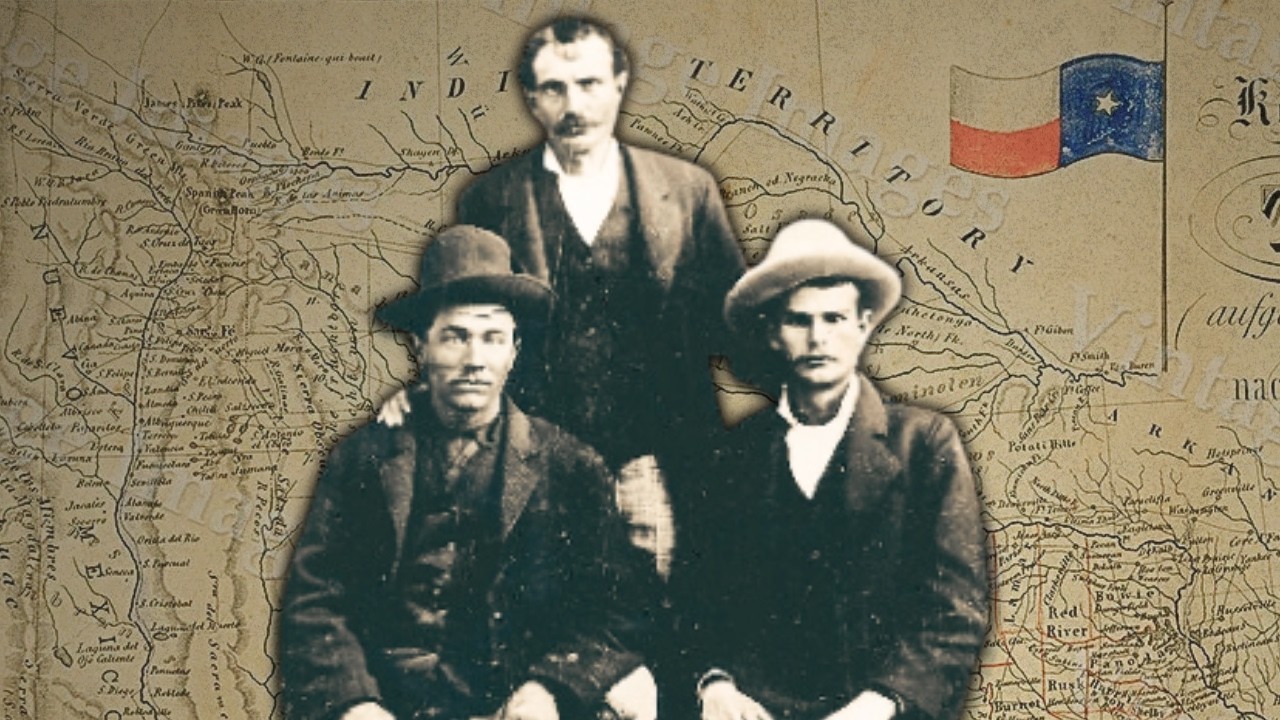
Before it was over, six more men would die, one at the hands of a young gunman named Johnny Ringo. And while the killings would eventually stop, almost nobody would ever be held responsible for any of them. To understand how it came to this, you have to go back decades, to the 1830s, when a German named Frederick Ernst received a large land grant in what is now Austin County, Texas. Ernst liked what he found and began writing letters to friends back home, describing Texas as a veritable paradise.
Those letters set off a chain migration that continued for decades. Between 1844 and 1847 alone, over 7,000 Germans flocked to Texas, pushing deep into the country and forming what became known as the German Belt, a broad stretch of settlements running from the Gulf Coast up to towns like Mason and Fredericksburg. They brought their own customs, their language, and their architecture: stone houses, Gothic churches, sauerkraut, polka music, and strong beer, a lot of beer. Their neighbors were mostly Texas cowboys and ranchers.
The two groups spoke different languages and went to different churches, but for the most part, they got along. They had to. The Comanche remained a very real threat, and raids were common. As late as 1860, Tom Milligan, the first sheriff of Mason County, was killed by a native war party on the outskirts of town.
Attacks like these forced Germans and non-Germans alike into an alliance. The Civil War changed things. Texas voted overwhelmingly to secede, but most of the newly arrived Germans opposed slavery, or at least opposed conscription. There was even a town in Mason County called Loyal Valley, named for the German residents who remained loyal to the United States.
This did not sit well with many Texas Confederates, and the tension quickly turned violent. During the summer of 1862, Confederate troops killed over thirty Germans who attempted to flee the draft. Farther north, in places like Cooke County, German immigrants were executed for their loyalty. Others were arrested, and in some cases their homes were burned down.
The animosity between the two communities ran deep. After the war, the Germans also fell prey to a good deal of cattle rustling. In those days, unbranded cattle were considered fair game, and if a few branded cows happened to get mixed in with a herd, well, many ranchers considered that the cost of doing business. The Germans disagreed.
First, they appealed to the army, asking for troops to be sent in. When that failed, they decided to take matters into their own hands. In October of 1873, the German majority in Mason County elected a sheriff named John Clark. Little is known about his background, even his middle name or initial is uncertain, and how an apparent stranger got elected is unclear.
When Clark rode out of town two years later, nobody was sure where he went. What is clear is that while he was sheriff, Clark had no problems with lynching or shooting those accused, or merely suspected, of livestock theft. Clark was no gunman himself, but he surrounded himself with armed men willing to do his dirty work, including Deputy Sheriff John Worley. At first, Clark used intimidation.
He arrested ranchers and scattered their herds. When that did not prove effective, he and his men resorted to murder. In February of 1875, they killed a seventeen-year-old cowboy named Allan Bolt, leaving his bullet-riddled body on the road to Mason with a sign labeling him a cow thief. Just a few days later, Clark stood by as an angry mob of Germans lynched and shot several of his prisoners.
The blatant killings caused at least two of the sheriff’s own men to turn on him. One of them, a man named Tom Gammel, formed a posse of his own, gathered men from nearby ranches, and rode to Mason to confront the sheriff. Clark wisely got out of town, but returned a few days later with twice as many well-armed Germans. The two sides squared off near the courthouse, and for a moment it looked like Mason was about to become a battlefield.
Fortunately, cooler heads prevailed, and a truce was negotiated. No more mobs. No more lynchings. For a while, things went back to normal.
Then, in mid-May, Clark sent Deputy Worley to arrest a well-respected rancher named Tim Williamson. Williamson had previously been arrested for possessing a stolen calf, allegedly, and a friend named Dan Horster had posted his bond. He was released. But for whatever reason, Horster then withdrew the bond, which is why Worley was riding out to bring Williamson in.
Despite Williamson’s foreman saying he would go to town later that day and post a new bond, Worley insisted on taking him in. About ten miles down the road, they were met by a dozen vigilantes. Williamson tried to escape, but his horse was shot out from underneath him, possibly by Worley himself. Once on foot, the vigilantes filled him full of lead.
That killing changed everything. Williamson had a young friend named Scott Cooley, and Scott Cooley was not the type of man you wanted coming after you. Cooley was originally from Missouri. His family moved to Jack County, Texas when he was a child, an area regularly raided by Indian war parties through the Civil War and into the 1870s.
The Austin Daily State Journal of February 17th, 1872 told the story of how three members of the Cooley family, trailing stolen horses on January 20th of that year, came upon about twenty-five Indians. The Cooleys opened fire, killing two Indians and scalping one, though they were not able to recover their stock. Whether Scott Cooley was in that particular chase is unclear, but he had other close encounters with hostiles, especially once he enlisted with Company D of the Texas Rangers. After one especially brutal battle, Cooley cut the throat of a wounded Comanche, then sliced a large piece of skin from his back, saying he would make a gourd out of it.
Cooley eventually left the Rangers and took a ranch just west of Mason County. He also helped trail cattle up to Kansas, which is how he first met Tim Williamson. Another story claims that Tim and his wife nursed Cooley back to health after he came down with typhoid. That story cannot be verified, but either way, Cooley looked to the Williamsons almost like surrogate parents.
When Williamson was killed, Cooley reportedly broke down crying. He waited for the legal system to do its job. When the Mason County Grand Jury failed to issue any indictments, he went on the warpath. His first target was Deputy John Worley.
He found him in Mason, helping to dig a well, shot him in the back of the head, and took his scalp. Nine days later, he rode out to a nearby farm and killed a man named Carl Bader. Why Carl? Because it was Carl’s brother Peter who allegedly killed Williamson.
Cooley could not locate Peter, so he settled for his brother. Just like that, the war was on. On September 7th, two of Cooley’s allies, Moses Baird and George Gladden, were ambushed by one of Sheriff Clark’s posses. Baird was killed and Gladden badly injured.
If killing Tim Williamson had been the biggest mistake made by Clark and company, the murder of Moses Baird was a close second. John Baird, Moses’ brother, rode into Mason County with John Ringo and several others, first to recover Moses’ body, and later to even the score. Ringo and John Baird joined Cooley in the relentless search for revenge. More than a dozen men from Burnet, Llano, Blanco, and Bandera counties rode into Mason to avenge Moses Baird’s death.
Yes, this is the same John Ringo of Tombstone fame. Weeks later, Ringo and another man identified only as Williams rode up into the yard of the man who had lured Baird and Gladden into the ambush and shot him as he was washing his face. And on it went. Things got so hot that the Texas Rangers were deployed, but even they could not stop the violence, mostly because the Rangers flat out refused to apprehend Cooley.
These were some of the same men who had once served with him, and there was still a good deal of respect. The killings continued. Cooley finally caught up with Dan Horster, the man who withdrew the bond for Tim Williamson, on the streets of Mason and gunned him down in broad daylight. That bold action caused Sheriff Clark to resign and flee the county entirely.
As for Peter Bader, the man Cooley had been looking for in late August, he was finally killed by George Gladden. For whatever reason, Cooley and Ringo then headed some seventy-five miles east to Burnet County, where they were arrested for threatening the sheriff and one of his deputies. They received a change of venue to the town of Lampasas. Later that May, a group of around forty of their friends busted them out of jail.
By that point, the Mason County War was pretty much over. Ten men had been killed in just as many months, and nobody was ever really held responsible for any of it. George Gladden would eventually be sentenced to prison for killing Bader, but he received a pardon just a few years later. Everyone else was either dead or scattered.
As for Scott Cooley, he disappeared about a month after his friends broke him out of jail. According to at least one source, he was shot while narrowly escaping a posse and died of his wounds over in Blanco County. Others claim he hid out in the Nimitz Hotel in Fredericksburg and died of a brain fever after being poisoned by the Germans. Either way, the killings stopped, and the war was effectively over.
Johnny Ringo was re-arrested, but soon released after a mysterious fire burned down the Mason County Courthouse. With all the incriminating records destroyed, there was no other option but to let him go. He somehow finagled his way into a constable’s position before finally heading west to Arizona. As for why the war is sometimes called the Hoodoo War, it seems to be mostly due to the vigilantes and their habit of wearing masks.
It is also a word former slaves used to describe members of the KKK. Considering both groups operated in similar fashions, disguising themselves as they terrorized people in the middle of the night, the name fits. Another source alludes to the word hoodoo being associated with bad luck. The death of Scott Cooley remains shrouded in mystery.
A gravestone bearing his name can be found at Miller Creek Cemetery, north of Blanco.






