Howard Markel was sixty-three years old in the autumn of 2001, and he was one of the last men to come up the hoist when the Sunshine Mine in the Kurden district of northern Idaho closed for good. He had worked underground there in one capacity or another since 1958, had survived the 1972 fire that killed ninety-one of his co-workers, the worst hard-rock mining disaster in American history at the time, and had watched the mine reopen, restructure, change ownership three times, and finally die in the long collapse of silver prices that ran through the late nineties. When the closure notice came, Markel was working the deepest stope crew at the 5,600-foot level, in a section the official maps described as the terminal extension of the main vein system. He had been working that section for nearly two years, drilling into rock the geological survey said should have been barren.
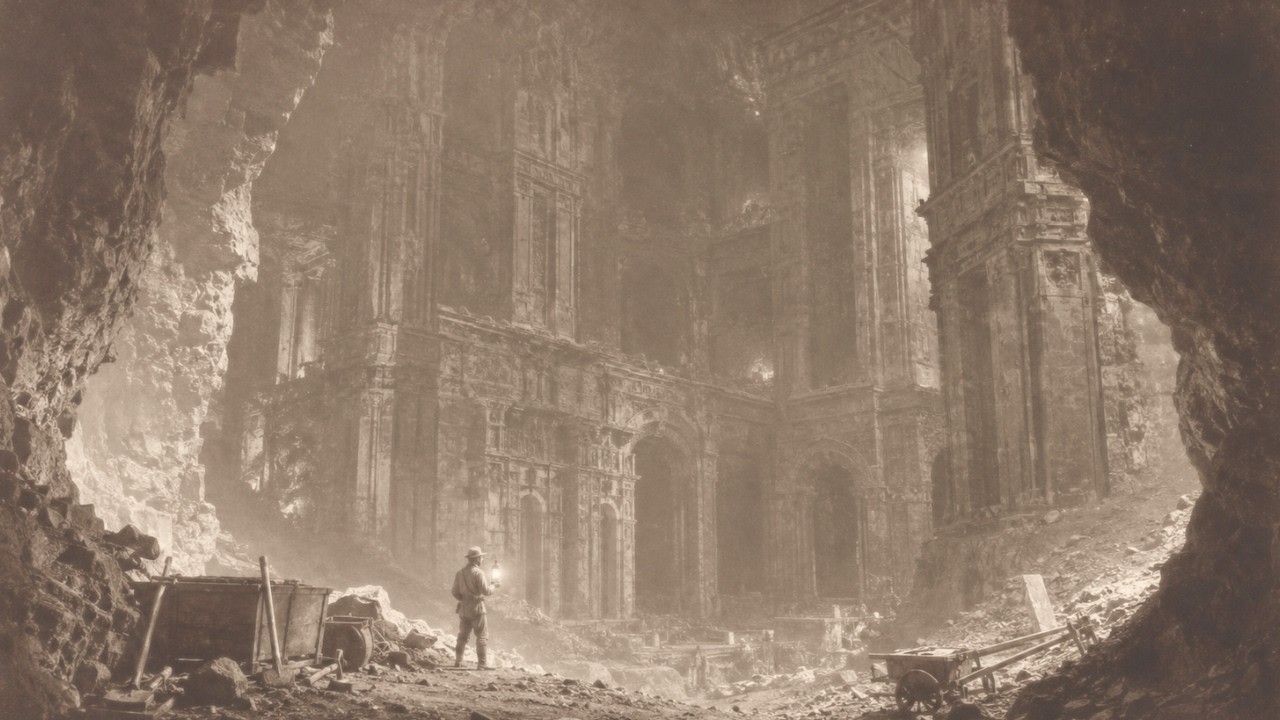
And in the final six weeks before the mine closed, in a side drift the company had never formally surveyed, he broke through into something the geological surveys did not describe. He told four people. One was his wife. One was his brother-in-law, a retired millwright.
One was a young geologist doing contract work for the company in the months before the closure. And one was a journalist for a regional newspaper, assigned a routine piece about the closing of the mine, who stayed on after the assignment was filed because Markel said something during the interview he could not let go of. Three of those four people are now dead. The fourth is the journalist, in his seventies, living in a small town outside Spokane, who has spent twenty-three years trying to figure out what to do with the notes he took during a series of conversations with Howard Markel between 2002 and 2004.
What Markel said he found in the side drift past the last documented vein has never been published in any major outlet. The notes exist. The journalist has shown them to two researchers under conditions of anonymity. The company that owned the mine at the time of closure is defunct.
The geological surveys from the period are in private hands. The young geologist was killed in a one-car accident on a logging road in 2007. Markel himself died of pulmonary fibrosis in 2011. His wife and brother-in-law followed within five years.
The story sits almost unwitnessed in a folder in a retired journalist’s filing cabinet, and the people who could have corroborated it are gone. The Kurden Mining District lies in the panhandle of northern Idaho, in the rugged country where the Bitterroot Mountains rise toward the Montana border. The district was officially discovered in 1882, when a prospector named Noah Kellogg found a galena outcrop on a slope that would later bear his name. By the late 1880s, it had become one of the richest silver- and lead-producing regions in the world.
The Bunker Hill, the Hercules, the Morning, the Star, the Galina, the Lucky Friday, and eventually the Sunshine all produced fortunes through the late nineteenth and twentieth centuries. The Sunshine Mine alone produced more than 360 million ounces of silver over its operating life, more than any other single silver mine in American history. The numbers are documented and public. That is the official story, and it is true as far as it goes.
The problem is that it does not go far enough, because the official discovery of the district in 1882 is itself the beginning of a carefully constructed narrative. That narrative says that before Kellogg, the region was un-worked wilderness, known only to small bands of Kurden tribal people who used it as hunting territory; that the mineral wealth was first extracted by American prospectors and mining companies of the late nineteenth century; and that everything documented about the district dates from after 1882. The physical record does not entirely support this. There are anomalies in the older workings.
There are stopes and adits that company records say were excavated in the 1880s and 1890s but show signs of having intersected older workings whose origin was never explained. There are passages in the deeper levels of several mines, including the Sunshine, that follow geological structures with a precision suggesting prior knowledge of the ore body, knowledge the founding generation of American prospectors should not have had. There are references in early company reports, some surviving in the archives of regional historical societies, to what the early miners called old workings found at depth, workings that did not correspond to any documented prospecting. The references were brief, were never pursued in company histories, and have been quietly dropped from the standard accounts.
Markel had spent more than four decades underground in the district. He knew the Sunshine’s ore body with the kind of intimacy that only comes from working it personally that long. He had seen the official maps, and he had also seen the unofficial features: dead drifts the company walled off without explanation, shafts that appeared on older maps but were missing from newer ones, sections of rock face showing tool marks that matched no documented period of company excavation. None of this was discussed in company communications.
The miners who worked the deep levels knew. They did not talk about it with management. They did not talk about it with the press. They worked their stopes, drew their wages, and left the questions for somebody else.
In late 2001, with the closure imminent, Markel and a small crew were working a stope at the 5,600-foot level in a section the maps described as the deepest accessible part of the main vein system. The vein was thinning, the grade poor, and the crew was working out the last economically viable ore before the mine shut. Markel was running the lead drill. He had worked the same drift for months and knew the rock face.
On a Wednesday afternoon in mid-October, he hit something that did not match the geology. According to the notes the journalist took in 2002, the drill broke through into open space, and the open space was not a natural cavity. It was a passage cut through the rock, with worked surfaces on the walls and a floor that had been deliberately leveled. The passage was roughly seven feet high and four feet wide.
It ran off to the northwest, into rock the official surveys described as untouched country between the Sunshine and the next mine over. The tool marks were not marks of modern mining. They were marks of handwork, of pickaxes and chisels, of slow, careful excavation by men with no power tools and no industrial methods. Markel did not report it.
The mine was closing in six weeks, and reporting an anomalous discovery would have meant inspectors, geologists, surveyors, paperwork, delays. The company was already losing money. There would have been no appetite for an investigation that could complicate the timeline. So Markel made a decision.
He walled off the breakthrough with mine timber and tarp, told his crew he had broken into barren rock and was abandoning that face, and moved the operation to a different part of the stope. Then he came back alone on three subsequent shifts, with a flashlight and a small camera, and explored as much of the passage as he could without leaving signs that would alert his crew or management. The passage extended for roughly four hundred feet. It was clearly a working in the mining sense, but it was older than anything that should have been there.
The rock had been removed in a pattern that suggested the workers had been following a vein, but it was not the vein the Sunshine had been working. It was a different ore body, oriented differently, with a different mineralogy. Markel chipped a sample from the wall and pocketed it. He took photographs.
He noted dimensions. The passage showed no evidence of recent activity. Where timbering had been used, the wood was of a type and fastening method that matched no twentieth-century American mining practice. The fasteners were hand-forged, not factory-made.
At the deepest point he could reach before having to turn back to avoid attracting attention, the passage opened into a chamber. It was roughly thirty feet across and had been deliberately shaped, its walls dressed with a level of finish that exceeded anything in the documented Sunshine workings. There were marks on the floor suggesting heavy objects had once stood there and been removed. Nothing portable remained.
Whatever the chamber had held had been taken out, but the passage and chamber had not been backfilled. They had been simply abandoned, sealed off at some point in their own past, and left for whoever would eventually drill in. What struck Markel most was the geometry. The walls were not the rough, hewn surfaces of a typical working stope.
They were regular, as if the chamber had been built for a purpose other than extraction. Niches were cut into the walls at regular intervals, recesses about two feet deep and three feet high, evenly spaced around the perimeter, and empty. The floor showed wear patterns consistent with sustained use, not the wear of extraction work but the wear of repeated foot traffic over a long period. In the center of the chamber was a depression Markel could not interpret, roughly circular, about six feet across, worn smooth in a way that suggested prolonged contact with a heavy object that had once stood there, or some repeated activity centered on that point.
Markel photographed all of it. The photographs, developed at a drugstore in Wallace, Idaho, are in the journalist’s folder. Two researchers who have examined them state, on condition of anonymity, that they show a clearly worked chamber with the features Markel described, that they do not appear to be of any documented Sunshine working, and that the workmanship is inconsistent with American hard-rock mining practice of any documented period. The closure proceeded on schedule.
The deep stopes were abandoned, the pumps switched off, and the lower levels began to flood. Within months the section where Markel had broken through was below the water table; within a year it was inaccessible. The breakthrough point, the passage, the chamber, all of it is now submerged under hundreds of feet of mine water in a closed mine whose ownership has changed hands multiple times and whose deep workings nobody will ever pump out again. The physical evidence is gone.
The samples Markel took, except for one small chip he kept in a tobacco tin, were given to the geologist who was killed in 2007 and have not been recovered from his estate. The photographs exist. The journalist has shown them to two researchers, who confirm they show what Markel described, but they have not been published, and the journalist has been unable to find a publication willing to run the story with the documentary support he has available. The question, of course, is whether the story is true.
The journalist is by all accounts a careful man, a working journalist for forty years with no history of falling for hoaxes or fabricating sources. He says the photographs are real, and he describes Markel as a careful, sober, technically detailed witness. The other people who heard the story before they died are described in the notes as confirming its basic outlines, though none of them had been physically present in the passage. The geological community has not been able to evaluate the samples because the samples are gone.
The mine is flooded. The story rests on the testimony of a single witness, supported by photographs and one small ore sample, recorded by a journalist whose credibility is not in question but whose ability to corroborate the testimony is limited by the death of every other witness. But the district has had similar reports before. Not frequently, and never amplified by the regional press, but they have existed in the oral history of the deep miners for as long as the district has operated.
Stories from the Bunker Hill dating to the 1890s of crews breaking into older workings at depth. Stories from the Hercules from the early twentieth century. Stories from the Lucky Friday from the 1950s, of timbered passages found at depth that appeared on no company map and could not be attributed to any documented period of operation. The miners told their families and other miners; they did not report to management.
The few times they did, the response was uniformly to seal the discovery, document it minimally if at all, and move on. The pattern across the district is consistent: the deep workings occasionally intersect older workings whose origin nobody on the surface wants to investigate. The intersections are sealed. The crews are reassigned.
The stories enter the oral tradition. The official record is kept clean. One of the most detailed accounts comes from a Bunker Hill miner named Walter Stannic, who died in 1968. His recollections were recorded in interviews by a regional folklorist in the late 1950s, and the tapes and transcripts are preserved in the special collections of a small Idaho university library.
Stannic worked the Bunker Hill from 1908 until his retirement in 1953. He described an incident in 1923 when his crew broke into a passage at the 4,000-foot level and the foreman immediately ordered it sealed. Stannic described the passage in terms remarkably similar to what Markel would describe nearly eighty years later: worked walls, old timber, tool marks that did not match modern practice. The foreman told the crew never to speak of it.
The passage was sealed within two days. Decades later, when Stannic was helping a younger relative prepare a regional history project, he saw the company records for that month. There was no reference to the discovery. The work logs had been edited.
The folklorist who recorded Stannic’s testimony, a woman named Ruth Tarant, conducted similar interviews with several other retired Kurden miners through the late 1950s and early 1960s. Her notes fill three boxes in the university archive and contain at least seven separate accounts of underground discoveries that did not match documented company workings. The accounts come from miners who worked different mines in different decades, with no apparent connection to one another. The details vary; the pattern does not.
In each case, the discovery was sealed. In each case, the company records do not reflect it. In each case, the men carried what they had seen to their graves. Tarant never published the material.
She died in 1979, and her family donated the notes to the university. A handful of regional historians have examined them over the years; none has been willing to pursue the larger pattern they describe. The documented mining boom of the late nineteenth century may therefore not have been the first major extraction event in these mountains. The official story, beginning with Noah Kellogg in 1882, may itself be a layer applied on top of an older record of mineral extraction whose existence the late nineteenth-century companies had every reason to obscure.
The older workings, when encountered, were inconvenient. They raised questions about prior claims, prior discoveries, who had actually been here first and what had actually been taken out before the documented operations began. The simplest response from a business perspective was to seal them, attribute them to nobody, and continue the official story. Markel had begun asking these questions himself in 2001, and he was still asking when he died in 2011.
He did not have answers. He had a single passage explored alone, a chamber emptied before he reached it, a small sample of ore in a tobacco tin, a few photographs, and a story told to four people. The samples and photographs cannot answer the larger question by themselves; they can only confirm that the question deserves to be asked. The larger answer would require the systematic investigation of the deep workings of the entire district, and nobody is funding that, no academic institution is pursuing it, and no government agency has shown any interest in conducting it.
The mines are closed. The Sunshine is flooded. The Bunker Hill is sealed. The Hercules has been abandoned for decades.
The deep levels of the entire district are underwater, hundreds of feet below the surface, in workings nobody is ever going to pump out again at any price. Whatever was in those older passages, whatever the chamber at the end of the four-hundred-foot drift had once contained, whatever the rest of the workings beyond Markel’s reach might have shown, is now beyond recovery. The mountain will keep its secret. The tobacco tin with the ore sample is still in the journalist’s possession.
The single chip of rock Markel pocketed on his second solo trip into the chamber, the one piece of physical evidence that did not pass through the dead geologist’s estate, sits in a small metal container in a desk drawer in a town outside Spokane. The chip has been examined informally, under conditions of anonymity, by one university geologist. The geologist’s preliminary observation, never written up in any formal report, was that the chip’s mineralogy was unusual for the Sunshine ore body and contained trace elements in proportions that did not match the documented Kurden district profile. The geologist declined to take the analysis further.
The chip remains in the drawer, the last physical fragment of what Markel found, the last tangible link to a chamber that nobody alive will ever see again. What Howard Markel found past the last vein was a piece of evidence for an economic history the mainstream narrative has spent a century burying. He found it. He documented it as best he could.
He told the few people he trusted. And then he watched the institutional system close around the discovery the way it has closed around every similar discovery in the long quiet history of those mountains. The system does not have to be coordinated. It does not require a conspiracy.
It requires only the accumulated decisions of company managers, regional editors, academic gatekeepers, and government regulators, each with small reasons to leave the inherited layer untouched and large reasons to keep the surface story intact. The accumulated decisions add up to the history now on record, and that history is missing the inherited layer. The men who encountered it directly across more than a century of operation took what they saw to their graves because the institutional system had given them no place to put it. Howard Markel was the last of those men, or close to the last.
The Sunshine Mine has not reopened and will not reopen. The passage he walled off in 2001 lies under hundreds of feet of mine water and will remain there until the mountain itself is gone. The journalist still has the folder. He is still trying to figure out what to do with it.
He has shown it to a small number of researchers. The story sits waiting while the people who could have corroborated it die one by one and the physical evidence becomes more unreachable. The tobacco tin with the ore sample is still in his possession.
The chip is still in the drawer.






