The cashier never looked up. Her fingers moved across the keys of the mechanical register in a rhythm that had been built over years, each item lifted, read, and priced in a single fluid motion. There were no scanners, no barcodes, no screens to confirm. Just the clatter of the keys, the cha-ching of the drawer springing open, and the paper bag filling up on the other side.
She knew the price of everything in the store from memory. She held a conversation while she worked, remembered your name, asked about your kids, and never missed a beat. Behind her, a teenage bag boy packed the groceries into brown paper bags, heavy items on the bottom, eggs and bread always on top. There was a skill to it.
Those bags had no handles. Regulars chose their lane based on who was working the register. If the fast cashier was on, you got in her line no matter how long it was. Watching one of them work was something worth stopping to admire.
It was the center of the weekly trip, the point where everything came together. But the trip started long before anyone reached the store. Every Wednesday or Thursday, the newspaper arrived thick with grocery store inserts. The pages spread across the kitchen table like a campaign map.
Safeway had ground beef on sale. A&P was cheaper on eggs. Kroger had a deal on canned soup. Families planned their route to hit multiple stores, calculating which order made sense, which ones were close enough to justify the stop.
With the oil crises of 1973 and 1979 pushing gas prices sky-high, you had to make every trip count. Running out of something midweek meant making do until Saturday. You didn’t just run back out for a missing ingredient. The cost of the drive was part of the calculation.
Some families kept a small tally calculator in their purse, a little device that let them add up the total as they went along, so the number at the register never came as a shock. Every cent was accounted for. The weekly grocery bill was one of the biggest line items in the family budget, and in the 1970s, that bill was climbing. When you arrived at the store, the first thing you noticed was how people were dressed.
Going to the grocery store was a social event, not just an errand. Women wore blouses and pressed slacks. Men tucked their shirts in. Children were put together.
You were going out, and you dressed for it. And yes, you’d sometimes spot a woman doing the weekly shop in hair curlers, not because she didn’t care, but because she was setting her hair for a Saturday night out and the shopping needed doing while it dried. A different era, different priorities. The store itself had an atmosphere the moment you walked in.
The smell of produce, fresh meat, floor wax, and cardboard all mixing together. Fluorescent lights overhead. Easy listening drifting from the ceiling speakers, the kind of music that made you feel like you had time. You grabbed a cart from the parking lot corral, metal, squeaky, with a child seat up front and wheels that had a mind of their own.
Finding one that rolled straight was half the battle. Some stores required a quarter deposit. You slipped it in, took your cart, and got the coin back when you returned it. No abandoned carts, no cameras needed.
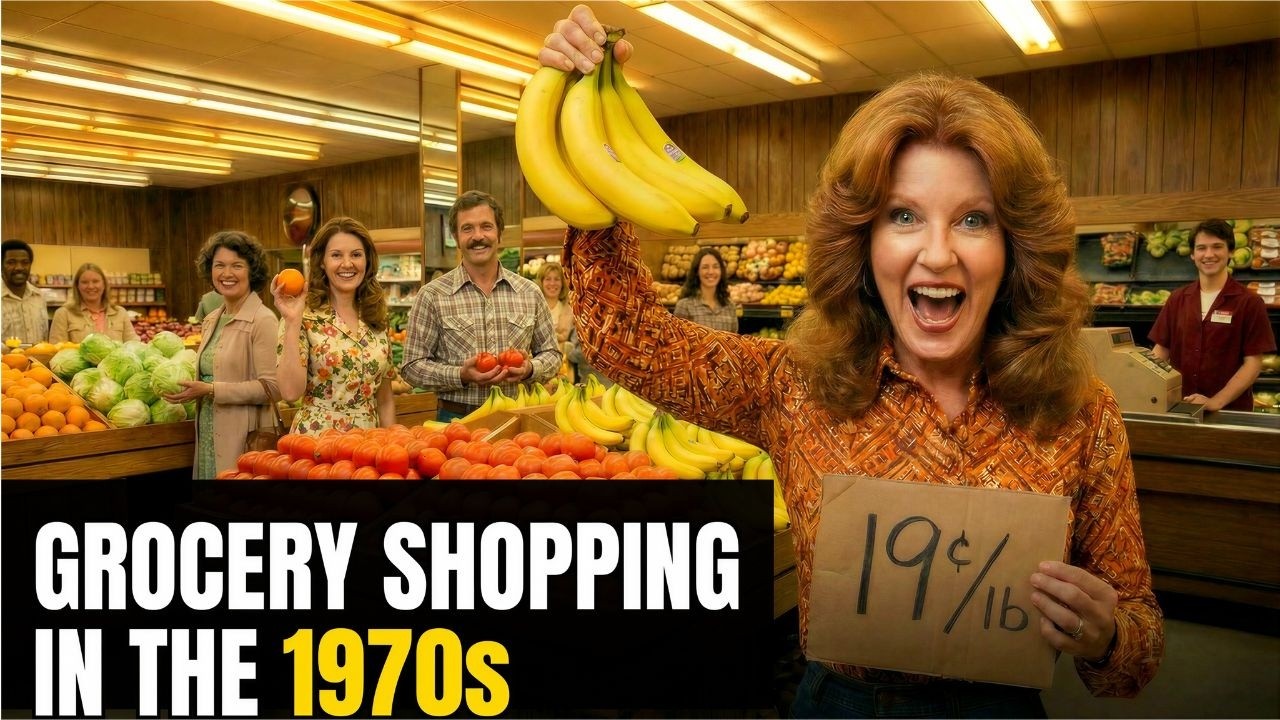
Just a quarter. The produce section was smaller, and it told you what season it was. In winter, the selection narrowed to what could be stored: potatoes, onions, cabbage, carrots, apples. Then the novelties began to appear, oddities like kiwis, mangoes, and avocados, exotic things most shoppers had never seen on a shelf.
The produce section was there to provide vegetables for cooking. Full stop. Everything was loose. You picked your own apples one by one, weighed them yourself on the scale, noted the price per pound on a twist tie, and trusted yourself to mark it correctly.
Nobody was watching. The honor system was real. Lettuce meant iceberg. Fresh herbs weren’t stocked.
Tomatoes were often pale and mealy, and nobody complained. That was just tomatoes. But when strawberries came in, people noticed. When fresh corn arrived in summer, families made a point of it.
Seasonal produce meant something because it wasn’t there all year long. You waited for it, and when it came, it was an event. The meat counter was an event in itself. You took a number and waited your turn.
Behind the glass stood an actual butcher, white coat, grease pencil behind his ear. When your number was called, you told him what you wanted and he cut it fresh right there. He’d wrap it in paper, scroll the price on top, and hand it over the counter. Ground beef came in different fat grades, and if you wanted something specific, you asked.
He’d advise you. Regulars had relationships with their butchers, and those relationships mattered. The best cuts went to people who showed up every week. No shrink-wrapped styrofoam trays, just paper, pencil, and a handshake understanding of what good meat looked like.
One thing you wouldn’t see in a grocery store today: someone lighting up near the meat counter. Smoking in stores wasn’t banned. It was just Tuesday. The dairy section was smaller and more local.
In the early 1970s, some stores still carried milk in glass bottles from nearby dairies. You checked the dates carefully. Milk didn’t last as long without today’s ultra-pasteurization. Cheese was American, cheddar, or Swiss.
Yogurt was plain or strawberry. Brown eggs were a specialty. White eggs were just eggs. And ice cream came in an actual half gallon, not a container designed to look like a half gallon.
A quart was a quart. Shoppers in the 1970s would find today’s shrinkflation absolutely bewildering. Then there was the cereal aisle, the most dangerous aisle. If you had children, Cap’n Crunch, Froot Loops, Lucky Charms, Count Chocula, prizes hidden inside the boxes.
The negotiation between parent and child played out in that aisle every single week. The compromise was almost always the same: one fun cereal, one sensible one. Cheerios usually won the second slot. The center aisles were the backbone of 1970s grocery shopping.
Campbell’s soup, Del Monte vegetables, Hunt’s tomato sauce. Everything came in cans, and canned goods were the foundation of American cooking. When something went on sale, ten cans of soup at nineteen cents each, you bought as many as you could carry. A well-stocked pantry wasn’t hoarding.
It was smart household management. Frozen foods existed, but it was a small section. Swanson TV dinners in their aluminium trays were the flagship. The frozen aisle was for treats and quick meals, not the wall-to-wall selection stores carry today.
If you were a child in the 1970s, you knew exactly what waited at the checkout counter. Candy bars sat right at eye level, right where you stood while your mother unloaded the cart. The negotiations that happened in that line were a masterclass in childhood diplomacy. A Hershey bar.
A pack of gum. Something small and sweet, the unofficial reward for good behavior. Everybody understood the unspoken deal. Not every child went inside.
Plenty of families left kids in the car while the shopping got done. No phones, no tablets, just the radio, the windows cracked, and the faint hope that dad would come back with bananas. A different calculation about childhood, and it was simply normal. Payment meant cash or check.
Credit cards existed, but most families didn’t use them for groceries. If you wrote a check, the cashier asked for ID and cross-referenced it against a handwritten bad-check list pinned near the register. No digital approval, just trust and a signature. Your receipt listed every item and its price.
You could follow every line. Math errors happened, sometimes in your favor, sometimes not. Careful shoppers checked the tape before they left. The inflation of the 1970s wasn’t just an inconvenience for many families.
It was frightening. Prices rose noticeably month to month. Something that cost eighty-nine cents in January might cost a dollar nineteen by summer. The weekly grocery bill that had been thirty dollars climbed to forty, then fifty.
And incomes didn’t always keep pace. Families adjusted. Cheaper cuts of meat, more canned goods, treats dropped from the list. Some retirees on fixed incomes found grocery and gas prices eating into savings they’d spent decades building.
Home vegetable gardens came back in the 1970s for the same reason they had thrived during the Depression: because growing your own was one way to take back some control. Canning and preserving at home returned to kitchens that hadn’t seen a pressure cooker in years. Before loyalty apps and reward points, there were trading stamps. And the most famous were S&H Green Stamps.
Every time you shopped, the cashier handed you stamps based on your total. You brought them home, licked them, yes, licked them, and pasted them carefully into little booklets. When you filled enough books, you took them to a redemption center and traded them in for merchandise. Families saved for months, working towards something specific, a lamp for the living room, a set of dishes, a small appliance.
Going to the redemption center was its own kind of shopping trip, one where everything had already been paid for slowly, one grocery run at a time. Some of those items are still in families today. What made grocery shopping in the 1970s genuinely different was this: it was a community experience. The store manager knew regulars by name.
The butcher knew your usual order. The cashier remembered your kids. Shopping wasn’t a transaction to complete as quickly as possible. It was a weekly rhythm that connected you to your neighborhood.
You’d see a neighbor in the bread aisle and stop to compare deals. You’d swap a recipe over the produce bins. The grocery store was where a community quietly maintained itself week after week. The food felt different, too.
Less processed, fewer ingredients you couldn’t pronounce. People who lived through that era often say simply, “It tasted like food. ” Whether that’s memory or reality, the feeling is real. And it’s something a lot of people clearly miss.
Grocery shopping in the 1970s took longer. It required more planning, more patience, more human contact. A trip that takes thirty minutes today took an hour back then. And that extra time was filled with conversations and small rituals that gave the whole experience a texture that’s mostly gone now.
The cashier who never looked up but never missed a price. The sound of that drawer springing open. The weight of a full paper bag against your chest in the parking lot. The stamps you saved for six months to get a lamp for the living room.
That world isn’t coming back. But for the people who remember it, those memories don’t fade easily.






