In 1959, a small office opened in Los Angeles with eight employees and two hundred fifty thousand dollars in startup capital. The American motorcycle industry barely noticed. The company was American Honda Motor Company, and its founder, Kihachiro Kawashima, was not trying to sell motorcycles to people who already owned them. That single decision would unravel nearly every assumption the established industry had built around itself.
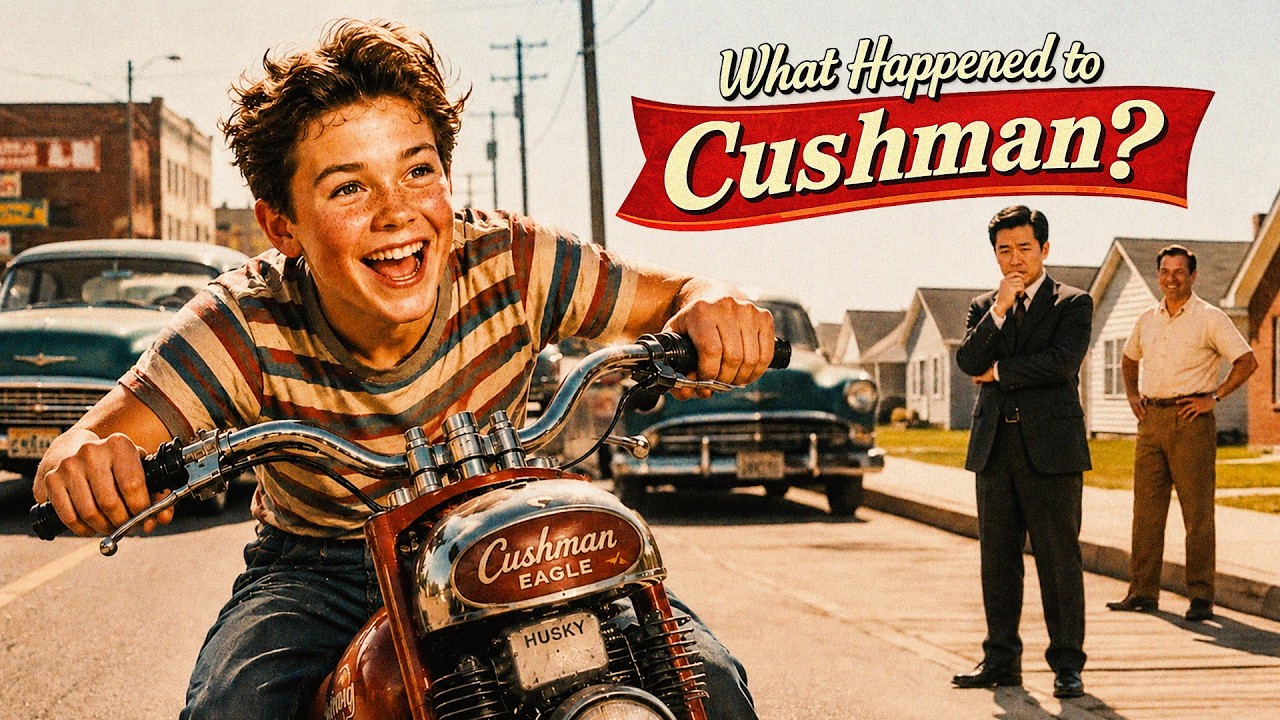
For decades, the American market had belonged to Harley-Davidson and to companies like Cushman Motor Works, a Nebraska operation that built scooters tough enough to survive a parachute drop behind enemy lines. But Cushman could not survive a 49cc engine from Japan that cost $295 and weighed less than a golden retriever. The company did not fail because it built a bad machine. It failed because every smart decision it had ever made pointed in the wrong direction the moment Honda walked through the door.
Cushman started not with scooters but with engines. In 1903, cousins Everett and Clinton Cushman set up shop in Lincoln, Nebraska, building stationary cast-iron engines for farm equipment. By 1911, their Model C binder engine had a reputation across the Great Plains for one quality above all others: it never quit. These were machines built for hundred-degree fields, for farmers who could not afford a single breakdown.
Low revs, high torque, and a culture that prized indestructibility above elegance. Cushman engineers were not proud of refined engineering. They were proud of machines that outlasted everything else. That standard produced extraordinary reliability and a blind spot that took decades to become a fatal problem.
By 1922, the Husky engine powered lawn mowers, water pumps, and concrete mixers across the country. Then the Depression hollowed out the agricultural market overnight. Nobody was buying engines. The factory was bleeding money.
Someone looked at a Husky sitting on a workbench and asked the question that changed everything: what if we put this on wheels? The Auto-Glide launched in 1936. A 212cc Husky engine bolted to a tube frame with two wheels and a seat. It got seventy-five miles per gallon and cost less than almost anything else with a motor.
People bought it because it was the cheapest way to get somewhere. Six years later, the army came calling. The military needed a vehicle that could be strapped to a parachute, dropped behind enemy lines, survive the fall, and start on the first kick in a dark French field at midnight. The contract went to Cushman.
The Model 53 Airborne was as stripped down as engineering gets. It could climb a twenty-five percent grade, cross a foot of standing water, and cover more than a hundred miles on a single tank. A soldier would jump from one aircraft while his scooter exited from another. Somewhere in occupied territory, in the dark, they would find each other.
The soldier would twist the throttle and disappear carrying orders across terrain no Jeep could reach. The scooter started on the first kick because someone’s survival depended on it. The war ended in 1945, and America entered its most confident decade. Cushman looked at what teenagers wanted more than anything and did something nobody expected from a farm engine company.
They built desire. The Cushman Eagle launched in 1949. It looked almost exactly like a Harley-Davidson scaled down to a size a fourteen-year-old could handle, priced at a number a teenager could reach after mowing enough lawns. Wide swept-back handlebars, contoured fenders, a teardrop fuel tank, and an exposed 318cc single-cylinder flathead engine sitting between the rider’s knees.
Eight horsepower, a two-speed gearbox, a foot clutch, and a hand shifter mounted on the tank. Tuck behind the headlight and it would touch fifty-five miles per hour. Depending on where you lived, you might not even need a motorcycle license. Just be fourteen and have the machine.
By 1957, the Outboard Marine Corporation, the company behind Evinrude and Johnson outboard motors, had acquired Cushman and brought serious corporate money into the operation. By 1958, the Lincoln factory was rolling out around fifteen thousand scooters a year. Premium versions followed: the Super Eagle, then the Silver Eagle, with a 354cc overhead valve engine, electric starter, telescopic front forks, rear swing arm, saddlebags, turn signals, and a full speedometer. The Eagle sold through Cushman dealers in forty-eight states, through Sears under the Allstate badge, and through farm supply shops that had carried Cushman parts for twenty years.
Gas stations stocked Husky engine parts because so many Eagles passed through. For half a decade, Cushman owned that part of the market. But there was one quirk nobody warned you about. Every motorcycle ever made accelerates the same way: roll the right grip back toward your body.
On a Cushman, you twisted the grip forward, away from your body, clockwise. In a moment of panic, when every instinct said pull back, a Cushman rider would slam the throttle wide open instead of closing it. Most kids figured it out in the first five minutes. Cushman never changed it in thirty years of production.
The throttle was a corporate personality, the engineering equivalent of a company crossing its arms and saying the world can adapt. An entire consumer market was about to refuse. Honda’s CA100 ran a 49cc four-stroke engine built from lightweight aluminum, with overhead valves running cleaner and more efficiently than the flathead side-valve design Cushman had carried since the agricultural era. A three-speed semi-automatic transmission with an automatic clutch meant you needed no riding experience.
The Cushman Eagle weighed 250 pounds of cast iron. The Honda 50 weighed 143. Cushman claimed seventy-five miles per gallon. Honda claimed over a hundred and marketed the difference as a penny a mile.
The retail price was $295. A Cushman Silver Eagle started at $500 and pushed past $700 fully loaded. Honda did not sell through motorcycle dealers. They sold through hardware stores, bicycle shops, and outdoor outfitters, stores where families spent their Saturday afternoons.
In 1963, they launched a campaign: You meet the nicest people on a Honda. Clean, colorful ads showed everyday Americans on scooters. Families. Young women.
People in good clothes on sunny days. The message was clear. This is not a motorcycle. It is a household appliance.
Anyone can ride it. Honda had redefined what a two-wheeled machine was supposed to be. US Honda sales climbed from 3,200 units in 1960 to 40,000 in 1962. By the end of the decade, they were moving hundreds of thousands of units a year.
Cushman’s best year had been 15,000. By late 1960, Cushman’s management knew they had a problem with no clean solution. Retooling the factory for lightweight aluminum construction would take years. Their engineers were built around heavy-duty cast-iron thinking.
There was no time to redesign from scratch. So OMC made a deal. In November 1960, Cushman signed a distribution agreement with Piaggio, the Italian manufacturer behind the Vespa. Starting January 1, 1961, Cushman would push Vespas through its existing American dealer network.
No new engineering. No factory conversion. Just a contract, a quota, and a bet that Cushman’s dealer relationships would do the work. The agreement required Cushman and OMC to purchase a minimum of three million dollars in Vespa scooters, parts, and equipment across the combined 1961 and 1962 calendar years.
The Vespa was a genuinely good machine, a true icon in Europe. But in America in 1961, Honda was selling a technically superior step-through scooter with an automatic clutch and an aluminum engine for $295, backed by a campaign rewriting the entire image of two-wheel transportation. Cushman’s dealers tried. The Vespas sat.
Court records from the subsequent litigation showed Cushman had sold just 1,341 Vespas nationally in all of 1961, across every model and every dealer in the country. Warehouses backed up with Italian scooters going obsolete before anyone ever sat on them. Cushman tried to renegotiate the quota. Piaggio refused.
The whole agreement collapsed into a federal lawsuit that dragged through the courts for years, bleeding resources and destroying what remained of the import strategy. The dealer network, built over decades on the trust of reliable American-made machinery, had spent two years trying to move a foreign product customers did not want at prices Honda had already undercut. The relationship frayed in ways no new product announcement was going to repair. There would not be a new product announcement anyway.
They had borrowed someone else’s engineering to fight a war Honda had already won. In 1964, Honda introduced an overhead camshaft engine in its C65 model. The gap between Cushman’s flathead cast iron and Honda’s new engineering was no longer a competitive distance. It was a generational divide.
In 1965, Cushman shut down its consumer scooter lines. The last Eagles moved as 1966 models. Leftover inventory cleared through whatever remained of the dealer network. No final campaign.
No ceremony. The factory shifted to Trucksters, golf carts, and industrial turf equipment for airports, stadiums, and parking lots. The Husky engine still doing what it had always done. Just not for teenagers anymore.
OMC eventually sold Cushman to Ransomes of Great Britain in 1989, and then to Textron in 1998. The brand survived, but the consumer chapter ended in 1965. What happened to Cushman is what happens when a company built on the belief that durability is everything runs headlong into a competitor for whom accessibility is everything. Honda did not build a better Eagle.
They built a different promise to a much larger group of people at a price nobody could argue with. Cushman had military contracts, a famous dealer network, the financial backing of a Fortune 500 parent, and a product teenagers genuinely loved. Honda had eight employees, a storefront in Los Angeles, and absolute clarity about exactly who they were selling to and why. Clarity beat cast iron.
And the cast iron, stubborn and overbuilt to the end, outlasted the company that made it. A pristine 1965 Silver Eagle brings upwards of eleven thousand dollars at collector auction today. Owners report Husky engines that have run continuously since the 1950s on nothing more than regular oil changes and occasional points. Parts are still available.
The flat idle can be restored to exactly what it sounded like rolling out of the Lincoln factory in 1958, because the engineering was never complicated enough to make the old hardware obsolete. The exact stubbornness that made Cushman vulnerable to Honda is the same quality that made the Eagle last.






