In the winter of 1843, an American businessman named Julius Eldred made his way into the copper country of the Lake Superior region, a territory the Ojibwe had known for generations as ground that was not free for the taking. At the end of his journey, along the Ontonagon River, lay a single mass of pure float copper weighing more than a ton and a half. The Ojibwe had marked it and revered it for untold generations, holding it sacred, a thing of power that they would not move because it was not theirs to take. Eldred hauled it out over the protests and the sorrow of the people who held it sacred.
After a tangle of disputes, the federal government seized the boulder and carried it away to the Smithsonian in Washington, where a piece of it sits to this day. The taking of that sacred stone was not an isolated act of greed. It was the opening of a door, and beyond that door lay a mystery the mainstream has never fully explained. To understand the warning the Ojibwe had been delivering for generations, one must understand the being at the center of it.
They called it Mishipeshu, the great underwater lynx, the underwater panther. It was not a vague and gentle spirit. It was described with unnerving specificity, a great cat-like creature that lived in the deepest parts of Lake Superior, with horns, a body armored in scales of copper, and a long spiked tail that could stir a calm lake into a killing storm in minutes. The Ojibwe did not treat it as a fairy tale.
They treated it as a fact of the physical world, the way a person treats the danger of deep water or a downed power line. Before crossing the Great Lake, they made offerings, casting tobacco onto the water to Mishipeshu, asking to be allowed to pass. This was not worship in the abstract. This was the caution of people who believed, on the authority of generations of experience, that the lake could decide to keep you.
In the 1840s, an Indian agent and ethnographer named Henry Rowe Schoolcraft sat down year after year with the Ojibwe of that country and did something almost no white man of his age bothered to do. He listened. He wrote down their stories, their words, their names for things, their accounts of the world as their grandfathers had known it. He was not a romantic.
He was a government man married into the Ojibwe, fluent in their tongue. He filled volumes with what they told him. Buried inside all that testimony, beneath the everyday accounts of hunting and weather and war, was a warning, and it was delivered plainly and without embellishment. The great masses of pure copper scattered through that country did not belong to men.
They were watched. Something lived in the deep cold water of the greatest lake on earth and guarded that metal. To take it carelessly was to invite a death that did not come by accident. It was not one story told by one elder.
The account came up again and again across bands separated by hundreds of miles of forest and shoreline, always in the same shape, always with the same being at the center of it. Schoolcraft wrote it down, and the record went into the printed public record, where it has sat ever since, available to anyone. Almost no one with the authority to take it seriously ever has. The Ojibwe left their own record in stone as well, and it is still there.
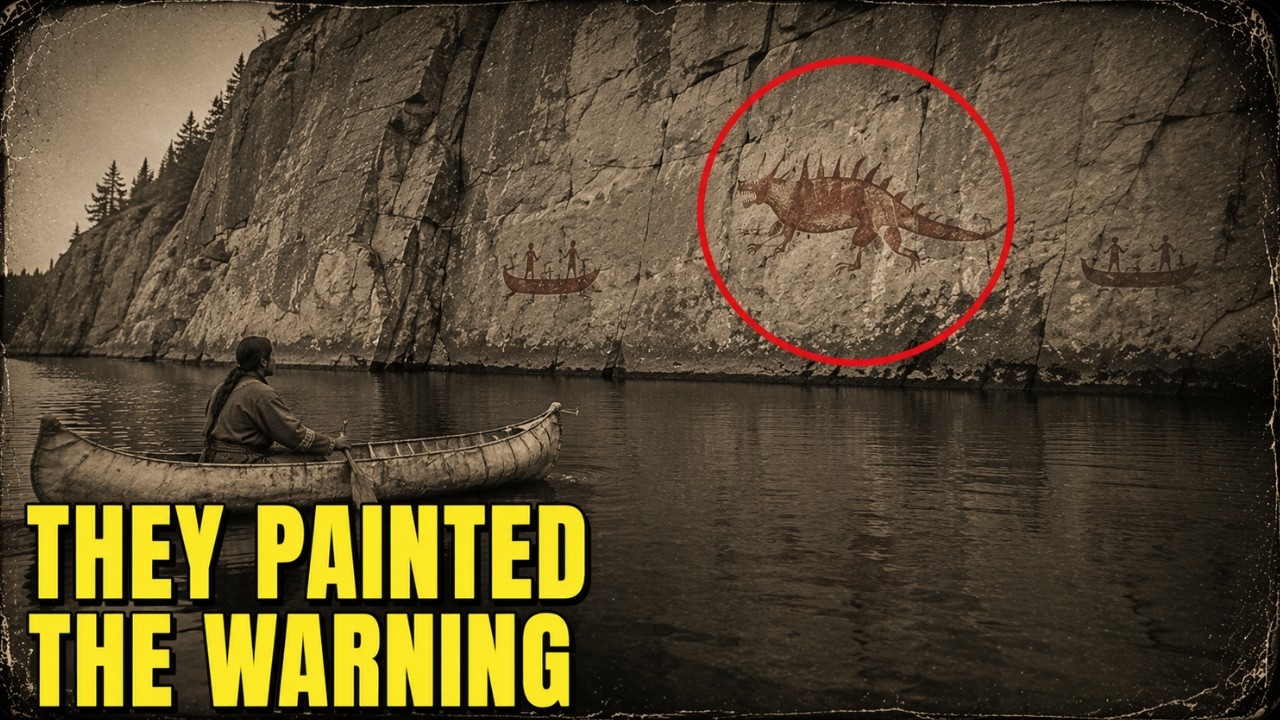
On the eastern shore of Lake Superior, at a place now called Agawa Rock, a sheer cliff face rises straight out of the water. Painted on that rock in red ochre are images that have survived for centuries in one of the harshest climates on Earth. Among the canoes and the figures is Mishipeshu, horned, spined, unmistakable, painted by Ojibwe hands directly above the deep water it was said to rule. This was not a story a European wrote down and might have garbled.
This was the Ojibwe themselves marking the rock at the edge of the water saying, here is what lives below, and here is what we must respect. A people do not paint a warning in a place that is hard to reach, above water that deep, if it were only a tale to frighten children. The rock art was a sign posted at the boundary. Now the warning collides with something the mainstream cannot fully explain.
The Lake Superior region holds a geological freak of nature, native copper, pure metallic copper lying in the rock and the soil in masses large and small, some of them enormous. It is the only place on Earth where pure copper occurs on that scale, ready to be worked without smelting or setting. For a very long time, everyone assumed the native peoples of the region had barely touched it. Then the surveyors and miners of the nineteenth-century copper rush went into that country, and they found something they were not looking for.
They found they were not the first. Scattered across the Keweenaw Peninsula, and above all across the remote island of Isle Royale, were thousands upon thousands of ancient mining pits, old workings dug into the rock following the copper veins, with the stone hammers of the miners still lying where they had been set down. Not a few pits, tens of thousands of pits. This was an industrial-scale operation carried out in the deep past by people the textbooks had assumed did nothing of the kind.
The dates that came back were staggering. This was not the work of a few centuries before the Europeans. The oldest of these copper workings have been dated back thousands of years, some estimates reaching six, seven, even more thousand years into the past, making it one of the oldest metal-working traditions anywhere in the world. While much of the world was still in the deep Stone Age, people on the shores and islands of Lake Superior were running organized, large-scale copper mining.
They knew where the veins ran. They knew how to break the rock with fire and water and stone. Archaeologists now call it the Old Copper Complex, and they will honestly say there is a great deal about it they do not understand. And here is the question that hangs over all of it, the question the Ojibwe warning speaks to directly.
Where did the copper go? When you tally up the ancient pits, the sheer number of them, the volume of rock moved, the size of some of the masses that were clearly cut free and carried off, you are looking at an enormous quantity of copper extracted from that region over thousands of years. Estimates of the total run into the millions of pounds. And yet the amount of finished copper objects found across the whole of Native North America from that entire span of time does not come close to accounting for it.
There is a gap, a vast gap between how much copper was mined out of Lake Superior and how much anyone can find. Who took it, and where? And why is so little of it left in the ground where it should have ended up? Mainstream archaeology has answers, of course.
Trade, loss, recycling, the slow scattering of centuries. But the honest ones admit the numbers are strange. And the Ojibwe, when asked, did not say it was traded away. They said it was guarded.
They said you did not simply take it. Consider the man most responsible for opening that country to the copper rush. Douglas Houghton was the state geologist of Michigan, the one who surveyed the mineral wealth and told the nation what lay waiting on those shores. In 1845, he was out on Lake Superior in a small boat doing his survey work when a sudden storm came up off the water, the kind of fast, violent squall the Ojibwe had always warned attended that lake.
The storm capsized his boat and drowned him. He was thirty-six years old. A rational man calls that an accident, and it was an accident, storms on Lake Superior kill people to this day. But sit for a moment inside the Ojibwe frame, the one Schoolcraft wrote down.
A being that lives in the deep water. A being that guards the copper. A tail that lashes the calm lake into a sudden killing storm. The very man who opened the copper to the taking, dead in exactly that way, in exactly that water, within two years of the rush he started.
The Ojibwe had no survey instruments and no geology, and yet they had told him, in effect, decades before he ever launched his boat, precisely what the lake was capable of doing to a man who came for the metal. Within a few short years of the copper rush beginning, by the Treaty of La Pointe in 1842, the Ojibwe had ceded that entire mineral country, the copper, the shore, the ancient pits, all of it, to the United States. The great taking began in earnest. And the lake, they said, did not forgive carelessness.
Put it together the way the Ojibwe put it together. The mainstream tells you there is a huge, ancient, poorly understood mining operation on Lake Superior, that a mysteriously large amount of copper is unaccounted for, that the people who lived there had a detailed tradition about a being that guarded that metal and punished those who took it wrongly, and that these facts have nothing whatsoever to do with one another. The Ojibwe told a single coherent account. The copper is not free for the taking.
It is watched. And the watcher is real. One of these is a pile of unrelated coincidences that the experts would rather not look at too closely. The other is a warning delivered plainly by the only people who had actually lived on that water for thousands of years, a warning that was written down and filed and never truly investigated by anyone with the power to test it.
The institutions that could have taken the Ojibwe account seriously as evidence, that could have asked what a people who mined that copper for millennia actually knew about it, did not decline because they investigated and found nothing. They declined because they never thought a warning about a lake was worth investigating at all. What lived in that water? What did those ancient miners believe they were dealing with that made them leave offerings before they crossed and mark the rock with its image and speak of the copper as a thing that belonged to something else?
Where did the missing millions of pounds of Lake Superior copper actually go? If the mainstream cannot fully answer that after two centuries of study, why are we so certain the people who were there for six thousand years had nothing to teach us? The Ojibwe did not claim Mishipeshu was a god or a ghost or a wonder. They said it was real, and it was in the water, and it guarded the metal, and it should be respected.
A nation that wanted the copper took the copper, drowned in its lakes, carried off its sacred stone, and never once sat still long enough to ask the people who had lived there the length of all recorded history what exactly they had been trying to say. They spent generations trying to tell us, and we did not listen. The record was always there. It was printed, public, available to anyone.
Nobody with authority ever chose to look at it properly.






