At seven in the morning on May 31, 1944, in the Admiralty Sea northwest of New Guinea, three American escort destroyers had been chasing a single Japanese submarine for twenty-five hours. Twenty attacks. Twenty failed attempts. On the bridge of one ship, Commander Hamilton Haines switched on the radio and sent a signal that remains in the United States Navy archives to this day.
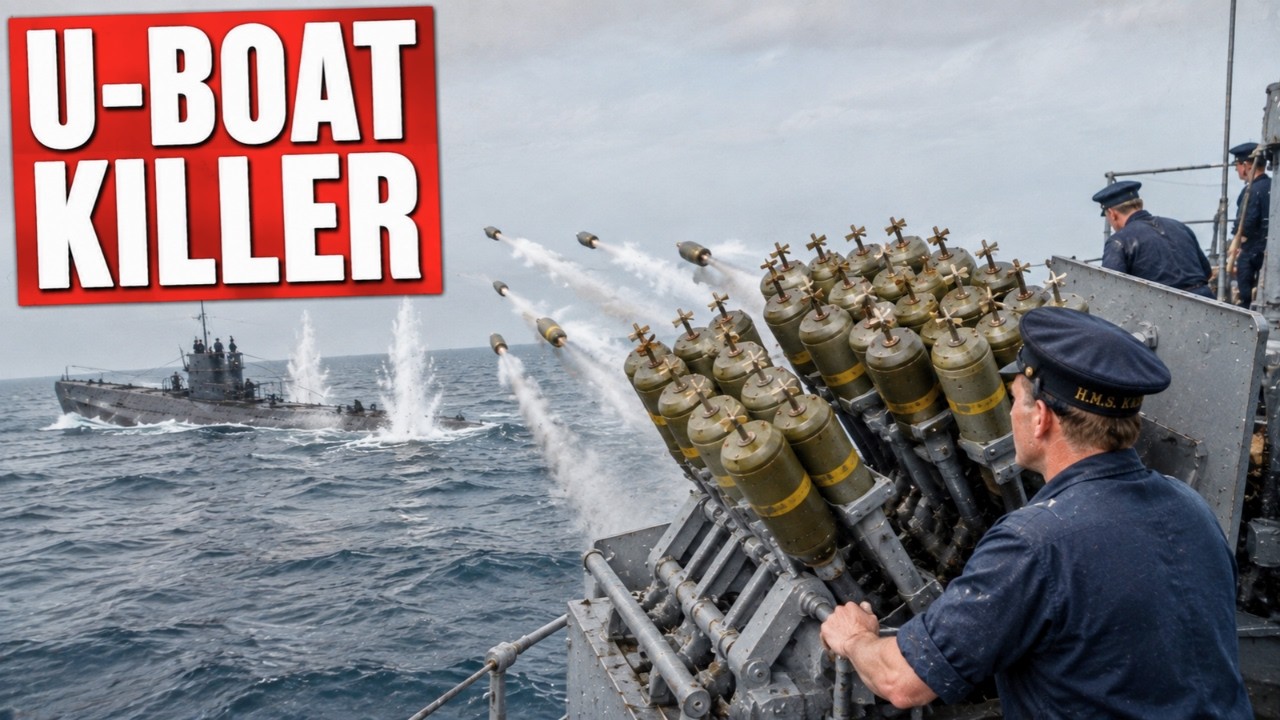
It was four words. “To hell with it. Go get her, England. ” At 7:36 that morning, USS England entered her attack run and fired one salvo from a weapon that, to anyone seeing it for the first time, looked like a garden frame full of steel spikes mounted on her forward deck.
Six to ten explosions followed beneath the surface. Five minutes later, sixty Japanese sailors were dead. That was the sixth submarine the ship had destroyed in twelve days. No warship in any navy has ever equaled that record.
The weapon was British. The Germans thought it was useless. Even British sailors refused to use it for nearly a year. This is the story of how a cluster of spikes on a wet deck, designed by sixty amateurs in a converted office in London, ended up killing submarines ten times more efficiently than the weapon the fleet preferred.
To understand how that happened, you have to go back four years to a dark night in the North Atlantic and to the moment every escort commander in the Royal Navy learned to fear. The sea was black. The wind was rising. Somewhere behind the zigzag line of merchant ships, a young lieutenant pressed a rubber headset to his ears and listened for one steady tone traveling through five hundred feet of freezing water.
Ping. The echo came back sharp and audible. He raised his hand. On the bridge above him, the commander read the signal, and the destroyer heeled to port, chasing the echo across the waves.
Two hundred yards off the bow, just below the surface, a German submarine was holding its breath and waiting. Ping. Closer now, the echo tightened. The men in the control room leaned forward unconsciously.
On the aft deck, sailors stood ready at the depth charge racks, hands on the release levers. This was the moment. It was always the moment. Ping.
Then nothing. No echo. No response. Only the hiss of the sea and the rumble of the ship’s engines.
The operator leaned over his set and swept the beam left, then right, then left again, like a man searching a dark room with a candle. The submarine was gone. It had not surfaced. It had not sunk.
It had simply ceased to exist there. The captain’s expression did not change. He knew what had happened. Every escort captain in the Royal Navy knew.
So did every submarine captain in the German Navy. They called it the blind spot. For three years, from the first winter of the war until the summer of 1943, that blind spot was why the ocean was being lost to the Germans. It was a flaw in the physics of sound and steel that turned every kill into a coin toss and every convoy into a waiting funeral.
The Royal Navy had nothing, and no design in any British shipyard, that could fix it. To understand what the Hedgehog system would eventually do, you first have to understand the wound it was built to heal. Sonar, which the British called ASDIC, worked by sending a cone of sound downward and forward from a warship’s hull. When the sound hit a solid object, it returned as an echo, heard by the operator as a clear metallic ping.
Distance, direction, and sometimes, if the operator was skilled, even the shape of the target. But the cone had a special geometry. It pointed forward and tilted downward at a shallow angle, and it could not see directly below the ship carrying it. As a destroyer approached a submerged submarine, the cone narrowed and rose, and the target, solid and clear at a thousand yards, began to slide under the beam.
At about two hundred yards, sometimes less depending on the submarine’s depth, the echo simply stopped. The submarine had not moved. The ASDIC had not broken. The laws of physics had run out, and two hundred yards at attack speed meant less than half a minute in open water.
That was the moment when depth charges had to go. Depth charges were rolled off the stern or thrown from the sides of the ship. They were steel barrels packed with Amatol, weighted to sink, and set to explode at a chosen depth by a hydrostatic valve. To use them, an escort had to sail directly over the vanished target, guessing the range, the depth, and the course the submarine was already changing.
Then the barrels hit the water and the ship kept sailing, because the shock wave from its own weapons could destroy it if it stopped, while the crew waited for the sea’s answer. Sometimes the sea answered with oil, sometimes with wreckage. Most often, it answered with nothing at all. German captains had studied this.
They had trained for it. The moment a British destroyer’s propeller noise passed over the hull, the submarine commander turned his rudder ninety degrees and held it. That turn took less than a minute. Depth charges took about the same time to reach their set depth.
By the time the water exploded, the submarine had moved out of the kill zone, slipping into the dark toward a new course the escort could not guess. Some carried something crueler, a device called Bold, a small cylinder that released a cloud of chemical bubbles into the sea. The bubbles bounced back to the sonar as a false echo, a ghost, and lured the hunter after a target that did not exist. Then there was the second strike, the one nobody talked about because nobody could do anything about it.
The depth charges themselves blinded the ship that dropped them. When the barrels exploded, they turned the water into a raging column of noise. The shock wave spread across the ocean and struck the sensitive membrane of the sonar set, rendering it useless. Not for a minute or two, but for as long as the escort remained deaf.
It could not hear a submarine two hundred yards from its hull. It could not hear one ten yards away. It stood in the sea, engines thrumming, listening to the echo of its own noise. And by then the convoy had moved miles ahead.
It could not stay. It had to speed to catch up. So the submarine, wherever it was and whatever it was doing, was free. One attack, one chance, a coin toss in the dark.
The numbers were terrible. Throughout World War II, the Royal Navy ultimately recorded more than five thousand depth charge attacks. 5,174 attacks to be precise. From all of that, all that steel and explosive and cold wet effort, they confirmed the destruction of about eighty-five submarines.
One hit for every sixty attacks. Fifty-nine failures for every success. By the winter of 1940, in the Admiralty headquarters in Westminster, men in dark suits and medals looked at those numbers and realized in silence that they were losing. Not fast, but steadily.
Ton by ton, ship by ship, the balance of the sea was tipping the wrong way. One submarine, one successful patrol, could sink more merchant ships than an entire escort group could sink submarines in a year. The arithmetic did not balance. Someone had to build a weapon that could be fired before the submarine disappeared.
A weapon that flew forward ahead of the ship while sonar still held contact. A weapon that struck in the last thirty seconds, in the zone where the sonar beam faded. Everyone in the navy knew this. Nobody in the navy had such a weapon.
There was a reason for that. The idea itself was not new. It was not even recent. The idea was thirty years old.
It had first been proposed to the British Ordnance Board, the body that approved every artillery weapon used by the army and navy, in 1910. A retired officer, Major X, proposed in a memorandum whose exact wording is lost to history, a forward-firing device for attacking submerged targets. The board considered the proposal. The board rejected the proposal.
In 1930, a retired Royal Artillery officer, Lieutenant Colonel Latham Valentine Stewart Blacker, resubmitted a modified version of the same idea to the board. Blacker was fifty years old, a decorated soldier, aviator, and inventor, a man who did not believe in using gun barrels. He had spent his career fascinated by a type of weapon called a spigot mortar. Instead of a tube, the spigot had a steel rod.
The bomb sat over the rod like a sheath, and the propellant charge was inside the bomb’s tail. When fired, the bomb was thrown off the rod, and the rod stayed in place ready for the next bomb. It was cheap. It was light.
It could throw bombs of almost any size. The Ordnance Board considered Blacker’s proposal. The Ordnance Board rejected it. In 1939, with war weeks away, a Royal Engineers officer named Millis Jefferis, working inside a small experimental cell later nicknamed Churchill’s Toyshop, brought the spigot mortar concept to the table for a third time.
Jefferis had studied Blacker’s drawings. He had improved them. He believed the idea would work at sea, on land, against tanks, against submarines, against almost anything the military could imagine wanting to hit. The Ordnance Board considered Jefferis’s proposal.
The Ordnance Board rejected it. Somewhere in the papers of that third rejection, according to the account later preserved by Nevil Shute Norway in his memoirs, a prominent board member was said to have uttered a sentence that echoed through the rest of the war. When pressed by another officer as to why the concept could not be reconsidered, he replied with perfect calm: “If the Almighty Himself had fathered the spigot mortar, it would still be rejected by the Ordnance Board. ” Three rejections, thirty years.
The weapon that would eventually change the course of the Battle of the Atlantic had been sitting in a filing cabinet in London since the reign of King Edward VII. By the summer of 1940, the men who could save it were not on the Ordnance Board. They were in a converted office wing in the Admiralty building on Whitehall, working under the loose authority of an admiral named Sir James Somerville. Somerville had been relieved of active command due to a diagnosis of tuberculosis that later proved incorrect.
Instead of sending him home, the navy gave him a small research office to run. Its official name was the Inspectorate of Anti-Aircraft Weapons and Devices, abbreviated IAAWD, and it was supposed to develop new ways to shoot down German bombers. The rest of the navy did not take it seriously. Within weeks of its formation, the initials IAAWD had been quietly translated in every wardroom in the fleet into a new nickname: the Wheezes and Dodgers.
Schemes and amateur tinkering. The nickname stuck. It would still be the name a year and two years later, when the inspectorate had turned into something entirely different and far more dangerous. In 1941, it was formally reorganized as the Directorate of Miscellaneous Weapons Development, DMWD.
The sailors kept calling them the Wheezers and Dodgers, and the Wheezers and Dodgers, for the most part, seemed to like it. They numbered fewer than sixty people. By the standards of the Royal Navy’s professional ordnance establishment, they were a collection of oddities. A physical chemist from the University of London named Charles Frederick Goodeve, thirty-six years old, born in Neepawa, Manitoba, a Canadian volunteer who had joined the Royal Naval Volunteer Reserve as a cadet and stayed because he loved the sea.
A retired motor racing photographer. A handful of university lecturers who had never worn a uniform before 1939. And a tall, quiet lieutenant commander in the Royal Naval Reserve named Nevil Shute Norway, forty-two years old, who spent his weekends writing novels under the pen name Nevil Shute and had been, before the war, one of the aeronautical engineers who designed the R100 airship. Goodeve was the driving force.
He had an energy that made senior officers slightly uncomfortable. He asked questions. He walked into offices without appointments. He wrote memoranda assuming the reader would say yes, and when the reader said no, he wrote a second memorandum assuming the reader had misunderstood the first.
Within a year, Somerville had expanded his small anti-aircraft cell into an outfit dealing with mines, rockets, degaussing, camouflage, dummy convoys, and weapons the Admiralty had never heard of and would never have thought to build itself. He had also begun quietly inquiring about the anti-submarine war. In late December 1940, a memorandum reached his office. It came from the Director of Anti-Submarine Warfare and referred to a meeting to discuss the use of what the writer called “spigot guns” for anti-submarine purposes.
Attached to the memorandum was a small diagram of the mechanism in the careful hand of Major Millis Jefferis, with a description of how the thing would work at sea. Norway, or perhaps his secretary, wrote a single word in the margin of the memo. Norway. The name of the man who would take it forward.
That was December 22, 1940. The Battle of Britain had been decided in the air. The Battle of the Atlantic was being lost in the water. In the Admiralty, inside a converted office wing full of civilians and reservists and one admiral recovering from tuberculosis, there was a diagram pinned to the wall.
Outside, in the winter dark, the convoys were still sailing. The sonar beams were still sweeping the depths. The depth charges were still falling into the sea, one after another, to no avail. And in the black water, somewhere off the Western Approaches, a young German U-boat commander wearing an Iron Cross around his neck was watching through his periscope the moment of silence when a British destroyer’s propeller noise passed over his hull, then put his rudder hard over to starboard, and the sea closed over him without a sound.
The diagram did not stay on the wall as a drawing for long. By the first weeks of 1941, the men in the Whitehall office were turning the drawing into wood and steel. Nevil Shute Norway took the idea to a small experimental facility on the Somerset coast, in Weston-super-Mare, on a Victorian pleasure pier called Birnbeck. The Royal Navy had leased the pier as a shore station and named it HMS Birnbeck.
It had rusty railings and salt-eaten wooden planks and a view across the Bristol Channel that, on a clear day, was one of the loveliest in England. On that pier, in a series of huts and canvas sheds, the Wheezers and Dodgers began building a weapon that did not work at first at all. The problems were not the ones anyone expected. The idea itself was sound.
Twenty-four bombs, each about four feet long, mounted vertically on a steel rod, arranged in four rows of six on the warship’s forward deck. A propellant charge inside the tail of each bomb. A rippling firing sequence that sent pairs into the air fractions of a second apart so that they all landed in the sea together in an oval 140 feet long and 120 feet wide, about two hundred yards ahead of the ship. At the head of each bomb, instead of a hydrostatic valve set to a chosen depth, there would be a contact fuse.
The bomb would not explode when it reached a selected level. It would explode when it hit something solid, like a submarine’s hull. Nothing else. That was the point.
That was the whole point. If the projectiles missed their target, the bombs would sink safely to the ocean floor. The sea would not boil. The ASDIC would not be blinded.
The ship would keep contact, reload in about three minutes, and attack again and again until the submarine was sunk or dived too deep for the game to continue. On paper, it was elegant. In the workshops at Birnbeck, it was a nightmare. The contact fuse was the first problem.
A fuse that could survive a sixty-foot launch into the air, hit the sea at high speed, sink through cold dark water for six or seven seconds, then detonate with a full explosive charge the instant it touched a submerged submarine’s hull. If it exploded early, it would go off in the air or on hitting the water, destroying the ship that fired it. If it exploded late, it would drift uselessly to the bottom and settle there forever. The shape of the projectile was the second problem.
The bomb’s head had to hit the water in a way that kept it diving straight down. If the head was round, the bombs would glance sideways on impact, deflecting in twenty-four different directions like a handful of dice thrown on a table. The pattern would collapse. The oval would become a scatter.
A 220-foot submarine inside that pattern could have every bomb pass by its hull and vanish into the depths. Repeated trials finally proved the head had to be flat, not streamlined, not clever. Flat. The flat head hit the water without skidding.
The charge was the third problem. Twenty pounds of explosive would not reliably penetrate a Type VII submarine’s hull. Thirty pounds might. Nobody was quite sure.
Torpex, a recently developed explosive mixing RDX and TNT with aluminum powder, was measurably stronger than TNT alone and useful when it was needed. In the end, the solution was 35 pounds of Torpex per bomb. The finished projectile weighed about 65 pounds, just over 7 inches in diameter, and could destroy a submarine with a single direct hit. There was a strange little detail about who made the first projectiles.
The Admiralty did not have the industrial capacity to produce the first bombs in the required numbers. So, in a decision later recounted in bars from Portsmouth to Halifax with a kind of quiet amusement, the contract for the first batch of Hedgehog bombs was given to a company called Boosey & Hawkes. Boosey & Hawkes made musical instruments, clarinets, trumpets, and bassoons. The men who cast the projectiles that would sink German submarines had been casting brass bells for orchestra horns before the war.
The name Hedgehog itself was born the same way, spontaneously. Someone at Birnbeck looked at the launcher, at the rows of empty spigots standing upright after the bombs were removed, and at the way they protruded from the base like the spines of a startled animal, and suggested the word. A small internal competition was held. The winning entrant received a single bottle of sherry.
By spring 1941, they had something they could mount on a ship. The ship they chose was HMS Westcott, a 23-year-old W-class destroyer, a survivor of the previous war, worn but reliable, then attached to the 7th Escort Group in Liverpool. Her forward 4-inch gun was unbolted from the forecastle and lifted away. In its place, in August 1941, they installed the first operational Hedgehog launcher in the world, a fixed base of twenty-four spigots pointing at the sky.
The men of Westcott, when they first saw it, did not know what to make of it. There was an accident during loading trials. A sailor handling one of the bombs was seriously injured in the hand. The scientists who had come aboard for the firing trials stood on the wet deck in their civilian coats and watched in silence as the wounded man was helped away.
Another sailor who watched the same scene would later recall that the spigots had been emptied and reloaded so many times during trials that the safety pin lanyards had worn through, and that at least one salvo, when finally fired, detonated on contact with the water. Not on contact with the target, but on contact with the sea itself. Those were the early days. In May 1941, off Liverpool Bay, they tested the weapon against a known wreck resting on the sea floor.
This time the test was not a failure. The Hedgehog put its pattern where it was supposed to put it. The scientists at Birnbeck lifted their heads. Goodeve in Whitehall allowed himself a small, cautious smile.
Then he did the thing that saved the entire program. He arranged a demonstration for the Prime Minister. Winston Churchill was sixty-six years old in the spring of 1941. He had been in office for one year.
In that year he had watched the fall of France, the burning of London, and the beginning of the Atlantic convoy bleeding. He had said, and would say again in his memoirs, that the only thing he truly feared during the war was the U-boat peril. He said it plainly, in ordinary words, without embellishment, because he meant it. Goodeve knew this.
According to Gerald Pawle’s internal history of the department, written a decade after the war, Goodeve arranged for Churchill to watch a live Hedgehog firing. The Prime Minister came in his black coat and black hat, stood on the windswept deck, and watched twenty-four bombs rise into the grey English sky and fall into the sea in a tight, precise oval. Then, according to the account passed down through the departments, he did something unusual. He did not applaud.
He did not speak. He simply asked for the salvo to be fired again. The second salvo went up. The second salvo fell.
The Prime Minister watched and said nothing, then asked for a third. The third salvo went up and fell as the first two had. Churchill nodded once and turned back to his car. The next morning at the Admiralty, the First Sea Lord, Charles Goodeve, was summoned.
Whatever he had thought of the Hedgehog before that morning, he had a different opinion now. Goodeve gave his word that the program would have the full support of the Naval Staff. The Hedgehog would go into production. The Hedgehog would go to sea.
By the beginning of 1942, launchers were being mounted on escort after escort. Destroyers carried the full 24-spigot launcher on their bows. Smaller ships, like Flower-class corvettes and sloops, carried a split version, two 12-spigot units, one to starboard and one to port. By the end of that year, more than one hundred Royal Navy ships carried a Hedgehog somewhere on their decks.
And within roughly twelve months of service, none of them had succeeded in destroying a submarine with it. There is still a story told that HMS Westcott achieved the first Hedgehog kill on February 2, 1942, when she sank U-581 southwest of the Azores. That story appears in some old history books. It is also on some commemorative plaques.
But when you read the accounts carefully and compare them, they do not match. The son of one of Westcott’s signalmen, recalling what his father told him, stated firmly that U-581 had been rammed. A book about the ship written by a crew member said the same. A newspaper clipping from 1942, kept in a family album for the rest of the century, described the ramming and the rescue of survivors from the sea.
German operational reports, when matched against Westcott’s movements that evening, confirmed the collision. Whatever the Hedgehog did that day, the submarine destroyed did not die from mortar bombs. The first confirmed Hedgehog kill did not come until November 1942, ten months after the weapon entered service, with more than a hundred ships carrying it by then. And the captains of those ships, in operations rooms in Liverpool, London, Derry, and Halifax, were beginning to talk about the weapon in a tone that mixed contempt with something approaching shame.
The reason was simple. They were not using it. A depth charge attack was something you could feel. When the barrels exploded, the sea rose in a white column fifty feet high.
The escort’s deck shuddered. The men in the engine room felt the tremble through the hull plates. Whether the submarine was destroyed or not, the ship had done something. Something loud.
Something visible. Something a captain could log in his diary without feeling his crew watching him for signs of doubt. A Hedgehog attack was, in words repeated across the fleet from winter 42 to spring 43, frustratingly quiet. Twenty-four bombs are fired into the Atlantic.
If they miss, and most of them missed, they sink silently to the ocean floor and explode harmlessly. There was no water column. There was no vibration. There was no evidence of any kind that anything had happened at all.
A captain who fired a Hedgehog and saw nothing had no way of knowing whether he had missed by ten feet or a hundred yards. He could not tell his crew they had been close. He could not tell them anything. So, ship after ship, the launcher on the forward deck became something men walked past without touching.
When a target did appear on ASDIC, they turned to depth charges. Depth charges felt like war. The Hedgehog felt like a rumor. By early 1943, the Admiralty knew.
Reports were coming into Whitehall. Contact after contact, attack after attack, always with depth charges, always with the same one-in-sixty success rate, and the new weapon bolted to the deck like a piece of furniture. The Royal Navy did something it had never done before and would rarely do again. It issued a written directive.
Any captain of a ship fitted with Hedgehog who did not use it when a submerged target was detected would be required to explain that in writing. An Admiralty order demanding officers justify their decision not to fire a weapon they had been issued. There is nothing else like this in the British naval war archives. And still, in the first months of 1943, no kills were made.
The men of the Directorate of Miscellaneous Weapons Development, in their Whitehall offices and their Birnbeck workshops, watched the results and realized they had built a weapon no one wanted to fire. They also realized that if they did not solve the problem, and quickly, the weapon would be withdrawn and the Battle of the Atlantic would continue to be lost at sixty attacks per kill. Goodeve made a decision. He sent one of his officers to find out why.
The man went to Londonderry in Northern Ireland, at the mouth of the River Foyle. In 1943, Londonderry was the main base for the North Atlantic convoy escorts. Warships came and went constantly. Their decks were crusted with salt, their crews exhausted from cold and fatigue, and their captains not much better.
It was the front line. It was where the war would be won or lost. The DMWD officer went aboard ship after ship. He talked to the commanding officers, to the first lieutenants, to the sailors who loaded the launchers and the ASDIC operators.
He carried with him detailed reports of the few successful Hedgehog attacks, their geometry, the exact procedures, the timing, how the pattern was dropped relative to the last known coordinates of the target. And during those conversations, he discovered two things. The first was technical. A North Atlantic winter, in the years of the great convoy battles, was an experience beyond what most navies have ever known.
Spray crashed over the bows of escorts in a continuous torrent. It froze on the ship’s railings. It seeped into the collars of wool coats. And it got, again and again, inside the firing circuits of the Hedgehog launchers.
The electrical circuits corroded. The contact points pitted and greened and failed. When the captain finally pressed the firing button, in some cases nothing happened. In others, only a few bombs fired, an erratic partial salvo that fell into the sea in a broken pattern with almost no chance of a hit.
In a few cases, the corrosion caused sympathetic detonations when one bomb exploded on deck and set off others still in their spigots. The mechanical fix was a matter of maintenance, new procedures for disassembly, cleaning, and resealing every week. New protective covers, new training for ammunition crews. The second problem was harder.
The second problem was psychological. It was the silence. The DMWD officer, sitting in the wardrooms of escort ships, realized the men did not doubt the Hedgehog’s calculations. They understood, when it was explained to them, that the contact fuse gave you multiple attacks, that maintaining ASDIC contact was better than a satisfying explosion.
They nodded. They agreed. Then they went to sea and fired depth charges, because depth charges felt like action, and the Hedgehog did not. What the officer finally did was tell stories.
He gathered whole ship’s companies in their mess decks. He told them in detail about the Hedgehog attacks that had succeeded. About the pattern that fell exactly where it should have fallen. About that small dark spot on the sonar screen that suddenly became two hits, then three, then an oil slick spreading on the surface.
He gave them, instead of the visual drama of a depth charge column, the invisible drama of a submarine crushed by the pressure of the water. He also gave them the numbers. By late 1944, Royal Navy operational research had proven that Hedgehog attacks, properly conducted, killed the submarine ten times more often per firing than the depth charges the crews preferred. That number, the ten-to-one ratio, when stated plainly in front of a room full of exhausted destroyer officers, changed their minds.
The kill rate began to rise. It kept rising. By the end of 1944, on ships that had been seriously trained in the new procedures, more than one in three Hedgehog attacks achieved a confirmed kill. But before the good news arrived, in September 1943, there was another moment when the program nearly collapsed entirely.
It happened aboard HMS Escapade, a British E-class destroyer, on the night of September 20, 1943. She was escorting Convoy ONS 18 in the North Atlantic and was closing on a target when the Hedgehog was fired in what should have been a routine attack. The projectiles did not leave the deck. A fault in the firing circuit, whether from corrosion or a defect in the ammunition itself, caused one bomb to explode while still in its spigot.
The explosion detonated the bombs next to it. The forward part of the ship, in less than a second, became a mass of fire and flying metal. The bridge was smashed. The men on the forecastle, in the wheelhouse, and in exposed positions on the forward superstructure were killed instantly.
Others were burned, blinded, or blown overboard. The captain, Edward Norman Vernon Currey, survived, but many of his men did not. The exact death toll varies between accounts, but in every version it is measured in dozens of dead and wounded on a single ship in a single moment, by the weapon designed to save them. Escapade fell out of the convoy heavily damaged.
She survived. She was repaired. She went back to sea. But the news of what happened aboard her spread through the escort fleet within days, and on ship after ship, the old fear, never entirely gone, returned with greater force.
You could see the old doubt hardening into something more solid in wardrooms after the Escapade signal came in. The Hedgehog had not only failed to destroy submarines for most of the year. Now it was killing men on deck. For the second time, the Directorate of Miscellaneous Weapons Development was on the verge of losing this weapon.
For the second time, they held on. The investigation into the Escapade incident produced definitive answers quickly. The cause was precisely identified. The fix was applied.
Every crew carrying a Hedgehog was trained in new safety procedures. And the training program that began in Londonderry continued. Ship after ship, wardroom after wardroom, mess deck after mess deck, until the men of the North Atlantic escort force believed in the weapon on their bows in a way they had never believed in anything else the Admiralty had given them. By the end of that autumn, the Hedgehog was no longer the weapon no one wanted to use.
By the end of that winter, it was the weapon many of them preferred. There was one man in particular who understood the Hedgehog better than anyone who ever fired it. His name was Frederick John Walker. The fleet called him Johnny.
He was a Royal Navy captain, forty-seven years old in the spring of 1943. For most of the previous fifteen years, his service had been considered a dead end. He had been passed over for promotion. He had been sent to shore billets that more glamorous officers avoided.
He had spent the interwar years being told in a hundred small ways that anti-submarine warfare was not the future of the Royal Navy, and that a man who specialized in it was choosing a slow, quiet exit from the officers’ list. The war saved him. By 1942, he was commanding an escort group. By 1943, he was commanding the 2nd Support Group out of Liverpool, six Black Swan-class sloops, and from the bridge of his flagship HMS Starling, he was devising a way to use the Hedgehog that no one had thought of before.
He called it the creeping attack. The old method was to rush in at attack speed with sonar pinging, hoping the submarine would not turn in time. Walker did not rush. He crept.
He kept two ships in the fight at all times. One stayed back in long-range sonar contact, tracking the submarine with a beam the submarine could not easily hear. The other approached from the direction determined by the first ship, slowly, engines nearly idle, coming in on a course the submarine could not detect, steered minute by minute by radio from the tracking ship. When the creeping ship reached position, she fired the Hedgehog at a spot she had never seen and did not need to see, because the other ship had been watching the target the whole time.
It worked. It worked spectacularly. Between January 31 and February 19, 1944, Walker’s 2nd Support Group sank six U-boats in one patrol. That was, at the time, the greatest anti-submarine performance in the history of the Royal Navy.
The record did not last more than four months. Walker himself did not live to see the end of the war. He collapsed on the dockside in Liverpool in July 1944, exhausted beyond recovery, and died in a naval hospital nine days later, aged forty-eight. His funeral filled the cathedral.
The First Sea Lord attended. So did the crews of the ships he had commanded, in their best working uniforms, standing in silence in the aisles. The Hedgehog he had learned to use so brilliantly outlived him. So did the men he trained.
Somewhere in the Bay of Biscay, in the early hours of a moonless night in December 1943, a British destroyer picked up a target on sonar and closed at fifteen knots. The operator’s headphones filled with a clear, sharp echo. Two hundred yards off the bow, a Type VII submarine was diving deep and turning hard to starboard, doing exactly what her captain had been trained to do to evade attack. But this time, the destroyer did not pass over the target.
At 250 yards, the Hedgehog fired. Twenty-four bombs left the deck in a rapid ripple through the dark air with their flat heads, hitting the water in a tight oval pattern ahead of the ship. They sank in silence, unheard by anyone on the surface, at a speed of about 23 feet per second. The sonar beam did not flicker or distort.
The echo stayed steady. The operator, bent over his set, tracked the submarine through its entire dive. Six seconds passed, then seven, then eight, and suddenly the sea under the destroyer’s port bow made one muffled sound, like a great door closing underwater, followed by another, and a heartbeat later a third, not a bomb but something larger, softer, and more final. On the sonar screen, the echo that had been a submarine turned into an expanding cloud that was no longer a submarine, then faded entirely.
The destroyer captain on the bridge said nothing for a moment. Then he very quietly ordered the ship to turn, and the crew to prepare to search for oil on the surface. The Hedgehog had done what it was built to do. Twelve minutes later, the first oil slick appeared.
Twenty minutes after that, the wreckage. By dawn, the destroyer had confirmed the kill and was steaming back to rejoin her convoy. In the offices of Whitehall, on a rusty pier in Somerset, and in the converted wing of the Admiralty where a diagram had hung on a wall, the innovators were beginning to realize what they had made. The men who received the Hedgehog had judged it first by its sound.
It was silent. For nearly a year, they had believed silence meant nothing. But they were about to discover that silence meant the sonar was still working. Silence meant attack after attack, until the submarine perished.
Silence meant exactly the thing German captains had learned to fear more than any explosion in the world. Silence, when it belonged to the Hedgehog, was the sound of a submarine that did not yet realize it was already lost. In the North Atlantic, during the last months of 1943 and the first of 1944, the balance began to change. Not quickly or dramatically, but steadily, ship by ship, kill by kill, the tide that had been running against the escort crews for four years turned quietly in the water under their hulls.
The Battle of the Atlantic was not over, but for the first time since the war began, the Royal Navy possessed a weapon that could see into the blind spot. The turning point had a name and a date. The name was ONS 5. The date was the last week of April and first week of May 1943.
Convoy ONS 5 was a slow westbound convoy of forty-two merchant ships from Britain to North America, guarded by a handful of destroyers and corvettes under Commander Peter Gretton. It sailed on April 22 in weather no man on any bridge in that formation would forget for the rest of his life. Storms, fog, and ice. The convoy scattered and re-formed and scattered again.
And somewhere in the black water south of Greenland, Karl Dönitz gathered his U-boats around it like wolves around a wounded deer. He had more than forty U-boats at sea against the five escorts. It was the largest pack of U-boats he had ever pushed against a single convoy in the entire war. For a week, the wolves and the escort crews fought in weather that made normal combat impossible.
Thirteen merchant ships were sunk. Their crews died in oil, in fire, in water that killed a man in fifteen minutes even if he could swim. The stories of those ships survived. A merchantman named West Madaket was hit by two torpedoes on May 5.
Her captain ordered an orderly, disciplined evacuation, and every man of his crew reached the lifeboats alive. They rowed away from the burning hull in thirty-knot winds, visibility under half a mile, and for three days were passed from escort to escort until the last of them climbed aboard a warm ship with dry clothes and hot tea. Others were less lucky. On some tankers, the men in the engine rooms never came out.
On some ammunition ships, the second explosion, after the torpedo, was the last thing anyone on the surface ever saw. The North Atlantic in May is not much warmer than in February. A man in a life jacket in oil-fouled water at forty degrees Fahrenheit has twenty minutes, if he is lucky. Many of them were not lucky.
Commander Peter Gretton, on the bridge of his flagship HMS Duncan, went days without sleep. His assistant brought him messages he had no answer for; there was nothing left to send. His fuel was running low. His escorts were running low.
His crew lacked the one thing, the most solid and invisible thing that men need when they have been shot at six nights in a row, and still the escort held its station in the dark water around him. The corvettes prowled the convoy’s columns. The destroyers pushed the U-boats deep and kept them there. The new radars drew their green ghosts on small screens in dark rooms below deck.
The direction-finding sets picked up German signals and told the escorts where to aim. And when a U-boat was cornered, the Hedgehog bombs went into the water, and sometimes oil slicks came up in the end. By May 6, the German captains around ONS 5 were beginning to make mistakes. When U-boats make mistakes, they die.
When the fighting stopped on May 6, the wolves themselves had lost the battle. Six U-boats were destroyed. Six more were so badly damaged they had to return home. Convoy ONS 5 survived, battered and shrunken, but afloat.
And the men of Dönitz’s crews, reading the reports from their headquarters in occupied France, realized something had changed. The Hedgehog was not the only reason those U-boats were destroyed, nor even the main one, in any honest accounting. It was one weapon among many. It was in the same ocean as the long-range B-24 Liberators that were closing the mid-Atlantic air gap.
It stood beside the HFDF sets that allowed escorts to fix the position of any U-boat that dared to transmit. It stood behind the codebreakers at Bletchley Park who were reading, by 1943, most German naval Enigma traffic within hours of transmission. It stood beside the new centimetric radar, Type 271, that could see surfaced U-boats at night in fog. None of these things alone would have won the Battle of the Atlantic.
But together, they were decisive. ONS 5 was the moment it started working. In the three weeks after ONS 5, Dönitz lost forty-one U-boats and their crews, nearly two thousand German sailors, most of them young men who never came home. The German naval command gave that month a name.
Schwarzer Mai. Black May. On May 24, 1943, Karl Dönitz did what he had believed he would never have to do. He withdrew his U-boats from the North Atlantic convoy routes.
He sent a signal to his commanders to break off, disperse, and head south, for survival. The wolves left the killing ground. They would come back later. They would try new tactics, new torpedoes, new submarines.
But the moment when they came close to strangling Britain had passed, and it had passed forever. And on the other side of the world, in a warm sea far from the North Atlantic, the same weapon that had helped break the U-boats was about to be handed to a young escort destroyer named USS England, to be used in a way no one on either side of the war had ever seen. The Pacific war in the spring of 1944 was moving fast. Admiral Chester Nimitz was advancing west across the central Pacific.
Douglas MacArthur was advancing north along the New Guinea coast. In Tokyo, a fifty-nine-year-old admiral named Soemu Toyoda had just been promoted to command the Combined Fleet and was trying to guess where America would strike next. He decided to use his submarines to find out. He established a patrol line, a fence of Imperial Japanese Navy submarines stretching across the sea from Truk in the Carolines west toward the Admiralty Islands northwest of New Guinea.
He reasoned that any American task force moving toward the Philippines or the Marianas would have to cross that line, and his submarines would report it. He assigned seven submarines to the operation: I-16, RO-104, RO-105, RO-106, RO-108, RO-116, and RO-117. I-16 was the largest, a veteran fleet submarine under squadron commander Yoshitaka Takeuchi. She was ordered to deliver rice in seventy-five-pound rubber bags to the isolated Japanese garrison on Bougainville before taking her position in the patrol line.
On May 13, 1944, I-16 sent a routine wireless message confirming her schedule. An American listening station picked it up. The message went to the codebreakers of the U. S.
Pacific Fleet. It was decrypted within hours, and the exact route, the exact timing, and the exact intention of Toyoda’s reconnaissance operation were no longer a Japanese secret from that moment. Escort Division 39 was lying in Purvis Bay in the Solomon Islands. Three brand-new Buckley-class destroyer escorts, small ships of barely 1,500 tons, with crews that had seen almost no combat.
USS George (DE-697), USS Raby (DE-698), and USS England (DE-635), named for a young lieutenant who had died aboard the battleship Oklahoma at Pearl Harbor on December 7, 1941. Her captain was Commander Walter Pendleton. Her executive officer was a lieutenant named John Williamson, twenty-nine years old, who had studied anti-submarine tactics in every school the navy had sent him to. Each of the three ships carried, mounted on her bow where the Royal Navy had first placed it three years earlier, a British-designed Hedgehog.
On May 18, the three ships received their orders. Intercept submarine I-16. They sailed. They found her.
At midday on May 19, in bright sunlight and calm water, USS England gained a steady submerged contact at 13:35. At 13:41, she fired her first Hedgehog salvo. It missed. She turned, regained contact, and fired again.
One hit at a depth of 130 feet. She fired a third time. Then a fourth. I-16 evaded all of them.
At 14:33, England fired her fifth salvo. Four to six explosions followed from the depths. A few seconds later, a much larger explosion came from below the surface. The submarine’s own torpedo warheads, or possibly her own depth charges, had detonated sympathetically.
The blast lifted England’s stern completely out of the water and knocked men on her afterdeck off their feet. Debris began reaching the surface twenty minutes later. By the next morning, a diesel oil slick three miles wide and six miles long was drifting across the calm Pacific where I-16 had been. Commander Takeuchi and his crew were gone, all of them.
The next day, May 20, another intercepted Japanese message reached American commanders. It described in detail the exact positions of the patrol line Toyoda was setting north of the Admiralties. Every station, every submarine, every schedule. The Americans knew the entire trap before it was set.
For twelve days, from May 19 to May 31, USS England and her sister ships did something unprecedented in the history of anti-submarine warfare, and unrepeated since. They hunted the patrol line to extinction. On May 22, before dawn, USS George picked up RO-106 on radar. England fired, missed, then turned and fired again at 5:05 a.
m. The Hedgehog projectiles hit. An underwater explosion followed. RO-106 was gone.
On the 23rd, they found RO-104. Raby and George attacked with eight depth charge patterns over two hours. Every one missed. England took over and on her second attack, at 8:44 a.
m. , finished her. On the 24th, they found RO-116. England destroyed her before dawn with a Hedgehog pattern that hit on the first attempt.
On the 26th, they found RO-108. Raby attacked and missed. England attacked at 23:23 and scored four to six hits. RO-108 went down with all hands, all fifty-three of her crew.
By that point, England’s crew was not sleeping well. They were rotating sonar operators every few hours. They were reloading launchers in the dark with hands that had been wet for days. Commander Pendleton was on the bridge living on cigarettes, coffee, and the sound of the sonar in the compartment below.
Then, on May 30, they found the last one, RO-105. She was commanded by Lieutenant Junichi Eno, and aboard her was the commander of Japanese Submarine Division 51, Captain Ryunosuke Kato. RO-105 did not die easily. The American escorts chased her for twenty-five hours.
USS Spangler had joined the group by then. Four ships, four Hedgehog systems working in rotation. They attacked her with depth charges. They attacked her with Hedgehog pattern after pattern.
Twenty attacks, one witness later said. More than twenty, said another. Nothing worked. RO-105 maneuvered, dived deeper, moved silently, dived again.
By the morning of the 31st, the commander of the escort division, Commander Hamilton Haines, aboard one of the other ships, had run out of patience. He had deliberately held England back, hoping to give the other captains a share of the record. Now, at 7:00 on the morning of May 31, 1944, he pressed the radio button. The signal sent to the United States was that England had been held back.
It consisted of four words. To hell with it. Go get her, England. At 7:36, thirty-six minutes after seven, England began her attack.
She fired her Hedgehog salvo once. Six to ten explosions followed in succession in the seconds after. One larger explosion at 7:41, and RO-105 was gone. Captain Kato was gone.
Lieutenant Eno was gone. The last submarine of Admiral Toyoda’s patrol line was gone. Great bubbles rose to the surface. A large diesel slick spread across the sea.
Some wooden debris, some pieces of clothing, and a small collection of personal luggage that had not been secured, floating because nothing else could be done with it. An hour later, the silence returned to the Pacific, which had resumed the flat, glittering blue it wears on any ordinary morning in the last week of May. Six Japanese submarines, twelve days, one destroyer. Nothing like it has ever been repeated by any warship in any navy in the world.
USS England received the Presidential Unit Citation. Commander Pendleton received the Navy Cross. And the words attributed to Admiral Ernest King, the Chief of Naval Operations, when he read the after-action report, have been repeated in every history ever written of the ship. He said, “There will always be an England in the United States Navy.
”
On the other side of the world, with the same weapon, in the same year, the North Atlantic gave the Hedgehog one more moment of significance. On May 29, 1944, in the eastern Atlantic west of Madeira, the American escort carrier USS Block Island was hit by three torpedoes from a German Type IXC/40 submarine, U-549, commanded by a lieutenant captain named Detlef Krankenhagen. The carrier sank with the loss of six of her crew. Her escorting destroyers hunted down the submarine that sank her.
The destroyer escort USS Eugene E. Elmore, of the same Buckley class as England, found U-549 on sonar. Her first Hedgehog salvo missed, but the Hedgehog, being a silent weapon, did not blind her sonar. She kept contact through the haze.
She reloaded. She fired again. And U-549 was destroyed on the second salvo, taking Commander Krankenhagen and every man of his crew with her. An American officer later wrote that a depth charge attack in the same position would have raised a column of water, blinded the ASDIC for fifteen minutes, and allowed the submarine to escape.
By the end of World War II, the arithmetic had been settled. 268 Hedgehog attacks, 47 confirmed submarine kills. A kill rate of roughly one submarine per 5. 7 attacks.
Depth charges, in the same period, killed at a rate of roughly one per sixty attacks. The Hedgehog represented only a small fraction of the total surface attacks made by Allied warships against submarines. But it was responsible for about one-third of all submarines destroyed by those surface ships. The successor weapon, Squid, designed by the same men in the Directorate of Miscellaneous Weapons Development and rushed into service in 1943, achieved a kill rate of one per 2.
9 attacks. The Wheezers and Dodgers, within four years, had gone from a nickname the fleet used as an insult to a department whose weapons defined how the Royal Navy would fight submarines for the rest of the twentieth century. On the other side of the war, the men who were the targets of this weapon did not mock it. They feared it.
The German naval command, watching the events of Black May in the summer of 1943, had already accelerated the program that would produce the Zaunkönig T5 acoustic homing torpedo, designed to allow a U-boat to kill an escort from a range that put it outside the reach of any forward-firing weapon. The Falk, the first family of those torpedoes, entered service the same year. They did not mock the Hedgehog. They tried hard to build something that would let them kill the ships carrying it before those ships could get close enough to fire.
They mostly failed. The war ended before the new torpedoes could change its course. Karl Dönitz, of whose 1,162 U-boats 785 never returned home, and of whose 40,000 submariners nearly 28,000 were killed, would write his memoirs after the war and struggle honestly to explain what finally defeated his fleet. He wrote about radar.
He wrote about aircraft. He wrote about the loss of Enigma. But he did not write at length about a row of spikes on the forward deck of a destroyer. Perhaps he did not know that it was, in the end, the thing that made the Hedgehog so lethal.
When it killed, it killed in silence, without a warning broadcast, without a final signal, without any of the damning evidence that might have allowed one U-boat to warn another. The submarines destroyed by Hedgehog attacks in 1943 and 1944 mostly died without knowing what hit them, and their command in France mostly did not find out. The German staff kept sending men to sea against tactics they could not properly analyze, because the weapon that killed them left no story behind it. That silence made the Hedgehog useless to the men who carried it at first.
In the end, that same silence made it a killer. The men who built it mostly went home after the war and returned to their peacetime work. Charles Goodeve was knighted in 1946 and spent the rest of his career in industrial research. Stewart Blacker died in 1964, having lived long enough to see the spigot mortar he proposed in 1930 recognized as the ancestor of a whole generation of anti-submarine weapons.
Nevil Shute Norway moved to Australia, wrote on a beach in a town that looked like Alice, and became, under a shorter pen name, one of the best-selling novelists of the mid-twentieth century. None of them spoke publicly of the Hedgehog with pride. That was not the department’s style. But if you had walked in the late 1940s on the rusty planks of the Birnbeck Pier at Weston-super-Mare, and stood at the seaward end where the salt wind still blows from the Bristol Channel, you would have seen empty concrete platforms where the test stands once stood.
The bays were empty. The covers were gone. The inventors had gone home. There were sixty of them.
They were given an insulting nickname, a small office in Whitehall, and told to try things no one else would try. They built the weapon that closed the blind spot. And on a 140-by-120-foot patch of black Atlantic water, and in twelve days of clear Pacific sunlight, in a war whose numbers still refuse to feel quite real eighty years later, they did something no professional ordnance officer in the Royal Navy or the United States Navy could do for them. They made silence lethal.
And the men who once refused even to fire the thing bolted to the bow of their ship learned, in the end, to trust it with their lives.






