In 1838, General Winfield Scott gave the order. Seven thousand soldiers and state militia swept through the Cherokee towns of the southern mountains, rounding up men, women, and children. They forced them into stockades through the summer, where they were confined in cramped and diseased conditions, weakening by the week. That fall, the march west began.
Over sixteen thousand Cherokee were forced to walk more than eight hundred miles in the cold of late 1838 and early 1839. Estimates put the death toll at roughly four thousand people, one in every four who began that march. They died of dysentery, starvation, pneumonia, and exhaustion. Children.
Elders. People who had lived their entire lives in the shadow of the same ridges that still stand today. That march became known as the Trail of Tears. And the name is not metaphor.
It is a literal record of what happened on a specific road, in a specific winter, to a specific people who had done nothing to deserve it. But here is the part the history books often leave for the footnote. Not everyone went. A small group of Cherokee, roughly one thousand people, refused to leave.
Some hid deep in the Great Smoky Mountains where the soldiers could not, or would not, follow. Others held land under earlier treaties and had the legal standing to stay. Those who remained eventually purchased land with the help of a white ally named William Holland Thomas, a man they had adopted as their own. That land became the Qualla Boundary in western North Carolina.
It still exists today. Home to the Eastern Band of Cherokee Indians, a sovereign nation of over fourteen thousand enrolled members living in the same mountains their ancestors refused to leave. Before any settler wagon rolled down the Great Wagon Road, before any Scots-Irish family ever saw the Blue Ridge in the distance, these mountains already had a name in a language no European had ever heard. The Cherokee called themselves Aniyvwiya, the Principal People, and they had been building towns, farming river valleys, and mapping the contours of these ridges since at least the time Hernando de Soto first stumbled through their territory in 1540.
Their world was not simple, and it was not small. Traditional Cherokee territory covered parts of what are now eight states: Virginia, West Virginia, Kentucky, Tennessee, North Carolina, South Carolina, Georgia, and Alabama. They built their towns along rivers. They farmed corn, beans, and squash.
They had clans, laws, trade routes, and a political structure that reached across hundreds of miles of mountain country. When European contact finally came in force in the 1600s, something unexpected happened. The Cherokee adapted. They traded deerskins for metal tools.
They learned English alongside their own tongue. They built European-style homesteads on their own land. By 1830, the Cherokee Nation had written its own constitution, modeled on that of the United States. They had a representative government, a chief executive, a court system, and their own newspaper published in a written language developed by a Cherokee man named Sequoyah, who created an entire syllabary, eighty-six characters representing every sound in the Cherokee tongue, in roughly a decade.
They did everything the United States had asked a native nation to do. And then the United States took the land anyway. The Indian Removal Act of 1830, signed by President Andrew Jackson, ordered the Cherokee and other tribes off their ancestral lands and west across the Mississippi River into what was called Indian Territory, present-day Oklahoma. The Cherokee challenged it.
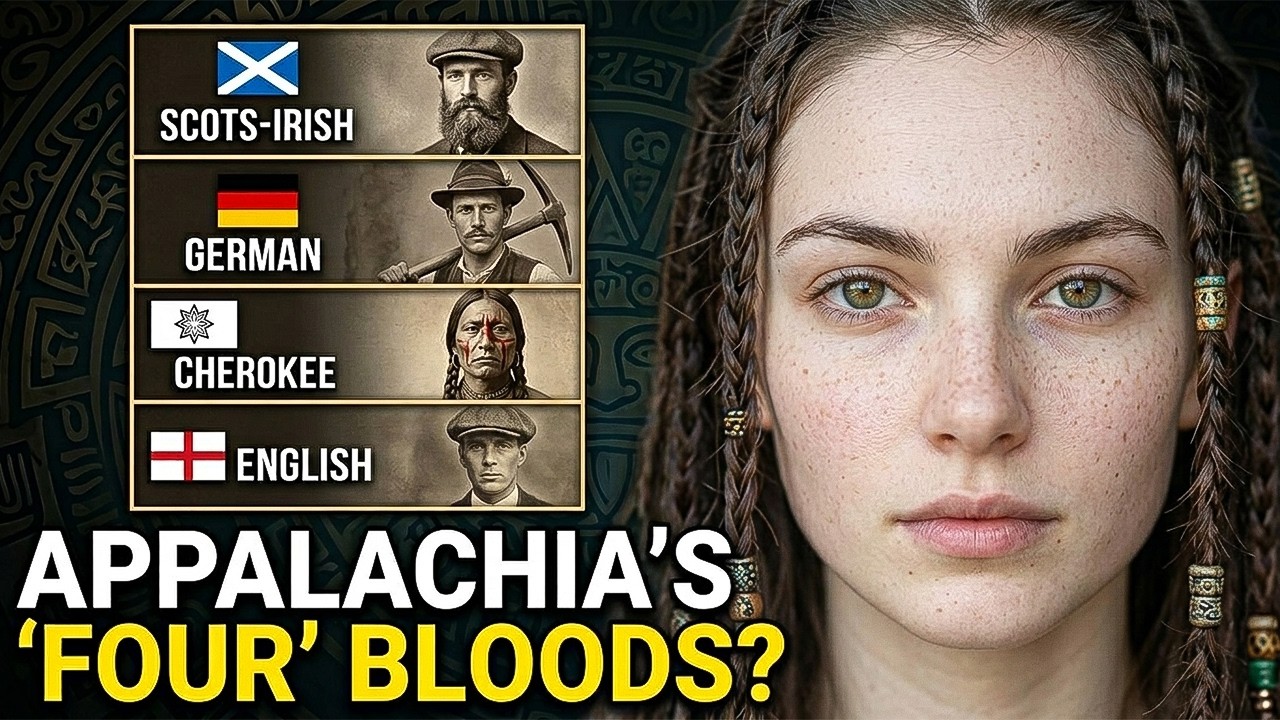
They won a case at the Supreme Court. The United States ignored the ruling and sent the army anyway. Now the second blood. The one that built the loudest reputation in these mountains, even if most people who carry it cannot tell you where it actually came from: the Scots-Irish.
The name sounds simple. It is not. These were not people who were half Scottish and half Irish in the way you might imagine. They were Lowland Scots, people from the border country between Scotland and England, who were sent to Northern Ireland in the early 1600s by the English crown as part of a colonial settlement called the Plantation of Ulster.
The idea was to displace the native Irish population with Protestant settlers loyal to the British throne. The Lowland Scots went, took land that was not theirs to take, and built a new life on contested soil. Then the ground shifted beneath them again. English landlords raised rents.
Crop failures hit hard. The Ulster famine of 1740 killed thousands. The Presbyterian faith these settlers carried clashed constantly with the Anglican establishment that ruled over them. By the early 1700s, they had endured two great displacements: driven from Scotland to Ireland, and now driven by hardship from Ireland to America.
They began arriving in large numbers in Philadelphia, starting around 1717, then turned south, not toward the settled, comfortable coasts, but toward the frontier. They were not welcome in the established ports. They moved where space existed, and authority had not yet arrived. That restless, suspicious relationship with distant power, the thing people call Appalachian independence, did not come from the mountains.
It came from two generations of watching governments take things from them. They arrived already practiced in refusing to be absorbed. There was a road, not much of one at first, little more than an old Native American trail worn smooth by centuries of feet and hooves, but it became the artery through which Appalachia was populated. The Great Wagon Road.
It started at the port of Philadelphia, where the boats came in from Ulster and Hamburg and Liverpool, and it ran south through Lancaster and York in Pennsylvania, down through the Shenandoah Valley of Virginia, through Rowan and Oak, and on into the Carolinas, Tennessee, and Georgia. At its furthest reach, it stretched over eight hundred miles. Historian Carl Bridenbaugh called it the most heavily traveled road in colonial America. In its final years, southbound traffic numbered in the tens of thousands.
The Scots-Irish moved down first, starting in the 1710s and accelerating through the mid-1700s, pushing into the backcountry not because it was easy, but because it was open. Colonial authorities were happy to encourage it. They offered cheap frontier land, sometimes free land, to settlers willing to put themselves between the established coastal colonies and the Native American tribes the settlers were displacing. The Scots-Irish, having spent generations as a buffer population between the English and the Irish, understood exactly what that arrangement meant.
They took the land anyway. By 1750, amid the French and Indian War, families were flooding south along that road every single day. The frontier suited a people whose grandparents had farmed contested soil in Ulster. It suited people whose great-grandparents had survived the reiving borders between Scotland and England.
They were not coming to be civilized. They were coming because civilization, in every form they had encountered it, had eventually tried to take something from them. So they moved toward the place that had not yet gotten around to doing it. The third blood came quietly.
Not with the same mythology as the Scots-Irish, not with the same tragedy as the Cherokee, but with plows and barns and a patience for hard soil that left a permanent mark on these mountains. Whether the history books acknowledge it or not, the Germans. Between 1710 and 1770, roughly eighty-one thousand German-speaking migrants arrived through the port of Philadelphia, most of them from the Palatinate and neighboring regions of southwestern Germany. They were farmers and craftspeople, Mennonites and Lutherans and Moravians, people fleeing a Europe that had spent decades tearing itself apart through the Nine Years’ War and the War of Spanish Succession, turning peasants into refugees without once consulting them on the matter.
The English-speaking colonists heard these newcomers call themselves Deutsch, the German word for German, and rendered it Pennsylvania Dutch, a name that stuck and misleads people to this day. By 1745, more than forty thousand Germans lived in Pennsylvania alone, building towns with names like Mannheim and Dunkard, farming the rich valleys of Lancaster and York counties, before following the Great Wagon Road south, just as the Scots-Irish had before them. They did not always travel the same road with equal hunger for the frontier. The Scots-Irish craved open land and distance from authority.
The Germans wanted fertile soil and stable ground. They moved where the farming was good, settled where the rivers ran clear, and built. Bank barns still standing in the Shenandoah Valley today carry the German hand in their design. Fraktur script, hex signs painted on buildings, communal churches that doubled as the social backbone of entire communities.
These were German contributions to a mountain culture that later got credited almost entirely to the Scots-Irish. The German blood in Appalachia is quieter than the others. It does not announce itself. It simply endured.
Here is what quiet endurance actually looks like after three centuries. In the western mountains of North Carolina, there is a community called Dutch Cove in Haywood County. Dutch here is the old Appalachian pronunciation of Deutsch, German. The community was established in 1796 by a Revolutionary War veteran of German descent.
In the Shenandoah Valley of Virginia, towns like Strasburg, Woodstock, and New Market carry German origins in their bones, even if their faces have long since become American. The surnames changed. Schmidt became Smith. Zimmermann became Carpenter.
The German language itself did not survive in Appalachia the way it did in Pennsylvania Dutch country. But the cultural fingerprints did: in the building techniques, in the agricultural methods, in the communal institutions that German settlers built wherever they landed. German settlers brought a different relationship to the land than the Scots-Irish did. Where the Scots-Irish moved when the land got crowded, the Germans stayed and improved.
They understood soil rotation. They built structures meant to last. They planted orchards. When the Scots-Irish frontier pushed further west, the Germans often stayed behind and farmed the places the others had passed through.
That created a layering of culture across the mountain region that is still visible in the genealogy today if you know how to read it. The Appalachian counties with deep German heritage tend to show it in their family records, in Lutheran church registers, in land surveys with meticulous German handwriting, in surnames that anglicize just enough to survive but not enough to disappear entirely. If your surname is Kiser, Reinhardt, Justice, Koon, or Kuntz, the German word is still inside it. Your family just learned to pronounce it in English somewhere along the way and forgot to tell anyone.
And then there is the fourth blood. The one that is always somehow assumed and rarely examined: the English. The majority of early Appalachian settlers were English or Scots-Irish. And yet, the English contribution to mountain culture gets flattened into the background in most tellings, as if it were simply the water everything else swam in, rather than a distinct stream in its own right.
English settlers had been pushing toward Appalachia from the coastal colonies since the mid-1600s. They came in two very different shapes. The first were the wealthy landowners, speculators, younger sons of English families who could not inherit under the rigid primogeniture laws of the old country, and so crossed the Atlantic looking for land they could call their own. Virginia law at one point awarded land speculators a thousand acres for every family they settled west of the Blue Ridge.
Men with money and ambition took that offer seriously. The second shape was the opposite. Poor English settlers, indentured servants who had worked off their contracts, tenant farmers who had never owned the ground they worked in England and were not going to start there. These were people who came to the mountains not because they chose wilderness, but because the coast was already taken, already claimed by the wealthy who had arrived before them.
They moved inland because inland was what was left. What the English brought to Appalachia was the legal and political architecture the other groups were then forced to operate within. The court systems, the land grant structures, the county lines themselves were drawn by English colonial authorities. When historians write about early Appalachian governance, they are largely writing about English institutional frameworks applied to a mixed population that did not always recognize themselves in those frameworks.
The laws were English. The people living under them were something more complicated. By the middle of the eighteenth century, all four of these peoples were occupying the same mountain geography at the same time. And they were not living in separate tidy categories.
They were neighbors, sometimes enemies, sometimes relatives. The Cherokee had been trading with English colonists since the 1600s. Intermarriage between Cherokee women and European traders was common enough by the late 1700s that many prominent Cherokee leaders carried European surnames alongside their Cherokee identities. John Ross, principal chief of the Cherokee Nation during the removal era, was seven-eighths European by ancestry.
He was also, by every cultural and political measure, Cherokee. Blood in these mountains was never as clean as the categories suggest. Scots-Irish settlers and German settlers often occupied the same counties, attended different churches, and slowly intermarried across a generation or two until the distinctions blurred into a shared mountain culture that borrowed from both. English settlers brought laws.
Scots-Irish settlers brought the culture of defying them when they seemed unjust. A habit rooted so deep it showed up in events like the Whiskey Rebellion of 1794, where Appalachian farmers, many of them Scots-Irish, armed themselves against a federal tax on the whiskey they distilled, having crossed an ocean specifically to escape that kind of authority. By 1790, about eighty thousand people called the Appalachian region home. By 1800, that number had nearly doubled.
The mountains filled up fast, and they filled with people who brought their grievances with them. Every family that settled a ridge or a hollow or a creek bottom brought not just seeds and tools, but a specific memory of what had been done to them before they arrived. Appalachian culture is not simple because the people who built it were not simple. They were people who had already survived things before they got here.
The history is one thing. Knowing which part of it is yours is another. And there are answers hiding in places you have probably walked past every day without once stopping to read them. Start with your surname.
If your name is Campbell, McClanahan, Buchanan, Armstrong, Elliott, Graham, or Johnston, names that ring with the border country between Scotland and England, you are almost certainly looking at Scots-Irish heritage. These are surnames that made two great migrations: from the Scottish Lowlands to Ulster, and then from Ulster to the mountains of America. They carried through both crossings intact, and they are sitting in the Appalachian genealogical record in enormous numbers. If your surname has been anglicized just slightly, if it sounds almost German but not quite, if it ends in man or smith or miller in a way that feels slightly too neat, there is a real chance it started as something else.
Schmidt became Smith. Zimmermann became Carpenter. The anglicization was practical, not shameful, but it buried the German origin under a layer of English phonetics that can take some digging to find. If your family has always lived in the mountains of western North Carolina, eastern Tennessee, or the Cherokee County areas of Georgia, and there are names in your tree that appear on the Dawes Rolls, the federal census of the Five Civilized Tribes taken between 1898 and 1914, you may be looking at direct Cherokee descent.
DNA testing can point you in that direction, but tribal rolls are what actually matter for documented Cherokee ancestry, because no federally recognized Cherokee tribe accepts DNA alone as proof of lineage. And if your surname is one of the old English county names, the Adams, the Hensley, the Phipps, the families that show up in Quaker and Anglican records from Virginia and the Carolinas, the English blood is there, quieter than the rest, but older in this country than any of the others. Knowing the history is only half of this. The real question is what it means that you carry it.
And the answer is not comfortable, because it asks you to hold more than one true thing at the same time. The Scots-Irish who came to these mountains were in many cases people who had themselves been displaced by empire before they became part of one displacing someone else. They fled English landlords in Ulster, crossed an ocean to escape that kind of power, and then within a generation were doing exactly what had been done to them: pushing a people off land those people had called home for a thousand years. The Germans came looking for peace and found a frontier defined by someone else’s conflict.
The English built legal structures that protected their own interests and called it civilization. The Cherokee built a nation by every standard the United States had specified, and were removed from their homeland at gunpoint. None of these stories are simple. None of them allow you to feel entirely good or entirely wronged.
That is the honest version of Appalachian history, and it is messier than the one that gets told at heritage festivals. The region still carries all of it. The independence that Scots-Irish settlers brought is still in the political character of these mountains. The German work ethic still shows in how mountain communities organize themselves around labor and land.
The Cherokee place names, names for rivers and gaps and ridges that European settlers kept because they were already the right names, are still on every road sign and topographic map in the region. Four bloods. Four memories. One geography.
And somewhere in that combination, if you look at your own family closely enough, you will find exactly which part of this story belongs to you. If your ancestors settled the mountain valleys and your surname carries the ring of the Scottish border country, Armstrong, Campbell, Elliott, Graham, some Scots-Irish blood almost certainly runs through you. The blood of people who crossed two oceans and never stopped moving until the mountains finally held them still. If your family name has a German shape to it, even an anglicized one, the quiet endurance of people who came from a shattered Europe and rebuilt with their hands in the soil of these ridges is part of what you carry.
If your roots run deep into western North Carolina, eastern Tennessee, or the Cherokee territories of northern Georgia, and there are names in your tree that appear in the old tribal rolls, the oldest blood on this continent is still moving through your veins. The blood of people who refused to leave these mountains, even when the army came. And if your surname is English and your family came down from Virginia or the Carolinas into the backcountry in the 1700s, the founders of the legal and cultural framework that all the others were forced to navigate are your people. None of these bloods ever left.
They just stopped being separate. They became Appalachian instead. And now so did you.






