The woman stood with her back bent because the roof would not let her stand all the way up. Her shoulders had learned the angle. Her hands were cracked to the knuckle, the skin split weeks ago, and what healed over split again because the work did not stop long enough to let it close. There was no window.
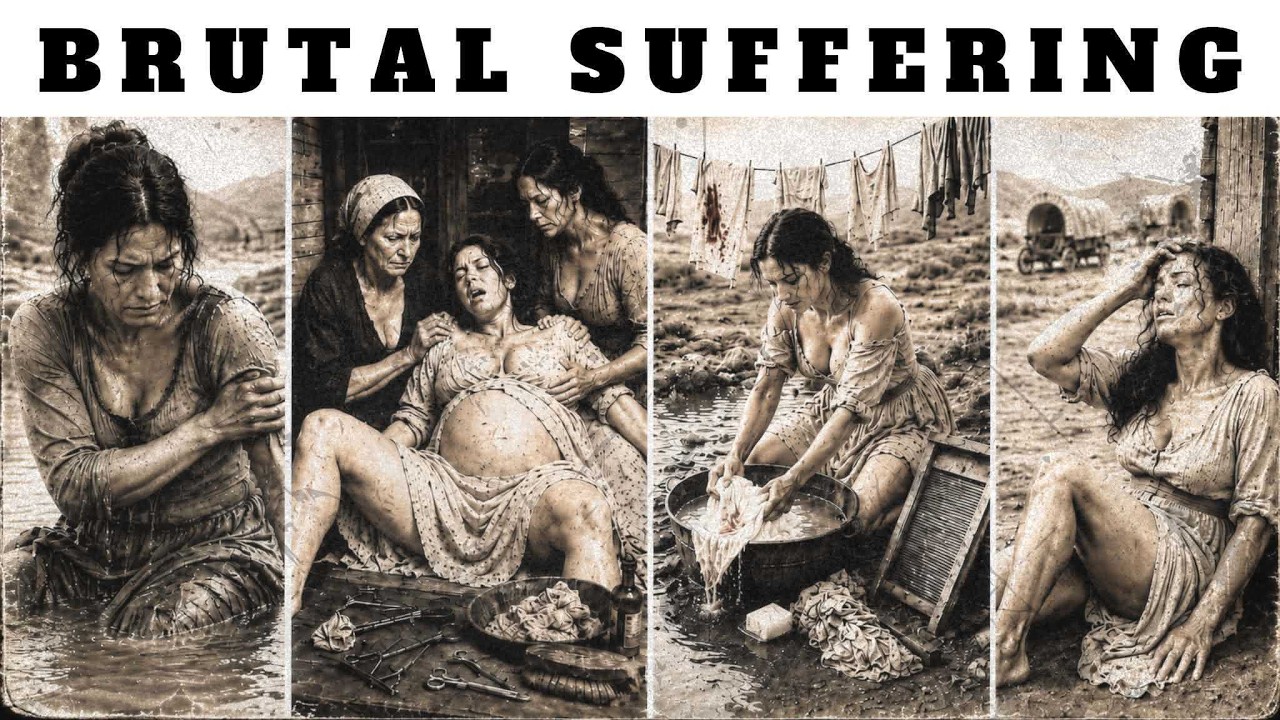
There was no door that locked. A blanket hung across the opening, and when the wind pulled it aside, the whole prairie looked in. The nearest clean water was a quarter mile east down a slope. She would walk twice that day, carrying a pail that weighed more on the way back.
The nearest doctor was a day and a half by horse, if the horse was sound and the weather held. Most days she was the only medical knowledge her family had. Most days she was the only everything her family had. She was not a character and not a metaphor.
She lived here. Thousands of women lived in dugouts and soddies and shanties that would not survive a single modern building inspection, and they stayed for the years it took to find out whether the land would keep them or kill them. It began with the first breath she fought to give someone else. A pioneer birth happened in a one-room sod house or under a canvas wagon top.
The whole family was right there: husband, older children, sometimes strangers sharing the same stretch of trail. The only partition was a quilt hung on a rope. On the Overland Trail, women labored with the sound of oxen and other families talking just feet away. There was no sterile room and no closed door.
What she got was a blanket on a rope and hope the wagon behind hers was not too close. On an isolated homestead fifty miles from the nearest neighbor, there was no one else. The husband delivered the baby. He had no training and no tools.
If something went wrong, there was no second pair of hands. Some of these men wrote about it in their journals, and the terror comes through plain. The same hands that split fence rails that morning caught the baby that night. If the cord was wrapped or the baby did not breathe, he was on his own with God and nothing else.
The most common drug used to speed a stalled labor was ergot of rye. It worked by forcing the uterus to contract violently. Too much, and the uterus ruptured; too much, and the blood supply to the limbs shut down, and gangrene followed. In 1824, Dr.
William Dewees published a warning that ergot had destroyed more lives than it had saved. Doctors kept prescribing it for another fifty years. On the frontier, women dosed themselves from folk recipes with no way to measure the strength. The cure was often worse than the wait.
Ether had been demonstrated in 1846, and chloroform followed a year later. Queen Victoria herself used chloroform during a delivery in 1853. But in America, the most powerful obstetrician in the country refused to allow it. Dr.
Charles Meigs of Philadelphia told his students in 1848 that pain in childbirth was a desirable and conservative manifestation of the life force. To remove it, he said, was to defy God. The frontier woman did not lack the drug because it had not been invented. She lacked it because a man in a lecture hall decided she was meant to suffer.
Amelia Stewart Knight’s diary entry is plain. She delivered, and the next day she recorded the miles walked. No rest, no recovery. On a homestead the animals needed feeding by dawn and the children still needed minding; the crop was not going to wait.
Women who had given birth that same morning were hauling water before the sun went down. The average frontier woman bore between seven and ten children. Some bore more. Pregnancies came back to back, often while she was still nursing the last one.
Calcium leached from her bones. Her spine compressed. Her organs shifted and never returned. A woman of thirty-five on the frontier could carry the skeleton of someone twice her age.
She did not wear out from years. She wore out from use. The umbilical cord was cut with whatever was at hand: a kitchen knife, sewing scissors, sometimes a piece of broken glass. If the blade was dirty, the wound let in Clostridium tetani.
They called the result the nine-day fits because the convulsions began around the ninth day of life. In some frontier counties, neonatal tetanus was the single leading cause of newborn death. The baby survived the birth and died from the blade that cut the cord. A baby presenting feet first or sideways, or a labor that stalled for days with no progress, were death sentences for the child and often for the mother.
Forceps existed but were almost never available on a remote homestead. In untrained hands they caused as much damage as the obstruction itself. In a city a doctor might be summoned within the hour. On the plains the nearest doctor was a three-day ride away, and the baby was not going to wait three days.
Before antiseptic surgery, opening the abdomen meant infection, and infection meant death. The maternal mortality rate for a cesarean before antiseptics ran above ninety percent by most estimates. The most famous exception is Dr. Jesse Bennett, who reportedly performed a cesarean on his own wife, Elizabeth, on a crude wooden table in the Virginia backcountry in 1794.
She survived, but the account was not published until 1830, by a colleague, not by Bennett himself. No contemporary document confirms it. The frontier produced exactly one famous cesarean survival story, and it may not even be true. Thousands of pioneer women carried pregnancies across the Overland Trail and delivered babies who never drew breath.
Historians estimate that between twenty and thirty thousand graves line the Oregon, California, and Mormon trails. A significant share of them belong to infants born dead or dying. Many of those graves were left unmarked or deliberately disguised to prevent animals from digging. In some accounts, the mother dug the hole herself, and the wagon train moved on in the morning.
When a mother died in childbirth or was too ill to nurse, the family tried feeding the newborn cow’s milk or sugar water through a rag. Studies from the period show the mortality rate for hand-fed infants ran above fifty percent in the first year. The mother and the child were one system, and when that system broke, both halves usually failed. Uterine prolapse, fistulas, and pelvic floor damage were common among women who delivered repeatedly with no medical care and went straight back to hauling water and splitting wood.
These injuries lasted a lifetime. They were painful and humiliating, and almost no one treated them. In the 1840s, Dr. J.
Marion Sims developed a surgical repair for one of these conditions, but his patients were enslaved women in Alabama, and the procedure did not reach frontier women for decades. She carried the injury from her first birth to the grave. No one called it an injury. They called it womanhood.
Infant and child mortality on the frontier ran between twenty-five and forty percent in the hardest years and places. A woman who bore eight children might bury three or four before they reached the age of five. Dysentery, measles, scarlet fever, diphtheria, a fall from a wagon, a winter that would not end. The grief was cumulative and unending, and the culture expected her to bear it quietly and conceive again.
The headstones, where there are headstones at all, are the size of a shoe. And then there was childbed fever. The birth goes well. The baby lives.
The mother seems fine. Then two or three days later the fever begins, the abdomen swells and hardens, the pain becomes unbearable, and within a week she is dead. In case after documented case, the bacteria were introduced on the unwashed hands of the very person who delivered the baby. In 1847, a Hungarian physician named Ignaz Semmelweis proved it.
At the Vienna General Hospital, the maternity ward staffed by doctors had a death rate near one in six; the ward staffed by midwives had a death rate far below that. The doctors came straight from the autopsy room to the delivery room without washing their hands. Semmelweis ordered his staff to wash in chlorinated lime solution, and the death rate fell to below one in fifty almost overnight. He published the data.
The medical establishment rejected him. He was mocked and dismissed from his post, and in 1865 he was committed to an asylum, where he died within two weeks. He was forty-seven years old. On the frontier, births attended by experienced midwives, women who worked only with laboring mothers and never touched a corpse, had significantly lower death rates than births attended by physicians.
The replacement of midwives by doctors was sold as progress. The data said the opposite. The hand that was supposed to save her was the hand that killed her. But birth was only the door she walked through.
The body she labored in still had to be kept alive the next morning, and the morning after that. By the time she was thirty-five, tooth decay was nearly universal. Martha Ballard, a midwife in rural Maine, recorded tooth extractions in her diary: no anesthetic, a pair of common pliers, the patient held down by her own family. Katherine Beecher’s 1841 manual recommends salt and charcoal rubbed on teeth with a rag or a chewed twig, and nothing else.
Abscesses went untreated until they burst or killed. The daguerreotypes that survive show women barely past twenty with teeth already missing. Hollywood casts them with full white smiles. The camera is lying before the first frame rolls.
The real reason pioneer women wore their hair pulled tight and covered was not modesty. It was containment. Lydia Maria Child’s 1832 manual and Katherine Beecher’s 1841 guide both recommend kerosene combed through the hair to kill lice, and lard smeared on the scalp and wrapped overnight to suffocate them. Narcissa Whitman wrote about the difficulty of even basic hair care on the overland journey.
Hair washing with water happened once a month or less. That tight braid under a bonnet was not a fashion choice. It was a woman holding a losing line against creatures that never stopped coming. A woman in the dark in January, walking thirty yards to a hole in the frozen ground: that was the outhouse.
On the trail there was no outhouse at all. Amelia Stewart Knight wrote about it in her 1853 diary, describing the humiliation of finding privacy on open prairie with hundreds of wagons in the train. Women formed circles with their skirts to shield each other. Chamber pots served in winter, open ground in summer.
When dysentery struck, even those small dignities collapsed. The old saying about not throwing the baby out with the bathwater was not a joke. It was a real warning. Katherine Haun, crossing the plains in 1849, described bathing in rivers when the train stopped, with no privacy and livestock upstream.
On the homestead, Saturday night meant one tub and one pot of heated water: father first, mother second, children oldest to youngest. By the last child, the water was gray. In 1870, not a single homestead on the Kansas plains had running water. Lice did not visit.
They moved in. They lived in the bedding, in the seams of every garment, in the children’s hair. Lydia Allen Rudd’s 1852 trail diary mentions them so often they become background noise. Mattresses stuffed with prairie grass were breeding grounds, and frontier hotels were notorious.
Period newspapers carried complaints from travelers who woke covered in bites. Women fought this war every single day with boiling water and kerosene, and they never fully won. Monday was wash day, and wash day was the most dangerous day of a frontier woman’s week. Water was hauled and heated over an open fire.
Lye soap ate the skin raw. Clothes were beaten on rocks and wrung by hand for hours. A full wash for a family of eight ran from sunup to sundown, and burns were common and serious. On the trail, women sometimes washed in alkali water that blistered their hands down to raw flesh.
Laundry was not a chore. It was a day-long physical ordeal with real injury risk. Think about what a pioneer woman was actually wearing against her skin. A chemise, the only layer that touched the body, and over that stays or a corset, petticoats, a dress, an apron.
Drawers as we know them did not become common for women until the middle of the century. The outer dress might go weeks between washings, with sweat, blood, food, dirt, and smoke all soaking into fabric that could not easily be cleaned. Susan Magoffin, crossing the Santa Fe Trail in 1846, described her clothing falling apart on her body. Most frontier women owned two dresses.
Some owned one. Lydia Maria Child published the recipe for lye soap in 1832: hardwood ash lye mixed with rendered animal fat. The process itself could scar you. Lye is caustic, and rendering fat over an open fire is a burn waiting to happen.
The resulting soap stripped every oil from the skin and cracked the hands that used it. It was the only soap most frontier women ever touched. Every pioneer woman of childbearing age dealt with menstruation every single month, and it appears in almost no diary, no letter, no novel, and not one frame of film ever made. The silence itself is the evidence.
What survives are scattered references to being unwell in private letters and instructions in domestic manuals for making rags. On the trail there was no running water, no privacy, no reliable way to wash those rags. Women bled through their clothing and kept walking. Staining patterns on surviving period garments confirm it.
Contaminated water was the single deadliest hygiene failure on the frontier. The Oregon-California Trails Association estimates that twenty to thirty thousand immigrants died on the overland trails between 1840 and 1860, and cholera, a waterborne disease, was the leading killer. One in ten who started the trail did not finish it. John Snow proved in London in 1854 that cholera spread through water, but the immigrants had no way to know.
They drank from streams where dead oxen lay upstream and filled cooking pots from creeks where hundreds of camps had dumped their waste. Lydia Allen Rudd recorded passing grave after grave along the Platte, the dead buried shallow or not at all. The living drank from the same water that ran past the dead. Cholera could kill in hours.
A woman healthy at breakfast could be gone by nightfall. When the knife slipped or the child fell, a frontier woman reached for turpentine poured straight into the wound, spiderwebs pressed into cuts to slow the bleeding, poultices of bread and milk, poultices of cow dung which introduced infection directly. Burns were treated with lard, which trapped the heat and made the damage worse. These women were not foolish.
They used what they had and what they had been taught. But germ theory did not exist in common knowledge. The cure was often the killer, and no one alive could have told them why. Home canning spread across the frontier in the second half of the 1800s, but the science of safe preservation lagged far behind the practice.
Botulism from improperly sealed jars appeared in period medical records. Meat went bad in salt brine. Milk soured within hours during summer. Air in badly stored grain poisoned entire households.
The woman who stocked the pantry bore the blame when something went wrong. One bad seal on a canning jar, one warm afternoon in the root cellar, and the food she had worked all harvest to preserve became the thing that killed her family. By some trail historians’ calculations, there was a grave every eighty yards from the Missouri River to the Willamette Valley. Cholera, dysentery, typhoid: all hygiene-driven.
Amelia Stewart Knight wrote in 1853 of passing seven new-made graves in a single day. Lavinia Frizzell in 1852 described the smell of decay streaming from shallow graves along the trail. The women did the nursing. They wiped fevered children with dirty rags and buried them in graves they dug with their own blistered hands.
Then they walked on. Frontier child mortality was staggering. In some regions and trail years, between twenty-five and nearly fifty percent of children died before the age of five. The causes were overwhelmingly tied to hygiene: diarrheal disease from contaminated water, infant dysentery, what they called the summer complaint, measles and whooping cough ripping through crowded trail camps, diaper cloths washed in the same compromised water.
Amelia Stewart Knight, eight months pregnant on the trail, recorded one child’s illness after another in a steady, quiet hand. Today, fewer than seven children in a thousand die before age five. On the frontier it could be two hundred fifty or more. She survived the trail.
She survived the winter. She survived the labor itself. And then the hands that delivered her baby killed her. In 1847 Semmelweis proved it at the Vienna General Hospital: doctors walking from autopsy rooms straight to the delivery ward without washing their hands were killing mothers at rates reaching one in three.
Oliver Wendell Holmes argued the same thing in America in 1843, and the medical establishment attacked him for it. On the frontier, conditions were worse: deliveries on dirt floors attended by neighbors whose hands had just come from the barn or the field, no antiseptic, no understanding of germ theory for decades to come. Martha Ballard documented hundreds of deliveries and maternal deaths in her diary. The timeline was always the same.
The baby arrives safely. The mother smiles. Forty-eight hours later the fever begins: chills, rising heat, abdominal pain that becomes agony. Within a week she is dead.
The thing that killed pioneer mothers was not the wilderness, not the weather, not the distance. It was human hands during the most vulnerable moment of their lives, and it was preventable by knowledge that already existed and was being ignored. The Saturday night bath had a strict pecking order. One tub, one fire, one kettle of heated water carried across the cabin.
Father went first, then mother, then the children, eldest to youngest, into the same water. By the time the smallest child went in, it was gray and barely warm. There was no draining and refilling. Water was hauled by hand, heated over a fire, and used until it was gone.
The old warning was advice from a time when the baby went last and the water was too dark to see through. Lydia Maria Child published The American Frugal Housewife in 1829. In it she laid out how to make soap from rendered animal fat and hardwood ash lye, boiled for hours in an iron kettle over an open fire. You tested its strength on the back of your hand.
Too weak and it would not cut the grease; too strong and it burned. There was no measured formula. A frontier woman gauged the chemistry by feel, batch after batch, year after year. The real bar smelled of tallow and wood smoke, and it could peel the skin off your knuckles.
Godey’s Lady’s Book, the most widely read women’s magazine of the nineteenth century, recommended washing the hair no more than once a month. The methods were egg yolk beaten into the scalp, borax dissolved in rainwater, or castile soap if you could afford it. Between washings a woman dragged a boar-bristle brush through her hair. On the trail and in the soddies, even monthly was too often to manage.
Lice were constant. The swept-up hair in every western was in real life often matted and crawling. A sponge bath was the only daily routine most women ever knew: a basin, a rag, and a pint of heated water, for the face, neck, hands, and underarms, and nothing more. Mollie Dorsey Sanford kept a diary on the Nebraska frontier starting in 1857.
In her pages, a full bath was an event worth writing down. Most mornings the cat wash was everything she got. Full immersion meant heating a full tub of water, which meant burning fuel, which meant labor, which meant daylight she could not spare. A single bath could cost a woman half her morning.
Most mornings she chose the rag. Masking the smell was a science of its own. Vinegar dabbed behind the ears, lavender sachets stitched inside a petticoat, camphor tucked into an apron pocket, rose water if you could get it, and most could not. Women chewed cloves or fennel seed to manage their breath.
The smell inside a frontier cabin was wood smoke, animal grease, sweat, and lye. Where running water was close, women used it, but social codes did not bend for comfort. Bathing without clothing in daylight was unthinkable in that world. Many bathed fully dressed or waited until after dark.
A woman in soaked skirts and petticoats caught in a river current carried thirty extra pounds of wet cloth pulling her down. Drownings along the immigrant trails were documented in plain language. The Overland Trail destroyed every routine a woman had. Amelia Stewart Knight’s 1853 diary records weeks of alkaline dust that cracked her lips and burned her eyes.
The water along stretches of the trail was not dirty; it was caustic. Women who washed their faces in it came away with reddened, peeling skin. There was no fuel to heat bath water, no privacy behind a canvas wagon with forty families camped within earshot. Catherine Haun, bound for California in 1849, wrote of water rationed strictly for drinking, with nothing left over for washing.
Five months on that trail, and the last real bath a woman remembered might have been back in Missouri. Winter on the plains could mean months without washing at all. Inside a sod house on the Nebraska frontier, the air could hover near freezing for weeks. Water froze in the basin before morning.
Heating a full tub meant burning fuel, and every twisted stem of hay, every dried buffalo chip, every corncob burned for bath water was one not burned to cook a meal or keep a child alive through the night. Some families went from November through March without a single full bath, not because they did not want one but because the arithmetic of survival would not allow it. A woman chose between her body and her children. She chose the children every time.
The bath house existed, but it was not built for her. In Dodge City, Virginia City, and Abilene, a hot bath could be bought for twenty-five cents, but the tub sat in a back room behind the barbershop or upstairs from the saloon, spaces built for trail hands and cattlemen and miners. An unaccompanied woman walking into one of those rooms would have drawn stares at best. For the farm wife on a quarter section twenty miles from town, the bath house did not exist.
After childbirth, a frontier woman was confined to bed and full washing was forbidden, sometimes for two weeks, sometimes longer. Gunn’s Domestic Medicine, first printed in 1830 and carried west in thousands of wagons, warned that bathing too soon after birth could bring childbed fever. In an era when puerperal fever killed roughly one in every twenty to forty women who gave birth, the fear behind that rule was not irrational, but the cost was real: weeks unwashed in the same bedding in a cabin with no ventilation. A toothbrush was a luxury most frontier women never held in their hands.
Salt rubbed on the gums with a finger, baking soda if it was available, soot from the fireplace used as a crude abrasive. Many used nothing but a frayed willow twig. By her mid-thirties a frontier woman was likely missing several teeth, and gum disease was a constant companion. The dominant medical theory of the eighteenth and nineteenth centuries held that disease entered through open pores.
Warm water opened the pores, therefore bathing invited sickness in. Dr. William Buchan published Domestic Medicine in 1769; it was reprinted for nearly a century, became one of the most widely owned medical books in frontier households, and warned against frequent bathing. This woman was not ignorant and not backward.
She was following the best advice her world could give her, and the advice was wrong. And the rags were real. That phrase “on the rag” came from strips of cotton or linen folded and pinned between the legs, worn all day under layers of skirt. When the day was done, a woman washed that cloth in the same river her family drank from, the same basin that cleaned their wounds, with cold water and lye soap that stripped skin raw, no drying rack in a moving wagon train, wet cloth reworn the next morning.
For most of the frontier era, women wore split drawers open at the center, designed for practicality under long skirts, not for holding anything in place. There was no elastic, no waistband that gripped, nothing to attach a cloth to. Everything stayed where it was by folding, by friction, and by hope. When cloth was not available, the land provided.
Sphagnum moss in the Pacific Northwest, buffalo grass on the open plains, wool scraps where sheep were kept, rabbit fur in the mountain camps. Sphagnum moss absorbs up to twenty times its weight in moisture. The Red Cross used it for wound dressings in the First World War. Frontier women knew it long before that.
The trail diaries tell you almost everything about a pioneer woman’s life, what she cooked, what she feared, how her children cried at night. But the word menstruation appears almost nowhere. What appears instead is “unwell,” “sick,” “the curse,” “my monthly. ” Some diaries run for years without a single reference.
Into that silence walked Lydia Pinkham. In 1875, from a kitchen in Lynn, Massachusetts, she bottled something she called a vegetable compound. By the 1880s it was the most widely advertised product in America, promising relief from “female complaints,” a phrase that covered everything from cramps to a prolapsed uterus. The active ingredients were black cohosh, fenugreek, and up to eighteen percent alcohol.
One bottle cost a dollar, a full day’s wages for a working woman. Pioneer women drank it because there was nothing else on the shelf. The menstrual belt, a cotton or elastic waistband with clips to hold a folded cloth in place, came later. The Hoosier sanitary belt, patented in the 1890s, was one of the first commercial versions.
Before that, women built their own from strips of fabric and whatever fastener they could find. The belt sat against the skin under every layer all day. Adjusting it meant undressing. In a one-room sod house with a husband and six children, that meant waiting until dark.
In March of 1873, Congress passed the Comstock Act, and Anthony Comstock personally supervised its enforcement. The law classified information about menstruation, contraception, and female health as obscene material: illegal to mail, illegal to publish, illegal to distribute. A woman on a homestead in Nebraska in 1880 could not legally receive a pamphlet explaining what was happening inside her own body. The penalty was up to five years in prison at hard labor.
The law did not just suppress products. It suppressed knowledge, and it worked. The work did not stop, not for a day, not for an hour. Catherine Haun’s diary, held at the Bancroft Library, records women walking fifteen to twenty miles a day beside the wagon, cooking over open fire at every stop, hauling water, lifting children.
Illness changed nothing in the schedule. A wagon company of two hundred people moved in a column across open prairie. No trees for a hundred miles, no outhouse, no tent. Women developed a system.
They would walk to the far side of the wagon before dawn, fall behind the column, and crouch with their skirts spread wide as a shield. That was the only wall they had. Without clean water, without soap that did not strip the skin, without any understanding of bacteria until the end of the century, reused menstrual cloths bred chronic irritation and worse. Medical texts from the era reference conditions they called uterine catarrh, and they blamed the women, not the conditions.
There was no sex education. Mothers often could not bring themselves to explain. Katherine Beecher published the most detailed domestic guide of the era, covering everything from bread to bookkeeping. Menstruation did not appear.
Girls learned what was happening to them by having it happen. Multiple first-person accounts from the late nineteenth century described girls who believed they were dying when their first blood arrived. When a woman’s body reached the end of its fertile years, the frontier medical literature classified every symptom of menopause under hysteria or nervous collapse. Dr.
Edward Clarke published Sex in Education in 1873, arguing that female biology made women unfit for serious work. Hot flashes, mood changes, irregular bleeding: the prescription was bed rest, opiates, or an asylum. Every condition from cramps to cancer was filed under two words: female complaints. It was not just a euphemism.
It was a diagnostic dead end. Frontier doctors would not examine women, would not name what was wrong, would not look. Women died of ovarian cysts and ectopic pregnancies that were never treated because no one would investigate. The letters pioneer women wrote to Lydia Pinkham’s company, archived at the Schlesinger Library at Radcliffe, described their symptoms in heartbreaking detail.
They wrote to a patent medicine company because it was the only place that answered. The average frontier woman bore seven to ten children. Census data from the 1850s through the 1870s shows average family sizes of eight to twelve in frontier counties. Pregnancy suppresses menstruation, and so does breastfeeding, which lasted up to two years per child because there was no alternative food for an infant.
A woman who married at eighteen and bore ten children spent the majority of her fertile life either pregnant or nursing. The monthly problem was not monthly for her. It happened in the gaps between pregnancies. Between relentless pregnancy, years of breastfeeding, chronic malnutrition, extreme physical labor, and dangerously low body fat, many frontier women experienced amenorrhea, the absence of menstruation, not for a month but for years at a stretch.
A modern woman will menstruate roughly four hundred fifty times in her life. A frontier woman who bore ten children may have menstruated fewer than fifty times in hers. Their bodies were under such relentless strain that menstruation was a luxury their biology could not afford. Every frontier woman made soap.
She had no choice. The process meant leeching wood ash into water until it turned caustic, then boiling it with animal fat in an open kettle over a fire. Katherine Beecher warned about it plainly in her domestic receipt book in 1846. One splash could blind; a full spill could kill.
Women did this chore every month, stirring a pot of boiling alkali in long skirts beside an open flame. The county records that survive call these deaths scalding or accident. They almost never record the woman’s name. Along the Platte River route, the springs turned white with alkali.
Lavinia Frizzell wrote about it in her diary in 1852. The smell hit you before you saw the water. Dead cattle bloated beside the holes, tongues black, bellies split in the sun. The families drank anyway because there was nothing else for miles.
The cramps began within the hour. Add to that the lead leaching quietly from pewter cups and tin cookware, the arsenic woven into green dyed fabric that women handled every day, the wild plants that looked right but were not. A woman reaching into a woodpile at dusk, a barefoot stepping off the threshold of a dugout in Kansas, a hand brushing tall grass while gathering buffalo chips for the evening fire. Trail diaries record these deaths the way they record weather, matter of fact, brief.
There was no antivenom anywhere on the continent. Treatment was whiskey, turpentine, or a mud poultice, and none of them worked. A bite on the hand while gathering kindling could kill in hours. Amelia Stewart Knight recorded her children falling, slipping, nearly crushed over and over across hundreds of miles.
The wheels were iron-rimmed and weighed hundreds of pounds. The oxen did not stop on command. A fall from the wagon seat onto hard-packed ground could break a spine. A stumble beside the wheel could pull a woman under before the driver even knew.
Most women walked beside the wagon every step, fifteen miles a day, sometimes twenty, in thin, soled shoes beside a two-thousand-pound machine that could kill them with one wrong step. River crossings were the most feared stretch of any overland trail. Wagons overturned in current. Makeshift ferries capsized without warning.
Women slipped on wet rock while kneeling to wash clothes at the water’s edge, and their heavy wool and cotton skirts soaked through and pulled them under before anyone could reach them. The documented drownings at the Green River crossings in Wyoming alone fill pages in the immigrant records. At the Dalles of the Columbia, entire families were lost when rafts broke apart in rapids. Cooking over an open fire in floor-length skirts was a daily gamble.
The buffalo chip fires of the plains were volatile and unpredictable. A gust of wind, a shift in draft, and the hem caught. Kansas and Nebraska newspapers in the 1870s and 1880s reported women’s deaths by burning with a regularity that should disturb anyone reading them today. Three times a day, every day, these women stood over open fire in clothing designed to catch it.
Cholera could take a healthy woman at breakfast and put her in the ground by nightfall, twelve hours. The epidemics along the Oregon and California trails between 1849 and 1855 are among the best-documented mass death events in American westward expansion. Graves lined the trail every half mile in the worst years. The women who nursed the sick and washed the soiled bedding had the highest sustained exposure of anyone in the wagon party.
A woman survived labor. The baby lived. And then three days later the fever began: puerperal sepsis, infection carried by unwashed hands, unsterilized instruments, and a complete absence of germ theory. Semmelweis proved in 1847 that handwashing could stop it.
The medical establishment ignored him for decades. On the frontier, a neighbor helped deliver the baby, then went home. The mother burned with fever, delirious, the newborn crying beside her. County death registers recorded it the same way every time: died in childbed.
No further detail, no cause, no name for what killed her. Exhaustion. They called it giving out. A woman on the Overland Trail walked fifteen to twenty miles a day, often pregnant, often carrying a child on her hip.
At camp she cooked, washed, mended, hauled water, and started again at dawn. On the homestead it was no different: hauling, splitting, plowing, harvesting, preserving, bearing a child every eighteen months to two years. The frontier had no medical language for working a woman to death. It was not a cause of death.
It was just life. The wind never stopped. Miles of grass in every direction, no tree, no neighbor, no sound but the wind and the silence underneath it. Women on the Kansas, Nebraska, and Dakota plains lived in sod houses with no window in an isolation so total it broke them.
O. E. Rølvaag wrote it into Giants in the Earth in 1927, but the asylum commitments from the period tell it without poetry. Women walked into the snow.
Women drank laudanum from the medicine chest. Women set fire to the house they could not leave. Hemorrhage. Uncontrolled bleeding during or just after labor, far from any surgical help: a retained placenta, a torn uterus, a breech birth gone wrong in a cabin lit by one candle.
There was no cesarean section that a frontier woman could survive. Most births were attended by a midwife or a neighbor or no one at all. When the bleeding started, there was nothing to stop it, no sutures, no transfusion, no ambulance. It meant dying on a dirt floor while your husband stood outside the door and listened.
A frontier woman could expect to be pregnant or nursing for most of her adult life. Six pregnancies, eight, ten, twelve. Each one a roll of the dice with no doctor holding the odds. Eclampsia, obstructed labor, breech presentation, prolapsed uterus, ectopic pregnancy that no frontier physician could diagnose, let alone treat.
There were no forceps in most cabins, no chloroform, no clean hands. Maternal mortality on the frontier is estimated at roughly one death for every hundred live births, some estimates higher. A woman who bore eight children faced something close to an eight percent chance of dying somewhere in the process. In Wabaunsee County, Kansas, a woman named only as Mrs.
Brewer in the 1868 county register bore seven children and died with the eighth. One line. No first name. That is all the record kept of her.
Childbirth killed more pioneer women than anything else on the frontier. But it was not labor that killed most of them. It was not the pain, the screaming, the drama a camera could capture. It was what came after: the fever, the infection, the silence three to five days later.
Every one of these truths lived in the same body on the same day. The woman who bled into rags she rinsed in a creek was the same woman who delivered a child on a dirt floor and buried another before spring. What we separated into chapters was for her a single life lived in a body the myth could not afford to show. She was one woman, whole and unfinished, and no one asked what it felt like.
She was not alone. There were women like her in every territory, on every stretch of open land the government handed out and called opportunity. Some of their names survived. Most did not.
What survived were the homestead filings with a husband’s name on the front page and hers nowhere. What survived were photographs where she stands beside a sod house, face unreadable, because the camera needed her still, and that version was the only one anyone kept. What survived were letters to sisters back east where she said the weather was hard and the children were growing, and did not say the rest because it did not fit in a sentence. The dugout is still there if you know where to look.
The roof caved in decades ago. Grass has grown over the entrance so completely you could walk past and never know someone lived beneath your feet. If you kneel and look down, you will see the room she spent her years in. You will see how small it was.
She is gone. No studio filmed what she carried. No plaque lists the children she delivered in the dark. But the prairie remembers what the myth would not.
She was real. The record was not. And now you know what it left out.






