In the last days of April 1945, deep inside the Führerbunker in Berlin, Adolf Hitler was waiting to be rescued. The Soviet Army was less than a mile away. The city above him was burning. His generals were dead, captured, or retreating.
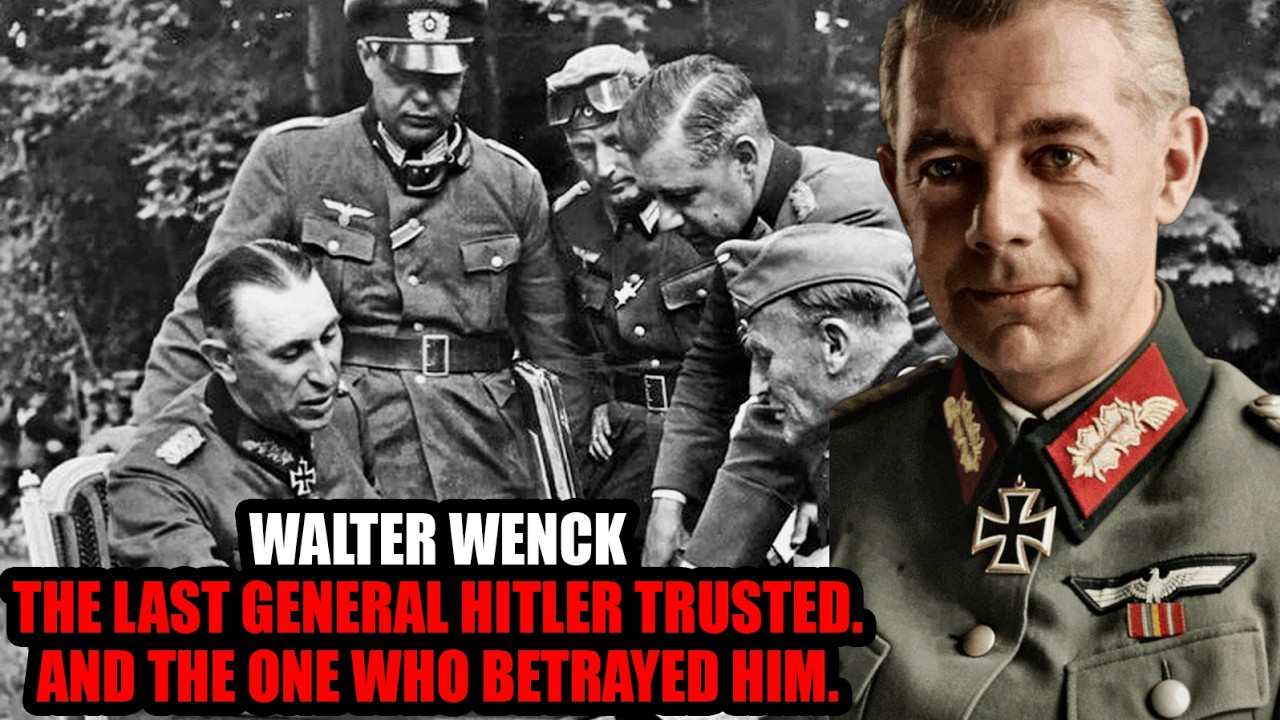
His closest allies had already begun negotiating their own surrenders behind his back. And Hitler was standing over a map table, moving units that no longer existed, planning a relief operation that every professional soldier around him knew was a fantasy. He was waiting for one man: Walther Wenck, commander of the 12th Army, the last coherent German military force on the Western Front. Hitler had personally ordered him to turn his forces around, abandon the Americans he was facing, drive east through Soviet lines, and relieve Berlin.
Hitler trusted Wenck completely. He believed Wenck was coming. He made his final military decisions based on that assumption. Walther Wenck was not coming.
Walther Wenck was born on September 18, 1900, in Wittenberg, into a military family. He was part of a generation slightly too young for the First World War—old enough to be shaped by it, but formed in the professional, rigorous military education of the interwar Reichswehr. He developed into a staff officer of exceptional quality, the kind of operational mind that could look at a situation with all its constraints and variables and find the solution that actually worked. Through the 1930s he rose steadily through the Wehrmacht’s ranks.
He served in France in 1940, in the Balkans, and then on the Eastern Front, where the scale of operations gave officers of his caliber the chance to prove themselves. By the middle years of the war, he was one of the most capable operational planners in the German Army. Not famous in the way of Rommel or Guderian, but the kind of general other generals wanted on their staff when the situation was genuinely difficult and the margin for error was zero. In early 1945, at the age of 44, he was appointed Chief of the Army General Staff, one of the most senior positions in the Wehrmacht.
The war was obviously lost. Germany was being compressed from both sides, Soviet forces driving from the east, American and British forces from the west. The only questions were how long the collapse would take and how many more people would die before it was complete. Wenck sat in planning meetings and looked at maps that told a story with only one possible ending.
He did his job with the professional precision that had characterized his entire career, because that is what professional soldiers do, even when the cause is lost. Then, in February 1945, something happened that nearly killed him. Driving back from a briefing late at night, exhausted after days without proper sleep, he fell asleep at the wheel. His car went off the road and rolled down an embankment.
He suffered serious injuries: broken ribs, a fractured skull, injuries that put him in hospital for weeks at a point in the war when weeks were everything. He was still recovering when April arrived and the Soviet offensive that would end the war in Europe began its final push toward Berlin. Hitler needed an army. More precisely, he needed the last army.
The 12th Army had been assembled on the Elbe River facing the Americans, a scratch force of whatever units could be gathered: young soldiers, old soldiers, men pulled from training establishments and rear area units, remnants of formations destroyed and reconstituted so many times they barely existed as coherent organizations. It was not, by the standards of the Wehrmacht’s peak years, an impressive force. But in April 1945, it was real. It was organized.
It was in the field. And it was the last thing resembling a complete German army on the Western Front. Hitler ordered it east. He ordered Wenck, still not fully recovered from his injuries, to take command, turn the army around, drive through the Soviet forces surrounding Berlin, and relieve the capital.
He told Wenck this operation would decide the outcome of the war. That Berlin must be held. That the fate of Germany depended on what the 12th Army did in the next few days. Wenck looked at the orders.
He looked at his maps, his forces, the forces opposing him, the distances, the state of the roads, the supply situation. He understood immediately, with complete clarity, that what Hitler was ordering was not possible. The Soviet forces surrounding Berlin were not a thin screen that could be penetrated by a determined thrust. They were a massive concentration of armor, infantry, and artillery that had been building for weeks, outnumbering anything Wenck could bring by margins that made the arithmetic obvious.
A serious attempt to drive to Berlin would destroy the 12th Army without relieving Berlin, leaving nothing between the Americans on the Elbe and the complete collapse of whatever remained of organized German resistance in the west. But Wenck understood something else. Between his army and Berlin, in the forests and along the roads, there were civilians. Hundreds of thousands of German civilians.
Refugees from the east who had been fleeing the Soviet advance for months. People who had heard the stories of what happened to German civilians in the path of the Soviet offensive and were terrified of being caught. Old people, women, children, wounded soldiers—all the categories of human being that end up on the wrong side of a collapsing front. They were trapped between the Soviet forces closing in from the east and the Elbe River to the west.
And the Americans were on the other side of the Elbe. And the Americans were not shooting civilians. Wenck made his decision. He would advance east.
He would make the motions of a relief operation toward Berlin. Enough to satisfy the reporting requirements. Enough to maintain the appearance of compliance. Enough to keep Hitler believing that Wenck was coming.
But the real objective of the 12th Army’s movement was not Berlin. The real objective was to open a corridor to those civilians. To hold that corridor long enough for as many people as possible to reach the Elbe. And then to surrender to the Americans rather than the Soviets.
He discussed this with his core commanders. He was not hiding what he intended. This was a collective decision made by professional soldiers who decided that their actual duty—the duty to the people they were supposed to be protecting—pointed in a different direction than their orders. In the Führerbunker, Hitler waited.
Updates came in about the 12th Army’s progress. The reports were interpreted as signs that Wenck was fighting his way toward Berlin. Hitler told his staff that Wenck would arrive. He made decisions based on Wenck’s arrival.
The name Wenck became a kind of talisman. The last reason to believe that something could still change. What was actually happening was this. The 12th Army pushed east, far enough to make contact with the remnants of the 9th Army, which had been encircled by Soviet forces southeast of Berlin and was trying to break out westward with whatever was left of its strength.
Wenck’s forces opened a corridor. Through that corridor came soldiers from the 9th Army. And with them, and behind them, came civilians. The refugees who had been waiting for exactly this moment.
Their one chance to reach the western side of the line before it closed. For several days in late April and early May 1945, the corridor held. Estimates suggest that somewhere between 100,000 and 300,000 people—soldiers and civilians together—crossed the Elbe to American captivity through the passage Wenck’s army created and held open. On April 30, 1945, Adolf Hitler killed himself in the Führerbunker.
He had waited for Wenck until the end. The relief that was never coming had been one of the last things he believed in. On May 7, Germany surrendered unconditionally. The war in Europe was over.
Walther Wenck was taken into American custody. Held for questioning, and released relatively quickly by the standards of senior Wehrmacht officers. He had surrendered to the Americans, which was the outcome he had planned for. He had not been involved in SS operations or war crimes in the way that contaminated the records of many of his contemporaries.
He was a professional soldier who had done his job, made one decisive and consequential decision in the final days of the war, and then accepted the consequences of Germany’s defeat with the same professional composure that had characterized everything else he did. He was released from captivity in 1947. He spent the rest of his life in West Germany, working in business, living quietly, occasionally giving interviews to historians piecing together the story of the war’s final weeks. He died on May 1, 1982, in Herford at the age of 81.
The historical judgment on Walther Wenck is genuinely complicated. He served the Wehrmacht loyally and effectively for the entire war. He was a professional instrument of a criminal regime. The fact that he disobeyed his final orders does not erase the years of service that preceded that disobedience.
He was not a resistance figure. He was a professional soldier who did his job until the very end. And then, at the very end, made one decision that pointed in a different direction. But that decision matters.
It matters because of the 100,000 people, or the 200,000, or however many it actually was, who crossed the Elbe because of what he chose to do. Those people were real. Their survival was real. He could have done what his orders said.
He could have driven east and destroyed his army against the Soviet forces surrounding Berlin and died in the rubble of a city that was already lost. That would have been obedience. Instead, he chose something else. He chose to be useful in the only way that was still available to him.
Not to the regime that had issued his orders. Not to the Führer waiting in his bunker. But to the people who were trapped between armies and needed someone with tanks and soldiers to hold a door open long enough for them to walk through it. Hitler waited for Wenck until the end.
Wenck never came. And the people who crossed the Elbe because of that decision lived lives they would not otherwise have lived. In the specific circumstances of April 1945, that was the most human thing anyone in a German uniform managed to do.






