She was born in the heart of the monarchy, and she spent her life planning her escape from it. On the twentieth of November 1947, the world watched a scene that seemed plucked from a fairy tale unfold in Westminster Abbey. In the official photographs, all eyes turn to the radiant Princess Elizabeth, the future queen. But if you look carefully, in the shadows, holding the train of the bride’s dress, stands a young woman with a sharp, almost unsettling gaze.
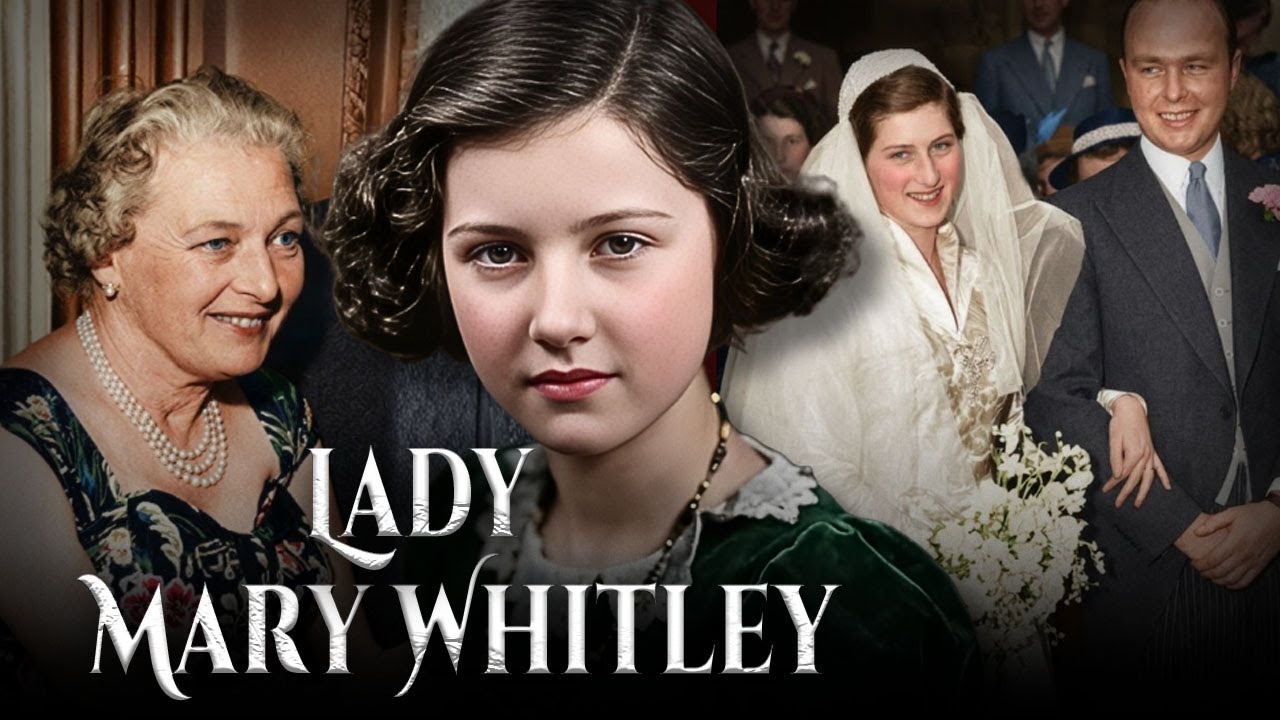
Her name was Lady Mary Cambridge, the King’s second cousin, and while Elizabeth was moving toward the throne, Mary was already planning her flight. She had seen what the Crown had done to her family—how it stripped them of their names, broke her uncle’s heart, and would soon destroy her cousin Margaret. This is not a story of royal glamour. It is the story of a bridesmaid who looked at the most powerful institution on earth and saw a death sentence.
While the world celebrated the dawn of a new Elizabethan age, Lady Mary quietly slipped out the back door of history to survive. This is the puzzle of the princess who chose to be nobody. Mary was born on 24 September 1924, in London. The world she entered was the restless world of the twenties, the decade of jazz and short skirts and a feverish, desperate attempt to forget the horrors of the First World War.
But in the Cambridge nursery there was no jazz. There was only the crushing weight of a history that had been hastily rewritten. Her father was George Francis Hugh Cambridge, the second Marquess of Cambridge, but he had been born Prince George of Teck. Her grandfather was Prince Adolphus, Duke of Teck.
For generations her family had been royal highnesses, members of a German princely house that had married into the British royal family. They were the Tecks, proud, poor, and intensely aware of their noble blood. Then, in 1917, the world collapsed. The First World War turned British public opinion against anything with the faintest trace of Germanness.
King George V, who feared that anti-German hysteria would topple his throne as it had toppled that of his cousin Nicholas II in Russia, made a brutal decision. He issued a decree stripping his family of its German titles. The Saxe-Coburgs and Gothas became the Windsors. The Tecks were ordered to renounce their princely title.
Mary’s grandfather was forced to give up the Dukedom of Teck. He had to choose a new name. He chose Cambridge, a solid English name, evoking a university town, safe and threatening to no one. Overnight, a dynasty of German princes was transformed into British marquesses.
This was the atmosphere into which Mary was born, a family suffering from a collective phantom-limb syndrome. They were royalty who were no longer royalty. They were highnesses demoted to lords and ladies. Mary, even as a child, must have sensed this silent anxiety, this feeling that their place in the world was conditional.
They were the poor relations of the Windsors, the cousins who had to be more polite, more loyal, and less visible than anyone else, lest the King decide to trim the family tree even further. Her mother, Dorothy Isabel Westenra Hastings, was not herself royal, but she came from the ancient aristocracy. She was descended from the fourteenth Earl of Huntingdon, and she was also a granddaughter of the first Duke of Westminster, which placed her in a family of immense land, wealth, and social power. They did not need titles to know they mattered.
This double inheritance—the Teck branch in Cambridge, which had been modified, Germanized, and rendered fragile on one hand, and the ancient land-owning families like the Grosvenors and Huntingdons on the other—created a strange psychological environment for little Mary. She grew up aware that her blood was exceedingly noble, and that nothing about her status was ever fully guaranteed. She was a mix of enchanted princess and pragmatic aristocrat. She spent her childhood mostly at her home at 19 Lowndes Square in Kensington, and at the country houses of her relatives.
Her routine was the usual one for an upper-class girl—polished floors, beeswax, damp wool—and the constant feeling that the furniture was older than most of the people in the room. Her father, George Cambridge, worked in the City as a director of Coutts Bank. The family lived in comfortable upper-class London, rather than moving from house to house in search of money. But the center of gravity, the sun around which their small planet orbited, was always the same: Aunt May.
To the rest of the world, Aunt May was Queen Mary, wife of King George V. She was a woman of formidable dignity, a mass of woolly hats, pearls, and stiff brocade, who seemed to have been born middle-aged. She was a mother who believed that emotions were a vulgarity best left to servants, and that duty was the only religion worth practicing. But for little Mary Cambridge, the Queen was a constant presence.
Mary was the Queen’s niece, and the Queen took a particular interest in the Cambridge girls. The visits to the royal residences—Sandringham in winter, Balmoral in summer, Windsor at Easter—were not holidays. They were inspections. One can imagine the scene: a small girl, dark-haired, aged six or seven, dressed in the stiff lace and velvet that court protocol demanded, led into a high-ceilinged drawing room.
The air was thick with potpourri and the Queen’s scented cigarettes. Mary had to curtsey, not a casual dip but a deep, reverent bow, and then wait to be addressed. “Well, Mary, have you been a good girl? ” the Queen’s voice would boom, a voice that seemed to come from inside a cave.
These encounters taught Mary the first and most important lesson of her life: performance. Belonging to the royal family, even at the second rank, was a job. You were an actress on a stage. You were not allowed to slouch, or cry, or even look bored.
You had to stand still for hours while the adults talked about horses, regiments, and who had recently died. You were simply decor in the theatre of monarchy. Mary was a quiet child, often described by contemporaries as watchful. While her cousins, Princess Elizabeth and Princess Margaret, were the stars of the show, living in the spotlight as the King’s granddaughters, Mary was in the audience.
She watched. She saw the tension in her father’s eyes as he struggled to maintain appearances. She saw how the courtiers bowed lower to Lilibet than to her. She learned early that in the hierarchy of blood, she was less than others.
But there was an advantage to being less. It meant no one was watching her too closely. The 1930s were the golden twilight of the British aristocracy, a decade in which the upper classes tried desperately to pretend the Victorian age had never ended. Mary’s education was typical for a girl of her class and station—that is, it was almost nonexistent.
She was educated at home by governesses. The curriculum was designed to produce a lady, not a scholar. She learned French. She learned the piano.
She learned the waltz and the foxtrot. She learned the intricate genealogies of the royal houses of Europe. She did not learn to cook, or manage a bank account, or understand how the Underground worked. She was being prepared for one specific purpose: a successful marriage.
In the calculations of the 1930s, Mary Cambridge was a valuable asset. She was Protestant, healthy, and Queen Victoria’s blood ran in her veins. Mary was a potential candidate for the remaining thrones of Europe or the aristocracy of England. But even in her childhood, the clouds of the outside world were gathering.
Mary was an astute girl, with the sharp eyes of the Teck family, eyes that missed nothing. She noticed the hushed conversations between her parents, the quick folding of newspapers when the children entered the room. In 1936, when Mary was twelve, the first pillar of her world collapsed. Her uncle David, King Edward VIII, abdicated the throne for Wallis Simpson.
To the public, the abdication crisis was a romantic drama; to Mary, it was a family earthquake. She was old enough to understand the enormity of it. She saw her aunt May suffering the shame of her son’s duty, and she saw her cousin Bertie, the shy, stammering man who feared the crown, forced onto the throne like a man being led to the gallows. The abdication taught Mary a terrifying lesson about the price of the crown.
She saw that the institution was a monster that devoured its own children. It had destroyed her uncle David; now it was destroying her uncle Bertie. And she looked at her childhood companion Lilibet, now the heir presumptive, and saw the trap closing around her. Lilibet was no longer just a girl.
She was the future queen. The barrier between them thickened. Lilibet was destined for the state; Mary was, legally, still an ordinary person. And for the first time, perhaps, Mary felt not envy, but relief.
The years between the abdication and the war were strange and suspended. Mary was entering adolescence, growing into a beauty—not the dazzling cinema-star beauty of the age, but the classic English rose. Her hair was dark, her skin clear as porcelain, and her reserve was often mistaken for haughtiness. In truth, it was shyness.
She was a girl who preferred her dogs to people, and felt more comfortable in the stables than the ballroom. She spent long summers at her mother’s family estates, riding horses in the misty mornings, tasting a freedom that only the countryside could give her. In those moments, galloping across a muddy field with the wind in her hair, Mary forgot the suffocating rules of London. She forgot she was Lady Mary Cambridge, the Queen’s niece.
She was just a girl on a horse. But the drums of war were beating louder. By 1938, the tension in Europe was palpable. Gas masks were distributed.
Trenches were dug in Hyde Park. The adults spoke of Mr. Hitler with a mixture of contempt and fear. For Mary, the approaching war felt deeply personal.
She knew she had German cousins. She knew the planes that might bomb London were flown by men who, a generation earlier, would have been her dance partners at a court ball. The Teck inheritance, the German blood that had been renamed Cambridge, suddenly weighed heavily on her again. In the summer of 1939, a few weeks before the invasion of Poland, Mary was fourteen.
She stood on the threshold of adulthood, a girl raised on the strict traditions of the nineteenth century, about to be thrown into the furnace of the twentieth. The long weekends of the peacetime years were over. The garden parties were over. The white gloves were being put away.
As the crisis deepened, Mary orbited the same narrow royal circle as the Yorks, moving between London and the country houses while the adults listened anxiously to the radio. The heather was in bloom, painting the Scottish hills purple. The scene seemed peaceful, but inside the castle the radio was crackling with the voice of Prime Minister Neville Chamberlain. When war was declared on 3 September, Mary was attending a church service.
She watched the King and Queen. She saw the resolve in their faces, the mask of duty snapping firmly into place. She realized that her childhood had officially died. The door to the nursery was closed.
The gilded cage was about to be shaken by a storm that would level cities and topple empires. And in the midst of that fear, a question was forming in the mind of the fourteen-year-old girl, a question that would define her destiny: in a world that was collapsing, who was she supposed to be? She was about to find out. The princess was about to become a worker.
The watcher was about to become a participant. The transition from the somber golden afternoon of the thirties to the brutal monochrome reality of total war did not happen overnight. For Lady Mary Cambridge, now fifteen and on the edge of adulthood, the Phoney War of late 1939 was a period of strange stasis. Gas masks were distributed—those bulky, rubber-smelling things in cardboard boxes—and blackout curtains were sewn, plunging the grand houses of her childhood back into a tomb-like darkness every night.
But the bombs did not fall immediately. There was only the waiting, a silent accumulation of anxiety that settled in the stomach like a stone. For a girl raised in the Teck tradition, where idleness was a sin and duty was sacred, this waiting was torture. The royal machine, normally so precise in its scheduling of balls, garden parties, and official visits, had stopped.
The King and Queen remained at Buckingham Palace, becoming symbols of national resistance. The younger generation, the spares and the servants of the family like Mary, were sent to the safety of the countryside. But safety is a relative concept when the sky is about to ignite. When the Blitz began in earnest in 1940, the war was no longer just news.
It was a terrifying sensory nightmare. Mary was no longer merely the Queen’s niece. She had become a citizen of a besieged island. The defining experience of the war for Mary, as for her cousin Elizabeth, was the shattering of the glass wall that separated the royal family from the people.
Before 1940, Mary’s interactions with ordinary people were governed by strict protocol. They were servants, gardeners, or cheering crowds, nameless faces, hands raising hats. But as the Luftwaffe reduced London to rubble, those distinctions crumbled along with its walls. As she grew older, Mary joined the war effort—not as a symbol, but as a working girl.
Near the end of the war, she worked as a volunteer nurse in London’s bomb-affected areas, enduring long shifts, makeshift wards, and the brutal side of heroism. There were no servants to open doors. There was no one to tell her she looked pretty. There was only the exhausting, endless rhythm of the wards.
She scrubbed floors until her knees blistered. She emptied bedpans. She changed bandages on wounds that would have made a society girl of 1913 faint. In the hospital, anonymity was her greatest asset.
To the wounded soldiers—men rescued from the burning beaches of Dunkirk or from the smoky cockpits of Spitfires—she was not Lady Mary. She was just a nurse, a sweetheart, or a duck. For the first time in her life, she was not judged by her lineage, but by her utility. Could she dress a leg without her hands trembling?
Could she bring a cup of tea with a steady hand? Could she sit bedside a dying boy and hold his hand while he cried for his mother, without letting her composure crack? Yes, she could. And in discovering that she could, Mary found a sense of self-worth that no title could ever confer.
The war had tempered her, but it had also made her more human. She saw the fragility of the human body. She saw that a bullet does not ask about your pedigree before it tears through muscle and bone. This democracy of suffering planted a seed of doubt in her mind about the divine right of her class.
If they all bled the same red blood, why did she have to live in a cage while others walked free? Her cousin, Princess Elizabeth, was also in uniform, training as a mechanic in the Auxiliary Territorial Service, and the press loved it. Pictures of the future queen changing a tire were printed everywhere, a powerful propaganda coup for the monarchy. But Mary’s service was quieter, less famous, perhaps more intimate.
She was not doing it for the cameras. She was doing it because, for the first time, she felt useful. But the war was not just work; it was also a strange kind of feverish social life. The blackout created a unique atmosphere in London.
When Mary was in town, the nights were pitch black, dangerous, and exciting. Torchlights were dimmed with tissue paper. People moved by touch and sound. In the nightclubs that stayed open, like the 400 and the Café de Paris, the band played louder to cover the air-raid sirens.
Mary, a young woman in her late teens, lived the frantic romance of the war. Life moved at double speed because no one knew if they would see the morning. She danced with officers who would be dead within a week. She saw the desperation in people’s eyes, the longing for connection before the end.
It was a world utterly different from the rigid, formal courtship rituals of her mother’s generation. In the blackout, the rules of chaperones and protocol seemed absurd. And yet, even in the chaos, the ghost of her family lingered. She was still a Teck.
She was still a Cambridge. Her German relations were on the other side of the line. It was a silent torment the family rarely spoke of. While Mary bandaged British soldiers, her cousins in Germany were fighting in the Wehrmacht.
Her aunt, Queen Mary, sat in Badminton House, as immovable as a statue, while the state of her ancestors bombed the state of her husband. The psychological split required to survive was immense. Mary learned to hide some thoughts in a cellar of her mind, a skill that would serve her well in later years. The war in Europe ended in May 1945.
VE Day was a collective exhale of relief, a riotous celebration of flags and relief. Mary stood on the balcony of Buckingham Palace with the royal family in the famous photograph. The King, the Queen, Elizabeth, Margaret, and the rest of the family waved at the crowds flooding the Mall. To the crowds, it looked like a triumph of continuity.
The monarchy had held. The Empire had won. But Mary, standing in the background, knew the truth. The victory had been expensive.
The country was bankrupt. The aristocracy was on the brink of collapse. The great country houses were crumbling, their roofs leaking, their servants gone. The world that had existed in 1939 was as dead as the Romanovs.
A Labour government had swept to power on a mandate for change. The age of deference was dying. For a young woman of twenty-one, the post-war world was a bleak and harsh place. Rationing was stricter than ever.
In the winter of 1947, a brutal cold snap buried Britain in snow and misery. Coal was scarce; people froze in their homes. The glamour of the royal family seemed provocative next to bread queues and bomb sites. But the institution had one last card to play.
The monarchy needed a radical reinvention, a spectacle to remind the people why they paid for the palaces. They needed a wedding. The engagement of Princess Elizabeth to Philip Mountbatten was the spark. It was marketed as a fairy tale: the beautiful heiress and the handsome blond Viking prince.
Mary Cambridge was chosen as a bridesmaid, the highest honor a girl of her class could receive, a sign of her place in the inner circle. But as the preparations for the November wedding began, Mary found herself forced back into the world she had escaped during her nursing days. The preparations were grueling. Norman Hartnell, the court dressmaker, designed dresses of ivory silk tulle inspired by Botticelli’s Primavera.
The dresses were exquisite, embroidered with purple stars and ears of wheat. But the process of being fitted was a reminder of Mary’s role as decoration. She stood for hours while pins were stuck into fabric, while the courtiers debated the length of the hems, as if the fate of the nation hung upon it. Mary was one of a group—Princess Alexandra, Lady Caroline Montagu-Douglas-Scott, Lady Elizabeth Lambart, and others.
They were the supporting cast, the ornamentation surrounding the main event. On the morning of 20 November 1947, London was a foggy city of anticipation. Mary arrived at Buckingham Palace to dress. The atmosphere was tense.
The bride, Elizabeth, was calm but pale. There was the famous panic when the Queen’s tiara broke—an ill omen that the court jeweler quickly repaired. As the carriages made their way to Westminster Abbey, Mary sat amid the tulle and flowers, waving to the crowds. The roar of the people was deafening, a wall of sound that vibrated through the floor of the carriage.
They were cheering for the bride, for the King, for the idea of Britain. Mary was just a pretty detail in that procession. As she walked down the aisle of the Abbey, Mary felt the weight of history. The air was thick with incense and the dust of centuries.
Light filtered through the stained glass to illuminate the gold plate on the high altar. Ahead of her, Elizabeth walked, moving toward the man who would be her consort and toward the throne that would be her life. At that moment, standing near the altar while the Archbishop of Canterbury recited the marriage vows, Mary felt a moment of profound clarity. She looked at her cousin.
Elizabeth seemed radiant, yes, but she also seemed trapped. She was about to make a vow that would bind her not just to a man, but to a duty that would consume her entire life until her dying breath. She would never again be able to walk down a street unnoticed. She would never again be able to voice an opinion freely.
She had become a symbol, a statue, a postage stamp. It is easy, watching from a distance, to imagine Mary realizing the immense personal price her cousin was paying for the crown. Unlike Elizabeth, she could still back out of this bargain. And soon, she would quietly do so.
She was royal enough to be a bridesmaid, but not important enough to be a victim. She could leave. The reception at Buckingham Palace was a blur of champagne and forced smiles. Kings and queens from across Europe, those who had survived the war, were there.
But Mary was distracted. The seeds planted in the hospital wards of the Blitz were now blooming. She did not want this life. She did not want the endless round of bazaars, the polite chatter with ambassadors, or a marriage to a safe, dull duke who would not have cared for her.
She wanted what the soldiers in the hospital had talked about: a home, a job, a life of her own. And as the royal couple departed for their honeymoon under a shower of rose petals, the guests began to disperse. Mary Cambridge took off her bridesmaid’s dress and carefully hung the ivory silk, the stars, the tulle, in the wardrobe. It was a beautiful dress—a costume from a play in which she no longer wished to star.
She looked in the mirror. The girl who had stared back in 1939 was gone. The woman looking back now was twenty-three. She had seen death.
She had seen survival. She had just witnessed the most famous woman in the world surrender her freedom. Mary turned her back on the mirror. The war was over.
The wedding was over. Now her own battle for her life would begin. She had to find a way out of the palace without burning it down. She had to find a way to be ordinary in a family that demanded she be extraordinary.
She did not yet know it, but the key to her escape was waiting in the form of a man the court would consider deeply unsuitable. The year 1947 ended with a bitter cold snap that froze the Thames and turned London into a landscape of iron and ice. For Lady Mary, the warmth of the wedding faded quickly, replaced by the chill of uncertainty. She resumed her duties, her charities, her role as an obedient daughter and niece.
But the inner transformation had happened. She walked through the corridors of her parents’ home like a spy, watching the rituals of her class with a new, critical eye. She attended the debutante balls of the following seasons, dancing with eligible noblemen and guards officers approved by her mother. They were polite.
They were wealthy. They were utterly suffocating. They talked about the past. Mary was interested in the future.
Somewhere in the sprawling, smoky city of London, a man named Peter Whitley was going about his daily business. He was not royal. He was not an aristocrat. He was a man of the new age—ambitious, pragmatic, unimpressed by titles.
Their paths would cross, drawn together by the weight of inevitable change. The winter of 1948 lay over London like a damp woolen blanket. The dream of the grand royal wedding had faded, replaced by the reality of exhausted, tired, hungry Britain. The new Elizabethan age was still just a slogan in a newspaper.
The reality was ration books, bomb sites turned into car parks, and thick, choking smog that settled over the city for days. For Lady Mary Cambridge, now twenty-four, this bleak state mirrored her inner world. In the ruthless calculations of the aristocracy, she was entering dangerous territory. She was no longer a fresh-faced girl but was on the verge of being considered an old maid.
The brilliant young men of her generation were marrying, walking down the aisle of St. Margaret’s, Westminster, to wed heiresses of titles and baronies, securing the family alliances that had kept their class alive for centuries. The pressure on Mary was subtle but suffocating. It came not in loud commands, but in the questioning looks of her aunts over tea, and in the veiled invitations to shooting weekends at Norfolk estates where the right sort of young men would be present.
And they were there, the eligible bachelors of the post-war upper class. They were men with hyphenated titles and crumbling country houses. They were men who had served in the Guards, who spoke with their class’s distinctive drawl, and who talked of hunting, dogs, and White’s club. To Mary, who had spent the war washing the blood of soldiers, men who had given their lives for their country, these men seemed hollow.
They were characters from a play she had already left. She played the part of the docile debutante. She danced the foxtrot. She made polite conversation.
She wore the pearls. But behind her tired eyes, a quiet revolution was brewing. It was not a loud revolution. She was not going to run off to Paris to paint, or give an interview denouncing the monarchy.
That was not her style. Hers was a revolution of silence. She simply waited, engaging in passive resistance against the destiny that had been written for her. Then, everything was turned upside down.
She met Peter Whitley. Peter was the complete antithesis of upper-class life. Born in Singapore, the son of Sir Norman Whitley, a colonial judge, he was a self-made man. He was thirty years older than Mary, who was twenty-five at the time.
He had served in the Royal Air Force during the war. He was a businessman. In the class-conscious world of 1950s London, the word “businessman” carried vague connotations in royal circles. It meant he worked for a living, that he checked his bank balance, that he was in trade, however respectable.
Peter was not a nobleman, and he had no title to give Mary. In the eyes of the old guard courtiers, he was an ordinary man in every sense of the word. They likely met at a dinner party, one of those peripheral occasions where the circles of the royal family overlapped with the circles of professional success. One can imagine the scene: a smoky room, the clink of crystal, boring talk about horse racing.
Then Mary finds herself speaking to a man who does not bow much, does not stammer, and does not look at her as the Queen’s cousin, but as a woman standing in a room. The attraction was immediate and profound. Peter offered Mary what no duke could offer: reality. He offered her a life where she would not have to cut ribbons.
He offered her a life where she could wear trousers in the garden. He offered her the one thing she craved more than anything else: privacy. Their engagement was kept secret. It had to be.
The ghost of the abdication still haunted the family. The idea of a member of the royal family marrying a commoner was still considered dangerous—a crack in the dam that would let the magic out. They met in quiet restaurants where the head waiters were discreet. They went on drives in the countryside.
It was a love story of stolen moments, fueled by the thrill of crossing class lines. But royal secrets are like damp rot. Eventually, they show through the wallpaper. Mary knew she had to face the truth.
She had to ask permission. The hierarchy of the family was clear. There was the King, her cousin; her parents, the Marquess and Marchioness of Cambridge; but the real power, the final arbiter of what was acceptable and what was not, was still Aunt May, Queen Mary. The Queen Dowager was now eighty years old, a formidable Victorian figure living at Marlborough House.
She was the woman who had forced her sons to put duty above everything. She was the woman who wore diamonds to dinner during the Second World War. The common wisdom was that Queen Mary would crush this romance like a beetle. A businessman?
For a Teck princess? Impossible. Mary went to see her aunt. The meeting at Marlborough House is one of those peculiar historical turning points never recorded in court annals.
We can imagine the room, the clutter of jade figurines, Fabergé eggs, and heavy velvet curtains that shut out the modern world. Mary sat on the edge of her chair, hands clasped, explaining that she loved Peter Whitley and intended to marry him. She must have been prepared for a long lecture, expecting a formal speech. But Queen Mary surprised everyone.
The old Queen looked at her niece, saw the anxiety, but also saw the determination. And Queen Mary, despite her outward rigidity, was a woman of sharp intelligence. She had watched the twentieth century destroy the monarchies that refused to adapt. She had seen the murder of the Romanovs, the exile of the Hohenzollerns.
She knew the British monarchy had survived because it evolved. Moreover, she knew Mary well, and she knew Mary was not suited for public life. She knew that forcing Mary into a big, public royal marriage would be a disaster. Later accounts suggest that Queen Mary, rather than blocking the marriage, was primarily concerned with ensuring that Peter was a respectable man and that Mary would be happy with him.
Once the old Queen was satisfied on those points, she gave her official blessing, quietly allowing one of her nieces to renounce her royal duties. It was a practical decision. Better for her niece to live a quiet, happy life in the suburbs than to be an unhappy duchess causing scandals in the tabloids. In many ways, it was Queen Mary’s last act of modernization.
She had opened the door for Mary to leave. With the Queen’s approval, the rest of the family followed suit. The engagement was announced in 1951. The press reaction was polite but puzzled.
“King’s cousin to marry businessman,” the headlines read. There was an undercurrent of disappointment. The public wanted another fairy tale. They wanted golden carriages and tiaras.
They did not want a civil ceremony and a husband who commuted to work. But Mary did not care. She was ecstatic. The wedding took place on 9 November 1951, not in Westminster Abbey, but in St.
Margaret’s Church, the smaller church standing in the Abbey’s shadow. The difference in scale between this wedding and Princess Elizabeth’s in 1947 was intentional. Mary did not want a grand spectacle; she wanted a real marriage. And yet, the guest list was staggering.
The King and Queen attended, as did Princess Elizabeth and Prince Philip, and Queen Mary, frail but still imposing. It was a gathering of the royal family, come to see one of their own off. Mary’s dress was distinctive. It was designed by Norman Hartnell, the same designer who had created her bridesmaid’s dress four years earlier.
But this dress was different, simpler. Elegant, yes, but not ostentatious. It was a dress for a woman, not a historical artifact. There is newsreel footage from that day.
You can see Mary leaving the church with Peter. She is smiling—a genuine, wide, spontaneous smile that lights up her face. It is the smile of someone who has just pulled off a great escape. She looks radiant, not with the glow of a royal bride, but with the relief of a prisoner who has just seen the gate open.
As they drove off, the crowds cheered, but they were already beginning to forget her. The cameras returned to the pregnant Princess Elizabeth and the dying King. The royal circus moved on. Mary and Peter left London, away from the palaces, away from the protocol, away from history.
The transformation was immediate. Overnight, Lady Mary Cambridge became Lady Mary Whitley. Cambridge was a marquess’s name; Whitley was a man’s name. She had exchanged a relic of the First World War for a name that belonged to the future.
The first months of her marriage were a period of relief. It was like taking off a corset she had worn for twenty-seven years. She had to learn how to be normal. She had to learn how to run a household without an army of servants.
She had to learn how to deal with people who did not know or care about the difference between Her Highness and Her Royal Highness. It must have been strange for Peter as well. He had married a woman with the blood of George III in her veins, who nonetheless longed to be treated as a housewife. He became her protector, not just financially, but emotionally.
He stood between her and the world she had left behind. But the world she left was not finished with her yet. A few months after her wedding, in February 1952, the King died. George VI passed away in his sleep at Sandringham.
He was only fifty-six. The stress of the war and the burden of a crown he had never wanted had killed him. Mary received the news with a double grief. She mourned her cousin, the kind, stammering man who had been good to her, but she also saw a terrifying confirmation of her own choices.
The crown had killed him, and now it was Elizabeth’s turn. Elizabeth was now Queen. The companion of her childhood had become the monarch. The gulf between them, which had been widening for years, was now an ocean.
Elizabeth had become part of history; Mary had become part of Peter. At George VI’s funeral, Mary walked in the funeral procession, draped in heavy black mourning. She saw the new young Queen, pale and resolute, carrying the weight of the monarchy on her slender shoulders. Mary must have felt a profound survivor’s guilt.
She was safe, returning to a quiet home and a husband who would be there for dinner. Elizabeth was returning to Buckingham Palace to be alone in a crowd of millions. In 1952, the separation became final. The new Elizabethan age, the age of television, celebrity, and intense scrutiny, had begun.
And as the spotlight shone brightly on the young Queen and her family, Lady Mary Whitley quietly retreated into the shadows. After the wedding, Mary and Peter first settled at Lord Cambridge’s house in St. James’s Square in London. Over time, their lives settled into a quieter rhythm between London and the country.
It was a life where garden shears took precedence over tiaras, which suited her perfectly. But the past never dies in the royal family; it just waits in the folds of memory. As the 1950s progressed, Mary found that shedding the title had been easy; shedding the family connection was impossible. By the spring of 1952, the Whitley experiment was in full swing.
To the neighbors in their quiet corner of the Home Counties, the Whitleys were a charming, if somewhat reserved, couple. They knew, of course, that she was related to the Queen, but Mary never mentioned it. She deflected questions with a polite smile and a comment about the weather. She was discovering the simple pleasures of everyday life—going to the supermarket, the post office, the freedom of walking down the street without a detective following her.
While Mary was living an ordinary life, the royal family was entering a dramatic period. The Coronation was approaching, a medieval spectacle for the television age. Princess Margaret was falling in love with Peter Townsend, a love story that would tear the family apart. Mary watched from a distance.
She was the one who had successfully married outside the royal fold. She was living proof it could be done. And as the storms gathered over Buckingham Palace, her quiet home became something rare and precious—a neutral refuge, a place where the Queen could come for tea and pretend, for one hour, to be just a woman named Lilibet. The rebel had become a sanctuary.
The rain on the morning of 2 June 1953 was relentless. It was cold, blustery English rain that drowned the decorations, turned the red carpets into sodden woolen sponges, and chilled the millions of people lining the streets of London. But the rain did not matter. This was the Coronation of Queen Elizabeth II, the dawn of the new Elizabethan age, a moment of spiritual transformation as a twenty-seven-year-old woman was anointed with holy oil and transformed into the living symbol of the state.
Lady Mary Whitley sat in Westminster Abbey watching the theatre of history unfold before her. Six years earlier, she had stood beside the altar as a bridesmaid, holding the bride’s train, part of the inner circle of the performance. Now she was in the front seats, a spectator. She wore the robes and hat befitting her rank—she was, after all, still a marquess’s daughter.
But the psychological distance between her and the woman sitting on St. Edward’s Chair was now immense. As the heavy crown of St. Edward was lowered onto Elizabeth’s head, Mary must have felt a complex mix of awe and pity.
The crown was heavy—literally, weighing nearly 2. 3 kilograms of solid gold and precious stones. But the metaphorical weight was heavier. The individual had been sacrificed on the altar of the institution.
Mary, sitting quietly beside her husband Peter, knew she had escaped that sacrifice. When the ceremony ended and the great bells of London began to ring, proclaiming the start of a new reign, Mary did not have to go out onto the balcony to wave at a terrifying sea of faces. She could go home. She could take off her robes, put on a cardigan, and make a cup of tea.
It was a freedom so profound that only someone who had grown up in a cage could truly appreciate its sweetness. The years following the Coronation were a testing ground for the Whitley experiment. The 1950s in Britain was a decade of rigid conformity, trim gardens, and strict social rules. For Mary, this suited her perfectly.
She and Peter settled into a life that was aggressively, even defiantly ordinary. They did not buy a castle. They did not surround themselves with ladies-in-waiting. They lived in a comfortable house in the London suburbs, the kind of house where dogs were allowed on the sofas, and newspapers were read for cricket scores rather than court circulars.
In 1954, Mary had her first child, a daughter named Sarah. Seven years later, in 1961, she had a son, Charles. The birth of a royal baby would normally be a formal event, marked by gun salutes and the posting of notices on the gates of Buckingham Palace. But Sarah and Charles Whitley were born with no such fanfare.
There were no cannons, no crowds. This was Mary’s defining stroke. She made a conscious, determined decision to break the cycle of royal trauma. She would not raise her children as members of the royal family.
She would not teach them to curtsey and bow to their relatives. She raised them as Whitleys. But maintaining this ordinary life required constant, vigilant effort. It required building a glass wall between her domestic life and her royal inheritance.
On one side of the wall was Mrs. Whitley, the mother who drove her children to school, worried about chickenpox, and organized the local charity fete. On the other side was Lady Mary, the Queen’s cousin, who had to attend the Cenotaph on Remembrance Sunday and the family Christmas gathering at Windsor. Navigating between these two worlds was like walking a tightrope.
Imagine the confusion of arguing with a plumber about a leak on Tuesday morning, then curtseying to your cousin wearing the Koh-i-Noor on Tuesday evening. Most people would have developed a split personality. But Mary survived by maintaining a strict separation. She rarely spoke of the Queen to her suburban friends.
She rarely spoke of plumbing problems to the Queen. She became expert at compartmentalization. Yet, even as Mary successfully built her sanctuary of silence, the other one of her generation was destroying herself in the spotlight. The tragedy of Princess Margaret is the dark mirror of Lady Mary Whitley’s triumph.
Margaret, the Queen’s sister, was the charming, brilliant, chain-smoking rebel who had captivated the world. In the mid-1950s, while Mary was changing nappies in the suburbs, Margaret was embroiled in the scandal of the century: her doomed romance with Group Captain Peter Townsend. The parallels were painful. Townsend, like Peter Whitley, was a commoner.
Margaret wanted to marry him, but unlike Mary, Margaret was too close to the throne. She was third in line. The institution, the Church, the government, the mustachioed men, all of them combined. They told Margaret she could only marry Townsend if she gave up her titles, her income from the Civil List, her royal standing.
Margaret looked into the abyss—the same abyss Mary had jumped into—and blinked. She could not do it. She could not be Mrs. Townsend.
She was addicted to the reverence, the glamour, the royal magic. She gave up the man she loved to keep a title she did not need. Mary watched this drama unfold with a heavy heart. She knew, more than anyone, that Margaret had made the wrong choice.
She knew that a title was a cold companion. Margaret’s later life—her unhappy marriage to Antony Armstrong-Jones, her spiral into alcoholism and affairs—was like a slow-motion car crash that Mary watched from a safe place on the sidewalk. Margaret was a cautionary tale. Mary was the survivor.
By the early 1960s, the world was changing faster than the monarchy could absorb. The Beatles were awarded MBEs. Skirts grew shorter. The deference that had protected the royal family for centuries was eroding.
The press, once fawningly respectful, was gaining power. They wanted gossip. They wanted access. They wanted to know what the royals ate, who they slept with, and what they argued about.
Mary and Peter Whitley were becoming relics of the past. In this neon-lit decade, they were a throwback to a quieter, more reserved England. They did not go to nightclubs. They did not mix with rock stars.
They stayed at home. But this very dullness was what made Mary so valuable to the Queen. Elizabeth II was one of the loneliest women in the world. Surrounded by a court that told her what she wanted to hear, and a sister who was a constant source of drama, the Queen needed a safe haven.
She found it with the Whitleys. The Queen and Mary remained close, and Mary’s cousins later recalled that Elizabeth treasured having at least one relative who lived an entirely private life. Whatever form their visits took, Mary’s sitting room provided something that Buckingham Palace rarely offered: relaxation. In Mary’s living room, the Queen could take off her mask.
She did not have to be Her Majesty. She could just be Lilibet. They would talk about dogs—always a safe topic—and horses and children. They did not talk about the Suez Crisis or the latest political scandal.
Mary offered the Queen the gift of normality. Mary’s home was a neutral refuge, a place where protocol was hung up at the door. It is said that Mary was one of the few people who could tell the Queen the unvarnished truth without fear of reprisal. Mary wanted nothing—no title for her husband, no palace, no grant.
She was incorruptible. In a court full of people jockeying for position, Mary was a pillar of integrity. But the 1960s also saw the first cracks in this protective barrier. As the media grew more aggressive, maintaining the privacy Mary cherished became harder.
Paparazzi began to lurk, and journalists started digging into the family tree, searching for forgotten royals. Mary developed a strategy of aggressive politeness. If cornered by a journalist, she would smile pleasantly and say nothing of value. She became an enigma.
She understood that if she gave the press nothing, they would eventually get bored and leave. So she deliberately made herself uninteresting, and that was her camouflage. While her cousins wore bright colors to be seen, Mary wore beige to disappear. By the 1970s, the generational shift was undeniable.
Mary’s children were growing up, entering a world utterly different from the Sandringham nursery. The new generation of the royal family—Prince Charles and Princess Anne—were taking center stage. Mary looked at Prince Charles with particular sympathy. She saw a sensitive, thoughtful young man being thrust into the maw of the monarchy.
She saw the pressure for him to find a bride, the constant scrutiny of his private life. It was the 1930s all over again, but with telephoto lenses. In 1977, the country celebrated the Queen’s Silver Jubilee. It was a moment of national unity, a populist celebration of flags and patriotism that masked the economic gloom of the era.
The Sex Pistols were snarling “God Save the Queen” on the radio, but the nation turned out to cheer Elizabeth. Mary attended the thanksgiving service at St. Paul’s Cathedral. She was fifty-three years old, and grey was creeping into her hair.
She sat in the pews, surrounded by the memories of her past and the uncertain future of her family. As she listened to the hymns, she must have thought about the resilience of the woman on the throne. Elizabeth had lasted twenty-five years, keeping her vow, but at what cost? The family was fractured.
Margaret’s marriage had collapsed. Charles was lonely and adrift. Anne had been the victim of a kidnapping attempt. The Firm was still standing, but the human casualties were catastrophic.
Mary returned to her quiet home that evening with Peter, and they probably had a simple dinner. They probably watched the Jubilee highlights on television. And Mary must have looked at her husband, the ordinary man who had given her this life, with profound gratitude. They had won.
They had beaten the system. They had raised happy children, unafflicted by royal neuroses. Theirs was a true partnership, not a publicity stunt. But the 1970s ended on a sinister note.
In 1979, Lord Mountbatten—Uncle Dickie, the mentor of Prince Charles, a pivotal figure in Mary’s life—was assassinated by the IRA. His boat was blown up in Ireland. The shock was physical. It shattered the illusion of the royal family’s invincibility.
It brought the violence of the world into the heart of the family. For Mary, who had spent the war nursing soldiers, it was a reminder that history was never risk-free. Chaos always lurks. Mountbatten’s death hardened the royal family’s resolve.
Security was tightened. Walls went up. For Mary, it confirmed her decision to stay behind the scenes. The monarchy was a target.
To be a public figure was to be a target. As the decade drew to a close, a new name began to circulate in royal circles. A young Spencer girl was being courted by Prince Charles—Lady Diana Spencer. Mary, watching from the shadows, saw the storm clouds gathering before anyone else.
She saw a girl who was too young, too fragile, too starry-eyed about the idea of royalty to understand the reality. She saw the machine preparing to grind into motion once more. The stage was being set for the tragedy of the 1980s. And Lady Mary Whitley, the ghost in the machine, braced herself to watch the final, spectacular collision between fantasy and reality.
She had built her glass wall to keep the world out, but she could not stop the world from burning around her. She was about to become the last witness to the old way of doing things, the silent guardian of a value system that was about to be swept away by the tide of celebrity culture. The years of silence were over. The years of noise had begun.
The dawn of the 1980s felt less like a new day than the onset of a fever. The media landscape had changed. The respectful newsreels of Mary’s youth were gone, replaced by a frenzy of paparazzi. The royal family had become a global soap opera, a commodity to be consumed.
In the quiet of her garden, Lady Mary pruned her roses. She was fifty-six, entering the autumn of her life. She had successfully navigated the treacherous postwar waters. She had kept her name out of the papers.
She had kept her soul intact. But she knew that silence was a fleeting luxury. As the obsession with Charles and Diana intensified, the press began to comb the royal family, looking for any blue-blooded individual to quote, exploit, and drag into the circus. Mary tightened her grip on her surroundings, reinforced her glass wall, and prepared to defend her privacy with the same steeliness with which her aunt Queen Mary had defended the Crown.
The world was going mad, but inside the Whitley house, sanity would be maintained, no matter the cost. Yet time is the only enemy that cannot be defeated by silence. The generation that had raised her—those grand Victorian characters—was gone. She was now the elder.
As the family careened toward the catastrophe of the 1990s, Mary found herself in the position of a helpless spectator, watching the institution she had fled go up in flames, knowing she held the truth in her hand, the truth of what really mattered—but no one was listening. The summer of 1981 was hot, a suffocating heat that seemed to bake the pavements of London and heighten the hysteria sweeping the country. Lady Mary Whitley, now fifty-seven, found herself again seated in the pews of St. Paul’s Cathedral on 29 July.
The air inside the vast dome was thick with expensive perfume, nervous sweat, and the electric anticipation of a global audience estimated at 750 million. She was watching the wedding of Prince Charles and Lady Diana Spencer. To the world, it was the wedding of the century, a fairy tale made flesh in taffeta and silk. To Mary, watching from her discreet seat in the family section, it must have looked like a sacrificial rite.
She looked at the bride, a twenty-year-old girl with terrified eyes hidden behind a wall of blue stone fabric, and she recognized that look. It was the same look she had seen on her cousin Elizabeth’s face in 1947, but it was devoid of the tough Hanoverian resolve. Diana looked like a fawn caught in the headlights of a truck. Mary clutched her husband Peter’s hand.
They had been married for thirty years. Their hands were weathered, their bond rooted in the warmth of married life, not the glare of the spotlight. As the Archbishop intoned the marriage vows, Mary must have felt a profound sense of déjà vu, tinged with a horrible premonition. She knew the machine.
She knew it devoured the innocent for breakfast. She had walked away from it in 1951 to save her soul. Diana was walking straight into its mouth. The 1980s, the decade that followed, would prove Mary’s instincts right in the most brutal way possible.
It was the era of Dallas and Dynasty, and the Windsors had decided to star in their own global soap opera. For Lady Mary, the 1980s were a study in contrasts. While news of her royal cousins topped the tabloids daily—their marriages collapsing, their scandals exposed, their private phone calls leaked—Mary and Peter lived in a parallel universe of resounding normalcy. They tended their garden, took quiet holidays, and watched their children, Sarah and Charles, build lives free from the weight of history.
Mary became the invisible woman of the royal family, mastering the art of not being noticed. When she attended family gatherings, she wore clothes that blended with the wallpaper: beige, light blue, practical hats. She avoided the photographers’ gaze with the skill of a seasoned spy, knowing that invisibility in the age of the telephoto lens was the ultimate luxury. But within the family, her silence was louder than words.
As the War of the Waleses escalated, as Charles and Diana’s marriage collapsed in bitterness, Mary became a silent pillar, taking no sides. She never leaked stories. She simply served as a reminder that there was another way. She was living proof that it was possible to have both good birth and a happy marriage, provided you gave up the vanity of the crown.
The Queen, increasingly isolated as her children’s lives became tabloid fodder, leaned on Mary’s generation, the old guard, more than ever. They were the ones who remembered the rules. They were the ones who remembered that duty meant keeping your mouth shut and your head high. Then came 1992, the annus horribilis.
It was the year the royal family crumbled. Prince Andrew separated from Sarah Ferguson. Princess Anne divorced Mark Phillips. Princess Diana published a devastating biography detailing her suicide attempts and bulimia.
The curtain was pulled back, and the magic was revealed to be a mess of human dysfunction. The symbolic climax of that year came on 20 November 1992. Ironically, on the forty-fifth anniversary of the Queen’s and Prince Philip’s wedding, a fire broke out at Windsor Castle. Lady Mary watched the news footage from her living room.
She saw the flames licking at the ancient stone towers, saw the smoke rising over the river. Windsor was not just a tourist attraction to her; it was the stage of her childhood. She had played in those corridors with Lilibet, hidden behind those curtains. Watching Windsor burn was a brutal shock.
It felt like the final burning of the Victorian world she was born into. The building was collapsing, the roof caving in, the fire consuming history. Yet, amid the ashes of the royal family’s reputation, the Whitley marriage stood firm. While three of the Queen’s four children saw their marriages collapse, Mary and Peter celebrated their fortieth anniversary.
The contrast that had defined 1951—the princess and the businessman—was the only marriage that had weathered the storm. It was a triumph that needed no words. Mary had chosen the man, not the position, and that choice had saved her. The 1990s dragged on, a decade of decline for the old order.
Deference vanished. The public raged. The press attacked with ferocity. Mary, now in her seventies, was beginning to physically fade.
The striking dark-eyed beauty of the 1940s had given way to a frail old age. Her movements were slower. She tired easily. But her mind remained sharp, and her heart remained protected.
She saw the final tragedy coming before it happened. On 31 August 1997, the phone rang in the middle of the night. Princess Diana was dead. Killed in a car crash in a Paris tunnel while fleeing the paparazzi.
To the world, it was a moment of hysteria. To Mary, it was the grim fulfillment of the prophecy she had sensed in St. Paul’s Cathedral sixteen years earlier. The machine had finally consumed its star.
The very light Diana had courted and then fled had become a literal weapon. Mary mourned Diana, but she also mourned the loss of her own kind of dignity. The week that followed Diana’s death was a carnival of grief, something that Mary, raised to suppress her feelings, must have found bewildering. The weeping in the streets, the mountains of flowers, the popular anger directed at the Queen—all of it was alien to her.
Mary belonged to a generation that grieved in private, behind drawn curtains. This new world, where emotions were displayed for public consumption, was not her world. She realized, perhaps with a sense of finality, that her time was over. The twentieth century was ending, and the values she embodied—restraint, duty, silence—were being buried with Diana, Princess of Wales.
The last two years of Mary’s life were quiet. She withdrew further into the sanctuary of her home. She spent time with Peter, the man who had been her anchor for half a century. She was fortunate that she never had to live without him.
In so many royal stories, the woman is left alone—Victoria without Albert, the Queen Mother without George VI. But Mary and Peter were a team until the very end. Lady Mary Whitley died on 13 December 1999, at the age of seventy-five, a few days before the end of the century she had lived through so closely. The world was obsessed with the Y2K bug, the new millennium, the future.
But Mary was looking back. She lay on her bed surrounded by photographs of a life that spanned the entire turbulent century. There she was as a child in the arms of a Teck princess. There she was in her nurse’s uniform during the Second World War.
There she was in her Hartnell dress, holding the Queen’s train. There she was with Peter on their wedding day, laughing. She missed the twenty-first century by eighteen days. It was a poetic departure.
She was a daughter of the twentieth century, a witness to the fall of empires and the rise of the individual, and she had no place in the new millennium. There was no state funeral. The BBC did not interrupt its programming. Flags were not lowered to half-mast.
She was buried quietly, attended only by her family and close friends. It was the funeral of an ordinary citizen, which was the greatest achievement of her life. Peter Whitley, bereft of his princess, lived four more years, dying in 2003. They are now together, away from the marble mausoleums of kings and queens.
What is her legacy? In the loud narrative of history, Lady Mary Whitley is merely a footnote. She is a blur in the background of a newsreel. The name you skip over on the family tree.
By the standards of the modern world—fame, followers, scandals, headlines—she was a failure. Born a lady, she died a wife. She left no legacy of palaces or institutions. But if you look closely, if you strip away the baubles and the trappings, you will see a triumph.
Lady Mary Cambridge was the control group in the great Windsor experiment. Her cousins were the variables, exposed to the radiation of the Crown. David was destroyed by it. Bertie was killed by it.
Margaret was deformed by it. It consumed her. Even Elizabeth, the great survivor, had to sacrifice her entire self to serve it. Only Mary escaped.
She was the one who saw the open door in the burning house and walked through it. She proved that you could give up power and find something better. She proved that a title is not a shield, but a target. She proved that the only true sovereignty is sovereignty over one’s own life.
She is the patron saint of the road not taken. She reminds us that in a world that screams for fame, there is a profound, quiet dignity in being unknown. She teaches us that the best ending to a fairy tale is not to become a queen, but to be happy. When you look today at the 1947 wedding photo of the radiant Elizabeth and the handsome Philip, look to the side.
Find the dark-haired girl holding the train, standing in the shadows. She is not waiting for her turn. She is not waiting for a prince. She is looking at the exit.
And she is the only one who escaped.






