The phone number, as a piece of paper, is not actually called a “Simeon” or “Yissachar. ” Those names are easy to find in the phonebook alongside “Cohen. ” The name “Cohen” itself, however, is different. The man who carries the name “Cohen,” or “Kahn,” or “Kagan,” or “Kaganovich,” carries a claim that is, by any measure, one of the most extraordinary in the entire history of human naming.
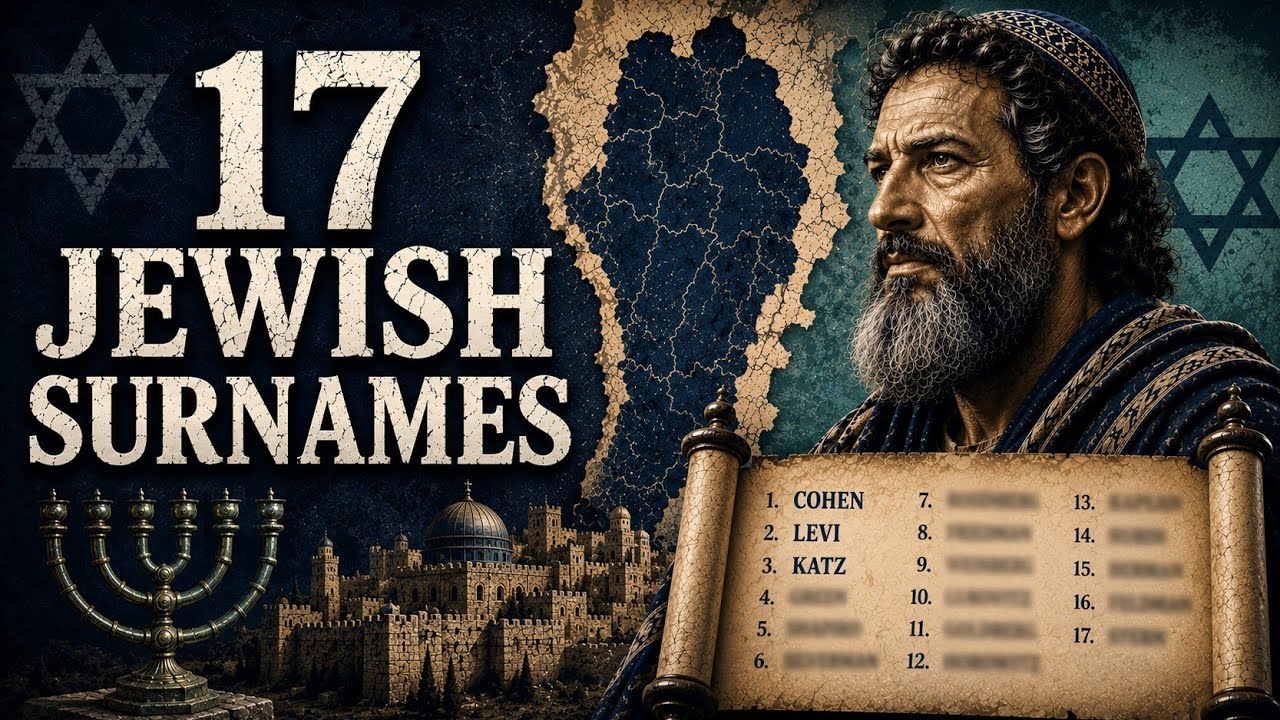
The family name “Cohen” and all its variations derive directly from the Hebrew word *kohen*, meaning priest. Not a priest in the general religious sense, but specifically the ancient priestly class of Israel descended from Aaron, the brother of Moses, of the tribe of Levi. The Cohanim, the plural of Cohen, were the men who performed the sacrifices at the Temple, who blessed the congregation, who maintained the ritual purity requirements of the priestly role, transmitting that role and that title exclusively through the paternal line, from father to son, generation after generation, as an inherited religious status. The title “Cohen” was maintained throughout the First Temple period, the Babylonian exile, the rebuilding of the Second Temple, and the Roman destruction of that Temple in the year 70 CE.
It survived for 2,000 years of diaspora, after that destruction ended the priestly functions completely. Men no longer able to perform Temple service continued to pass the title to their sons, who passed it to their sons, carrying it down through the centuries of dispersion until the moment in the late eighteenth century when European governments compelled families to adopt hereditary surnames. The priests then formalized what had always been their title—*kohen*—into the surname “Cohen. ”
Jewish families throughout Europe did not comprehensively adopt hereditary surnames until the late eighteenth and early nineteenth centuries.
Before that, Jewish naming followed the tradition of patronymics. A person was defined as the son or daughter of their father. Avraham ben Yitzhak, Rahel bat Moshe. The name changed with every generation.
There was no fixed family name passed from father to son to grandson as in European hereditary surnames. This changed under external pressure. The imposition of surname adoption came with the emancipation laws and military conscription requirements of governments needing to track Jewish populations in their records. Austria in 1787, France in 1808, Prussia in 1812, Russia in 1844.
Across Central and Eastern Europe, within roughly sixty years, Jewish families who had identified themselves for centuries by patronymics were suddenly required by law to choose or accept a fixed hereditary family surname. When those surnames were assigned or chosen, they were drawn from several sources. Some came from the town or region where the family lived. Some came from the father’s or grandfather’s first name, rendered into a fixed surname.
Some came from occupations. Some came from physical descriptions. And some, most relevant to this matter, came from ancient priestly, Levitical, and tribal designations that families had preserved through oral tradition and religious practice for centuries, sometimes millennia, before European governments compelled them to codify those designations as inherited names. The result is extraordinary.
Certain Jewish surnames encode tribal information that predates the surname system itself by 2,000 years. Ancient designations preserved through religious practice and collective memory, formalized as hereditary surnames when European law required it, and carried to the present day without most of the families bearing them realizing what their names actually contain. But before surnames, further context is needed, because the tribal system to which these names connect is not simple, and understanding the underlying structure matters. The twelve tribes of Israel, according to the Hebrew Bible, descend from the twelve sons of Jacob, the patriarch also called Israel, and formed the basic social and territorial organization of ancient Israelite society.
When the Israelites conquered and settled Canaan, each tribe received a territorial portion with one critical exception. The tribe of Levi was designated as a priestly tribe, distributed throughout the territories of the other tribes rather than receiving land of their own, because their role was religious service, not agricultural settlement. Ten of the twelve tribes were exiled by the Assyrian Empire in 722 BCE, resettled in distant parts of the Assyrian Empire. Their distinct collective identities gradually faded, and they became known to history as the Ten Lost Tribes, a phrase spawning centuries of speculation, claims of identity, and genuine historical mystery.
Two tribes survived—Judah and Benjamin—along with the scattered Levites, as distinct communities throughout the Babylonian exile and the subsequent Persian, Greek, and Roman periods of rule. These surviving communities became the ancestors of what we now call the Jewish people. The word “Jew” itself derives from “Yehudi,” meaning a person from the tribe of Judah, a tribal designation that became a general ethnic and religious label. Most Jews today descend primarily from Judah, Benjamin, or Levi.
But surnames tell a far more complex and interesting story than this simple summary suggests. The second group connected to the same tribe, Levi, represents a broader category of Levitical descent extending far beyond the specific Aaronide priestly lineage. Levi, Levy, Levine, Levit, Levinson, Levin, and a name that surprises nearly everyone who hears it: Segal. The tribe of Levi is identified in the Torah as a supporting tribe for the priests.
The Levites assisted the priests in Temple service, guarded the sanctuary, carried the Ark of the Covenant during the period of wandering, and served as teachers, judges, and musicians in the territories of the other tribes. While the Cohanim are a specific subgroup of Levites, the descendants of Aaron specifically, all Levites carry Levitical descent, which in traditional Jewish practice comes with its own set of honors and obligations, distinct from but related to those of the priests. The surname Levy and its variations are among the most common Jewish family names in the world. “Levy” is the French form, pronounced in French-speaking communities to rhyme with the English word “heavy,” though often anglicized in English-speaking communities.
“Levine” and “Levin” are the most common forms among Ashkenazim. The suffixes “-in” and “-ine” represent Slavic and French diminutive or descriptive renderings of the original name, common in regions where Ashkenazi communities were concentrated. “Levinson” and “Levit” represent constructions expressing descent, meaning son of Levi, which were formalized as hereditary family surnames during the surname imposition period. And then there is Segal.
The family name “Segal” and its variations “Siegel” and “Segal” is not obvious at first glance as a Levitical surname, but it derives from the Hebrew acronym *segan Levi*, meaning deputy or assistant Levite, a designation for a specific subclass within the Levitical hierarchy, referring to Levites who held a special administrative or functional role in Temple service. When families bearing this designation formally documented their surnames, *segan Levi* was shortened to “Segal,” and the acronymic origin of the surname was gradually forgotten by most bearers of the name. The surname of Steven Seagal, regardless of his personal origins, encodes this ancient Levitical designation. As does every “Segal” on a law firm letterhead, every “Siegel” in a university directory, every family that spelled the name slightly differently across the Atlantic crossing and the generations that followed.
The genetic picture for Levites is more complex than for priests. Ashkenazi Levite men show greater genetic diversity than priests, with a puzzling pattern that will be addressed in the genetic section. But this surname family is one of the most clearly documented tribal designations in the entire Jewish naming tradition. If your surname is Levy, Levine, or Segal, your family carries a 2,000-year-old functional title.
That function may no longer exist. But the name never disappeared. The third group connects to the tribe that gave the Jewish people their name: Judah. The tribe of Judah is the tribe from which the word “Jew” derives.
The term “Yehudi,” meaning a person from Judah, became the general ethnic and religious designation for all Israelites after the Babylonian exile, when Judah was the only remaining political entity. Nearly all Jews are, in the general sense, descended from Judah or the communities that joined under its political successor. But the specific surnames encoding claims of direct descent from Judah go beyond the general category and are rarer and more precise. The most important of these is “Peretz,” with its Ashkenazi form “Peretz.
” Peretz was a son of Judah, recorded in the genealogies preserved in the Book of Genesis, and again in the Book of Ruth, which traced his lineage through the line of King David himself. David’s line, as recorded in the Book of Ruth, passes through Peretz of Judah, meaning that families bearing the surname Peretz or Peretz claim or preserve a memory of descent from the specific clan of Judah that produced the Davidic royal dynasty. This is not a modest claim. The Davidic dynasty is the royal line from which the Messiah is expected to come in Jewish, Christian, and Islamic traditions alike.
Families bearing the surname Peretz carry a connection to the most important royal dynasty in the history of the monotheistic religions. The “Nasi” surnames encode a related claim. The title “Nasi,” meaning prince or patriarch, was used for the leaders of the Jewish community in the Roman and Byzantine periods, specifically the descendants of Hillel the Elder, recognized by Roman and then Byzantine governments as official leaders of the Jewish people. This dynasty claimed documented descent from David, and families preserving “Nasi” as a hereditary surname encode that claim of patriarchal leadership.
Shealtiel is one of the rarest surnames in this list, and one of the most specific. Shealtiel was the son of King Jeconiah, one of the last kings of Judah before the Babylonian exile, making him a direct descendant of David and a member of the royal house of Judah in its final years. Families preserving this name as a hereditary surname maintain one of the most direct Davidic descent claims in Jewish naming tradition. The tribe of Judah is the one that gave its name to the entire Jewish people.
The surnames referring directly to it are among the rarest and most historically significant in Jewish naming tradition. The tribe of Benjamin was the smallest of the surviving tribes. It was also nearly the most tragic. In the Book of Judges, the tribe of Benjamin was subjected to an internal war among the Israelites so catastrophic that only 600 men of the tribe remained, their women killed, their cities burned, their existence as a distinct people nearly ended before the period of the monarchies began.
From these six hundred survivors, the tribe rebuilt itself. It produced the first king of Israel, Saul. The tribe inhabited a territory that included the northern part of Jerusalem, and it survived long enough to merge its identity with Judah and contribute to the community that became the Jewish people. The surname “Benjamin” is the most direct expression of tribal identity in this entire list, being simply the name of the tribe itself adopted as a hereditary family surname.
Families bearing “Benjamin” as a family name present or preserve an explicit claim of descent from the tribe of Benjamin. The names “Saul” and “Shaul” memorialize the name of the first king of Israel, a Benjaminite, and families bearing this surname preserve the memory of that tribe’s royal era. The figure of Saul, the tragic first king ultimately rejected by the prophet Samuel in favor of David, is one of the most complex characters in the entire Hebrew Bible, and his tribal identity is clearly Benjaminite throughout the narrative. Mordechai, the hero of the Book of Esther, is explicitly identified in the biblical text as a Benjaminite of the clan of Kish, the same clan as King Saul.
Families preserving “Mordechai” as a hereditary family surname document both the individual hero of the Purim story and his explicit tribal affiliation. The tribe that was nearly annihilated in the Book of Judges survived, and its surnames are still carried today. Now we reach the most mysterious part of this story: the surnames that connect not to the two surviving tribes or the Levites, but to the ten allegedly lost ones. In 722 BCE, the Assyrian Empire under Sargon II conquered the northern kingdom of Israel and exiled its population to the far reaches of the empire, resettling foreign peoples in their place.
The ten tribes that had inhabited the northern kingdom—Reuben, Simeon, Dan, Naphtali, Gad, Asher, Issachar, Zebulun, Ephraim, and Manasseh—disappeared from the historical record as distinct communities. They became the Ten Lost Tribes, and for nearly 3,000 years the question of their fate has fueled everything from serious historical research to elaborate conspiracy theories. The surnames in this section connect to some of the most intriguing answers posed by historical, genetic, and genealogical research. “Ephrati” and “de Vries” are surnames encoding descent from Ephraim, one of the two half-tribes descended from Joseph.
These surnames appear in Sephardic communities and in some Yemenite Jewish families possessing genealogical records claiming descent from Ephraim. These records predate the surname imposition period, indicating that these families maintained claims of tribal identity through centuries of diaspora in isolation from any government requirement to formalize them. “Naphtali” and its derivatives preserve the name of the tribe of Naphtali, one of the northern tribes whose territory comprised the Galilee region of northern Israel. These names were initially borne as given names in Talmudic and medieval times, then became hereditary surnames in Jewish communities of Eastern Europe and the Middle East whose families maintained explicit tribal memory through naming tradition.
Then there is Beta Israel, the Jewish community of Ethiopia. The Beta Israel community, sometimes known as the Falasha, has long asserted for centuries that they descend from the tribe of Dan, one of the lost tribes. According to their tradition, their ancestors left the land of Israel before the Babylonian exile, traveled through Egypt, and eventually settled in Ethiopia, maintaining their Jewish identity in near-total isolation from the mainstream Jewish world for over two thousand years. This claim has been examined through genetic research.
The results are complex. Beta Israel shows evidence of ancient Middle Eastern ancestry consistent with an Israelite origin, alongside significant admixture with Ethiopian populations accumulated over the centuries. The genetic picture neither definitively confirms nor refutes the claim of Danite affiliation. It is consistent with an ancient community of Israelite origin that maintained its identity while genetically integrating with surrounding Ethiopian populations over many generations.
The lost tribes were never entirely lost. Some of them left their names encoded in surnames quietly preserved for 2,000 years while the world forgot their existence. Not every tribal connection announces itself with an obvious name. Shapiro, Horowitz, Margolis.
These surnames do not look like tribal designations. They look like town names and descriptive terms. But beneath the surface, they encode something far more specific. “Shapiro” derives from Speyer, a city in the Rhineland region of Germany that was home to one of the oldest Ashkenazi Jewish communities, founded in the early Middle Ages.
According to the community’s preserved records, the founding families of the Speyer Jewish community included large numbers of Cohanim, priestly families who had made their way west from the land of Israel through the Roman diaspora. The town’s name became a family surname, but the families who carried it westward from Speyer were, in many documented cases, Cohanim, making “Shapiro” an indirect priestly surname through communal origin rather than direct designation. “Horowitz” derives from the Bohemian town of Horowitz, but the specific Horowitz family that spread throughout Central Europe and produced some of the most prominent rabbinic scholars of the early modern period maintained a documented Levitical lineage through their own genealogical records. The town name became the surname.
The Levitical descent was preserved separately in family and community records, and is now considered an established genealogical fact for families descending from the original Horowitz rabbinical line. The names “Margolis” and “Margolies” derive from a Hebrew and Aramaic word meaning pearl, a beautiful and distinctive name. But this name has been particularly associated in rabbinic tradition with families of Levitical origin, and in the genealogical records of families bearing it, Levitical descent appears with sufficient consistency to make the association meaningful. Not every tribal connection declares itself.
Some of the deepest genealogical information in Jewish surnames is hidden inside place names and occupational titles you would never imagine carry a tribal memory. The Sephardic tradition merits its own section because Sephardic Jewish families, those descended from the communities expelled from Spain in 1492 and from Portugal in 1497, carried hereditary surnames centuries before Ashkenazi families were required to adopt them, and older surnames mean longer documented genealogical trails. “Abarbanel” is one of the most distinguished surnames in the entire Sephardic tradition. The family of Isaac Abarbanel, the fifteenth-century philosopher, biblical commentator, and financier who served in the courts of Portugal, Castile, and Naples, maintained documented Davidic descent claims that the medieval royal courts they served took seriously.
When the expulsion came in 1492, Isaac Abarbanel refused conversion, led the Jewish community in its negotiations with Ferdinand and Isabella, and when those negotiations failed, went into exile rather than abandon his faith. His family’s claim of Davidic descent, maintained across generations, represents one of the most carefully documented royal lineage claims in Jewish genealogical history. The Sassoon family, the prominent Baghdadi Jewish family whose commercial empire stretched from Baghdad to Bombay and then to London in the nineteenth century, bears a surname derived from the Hebrew word *sasson*, meaning joy. Their family maintained documented priestly genealogical records through centuries of residence in Iraq, records taken seriously by the Jewish legal authorities in their communities.
The surname “Toledano” derives from Toledo, one of the greatest centers of medieval Jewish intellectual life in Spain. The founding families of the Jewish community of Toledo, according to its historical records, trace origins brought to Spain from Judah during the period of the Babylonian diaspora, meaning the surname “Toledano” carries a potential connection to Judah transmitted through two and a half thousand years of preserved genealogical memory. Sephardic families had family surnames before Ashkenazi families were required to take them, and therefore their genealogical records are older and more precisely documented. Now we come to genetics, because this entire story has been building toward a question many have asked since the “Cohen” passage: what does your DNA actually tell you about which tribe you belong to?
The honest answer is both more and less than you might hope. The “Cohen modal haplotype,” the Y-chromosome signature identified by Skorecki and his colleagues in 1997 and then developed in subsequent research, remains the most scientifically robust finding in the field of Jewish genetic genealogy. The elevated frequency of this specific Y-chromosome pattern among self-identified priests across Ashkenazi, Sephardic, and Mizrahi communities is real, documented, and replicated. In 1997, a team of geneticists led by Karl Skorecki published a paper in the journal *Nature* examining the Y chromosome, the genetic material transmitted exclusively from father to son, following exactly the same paternal path as the title “Cohen,” in men who identified themselves as priests across Ashkenazi, Sephardic, and Mizrahi Jewish communities.
Communities that had been geographically separated for centuries. Communities that spoke different languages, followed different local customs, developed different cultural practices in their diaspora locations. What they found became known as the “Cohen modal haplotype,” a specific pattern of genetic markers on the Y chromosome present at strikingly high frequency among self-identified priests across all three major Jewish communal groups, Ashkenazi, Sephardic, and Mizrahi, compared to non-Cohen Jewish men from the same communities. The probability of this shared genetic fingerprint appearing by chance across three geographically separated communities was calculated to be extremely low.
The most likely explanation, the simplest one consistent with the evidence, is that a significant proportion of men bearing the surname “Cohen” do indeed share a common paternal ancestor: a real man who lived approximately 2,000 to 3,000 years ago, whose paternal descendants transmitted from father to son across the centuries, the name remaining attached to it throughout that time. If you are a man who identifies yourself as a Cohen, and your family has maintained the surname “Cohen” through the paternal line, there is a statistically significant probability that your Y chromosome carries this ancient priestly fingerprint. Not a certainty, but a real probability exceeding what chance alone would predict. Beyond the priests, genetic research on Jewish population structure has confirmed something extraordinary.
Jewish communities from around the world—Ashkenazim from Eastern Europe, Sephardim from the Mediterranean, Mizrahim from the Middle East, Yemenites from the Arabian Peninsula, even Beta Israel from Ethiopia—share a common genetic core connecting them to an ancestral Middle Eastern population that lived approximately 2,000 to 3,000 years ago. The diaspora scattered Jewish communities around the world. It did not erase their common origin. But here is what genetics currently cannot do.
It cannot tell most Jews which of the twelve tribes their ancestors belonged to. The genetic differences between the tribes, if they ever existed at a level distinguishable by ancient DNA analysis, have been largely homogenized by 2,000 years of marriage within the broader Jewish community. The population structure of the ancient twelve-tribe system has been replaced on a genetic level by the population structure of Jewish diaspora communities. The community has replaced the tribe.
The one exception, and it is a remarkable and puzzling one, is the Levites. Specifically, Ashkenazi Levite men. When researchers examined the Y chromosomes of men who identified themselves as Levites in Ashkenazi communities, they found something unexpected. A specific Y-chromosome haplogroup known as R1a appears at very high frequency among Ashkenazi Levite men.
But R1a is a haplogroup typically associated with Eastern European and Central Asian populations, not the Middle Eastern origins expected from a direct Israelite paternal lineage. This finding suggests that at some point in the history of Ashkenazi Levite lineages, perhaps during the early Middle Ages in Eastern Europe, a founder effect or admixture event introduced an Eastern European paternal lineage into what had been a Middle Eastern Levitical line. The exact mechanism remains under debate, but the result is that Ashkenazi Levites show a genetic profile distinct from both Ashkenazi priests and the general Ashkenazi population. A genetic puzzle researchers are still working to fully explain.
Genetics confirms the ancient Middle Eastern origin of the Jewish people. It confirms the priestly lineage with remarkable precision. But for most tribal connections, the surname carries more specific information than DNA can currently provide. These seventeen surnames represent 3,000 years of history encoded in the names Jewish families have carried through every country on earth, through every exile and migration and century of loss and survival contained in the Jewish historical experience.
Cohen and its variants carry the genetic fingerprint of the ancient priesthood, verified by modern science to a degree achieved by no other hereditary surname in history. Levy, Levi, Levine, Segal carry the Levitical designation that supported the priestly system throughout the Temple period and has been preserved in names ever since. Peretz carries the lineage of the Judahite clan that produced King David and the royal dynasty still holding messianic significance across three world religions. Benjamin, Saul, Mordechai carry the memory of the tribe that almost vanished and then returned, that produced the first king, that gave the world one of the great heroes of the biblical narrative.
Ephrati, Naphtali, and the Danite claim of Beta Israel carry the most mysterious legacy of all: the possibility that the lost tribes were never entirely lost, merely scattered beyond the boundaries of documentary record. And the hidden surnames—Shapiro, Horowitz, Margolis, Abarbanel, Sassoon, Toledano—carry lineage information encoded not in obvious tribal names, but in communal histories and family records preserving what the names themselves do not declare. If your surname appeared in this story, or resembled one of them, your family has carried a piece of ancient Israel through every exile, every migration, every generation. The tribe may be scattered.
But the name never was.






