Imagine a silver coin resting in your palm. It is heavy. It is cold. It gleams with the quiet confidence of a metal that has earned the trust of merchants, mercenaries, and emperors for centuries.
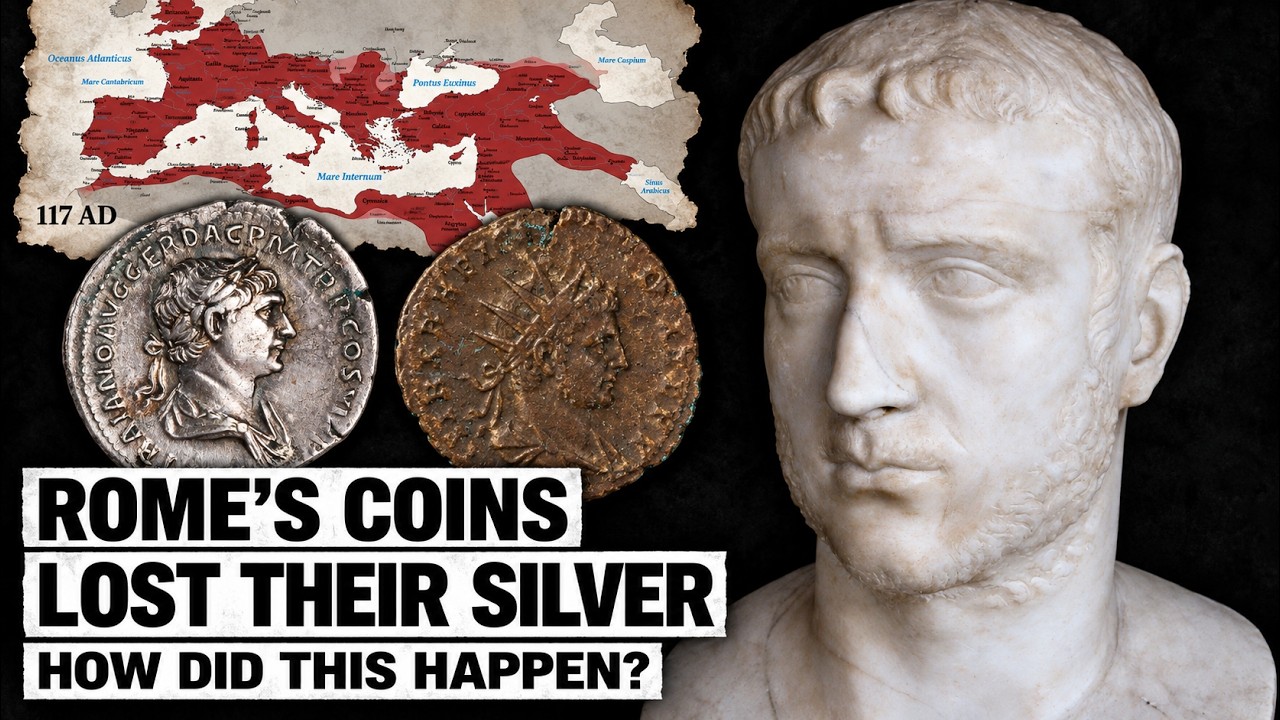
Now imagine that this coin, which once rang like a bell when dropped on marble, has been secretly altered generation after generation until it is nothing more than a piece of copper wearing a mask of silver so thin that a fingernail can scratch through to the base metal beneath. The weight is roughly the same. The face stamped on it is still a Roman emperor’s. The lettering is still proud, confident Latin.
But over three hundred years, its precious contents were stripped away, bit by bit. This is the story of the denarius, the silver coin that built the greatest empire of the ancient world, and the slow catastrophe that turned it from one of the purest coins in antiquity into a copper token pretending to be silver. It is a story that echoes through every modern economy that asks its citizens to trust in paper, in numbers, in the promise of the state. The denarius was not born in luxury.
It was born in war. Around 211 BC, during the brutal Second Punic War against the Carthaginian general Hannibal, Rome introduced a new silver coin. It was a crisis currency, created at a moment when Rome was fighting for its very existence on the Italian peninsula. The denarius began as a piece of nearly pure silver weighing about 4.
5 grams, one seventy-second of a Roman pound. Its name came from the number ten, because one denarius was worth ten bronze coins called asses. From the start, the coin was tied to the real economy. It paid the soldiers who conquered Spain, Gaul, Greece, Egypt, and North Africa.
It collected taxes from the provinces. Merchants used it to buy olive oil from Baetica, wine from Campania, grain from Sicily, and spices from Alexandria. Wherever the Roman eagle marched, the denarius followed. And wherever the denarius circulated, trust circulated with it.
For nearly two centuries, Rome’s silver coin was almost pure. It carried the weight of the empire in a way no marble monument or triumphal arch ever could. When a soldier in Gaul opened his pay pouch and felt the cold weight of twenty-five silver coins, he was holding more than money. He was holding a promise made by Rome.
Minting that coin required mountains of silver. Rome controlled the richest silver mines in the known world. The Iberian Peninsula, which the Romans called Hispania, held geological wealth that financed imperial expansion for centuries. At the Rio Tinto mines in southwestern Spain and the great silver works at Cartagena, which the Romans called Carthago Nova, the earth itself produced a constant stream of precious metal.
These were not small operations. Ancient sources say that Carthago Nova alone employed some forty thousand workers, many of them slaves descending more than a hundred meters into mine shafts. Some tunnels stretched for hundreds of meters, connected by sloping ramps, using advanced technology like water wheels and chain pumps for drainage. The piles of slag left behind by Roman silver smelting still scar the Spanish countryside today.
Historians estimate that a significant portion of all silver used in Roman coinage came from Rio Tinto alone. But cracks were already beginning to appear in the final years of the Roman Republic. In 91 BC, Rome was tearing itself apart in the Social War, when Rome’s own Italian allies revolted demanding citizenship, and the state poured money into the conflict at an unprecedented rate. For the first time in history, Rome faced a situation that would become all too familiar in the centuries to come: a government that needed more silver than it could produce.
According to a five-year scientific study by researchers from the University of Warwick, the University of Liverpool, and the Rutherford Appleton Laboratory, the denarius’s silver content dropped in two distinct stages during this crisis. The coin first fell from near pure to about 95 percent, then down to about 90 percent, with some coins reaching as low as 86 percent. This may seem trivial in modern times, but to a world accustomed to nearly pure silver, it was a profound shock. The Roman statesman Cicero later wrote that the currency system became so confused that no one could know what he actually had.
In plain terms, people had lost faith in their own money. A silent panic set in. When the praetor Marcus Marius Gratidianus issued an edict stabilizing the exchange rate between silver and bronze coins, he became wildly popular. Statues were erected to him in Rome’s neighborhoods.
People burned candles to him as if he were a god. This tells us how terrified the Romans had become at the prospect that their silver might no longer be silver. The debasement was eventually reversed. The denarius was restored to high purity.
But the lesson stayed in the historical record. When the state faced a silver shortage, it did not stop spending. It mixed copper into the silver and hoped no one would notice. This was the first rehearsal for a tragedy that would play out three hundred years later on a much larger scale.
When Augustus consolidated power at the end of the first century BC and inaugurated the age of emperors, the denarius entered what historians have called its golden age. For about ninety years, under the Julio-Claudian emperors, the purity of Rome’s silver coin was unquestionable: fully 98 percent pure silver or better. The denarii of Augustus, Tiberius, and Claudius were virtually indistinguishable from one another in composition. Each had a brilliant weight that made it the most trusted coin on earth.
It was this trust that held the empire together. Mediterranean trade expanded. Taxes flowed in. Legions guarded the frontiers.
Roads were built. Aqueducts were constructed. Cities flourished from Londinium in Britain to Palmyra in Syria. At the core of it all was that one silver coin.
A citizen in Alexandria and a citizen in Lyon could trade with one another because both trusted the same piece of metal. That trust was Rome’s greatest invention, greater than the arch, greater than the aqueduct, greater even than the legion. And that trust was about to be destroyed by a man better known for playing music while his city burned. In July of AD 64, a fire engulfed Rome.
For six days and seven nights, the flames consumed the city, destroying entire districts and leaving thousands homeless. Only four of Rome’s fourteen districts escaped the fire. Three were completely destroyed. Reconstruction was enormously expensive.
Emperor Nero poured the empire’s wealth into rebuilding the capital on a grander scale than ever before, with wide streets, tall buildings, and his own luxurious new palace, the Domus Aurea or Golden House, at its center. But rebuilding Rome required silver. Enormous amounts of silver. The Spanish mines could not supply it fast enough to meet Nero’s demands.
So in AD 64, Nero made a decision that would echo through two hundred years of imperial history. He reformed the coinage. He reduced the denarius’s weight from one seventy-second of a Roman pound to one ninety-sixth, bringing it down to about 3. 41 grams.
And he quietly reduced its silver content from about 98 percent to about 93. 5 percent. The difference seemed negligible. A tiny amount of silver was shaved from each coin and replaced with an invisible layer of copper.
But since the empire issued the new coins at the same value as the old ones, the state suddenly found it could produce more coins from the same amount of silver. More coins meant more spending power for the government. On the surface, it worked. Rome was rebuilt.
Soldiers were paid. Construction projects continued. But Nero had crossed a Rubicon that no previous emperor had dared to cross. He had shown his successors that when the state needed money, it did not have to raise taxes or cut spending.
It could simply rig the coinage. Nero was killed in a coup in AD 68, but his monetary experiment survived him. His successors saw what he had done, and they liked it. In the decades that followed, the denarius’s silver content moved in only one direction: downward.
Under Vespasian, who came to power in AD 69 after the chaos of the Year of the Four Emperors, the silver content dropped to about 89 percent. Under Trajan, around AD 99 or 100, the denarius was formally set at about 80 percent silver. Trajan is remembered as one of Rome’s greatest emperors. His reign saw the empire reach its maximum geographical extent, stretching from Britain to Mesopotamia.
His wars in Dacia, in modern Romania, brought back enormous amounts of gold and silver as loot. Yet even Trajan, flush with conquest and plunder, continued to debase the silver coinage. The reason is not hard to understand. Running an empire of fifty to seventy million people was expensive.
Paying millions of soldiers was expensive. Building roads, fortresses, aqueducts, baths, temples, and amphitheaters was extremely expensive. Emperors discovered that debasement was the least politically painful way to finance it all. The slippage was slow.
It was almost dignified. But it was relentless. By the mid-second century, under Antoninus Pius, the denarius had fallen to about 83 or 84 percent silver. Then came the Marcomannic Wars.
Beginning in AD 166 under the philosopher emperor Marcus Aurelius, Rome became embroiled in a brutal and protracted struggle against Germanic tribes pressing on its northern frontier. The wars dragged on for over a decade. They consumed men, grain, equipment, and above all money. To make matters worse, a devastating pandemic known as the Antonine Plague swept through the empire at the same time.
It was likely smallpox or measles, and it is believed to have killed millions across the Roman world over nearly two decades. The plague weakened the army. It destroyed the tax base. It depopulated cities and villages.
Marcus Aurelius, despite his reputation as a wise and philosophical ruler, saw no choice but to continue debasing the coinage. By the end of his reign, the denarius had fallen to about 75 percent silver. The pattern was now permanent. Every time Rome faced a military, political, or epidemiological crisis, the response was the same.
Lower the silver content a little more. Strike more coins from the same amount of metal. Hope that the long-term consequences would fall on someone else’s reign. Then came Septimius Severus, a tough general from North Africa who seized the throne by force in AD 193.
Severus understood one thing very clearly: his power depended on the loyalty of the army, and the army had to be paid. He is said to have told his sons before his death, enrich the soldiers, and scorn everyone else. He lived by that advice. Severus nearly doubled the legionaries’ annual pay, from the 300 denarii set by Domitian to somewhere between 500 and 600 denarii.
On paper, it was a massive pay raise. In reality, it was a kind of accounting trick, because Severus simultaneously accelerated the debasement of the denarius, dropping its silver content from about 75 percent to about 50 percent. The coins in the soldiers’ hands now contained very little silver at all. In terms of real purchasing power, Severus did almost nothing for his troops.
His son Caracalla, who seized sole power in AD 211 by murdering his own brother, continued the strategy and pushed it further. Caracalla raised military pay again, possibly another 50 percent, reaching about 700 denarii per year. Then, in AD 215, he introduced one of the most notorious monetary innovations in Roman history: a new coin that modern numismatists call the antoninianus, named after his official name. To the public, it was presented as a double denarius.
It was supposed to be worth two denarii, but in reality, it contained only about one and a half times as much silver. In other words, the state was now openly asking its citizens to accept two denarii’s worth of value for a coin that contained only one and a half denarii’s worth of silver. People noticed. They were not stupid.
The ancient principle that bad money drives out good, later formulated as Gresham’s Law, began to operate with brutal efficiency. The older, purer denarii vanished from circulation. People hoarded them, melted them down, or buried them in the ground. The lighter antoniniani flooded the market.
Within a generation, the antoninianus had almost entirely replaced the denarius as the standard silver coin of the empire. And now the debasement was no longer slow. It was a steep decline. The period from AD 235 to AD 284 is known to historians as the Crisis of the Third Century.
For forty-nine years, the Roman Empire teetered on the brink of total collapse. In that half-century, more than fifty men claimed the imperial throne, most of them raised up by their own armies, and nearly all of them murdered within a few years, often by the very soldiers who had put them in power. These were the barracks emperors. The empire fragmented.
For a time, there were three separate Roman states: the Gallic Empire in the west, the Palmyrene Empire in the east, and the remnant of the Roman Empire in between, each with its own emperor, its own army, and its own mint. Barbarian invaders poured across the frontiers. The Goths crossed the Danube. The new Sassanian dynasty of Persia inflicted devastating defeats in the east, even capturing Emperor Valerian in AD 260 and displaying him as a human footstool.
In the midst of this chaos, the final collapse of Rome’s silver coinage began. At the start of the crisis, the denarius had already fallen to about 50 percent silver. By AD 241, under Gordian III, it was 48 percent. From there, the fall became precipitous.
Each new emperor needed to pay his army and buy the loyalty of his commanders. By the mid-260s, under Emperor Gallienus, the supposedly silver antoninianus had become almost unrecognizable. Surviving specimens contain as little as 5 percent silver. Some contain as little as 2.
5 percent. In practice, they were small bronze tokens coated with a thin silver wash to make them look valuable when they left the mint. That thin wash wore off within weeks of entering circulation, exposing the base metal beneath. The most trusted coin in the world had become a lie, and everyone knew it.
The economic consequences were devastating. Prices skyrocketed. One estimate suggests that by the end of the third century, prices in Rome had risen roughly seventy-fold compared to two centuries earlier, with most of that inflation occurring in the final decade of the crisis. Entire regions of the empire reverted to barter.
Tax collection became an administrative nightmare. In some provinces, the state began demanding taxes in kind, in grain, wine, and oil, because its own coinage was no longer usable as a measure of value. Soldiers demanded payment in gold instead of silver, because they knew silver coins were worthless. Merchants hoarded the old pure coins and spent only the new debased ones, further draining real wealth from the economy.
Archaeologists have found hoards of pre-crisis denarii all across the former empire, buried by anxious citizens who hoped to recover them once the storm passed. Many of those citizens never returned. Entire villages were depopulated. Trade routes withered.
Cities that had once buzzed with merchants haggling in a dozen languages fell silent. Out of this despair rose a man who may have been Rome’s most influential emperor since Augustus. His name was Diocletian, and he came from a humble family in Dalmatia on the Adriatic coast. He took power in AD 284 and began the monumental task of pulling the empire back from the brink.
His reforms were vast and radical. He reorganized the administration and divided the empire into east and west for easier governance. He created the tetrarchy, a system of four co-emperors, two senior Augusti and two junior Caesars. He expanded the bureaucracy.
He increased the size of the army. And in AD 293, he attempted the most ambitious monetary reform Rome had seen in centuries. Diocletian introduced a new high-purity silver coin called the argenteus, struck at ninety-six to the Roman pound. He revalued the gold coinage.
He tried to bring some logic to the chaotic exchange rates among various metals and coins. For a time, it seemed it might work. But the underlying problem had not been solved. The empire still had enormous expenses, an enormous army, and an enormous bureaucracy.
Prices kept rising. In AD 301, Diocletian made one of the most famous mistakes in economic history. He issued an edict of maximum prices. The edict was staggering in its ambition.
It attempted to set maximum prices for more than 1,400 different goods and services across the entire empire, from bread to beef, from wine to purple dye, even setting a legal maximum for a shepherd’s daily wage. The penalty for exceeding the set prices was death. The edict blamed greedy merchants for raising prices in response to debasement. In other words, Diocletian blamed ordinary people trying to survive for the inflation, rather than the centuries of debasement that had destroyed the purchasing power of Roman money.
The edict was a disaster. Merchants withdrew their goods from the market rather than sell at a loss. Shortages appeared almost immediately. Black markets flourished.
Enforcement was impossible. Within a few years, the imperial decree was effectively dead, though it was never formally repealed. In AD 305, in a decision unprecedented in Roman history, Diocletian voluntarily abdicated and retired to his grand palace on the Dalmatian coast, where he reportedly spent his final years growing cabbages. The real task of saving the empire fell to the next great reformer, a man whose name every schoolchild in the Western world eventually learns: Constantine the Great.
Constantine came to power through a series of civil wars that ended with his defeat of his final rival Licinius in AD 324. He is remembered today for two things above all: his adoption of Christianity, which transformed the religious landscape of the Western world, and his founding of a new eastern capital at Byzantium, which he renamed Constantinople and which survived as the center of the Roman world for another thousand years after the fall of Rome. But Constantine’s economic reforms deserve equal remembrance. Around AD 310, he began striking a new gold coin called the solidus.
The name came from the Latin word solidus, meaning solid, and that was its whole purpose. The coin was struck at seventy-two to the Roman pound, weighing about 4. 5 grams. It was minted at about 95.
8 percent purity, nearly pure gold. And unlike any Roman coin before it, the solidus was protected, guarded, and maintained by imperial authority with near-religious devotion. For the next seven hundred years, through the fall of the Western Empire, the rise of Islam, the Middle Ages, countless wars, dynasties, and revolutions, the solidus remained a reliable standard of value. It became the most successful coin in human history.
Byzantine solidi have been found at archaeological sites from Scandinavia to China. Arab caliphs imitated it. Medieval European merchants prized it. It was the dollar of the medieval world.
Constantine understood something his predecessors had either forgotten or ignored. Trust in money cannot be created by law. It cannot be imposed by decree. It has to be earned gradually, through generations of fiscal discipline.
With gold, he did the right thing. Unfortunately for his empire, he was not successful with silver. The debasement of the silver coinage continued. Subsequent emperors introduced small silver coins called siliquae and base-metal coins called folles, which continued to lose value from the fourth century into the fifth.
By the time the Western Roman Empire fell in AD 476, the silver denarius had long since ceased to exist, surviving only as a ghost, a memory of a lost age. What destroyed the silver content of Roman coinage? There is no single villain in this story. There is no secret cabal of corrupt bankers, no shadowy conspiracy of powerful financiers.
The debasement of the denarius was the collective work of dozens of emperors, each of whom made decisions that seemed reasonable, practical, and small at the time. Nero needed to rebuild Rome. Trajan needed to pay his soldiers. Marcus Aurelius needed to fight the Germanic tribes.
Septimius Severus needed to secure his soldiers’ loyalty. Caracalla needed to buy political support. The barracks emperors needed to survive long enough to die of natural causes rather than assassination. Each of them saw the mint as a machine that could solve immediate problems without the political pain of raising taxes or cutting spending.
Each of them left the long-term consequences to their successors. And when those long-term consequences finally arrived, they were catastrophic. The empire’s citizens lost faith in their currency. Trade contracted.
Cities shrank. Revenue stopped flowing. The state became unable to pay the very soldiers whose support had driven the debasement in the first place. In the end, the debasement that was meant to sustain the empire became one of the leading causes of its fall.
Historians debate how much of Rome’s decline was caused by monetary mismanagement versus barbarian invasions, climate change, pandemics, or administrative decay. But nearly all agree that debasement was a major factor in the story. You cannot run an empire on a coin that no one trusts. The Roman story is not some curious relic of the distant past.
It is a warning drawn from the deepest well of economic history, still echoing in the present. The temptation Nero yielded to in AD 64 is the same temptation faced by every king who clipped the edge of a silver shilling, every finance minister who printed more banknotes than the gold in the vaults, every modern central banker who expanded the money supply to cope with a crisis. The techniques have changed, but the underlying temptation remains the same. In Weimar Germany in the 1920s, a wheelbarrow full of banknotes was needed to buy a single loaf of bread.
In Zimbabwe in the 2000s, prices doubled every twenty-four hours during hyperinflation. In Venezuela in the 2010s and 2020s, citizens weighed bundles of cash on scales rather than counting the bills. In every case, the political authority debased the currency under short-term pressure, hoping the long-term consequences would fall on someone else. And in every case, the long-term consequences eventually arrived.
This is why, throughout most of history, conscious savers have stored gold rather than paper. This is why, even today, when inflation crises strike, people reach first for the hardest and most reliable money they can find. Gresham’s Law has never stopped working. Bad money still drives out good.
Debasement is essentially a hidden tax. It takes from ordinary people to pay the needs of the few. It does not look like a tax. It has no official name.
No politician has to campaign for it. But its effects are just as real as any tax written into law. And in the end, when the system collapses, it hurts everyone, even the elites who profited from it for so long. The lesson from Rome is not that debasement is always immediately catastrophic.
For decades, the slow decline of the denarius produced no visible crisis. The lesson is that the costs are deferred, accumulated, and compounded, until one day the system can no longer bear them. The Roman Empire ran on silver coinage for three centuries, until the silver ran out. Then it ran on debased coinage for another two centuries, until even that last shred of silver illusion could no longer be sustained.
The question that haunts this story is not whether the Romans understood what was happening to their money. Many of them clearly did. The question is why they could not stop it. And the uncomfortable answer is that stopping it would have required admitting the bitter truth that the empire was living beyond its means, that its army was too large, its bureaucracy too expensive, and its ambitions far greater than the real resources available.
No emperor wanted to deliver that message. So they all avoided the problem, century after century, until there was no more avoiding left. Rome did not fall because of silver alone. It fell because of thousands of interconnected pressures, from climate to plague, from Germanic tribes to Persian wars, from administrative decay to religious unrest.
But the slow death of its silver coinage was among the most quietly destructive of all those pressures. It was the thread that ran through everything else. Every crisis required money. Every solution required silver.
Every shortfall was met by mixing a little more copper into the silver. And one day, the empire’s citizens woke up to discover that the coin in their hand still bore the emperor’s face and the proud lettering of the Roman mint, but it was no longer silver at all. It was something else. Something that scratched under a fingernail.
Something no eastern merchant would accept at real value. Something that within a few generations would vanish entirely into oblivion, making way for new gold coins struck in a new capital on a new shore. The empire built on silver still survived, at least in the east. But the silver itself was gone.
It had been eroded away, bit by bit, in a web of three hundred years of imperial decisions. No thief had stolen it. The state itself had stolen it, the state that had sworn to protect it. That is the real story of Rome’s silver coinage.
Not a triumph, not a war, not a conquest. But a long, patient, generational theft of value hidden behind the face of a coin, a theft no one wanted to look at too closely. Until one day, there was nothing left inside the coin to see.






