The axe handle was wrapped in wire, the same kind of wire that might hold a worn boot sole in place. It stood driven blade-first into the bare dark soil at the center of a perfectly circular clearing, roughly fifty yards across, ringed by trees that curved inward as if they were bowing. The trapper Josias Farwell had worked these Oregon streams for over thirty years and knew the terrain as well as any living man, but he had never seen this clearing before, and he did not enter it. He stood at its edge, looking at that axe, and felt what he would later describe to the postmaster in Riddle Creek as the absolute certainty that if he stepped into that circle, he would never step out again.
He marked the location on his personal map and left. When he returned two weeks later with two companions, the clearing was gone. The trees were dense and unbroken, no circle, no bare ground, no axe. The forest had closed over the spot as completely as if it had never existed.
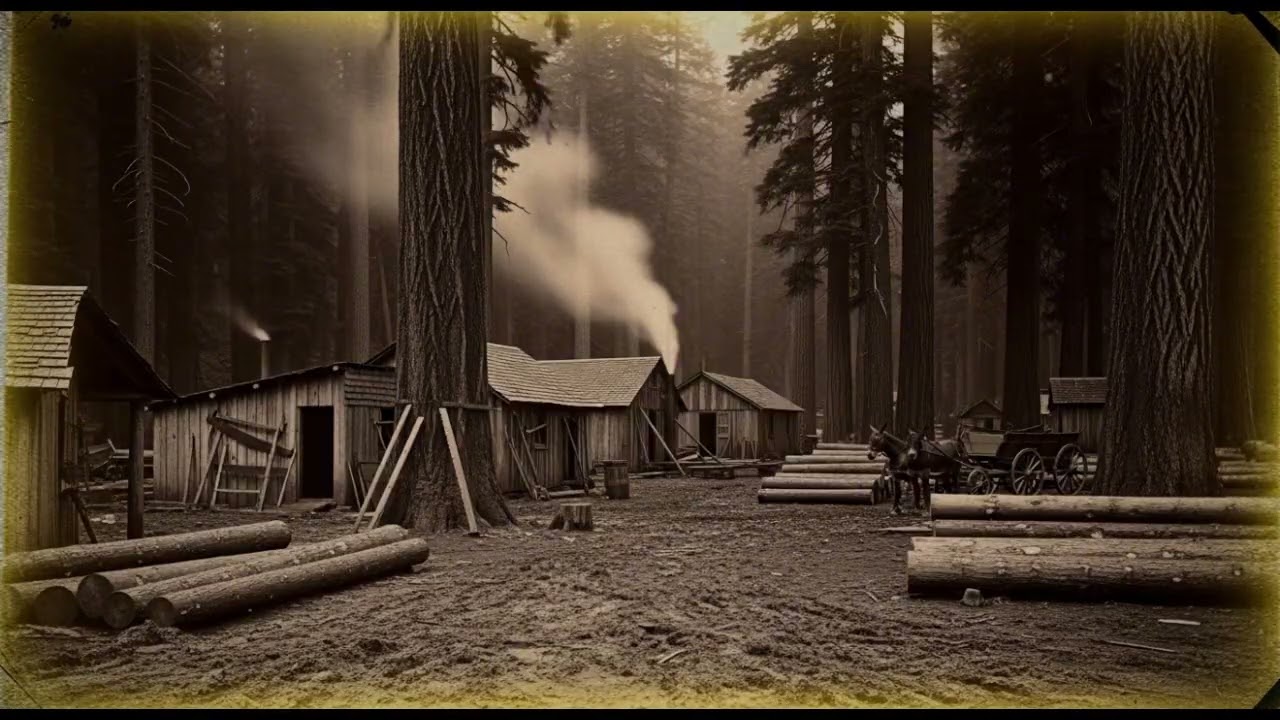
To understand what Josias had stumbled upon, and what had happened before he found it, one has to go back to the fall of 1891, deep in the mountains of northern Oregon, in a stretch of old-growth forest so vast and so dense that even the men who worked it their entire lives admitted they had never seen all of it. The locals called the region the Black Pine Corridor, not because of any particular species of tree, but because the canopy was so thick that even at midday the forest floor sat in a permanent twilight, and the bark of every trunk looked black from the perpetual damp. It was timber country, raw and unforgiving, and the men who came to work there were the kind who had already exhausted their options everywhere else. The camp was called Black Pine Lumber Camp Number Seven, though no one who worked there ever used the full name.
They just called it Seven. It had been established three years earlier by the Hargrove Timber Consortium out of Portland, a company known for pushing deeper into wilderness than any of its competitors dared, and for losing more men in the process. Seven sat at the end of a supply road that took nearly two days to travel by mule wagon from the nearest town, a place called Riddle Creek, which itself was barely more than a general store, a postal office, and a handful of houses leaning against the wind. Once you arrived at Seven, you were as close to the edge of the known world as a man could get without leaving the country entirely.
The foreman was a man named Ogden Harshaw, forty-seven years old, built like a man who had been carved from the same timber he spent his life cutting. His hands were enormous, scarred across every knuckle, and his left ear was partially missing from a cable snap years earlier that had nearly taken his head off. Ogden had worked lumber since he was twenty, starting in the camps of northern Michigan before drifting west with the industry. He had the kind of authority that did not come from a title on a piece of paper.
It came from the fact that he had survived things that had ended other men. He spoke rarely, and when he did, nobody interrupted. Under Ogden worked a crew of thirty-one men that fall, a mix of seasoned loggers and newcomers desperate enough to sign on for a season in the most isolated camp the Hargrove Consortium operated. Among them was the company clerk, a thin and meticulous man of thirty-four named Prentice Moyle, who had come west from Pennsylvania after a failed career in banking and found himself, somewhat improbably, keeping the books and inventory records for a lumber operation in the deepest woods he had ever seen.
Prentice wore spectacles with wire frames that he cleaned obsessively, and he had the kind of pale complexion that never quite adjusted to outdoor life. His hands were soft, his fingernails clean, and the other men regarded him with the vague suspicion that working men often reserve for those who earn their living with a pen. The cook was a broad-shouldered woman of fifty-one named Bertha Cleary, one of the only women within a hundred miles, a German immigrant who had been cooking for lumber camps for over two decades and who ran her kitchen with an authority that rivaled Ogden’s command of the cutting crews. Bertha had a deep voice, iron gray hair she kept pinned beneath a wool cap, and a scar across her right forearm from a grease fire that she had never explained.
She had outlasted every camp she had ever worked in, and she intended to outlast this one too. And then there was the man this story is really about. His name was Clement Aldridge, and he arrived at Camp Seven on the 14th of October, 1891, three weeks after the season had already begun. He came alone on foot, carrying nothing but a canvas rucksack, and wearing boots so worn that the sole of the left one was held on with wire.
He was thirty-nine years old, lean, with deep-set eyes the color of creek water, and a beard that looked like it had not been trimmed in months. His cheekbones were sharp, his skin weathered far beyond his years, and he had a way of standing perfectly still while everyone around him moved, as if he existed on a slightly different rhythm than the rest of the world. Nobody knew where Clement had come from. When Ogden asked, Clement said only that he had worked camps in Washington and Montana, and that he was looking for a season’s wages, nothing more.
Ogden, who had seen enough drifters to know when a man was running from something, did not press. He needed hands. The season was behind schedule. He signed Clement on and assigned him to the felling crew under a senior logger named Wyatt Doss, a broad-chested man of forty who had been with Hargrove for six years, and who had a reputation for working harder and talking less than anyone in camp.
For the first week, nothing unusual happened. Clement worked without complaint. He was skilled with an axe, efficient with a crosscut saw, and he followed instructions without the need for repetition. Wyatt, who trusted no one easily, admitted to Ogden after five days that the new man was one of the best fallers he had seen.
Clement ate his meals in silence at the far end of the mess table, spoke to no one unless spoken to, and retired to his bunk before the lanterns were dimmed each night. The other men left him alone, which is what men in lumber camps generally do with someone who clearly prefers it. But then came the night of October 21st. Prentice Moyle was working late in the supply shack, updating the inventory ledgers by lamplight, when he heard something that made him set down his pen.
It was a sound from the woods beyond the perimeter of the camp, and at first he thought it was an animal, perhaps an elk or a bear moving through the brush. But the sound did not move. It stayed in one place, a low rhythmic noise, almost like breathing, except far too deep and far too slow to come from any living thing Prentice could name. He sat perfectly still and listened.
The sound continued for perhaps two minutes, then stopped as abruptly as it had started. And the silence that followed was somehow worse than the noise itself. Prentice mentioned it to Bertha the next morning over coffee. She looked at him for a long moment, then said something that struck him as odd.
She said she had been in these woods for three months now, and in all that time, she had never once heard a bird sing at night, not an owl, not a whippoorwill, nothing. The forest around Camp Seven, she said, was the quietest place she had ever worked, and she had worked in some very quiet places. Prentice thought about that for the rest of the day. Over the following week, other men began to notice things, small things, the kind that are easy to dismiss individually, but harder to ignore when they start accumulating.
Wyatt Doss reported that his felling crew had found a clearing about a mile north of camp where the trees had grown in a perfect circle, every trunk curved slightly inward, as though the entire grove had been pulled toward a central point. The ground inside the circle was bare, completely bare, no moss, no fern, no undergrowth of any kind, just dark soil that felt oddly warm to the touch, even though the October air was already carrying frost. Two days after that, a logger named Severdt Undset, a Norwegian immigrant of twenty-eight with arms like dock ropes, was working alone trimming branches from a felled pine when he looked up and saw a figure standing at the tree line roughly two hundred yards away. He could not make out any details, only that it was tall and motionless and appeared to be watching him.
Severdt called out, thinking it might be one of the other men, but received no answer. He set down his hatchet and began walking toward the figure. When he had covered about half the distance, the figure was no longer there. Not gone exactly.
Severdt would tell this story several times over the following days, and each time he used the same word. The figure did not leave. It was simply no longer there, as though it had been subtracted from the landscape. There was no telephone at Camp Seven, no telegraph.
The nearest town was two days away by mule. If something went wrong, you dealt with it yourself, or you did not deal with it at all. These men were, in every meaningful sense, alone. On the 29th of October, Ogden Harshaw made a decision that would alter the course of everything that followed.
He ordered a crew of six men, led by Wyatt Doss, to push the cutting line further north than any crew had gone before, into a section of forest that appeared on the company maps as simply unmarked territory. The Hargrove Consortium wanted volume, and the timber to the north was rumored to be some of the largest old growth pine left standing in Oregon. Ogden had resisted the push for weeks, not out of fear, but out of practicality. The terrain was rough, the supply line was already stretched thin, and winter was approaching faster than usual.
But the company sent word through the last supply wagon that production targets had to be met, or the camp would be closed. So Ogden gave the order. The crew set out before dawn, six men carrying saws, axes, and enough provisions for three days. Among them were Wyatt, Severdt, a quiet Scotsman of forty-three named Fergus Leith, who had a habit of whistling old hymns while he worked, and Clement Aldridge, who had volunteered for the expedition without being asked, which surprised everyone because Clement had never volunteered for anything.
Prentice watched them leave from the doorway of the supply shack. He would later write in his personal journal, which was recovered years afterward, that as the men disappeared into the tree line, the forest seemed to close behind them like a curtain, and that for a brief irrational moment, he felt certain he would never see all of them again. The crew was supposed to return on the evening of the 31st. They did not.
They did not return on the 1st of November either. By the 2nd, Ogden organized a search party of eight men and set out along the trail the crew had blazed north. What they found six miles from camp was the crew’s base site. The tents were still standing.
The provisions were untouched. The saws and axes were laid out in a neat row, as though the men had carefully set down their tools before walking away. There were boot prints in the soft earth leading north from the site, six sets walking in a single file, spaced evenly apart. And here was the detail that would haunt Prentice Moyle for the rest of his life.
The boot prints did not wander. They did not hesitate. They moved in a perfectly straight line directly north, as though the six men had been following something only they could see, and the prints simply ended. Not at a river.
Not at a cliff. They ended in the middle of flat open ground, as if the men had been walking and then, between one step and the next, had ceased to exist. Ogden stood at the terminus of those tracks for a long time without speaking. The search party fanned out in every direction, calling names, looking for any sign of passage, a broken branch, a torn piece of cloth, a dropped tool.
They found nothing. The forest beyond the end of those tracks was undisturbed, as though no human being had ever set foot in it. They returned to camp that evening in silence. That night, Bertha Cleary did something she had never done in her twenty years of camp cooking.
She locked the kitchen door from the inside and slept beside the stove with a carving knife within arm’s reach. When Prentice asked her why, she said that while the search party was gone, she had been alone in the kitchen preparing the evening meal, and she had heard footsteps on the roof. Not an animal. Footsteps.
Two feet walking slowly from one end of the building to the other, pausing at the center directly above where she stood, and then walking back. She had gone outside immediately and looked up. The roof was empty. There were no tracks in the frost that had begun to gather on the shingles, but she had heard it, she said, as clearly as she could hear Prentice breathing right now.
The camp began to change after that. Not all at once, but in the way that rot works through wood, slowly from the inside, until the structure that looks solid from the outside is hollow at its core. Men who had been steady and reliable began making mistakes. Ropes were tied wrong.
Trees fell in unpredicted directions. Two men suffered injuries in a single week, one a crushed hand, the other a gash across the thigh from a slipped axe blade. Neither injury was life-threatening, but both were the kind of careless accident that simply did not happen to experienced loggers. And the dreams started.
Prentice documented this in his journal with the careful precision of a man trained in bookkeeping. On November 5th, he noted that four men independently reported the same dream. They had dreamed of standing in the forest at night, unable to move, watching a light move between the trees in the distance. The light was not a lantern.
It was not fire. It was a pale bluish glow that moved slowly, deliberately, as though it were searching for something. In the dream, each man felt an overwhelming urge to follow the light. And each man felt simultaneously certain that doing so would be the last thing he ever did.
They woke at exactly the same time, three in the morning, drenched in sweat. By November 7th, the number of men reporting the same dream had risen to eleven. Ogden called a meeting. He stood before the assembled crew in the mess hall, his enormous frame backlit by the fire, and he told them plainly that six men were missing, that no trace of them had been found, and that he had sent word to Riddle Creek requesting additional support from the Hargrove Consortium.
He told them that until help arrived, operations would continue, because stopping work would accomplish nothing except to give fear more room to grow. He told them that he had been in these woods longer than any of them, and that the mountains played tricks on the mind, and that the best defense against the unknown was routine, discipline, and keeping your hands busy. It was a good speech. The men wanted to believe it.
But Prentice noticed something as Ogden spoke. He noticed that Ogden’s hands, those enormous, scarred, unshakable hands, were trembling. On November 9th, two men deserted. They packed their belongings before dawn, left a note on the mess table that said simply “gone,” and walked south toward Riddle Creek.
Ogden did not send anyone after them. On November 11th, three more left. By the 15th, the camp’s complement had dropped from thirty-one to nineteen, not counting the six who had vanished. And then Prentice discovered the drawings.
He found them by accident. He had been reorganizing the supply shack, trying to account for provisions that seemed to be disappearing faster than the reduced crew should have been consuming them. When he moved a stack of empty crates, he found scratched into the wooden wall behind them a series of markings. At first he thought they were random, the kind of idle scratching a bored man might do with a knife.
But as he held his lamp closer, he realized they were deliberate. They were drawings, crude but unmistakable, of trees arranged in a circle. Inside the circle, in every single drawing, there was a figure. The figure had no face.
It was tall, far taller than any human proportion would allow, and its arms extended outward at impossible angles. There were dozens of these drawings scratched into the wood at different times. Some old enough that the exposed grain had darkened, others fresh enough that the shavings still clung to the grooves. Prentice showed them to Ogden.
Ogden stared at the wall for a full minute, then turned to Prentice and asked him a question that chilled the clerk to his core. Ogden asked when Prentice had last seen Clement Aldridge. Prentice realized with a sudden drop in his stomach that he could not remember. He had not seen Clement since the search party returned.
That was over a week ago. He checked the bunkhouse. Clement’s belongings were still there, his rucksack, his spare shirt, his razor. But his bunk had not been slept in.
The blankets were laid out with military precision, and on the pillow, placed carefully in the exact center, was a single pinecone. Ogden ordered a head count. Every man was accounted for except Clement Aldridge. No one could say with certainty when they had last seen him.
Wyatt Doss had been among the six who vanished on the northern expedition, so there was no crew leader to consult. The men who had worked alongside Clement had varying memories. One said he had seen Clement at breakfast three days ago. Another was certain Clement had not been in camp for at least a week.
A third said, with visible discomfort, that he had seen Clement standing at the edge of the tree line the previous night, facing the forest, perfectly still, and that he had called out to him and received no response. When he had walked closer, he said, Clement was not there. That same word again. Not gone, simply not there.
Bertha, who had served every meal in camp for three months, told Prentice something that made the hair on his arms stand up. She said she had been setting out plates every evening for the full crew, and every evening every plate came back empty, including the one she set at the far end of the table, the place where Clement always sat. Someone or something had been eating that food. On November 18th, the supply wagon from Riddle Creek arrived, two weeks late.
The driver, a grizzled teamster of fifty-five named Hobart Crane, said the delay was caused by the road. Not weather, not mechanical failure, the road itself. Hobart had driven the supply route to Camp Seven four times that season, and he swore on everything he held sacred that the road had changed. Turns that he remembered as gentle curves had become sharp switchbacks.
A creek crossing that had been shallow and wide was now narrow and deep. And there was a stretch of about a quarter mile, roughly halfway between Riddle Creek and the camp, where the trees on both sides of the road had grown so close together that his wagon barely fit through. And he was absolutely certain that those trees had not been there on his last trip. Nobody argued with Hobart.
By this point, the men of Camp Seven had stopped arguing with anything. Prentice used the supply wagon to send his journal and a letter to the Hargrove Consortium office in Portland, describing the situation in careful, understated terms that nonetheless conveyed the gravity of what was happening. He requested immediate evacuation of the camp. He did not know if the letter would arrive.
He did not know if anyone would believe it. The night of November 20th was the night everything came apart. It started with the dogs. Camp Seven kept three hounds for tracking and general security, tough, reliable animals that had been in camp since the season began.
At approximately two in the morning, all three dogs began howling simultaneously, a sound so loud and so anguished that it woke every man in camp. Prentice described it in his journal as a sound he had never heard a dog make before, not barking, not growling, but a sustained, rising wail that sounded almost human. The dogs were straining at their chains, not toward the forest, but away from it, pulling so hard that the posts they were tied to began to splinter. Ogden was the first one out of the bunkhouse.
He stood in the center of the camp with a lantern raised and looked toward the northern tree line. What he saw, according to Prentice, who was standing directly behind him, was a light. A pale bluish glow moving slowly between the trees, exactly as the men had described in their dreams. It moved from left to right, paused, then moved back.
Then it stopped. And it began to move toward the camp. Ogden did not run. He turned to the men gathered behind him and said very calmly that they were leaving.
All of them, right now. He told them to take nothing except what they could carry in their hands and to walk south. Do not run. Do not look back.
Do not stop until they reached Riddle Creek. Nineteen men and one woman walked out of Camp Seven that night. They left everything behind, the equipment, the provisions, the cut timber stacked and ready for transport. Months of work abandoned in a matter of minutes.
They walked in single file down the supply road with Ogden at the front and Bertha at the rear. And not one of them spoke a word for the first three hours. Prentice, walking somewhere in the middle of the line, turned around once, only once. He looked back toward where the camp would have been, though it was far behind them by then, invisible in the darkness and the trees.
He saw nothing. But he heard something. It was faint, carried on the wind, and it lasted only a moment before it was swallowed by the forest. It was the sound of an axe striking wood.
Slow, rhythmic, deliberate, as if someone or something had resumed the work the men had abandoned. They reached Riddle Creek on the afternoon of November 22nd, exhausted, filthy, and shaken in ways that did not show on the surface, but ran deep enough to last a lifetime. Ogden reported the loss of the camp and the missing men to the local authority, a part-time constable named Virgil Hepp, who had no experience with anything more serious than property disputes and public intoxication. A search party was organized, twelve men from Riddle Creek and the surrounding area, and they set out for Camp Seven on the 25th.
They found the camp intact. Every building was standing. Every tool was where it had been left. The provisions in the kitchen were untouched.
The fire in the main stove was cold. Everything was exactly as it should have been, with two exceptions. The first was the bunkhouse wall. On the interior wall of the bunkhouse, covering every available surface from floor to ceiling, were hundreds of drawings identical to the ones Prentice had found in the supply shack.
The faceless figure, impossibly tall, arms extended, standing inside a circle of trees, scratched into the wood with such force that in several places the blade had gone clean through to the other side. The second exception was the dogs. The three hounds were still chained to their posts. They were alive.
They were unharmed. But they were sitting perfectly still, all three facing north. All three staring into the tree line with an intensity that the search party found deeply unsettling. When the men approached the dogs, the animals did not react.
They did not bark. They did not wag their tails. They did not even blink. They simply sat and stared, as though they were watching something in the forest that no one else could see.
One of the search party members, against the advice of the others, unchained the dogs. All three immediately bolted south, running at full speed, and did not stop. Two of them were recovered days later near Riddle Creek. The third was never found.
The search party spent four hours at Camp Seven. They found no trace of the six missing loggers. They found no trace of Clement Aldridge. They found no evidence of foul play, no blood, no signs of struggle, no indication that anything violent had occurred.
What they found was absence. The absence of explanation. The absence of reason. The absence of anything that fit within the framework of the world as they understood it.
They left before nightfall. Not one of them suggested staying overnight. The Hargrove Timber Consortium sent its own investigators in December. A team of three men from the Portland office arrived with surveying equipment and an attitude of professional skepticism.
They spent two days at Camp Seven. Their official report, filed in January of 1892, attributed the disappearances to desertion, the drawings to the work of a disturbed individual, and the general atmosphere of unease to a combination of isolation, harsh conditions, and what the report called “mass suggestibility among uneducated laborers. ” The report recommended that Camp Seven be decommissioned and the site abandoned. The Hargrove Consortium agreed.
No further logging operations were ever conducted in the Black Pine Corridor. But that is not where the story ends. In the spring of 1892, the trapper Josias Farwell was working the streams about fifteen miles north of where Camp Seven had stood. Sixty-three years old, a solitary man who had lived in the Oregon mountains for over three decades, he knew the terrain as well as anyone alive.
In late March, following a creek he had trapped for years, he came upon the clearing with the axe driven into the ground at its center. He left that place, marked it on his map, and never returned to it. Two weeks later, with companions, the clearing was gone, closed over by forest as if it had never existed. Prentice Moyle left Oregon in the spring of 1892 and returned to Pennsylvania.
He never worked for a lumber company again. He took a position as a clerk in a hardware store in a small town outside Philadelphia and lived a quiet, unremarkable life for the next thirty-seven years. But he kept his journal, and in his later years he added occasional entries, not about Camp Seven directly, but about things he noticed. He noticed that every autumn, beginning in October, the trees near his home seemed to lean slightly toward his house, though no one else could see it.
He noticed that on certain nights, when the wind was still and the air was cold, he could smell pine sap, even though the nearest pine tree was miles away. And he noticed that sometimes, in the moments just before sleep, he could hear the faint, distant sound of an axe striking wood. Slow, rhythmic, deliberate. Ogden Harshaw never spoke publicly about what happened at Camp Seven.
He continued working in the timber industry for another decade before retiring to a small farm in the Willamette Valley. He lived alone. He kept no dogs. He cut no trees.
According to the few people who knew him in his later years, he slept with a lantern burning every night, and he had removed every north-facing window in his house and boarded them shut from the inside. When asked why, he would say only that some directions should not be looked into. Bertha Cleary returned to lumber camp cooking and worked for another fifteen years before retiring to a boarding house in Seattle. She was known among the people who lived there as a pleasant, competent woman who kept to herself and who had one peculiar habit.
Every evening at sundown, she would walk to the nearest window that faced north, draw the curtain closed, and whisper something under her breath. The other residents asked her about it once. She said she was saying good night. When they asked to whom, she did not answer.
Clement Aldridge was never found. No record of him was ever discovered in any logging company’s employment files before or after Camp Seven. No town in Washington or Montana had any record of a man by that name. The Hargrove Consortium’s investigators concluded that Clement Aldridge was likely a false name used by a drifter who had moved on as drifters do.
But Prentice Moyle, in the final entry of his journal, written in 1929, the year before he passed away in his sleep at the age of seventy-two, wrote something that has stayed with everyone who has read it since. He wrote that he had spent thirty-seven years trying to understand what happened at Black Pine, and that he had arrived at only one conclusion. He did not believe that Clement Aldridge had come to Camp Seven looking for work. He believed Clement had come looking for something else entirely, something in the forest, something in that circle of trees, something that had been waiting there long before the Hargrove Consortium ever drove its first stake into the ground.
And he believed that Clement had found it, or it had found him. And that the six men who walked north in single file, in a perfectly straight line, following something only they could see, had not been taken. They had been invited. The last line of the journal reads simply this: “I still hear the axe.
I fear I always will. ”
The Black Pine Corridor still exists. The trees are still there, older and darker than they were in 1891, and no logging operation has ever returned. Hikers occasionally venture into the area, and most come back with nothing to report except an unusual quiet, a stillness that feels heavier than it should.
But every few years, someone reports finding a clearing in the woods, circular, bare ground, trees bending inward, and at the center, always at the center, an axe driven into the earth. Nobody has ever pulled it out.