The flat of the hand came without warning. The boy, eight years old, had stepped before the Führer, raised his arm, and shouted the greeting he had heard a thousand times in the corridors of the Berghof: “Heil Hitler, mein Führer. ” It was a small mistake, but in that world it was a large one. His father, Martin Bormann, struck him on the spot.
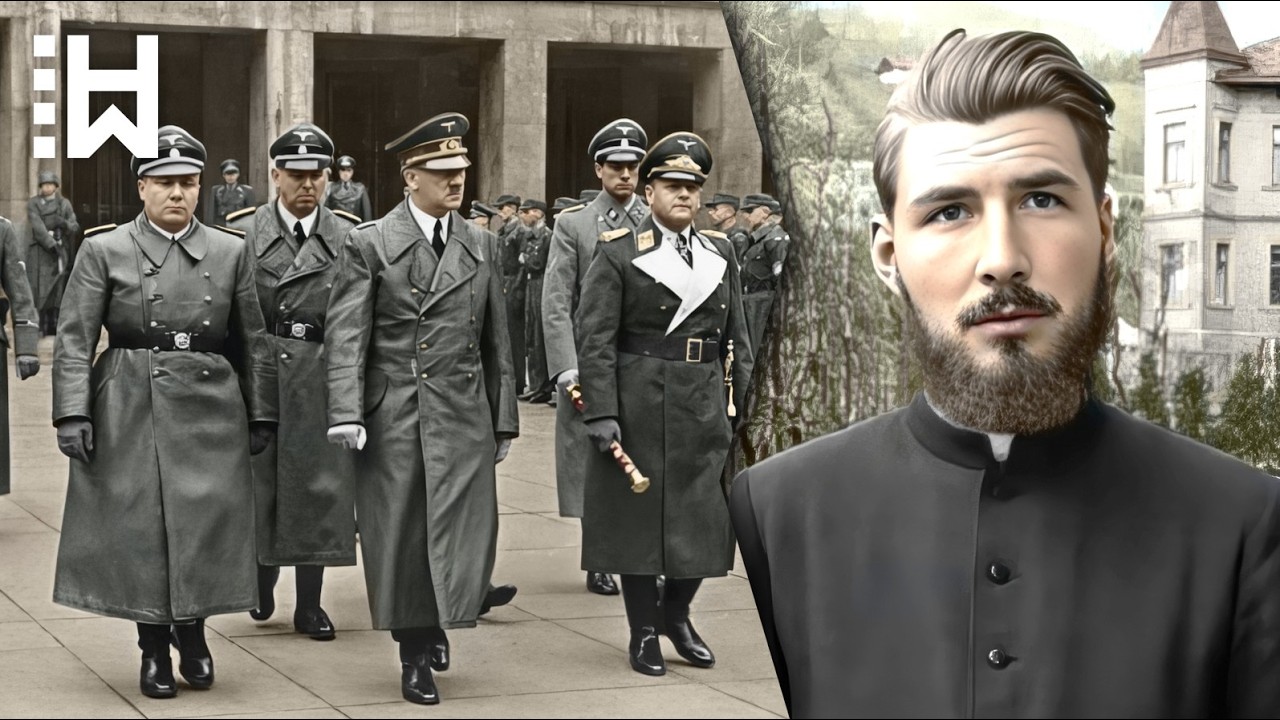
In the presence of Adolf Hitler, the proper greeting was simply “Heil. ” The boy had added the extra word, and for that he was corrected in front of everyone. The boy’s name was Martin Adolf Bormann. Inside the family they called him Krönchen, the little crown prince—the heir apparent of the Third Reich.
He was born on April 14, 1930, in Grünwald, a suburb south of Munich, the eldest of ten children. His father was Martin Bormann, soon to become head of the Nazi Party Chancellery and private secretary to Hitler. His mother was Gerda Buch, daughter of Walther Buch, the long-serving chairman of the Nazi Party’s internal court. The family was shaped by ideology as much as by domestic routine.
The elder Bormann made himself indispensable to Hitler by controlling access to him and processing nearly every paper that crossed the Führer’s desk. He was among the most powerful and most feared men in the Reich. His wife shared his convictions completely. Gerda Bormann was a devoted National Socialist who treated childbearing as a political duty.
In letters to her husband at the front, she rejected sympathy as weakness and proposed polygamy as a way to raise the birth rate. The children were baptized selectively. Martin Adolf was received into the German Evangelical Church, with Hitler named as his godfather in a largely ceremonial gesture. But as his parents’ hostility toward organized Christianity deepened, the later children were not baptized at all.
From his earliest years, Martin Adolf lived inside the circle of Nazi leadership. During the war years, the family lived partly at Obersalzberg, the fortified mountain retreat near Berchtesgaden in the Bavarian Alps, where his father oversaw the construction of an entire complex of villas, roads, and barracks around Hitler’s residence, the Berghof. The Bormann children were constant visitors there. Hitler, by all accounts, treated them with warmth, a surrogate uncle in a household that had no other private life.
It was in this setting that the young boy learned the rules of the inner circle—including the one he broke on the day of the slap. In 1940, at the age of ten, Martin Adolf was sent to the Reichsschule Feldafing, an elite boarding school founded by the Nazi Party in 1933 on the shores of Lake Starnberg in Bavaria, established to mold an ideological elite, the future leaders of party and state. He spent five years there, absorbing Nazi doctrine, undergoing physical training, and being prepared for a role in a world that was visibly collapsing around him. Even as the war turned and the school continued its routine, he remained—by his own later account—an enthusiastic young Nazi throughout, fully committed to the ideology his parents had instilled from childhood.
On April 15, 1945, with the school dissolved, Martin Adolf was among a group of pupils in Matrei am Osttirol, a market town in East Tyrol in present-day Austria, who were told to make their way back to their families. The Western Allied armies were advancing from the west and the Red Army from the east; the Reich was weeks from total collapse. A party official in Munich named Hummel advised the fifteen-year-old to try to reach his mother, who had fled from Urlach with eight of her younger children after an Allied air raid and was sheltering in the village of Völkenstein in South Tyrol. The journey proved impossible.
Transport had stopped running, the roads were clogged with columns of retreating soldiers, and every authority was dissolving. Martin Adolf found himself stranded in Salzburg, where the Gauleiter, the regional Nazi leader Gustav Adolf Scheel, provided him with forged identity papers. He found shelter with a farmer named Nikolaus Hienwadl on a mountain farm called Krai Lichtenhohe in the Salzburg Alps. He gave a false name and said nothing about his real identity.
Meanwhile, Hitler committed suicide on April 30, 1945, and Berlin fell. In the chaos of the final escape attempt, Martin Bormann the elder vanished. Witnesses reported seeing him flee with a small group in the early hours of May 2, 1945, heading through a burning city under Soviet fire. After that, no trace of him appeared.
His wife, interrogated by Allied intelligence officers after her arrest in Italy, could provide no information about him. Her health was deteriorating rapidly. In the autumn of 1945, she was taken to the prison hospital in Meran, a town in South Tyrol, where doctors discovered she had uterine cancer. She died there on March 23, 1946, at the age of thirty-six.
In the meantime, the farmer treated the former crown prince of Nazi Germany like his own son. That continued even after Bormann revealed his identity to him in October 1946, when he learned that his father had been sentenced to death in absentia. Instead of reporting him, Hienwadl turned to the local priest, and the priest of the pilgrimage church in Maria Kirchental took him into his home. It was during this period that Martin Adolf first confronted the full scope of the crimes committed by the regime he had been raised to serve.
He also witnessed the help and kindness of Catholic believers and church authorities. Taken together, these influences led him to convert to Catholicism. The faith he began to embrace represented a complete reversal of everything his upbringing had intended for him. While serving as an altar boy in Maria Kirchental, he was arrested by American intelligence and taken to Hallein, a town in the Austrian state of Salzburg, for interrogation over several days.
The Americans wanted to know where his father was. He genuinely did not know. Repeated tests confirmed he was telling the truth, and he returned to the parish. After his time in Maria Kirchental, Martin Adolf Bormann came under the care and educational support of the missionaries of the Sacred Heart.
He attended their school, and after completing his secondary education in 1951, he entered religious formation. In the same year he went to Austria and began the prescribed novitiate, then philosophical and theological studies in the city of Innsbruck. He kept his birth name throughout, dropping only the name Adolf in daily use. As he later explained, no one could choose their parents.
He gradually resumed contact with his brothers and sisters, nearly all of whom had also converted to Catholicism, except for one sister. On July 26, 1958, Martin Adolf Bormann was ordained as a Catholic priest. In 1961, he was assigned to the newly independent Republic of the Congo, formerly the Belgian Congo, a country in turmoil from the violence of decolonization and Cold War interventions. He worked in pastoral care and education under very difficult conditions.
In 1964, Bormann was forced to flee because of the Simba rebellion, which targeted foreigners and missionaries as symbols of external domination. He returned for an additional year in 1966, but the environment remained unstable and he left the country again. In 1969, he was seriously injured in a car accident, an injury that nearly killed him. During his long recovery, he was cared for by a nun named Cordula until he regained his health.
Their relationship developed beyond what their religious vows permitted. In the early 1970s, Bormann left the priesthood and Cordula relinquished her vows as a nun. They married in 1971 and had no children. He later worked teaching philosophy and theology in the town of Heine in West Germany until his retirement.
While Martin Adolf moved further from the world of the Third Reich, questions about his father’s fate persisted for decades. Rumors placed him in South America, Australia, or Italy. Intelligence agencies, including the American CIA and the West German government, searched for him without success. Then, in December 1972, construction workers found human remains near the Lehrter station in West Berlin.
Glass fragments embedded in the jaw of the skeleton suggested death by cyanide capsule. Dental reconstruction pointed to Martin Bormann the elder, and the West German government officially declared him dead. But doubts continued, and the identity was not definitively confirmed until 1998, through DNA testing that compared the remains with a sample from a living relative. On August 16, 1999, at the initiative of the Frankfurt public prosecutor’s office, Martin Bormann’s remains were secretly cremated in Bavaria and his ashes scattered in the Baltic Sea in the Bay of Kiel, outside German territorial waters.
The authorities wanted to ensure that no grave could become a shrine for neo-Nazi remembrance. Martin Adolf Bormann did not remain silent about his origins or his father’s crimes. From 1987, he participated in the reconciliation group “Children of Perpetrators, Children of Victims,” promoting dialogue between the descendants of Nazi officials and the descendants of those they killed. Bormann later spoke in classrooms across Germany and Austria about his biography, the Nazi past, and the responsibility of confronting what his father’s generation had done.
In 2011, shadows fell over his final years when a former student of an Austrian Catholic boarding school accused him of rape, claiming the assault occurred when he was twelve years old, at a time when Bormann was working there as a priest and teacher in the early 1960s. Other former students alleged severe physical violence against them and others during the same period. For some, these claims suggested that the son had ultimately become morally worse than the father he had spent his life disowning. Bormann denied any knowledge of these accusations.
By that time, he was suffering from advanced dementia and was no longer able to offer a coherent defense. The Catholic Church compensated the man who had made the accusation. Martin Adolf Bormann, the former crown prince of the Third Reich and Catholic priest, died on March 11, 2013, in Heira, a town in western Germany.
He was eighty-two years old.






