In 1945, a man without a high school diploma stood in a Raytheon weapons laboratory in Waltham, Massachusetts, testing radar equipment for the army. He reached into his pocket and found a melted chocolate bar. His name was Percy Spencer, an orphan from rural Maine who had never gone beyond the fifth grade. By 1997, more than ninety percent of American homes would own the device he accidentally conceived that afternoon.
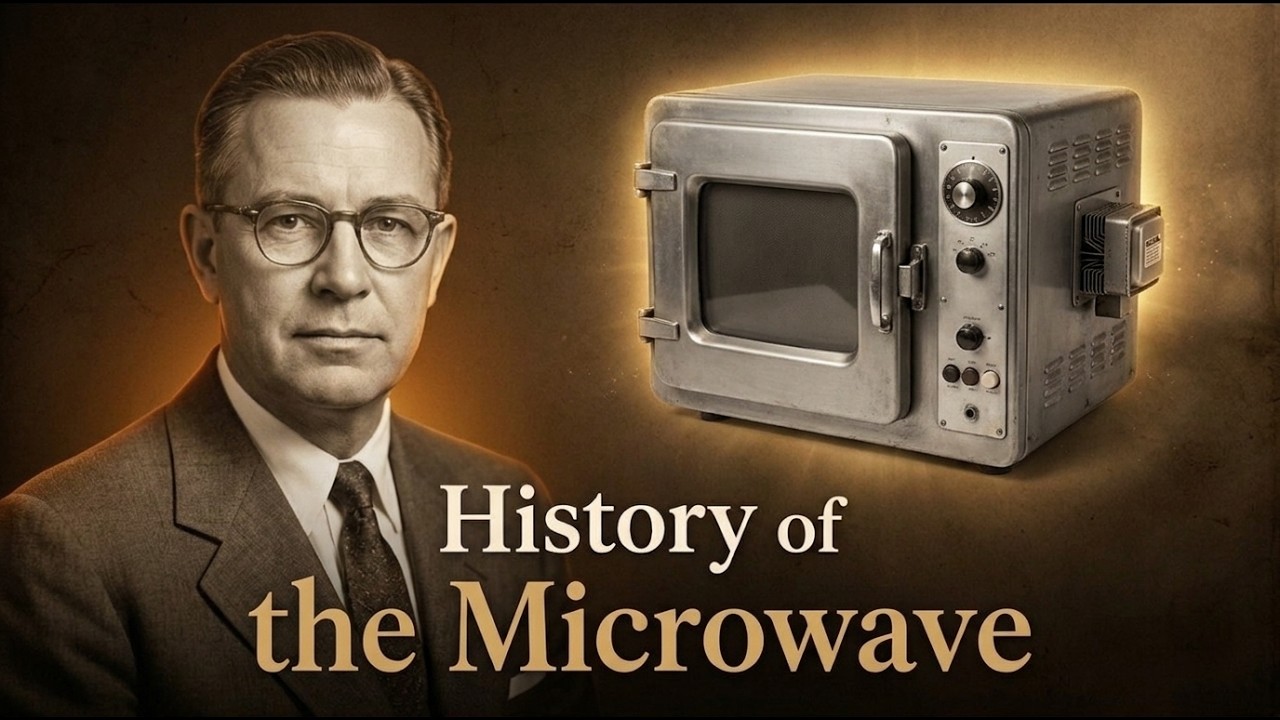
The question is how a melted candy bar in a weapons lab became the most common cooking appliance in America. Ask anyone at Raytheon about Percy Spencer in the early 1940s, and they would have called him the most valuable engineer in the building. They would have spoken about his work on radar tubes and his talent for solving problems that stumped everyone else. No one had any idea that he was about to discover something that would transform how an entire country prepared food.
Percy LeBaron Spencer was born on July 9, 1894, in the small town of Howland, Maine. His father died when Percy was just eighteen months old. His mother left shortly afterward, sending Percy and his older brother to live with an uncle and aunt. When his uncle died, Percy was only seven.
From that point, Percy and his widowed aunt drifted across New England, living on her sewing income and the few pennies he earned from odd jobs. There was no inheritance, no scholarship waiting, no wealthy relative to step in. Spencer later recalled that he had to sort out his situation for himself. At twelve, he left school and began full-time work in a spool factory in South Lincoln, Maine.
He worked from sunrise to sunset. When he was not at the factory, he read, teaching himself the basics of electricity from whatever textbooks he could find. At sixteen, he heard that a local paper mill owner planned to electrify the facility. Spencer applied for one of three electrician jobs, despite having no formal training and never having wired anything in his life.
He got the job, learning the trade by studying at night and experimenting during the day. In 1912, something caught his attention. The RMS Titanic sank in the North Atlantic, and every newspaper in the country covered the story. What impressed young Percy was not the ship itself but the wireless operators aboard the rescue vessel Carpathia, who had received distress signals across the open ocean.
The idea that invisible signals could travel through the air and save lives captivated him. At eighteen, he joined the United States Navy to learn wireless telegraphy. During long night watch shifts at sea, while other sailors slept, Spencer sat alone with borrowed books, teaching himself calculus, trigonometry, chemistry, physics, and metallurgy. He later told an interviewer that he just got a lot of textbooks and taught himself during his night watches.
His commanding officers noticed. His fellow sailors noticed. Spencer had a gift for absorbing complex technical material and applying it in practical ways that often escaped the academic engineers around him. A colleague at Raytheon later said that the educated world knows many things that will not work, but Percy does not know what is impossible.
After leaving the navy, Spencer took a job at a small electronics company in Cambridge, Massachusetts, called the American Appliance Company. The firm specialized in vacuum tubes and radio technology, and Spencer’s navy experience with wireless equipment made him a perfect fit. He started on the factory floor and worked his way up. The company eventually changed its name to Raytheon.
Over the next two decades, Spencer became its leading expert in vacuum tubes and microwave technology, earning patents at a pace that astonished colleagues, many of whom held engineering degrees from MIT and Harvard. By the late 1930s, he ran Raytheon’s power tube division and had a reputation as one of the country’s foremost authorities on radar tube design. Raytheon was about to hand him a manufacturing problem that would shape the outcome of World War II. To understand what happened next, you need to know about a secret mission that changed the course of the war before most Americans even realized war was coming.
In February 1940, two British physicists at the University of Birmingham, John Randall and Harry Boot, built a working prototype of something called the cavity magnetron. This was a vacuum tube that could generate microwave energy pulses at power levels and frequencies no one had ever achieved before. It was a hundred times more advanced than anything American researchers were developing and was the component radar systems needed to track enemy submarines and aircraft with real accuracy. Britain had the invention but faced a problem.
The country was being bombed nightly during the Blitz, and its manufacturing capacity was collapsing. German U-boats were destroying Allied supply convoys in the Atlantic, sinking hundreds of thousands of tons of provisions. The British military needed the cavity magnetron produced in massive quantities immediately, and they did not have the factories to do it. In September 1940, a highly secret delegation called the Tizard Mission traveled from Britain to Washington.
Led by Sir Henry Tizard, the group carried a metal box across an Atlantic patrolled by German submarines. Inside the box was a single working cavity magnetron, along with classified secrets about jet engines, radar defense systems, and nuclear research. This was not a routine diplomatic visit. Britain was handing over its most guarded technology to a country not yet in the war, in exchange for American industrial power.
American historian James Phinney Baxter later wrote that they brought the most valuable cargo ever brought to our shores. When American researchers saw a demonstration of the cavity magnetron at a meeting in Washington’s Wardman Park Hotel, they were stunned. The device outperformed the best American microwave equipment by a hundredfold. The potential was obvious to everyone in the room.
The American government moved quickly. A new laboratory, the Radiation Laboratory at MIT, was created specifically to develop microwave radar using the British magnetron. Contracts went to American manufacturers that could gear up for mass production. Raytheon, the small Cambridge electronics company where Spencer had quietly built his career for two decades, won a major contract to produce magnetrons in huge quantities for Allied radar systems.
When Spencer started on the project, Raytheon was producing just seventeen magnetrons a day. The military needed thousands. Spencer studied the existing British design, identified the bottlenecks, and realized that production was slow because of precisely machined copper parts and carefully soldered internal wiring. Each magnetron was essentially handmade.
His solution was ingenious. He replaced the fine copper rods with stamped sheets, a process that could be done by machine rather than by hand, and replaced the soldered internal wiring with a simple solid ring. These changes radically simplified the entire manufacturing process, raising production from seventeen units a day to 2,600. The radar units Spencer designed could spot German submarine periscopes from the air, a capability that helped turn the tide of the Battle of the Atlantic.
His department at Raytheon grew from fifteen employees to 5,000 during the war. Raytheon ended up producing nearly eighty percent of all magnetron tubes used in American and British radars during the conflict. For this work, the Navy awarded Spencer the Distinguished Public Service Award, the highest civilian honor the Navy could give. By 1945, Spencer held more than 150 patents.
Then, on an ordinary day that year, he was standing near an active magnetron in the Raytheon lab, conducting the kind of routine test he had done thousands of times. He reached into his pocket for a candy bar and found it completely melted, soft, warm, and stuck to the lining. Other engineers had probably noticed stray heat effects around radar equipment before. Many had stood near magnetrons, but no one had stopped to ask whether you could intentionally harness that effect.
Spencer did. He sent someone to get a bag of unpopped corn. He held the kernels near the magnetron, and they began to crack, pop, and scatter across the lab floor. The next morning, he brought in an egg.
He made a metal box with a hole in the side, placed the egg inside still in its shell, and directed the magnetron’s microwave beam through the opening. A skeptical colleague bent down to look at the egg through the hole. The egg exploded, leaving the skeptic’s face covered in hot egg. Spencer had just proven that microwave radiation could heat food quickly from the inside out.
He had also proven the danger of heating an egg in its shell in a microwave, a lesson every college student with a microwave would eventually learn the hard way. On October 8, 1945, Raytheon filed a patent for a high-frequency dielectric heating device. Percy Spencer had invented the microwave oven. For that patent, he received two dollars, the standard amount Raytheon paid employees for any patent they filed.
Two dollars for technology that would end up in more than 200 million homes worldwide. The war ended, and Raytheon, like every defense contractor, looked for peacetime uses for its wartime technology. Spencer’s discovery offered one. The company built a commercial model and unveiled it to the public in 1947 as the Radarange, a name combining radar and range, because the magnetron inside used the same technology that had powered Allied radar systems.
In January 1947, one of the first public demonstrations of microwave cooking was a vending machine installed at Grand Central Station in New York City. Commuters could insert a coin and receive a freshly cooked hot dog heated by microwave energy in seconds. It drew attention, but a vending machine in a train station was far from changing how American families cooked dinner. The first commercial Radarange stood about six feet tall, weighed 750 pounds, required continuous water cooling to prevent the magnetron from overheating, and cost about $5,000, roughly $70,000 in today’s money.
It could cook a whole potato in thirty seconds, which was impressive, but finding someone willing to spend that much on a refrigerator-sized cooker that needed special plumbing was another problem entirely. The target market was commercial kitchens, train dining cars, and ocean liners. Homes were out of the question. Spencer’s grandson, Rod Spencer, later described the situation clearly.
The microwave oven ultimately became known as Raytheon’s biggest commercial failure, because like many failures, they saw the amazing technology but did not understand the market. Raytheon’s managers were engineers, not appliance marketers. They looked at the Radarange and saw a physics miracle. Consumers looked at it and saw a 750-pound science experiment that cost more than a car.
Spencer himself insisted that the company chef cook all his meals using the microwave. The chef tried, but the oven could not brown meat, could not make french fries crispy, and everything came out soft, rubbery, and unappealing. The chef quit. Microwave radiation heats water molecules inside food, but it does not create the Maillard reaction, the chemical browning that gives grilled and fried food its flavor and texture.
The food got hot, but it did not taste good. Raytheon did not give up. In 1952, they licensed the technology to Tappan Stove, an Ohio manufacturer of conventional ovens that understood the home kitchen market far better than a defense contractor. In 1955, Tappan released the RL-1, the first microwave oven designed specifically for home use.
It was a wall-mounted unit, meaning any family that bought one had to hire someone to cut a microwave-sized hole in their kitchen wall. The price was $1,295, roughly $13,000 today. Over nine years on the market, Tappan sold just 1,369 units in total. The American public did not trust the technology.
The word microwave sounded like radiation, and radiation sounded like atomic bombs. This was the 1950s. Schoolchildren were practicing duck-and-cover drills, families were building fallout shelters in their backyards, and the government was testing nuclear weapons in the Nevada desert on the evening news. The idea of putting a device with the word radiation in its description next to the family dinner table was nearly impossible to sell.
Even people who were not afraid of the technology could not figure out what they needed it for. A conventional oven browned a roast beautifully. A stove boiled water and seared a steak. The microwave could heat food quickly, and that was about it.
For a 1950s homemaker spending much of her day cooking from scratch, speed was not the selling point Raytheon and Tappan assumed. The appliance was a solution to a problem most American families did not yet have. In 1965, Raytheon acquired Amana, an established appliance manufacturer based in Iowa with decades of experience selling refrigerators, freezers, and air conditioners directly to American families. That move changed everything because it put Raytheon’s radar cooking technology under one roof with a company that actually understood how to market, distribute, and sell consumer appliances to ordinary households.
Meanwhile, something important was happening on the other side of the Pacific. Japanese engineers developed a smaller, more efficient magnetron in 1964, compact enough to replace the bulky water-cooled tubes of the war era, making countertop-sized microwaves possible for the first time in the technology’s twenty-year history. In 1967, Amana introduced the countertop Radarange. It plugged into a standard 115-volt household outlet, with no special wiring, plumbing, or wall cutting required.
It weighed less than 100 pounds, fit on a kitchen counter, and cost $495, about $4,700 today. Expensive, but for the first time, an average middle-class American family could buy a microwave at a store, carry it home, and plug it in next to the toaster. The timing was staggeringly perfect. By the late 1960s, American society was changing in ways that suddenly made the microwave useful.
More women were entering the workforce in large numbers, and the number of married women working outside the home rose sharply between 1960 and 1980. The traditional model of one parent spending hours preparing food from scratch began to fade in favor of a faster, more fragmented family schedule. Families had less time and needed meals that fit their lifestyle. The frozen food industry, which had been developing its products since Swanson introduced TV dinners in 1953, found a perfect technological partner.
A frozen dinner that required forty-five minutes in a conventional oven was ready in five minutes in a microwave. A cup of leftover coffee could be reheated in thirty seconds. A stick of butter forgotten in the refrigerator could be softened in ten seconds. The equation was clear, and it began to play out in millions of kitchens across the country.
The microwave did not just save time; it changed when and how Americans ate. Families no longer needed to eat together at a set dinner hour. A teenager could heat leftovers after football practice. A parent working late could reheat a plate without turning on the oven.
The microwave made eating asynchronous, and that behavioral shift proved permanent. Sales were slow at first. The $495 price was still expensive for most families, and old fears had not entirely faded. Then, in 1968, those fears received some confirmation.
The Walter Reed Army Medical Center conducted a series of tests on early microwave ovens and confirmed that the devices were indeed leaking microwaves through their door seals. The findings made headlines and slowed adoption nationwide. But the detail that escaped everyone at the time was that the radiation leaking from microwave ovens is non-ionizing, fundamentally different from the ionizing radiation produced by nuclear weapons and X-ray machines. Non-ionizing microwave energy can heat tissue, but it does not damage DNA or cause the kind of cellular harm people associate with the word radiation.
The ovens needed better shielding, not removal from the market. In 1971, the federal government imposed strict safety standards for microwave oven manufacturing, requiring manufacturers to limit leakage to levels far below anything that could affect human health. The new regulations solved the problem, and public confidence slowly recovered. Other manufacturers sensed the opportunity.
Litton Industries entered the market, producing commercial microwave ovens for restaurants and vending machines. Then the Japanese manufacturers arrived. Sharp had been developing its own microwave technology since the early 1960s and entered the American market with highly competitive prices, followed by Panasonic and Samsung. By the early 1970s, the market had grown from one player to a dozen, and competition did what it always does.
Prices fell, models shrank, and features improved. The microwave went from a luxury device to a practical household purchase a working family could justify. Something else happened in that decade that no one at Raytheon had predicted. The microwave oven did not replace the conventional oven as the early engineers had assumed.
Instead, it carved out a completely new role in the kitchen. People used it to reheat leftovers, defrost frozen meat, warm baby bottles, melt butter, and heat water for tea. It became the kitchen workhorse, the appliance you use twenty times a day for small tasks that do not justify turning on a full-size oven. That shift in use, from primary cooker to daily convenience tool, is what finally drove its mass adoption.
By 1975, microwave oven sales exceeded gas range sales in the United States. Thirty years after a candy bar melted in a radar lab, the microwave had overtaken the gas stove. By 1986, about twenty-five percent of American homes had a microwave. By 1994, the figure reached ninety percent.
By 1997, more than ninety percent of all American households owned one. Percy Spencer did not live to see any of it. He retired from Raytheon in 1964 as senior vice president and a member of the board of directors. He never returned to school, never got a high school diploma, never took a college course, but he received honorary doctorates from the University of Massachusetts, Nasson College, and the University of Maine.
He was elected a fellow of the American Academy of Arts and Sciences and the Institute of Radio Engineers. He held more than 300 patents by the end of his career, and a building at Raytheon was named for him. He died on September 8, 1970, at age seventy-six, in Newton, Massachusetts. At the time of his death, the microwave oven was still more of a curiosity than a kitchen staple.
The Amana countertop model had been on the market for only three years, and sales were growing slowly. Spencer had no way of knowing that the device he had stumbled upon while testing radar tubes would outsell gas stoves within five years, would be in a quarter of American kitchens within two decades, and would eventually be in nearly all of them. The man who received two dollars for his patent never saw that return. But then again, Spencer was not working for money.
He was working because a piece of chocolate melted and he wanted to know why. That instinct, his refusal to walk past something strange without investigating it, defined his entire life. In 1999, twenty-nine years after his death, the National Inventors Hall of Fame inducted Percy Spencer for his work on the high-efficiency magnetron. Today, more than 200 million microwave ovens are in use around the world.
It all began because a fifth-grade dropout from Howland, Maine, who taught himself physics from borrowed books during navy night watches, reached into his pocket on an ordinary afternoon in a weapons lab and found a warm, sticky lump where his chocolate bar should have been.






