The drawing was made in a single sitting, in a sheriff’s office in West Texas, in the autumn of 1867. Nobody who has studied it since has been able to say, without changing their answer later, what it actually is. The town was called Cinder Wells. You will not find it under that name on a map today, and you would not have found it easily on one in 1867.
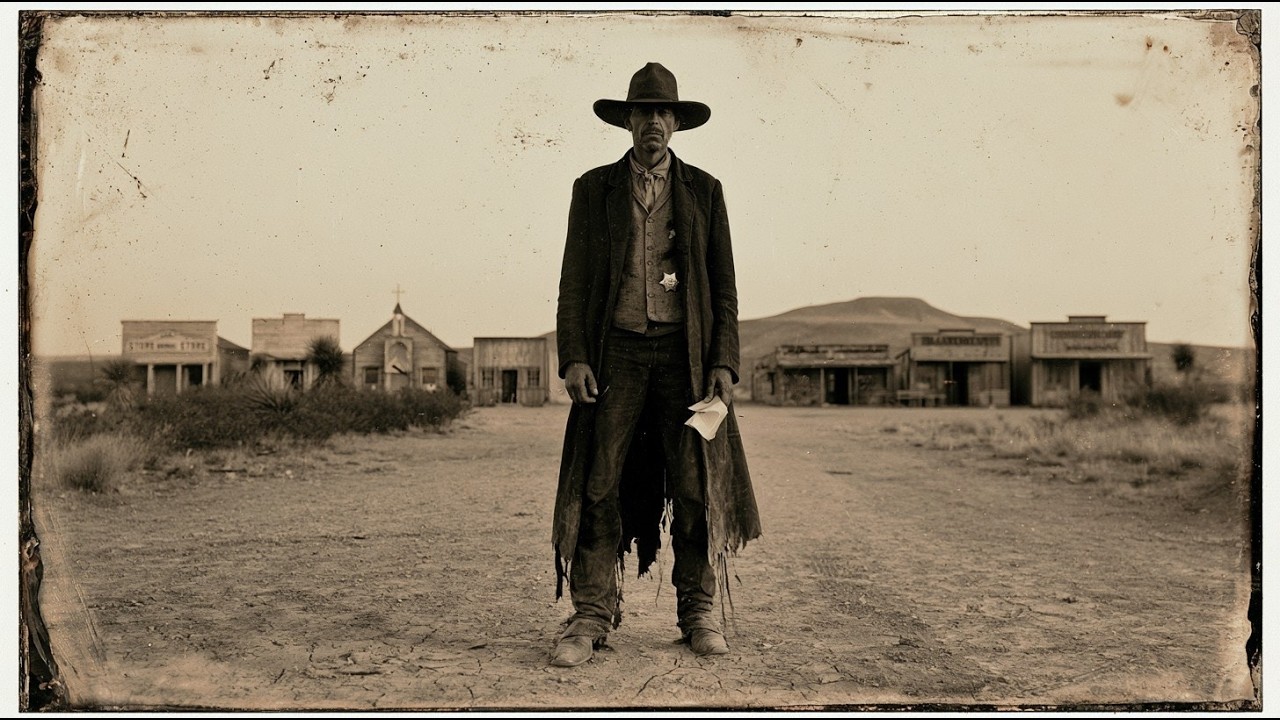
It sat in the far reach of what men then called the Trans-Pecos country, a dry, opened palm of land west of the Pecos River, north of the Rio Grande, and a very long way from anyone who was going to help you. Cinder Wells had six standing buildings on its main street: a telegraph office that had lost its wire twice, a church with no bell yet, a general store, a blacksmith who was also a cooper, a saloon called the Widow Lantern, and the sheriff’s office, one room deep and one room wide, with a cell attached that had been used over the years, mostly for men who drank until they wept. It also had a well. That is where the name came from.
The water was black at the top and clean at the bottom, and if you drew it up at dawn it tasted faintly of iron and ash, and if you drew it up at dusk it did not. The sheriff was Cassius Whitaker, sixty-one years old that autumn: a wide, slow-moving man with a face that had gone from tanned to weathered to something like leather someone had folded and refolded. He wore his hair long because he had never bothered to cut it after his wife died in ’53, and he wore his badge over the second button of his coat because he had once been shot at the first. He was not a fanciful man.
That will be important. The disappearances began in the spring of 1866. They came slowly at first, then not slowly. The first man was named Amos Trethaway, a freighter.
He drove mules between Cinder Wells and a supply depot two days east, and he had been doing that run for eleven years. In April he did not come back. His mules did. They arrived at the edge of town at first light, still hitched to the wagon, still standing in formation, standing so still that the boy who found them thought at first they were carved.
The wagon bed was empty. Trethaway’s coat was folded neatly on the driver’s seat, his pipe still packed, his hat hanging from the brake handle by its cord, and a pair of boots he was known to wear placed heel to heel on the floorboard. Nothing else. No blood.
No signs of struggle. No prints in the road behind them long enough to say where he had stepped off. Whitaker rode the route himself, for three days. He found no one, and nothing that had once belonged to a man.
He wrote it down as a probable death by exposure, and he kept the coat and the pipe in a drawer. Six weeks later, Silas Merrick, who cut stone in a small quarry east of town, walked out toward his work at dawn and did not walk back. His pick was found leaned against the quarry wall, sharpened. Nothing else.
Then in July, Obadiah Fen was a Methodist circuit rider, thirty-four years old, a preacher with a saddlebag full of pamphlets and a habit of writing his sermons into the margins of the pamphlets he had already given away. He was riding a circuit that took him to three ranches over the course of a week. He never arrived at the first one. His horse was found at the second, still saddled, still calm, still eating from a feed sack that had been carefully set out on the ground for it, as if by a considerate hand.
By the end of that summer, five men were gone from the country around Cinder Wells. By the end of the year, seven. By the following spring, eight. Nobody screamed.
Nobody left signs. Nobody was seen walking away. That last part was what began to bother Whitaker most. In a country as flat and as wide as that one, a man going somewhere is a visible thing.
You see him for miles. You see the dust before you see him. Every one of those eight men had at some point been going somewhere, and yet nobody on any nearby ranch, in any nearby settlement, on any road within twenty miles, had seen them going. They had simply stopped being anywhere.
He wrote to the state. The state in 1867 was still finding its shape again after the war. The Ranger companies had been dissolved during the Confederacy, folded into other kinds of work, and were now being reassembled piece by piece in whatever fashion the reconstruction government could manage. Requests for a ranger did not always find one.
When they did, the ranger who came was often a man of a particular kind. The one who came to Cinder Wells that October was Ephraim Kilburn. He was forty-four years old, tall in a way that made you notice him before you saw him. It was not that he was much taller than other men; it was that he had a way of standing which took up more of the sky than his body should have.
He wore his hat low. His hair was already gray at the temples. He had gray eyes of the sort that never quite settled on you when he was speaking, and a scar that began at the corner of his mouth and stopped just under his left ear, received, according to the two stories he had ever told about it, either from a knife or from a wolf, depending on whom he was talking to at the time. He had ridden as a scout in the war.
Before that, he had lived for some years in the country north of the Red River with people who were not his blood. He knew how to read a piece of ground the way a preacher reads a page: where a man might have knelt to drink, where a horse had lain down for the night, where a rock had been moved and put back not quite in its old spot. He rode into Cinder Wells on the afternoon of October 4th. He did not speak to anyone in the street.
He rode directly to Whitaker’s office, dismounted, tied his horse himself, and knocked once. Whitaker opened the door and said, “You’re the ranger. ” Kilburn said, “I’m the one they sent. ” That was the beginning of it.
They sat together in that one-room office for most of two days. Whitaker had by then prepared everything he could prepare: the names of the men, the dates they had gone, the places they had been last seen, the things that had been found after them, laid out in the drawer in a careful order, each item labeled in his own hand. Kilburn went through the drawer once. He did not touch anything.
He went through the papers twice. He asked questions in a voice so low that Whitaker had to lean toward him to hear the answers. Where was Trethaway coming from? Where was Fen going?
What time did Merrick usually reach his quarry? Did the mules act sick when they returned? Did the horse act sick? Did the coat smell of anything?
Whitaker answered as best he could. Where he did not know, he said so. That more than anything was what Kilburn wanted to hear. He did not like a man who invented answers when he did not have them.
He said quietly at one point, “A man’s memory will fill in every hole with a piece of the wrong shape if you let it. ”
On the second afternoon, Kilburn stood up, walked to the map Whitaker had pinned on the wall, and stood in front of it without speaking for a long time. The map showed the country between the Pecos and the Rio Grande, drawn by a surveyor in 1859. It had a lot of blank places in it where the surveyor had never gone.
Kilburn pointed at one of the blanks. He said, “There. ” Whitaker said, “That’s nothing. That’s just where he ran out of paper.
” Kilburn said, “That’s where I’ll go first. ”
The blank place was about a day’s ride east and slightly north of town: a stretch of low, broken country between two dry water courses, called at the time by names that had already begun to slip out of use. The people who had once given those names had been mostly pushed further west by 1867, and the settlers who lived in the region did not use them, and so the names were fading in the way names do when nobody has a reason to hold onto them. The country in there had no roads worth calling roads, only a few tracks worn by cattle and by the men who followed them, one stand of cottonwoods along one of the dry courses, and one cracked, sun-bleached rise of low stones that some travelers used as a landmark.
Otherwise it was open scrub. Mesquite. Occotillo. Wide flats of gravel and hard-baked clay.
There was nothing there. That was what everyone said about it. Kilburn rode out on the morning of October 5th. He took provisions for two weeks: a tin of coffee, a packet of hardtack, bacon, a little sugar, powder and shot, a canteen, a blanket, a knife, a small clothbound notebook, and a stub of pencil.
He did not take anyone with him. At the door, before he mounted, he said to Whitaker, “You will not send anyone after me. You will not come after me. You will wait.
” Whitaker said, “For how long? ” Kilburn said, “Until I come back. ” Then he added, quietly, in a way that Whitaker later said had the shape of a small joke, but only the shape: “Or until you stop expecting me to. ” He turned his horse.
He rode east. He did not look back. The last person to see him alive, or so people later said, was a woman named Loretta Vance, who kept a way station at a spring about six hours east of Cinder Wells. Kilburn stopped there on the afternoon of the 6th.
He watered his horse. He bought a small paper twist of sugar for his coffee. He sat on Loretta’s porch for the better part of an hour, not saying much, watching the country to the east. Loretta told the story later, and said Kilburn asked her only two things.
The first was whether she had heard any strange sounds coming from that country at night over the past year. She said she had not. Kilburn nodded and did not press. The second was whether she thought the hills moved at night.
She thought at first this was some kind of ranger’s joke. She laughed and said, “Well, they hadn’t, when she checked last. ” Kilburn did not laugh. He said quietly, “You would not know if you were the one who was moving.
” Then he thanked her for the sugar, stood, put his hat on, and rode off. Loretta said that as she watched him go, she had the strong feeling, which she could not have explained if you had asked her, that she was watching a man walk into a room and shut a door behind him. Two weeks passed. Whitaker was still confident.
Two weeks was reasonable. Two weeks was, in fact, what Kilburn had gone out prepared for. Three weeks passed, and Whitaker began to sleep less well. Four weeks passed, and Whitaker composed a letter to the Ranger headquarters in Austin.
He did not, in the end, send it. He wrote it out three times and set it aside each time, because he could not quite bring himself to write the word “missing” beside the name of a man who had specifically told him not to come after him. In that fourth week, a ninth man went missing. His name was Micajah Pruitt.
He was a horse trader who worked a wide loop between three counties. He had left his home at dawn with a string of six mustangs he had bought off a Mexican rancher, and was leading them that morning toward Cinder Wells. The mustangs arrived that evening. Pruitt did not.
And the mustangs had been led, at least for the last stretch of their journey, by someone. They had not been driven. When the boy at the livery caught the lead rope of the first one, he found that the rope had been tied off at the other end to nothing at all. The rope simply ended in a knot, and the knot had been recently tied.
Whitaker put on his coat and walked out to the livery and looked at the knot for a long time. Then he walked back to his office and sent the letter to Austin. It said, in part: “I have lost my ranger. I have lost another man.
I have never in my life felt as watched as I feel in this town this month. I ask for anything you can send. ”
The reply came a week later. It said, “Wait.
” It said that Kilburn, when he took a case, was not to be interfered with; that he had been reported missing three times in his career and had come back on his own each time; that the state understood the sheriff’s concern, but that the state’s concern was at present elsewhere. “At the end,” it said, “we will send another ranger in the spring. ” Whitaker folded the letter twice and put it in the drawer with the pipe. Forty-seven days after Ephraim Kilburn rode out of Cinder Wells, he came back.
He came back on foot. It was the morning of November 20th, 1867. He was found on the west edge of town at first light by a widow named Ida Kepler, who lived alone in a small house at the end of the wagon road and who was on that particular morning walking out to feed a stray dog that had been sleeping under her porch. She was going toward the road with a piece of bacon in her hand when she saw a man standing very still in the middle of the road, facing town, not moving.
She said afterward that at first she did not recognize him. His coat was in ribbons — not torn, not shredded, but ribboned in the way thin strips of cloth will hang from a garment that has, over some long time, been pulled at by many small hands. His boots were worn straight through at the soles, and he was standing, she said, as if he did not quite know he was on the ground. She said, “Ranger.
” He did not turn. She said, “Ranger Kilburn, sir. ” He turned then, but in a way that made her step back off the road and into the tall grass. He turned, she said, in stages: his shoulders first, then his hips, then his head, as if the turning had to be worked through one part at a time.
She said she had once seen a paper doll articulated with brass pins, and that this was what he moved like. His face, when it faced her, was empty of expression, but his eyes were tracking very quickly, as if reading. She said, “Ranger, do you know me? ” He said nothing.
She dropped the bacon in the grass and walked to town. By the time Whitaker got out to the road with two other men, Kilburn had begun slowly to walk again, toward the sheriff’s office. He knew in some way where he was going. He did not respond to questions.
He allowed himself to be helped. He allowed himself to be led. They got him into the office, sat him in the chair by Whitaker’s desk, and gave him water, which he drank as though the drinking was something he was remembering how to do. His hands throughout would not stop moving.
That was the first thing Whitaker later remembered: the hands. They moved constantly, both of them, in small, precise motions, little arcs, little diagonals. The wrists would tilt. The fingers would pinch and release, as if he were at every moment gripping and using a small tool nobody else could see.
He did not speak for the first six hours. At noon, or a little past, he looked directly at Whitaker for the first time, and held his eye for what Whitaker afterward said was the longest four or five seconds of his life. Then Kilburn said, very clearly, “Paper. ” Whitaker got him paper.
He said, “Pencil, soft. ” Whitaker got him a pencil, and had to sharpen it — it was the only pencil in the office. Kilburn set the paper on the desk in front of him. He did not at first draw.
He sat with the pencil in his right hand and let his left hand rest flat on the paper. He closed his eyes. He was still for perhaps a full minute — the only minute in which his hands did not move from the moment he had returned. Then he began.
He drew for six hours. Whitaker watched almost the entire time. He did not eat. He did not leave the room.
He sat opposite Kilburn at the desk with his hands folded, and watched a man he did not by the end believe he knew do something he had never seen a human being do. Kilburn drew with both hands. He did not use them together at first — the right hand mostly, the left hovering close, sometimes tracing the air an inch or two above the paper, as if steadying an image only he could see. But as the hours went on, the left hand began to work too.
Sometimes it would take the pencil from the right. Sometimes it would smudge a line the right had drawn, softening it, adjusting a shadow. The right and the left worked in a way that Whitaker later, groping for the right word, called “cooperative. ” He wrote in his own account of the day, which is in the county archive: “I have seen two men working the same corner of a barn roof, less coordinated than his two hands were with each other.
It was as if his hands were two separate persons, and both of them were very good, and both of them were doing the same drawing. ”
What he drew was a view. That was what Whitaker realized first, watching it come together: a landscape. Kilburn drew Cinder Wells and the country around it, seen from up high and slightly to the east.
He drew the town first, only an outline: the main street, the six standing buildings, the well. He drew with more care than seemed necessary the sheriff’s office, down to the crack in the doorframe that Whitaker himself had never bothered to fix, down to the exact position of the small square of glass propped in the west window that Whitaker used to see who was coming when the sun was low. He drew the church that did not yet have a bell. Then he drew the country outside the town: the roads leading in, the two dry water courses to the east, the stand of cottonwoods, the cracked sun-bleached rise of low stones.
He drew everything precisely as it was. Then he drew, along each road and out into the flats and on the banks of the dry water courses and at the base of the low stones, small human figures. Nine of them. At first Whitaker thought nothing of it.
It was, after all, a landscape, and landscapes have people in them. Then, as Kilburn kept working, Whitaker began to lean forward. The first figure stood on the north road, about a mile out of town. He was on foot, facing away from the town, his hands at his sides.
Beside him, Kilburn wrote in a small, clean hand: “Trethaway. ” Whitaker told himself at first that this was a coincidence — a ranger trying to organize his thoughts, laying out the missing men in a picture as one might lay out chess pieces on a board. The second figure was at the quarry. He was kneeling, his right arm extended as if reaching for something Kilburn had not drawn yet, his head turned, his face in profile.
The profile, Whitaker later said, was clearly Silas Merrick’s. Beside him, Kilburn wrote, “Merrick. ”
The third was on the middle road, halfway to the way station. He was on horseback, and the horse was drawn with unusual care, and the way the man sat the horse was very specific — one shoulder lower than the other, the reins held in a way that a preacher who had ridden for years would hold them.
Beside him, Kilburn wrote, “Fen. ”
By this point, Whitaker had stopped telling himself anything. The fourth figure was in a place that had, in Whitaker’s memory, no significance: a stretch of open flat about four miles south of town, where there was nothing. The man was standing, facing the town.
His hat was on the ground beside him, brim up, as if it had been placed there. Beside him, Kilburn wrote, “Allderdice. Ezra Allderdice, missing since August. He had been a surveyor.
” Whitaker had never known where he had last been seen. The fifth figure was closer to town, seated on a stone, his head in his hands — a posture of exhaustion, or grief, or resignation; Whitaker could not tell. Beside him, Kilburn wrote, “Holstead. Ruben Holstead, missing since October.
A tinsmith. A quiet man. ” Whitaker had not until that moment known that Holstead ever sat down on stones. The sixth was in the cottonwoods, standing very still, his arms slightly raised.
“Boz. Hollis Boz. Cattle drover. Missing since June.
”
The seventh figure was on the low stones, in a posture Whitaker did not at first understand: drawn as if he were listening to the stones, his ear pressed against the largest of them, his hands flat against the stone on either side of his head. “Reich. Cornelius Reich. Missing since July.
”
The eighth figure was near the well, right there in the town — on the drawing of Cinder Wells itself. The ninth man lost from the country around it was standing at the very edge of the town well, looking down into it. “Pruitt. ” The horse trader, whose mustangs had been led by a knot tied to nothing.
Whitaker put his hand over his mouth and kept it there. He did not speak. Kilburn kept working. He drew at last a ninth figure.
This one was different. The other eight were on the ground — on roads, in flats, near the town, in places that at least in theory existed. The ninth was above them. He was drawn on a small hill, a rise, a modest bump in the terrain — not a mountain, just a low, natural-looking hill, drawn about three miles east of Cinder Wells, and drawn from a perspective that would have placed the viewer higher still, as if the ninth figure were on the hill and the artist had been somewhere just above the hill, looking down at all of it.
The ninth figure was standing, his arms at his sides, his head tilted slightly in what Whitaker later described as the exact position of a man listening for a distant sound. Beside him, Kilburn wrote nothing. He set the pencil down. Whitaker cleared his throat.
He said, very quietly, “Kilburn. Who is that? ” Kilburn did not answer for what felt like a very long time. Then he said, “Not who.
Where. ” Whitaker said, “Where? ” Kilburn looked at him. Then he said, “That is where he watches from.
” Whitaker said, “Who? ” Kilburn blinked slowly. He looked back down at the drawing, and said, in a voice that was almost gentle, “The one who taught me how to draw. ”
Then he put his head down on the desk.
He did not get back up under his own power. Whitaker and two other men carried him to the cell in the back, the only place with a cot, and laid him on it, took his boots off, and covered him with a blanket. He did not wake that day or the next in the way that a man wakes. He would open his eyes.
He would look at the ceiling. He would sometimes move his lips in tiny, precise movements, as though tracing lines. His hands throughout did not stop. Whitaker sat with the drawing for the rest of that afternoon and most of the evening.
He did not touch the paper. He looked at each figure, each name, and compared in his memory what he knew of each man’s disappearance to what the drawing showed: where each figure was standing, what each figure was doing. In every case, in every single case, the drawing said something about the missing man that Whitaker had not known before that day. He had not known that Merrick had knelt.
He had not known Fen had held his reins that way. He had not known Allderdice had taken off his hat. He had certainly not known that Reich had done anything with the low stones. Kilburn, who had been out in that country for forty-seven days, might, in theory, have found some of them, might in some way Whitaker could not quite picture have reconstructed their postures from what he found.
But he could not have known that Pruitt’s mustangs had come back the way they had. That story had not yet reached Kilburn. Pruitt had gone missing while Kilburn was out, and yet Pruitt was in the drawing, at the well, looking down into it. Whitaker rode out the next morning, to the first location: the spot on the north road where the figure labeled “Trethaway” had been standing.
He had ridden that stretch of road perhaps a hundred times, ridden it looking for Trethaway, ridden it after the wagon had come home without him. He rode to it now with the drawing folded inside his coat, and stopped where the figure had been standing. He looked to the south — the direction the figure faced. He got off his horse.
He walked in a slow, widening spiral out from the point on the road. Ten paces from the road, in a small depression he had never noticed, he found a coat button — a brass one, the kind Trethaway had used to sew back onto his freighting coat, one by one, when they popped off. Twenty paces further out, in a stand of low grass, he found the freighter’s tobacco pouch — empty, dry, cracked. Forty paces further out, in the shade of a mesquite, he found what was left of Amos Trethaway.
He did not describe in his report what he found there. He wrote only that the freighter had been located, that there was no doubt as to the identification, that the remains were treated with the respect due a man who had been lost, and that a marker had been placed. He rode back to town that evening in a state of quiet that his deputy, meeting him at the stable, said he had never seen on the sheriff before. The next day, Whitaker rode to the second location, the quarry.
He walked with the drawing in his hand to the spot where the figure of Merrick had been kneeling. He knelt himself in the same posture. He extended his right arm, as the drawing had, and let his hand fall where the figure’s hand had fallen. His fingers touched something in the dust.
It was Merrick’s small stone hammer, the one his brother had given him. It had been buried, or half buried, or perhaps only very carefully covered, and it was there, at the exact point on the ground where the drawn hand had reached. Six paces further on, in a shallow gully, he found the rest. He wrote home.
He did this eight times. Over the course of eleven days, he went to every location on the drawing that corresponded to a named figure: the middle road, the flats south of town, the stone Holstead had sat on, the cottonwoods, the low sun-bleached rise, the edge of the well. In each of those places he found something — sometimes very little, sometimes only a marker of what had once been a man. The last one was the hardest.
He did not want to go to the well. He went in the small hours of one morning, alone, with a lantern. He held the lantern out over the mouth of the well and looked down. He did not describe what he saw.
He wrote only in his report: “We have accounted for Pruitt as well. May the Lord have mercy on us. ”
The drawing had told the truth about all eight of them. But there was a ninth figure on the hill.
And there was no hill. Whitaker rode out to the place on the drawing where the hill should have been, three miles due east of Cinder Wells and slightly north. The country there was flat. It had a slight, almost imperceptible rise in the western portion — no more than a foot or two, the sort of rise a wagon wheel would not notice.
Otherwise it was open scrub, cactus, occotillo, loose gravel — nothing that could, by any stretch of a man’s eye, be called a hill. He walked its length. He walked its breadth. He rode it in a slow spiral at noon, at dusk, at dawn.
He returned to it in fog. He returned to it in a thin rain. There was no hill, and no place on that flat, no matter where he stood, from which the town of Cinder Wells could be seen at the angle the drawing showed. To see the town from that angle, he would have had to be at least sixty feet above the ground.
There was quite simply nowhere to stand. He went back to the office and looked at the drawing again. The ninth figure was still there, standing on his impossible hill, his arms at his sides, his head tilted in that slight listening way. Whitaker went to the cell.
Kilburn was awake, and by then sometimes almost conversant — not for long; his mind wandered off in the middle of any exchange, but sometimes, briefly, he could focus on a question and give an answer that made sense in the language of ordinary men. Whitaker sat on the edge of the cot. He said, “Ephraim. ” Kilburn’s eyes moved to him.
Whitaker said, “The hill in the drawing, where you drew that ninth man. There is no hill there. ” Kilburn blinked. He said, “No.
” Whitaker said, “But there was. ” Kilburn said, “There is. ” Whitaker said, “Where? ” Kilburn looked at the ceiling.
He was quiet for a while. His hands on his chest kept moving. Then he said, “You do not see it because you have not been where I have been. ” Whitaker said, “Where were you, Ephraim?
” Kilburn said, “In the place where you can see it from. ” Whitaker said, “You were out forty-seven days. Where were you? ” Kilburn turned his head slowly to look at him.
He said, “I was on the hill. ” Whitaker said, “For forty-seven days. ” Kilburn said, “No. I was on the hill for one afternoon.
After that, I was learning to draw. ”
Whitaker sat with that for a long time. He said, at last, “Who taught you? ” Kilburn’s eyes went unfocused.
His mouth moved a little, in tiny, deliberate ways, as if forming small shapes he did not intend to make sounds out of. His hands kept moving. Then he said, “He watches from that hill. He does not come down.
He does not need to. ” Then, quietly: “You will not find him in the place where the hill would be. He is not in the country. He is in the drawing.
”
Whitaker went cold in a way that he later said had nothing to do with the weather. He said, “Ephraim, the hill in the drawing — what is it? ” Kilburn, without any change of tone, said, “It is the place from which the drawing is made. ” Then he closed his eyes.
He did not speak again in a way that Whitaker could make useful sense of. He lived in that cell for the better part of five months. He would eat if fed. He would drink.
He would sit sometimes in the chair by the small barred window and look out at the light. He would allow himself to be shaved. He would allow himself to be walked once a day in the backyard behind the office. His hands never stopped.
Whitaker, at some point in December, gave him paper. In retrospect, perhaps not the wise thing. Kilburn drew. He drew first the same drawing: Cinder Wells, the roads, the dry water courses, the nine figures, the eight names, the impossible hill.
Whitaker took it and compared it to the first one. It was identical — not similar, identical to the width of a hair, to the placement of every mark. Whitaker had not thought a human being could do such a thing twice; he had certainly not thought a human being could do it twice, weeks apart, with the same hand. Kilburn drew it again the next day, identical.
He drew it every day for the rest of December and into January and into February — or nearly identical, because on some days Whitaker noticed there were tiny changes. On one day, in the middle of December, there was a tenth figure. The tenth figure stood on the main street of Cinder Wells, outside the sheriff’s office, facing the door, his hands at his sides, his head tilted slightly in the same listening posture as the ninth. Whitaker looked at the tenth figure, at the way it was drawn, and saw, without the aid of a mirror, that it was him.
Beside it, Kilburn had written, quite clearly: “Whitaker. ” Whitaker did not eat that day. He hid that particular version of the drawing at the back of a shelf. The next day’s drawing had no tenth figure; it was the original nine.
Whitaker looked at it for a long time, compared it from memory to the one from the day before, and found that his memory of the day before had been perfectly ordinary. He had to go and dig the hidden one out from behind the shelf to convince himself again that he had not imagined the tenth figure. In January, Kilburn drew a version in which the eighth figure at the well was no longer Pruitt. The name beside him was “Kilburn.
” The next day it was “Pruitt” again. The day after, it was blank. The day after that, it was “Whitaker. ”
Whitaker began to keep the drawings in a strongbox.
He counted forty-three of them by the middle of February. Toward the end of that month, Kilburn stopped drawing. He simply stopped. One morning he did not reach for the paper.
He sat with his hands folded in his lap. He looked calmly at the wall. His hands were still. For the first time since he had returned, his hands were still.
He died three nights later. The doctor who examined the body said that Ephraim Kilburn had died in his sleep of natural causes, consistent with a man of his age who had, in his words, exhausted himself. The doctor was a decent, plain-thinking country practitioner. He did not believe in the sort of things Kilburn had drawn, and he did not want to.
He signed the certificate and went home. Whitaker did not sleep for two nights after Kilburn died. He sat at his desk with the strongbox open in front of him. He did not look again at all of the drawings.
He was afraid, he wrote later, that he would see himself in more of them than he could bear to. He selected one — the first one, the original, the one Kilburn had drawn on the day he came back. He wrapped it in oilcloth. He placed it in an inner drawer of his safe.
He locked the safe. He burned the others, or he tried to. He wrote, in the note he left with the original drawing, that when he tried to burn the copies, they had not burned in the ordinary manner. The paper had blackened.
The paper had crumpled. But when he raked the ashes with a stick to be sure it had gone all the way, he had found at the bottom of the ash pile some pieces that had refused to blacken. The pieces, he wrote, were the pieces on which the ninth figure had been drawn. He said in the note: “I have buried those.
I have not looked at where I buried them since. If you find this note, do not look either. ”
He wrote the note in June of 1868, in a hand that his deputies later said was by that point no longer quite the sheriff’s ordinary hand. He kept the note with the drawing.
He went on with his life. He did not, according to any surviving record, ever mention the drawing to anyone else in the town again. He served four more years. He died in office in the winter of 1872.
He was found at his desk in the morning by the same deputy who had noticed the odd handwriting, slumped forward, his head on his folded arms, as if he had lain down to think. The safe was closed. The strongbox was closed. His revolver was in his belt.
His hands were flat on the desk in front of him, absolutely still. The doctor again called it natural causes. The doctor was by then a different doctor. The drawing was found in the safe exactly where Whitaker had left it, wrapped in oilcloth with the note.
The county did not at that time know what to do with it. It was placed in the county archive, in a small tin box, for the better part of thirty years. It was moved in 1903, when the archive was reorganized, into a folder labeled “Cinder Wells case file” — though by that time Cinder Wells itself had shrunk to two standing buildings, and by 1912 it was gone from most maps. In 1922 the folder was transferred to a small museum in Austin dedicated to the history of the Ranger companies.
It was catalogued there briefly as “Item 611, unlabeled landscape. ” At some point in the 1930s, an archivist unfolded it in front of two colleagues for a routine assessment, and one of the colleagues, a man of about forty, later took an early retirement and never spoke publicly about the reason. By the 1940s, the item had been reclassified. It was listed from then on as “material sensitive to study.
” Its file was moved into an inner storeroom. It is, so far as any published record indicates, still there. It is not on display. The only description of it that appears in any modern reference is a single line in an internal catalogue compiled in 1955, which reads in full: “A pencil landscape of a small West Texas town and surrounding country, presenting significant perspective anomalies; discouraged for prolonged viewing.
”
The two people over the years who have described the drawing in writing after examining it both describe the same thing. They describe a landscape they cannot look at for more than a few minutes at a time. They describe an odd feeling that a small figure at the top of the drawing, standing on a hill they cannot make sense of, is looking not out from the drawing but into it. They describe a feeling that the town in the drawing is being watched.
They describe, in slightly different words but with the same substance, a feeling that they are also, while looking at it, being watched. They both describe, in almost identical phrasing at the end of their reports, that the hill in the drawing seems, when they look at it too long, to be very slightly closer to the town than it was when they first began looking. Neither of them writes a follow-up report. Ephraim Kilburn came back from those forty-seven days having learned how to draw.
He drew a view of a small town from a place that does not exist. In that view, everyone who was already gone was in his right place. And in that view, over time, more figures came in — figures that had not yet been drawn, figures that were still walking around. Whitaker was one of those figures.
The trouble with a drawing like that — the real trouble — is that it does not, so far as anyone has been able to say, matter what you believe. It has already been drawn.






