In the summer of 1934, a perfumer died at his estate outside Paris. Thirty years earlier, he had been an unknown salesman with a few bottles of cologne. Twenty years earlier, he had been one of the richest men in France. By the end, a costly divorce, a stock market crash, and years of losses on money-draining newspapers had bled much of that fortune away.
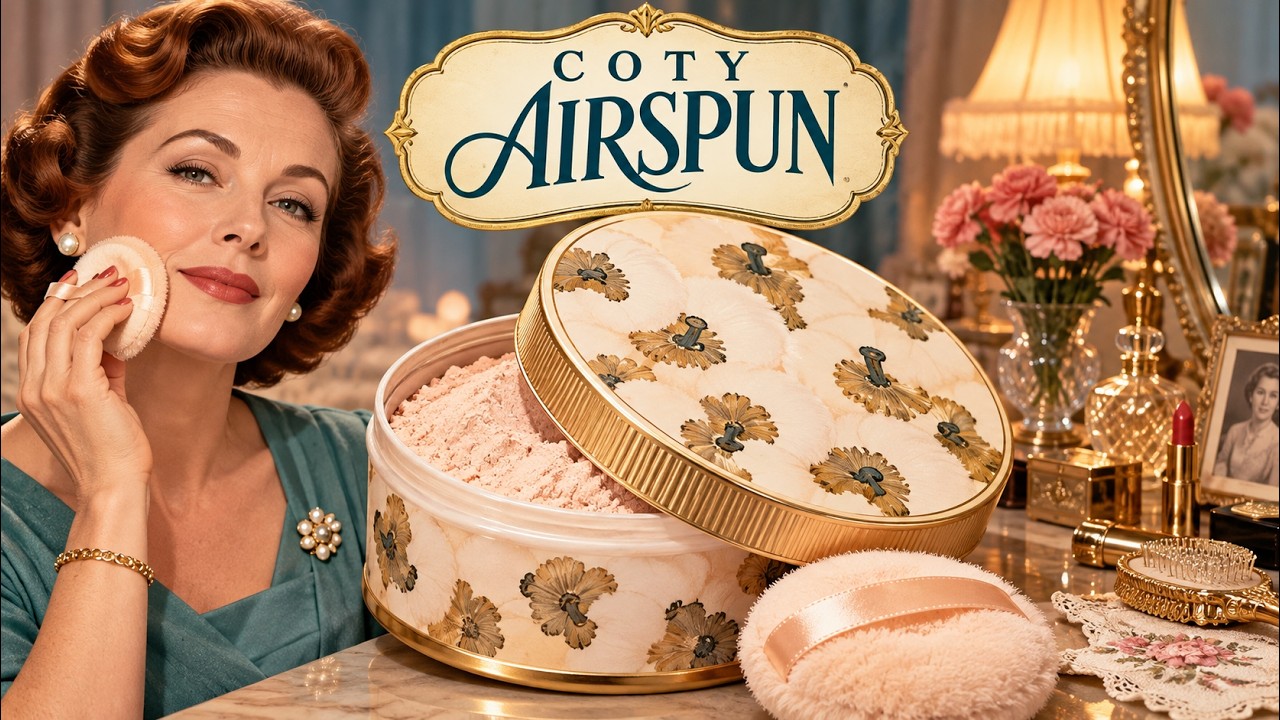
He did not live to see what his company released the following year. It was a face powder. Loose, fine, almost weightless. It came in a round paper box and sold for one dollar at drugstore counters across America.
It arrived in the depths of the Great Depression, when roughly one in five American workers had no job at all. That year, the company did something almost no competitor dared to do. It put forty percent more powder in the box, and it lowered the price. The powder was not ground by stone or sifted through cloth.
It was fed into a sealed metal drum and caught in a stream of cold purified air forced in at one hundred pounds per square inch. Inside, the air whirled so violently that the particles circled the chamber at more than a thousand miles an hour, colliding with one another until only the finest could escape. It was built to win a war. A rival brand had convinced millions of American women to test their face powder between their teeth and feel for grit.
Most powders failed. This one was engineered from the first particle to pass. The rival that started that war is gone. So is the orange lipstick that turned pink on the lips.
So is the Hollywood makeup house that taught a generation of women how to paint their faces for the camera. One by one, the great names of the American vanity table disappeared from the shelf. That one-dollar powder did not. Nearly nine decades later, it still sits on the lower shelves of American drugstores and supermarkets.
It comes in a round canister printed with a pattern of floating powder puffs, a design whose roots trace back to 1914 and a costume designer for the Russian ballet. Women who first saw it on their grandmother’s dressers now buy it for their daughters. Makeup artists half their age buy it by the case. And in September of 2025, the corporation that owns it announced a review that could end with its entire drugstore makeup business being sold off, with a decision expected before the end of 2026.
But the real story of Coty Airspun is not the story of a powder that refused to disappear. It is the story of a man who built an empire out of scent and lost most of it, of the rivals who fell while his last great idea kept selling, and of the women who kept reaching for it long after the world that made it had vanished. The story begins in Ajaccio, Corsica, in 1874. Ajaccio was a small Mediterranean port on a rugged, poor island.
Its fame rested on one fact: it was the birthplace of Napoleon Bonaparte. For most families, life on Corsica meant fishing, farming, or leaving. Thousands of young Corsicans left for mainland France every decade, looking for work in the army, the civil service, or the docks of Marseille. On May 3rd, 1874, a boy named Joseph Marie François Spoturno was born there.
His father, Jean-Baptiste, came from a family of modest merchants. His mother, Marie Adolphine, came from a local family named Coti. The boy would not keep either parent for long. His mother died when he was very young.
His father died when he was about seven. By the time he could read, François Spoturno was an orphan. He was sent across the water to Marseille and raised largely by his grandmother. It was a crowded working city of sailors, soap makers, and traders, and it gave him little besides an education in how to survive.
As a young man, he served roughly three years in the French army. When his service ended around the turn of the century, he did what ambitious Corsicans had done for generations. He went to Paris. His first real job there had nothing to do with perfume.
He worked as an assistant to Emmanuel Arène, a Corsican-born politician and journalist with connections across Parisian society. The work was part secretary, part errand runner, part political aide. It placed a young man with no money and no family name inside drawing rooms he could never have entered on his own. He learned how wealthy Parisians dressed, spoke, and shopped.
He learned what they valued, and he noticed what they wore on their skin. The turning point came through a neighbor. A pharmacist named Raymond Goery mixed his own eau de cologne in the back of his shop. In that era, pharmacies often sold simple scented waters alongside tonics and tinctures.
Spoturno began spending time in that back room, watching Goery blend alcohol, citrus oils, and flower essences in glass flasks. He was fascinated. He began to experiment himself. It was not enough to experiment.
He wanted to learn the trade properly. So he traveled south to Grasse, the hill town above the French Riviera that supplied much of the world’s perfume materials. Grasse was an industrial town built around a single purpose: turning flowers into oil. Jasmine, rose, and tuberose were harvested by the ton and processed in large factories.
Spoturno trained at one of the most respected of those houses, Chiris, where he studied how raw materials were extracted, graded, and combined. A perfumer, the craftsman who composes a scent, works less like a chemist and more like a composer. Each material is a note. Some evaporate within minutes.
Others linger on the skin for hours. The art lies in arranging them so the fragrance unfolds over time. Bright at first, warm in the middle, soft and lasting at the end. He came back to Paris ready to build something of his own.
He also changed his name. He took his mother’s family name, Coti, and altered one letter. François Spoturno became François Coty. In 1904, he released his first commercial perfume.
It was called La Rose Jacqueminot, named after a deep red rose variety well known in French gardens. He placed it in a bottle made by Baccarat, the famous French crystal house. Then he tried to sell it. What happened next has been retold so many times that it may have grown in the telling.
By the most popular account, Coty brought his perfume to the Grands Magasins du Louvre, one of the largest department stores in Paris. The buyer refused to stock it, and then a bottle broke on the counter, by accident or by design, depending on who tells the story. The scent filled the room. Shoppers came to the counter asking what it was.
The store placed an order. Whether that moment happened exactly that way is uncertain. What is certain is what came next. Within a few years, the unknown Corsican had become one of the most successful perfumers in France.
To understand why, it helps to understand what perfume was before him. At the start of the twentieth century, fine fragrance was a luxury for the few. The great Paris houses blended scents for aristocrats and wealthy clients, and they often sold them in plain pharmacy-style bottles. Cheaper perfumes existed, but they were simple and often harsh.
Between the two, there was almost nothing. No affordable scent with real artistry. No beautiful bottle a shopgirl could dream of owning. Coty saw the gap.
He built his business on three ideas. First, a quality fragrance. Second, a bottle beautiful enough to sit on display. Third, a range of sizes, so that a woman of modest means could afford the same scent as a duchess, just in a smaller bottle.
In 1905, he released L’Origan, a warm, spicy fragrance that became one of the defining scents of its decade. In 1908, he opened a shop at 23 Place Vendôme, the most prestigious address in Paris. Next door at number 24 was the studio of René Lalique, the master glassmaker. Coty asked Lalique to design labels and then bottles.
Their partnership helped turn the perfume bottle itself into an object of art. That same period, he built a vast production complex at Suresnes, just west of Paris. Workers there made perfume, bottles, boxes, and labels on a single site. It was, in effect, a factory town devoted to scent, and the more he produced, the lower his costs fell.
Luxury, for the first time, was being made on an industrial scale. Coty then looked across the Atlantic. America had money, cities, department stores, and millions of women who had never owned a French perfume. By the early 1910s, his products were being sold in the United States, and an American company was built to carry his name.
On Fifth Avenue in New York, the Coty building’s windows were fitted with panels of Lalique glass. It was a statement. Paris had come to America, and it intended to stay. In 1914, he extended the brand beyond perfume.
Coty released a face powder, and he hired Léon Bakst, the Russian artist famous for his costumes and sets for the Ballets Russes, to design the packaging. The result was a round box decorated with a pattern of floating powder puffs. It was playful, elegant, and instantly recognizable. No one could have guessed that it would still be used generations later.
In the 1920s, face powder was one of the most important products in any American woman’s routine. Liquid foundation was not yet common. Instead, women smoothed on a cold cream or vanishing cream, then pressed loose powder over it to create an even matte finish. But the powders of the day had a problem.
Many were milled from talc, rice starch, and chalk in mechanical grinders, and the particles were uneven. The result could look chalky on the skin, cake in the creases, and slide off by afternoon. In the early 1930s, a rival brand called Lady Esther turned that flaw into a weapon. Its advertising urged women to take a pinch of their own powder, place it between their teeth, and bite.
If they felt grit, they should switch. The campaign was a sensation. Most powders on the market failed the test, and Lady Esther rose to become the bestselling face powder in the United States. Every competitor was forced to respond.
Coty’s company needed a powder so fine that it could pass any test a woman could invent. The man who had built the company would not be part of that answer. By the late 1920s, François Coty had turned much of his energy and money toward newspapers and politics. His marriage ended in 1929 in a divorce with a settlement reported to be enormous.
Then the stock market crashed. His newspaper ventures lost heavily. His fortune, once among the largest in France, drained away year after year. In 1934, Coty’s company secured exclusive rights to a new way of making powder.
On July 25th of that same year, François Coty died at Louveciennes, outside Paris. He was sixty years old. The powder that would outlast him was already on its way. The machine that would change Coty’s powder had nothing to do with beauty.
It was an industrial mill, the kind of equipment engineers used to reduce minerals and pigments to extremely fine dust. It was called a micronizer, because it reduced particles to the size of a micron. A micron is one thousandth of a millimeter, or about one 125,000th of an inch. A single human hair is dozens of microns wide.
Coty secured exclusive rights to use this process for face powder. That word, exclusive, would matter as much as the machine itself. The traditional way of making face powder was mechanical. Raw materials were crushed, ground between surfaces, and pushed through fine screens.
Some manufacturers used a method called air floating. A fan blew the finished powder upward through a chamber, and only the lighter particles rose high enough to be collected. Both methods worked. Neither was precise.
Particles came out in a range of sizes, and a range of sizes meant a powder that felt uneven on the skin, and sometimes between the teeth. The micronizer worked on a different principle. Nothing ground the powder. The powder ground itself.
Inside a closed drum-shaped chamber, a continuous stream of purified cold air was forced in at one hundred pounds per square inch, several times the pressure in a car tire. The shape of the chamber and the angle of the air jet sent the air spinning around the walls at more than a thousand miles per hour. Into that man-made cyclone, workers fed the powder mix at a carefully controlled rate. The talc, the pigments, and the other ingredients were hurled against one another over and over until they broke themselves down.
Then physics did the sorting. The heavier particles, pushed outward by their own momentum, stayed trapped against the outer wall and kept colliding. Only when a particle had been reduced to the right size could it drift toward the center of the chamber and escape through the exit. As long as the air speed and the feed rate were held constant, every particle that came out was nearly the same size.
The powder was then collected in bags. Coty did not simply choose the smallest possible particle. According to technical accounts from the period, the final size was selected after repeated experiments, balancing three qualities: how the powder looked on the skin, the effect it created, and how well it clung. Too coarse, and it looked chalky.
Too fine, and it would not hold. The process had a second benefit that was less obvious. Because every ingredient was tumbled together at such speed, the color and the perfume were spread evenly through the entire batch. A cosmetics trade manual from the 1940s noted exactly this: finer powder, more uniform distribution of perfume and color, and greater fluffiness.
In plain terms, every pinch from the box matched the pinch before it. The effect on a woman’s face was what counted. The powder lay flat instead of sitting on top of the skin. It softened the look of fine lines rather than settling into them.
It did not streak or blotch, and it stayed through the afternoon, through a shift behind a counter or a Sunday dinner that ran long. Coty needed a name that could explain all of this without a single technical word. It chose Airspun. The advertising that launched it in 1935 leaned into the image.
The copy told women the powder was buffed by rushing torrents of air and swirled in a fantastic snowstorm. It drew a sharp line between the old way and the new. Other powders, the ad said, were made by grinding and sifting. Airspun was different.
The promise was built around the four things women worried about most: smoothness, coverage, color, and cling. The shades were described as warm living skin tints. The scent was said to last longer. And by contrasting air and snow with grinding machines, the campaign quietly buried the one word every powder company feared that decade: grit.
It also borrowed the glamour of the moment. In 1935, American movie theaters sold tens of millions of tickets every week. On the screen, under hot studio lights, the stars had skin that looked flawless and matte. Airspun’s advertising suggested that an ordinary woman with a one-dollar box could have the same finish at home.
That was Coty’s strategy from the beginning: put the look of luxury within reach of the woman who could not afford luxury. The box carried the same message. The powder came packaged in the round design built on Léon Bakst’s pattern of floating powder puffs, a clean, bright box that stood out on a drugstore shelf. For the launch, Coty also produced a store display unit.
A shopper could turn a dial on the display and watch the available shades rotate into view. In an era before testers and swatches, that small device let a woman choose her color without opening a single box. Then came the decision that made Airspun impossible to ignore. Coty put the new powder in a larger box holding forty percent more powder than before, and it cut the price from one dollar and ten cents to one dollar.
Even in 1935, a dollar carried real weight. A movie ticket cost about a quarter. A loaf of bread cost less than a dime. A woman working behind a department store counter might earn, by some estimates, somewhere between twelve and eighteen dollars a week.
For her, a dollar box of powder was a considered purchase, not an impulse. Giving her more powder for less money in the sixth year of the Depression was not just generosity. It was a direct answer to the question every shopper was asking at the counter: is this worth it? Airspun reached American women through the channels Coty had already built over two decades.
It was sold at drugstore cosmetic counters, in department stores, and in the pages of national magazines. It sat on the shelf next to the Coty perfumes women already knew, and it carried the same name. The results came quickly. By most accounts, Airspun was an immediate success when it reached stores in 1935.
The company that had nearly been left behind by Lady Esther’s bite test now had a better answer than the question itself. It did not just pass the test. It made the test irrelevant. Every rival could copy the advertising.
Every rival could promise smoothness, coverage, and cling. But only one company held the exclusive rights to spin its powder with air. The machine was the advantage, and no competitor could buy it. In the years after its launch, Airspun became the center of Coty’s American business.
Its advertising followed a clear pattern. The early campaigns explained the science. The later ones sold the feeling. By 1941, Coty was placing full-color Airspun advertisements in Ladies’ Home Journal, one of the most widely read magazines in the country.
The ads of that era rarely showed the machine anymore. They showed a woman’s face in soft focus, a bare shoulder, the round box printed with its floating puffs placed near her hand as if she had just set it down. The technical language had done its work. Women already knew the powder was spun by air.
Now the question was simply how it would make them look. Coty realized that Airspun had become a promise that could be attached to more than one product. By 1944, the company was advertising Airspun Rouge alongside the face powder, a powdered blush made to match the same finish. A woman could now build her entire complexion from one family of products: powder for the skin, rouge for the cheeks, and a Coty lipstick to finish the look.
That lipstick carried a name of its own. It was called Subdeb, and it was aimed at a customer the cosmetics industry had barely considered a decade earlier: the teenage girl. A debutante was a young woman formally introduced to society. A subdeb was the girl just below that age.
Too young for the ball, old enough to want to look ready for it. By naming a lipstick for her, Coty was reaching for the next generation of powder buyers before they had ever bought a box. Some Airspun boxes were scented with Coty’s own perfumes. One of the best known carried L’Aimant, a warm floral fragrance Coty had introduced in 1927.
The connection mattered. A woman who wore L’Aimant could now carry the same scent in her powder, so it rose from her skin every time she touched her face. Fragrance and makeup, once sold at separate counters, were now sold as a single identity. It was still the age of the movie palace.
Every week, tens of millions of Americans sat in the dark and watched faces thirty feet tall. Those faces were powdered, lit, and filmed to look flawless in black and white. Airspun’s advertising returned again and again to the same idea: the finish of the screen, available at the drugstore. For a woman in Cleveland or Kansas City who would never set foot in a Hollywood studio, the promise was both simple and powerful.
Her skin could look like that, too. The timing, in retrospect, was almost perfect. Coty had built its powder into a household name just as the world was about to change. In June of 1940, German forces entered Paris.
For the American cosmetics industry, the fall of France was more than distant news. For decades, Paris had been the source of fashion, fragrance, and prestige. American women had been taught that elegance came from France, and companies like Coty had built their image on that belief. Now Paris was occupied.
Its designers were cut off. Its perfume houses were behind a front line. The American Coty company had to decide what its name would stand for without Paris behind it. Its answer became one of the most lasting cultural institutions it ever created.
In 1942, Coty established the Coty American Fashion Critics Award. The idea was developed with Eleanor Lambert, a New York fashion publicist who believed American designers deserved the kind of recognition once reserved for Parisians. The first awards were presented in January of 1943. The first top honor went to Norman Norell, a designer from Indiana who would become one of the most respected names in American fashion.
The trophy was a bronze statuette designed by the sculptor Malvina Hoffman. The industry nicknamed it the Winnie. It was a remarkable move for a company founded by a Frenchman. At the very moment Paris went silent, the name on the Airspun box became the name that crowned American style.
At home, the war reached directly into the vanity drawer. The materials that made cosmetics, metals, oils, glycerin, alcohol, packaging, were suddenly needed for the military. In 1942, federal war planners moved to restrict the production of cosmetics as non-essential goods. The reaction was swift.
Manufacturers, retailers, and women themselves argued that makeup was not a frivolity but a matter of morale. Records suggest many of the restrictions were soon eased, though shortages of materials continued throughout the war. Packaging changed first. Brass lipstick cases gave way to plastic, and plastic gave way to cardboard and paper.
Powder compacts, once made of metal, were simplified or disappeared from shelves. Coty’s round powder box had always been made largely of paper, which meant the product women knew best looked almost the same in wartime as it had in peacetime. The women buying it had changed. Millions of American women took jobs outside the home during the war, many for the first time.
They built aircraft, assembled munitions, drove trucks, typed orders, and nursed the wounded. Makeup became part of the new working uniform. Government posters and magazine features encouraged women to keep up their appearance, presenting it as a sign that life at home had not surrendered to the war. The cosmetics industry followed women into uniform.
One rival house created a lipstick shade called Montezuma Red, designed to match the red trim on the uniforms of women serving in the Marine Corps. Beauty was no longer just personal. It had become patriotic. In that world, a one-dollar box of face powder carried an unusual weight.
A woman coming off a night shift at a defense plant could stand in a factory washroom, open the round box, press the puff to her face, and see for a moment the woman she had been before the war began. That was what the powder sold. Not a disguise. A reminder.
When the war ended in 1945, the country Coty had marketed to changed faster than at any time in its history. Millions of servicemen came home. Marriages surged. So did births.
New suburbs spread outward from nearly every major American city. And with them came new shopping centers, new chain drugstores, and new department store branches. A woman who once traveled downtown to buy her powder could now find it a few minutes from home. The rituals of beauty moved into those new houses.
Many homes built in the post-war years had a bedroom vanity or dressing table: a mirror, a small stool, and a surface covered in bottles and boxes. On that surface, the Coty box with its floating puffs became a familiar object. A woman would lift the lid, press the soft puff into the powder, tap away the excess, and pat it across her nose and cheeks. A thin cloud would rise in the light from the window.
A trace of scent would settle over the room. For many children growing up in those years, that ritual was their first memory of makeup. They watched their mothers do it before church, before dinners out, before weddings and funerals. They remembered the sound of the lid, the dust on the mirror, the smell that stayed on a coat collar.
When those girls grew up and bought their own first box of face powder, many of them reached for the one they already knew. By 1951, Coty was still advertising Airspun powder alongside its lipsticks in national magazines, now in the bright colors of the post-war era. The product had not needed to reinvent itself. The machine, the name, and the box were still doing their work.
Yet the man whose name appeared on every box never saw any of it. François Coty died a year before Airspun reached stores. He never saw the powder succeed in the Depression. He never saw his name on a fashion award that honored American designers.
He never saw his company’s powder boxes on the vanity tables of the new suburbs. His fortune had collapsed. His name had not. How large Airspun became is difficult to measure precisely.
Reliable sales figures for the powder alone have not survived in the public record. But one number captures the reach of the name it carried. From 1943 until the mid-1980s, for more than forty years, the most important prize in American fashion was known simply as the Coty Award. For four decades, the name on a one-dollar box of powder was the name that decided who mattered in American style.
But even at its height, the ground beneath loose powder was starting to move. In 1959, Coty itself was advertising a new product for American women. It was called Instant Beauty. It was a liquid makeup.
The first warning sign did not come from a competitor. It came from the way American women were beginning to wear their faces. For most of the first half of the twentieth century, loose powder had been the foundation of a woman’s complexion. After the war, that began to change.
Liquid and cream foundations became easier to buy and easier to use. Pressed powder, powder compacted into a solid cake inside a small case with a mirror, fit into a purse in a way a round box of loose powder never could. A woman on the move did not want a cloud of dust on a puff. She wanted a compact she could open on a bus, check in a restroom mirror, and snap shut in a second.
Coty saw the shift, and it followed its customers. By 1959, the company was advertising its own liquid makeup. The same company that had built its reputation on spinning powder with air was now telling women they could have a finished complexion from a bottle. That was not a mistake.
It was a reasonable business decision. But it revealed something that would define the next sixty years. Loose powder was no longer the center of the story. It had become one product among many.
Then came the decision that changed the company itself. In 1963, Coty was acquired by Pfizer. Pfizer was a pharmaceutical company. Its core business was medicine: antibiotics, research laboratories, and prescription drugs.
In the corporate strategy of the era, diversification was fashionable. Large companies bought businesses far outside their original field on the theory that good management could run anything. Cosmetics offered steady consumer sales and brand names people recognized. For Coty, the acquisition meant stability and deep financial resources.
It also meant that the company’s future would now be decided inside an organization whose priorities lay elsewhere. A face powder that sold steadily for a dollar or two was not a drug that could transform a balance sheet. It was a quiet, dependable product in a very large portfolio. Quiet products tend to receive quiet attention.
Through the 1960s and 1970s, American beauty changed again. The heavy, polished look of the post-war years gave way to a new ideal. Magazines and advertisers promoted a natural face, dewy skin, a light touch, the appearance of wearing little or nothing at all. For a younger woman in 1972, a matte, fully powdered face could look like something from her mother’s wedding photographs.
The generation that had grown up with the Coty box on the vanity table did not abandon it overnight. Many of them simply kept buying it year after year out of habit and trust. But their daughters were being taught to want something different. Loose powder moved from the center of the cosmetics counter toward its edges, and then toward the lower shelves.
The powder did not disappear. It simply stopped being new. Around it, one familiar name after another began to fade. Lady Esther, the brand whose bite test had forced the entire industry to change, gradually lost the dominance it held in the 1930s and faded from national prominence in the decades after the war.
The company that had once been the bestselling face powder in America became a name mainly remembered by collectors and advertising historians. Tangee, maker of the famous lipstick that appeared orange in the tube and turned pink on the lips, declined steadily in the post-war decades and eventually vanished from mainstream store shelves. Woodbury, whose soap and cosmetics had been advertised to generations of women, lost its place in the market as larger brands took over drugstore shelves. Even the giants were not safe.
Max Factor, the Hollywood makeup house whose products had helped define the look of the movie star, was withdrawn from American stores entirely in 2010. A brand that had once seemed inseparable from American glamour was no longer sold in the country where it had built its name. Coty’s own ownership kept changing. In 1992, Pfizer sold Coty to Joh.
A. Benckiser, a privately held German company best known for household cleaning and chemical products. The reported price was about $440 million. Once again, a face powder born in the age of radio found itself inside a company whose main business had little to do with the vanity table.
Under its new owners, Coty grew into a global fragrance and beauty company, acquiring brands and licenses around the world. In 2013, it became a publicly traded company on the New York Stock Exchange. In 2016, it completed one of the largest deals in the history of the beauty industry, taking over a collection of beauty brands from Procter & Gamble in a transaction valued at roughly $12. 5 billion.
Among them were CoverGirl and Max Factor. The company that owned Airspun had become enormous. The powder itself had become a small item inside it. On drugstore and supermarket shelves, the competition had changed completely.
The chain stores and big-box stores that replaced the old drugstore counters no longer employed a woman to recommend a shade. Products sat on long rows of pegs and shelves, and shoppers chose by price, by packaging, and by name. In the 2000s and 2010s, a new wave of brands arrived. Some were built by makeup artists.
Others were built by influencers on social media. Many were sold online, marketed through video tutorials, and priced to compete directly with the drugstore. Airspun had been designed for a world of magazine ads, department store counters, and mothers passing down habits to their daughters. That world was disappearing.
And yet, the powder kept selling. The next change touched the formula itself. For most of its history, like nearly every face powder of its era, Airspun had been built on talc, a soft mineral ground into a fine white powder that gives many cosmetics their smooth, silky feel. For decades, talc was simply what face powder was made of.
In the late 2010s and early 2020s, talc became one of the most closely watched ingredients in American personal care. Thousands of lawsuits were filed over talc-based baby powder sold by another major consumer products company. In 2022, Congress passed the Modernization of Cosmetics Regulation Act, which directed federal regulators to develop standardized testing methods for talc-containing cosmetics. Across the industry, many brands began reformulating.
Coty did the same. Around 2022, Airspun appeared on shelves with a new label and a new line in its description. The powder was now talc-free. In place of talc, the new formula relied on minerals and plant-based ingredients: mica, kaolin clay, oat flour, and tapioca starch.
The packaging had also changed over the years. The paper box of the 1930s had long since given way to a round plastic canister with a puff inside, though the floating powder puff pattern remained. For a product sold largely on trust and memory, this was a delicate moment. Loyal users had bought the same powder for years precisely because it did not change.
Now, for the first time in its long life, the core of the formula had changed. The company’s broader troubles deepened. In the fiscal year ending in June 2025, Coty reported a net loss of about $381 million. Sales in its consumer beauty division, the business that sold its drugstore brands, fell year over year.
The company had invested heavily in its American mass-market business only to watch that business struggle against lower-priced online competitors. On September 30th, 2025, Coty announced a strategic review of its consumer beauty business. The review covered its mass-market color cosmetics, a business with roughly $1. 2 to $1.
5 billion in annual revenue, along with its separate business in Brazil. The company said it would consider partnerships, spin-offs, divestitures, and other strategic options. News reports focused on the best-known names that could be sold: CoverGirl, Rimmel, Sally Hansen, and Max Factor. Airspun’s name did not appear in those headlines.
It rarely did. In March of 2026, Coty introduced a new corporate framework called Coty Curated, built around focusing on core brands and reducing complexity. The company described its next fiscal year as a transition. It said the strategic review was expected to be completed by the end of 2026.
The decision had not yet been made, but the direction was clear. The future of Coty, the company said, lay in fragrance. The company began with a single rose perfume. It may end its drugstore makeup business entirely.
The paper box is gone. The talc is gone. The founder is long gone. Lady Esther is gone.
Tangee is gone. Max Factor left American shelves. The owner is weighing a sale. The powder is still there.
The rescue did not come from the company. It came from the people using it. In the 2010s, a makeup technique moved from backstage dressing rooms onto millions of phone screens. It was called baking.
The method was simple. After applying concealer, a thick layer of loose powder was pressed under the eyes and along the face, then left to sit for several minutes while the warmth of the skin set the makeup underneath. Afterward, the excess was swept away with a brush. The result was a smooth, crease-free finish that held for hours under bright lights.
The technique had long been used by drag performers and stage makeup artists whose faces had to survive heat, sweat, and hours of performance. When beauty creators began filming it for YouTube and Instagram, it spread quickly. And those tutorials needed a loose powder that was affordable, widely available, and fine enough to set without looking heavy. Many of them reached for the same round canister their grandmothers had kept on the dresser.
Retailers began describing Airspun in new language. It was no longer just a face powder. It was a setting powder, a baking powder, a product for highlighting and contouring. The same particles designed in 1935 to pass the bite test were now being judged by young women filming close-ups in ring lights.
Many of them had never heard of Lady Esther, the Great Depression, or François Coty. They only knew that it worked. The powder also found a following among performers. The burlesque star Dita Von Teese has said she loves Coty Airspun, though she uses it mainly on her body for shows rather than on her face.
A product designed for an ordinary woman’s complexion had become part of a professional stage kit. By the mid-2020s, one version of Airspun on a major retailer’s website carried more than 14,000 customer ratings, averaging over four stars out of five. For a product first sold when Franklin Roosevelt was in his first term, those reviews told a remarkable story. Some came from women who had used it for decades.
Others came from people buying it for the first time. A few said simply that their mothers had loved it. This was not a revival built on a borrowed name. The product never left the shelf.
It was simply rediscovered by a generation that had inherited it without knowing. Alongside the new buyers, a second, quieter economy grew around the old boxes. Collectors of vanity items and cosmetic packaging search estate sales, antique shops, and online marketplaces for early Coty powder boxes. Empty paper boxes from the 1930s, some still carrying scent names like L’Aimant printed on the side, appear regularly in online listings.
Collectors of vintage advertising buy and frame original Airspun magazine ads from the 1940s and 1950s. Some buyers look for sealed canisters of the older talc-based formula, hoping to find the texture they remember. For them, the box is not only packaging. It is a record of a room, a mirror, and a person.
The reason the original still matters is concrete, not just sentimental. For many women, loose powder solves a problem no bottle can. A woman with oily skin needs something that controls shine through a long workday. A woman with fine lines needs a finish that softens them without settling into creases.
A bride needs makeup that will survive photographs, tears, and a crowded reception hall. A stage performer needs a face that will not melt under hot lights. For decades, Airspun met all of those needs for a few dollars. That is what its loyal users are protecting when they buy an extra canister before a store runs out.
They are not buying a memory alone. They are buying a finish they know will hold. The buildings that carried the Coty name tell their own story. In New York, the building at 714 Fifth Avenue, once home to Coty’s American showroom, still holds its windows of Lalique glass.
For many years, they were hidden. When they were rediscovered in the 1980s, the building was designated a New York City landmark. It later became the flagship of the department store Henri Bendel, which closed its doors in 2019. The glass that once announced French perfume on Fifth Avenue has now outlived its original purpose, its original tenant, and the store that followed.
And one detail on the powder canister itself carries more history than most customers ever realize. The pattern of floating powder puffs traces back to a design commissioned from Léon Bakst in 1914, an artist whose costumes and sets helped make the Ballets Russes one of the most celebrated dance companies in the world. Some collectors attribute versions of the design to René Lalique instead. Either way, the same family of design created for the Paris of the early twentieth century is printed on a canister sold at supermarkets across America.
Even the most detailed biography of François Coty, published in 2009, was co-written by a member of the Coty family. The man who built his fortune on scent and lost it is still being studied, still being argued over, and still being named on the powder he never saw. What does this story reveal? It suggests that the products that last are not always the most glamorous ones.
François Coty built crystal bottles, a perfume empire, and a factory town devoted to scent. Much of that disappeared. The product that endured was a plain round box of powder that cost a dollar. It survived because it solved a real problem, stayed affordable, and became part of a daily routine passed from one generation to the next.
Its owners changed. Its formula changed. Its box changed. The experience of using it, the lid, the puff, the soft cloud of powder, did not.
And in a world where beauty brands rise and vanish within a few years, that continuity became its greatest strength. Somewhere tonight, a woman is sitting in front of a bathroom mirror, lifting the lid of a small round canister, pressing a soft white puff into the powder, and tapping it gently against her cheek, exactly the way her mother once did.






