Three weeks. That was the terrifyingly thin margin between the first televised royal wedding in history and the birth of a child who could have brought the monarchy to its knees. For 45 years, Polly Fry was a ghost in her own life. Raised as the daughter of a wealthy chocolate heir, she was in reality the living, breathing evidence of a betrayal so reckless it defies belief.
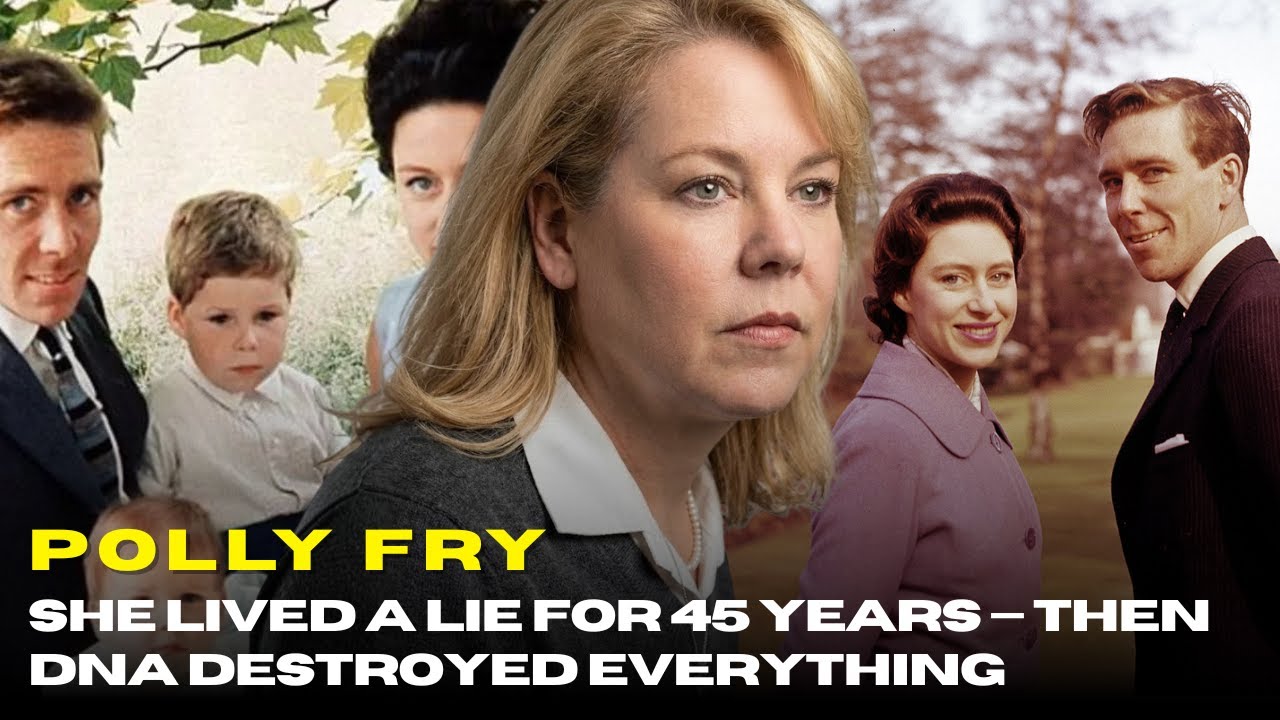
A DNA test in 2004 would finally shatter the illusion, proving that while Lord Snowdon was pledging his loyalty to the Queen’s sister, his biological daughter was kicking in the womb of his best friend’s wife. This is the story of the honeymoon baby, the secret Anthony Armstrong Jones tried to bury under half a century of silence. But the fuse for this biological time bomb was lit long before the birth, back in the autumn of 1959, in the sun-drenched, hedonistic playground of Widcombe Manor. This was the home of Jeremy and Camilla Fry, a couple who treated social boundaries as mere suggestions.
Into this world walked Anthony Armstrong Jones, or simply Tony. Before he was a royal icon, Tony was a photographer who moved through society like a feral cat in a tuxedo. Charming, sexually fluid, and utterly predatory. He was Jeremy’s best friend.
But for a man like Tony, friendship was no barrier to desire. The autumn of 1959 became the season of secrets. In London, Tony was conducting a covert, high-stakes courtship of Princess Margaret, playing the role of the devoted suitor. But in Bath, he was playing a very different game.
He treated Widcombe Manor as his personal hunting ground and his best friend’s wife Camilla as his prize. It was an act of breathtaking arrogance, juggling the most famous woman in the world and a married aristocrat simultaneously, addicted to the adrenaline of the double life. In February 1960, the engagement between the princess and the photographer was announced to a delighted world. But down in Bath, the math was turning into a nightmare.
Camilla Fry was pregnant. Counting back from the due date, the conception landed squarely in the danger zone: those illicit weekends at Widcombe, weeks before Tony proposed to the princess. The drama reached its peak just before the wedding. Jeremy Fry was set to be the best man, standing shoulder-to-shoulder with Tony at the altar of Westminster Abbey.
But the palace, sensing the radioactive potential of the situation, intervened. A polite medical lie was manufactured. Illness. And Jeremy was quietly erased from the lineup.
He watched the wedding of the century from the shadows while his wife carried a child that belonged to the groom. On May 6th, 1960, Princess Margaret walked down the aisle, radiant and unsuspecting. Tony stood at the altar, the picture of triumph. As they exchanged vows to forsake all others, the irony was thick enough to choke on.
The other was not a memory. She was a heavily pregnant woman 100 miles away. And as the newlyweds sailed away on the royal yacht Britannia for a six-week Caribbean honeymoon, the clock finally ran out. Three weeks later, on May 28th, 1960, Camilla Fry gave birth to a daughter.
They named her Polly. From her very first breath, Polly was a secret agent in her own life. She was born into a lie that had been constructed to protect the crown and the ego of a photographer. To the world, she was the third child of Jeremy and Camilla Fry.
She was a Fry. She was an heiress to the chocolate fortune. She was safe. But biology is a patient artist.
It paints its truth slowly over years. As an infant, Polly was just a baby. But as she grew, the features that would eventually damn her began to emerge. The sharp jawline, the hooded, intelligent eyes, the diminutive stature.
She was a physical echo of the man who was currently waving from the balcony of Buckingham Palace. The early years of Polly’s life were played out against the backdrop of the swinging sixties, a decade that Tony Armstrong Jones helped to define. While Polly was taking her first steps in the gardens of Widcombe, her biological father was created Earl of Snowdon in 1961, reshaping the visual language of the monarchy. He was the cool royal, the one who rode motorbikes and wore turtlenecks.
He was also a frequent visitor to Widcombe. This is the most chilling aspect of the deception. Tony did not run away. He leaned in.
Instead of disappearing, he remained close to the Fry household and was often treated as a familiar, almost uncle-like presence. Imagine the psychological perversity of that arrangement. The man who knew, or at least strongly suspected, that he was the father stood in a church, renounced the devil and all his works on the child’s behalf and promised to guide her spiritual upbringing. He appointed himself her uncle.
He cemented his presence in her life, not as a parent, but as a glamorous, benevolent satellite. For the child Polly, Uncle Tony was a figure of myth. He brought with him the scent of London, of chemicals from his darkroom, of royal privilege. He was funny, acerbic, and terrifyingly charming.
He would sweep into the manor, take photographs that stripped the subjects of their defenses, and then sweep out again. Polly adored him. She didn’t know why she felt a specific resonance with him, a vibrating frequency that she didn’t feel with the gentle, lanky Jeremy. She assumed it was just charisma.
She didn’t know it was recognition. Life at Widcombe Manor in the 1960s was a golden cage of privilege. It was a world of high aesthetics and low morals. The Frys were wealthy enough to create their own reality.
They lived in a bubble where the normal rules of conduct didn’t apply. Jeremy Fry was a fantastic father, engaged, creative, constantly building treehouses or inventing games. He loved Polly with a ferocity that belied any doubts he might have harbored. If he looked at her and saw his best friend’s face, he never let it show.
He raised her as a Fry, embedding in her the values of his family: curiosity, independence, and a slight disregard for authority. But a child is a sponge for the unspoken. As Polly moved from the nursery to the schoolroom, she began to absorb the ambient tension of her environment. There were whispers.
Servants’ talk. Guests’ talk. The set that circulated between London and Bath was a sieve of gossip. The rumor that Polly was Tony’s became a kind of dark parlor game among the upper classes.
It was told over brandy, laughed about at balls. Have you seen the Fry girl? She’s the spitting image of Snowdon. Polly was too young to understand the words, but she felt the gaze.
She felt the way people looked at her, searching her face for clues. She grew up with a vague, undefined sense of being an impostor in her own family. She didn’t look like her siblings. She didn’t feel like a Fry.
She felt like a cuckoo in the nest, but she had no idea where the other bird had come from. By the time Polly reached adolescence in the 1970s, the Snowdon marriage, the union that her birth had silently mocked, was disintegrating. Margaret and Tony were tearing each other apart in a war of attrition played out on the front pages of the tabloids. Tony was revealed to be cruel, unfaithful, and bored.
Margaret was revealed to be needy and demanding. The fairy tale of 1960 had become a horror story. And on the sidelines, watching the destruction of the marriage from the safety of the countryside, was the teenage girl who was the original sin of that union. Polly watched Uncle Tony on the news, saw his face scowling at the paparazzi, and felt a strange magnetic pull.
She didn’t know that the disintegration of his marriage to the princess would eventually lead him back to the question of her existence. She didn’t know that as the Snowdon marriage crumbled, the debris would eventually fall on her. She was living in the eye of the storm, enjoying the calm, unaware that the hurricane had been generated by her own conception. She was the honeymoon baby, the secret that had been kept for a decade, then two.
But secrets like this have a half-life. They decay. And as Polly stood on the brink of adulthood, the radiation of the lie was beginning to seep into her bones. The stage was set for the second act of her life, a period of denial, of dangerous whispers, and the slow, creeping realization that the man she called Dad was playing a role, and the man she called Uncle was holding the script.
The 1970s and 1980s were decades of transition for Britain, a slow slide from the chaotic optimism of the sixties into the sharper, colder edges of the Thatcher era. For Polly Fry, these were the decades of the great silence. She was growing up in the long shadow of a secret that everyone seemed to know except her. It is a peculiar psychological torture to be the subject of a rumor that is too polite to be spoken to your face but too juicy to be ignored behind your back.
Polly was living in a hall of mirrors where every reflection was distorted by the collective deceit of the British upper class. Adolescence is difficult for anyone. It is a time of searching for identity, of looking in the mirror and asking, who am I? For Polly, the mirror offered a confusing answer.
She looked at her father, Jeremy Fry, tall, lanky, with a face full of open, eccentric warmth. And then she looked at herself. She was small. She was fine-boned.
Her eyes had a piercing, hooded quality that felt alien to the Fry lineage. She was a biological non sequitur. In the rarefied world of the English aristocracy, physical resemblance is currency. It is the stamp of legitimacy.
When you walk into a drawing room, people look at your chin, your nose, your hairline, tracing the lines of dukes and earls back through the centuries. Polly failed this test every time she walked into a room with Jeremy. But she passed a different test, one she didn’t know she was taking. Whenever Uncle Tony, Lord Snowdon, appeared on the television or in the newspapers, the resemblance was uncanny.
It was not just a similarity, it was a duplication. The set of the jaw, the way the eyes narrowed in amusement or disdain, it was all there. But the human mind is a fortress designed to protect us from truths that would destroy our world. Polly built a wall of denial.
She loved Jeremy Fry. He was the only father she had ever known. He was the man who taught her to ride a bike, who encouraged her creativity, who paid her school fees. To question her paternity was to betray him.
It was to suggest that his love was based on a lie, or worse, that he was a cuckold who had been duped by his best friend. So Polly suppressed the doubts. She locked them in a mental box, taped it shut with loyalty, and buried it deep in her subconscious. However, the world outside was not so kind.
As Polly entered her twenties, the dangerous whispers moved from the background to the foreground. The society gossip machine, fueled by gin and malice, began to turn its gaze on her. At parties in London, amidst the clinking of champagne flutes, she would catch the tail end of conversations that stopped abruptly when she approached. She would see the knowing looks exchanged between older matrons.
Doesn’t she look like him? Poor Jeremy. The Snowdon girl. Occasionally, the whispers would become audible.
A drunken peer might make a clumsy joke. A friend might ask a probing question about her mother’s friendship with Tony. Polly developed a deflection mechanism. She laughed it off.
She treated it as a ridiculous, fantastical story, the kind of myth that attaches itself to famous families. Me, Lord Snowdon’s daughter? Don’t be absurd. He’s my godfather.
But beneath the laughter, the anxiety was rotting her confidence. She felt like an impostor. She felt a profound sense of displacement, a spiritual homelessness. She didn’t fit in with the Frys, but she had no right to claim any other identity.
She was drifting in the Atlantic Ocean between two continents: the warm, eccentric continent of Fry and the cold, glamorous continent of Snowdon. This internal dissonance was amplified by her own developing personality. As she matured, Polly discovered she had an artistic soul. She wasn’t an engineer like Jeremy.
She was a creative. She had an eye for composition, for aesthetics, for the visual language of the world. This talent felt like a betrayal. Every time she picked up a camera or sketched a design, she felt she was channeling the ghost of the man she wasn’t supposed to be related to.
Lord Snowdon was one of the most famous photographers in the world. His visual style, stark, dramatic, unsentimental, defined an era. Was her own talent a coincidence, or was it genetic memory asserting itself? Meanwhile, the man at the center of the mystery, Lord Snowdon, was living a life of public acclaim and private chaos.
His marriage to Princess Margaret had finally, inevitably, collapsed in 1978. Their divorce was a major modern royal scandal, one of the first of its kind in the contemporary monarchy. Tony was free. He remarried, to Lucy Lindsay-Hogg, and had another daughter, Frances.
He continued to work, to travel, to seduce. He remained a presence in Polly’s life, but a distant one. He was the bad fairy at the christening of her life: glamorous, dangerous, and intermittent. He would send the occasional card, make the occasional visit.
He never dropped the mask. He never took her aside and said, Polly, I need to tell you something. He played the role of godfather to perfection. He was a man who believed that if you ignored a problem long enough, it would simply cease to exist.
He had compartmentalized Polly into a box marked the past, and he had no intention of opening it. Jeremy Fry, for his part, played the role of the saint. He never wavered in his affection. If he knew the truth, and it is almost impossible to believe that a man of his intelligence didn’t suspect, he decided that love was stronger than biology.
He chose Polly. He chose to be her father every single day. This is the tragic beauty of Jeremy’s position. He was raising another man’s child, not out of obligation, but out of a profound, generous defiance of the facts.
He was proving that fatherhood is a set of actions, not a DNA sequence. But the 1990s brought a change in the atmosphere. The era of deference was dead. The tabloids were becoming more aggressive.
The royal family was disintegrating in real time. Charles and Diana, Andrew and Fergie. The concept of royal bastard was moving from the history books to the front pages. The pressure on the secrets of the past was mounting.
For Polly, the nineties were a time of settling down, of trying to build a life on the shaky foundations of her identity. She married. She had children of her own. Motherhood is often a catalyst for truth.
When you look at your own child, when you see the way your nose or your eyes are stamped onto a new face, you begin to understand the power of the bloodline. You realize that you are a link in a chain. Polly looked at her children and wondered, what chain am I part of? Which ancestors are staring back at me from these cradles?
Are they Frys with their chocolate and their inventions? Or are they Snowdons with their cameras and their royal connections? The denial began to crack. The box she had buried in her mind was leaking.
She started to read biographies of Snowdon. She started to look at his photographs with a new, obsessive intensity. She was looking for herself in his work. She was looking for a sign.
But the catalyst for the final explosion came not from her own curiosity, but from the brutal inevitability of death. As the new millennium dawned, Jeremy Fry’s health began to fail. There is nothing like the impending death of a parent to sharpen the focus of a child. As Jeremy grew weaker, Polly was seized by a panic that was almost primal.
She realized that the era of silence was ending. Once Jeremy died, the protective shield he had thrown around her would vanish. She would be left alone with the rumors. More importantly, she realized that she could not let him die without knowing the truth.
Or perhaps she couldn’t let him die while she was still living a lie. It was a terrible moral dilemma. If she investigated her paternity while Jeremy was alive, she risked breaking his heart. She risked telling a dying man that his daughter was a fraud.
But if she waited until he was dead, she risked never knowing the truth at all. The DNA, the source, was fading. In 2004, the dam broke. Polly was 44 years old.
She was no longer a child who could be protected. She was a woman who needed answers. The rumors had become deafening. She approached the only other person who held the key: Lord Snowdon.
Tony was now an old man. He was in his seventies, frail, cranky, but still possessed of that razor-sharp mind. He was living in his Kensington studio, surrounded by the debris of a lifetime of fame. When Polly came to him, she wasn’t asking for money.
She wasn’t asking for a title. She was asking for peace. Tell me, she effectively asked. Am I yours?
Snowdon’s reaction was complex. He was not a man given to sentimental confessions. He was a pragmatist. He initially resisted.
Why dig it up? Why now? But perhaps he too felt the weight of mortality. Perhaps he looked at this woman, this woman who looked so much like him, and felt a flicker of paternal responsibility, or at least curiosity.
He agreed to the test. The procedure was simple: a mouth swab, a few cells on a piece of cotton. It was a trivial medical act that contained the power of a nuclear bomb. The sample was sent to a laboratory.
The waiting began. Those days of waiting must have been a purgatory for Polly. She was suspended between two lives. In one version of reality, she was Polly Fry, daughter of Jeremy, and the rumors were just malicious lies.
In the other version, she was Polly Armstrong-Jones, daughter of the Earl of Snowdon, cousin to the Queen’s children, and a living scandal. She was praying for the former, but dreading the latter. When the results came back, there was no ambiguity. Science does not do politeness.
It deals in probabilities. And the result was reported as a 99. 9% match. Lord Snowdon was her biological father.
The revelation did not bring a Hollywood moment of tearful joy. It brought a crushing, suffocating sense of tragedy. Polly later described the moment as devastating. It wasn’t finding a father.
It was losing one. In that split second, Jeremy Fry, the man who had held her hand, dried her tears, and loved her without condition, was legally and biologically erased. He was reduced to a guardian. The man she had loved as Daddy was, in the cold light of DNA, a stranger.
And the man she had known as Uncle Tony, the distant, glamorous figure, was suddenly her father. It was a rewriting of her entire history. Every memory had to be re-examined. Every Christmas, every birthday, every family holiday was now tainted by the knowledge of the lie.
She realized that her mother and Tony had sat at dinner tables, laughing and drinking wine, while the secret of her conception sat between them like a ghost. She realized the magnitude of the betrayal. They had not just lied to the world. They had lied to her.
They had built her life on a foundation of sand. But the personal pain was only the beginning. Polly was not just a private citizen. She was now a public figure.
She was the royal bastard. She was proof that Lord Snowdon, the man who had married the Queen’s sister in a fairy-tale wedding, had been cheating on her right up to the altar. She was proof that the perfect royal marriage had been a sham from day one. As the news began to leak out, because secrets like this never stay in the lab report, Polly Fry prepared herself for the storm.
She was about to step out of the shadows of the great silence and into the blinding glare of the world’s judgment. She was about to become the most famous illegitimate daughter in Britain. In ancient tragedies, the truth was delivered by a messenger covered in dust or a ghost stalking the battlements. In the 21st century, it arrives on a piece of paper, a sterile grid of genetic markers that possesses the power to incinerate a lifetime of memory.
When Polly Fry held that paper in 2004, the numbers were unequivocal, but the emotional calculus was impossible to balance. The test confirmed that she was the daughter of Lord Snowdon, the Earl of the Realm, the ex-husband of Princess Margaret, and the most famous photographer in Britain. But in the brutal logic of the heart, the test did not give her a father. It effectively killed one.
For 44 years, the identity Polly Fry had been the cornerstone of her existence. It was built on the foundation of Jeremy Fry’s love, his eccentricities, his kindness, his specific way of looking at the world. The DNA test took a sledgehammer to that foundation. It declared that biologically, legally, and historically, she was a fraud.
She was not a Fry. She was an Armstrong-Jones. The man she had adored as Daddy was, in the cold eyes of science, a benevolent stranger who had raised another man’s cuckoo. The immediate aftermath of the discovery was not the euphoria of clarity, but the nausea of betrayal.
Polly later described the sensation as feeling dirty. She had gone behind the back of the man who raised her, Jeremy, who was now frail and approaching the end of his life, to uncover a truth that honored a man who had largely ignored her. It felt like a posthumous infidelity. She was validating the rumors that had mocked Jeremy for decades.
She was proving the gossips right. And then there was the reaction of the winner of this genetic lottery: Lord Snowdon. If Polly had hoped that the scientific proof of her paternity would melt the icy reserve of the lion in winter, she was sorely mistaken. Tony Armstrong-Jones was 74 years old.
He was a man who had survived the shark tank of the royal family. A man who had divorced a princess. A man who had built a career on being the detached observer behind the lens. He did not do Hallmark moments.
When the truth was laid bare, there was no tearful embrace, no falling to knees, no apologies for the lost years. There was simply a grunt of acknowledgement, a nodding acceptance of a fact that perhaps, deep down, he had known all along. The interaction was excruciatingly British. It was polite, clipped, and utterly devoid of the emotional restitution Polly so desperately needed.
Tony didn’t suddenly become Dad. He remained Tony. Just Tony, with an asterisk. He was willing to acknowledge the biology, but he had no interest in rewriting the history.
He had his life, his other children, his routine. Polly was a new variable in an equation he had solved long ago. He treated her not like a long-lost daughter, but like a newly discovered negative in an old archive: interesting, undeniable, but ultimately an artifact of the past. This rejection, not of her existence, but of her significance, was a second wound.
It is one thing not to know your father. It is another to find him and realize he doesn’t particularly need to be found. Snowdon’s attitude seemed to be, well, now we know what’s for lunch. He was a man who had spent a lifetime compartmentalizing his emotions, shutting them into boxes like equipment cases.
Polly was just another box. But while the private drama was playing out in the muted drawing rooms of Kensington and Bath, the public machinery was gearing up for a feast. Secrets of this magnitude involving the royal family have a way of leaking. The dangerous whispers that had circulated for forty years finally found a megaphone.
When the story broke, it was not just a gossip item. It was a historical revision. The headlines were ferocious. The honeymoon baby.
Snowdon’s secret. The lie at the heart of the monarchy. Overnight, Polly Fry ceased to be a private individual and became a public prop in the ongoing soap opera of the House of Windsor. The timeline of her birth, May 1960, three weeks after the royal wedding, was dissected by every royal historian and tabloid hack in the country.
The implications were devastating for the legacy of Princess Margaret. For decades, the narrative of the Margaret-Snowdon marriage had been one of a tragic princess and a difficult bohemian husband. But the Polly Fry revelation flipped the script. It painted Tony Armstrong-Jones not just as difficult, but as monstrously duplicitous.
It proved that he had stood at the altar of Westminster Abbey before God and the Queen, pledging his troth to Margaret, while his best friend’s wife was heavy with his child. It revealed the sheer breathtaking arrogance of the man. He had entered the royal family with a lie of nuclear proportions strapped to his back. Polly became the symbol of this deception.
Her face was splashed across the newspapers, placed side by side with Snowdon’s to highlight the undeniable resemblance. Reporters camped on her doorstep. They dug into the history of Widcombe Manor, painting it as a den of aristocratic vice. They dragged the reputation of her mother, Camilla, through the mud, characterizing her as the loose woman of the set.
Polly was forced to watch as the most intimate, painful details of her conception were turned into entertainment for the masses. She was no longer Polly Fry, the mother of five, the wife, the small business owner. She was the evidence. She was the stick used to beat the memory of a dead princess and a living earl.
And in the middle of this firestorm, the tragedy of Jeremy Fry reached its conclusion. Jeremy died in 2005, less than a year after the DNA test. His death marked the final severing of the cord that held Polly to her old life. The timing was heartbreaking.
He died just as the world was proclaiming that he was not her father. To the end, Jeremy maintained his dignity. He never publicly addressed the scandal. He never withdrew his love.
In his will, he treated Polly exactly as he treated his biological children. He refused to let the science dictate his heart. But for Polly, his death was complicated by a terrible guilt. She felt she had robbed him of his paternity in his final months.
She wondered if he knew about the test. She wondered if he had died knowing that she knew. The silence that had protected her for forty years had become a wall between them at the very end. She grieved for him not just as a daughter grieves a father, but as a conspirator grieves a victim.
She had defected to the enemy camp, Camp Snowdon, just as the general of Camp Fry was falling. With Jeremy gone, Polly was left exposed on the bleak landscape of her new reality. She was officially a Snowdon, but she had no place in the Snowdon hierarchy. She was not a lady.
She had no claim to the title. She was, in the brutal parlance of the aristocracy, a natural daughter, a polite euphemism for a bastard. She was trapped in the uncanny valley of royal relation. She was the half-sister of David Armstrong-Jones, Viscount Linley, and Lady Sarah Chatto, the Queen’s niece and nephew.
These were people she had watched from afar, people who were part of the inner sanctum of the monarchy. Now suddenly, they were her siblings. The reaction of the Snowdon legitimate children was a testament to the strange, stoic manners of the British upper class. There were no public denouncements.
There was no War of the Roses. David and Sarah, who had grown up in the epicenter of royal dysfunction, seemed to view Polly’s emergence with a kind of weary resignation. It was just another mess Tony had made, another piece of debris from the 1960s washing up on the shore. They were polite.
There were meetings. But you cannot manufacture a sibling bond in middle age, especially when that bond is forged in the fires of scandal. Polly was family, but she was not family. She was a biological fact they had to accommodate, not a sister they had grown up with.
The years following 2005 were a period of intense isolation for Polly. She had the truth, but the truth was cold comfort. She had found her father, but in doing so, she had lost her narrative. She was drifting.
She began to look for meaning, not in people, but in the one thing she shared with her biological father: art. It is one of the great ironies of genetics that while Tony Armstrong-Jones gave Polly no love, no money, and no time, he gave her his eye. As Polly navigated her forties and fifties, she leaned harder into her creative side. She wrote.
She took photographs. And every time she looked through a lens, she must have felt the ghost of Snowdon guiding her hand. It was a haunting validation. She realized that her talent wasn’t a hobby.
It was an inheritance. It was the only thing he had given her that he couldn’t take back. She realized that she was not just a victim of a lie. She was a product of a specific, powerful lineage.
The Snowdon gene, that mix of visual genius, charm, and emotional detachment, was running through her veins. She had to learn how to manage it. She had to ensure that she didn’t pass on the toxicity of that bloodline to her own children. She had to break the cycle of secrecy.
She made a conscious decision to be transparent with her own family. There would be no secrets in her house, no hidden fathers, no uncles who were actually dads. She used her pain as a blueprint for how not to raise a family. In this way, she began to reclaim her agency.
She wasn’t just the honeymoon baby. She was the woman who stopped the rot. But the world wasn’t done with the story yet. As Lord Snowdon entered his final decade, his health declining, the question of his legacy and Polly’s place in it began to loom larger.
He was becoming a historical monument, the last survivor of the golden age of the Windsors. Biographers were circling, and Polly Fry was the chapter everyone wanted to read. She faced a choice. She could hide, retreat into the anonymity of the countryside and pretend none of it had happened.
Or she could own it. She could step into the light, not as a scandal, but as a survivor. She began to give interviews, cautious at first, then more open. She spoke not with bitterness, but with a kind of melancholic wisdom.
She refused to villainize Jeremy Fry. She refused to villainize her mother. She even refused to fully villainize Tony. She presented the situation as a tragedy of manners, a collision of people who were too polite to tell the truth until it was too late.
She was crafting a new identity: the witness. She was the one person who had seen the story from both sides, from inside the lie and outside the truth. But as 2017 approached, the final act of the Snowdon drama was preparing to play out. The old man was dying.
And for Polly, this meant one last confrontation with the reality of her position. When a great man dies, the world mourns the legend. But the natural daughter mourns the man she never got to know. She knew that his funeral would be a state occasion, a gathering of royals and dignitaries.
She knew that she would be there, but she also knew that she would be in the pews, not in the procession. She would be the footnote at the funeral of the headline. The death of Lord Snowdon would be the final test of Polly Fry’s resilience. It would be the moment when the secret was finally laid to rest in the family vault, leaving her to walk out of the church alone, the sole custodian of a truth that had taken fifty years to tell.
When a bomb goes off, the initial roar is deafening, sucking the air out of the room and shattering the windows. But the true test of survival is not enduring the explosion. It is learning to live in the silence that follows. By 2006, the initial detonation of the Polly Fry scandal had subsided.
The tabloids had moved on to fresher meat. The honeymoon baby had been relegated from the front pages to the archives. But for Polly, the silence was not a relief. It was a vacuum.
She was standing in the wreckage of her identity, holding a DNA certificate that acted as a passport to a country that refused to let her in. The years between the revelation of her paternity and the death of Lord Snowdon were a period of strange suspended animation. Polly was living in a kind of genealogical limbo. To the public, she was now a known quantity: the illegitimate daughter of the Earl of Snowdon.
But within the high walls of the establishment, she was a problem that had been managed. The British aristocracy excels at the art of polite exclusion. They do not slam doors in your face. They simply fail to open them.
Polly was acknowledged. Yes, she was no longer a secret. But she was not family. This distinction between being a relative and being family became the defining struggle of her middle age.
She had half-siblings, David Armstrong-Jones, Viscount Linley, and Lady Sarah Chatto. These were the children of the fairy tale, the legitimate offspring of the union between a photographer and a princess. They had grown up in Kensington Palace, played in the corridors of Windsor Castle, and lived their lives in the soft golden glow of royal approval. Polly watched them from across the chasm of class and circumstance.
The interactions between Polly and her royal half-siblings were a masterclass in British awkwardness. There were no shouts, no tears, no dramatic rejections. Instead, there was a terrifying courtesy. David and Sarah, by all accounts decent and grounded people, were placed in an impossible position.
Here was a woman who shared their eyes, their chin, their father’s blood. Yet she was a stranger. To embrace her fully would be to disrespect the memory of their mother, Princess Margaret. It would be to validate the betrayal that had made Margaret’s life a misery.
So they walked a tightrope. There were polite lunches. There were Christmas cards. But there was a glass wall that could not be broken.
Polly was a guest in her own bloodline, allowed to look at the exhibits, but forbidden to touch. This sense of exclusion was compounded by the ghost of Jeremy Fry. As the shock of the DNA test faded, the reality of Jeremy’s absence began to ache in new and painful ways. Polly realized that in searching for her biological father, she had inadvertently orphaned herself.
Jeremy was the only father who had ever dried her tears. The only one who had ever been proud of her school grades. The only one who had loved her without conditions. Now he was dead, and she was left with Tony, a father who viewed her less as a daughter and more as a biographical typo he had forgotten to correct.
Lord Snowdon, in his late seventies and entering his eighties, was retreating further into the role of the grand old man of photography. He was becoming frail, a result of the polio he had suffered as a child returning to haunt his old age, twisting his body and darkening his mood. But physical frailty did not bring emotional softness. If anything, age calcified his defenses.
He became the lion in winter, surrounded by carers and assistants in his studio, protecting his legacy with a snarl. Polly’s relationship with him during this twilight era was a study in unrequited longing. She visited him. She tried to build bridges.
But Tony was a bridge that had been burned long ago. He would see her, but he would not see her. He would talk about photography, about the past, about the weather, anything to avoid the emotional crater in the center of the room. He treated her with the detached curiosity of a man looking at a portrait he had taken decades ago, admiring the composition, but feeling no connection to the subject.
There is a specific kind of grief that comes from mourning a person who is still sitting in front of you. Polly was grieving the father she never had. Even as she sat drinking tea with the man who was legally him, she realized that the Snowdon charm, that legendary electric charisma that had seduced Princess Margaret and captivated the swinging sixties, was a performance. It was a light he turned on for the camera and turned off for his family.
And for Polly, the illegitimate daughter, the light was almost always off. Yet in the absence of affection, Polly began to find something else: recognition. As she moved through her fifties, the genetic imprint of Anthony Armstrong-Jones became impossible to ignore. It wasn’t just the physical resemblance, which was now so strong it was almost comical.
It was the temperament. Polly found herself possessed of a visual hunger, a need to create, a way of seeing the world in frames and shadows. She realized that while Jeremy Fry had given her a moral compass, Tony Armstrong-Jones had given her an aesthetic engine. She began to write more, to photograph more.
She realized that her creativity was not a hobby. It was an inheritance. It was the Snowdon curse and the Snowdon gift intertwined. This realization was a form of salvation.
It allowed her to stop looking for her father in his words, which were cold, and start looking for him in his work, which was brilliant. She could connect with him through the lens of a camera in a way she never could across a dinner table. She validated herself not as his daughter, but as his successor in spirit. But the world outside her internal journey continued to turn, and the context of the monarchy was shifting.
The Queen was aging. The new generation, William and Harry, was rising. The definition of royal was becoming more fluid. The public was becoming more forgiving of the broken parts of the Windsor story.
In a strange way, Polly became a figure of sympathy. The vitriol of 2004 had evaporated, replaced by a kind of melancholic respect. Here was a woman who had taken a massive hit and remained standing. She hadn’t sold her story to the tabloids for a quick buck.
She hadn’t written a Mommie Dearest takedown of her parents. She had kept her dignity. In the drawing rooms of London, the tone of the dangerous whispers changed. It shifted from, did you hear about the bastard?
To, have you seen Polly? She’s handling it rather well, isn’t she? She was acquiring the armor of the survivor. She was becoming the dignified secret, a role that carries its own peculiar status in British society.
She was like a piece of Sevres porcelain that had been cracked and glued back together. Imperfect, but perhaps more interesting for the damage. However, the financial reality of her situation was a constant low-level hum of anxiety. Being the daughter of an Earl sounds expensive, but illegitimacy comes with a steep discount.
Polly had no claim to the Snowdon estate. She had no claim to the titles. She was not in the line of succession for the family silver. She was a working woman, a mother running her own life without the safety net of generational wealth that cushioned her half-siblings.
This economic disparity was the final brutal reminder of her status. The laws of primogeniture and the laws of marriage are ruthless. They do not care about DNA. They care about paperwork.
And Polly’s paperwork was blank. As the decade turned and the 2010s advanced, the health of Lord Snowdon began to collapse. The inevitable end was approaching. For Polly, this triggered a resurgence of the old panic.
When he died, what would happen? Would she be mentioned in the obituary? Would she be invited to the funeral? Or would she be erased one final time?
The prospect of his death forced her to confront the finality of her situation. As long as he was alive, there was a tiny, microscopic ember of hope. The hope that one day he might pick up the phone and say, I’m sorry, or, I love you. Or even just, Polly.
But death extinguishes hope. It seals the record. Polly had to prepare herself for the fact that she would never get the closure she deserved. She had to learn to forgive a man who had never asked for forgiveness.
This is the hardest spiritual work a human being can do: to forgive the debt that will never be paid. Polly looked at this shrunken, difficult, brilliant old man, and she had to decide whether to carry the anger for the rest of her life or to lay it down. She looked at her own children, the grandchildren Tony barely knew, and she chose to lay it down. She chose to break the cycle.
She would not be the bitter spinster of the story. She would be the one who let go. In the final years, there was a quiet, unspoken detente. The interactions became softer.
Not because Tony changed, but because Polly stopped expecting him to. She accepted the crumbs: a nod, a brief conversation, a moment of shared silence. It wasn’t much, but it was all there was. And then the winter of 2016 turned into the January of 2017.
The air in London was damp and gray. The news came quietly, as it often does with the very old. Anthony Armstrong-Jones, first Earl of Snowdon, passed away peacefully at his home. The death of a famous father is a public event.
The BBC runs retrospectives. The newspapers print special supplements. The world mourns the artist, the icon, the royal in-law. But in a quiet house, away from the cameras, Polly Fry sat with the news that the man who had made her, and the man who had denied her, was gone.
The silence that had begun in 2006 had now become absolute. The phone would never ring. The apology would never come. The door was shut forever.
But as Polly prepared for the funeral, she realized something profound. She wasn’t afraid anymore. The fear that had dogged her life, the fear of the secret, the fear of the exposure, the fear of the rejection, had died with him. She was the last one left standing in the ring.
Jeremy was gone. Margaret was gone. Tony was gone. The toxic triangle that had created her had dissolved into dust.
She was no longer a result of a scandal. She was just Polly. A memorial service was later held at St. Margaret’s Church, Westminster, on April 7th, 2017, attended by senior members of the royal family.
It was a piece of card stock that represented her final test. To walk into that church, in front of the Queen, in front of the cameras, in front of the history books, and take her place, not as a legitimate daughter perhaps, but as an undeniable truth. She would walk into the church not to claim a title, but to witness the end of an era. She would go to say goodbye to the man who was her father, and to the Uncle Tony who was a myth, and to the secret that had defined her existence.
The long twilight was over. The night had come. But in the darkness, Polly Fry found that she could finally see clearly. As she took her seat, she felt the eyes of the congregation.
In the pews sat the House of Windsor: the Queen, the Duke of Edinburgh, the Duke of Cambridge, the very people whose family tree had been disrupted by her birth. To her left and right were her half-siblings, David and Sarah, the legitimate children of the Snowdon-Margaret union. The atmosphere was thick with the strange polite tension that characterizes the royal orbit. Polly was an undeniable presence, a living footnote to the eulogy being read from the pulpit.
She listened to the speakers praise Tony’s genius, his revolutionary eye, and his contribution to the nation. She heard them speak of a man who was vital, brilliant, and complex. She waited for a mention of his capacity for secrets. But the establishment does not eulogize the lies.
In that moment of sacred silence, Polly realized that the man being honored was a stranger to her, just as the Uncle Tony of her childhood had been a ghost. The biological bond was a fact, but the emotional bond was a void. She looked at the floral tributes and realized that the only father she truly missed was the one who wasn’t there: the one buried in a quiet churchyard in Somerset. Jeremy Fry, the man who had loved her without a DNA test, was the silent hero of her life’s tragedy.
He was the one who had turned the Snowdon betrayal into a Fry family. The death of Lord Snowdon in 2017 didn’t bring a sudden windfall or a royal title, but it did bring a final legalistic nod. Public reports have varied on whether she was formally provided for, but the symbolic weight of public acknowledgement mattered more than money. It was a modest gesture, far from the vast estates of the senior royals, but its significance was purely symbolic.
It was his final signature on the truth. He had acknowledged her in death, as he never quite could in life, as a daughter with a claim. For Polly, the money mattered far less than the acknowledgement. It was the final piece of the puzzle, the closing of the file.
In the years after the revelation, she largely remained a private figure, known publicly mainly through reporting on the DNA test and its implications for Snowdon’s legacy. The 2020s brought a global shift toward transparency and the speaking of truths. And in this new era, Polly Fry found a quiet relevance. She didn’t seek the spotlight, but she no longer hid from it.
She became a source of wisdom for a generation that was increasingly skeptical of institutional lies. She lived the truth that the Snowdon gene, the artistic fire, and the restless spirit could be harnessed for good, for creation, rather than for deception. She watched her own children grow into adults, secure in their own identities. Her daughters, May and Augusta, were raised in the light of the truth.
They knew exactly who they were and where they came from. The cycle of secrecy that had poisoned the 1960s was broken. Polly had taken the trauma of the Widcombe Manor affair and transformed it into a legacy of radical honesty. She proved that while you cannot choose the circumstances of your birth, you can absolutely choose the integrity of your life.
As 2025 arrived, Polly Fry occupied a unique space in the British cultural landscape. She was the woman who had survived the most dangerous secret of the twentieth century. She was a living bridge between the scandalous, hedonistic past of the aristocracy and a more authentic modern future. She was no longer defined by the betrayal of Tony Armstrong-Jones or the silence of Camilla Fry.
She was defined by her own resilience. She was a creator, a mother, and a survivor. She often returned to the memory of Widcombe Manor, but the pain of the deception was gone, replaced by a soft, amber-hued nostalgia for the man who had raised her. She realized that Jeremy Fry’s decision to remain silent was perhaps the greatest gift he ever gave her.
He had protected her childhood so that she could be strong enough to face the truth as an adult. He had given her forty-five years of peace, and in the end, that peace was her true inheritance. If you were to see Polly Fry today, perhaps walking through the lush, rain-washed hills of Somerset or through the creative quarters of London, you would see a woman who carries herself with a quiet, unshakable dignity. She is a woman who has looked into the abyss of her own identity and found a solid core.
The honeymoon baby tag has been discarded, replaced by a self-possession that only comes from surviving the unthinkable. Her story remains a cautionary tale for the ages, a reminder that the noble silence of the past was often just a mask for cowardice. But more than that, it is a testament to the power of the human spirit to reconstruct itself. Polly Fry did not let the lie destroy her.
She used it as raw material for a deeper, more honest existence. She demonstrated that blood may tell us where we started, but only love tells us who we are. In the final arithmetic of life, Polly Fry gained the world by losing her history. She traded a comfortable lie for a difficult truth, and in doing so, she became the only person in her family to truly be free.
She is the ghost who came back to life, the secret that refused to stay buried, and the woman who taught the House of Windsor that the truth, however late, is the only thing that can set you free. Imagine her one last time, standing on the terrace of a garden as the sun begins to set. She holds a photograph in her hand, not one taken by the famous Lord Snowdon, but a candid, blurred shot of Jeremy Fry laughing. She looks at it, and then she looks at the horizon.
The secrets are all told. The fathers are all at rest. The wind blows through the trees, carrying the scent of the coming rain, and Polly Fry turns her back on the palaces and the shadows, and walks into the evening, light as a feather, finally at home in her own skin.






