October 1931. Four men walked into a hollow called Bleakwater Fork, deep in the Smoky Mountains of eastern Tennessee. They carried steel chains, a brass transit, and a federal mandate to map every acre of the ridge before the new national park swallowed the land whole. Three days later, only one of them came back out.
He was found twelve miles down the mountain by a boy hunting ginseng, sitting in the middle of a creek in his stocking feet, his hair gone bone white, saying the same six words over and over to anyone who would come close. There is a door in the mountain. He never worked another day in his life. He never slept a whole night through again.
When the sheriff finally got him calm enough to answer a plain question, when he asked who had done this to the other three men, the survivor gave up a single name. It was a name the people down in the valley already spoke with their eyes turned to the floorboards. The Whitmore. For almost a hundred years, that family had lived up that fork with no road in and no reason to come down.
And for almost a hundred years, the folks below had learned to leave them be. The valley had learned earlier than that, in fact, and the lessons had cost it dearly. The four men of 1931 were the last ones the state ever sent in. To understand what happened to those four men, you have to understand the ground they walked into, because Bleakwater Fork is not an ordinary place, and it never was.
The hollow sits in a fold of the Smokies where two ridge lines press together so tight that the sun only reaches the creek bottom for about four hours a day. The rest of the time, the whole fork lives in a blue shadow. Old-timers in the valley called it a laurel hell, meaning the rhododendron grows so thick and so tangled that a grown man can lose the trail six feet from where he is standing and wander in circles until dark. Water comes off the high rock black as tea, from the tannin in the roots, which is where the fork got its name.
And that black water runs cold even in August. Nothing about the place invites a person in. And yet somewhere around the year 1840, when most of the surrounding coves were still being settled by ordinary farming families out of Carolina and Virginia, the Whitmore went up Bleakwater Fork, and they stayed. Nobody in the valley could ever say for certain where they came from.
They did not arrive the way other mountain families arrived, in a slow wagon train of cousins and grandparents and hogs and hand tools. According to the older stories, they were simply there one spring, three or four of them, grown and silent, already living in a cabin nobody remembered being built. The census taker who came through in 1850 put them down as a single word, Whitmore, with a note in the margin. The family declined to give ages.
They declined to give birthplaces. They declined to say how long they had held the land. That note is the first official record of the family. Even it reads like the man who wrote it wanted to be gone from that hollow before the ink dried.
The detail the valley people fixed on, the one repeated at every general store and every church supper for the next eighty years, was this: the Whitmore did not build the strangest things on their land. They inherited them. Up the fork, past the cabin, past the corn patch, the ground was studded with stonework that did not match anything else in those mountains. Foundations laid in cut blocks the size of coffins, fitted so close you could not slide a knife blade between them, with no mortar holding them and no tool marks on the faces.
Retaining walls running straight up the grade in courses too even, too engineered for any hill farmer to have stacked. And at the head of the hollow, half swallowed by the mountain itself, a facing of dressed stone with what looked for all the world like the top of an arch buried in the slope, as if a doorway had once stood there and the earth had risen up over the years and drowned it to the keystone. The Whitmore told the few outsiders who ever saw it that they did not make it. They said it was already old when the first of them came.
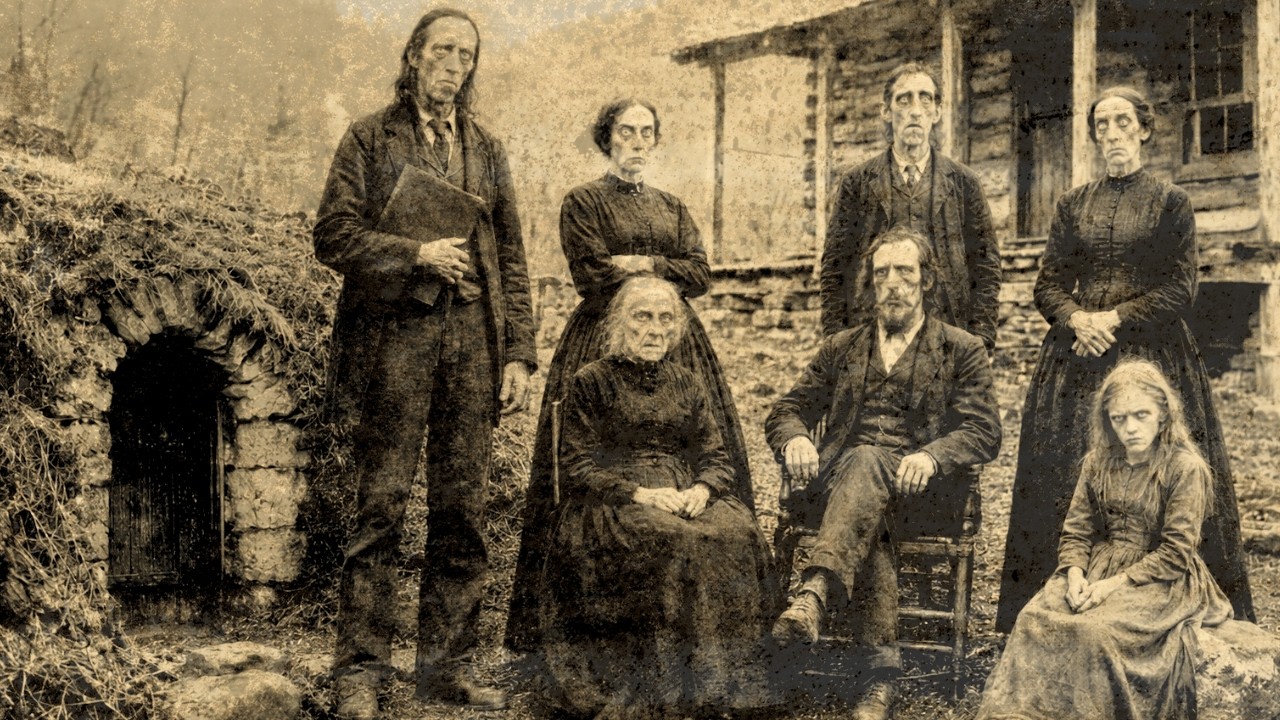
They said their whole reason for being up that fork was to keep it shut. It helps at this point to put faces on the family, because for all their strangeness, the Whitmore were people, and the valley did preserve a handful of names. The man most often described as the head of the household in the later years was called Orville, a tall, grave figure with the long Whitmore face who did what little trading the family required and who spoke, on the rare occasions he spoke at all, in a slow and formal English that struck listeners as belonging to no particular decade. Beside him in most accounts stands a woman named Delfia, taken for his wife, though no record of any marriage exists, who kept the cabin and the garden and who was said to sing to herself in the evenings in a tune that carried down the fork on still nights and that nobody below could ever name.
And there was always at least one child, described the same way in every telling, calm and pale-eyed and unnervingly composed, of whom the best remembered was a girl called Nessa. What the valley noticed about the household, when it noticed anything, was how little any of it changed. Orville was old in the earliest stories and old in the latest. Delfia’s singing carried down the fork across a span of years that no single woman’s voice should have covered.
And Nessa, the pale child on the trail, turns up in accounts separated by enough time that she ought to have grown and married and aged and died. And yet she is always a child, always ten or so, always polite, always turning back up into the laurel with a stranger’s primers under her arm. A rational mind reaches for the obvious answer, that these were different people sharing old family names down the generations, and that is surely part of it. But the valley, which watched that fork for a hundred years, never quite believed the obvious answer, because the valley had also noticed the other thing.
No new Whitmore ever came down to be baptized. No old Whitmore ever came down to be buried. The household simply persisted, the same few faces, the same slow speech, the same evening song, decade after decade, like a photograph that refused to fade while every photograph around it yellowed and curled. You did not have to believe in anything unnatural to find that unsettling.
You only had to keep count. The valley kept careful count of everything up that fork, because counting was the one defense it had. To the handful of valley folk who ever traded with them, the Whitmore were not wild men, and they were not simpletons. That was the unsettling part.
They were clean, they were literate, and they were unfailingly polite in a flat, careful way that made your skin crawl worse than rudeness ever could. The men were tall, taller than mountain men had any business being on the diet they lived on, with long faces and pale eyes that a Henden store clerk once described as looking at you like they were reading the date off a headstone. The women kept their hair long and pinned and wore dresses cut in a fashion nobody could place, not old and not new, just wrong for the year. They paid for what little they bought in old coin, worn thin, some of it foreign, none of it the kind of money that had any business circulating in a Tennessee hollow.
And they never bought much. A hollow full of people, generation after generation, that needed almost nothing from the outside world. Think about what it takes to feed and clothe a family for four generations without a road, without a store, without a doctor, without ever burying anyone in the church graveyard down below where the whole county could count the stones. That last piece haunted the valley the most.
In eighty years, no Whitmore was ever buried in consecrated ground. No Whitmore was ever married in the county church. No Whitmore was ever baptized. No Whitmore ever appeared on a jury list.
No Whitmore ever registered a birth or a death with the clerk in town. Officially on paper, in the eyes of the state of Tennessee, the family barely existed at all, a single word in a census margin and nothing else. It was as if they had agreed a long time ago to leave no record and had kept that agreement across a hundred years of people being born and people dying up that dark fork. Where were the graves?
That question got asked in the valley for decades, quiet at the edges of conversations. And nobody who went up Bleakwater Fork to find the answer ever came back down with it. Everyone who ever climbed up past the Whitmore cabin and lived to describe it came back saying the same impossible thing. The structures at the head of that hollow were not the work of eighteenth-century settlers, and they were not the work of the Cherokee who lived in those mountains before the settlers came.
The Cherokee built with wood and rivercane and earth. Nobody in the recorded history of those mountains cut and set stone the way the head of Bleakwater Fork was cut and set. We are talking about ashlar masonry, blocks squared to a tolerance you would expect from a machine, dry-fitted with no mortar, some of them weighing more than a wagon and team could ever have hauled up a grade that steep. Courses that stepped up the mountainside so evenly they read less like a farm wall and more like the foundation of something that had been meant to be enormous.
And the arch, always the arch buried to its keystone at the head of the hollow, dressed and true and pointing down into the dark. If any of this sounds familiar, it should, because you find this exact same anomaly all over the world and all over the historical record, and the official story never quite covers it. Cyclopean stonework with no clear builder. Structures that are supposedly primitive but are engineered with a precision our own machines struggle to match.
Foundations of a scale that implies giants, and buildings half sunk into the ground as though a great tide of mud and earth once rose up and swallowed a whole world of them in a single event. The Whitmore did not build the head of Bleakwater Fork. According to their own words, they were the people who came after. And their whole strange existence, their long faces, their old coin, their hundred years of silence, was organized around one task handed down to them like a curse.
Keep the door shut. Keep it buried. Do not let the valley learn what is under the mountain. The one time the outside world nearly got a real look at the Whitmore up close came in the spring of 1914, when the county sent a young school teacher named Verly Saar up the lower stretch of the fork to try to enroll the Whitmore children in the new common school.
It was a doomed errand and the county knew it, but the law had changed and the paperwork had to be filed. So Miss Saar climbed as far as the mouth of the hollow with a satchel of primers and a head full of good intentions. She got about as far as anyone ever did. On the trail she met three of the children, and what she wrote in her account afterward is one of the only firsthand descriptions we have of a Whitmore child.
She said the children were beautiful, and that this was the worst of it. Clean, well-spoken, calm, with those same pale eyes as the grown men. She said the oldest, a girl she guessed at maybe ten, corrected her on a point of history without any pride in it, the way you would correct a child who had gotten a small fact wrong. When Miss Saar named the year and named the president and named the war that had just ended in Europe, the girl listened politely and then told her gently that those were very recent things, and that the school in the valley was teaching the children only the last little scrap of what had happened, and that the real history, the long history, the history of what the mountains were before the water came, was written down safe at home, where the valley could not get at it and change it.
Then the girl thanked her for climbing all that way, took the primers so as not to be rude, and walked back up into the laurel. Miss Saar did not follow. She went home, resigned her post inside the month, and left the county for good before the year was out. In her letter of resignation, she wrote a single sentence about the experience.
Those children are not being raised. Those children are being kept. That phrase points straight at the second great mystery of Bleakwater Fork, which is the book. Almost everyone who ever spent more than a few minutes inside the lower Whitmore cabin mentioned it, and they all described it the same way.
A ledger. A great, heavy book bound in dark leather gone soft with handling, kept on a stand near the hearth, the way a family Bible would be kept, except it was far too big to be any Bible printed in this country. The pages, the few people who glimpsed them said, were covered in a small, dense hand, column after column, and the writing was not all in English. Some of it looked like English.
Some of it looked older than English, and the entries went back and back and back, far past any date that a family in Tennessee could honestly claim to have been keeping records. The Whitmore called it the accounting. Not the family Bible, not the genealogy. The accounting.
The closest anyone ever came to understanding what it accounted for came from a peddler named Amos Lyall, who traded up the fork twice a year in the 1890s and who was for a while the only outsider the family seemed to tolerate. Lyall told people in the valley that the book was a record of the door. Every time the mountain was opened, and every time it was shut, and everything that came up out of it or was put back down into it was written in that ledger in its own hand and its own date. He said the oldest Whitmore, a woman they called Granny, even though no one could guess her age within fifty years, would sometimes read to him from the early pages, and that the early pages spoke of a time when the stonework at the head of the hollow was not buried at all, when it stood in the open, whole and enormous, part of something that ran for miles under what were now these mountains.
And then the ledger said the water came and the mud came, and the world that had built those stones was pressed down into the ground and drowned, and only a few were left on the high places to remember where the doors were, and to make sure they stayed closed. The Whitmore, if you believe the book, were not a family at all in the way we mean it. They were a watch, a shift that had never ended. People vanished up Bleakwater Fork with a regularity that the valley learned to plan its life around.
It was never a slaughter. There was never a body in the creek, never a scream carried down on the wind, never anything so crude as violence that a sheriff could point to. People simply went up the fork with a reason and did not come down. And after a while, the valley stopped sending people up the fork with reasons.
The pattern, when you lay the old accounts side by side, is chillingly consistent. It was almost always an official someone sent by an authority that did not understand what it was sending a man into. In 1861, a Confederate press gang went up to conscript the Whitmore men and came back three short, and the officer who led them resigned his commission and would not speak of it. In 1878, a revenue agent went up convinced there was a still hidden in the hollow, since a family that bought so little had to be making its own money somehow.
The revenue service quietly closed his case as an abandonment of post six weeks later. Amos Lyall, the peddler, the one man the family had trusted, made his last trip up the fork in the winter of 1899 and was never seen on either side of the mountain again. His mule came down alone, and the pack on its back had been carefully unloaded and set on the ground at the mouth of the hollow, as if someone had wanted to be sure the animal was not blamed. Census men, surveyors, a mine company scout, a pair of hunters who bragged in a Henden tavern that they were going up to see the famous door for themselves.
All of them up the fork, none of them down. And every single time, if anyone in the valley worked up the nerve to go and ask, the Whitmore were polite and sorrowful and completely unbothered, and they said the same thing. He should not have gone down. We told him not to go down.
The mountain does not give them back. The case that ate at the valley most before the survey crew was the revenue man of 1878, because his was the disappearance that a distant authority actually tried, however briefly, to investigate. He was, by the one letter of his that survives, a confident and educated agent who regarded the warnings he collected in Henden as the predictable superstition of backward mountain people, and who wrote to his superior that he expected to be back inside the week with either a seized still or a good story to tell over dinner. He was not back inside the week.
The day stretched on, and he was not back at all. Some weeks later, the revenue office received a short and courteous letter, unsigned, written in a careful hand, informing the office that its agent had chosen to go down where he had been plainly told not to go, that the family bore him no ill will, and had warned him fairly, and that the office would do well to mark the drainage as closed and send no further men into it. The office predictably did not take orders from an anonymous mountain letter, and it sent a second man to find the first. The second man came back, though the file does not preserve what he reported, because the case was closed within the month under the heading of abandonment of post, and the missing agent’s name was struck from the active rolls, as though he had simply walked off the job and dissolved into the general population.
Which, in the most literal and terrible sense, is precisely what the valley believed had happened. A polite unsigned letter had told a federal office to stop asking, and the federal office, faced with a thing it could not explain and did not want to, had done the same thing every authority before and after it eventually did. It looked away. It closed the file, and it let the fork keep its silence and its dead.
The valley made exactly one organized attempt to save the souls of Bleakwater Fork. In the summer of 1906, a circuit preacher named Reverend Hume, a hard-shell Baptist with more courage than sense, announced from his pulpit in Henden that he would carry the gospel up to the Whitmore, whether they wanted it or not, and that he would come back down with either their conversion or their confession. He was warned off by every old head in three coves. He went anyway, on a bright Sunday, in his good black coat, with a Bible under his arm and a pair of deacons trailing a nervous fifty yards behind.
The deacons turned back at the mouth of the hollow. Reverend Hume did not. He came back down four days later, and he came back changed. He was not raving.
There was no white in his hair, none of what the surveyor would show twenty-five years on. He was calm, calmer than they had ever seen him, and he stood up in front of his congregation the following Sunday and told them in a level voice that he had been wrong about the Whitmore. He said they were not godless. They were, he told the room, the most faithful people he had ever met in his life, more faithful than any Christian sitting in front of him.
And they had been keeping a vigil since before the church he preached in had a name, since before the country he lived in had a name. He had seen the ledger, and he had seen the arch, and he would not describe either one, not for any amount of asking, because some knowledge was a weight, and he would not lay that weight on another living soul. Then he resigned his circuit and moved to the flatlands and never preached again. The only thing he ever added, years later to a nephew who pressed him on his deathbed, was this.
It is not a grave they are guarding. A grave you would want to keep the dead in. This one, he said, they are keeping the dead from getting out. There was one event, and only one, when the mountain seemed to act on its own.
A storm sat over the Smokies for the better part of a week that autumn of 1906, a cold, gray rain that would not quit, and on the sixth night, Bleakwater Fork flooded in a way the valley had never recorded before or since. The old-timers were exact about this. The black creek did not just rise. The ground itself let go.
A whole shoulder of the mountain above the Whitmore land slid, thousands of tons of saturated earth and rock and laurel, and it came down not in a chaotic slurry but in a slow, heaving wave of mud that people two miles down heard as a single long groan out of the dark. When the rain finally broke, and a few brave men crept up to see what was left, they found the lower Whitmore cabin gone, simply gone, and the whole floor of the hollow rearranged. And they found something else, something talked about in whispers for the rest of those men’s lives. The slide had not buried the head of the hollow.
The slide had partly uncovered it. Where there had been a single arch showing its keystone above the dirt, there was now a stretch of exposed wall thirty feet high, running back into the reopened slope, dressed stone on a scale that made the men who saw it sit down in the mud because their legs would not hold them. Set in that wall, no longer half sunk but standing full and clear for the first time in living memory, was the door. Not a metaphor, not an arch.
A door of dark, fitted stone, taller than three men, with the worn stair going down behind it into a black that the daylight would not enter. The men did not go down. Every instinct a human body has told them not to go down. They went home, and by the next spring the Whitmore had rebuilt lower on the fork, and the mud had been packed back up over the wall by hands that clearly knew how to do it, and the door was buried to its keystone again, exactly as it had always been, as though the mountain and the family were working together to put the lid back on something that had briefly, terribly come loose.
Which brings us, at last, back to 1931, and to the four men whose fate opened this story. By that year, the world had come a long way up to the edge of Bleakwater Fork without ever quite reaching in. The great national park was being assembled ridge by ridge, cove by cove, the government buying out or condemning the old mountain holdings and moving families down into the valley whether they wished to go or not. Surveyors were the tip of that spear, and a survey crew was exactly the kind of official party that the fork had been swallowing for the better part of a century.
The difference this time was that 1931 was not 1831. This crew carried government authority, government schedules, and a government expectation that men who went up a mountain would come back down and file their plat. When they did not, the machinery of a modern state, for the first and only time, turned its full attention on the Whitmore. The crew chief was a man named Silas Rock, and it was his younger brother who survived, a rodman barely twenty years old, whose name the newspapers of the day withheld, and whose testimony survives only in the sheriff’s own longhand notes.
The crew had orders to run a line straight up the fork to the state ridge, which meant walking straight through the Whitmore land and straight up to the head of the hollow. They had been warned in Henden. Of course they had been warned, and of course they had laughed it off the way educated men in 1931 laughed off mountain superstition. They went up on a Tuesday.
The Whitmore, the young rodman said, did not turn them away. That was the thing he could never get past afterward, the thing that broke something in him. The family welcomed the crew, fed them, talked with them, calm and courteous, all through the first day, as though they had been expecting this exact party for a hundred years and had simply been waiting for it to arrive. On the second day, the Whitmore took the crew up to the head of the hollow, and the door was open.
The young rodman was clear on this point every time he was asked, and he was asked many times over the years by many people who did not believe him. The family had opened it. The mud that had kept the arch for a generation had been dug back, and the great stone door stood ajar, and the stair went down. His brother Silas, being a surveyor to the bone, saw only a remarkable engineering problem and an opening that needed to be measured and mapped, and he ordered the crew down the stair with their chains and their lantern to see how deep the thing ran.
The rodman hung back. He said later he could not tell you why. The cold that came up out of the opening was not the honest, damp cold of a cave. It moved against your face like breath, and under the smell of wet stone, there was another smell that his body understood as danger before his mind could name it.
He watched his brother and the two other men go down into the mountain with the lantern. He watched the light go down and around a turn and grow faint. And then he watched the Whitmore, who had been standing quietly to either side of the door, step forward together without hurry and begin to close it. He screamed.
He said he screamed his brother’s name until his voice tore, and that the lantern light down in the dark never came back up, never wavered, never so much as flickered toward the shrinking gap of daylight, as if the men carrying it were already too far down to hear, or already something that no longer answered to their names. The old woman, Granny Whitmore, took him by the arm. She was not unkind, he said, and that was the horror of it. She told him the mountain had them now, that it had wanted them, that a line run straight to the door was an invitation, and his brother had accepted it on behalf of all four of them without knowing what he was accepting.
Then she told him to go down to the valley and be the record. Every so often, she said, the door needs to be shown that it is remembered, and you have been chosen to remember it. Now run. The sheriff of the county in 1931 was a heavy-set, unimaginative man named Aldus Pruit, and to his credit, he did not laugh.
He had grown up in that valley. The stories had come to him at his own grandmother’s knee. And when a white-haired boy came out of the mountains talking about a door and three vanished government men, Pruit did the thing that no lawman before him had ever quite been forced to do. He organized a party and went up Bleakwater Fork himself, with a warrant, with the law of the state of Tennessee at his back, to bring the Whitmore down and answer for a federal crew gone missing on their land.
It took him eleven days to put the party together, and every one of those days worked against him, because word of what was coming had all the time in the world to travel up the fork ahead of him. When Pruit and his deputies and two nervous men from the survey office finally climbed the hollow, they found the lower cabin cold. Not abandoned in a hurry, abandoned in order. The hearth swept, the few furnishings squared away, the corn crib emptied, the door latched.
Everything left the way a careful family leaves the house they do not intend to defend and do not intend to return to. There was no ledger. The great book was gone. There was no sign of struggle, no sign of the missing men, no sign of the Whitmore themselves, who numbered by the deputies’ own reckoning at least nine souls of varying ages, and who had, between one week and the next, walked off a mountain that had no road, carrying a book that two men could barely lift, and left not one track for a party of experienced woodsmen to follow.
Deputy Odel Tanner, who wrote the fullest account of the search, put it plainly in his report. It was, he wrote, as if the hollow had been closed up from the inside. Pruit was not a man to be beaten by an empty cabin, and so he pushed the party on up to the head of the hollow, to the place the surviving boy had described. And this is where the official record and the valley’s memory begin to split.
The government report, the one that eventually landed in a filing cabinet in Knoxville, says the search party found a rockfall at the head of Bleakwater Fork, a natural collapse of the slope, and no evidence of any structure, any door, or any stair. Case closed. Three men presumed lost to a fall or to exposure in rough country. The Whitmore never found, never charged, presumed to have fled the coming of the park like so many other mountain families.
Deputy Tanner’s private account, which did not go in any cabinet and which surfaced only decades later among his papers, tells a different story. Tanner wrote that they did find the wall, the great dressed stone wall thirty feet high, exactly as the flood of 1906 had briefly revealed it. He wrote that they found the door, and that the door was shut, and that it was shut in a way no rockfall shuts anything, its edges sealed with fresh mortar that was still faintly warm to the touch. He wrote that Pruit, a lawman with a warrant and a mission, stood in front of that door for a long time and then gave an order that Tanner never forgot and never forgave.
Pruit ordered them to leave it. Not to dig, not to break the seal, not to spend one more hour trying to open a thing that a family had spent a hundred years and God knew how many lives keeping closed. On the walk down, Tanner wrote, the sheriff said only one thing about it, and it was not the voice of a man who had failed to find a door. It was the voice of a man who had found one and understood finally why every sensible person in that valley had begged him not to go.
He should not have made me come up here, Pruit said. Now I have to know about it, too. There is one more detail from Tanner’s private account of that day at the head of the hollow. When the party first reached the great stone wall, two of the younger deputies laughed out of pure nerves, and one of them put his hand flat against the sealed door, the way you would test the side of a stove.
He took it away fast. The mortar sealing the edges of that door, Tanner wrote, was warm, and not warm the way stone goes warm in the sun, because the head of that hollow never saw the sun. It was warm the way a thing is warm when work has just been done on it, when a hand has only just left it. The wall around the door was cold to the touch in the very same moment, cold as any shaded rock in November, so that the warmth lived only in the fresh seal itself, in exactly the place where a family that had fled a full week ahead of the posse could not possibly have left it.
Tanner recorded the sound, too, though he buried it in the middle of a paragraph, as if he could not quite bear to look straight at it on the page. While the party stood at the wall, arguing in low voices about what to do, one of the deputies hushed the others, and in the quiet that followed, they all heard it, low and slow, and coming up through the soles of their boots more than through the air. Stone on stone. A patient grinding, a fitting, and a settling from behind the sealed door and below it, as though the ceiling they were staring at from the outside was being answered and reinforced from the inside by hands they could not see and did not want to.
Not one man in that party spoke of it on the walk down. Not one of them put it in the official report. But Tanner set it down years later in his own hand. And beneath it he added a single line that reads less like a lawman’s note and more like a confession made to no one.
We told ourselves it was water working in the rock. He wrote it was not water in the rock. Water does not fit a cut stone back into a wall. Every man on that mountain knew it, and every man on that mountain agreed, without a single word passing between them, to spend the rest of his life pretending he had not heard what he heard.
What happened next is the part that turns a mountain ghost story into something with the fingerprints of institutions on it. The Whitmore were gone, and the door was sealed, and by any ordinary telling, that should have been the end of Bleakwater Fork. Instead, the fork got erased. Not settled, not developed.
Erased. When the boundaries of the new national park were finalized, Bleakwater Fork was drawn inside them and then quietly closed. No trail was ever cut up the hollow. No trail was ever allowed to be cut.
On the earliest park maps, the fork appears by name. On the maps printed a decade later, the name is simply gone, the drainage left blank and unlabeled, a white space in the middle of the most heavily mapped mountains in the eastern United States. The survey plats that Silas Rock’s crew died trying to complete were never filed, and according to the one archivist who ever went looking, were never found. The sheriff’s longhand notes, the ones that preserve the surviving boy’s testimony, exist today only because Odel Tanner kept a private copy against orders.
The federal file on three missing survey employees runs to a single thin folder that says almost nothing and explains less. Somebody at some level of some agency looked at what had happened up Bleakwater Fork and made a decision that the correct response was not investigation and was not excavation. The correct response was to make the place disappear from the record as thoroughly as the Whitmore themselves had disappeared from the mountain. Places like that do not stay quiet forever, because people are curious and the park is enormous, and eventually somebody with a good compass and no respect for a blank spot on a map walks into the drainage that used to have a name.
They have been walking into it on and off for years now. The backcountry rangers know the fork the way you know a bad tooth, as a place you do not send people and do not go yourself without a reason. Hikers who have stumbled into it by accident come out with the same small collection of complaints, and the complaints are always the same, which is what makes them worth listening to. They say the compass wanders in the upper hollow, swinging a few degrees off true and then drifting back, the way a compass will do over a large mass of buried iron or stone.
They say there is a cold spot near the head of the drainage, a pocket of air that stays wrong even in July, and that the laurel around it grows in a strange, dead ring. And a few of them, the unlucky ones who camped a night in there before they understood what they had walked into, say they heard something in the dark that they will not call an animal and cannot call anything else. A sound like stone moving against stone, slow and deliberate, and deep underground, coming up through the soles of their boots more than through the air. Coming always from the head of the hollow.
A few years back, a seasonal ranger, a young man doing trail maintenance well off the beaten paths of the park, got turned around in bad weather and spent an unplanned night in a drainage he could not identify on his map. He did not know the name Bleakwater Fork. He had never heard the story. What he knew was that his compass would not settle, that the laurel grew in a dead gray ring around a cold pocket of air at the head of the hollow, and that near what he took at first for a natural rockfall, he found a face of cut stone that had no business being there, dressed and squared and running back into the slope farther than his headlamp would reach.
He photographed it. He is certain he photographed it. And when he got back to a station two days later, shaken and ready to report the strangest find of his career, the images were simply not on the card. Not corrupted, not there, as though the card had never held them.
What he did keep was the memory of the sound, and he described it to a supervisor who had been in that park thirty years, and who went very quiet and told him, off the record, to write it up as a rockfall and never file the drainage by any name. The sound came in the last hour before dawn, the ranger said, when the cold pocket was at its worst and the compass had stopped even trying. It was stone on stone, deep and slow from behind that buried face. And it was not the sound of stone falling.
Anyone can tell you what falling stone sounds like. This, he said, was the sound of stone being worked, fitted, set back into place patiently from the inside by hands that knew exactly what they were doing and had all the time in the world to do it. Someone, he said, is still down there, and someone is still keeping the door shut. Near the end of the last century, there was one serious attempt to put the whole thing back together with a scholar’s tools rather than a mountaineer’s memory.
A regional archivist working out of the state records office, a careful and skeptical woman by every account, came across Odel Tanner’s private papers in a donated box and recognized that she was holding something the official file did not want found. She spent the better part of two years on Bleakwater Fork. She pulled the census margins, the resignation letter, the revenue service closure, the thin federal folder on the missing crew, the preacher’s deathbed lines as recorded by his nephew, and she laid them all out side by side, the way no single clerk in any one decade ever had the chance to. What she found was not proof of a door.
She was honest about that to the end. What she found was a pattern too clean and too long to be the product of a hundred unrelated coincidences, and an institutional silence around that pattern that was itself a kind of evidence. She never published. Her notes described two visits to the park office to request access to the closed drainage and two refusals, the second one firm enough that she stopped asking.
The last entry in her working file is not a conclusion. It is a question. If the Whitmore were only a strange, sad family that finally fled the coming of the park, she wrote, then explain the seal on the door that a sheriff found warm to the touch. Explain the fork wiped from the maps.
Explain the file that says nothing. And explain why every single time in a hundred years that an authority sent a man up that hollow to prove there was nothing there, the mountain agreed to keep him. Her notes hold a short and careful list of other drainages scattered through the southern mountains that share the fork’s peculiar signature, and the signature is always the same three things braided tight together. A family that kept to itself past all reason and left no graves.
Stonework at the head of the hollow that the official history cannot hand to any known builder. And a quiet, steady toll of officials and surveyors and curious outsiders who went up and did not come down, filed away one at a time, never once gathered into a single list until somebody sat down and did the gathering on purpose. She named a hollow in the North Carolina high country where a family with an old, unpronounceable name held a cove for a century and vanished the same decade the park arrived, leaving a cabin swept and squared in the exact same manner. She named a fork in the Virginia mountains with its own buried wall and its own local rule, handed down mother to daughter, that you did not climb past the second bend after dark.
And she named a place up in the Kentucky knobs that does not appear on any modern map at all, though it plainly appears on the older ones, its name simply gone the way Bleakwater Fork’s name went, a white blank in the middle of country that has otherwise been surveyed down to the last spring and stone. None of these, taken alone, proves a thing. A family can be reclusive. A wall can be a trick of geology.
A name can slip off a map through nothing worse than carelessness. But the archivist’s point is that you are not looking at one case. You are looking at a pattern spread across three states in two hundred years. And a pattern that consistent is not built out of coincidences.
It is built out of a system. There are two loose threads worth pulling before the end, because they are the kind of small, stubborn detail that separates a tall tale from a thing that actually happened, and both of them come back to the coin. Remember that the Whitmore paid for their rare purchases in old money, worn thin, some of it foreign, none of it the currency of any Tennessee decade the valley could name. A Henden store clerk who handled some of it in the early 1900s kept a few of the strangest pieces out of curiosity, and the ones that were later described by people who saw them did not match any catalog of known coinage.
Worn smooth on both faces, heavy for their size, stamped with a device that no numismatist consulted could place. The obvious answer, the one the valley never said out loud, is that they were bringing it up out of the ground, that whatever lay behind the door was not only a threat to be sealed but a horde to be drawn on sparingly across the centuries by watchers who needed a little hard money now and then to keep the surface world at arm’s length. The second thread is the language. Reverend Hume would not describe the ledger’s early pages, but he did let one word slip to his nephew, a word he said appeared over and over in the oldest entries, and the nephew wrote it down phonetically because it meant nothing to him.
Scholars who have squinted at it since have gone in circles, but the likeliest readings all point in the same uncomfortable direction, toward an old root that means keeper, or warden, or the one who stands at the threshold. Not a family name. A title. The Whitmore, whoever they had been before they took up the watch, had stopped being a family in the ordinary sense a very long time ago and become an office, a post handed down, a word that meant the person currently responsible for making sure the door at the head of the hollow stayed shut.
You do not bury the dead of an office. You simply hand it on, which may be the plainest answer of all to the question of where the graves went. And the stair. We have circled the stair this whole time without looking straight down it, the way the surviving rodman circled it, the way sensible people have circled it for two hundred years.
Every account agrees the steps went down, down into the mountain, down past the reach of a lantern, down where a cold that moves like breath comes up to meet you and a smell your body reads as danger waits below the smell of wet stone. If we believe the fragments we have, the ledger does not treat the door as the entrance to a mere tomb or a mere horde. It treats it as a lid. A lid on a place that is not empty, that has never been empty, that pressed back against the seal often enough over the centuries that a whole line of watchers judged it worth their lives to keep sealed.
That is the true horror at the bottom of Bleakwater Fork. And it is a quieter and older horror than any monster. It is the possibility that the drowned world did not simply die when the water rose, that some part of it went down into the dark not as ruin but as prisoner, sealed under the new mountains along with its doors and its stairs, and that the survivors who scattered to the high places did not only keep the memory alive. They kept the guard posted.
Every single person the Whitmore turned back, they turned back gently. The school teacher was thanked and sent home. The preacher was shown the truth and released to carry the weight of it however he could. The surviving rodman was taken by the arm by an old woman who was not unkind and told to run home and live.
Even the officials who vanished were not by any account tormented. The family’s constant refrain across a hundred years was not a threat. It was a warning repeated with something close to grief. He should not have gone down.
We told him not to go down. The mountain does not give them back. These were not people who wanted to hurt the valley. These were people trying, across an impossible span of time and against the endless curiosity of everyone below them, to keep the valley from hurting itself on a door it did not understand.
The valley people were never fools about any of this, whatever the survey office in Knoxville decided to write in its thin folder. They did not go on believing in the door because they were backward. They went on believing in it because they had counted the men who walked up the fork and counted the men who walked back down, and the two numbers had never once matched in living memory. Belief is easy to dismiss from a city desk.
It is a great deal harder to dismiss when it is your own uncle whose mule came home alone, when it is the school teacher your county hired who fled the state inside a month, when it is the preacher you grew up under who came off that mountain and never preached again. The valley did not fear Bleakwater Fork out of ignorance. The valley feared it out of arithmetic, the plainest and most honest fear there is. Up the fork with a reason.
Never back down. You do not need a ledger to keep that sum. You only need to be paying attention and to be brave enough to admit what the numbers are telling you. The Whitmore walked off their mountain almost a hundred years ago, carrying a book that names every one of the things that duty requires.
They did not retire. They relocated, which means the watch is being kept somewhere right now, tonight, in a quiet fork you have never heard of, by a family the valley below has learned to leave alone. They gave up ordinary life. They gave up graves and marriages and baptisms and the simple mercy of growing old and dying on time.
And they gave up being known, letting the valley call them monsters because the alternative was to let the valley find out what monster actually meant. If there is a tragedy in Bleakwater Fork bigger than three lost surveyors, it is the Whitmore themselves, a family sentenced to guard the rest of us from a truth so heavy that carrying it cost them the right to be human at all. The blank spaces on the map are not always empty. Sometimes they are blank because someone needed them to be, and paid for the blankness with everything they had.
The door at the head of Bleakwater Fork is shut. Somewhere tonight, a keeper is making sure it stays that way. And the map is still full of forks that lost their names.






