In the autumn of 1893, seventeen men ventured into the dense forests of northwestern Montana on a trapping expedition that would make them part of one of the most disturbing unsolved mysteries in American frontier history. The fur trade had largely declined since its peak in the 1830s, but isolated groups still sought fortune in the valuable pelts of beaver and marten. Most of these men were not experienced wilderness veterans. They were newcomers drawn by a newspaper advertisement promising substantial profits, city men from Chicago, Boston, and St.
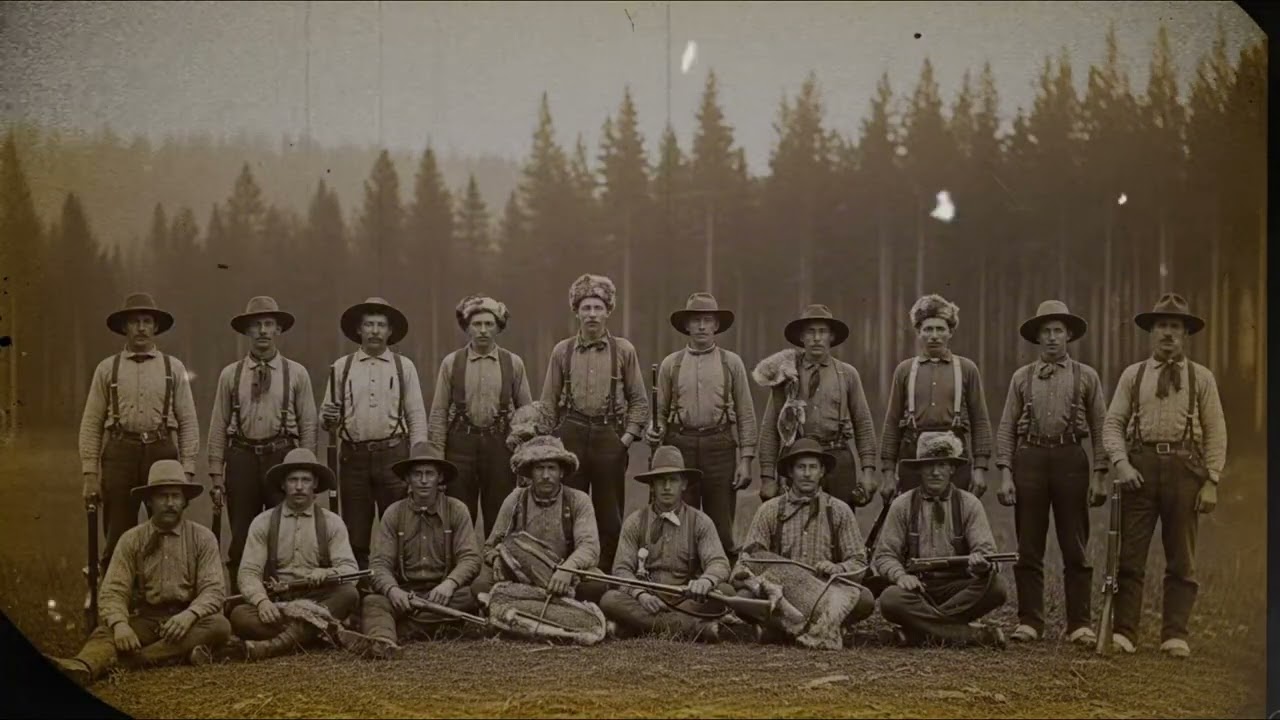
Louis, who had romantic notions of frontier life but little understanding of its harsh realities. The advertisement, published in the Helena Weekly Herald on July 29, 1893, called for enterprising men of sound constitution for a winter trapping expedition. More than thirty applied, but only fourteen were selected to join the three expedition leaders. The selection favored younger men with military experience or physical trades: blacksmiths, carpenters, and former ranch hands.
Only three among them had genuine wilderness experience: Zachary Voss, a weathered trapper in his fifties who had worked the Rocky Mountains since the 1860s; Hammond Rutledge, a former guide for wealthy hunting parties; and Silas Merritt, a half-French, half-Ojibwe man who had trapped in the Northern Territories for twenty years. The expedition was financed by the Northwestern Trading Company, a business established by Voss with two silent partners in Helena. They invested nearly three thousand dollars in supplies and equipment. Each man was issued a Marlin repeating rifle, two Colt revolvers, three dozen steel traps, and winter clothing.
The company would claim sixty percent of all pelts collected, with the remainder divided among the trappers. They departed from the settlement of Pine Creek on September 18, 1893, carrying six months of supplies and enough ammunition to last through the winter. The group followed the Blackwater River deeper into the mountains than most trappers typically ventured. Merritt’s letters described the area as uncommonly rich in beaver, otter, and marten, but also noted an unusual silence that seemed to blanket the forest.
Even the birds seemed reluctant to sing there. The quiet weighed upon a man’s shoulders like a physical burden, he wrote. According to later testimony, several indigenous guides from Pine Creek had refused to accompany them beyond a certain point, claiming the upper valley was a place where spirits walk. At the time, such reluctance was dismissed as superstition or perhaps a strategic attempt to discourage competition in prime trapping territory.
By early October, they established their main camp in a clearing, situated on slightly elevated ground near the convergence of three promising streams. They constructed four large cabins from the surrounding timber, completing them by October 9. The first week of trapping exceeded all expectations. A skilled trapper in good territory might typically expect five or six beaver in a week of work.
During their first week in Blackwater Valley, they averaged nearly three per man per day, an extraordinary rate that should have immediately raised questions. The first signs of trouble appeared around October 21. Two trappers returned to camp visibly shaken after checking traps along the eastern fork of the river. They reported finding several traps sprung but empty, and stranger still, discovered markings carved into nearby trees.
The markings resembled a series of vertical lines intersected by a horizontal wave, like water flowing beneath many pillars. Voss dismissed their concerns, suggesting the traps had been raided by wolves or indigenous hunters passing through. The markings, he declared, were likely old trail signs. Three days later, one of the trappers failed to return to camp.
His partner claimed they had separated that morning to check different sections of their line. When the man did not return by nightfall, Voss organized a search party, but a sudden snowstorm forced them back without finding any trace. A second search yielded only his rifle, found leaning against a tree nearly two miles from where he was last seen. The weapon was fully loaded and uncocked, suggesting it had been carefully placed rather than dropped in haste or during a struggle.
There was no track, no blood, no torn clothing. It was as if, in Merritt’s words, the forest had simply swallowed him whole. Voss imposed new safety protocols following the disappearance. No man was to travel alone.
All trappers were to return to camp by sunset. Firearms were to be kept loaded at all times. Despite these precautions, the atmosphere deteriorated rapidly. An argument broke out between Voss and Rutledge regarding the wisdom of continuing the expedition.
Rutledge, unsettled by the disappearance, advocated for abandoning the valley before winter fully set in. Voss insisted that one missing man was an unfortunate but not uncommon occurrence in such remote territory, and certainly not justification for abandoning what was proving to be the most profitable trapping expedition of his career. On November 5, three more men vanished while checking traps near a ravine approximately four miles west of the main camp. They found the men’s overnight camp intact, fire still smoldering, bed rolls laid out but unused.
Their rifles and packs were discovered neatly arranged, as if they had methodically unpacked and then simply walked away. The search parties found only a single set of unusual tracks, described in Merritt’s letters as wider than any human foot, yet too small for a bear, with an unusual gait that suggested neither man nor any animal he had encountered in thirty years of wilderness life. The disappearances continued throughout November. One man was found dead beside a frozen stream, his body unmarked except for an expression of absolute terror frozen on his face.
His hair had turned completely white, though he had been a man of only thirty-five with dark brown hair the day before. The territorial medical examiner later listed his cause of death as failure of the heart brought on by extreme fright. Another man vanished from his bunk during the night, leaving behind only a few drops of blood on his blanket. The cabin had been locked from the inside with no windows disturbed and no footprints in the fresh snow surrounding the structure.
By November 20, only eleven of the original seventeen remained. The survivors had abandoned the outlying cabins and consolidated in the main lodge, establishing a constant watch rotation. Men reported seeing tall shapes moving among the distant trees. The journal entries became increasingly fragmented, with several pages torn away or rendered illegible by water damage.
The final journal entry dated November 23 read: The silence has become oppressive. Even our voices seem swallowed by it, as if the very air resists the vibration of sound. A gap in the documentary record follows, with no written accounts surviving from November 24 through December 7. All accounts agree, however, on the events of December 8.
The remaining trappers were awakened shortly after midnight by a sound like the wind passing through thousands of hollow reeds, though not a branch moved on the trees outside. The man on watch claimed to see something moving between the trees, though he could not or would not elaborate on what exactly he witnessed. Another survivor, in a rare lucid moment during his later confinement at the Montana Territorial Asylum, provided the most detailed account of that night. They were like men, but not men, tall and thin as saplings, with limbs that moved wrong, like they had too many joints.
There were more of them than he could count, and they made that terrible whistle that was not coming from any mouths he could see. Whatever occurred that night sent the group into a panic. They abandoned camp before dawn, leaving behind most of their supplies and all of their hard-earned furs. The group fragmented when a blizzard descended without warning, reducing visibility to mere feet and disorienting even the most experienced among them.
The exact events of the next eight days remain unclear. The seven survivors who eventually reached safety did so separately or in pairs, each following different routes out of the valley. Merritt’s letters offer the most disturbing narrative of the escape. He wrote of traveling for days without rest, convinced he was being pursued through the forest.
They never showed themselves clearly, always remaining just at the edge of vision. Tall shadows slipping between distant trees. Only continuous movement seemed to keep them at a distance. Seven men eventually staggered into Pine Creek on December 17, 1893, after traveling through nearly fifty miles of wilderness in the midst of early winter conditions.
They arrived suffering from frostbite, malnutrition, and what the local physician described as severe nervous exhaustion. The survivors gave conflicting accounts of what had transpired in the forest. The territorial authorities conducted a brief investigation, taking formal statements from each survivor. Voss maintained they had been beset by a particularly cunning group of thieves, possibly renegade trappers or indigenous people defending territorial grounds.
Others blamed wild animals, perhaps a pack of unusually aggressive wolves. Another suggested some kind of poisoning, perhaps from contaminated water or toxic plants that had caused hallucinations and disoriented behavior leading to fatal accidents. This explanation gained some traction with the territorial judge who noted in his summary that the isolation and harsh conditions of wilderness life combined with potential toxins unknown to medical science provide a rational basis for the unfortunate events described. One survivor refused to speak at all about the events.
He suffered a complete mental breakdown three months later, spending the remainder of his life in the Montana Territorial Asylum. In his more coherent moments, he would draw the same pattern repeatedly: vertical lines crossed by a horizontal wave, matching the description of the markings found on trees near the trappers’ camp. The official investigation concluded that the missing men had likely perished from exposure or animal attacks, common dangers in the unforgiving wilderness. The case was officially closed in February 1894 with death certificates issued for the ten missing men despite the absence of recovered remains.
The Northwestern Trading Company filed an insurance claim for lost equipment and personnel which was settled out of court for an undisclosed sum. What makes this incident particularly unsettling are the connections that emerged decades later. In 1931, during an archaeological survey of Native American sites in the region, a professor from the University of Montana discovered a series of pictographs in a cave approximately five miles from where the trappers’ camp had been located. The images, estimated to be at least three hundred years old, depicted tall, elongated figures surrounding smaller human forms.
His indigenous guide refused to translate the accompanying symbols, saying only that they referred to those who dwell between, entities that his people avoided by never staying in the Blackwater Valley for more than three days. When the professor’s report was published in academic journals, these specific findings were conspicuously absent. When he returned to the site the following spring to document the pictographs more thoroughly, he found the cave entrance collapsed under an apparently recent rock slide. No subsequent expedition has relocated the site.
Oral histories collected from tribal elders in the early twentieth century described the area as simultaneously sacred and forbidden, a place where the boundaries between worlds grew thin, especially during the dark of winter. The valley had once been the site of an ancient settlement abandoned after a series of inexplicable disappearances. Tribal taboos strictly prohibited remaining in the valley after sunset or for more than three consecutive days. In 1947, another trapping expedition ventured into the same region, unaware of its history.
Like their predecessors, they reported unusual success in their early weeks, followed by increasingly disturbing incidents. Three of their party disappeared while checking a trap line near the eastern fork of the river, precisely where the strange tree markings had been found in 1893. The remaining members abandoned the area in late November, leaving behind most of their equipment in their haste to depart. The Blackwater Valley was officially closed to commercial activity in 1965, ostensibly for environmental conservation.
Today, it forms part of a federal wilderness preserve with limited access granted only to scientific research teams with special permits. Internal forest service memoranda obtained through Freedom of Information Act requests in 1998 reveal additional concerns: anomalous magnetic field readings that disrupt compass navigation, unusually high rates of equipment failure, and multiple instances of research team members experiencing acute psychological distress while working in the area. Of the seven survivors, all died within fifteen years of the incident. Voss was found dead in his Helena home in 1896, apparently having taken his own life.
According to the coroner’s report, he had barricaded himself in his bedroom, nailing blankets over all his windows. A journal found among his possessions contained increasingly paranoid entries about being watched and figures that stand in the corners when the light dims. Rutledge became a recluse and disappeared during a solo hunting trip in 1901. Only his rifle was recovered, leaning carefully against a tree with all its ammunition removed.
Merritt died of tuberculosis in 1897. The nurse who attended him in his final days reported that his last words were, They’re still watching. They never stopped. The most recent development in this ongoing mystery occurred in 2018 when a hiker discovered an old steel trap half buried in sediment along a stream bank near the restricted area.
During cleaning, conservators found something etched into the metal. An inscription read simply: Still here. Below it was a pattern of vertical lines crossed by a horizontal wave. What truly happened to the ten trappers who never emerged from the forest in 1893 remains one of Montana’s most disturbing unsolved mysteries.
The official records attribute their fate to the natural dangers of wilderness survival in harsh winter conditions. The pattern of disappearances that continues despite restrictive measures suggests that whatever dwells in the valley is neither contained by arbitrary boundaries nor deterred by human awareness of its presence.






