On a January night in 2024, fire consumed what remained of a brick industrial complex in Elizabethport, New Jersey. As the walls collapsed, more than a building fell. The ruins marked the end of a dynasty that had once sewn its way into nearly every home in America and much of the world. For over a century, the Singer Manufacturing Company had been the undisputed titan of the sewing machine industry, holding ninety percent of the American market at its peak, pioneering consumer credit, and building factories that were wonders of their age.
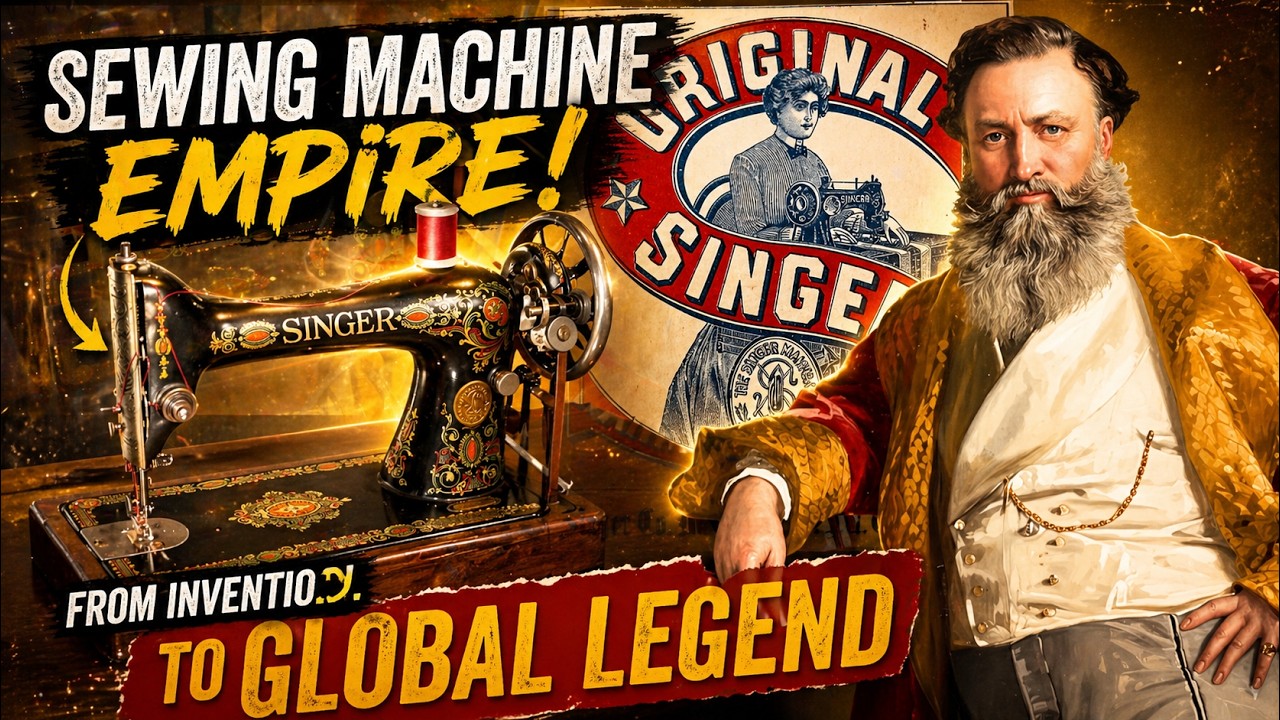
How did such an empire vanish into ash and a ghost brand printed on boxes shipped from Shenzhen? The story begins with a man running from his own failures. Isaac Merritt Singer was born in 1811 in Pittstown, New York, into grinding poverty. His parents divorced when he was ten, his mother disappeared from his life, and two years later he ran away from his stepmother.
His great ambition was not machinery but the stage. For nearly twenty years he pursued a career as a Shakespearean actor, founding his own touring troupe, the Merit Players, until the dream collapsed into debt and disappointment. By 1839, he tried inventing, designing a rock drilling machine that found no buyers. His personal life was a chaos of abandonment: he married Catherine Haley when he was nineteen and she was fifteen, then left her and their children, carried on relationships with multiple women across several cities, and fathered at least twenty-four children with five mothers.
In 1850, Singer was thirty-eight, broke, and working as a machine repairman in a Boston workshop. A customer brought in a broken sewing machine. Singer studied the clunky mechanism and saw not a repair job but a revolution. He barricaded himself in the workshop for eleven days, barely eating or sleeping, and emerged with a radically improved design: a straight vertical needle paired with a horizontal worktable and a foot pedal that freed both hands to guide the fabric.
His machine could produce nine hundred stitches a minute, against roughly forty by hand. On August 12, 1851, he secured patent number 8,294. But victory was decided in the courtroom. Elias Howe, who had patented an earlier design, sued Singer for infringement.
In 1854 the court sided with Howe, ordering Singer to pay fifteen thousand dollars plus a twenty-five-dollar royalty on every machine sold. The fledgling company might have died, except that in 1856 the major manufacturers, including Singer and Howe, reached the Albany Agreement, creating America’s first patent pool. They agreed to share their technologies and split royalties, turning legal war into a cartel that forced smaller manufacturers to pay license fees. Singer’s royalty dropped to five dollars per machine, and the industry moved forward.
The mechanical vision belonged to Isaac Singer, but the empire was built by a lawyer named Edward Clark, who joined the company in 1854. Singer’s machines cost over one hundred dollars, an impossible sum for most families. Clark’s solution was the installment plan: five dollars down and a few dollars a month. It was the world’s first major consumer credit scheme, and it worked.
Families took machines home immediately, used them to increase their productivity, and paid for the machines with the earnings those machines generated. Clark then added a trade-in program, but with a ruthless twist: old machines were not resold, they were systematically destroyed, eliminating the secondhand market and forcing customers back into the Singer ecosystem for new products. He also marketed directly to women, placing advertisements in women’s magazines, hiring female demonstrators, and opening elegant showrooms. By 1860, Singer was the world leader in sewing machine production.
By 1876, two million machines had been sold. Isaac Singer himself fled America in 1863 after his tangled personal life became front-page scandal. He died in Devon, England, in 1875, leaving behind his twenty-four children and a company that was just beginning its ascent. Demand soon outstripped capacity, and in 1871 Singer broke ground on a vast new factory in Elizabethport, New Jersey, chosen for its access to the Arthur Kill waterway and direct shipping to the Atlantic, as well as its rail connections and abundant immigrant labor.
When the factory opened in 1872, it was hailed as an industrial cathedral, a multi-story fortress of brick and iron. The company built its own foundry and forge, powered by coal-fired steam engines and lit by internal gas. For absolute self-sufficiency, Singer also owned timberlands in Canada and South Carolina to feed a massive cabinet factory in South Bend, Indiana, which consumed fifty million feet of hardwood and ten million feet of veneer each year and operated its own internal railway to move wood through the complex. The Elizabeth factory expanded from thirty-two acres to one hundred and thirteen, encompassing forty-eight buildings and 2.
6 million square feet. At its peak it employed five thousand workers and turned out six to seven thousand machines a week. A fire in 1890 destroyed part of the complex, but Singer rebuilt quickly and barely missed a beat. By 1890 the company had manufactured thirteen million sewing machines globally.
Expansion went global. Singer opened a factory in Glasgow in 1867, then replaced it with a massive plant at Clydebank, Scotland, opening between 1882 and 1884. That facility employed seven thousand workers, produced thirteen thousand machines a week, and was commanded by a two-hundred-foot clock tower with four five-ton faces, the largest four-faced clock in the world. In 1902, Singer tapped the eastern market with a factory in Podolsk, Russia.
The company practiced tariff jumping, manufacturing inside foreign markets to bypass import duties that crippled competitors. By the early 1900s, Singer exported more machines than it sold domestically. In 1913, it commanded ninety percent of the American household market. The famous Red S logo, a woman sewing inside the letter, was one of the most recognized symbols on Earth, painted on billboards, oil bottles, and even mountainsides in South America.
In 1908, the company built its crowning monument: the forty-seven-story Singer Building in New York, standing 612 feet tall and briefly the tallest building in the world. Designed by architect Ernest Flagg, it was a masterpiece of Beaux-Arts architecture. But its elegant floor plates were tiny by modern standards, and in 1967 the building was sold to U. S.
Steel and demolished, becoming the tallest structure ever peacefully torn down by its owner. Its destruction helped spark the modern historic preservation movement in New York. By the 1920s, Singer boasted 1,700 stores in the United States and 4,300 internationally, with over sixty thousand traveling salespeople. The sewing machine itself transformed society: a skilled woman could make a shirt in about an hour instead of fourteen.
The machine liberated women from grueling domestic labor and helped give rise to the ready-to-wear garment industry. Even Mahatma Gandhi, who boycotted Western industrial machinery, made an exception for the Singer, calling the sewing machine one of the few useful things ever invented. The golden age had a dark underside. Factory workers endured ten-to-twelve-hour shifts, six days a week, for subsistence wages, in deafening conditions thick with metal dust.
Accidents were routine. Children as young as ten worked the same brutal hours. Singer fiercely resisted unionization. In 1911, at the Clydebank plant, the firing of twelve women sparked a strike of ten thousand workers, one of the largest in Scottish history, a defining moment of the Red Clydeside labor movement.
Women were paid less than men for the same work, and immigrant workers were relegated to the dirtiest jobs. For over a century, the Elizabeth factory dumped heavy metals, oils, and chemical solvents directly into the Arthur Kill and Newark Bay, poisoning the ecosystem. When war came, Singer retooled. During World War I, assembly lines shifted from delicate machine parts to artillery shells and pistols.
During World War II, the U. S. government ordered a total end to civilian production, and the Elizabeth plant became a twenty-four-hour fortress employing forty thousand people, producing M1911A1 pistols, M1 carbines, Norden bombsights, and fire control computers for the B-29 Superfortress. A small run of five hundred Singer M1911A1 pistols became legendary among collectors, one selling at auction in 2017 for $414,000.
The Clydebank factory was bombed by the Luftwaffe in March 1941 during the Clydebank Blitz, losing 390,000 square feet of production space, but a worker named Alexander Ballantine led a home guard unit that saved the plant from total destruction and was awarded the George Medal. Singer’s German factory was seized and converted to produce Nazi armaments, and when the Soviet army advanced, they dismantled it entirely, shipping the machinery to Russia as war reparations. After the war, Singer faced a changed world. Nearly every household that wanted a sewing machine already had one, and Singer’s machines were built to last generations, so they did not need replacing.
Japanese and West German manufacturers flooded the market with cheaper, reliable, lightweight machines. Singer’s response was inertia. The corporate structure grew bloated and complacent. The Elizabeth factory ran on decades-old equipment.
Management clung to the past. In the 1960s, cultural shifts compounded the problem. The women’s liberation movement and the rise of fast fashion meant fewer women sewed at home; it was cheaper to buy a ready-made dress than to make one. In a panic, Singer diversified.
It acquired Friden, a maker of calculators and typewriters, then General Precision Equipment, then Link Flight Simulation, the company that built pilot trainers. Suddenly Singer was building simulators for NASA astronauts and military pilots. But the sewing machine division, still the most profitable part of the company, was starved of investment and treated as a cash cow to fund the failing aerospace gambles. In 1975, Singer posted its first major financial loss.
The stock tanked, factories began closing, and management made the devastating decision to spin off the sewing machine division entirely in 1986 to focus on defense. In February 1982, Singer announced the permanent closure of the Elizabeth factory after 110 years of continuous operation. On December 1, 1982, the doors closed for the last time. Thousands of workers lost their livelihoods, and the town of Elizabethport collapsed.
Unemployment skyrocketed, crime and drug use spiked, and the community disintegrated. In Canada, the company locked the doors of its huge St. John’s, Quebec facility in 1986 and was accused of disappearing with employees’ pension funds. Retirees fought in court for two decades; by the time justice was served in 2006, most had died waiting.
The weakened company became prey. In 1987, corporate raider Paul Bilzerian launched a hostile takeover, dismantling Singer piece by piece and selling off the divisions to pay his own debts. He was later convicted of securities fraud. In 1989, the sewing machine division was sold to Semitech Micro Electronics, and the brand changed hands repeatedly over the following decade.
In 1999, the sewing machine company filed for bankruptcy, 148 years after Isaac Singer patented his first machine. What Singer left behind in Elizabethport was an environmental disaster. The soil across the factory site was saturated with petroleum, chemicals, and lead, and the groundwater was poisoned. Decades after the closure, substantial portions of the land remained classified as hazardous.
The abandoned buildings decayed for years until, in January 2024, a massive fire tore through the remaining complex. Over one hundred firefighters battled the flames as two roofs collapsed. The oldest section survived, but large portions were reduced to charred wreckage. The Singer name still exists.
It is now owned by SVP Worldwide, a holding company controlled by the private equity firm Platinum Equity, whose CEO, Tom Gores, is better known for owning the Detroit Pistons. Under SVP Worldwide, Singer shares a corporate home with its former rivals, Husqvarna Viking and Pfaff, all manufactured in Asian factories. Not a single Singer machine is made in the United States. The brand survives on nostalgia, carried by grandmothers and baby boomers who remember the cast-iron machines of old.
In Sri Lanka, however, Singer is still a thriving retail and financial juggernaut, operating its own bank and issuing credit cards, serving nearly thirty percent of the population. The empire that once controlled ninety percent of its market, built the world’s tallest skyscraper, and taught the world to buy on credit was gone less than two decades after its decline began. The lessons are stark: innovate or die, do not abandon your core, listen to the market, and remember that a legacy is measured by what you leave behind as much as what you build. Singer had every advantage and still fell because it stopped moving, stopped listening, and stopped caring.
The scorched bricks of Elizabethport stand as a warning that past victories protect no one from current mistakes.






