In April 1944, Lieutenant Colonel James Cushing, a mining engineer turned guerrilla commander on the Philippine island of Cebu, was a hunted man. With several thousand guerrillas nominally under his command but only about twenty-five men at his side, he was being pursued across the island by a Japanese force in the hundreds. Under constant enemy pressure, he radioed Brisbane from the hills above Cebu with urgent news. Five days later, he was preparing a package unlike any other.
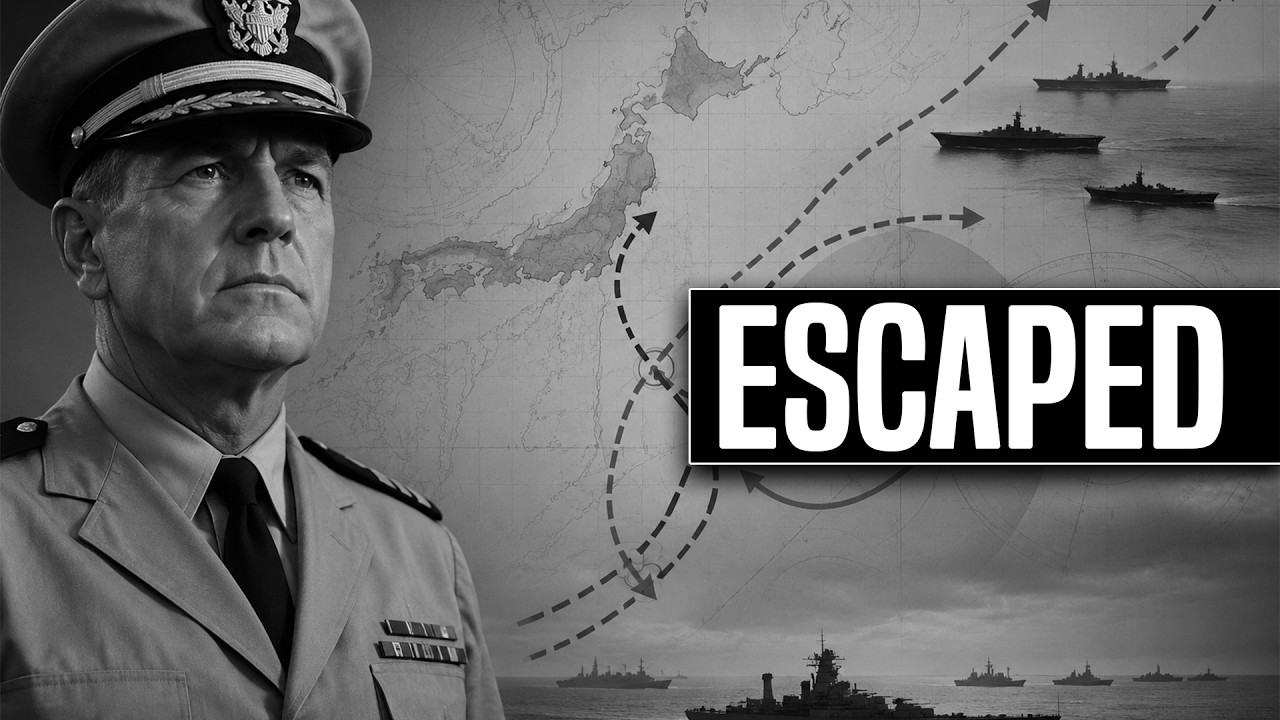
Cushing had come into possession of a stack of Japanese documents, carefully rolled and tied to fit inside two empty mortar shells. He handed them to two escaped American prisoners of war, Russ Snell and Jimmy Dyer, and told them to walk. They left on April 15, crossed Cebu, crossed the Tanon Strait, and reached the headquarters of Lieutenant Colonel Edwin Andrews in the hills behind a coastal village on southern Negros on the 28th. For thirteen days they had carried the operational orders of the Imperial Japanese Combined Fleet on their backs.
The documents had entered the sea two weeks earlier. On the last night of March, two Japanese flying boats had left Palau for the Philippines. One carried Admiral Mineichi Koga, commander-in-chief of the Combined Fleet, who had just told his chief of staff that Admiral Yamamoto had died at the right time and that the two of them should go out and die together. Koga’s aircraft flew into a storm and went into the sea with everyone aboard.
The second aircraft, carrying the chief of staff and a briefcase holding the fleet’s war plan, came down in the Bohol Strait about two and a half miles off Cebu at half past two in the morning. Twelve men died. Twelve got out, including the chief of staff, who swam for the beach believing the plan had gone down with the wreck. The plane did not sink.
The briefcase was packed in a wooden box, and the box floated. Three mornings later, a shopkeeper named Pedro Gantwongco saw something in the water off the beach at Parilos and sent a neighbor, Opoy Wamar, out in a boat to fetch it. Wamar opened it and found a red leather portfolio with a Z on the cover under a film of oil and seawater. Gantwongco told him to leave the box in the boat anchored in plain sight a couple of dozen yards off the beach and wait for dark.
Japanese troops walked that beach at noon looking for exactly this, and nobody searched the boat. That night, the two men carried the box up to a house and laid the wet packets out on a split bamboo floor to dry. Inside was a pouch of small gold nuggets, which they kept as spoils of war. The next evening, they buried the box.
The Japanese navy did not give up. Two hundred troops combed the village and went through every house. Tide and current specialists took similar boxes out to the crash site and let them drift, and the boxes came ashore at Parilos every time, which told them precisely where to look and nothing whatever about where the real one had gone. They assembled the villagers and offered rice and cloth to anyone who would talk.
Nobody talked. They burned Parilos, then raised the offer to 50,000 pesos, then dropped leaflets across the island addressed to Cushing by name with a deadline on them. The documents eventually made their way to the coast of Negros, where they were handed to the American submarine Crevalle on May 11. The submarine had stood in under orders to take off American refugees, which was the cover story.
Salvador Abcede, commanding the guerrilla district there, came aboard and told the captain there were 41 civilians on the beach rather than the 25 he had been promised. Forty came aboard, 21 of them children, and one minister decided to stay behind. Abcede also handed over a small wooden box and said MacArthur was anxious to see what was in it. Crevalle ran on the surface for speed, was attacked from the air, and took two severe depth chargings on the way south before reaching the Australian coast on the 19th.
The box went ashore at Darwin, into a courier’s hands, onto an aircraft, and 1,800 miles later it was in Brisbane by midday. Translators went to work on it on May 21 at a Brisbane suburb called Indooroopilly. What they had was copy number six of 550 of Combined Fleet Secret Operations Order Number 73, issued from the battleship Musashi at Palau on March 8 and signed by Koga himself. It was in plain language.
It had never been enciphered because it had never been meant to travel anywhere except from one Japanese flag officer to another. Accounts still disagree about which of the two admirals was actually carrying it. Both aircraft had gone into the sea within hours of each other, and neither man ever produced a clean answer. The translation team worked through two days and nights.
The section head then cranked out 20 copies of the 22-page result on a hand mimeograph, and the first went by officer courier to General Marshall in Washington, the second to MacArthur. The naval officer who grasped what he was looking at was Captain Arthur McCollum, the Seventh Fleet’s intelligence director, who pushed for the translations to reach Pearl Harbor immediately. An Army bomber carried them nearly 5,000 miles in 48 hours, refueling at islands along the way. At Pearl, they landed on the desk of Captain Edwin Layton, Nimitz’s fleet intelligence officer, under a stamp forbidding anyone to copy them without MacArthur’s permission.
Layton could see the work had been done by men who knew Japanese but not the Japanese Navy. So he sent for photostats of the originals and retranslated the whole plan with his own people. His verdict on the Army version was that it had mostly been right. Then it went to sea.
A flying boat carried Layton’s translation and Nimitz’s covering instructions to the anchorage at Eniwetok, where it was put aboard the cruiser Indianapolis on June 8. Task Force 58 had already sailed, so copies were dropped to Vice Admiral Marc Mitscher’s flagship on the open ocean. Eleven days later, the Japanese came. And they came in the shape the Americans had been handed.
Vice Admiral Jisaburo Ozawa brought six carriers and roughly 450 aircraft and one genuine advantage: his planes outranged the American ones and could fly through, land on the island airfields behind Task Force 58, refuel, rearm, and hit the fleet again on the way home. He launched four raids on June 19. Radar picked up every one of them well out. The fighter direction officer stacked Hellcats in front of each in turn, and the Japanese carrier air arm came apart in a single day.
Two submarines put down two of Ozawa’s carriers that afternoon, one of them his flagship. Dive bombers caught a third the following evening and sank her. Ozawa lost something like 476 aircraft across the two days, and the surviving hulls ran west. The argument started before the fuel smoke had cleared.
Vice Admiral John Towers, the senior aviator in the Pacific and Nimitz’s deputy, went to Nimitz demanding that Spruance be relieved for letting the enemy fleet escape, and proposed himself as the replacement. The Fifth Fleet Chief of Staff wrote at the time that there would be plenty of second-guessing out of Pearl Harbor and Washington by people who don’t know the circumstances and won’t wait to find them out. He was right about that. The most argued command decision of the Pacific War concerned the night of June 18.
With a position report placing the Japanese carrier fleet some 350 miles west-southwest of him, and with Mitscher asking permission to run west overnight and be in launch position at dawn, Spruance refused and turned the carriers back toward the island. Every aviator in Task Force 58 read it as a gunnery officer flinching from a carrier battle. The reading stuck for four decades. The bitterness in Mitscher’s own summing up afterwards set the tone for nearly everything written since.
Almost none of it said out loud that the man had been reading the enemy’s plan since June 8. Koga’s successor, Admiral Soemu Toyoda, had taken the captured document and modified it rather than throwing it away. The version he issued kept the central idea intact: use the carrier force as a diversion, pulling the American carriers away to the west while the surface fleet came in behind them onto whatever was left uncovered. That idea was sitting in translation aboard Indianapolis 11 days before Mitscher asked permission to steam west in the dark toward a Japanese carrier force.
The captured plan was also explicit about the airfields. Fighting 600 miles west of Guam would have handed Ozawa the strips on Guam and Tinian as a second flight deck and doubled the value of every sortie he flew. It would have put Task Force 58 inside the reach of the land-based bombers staging down from Japan through the Bonins. Spruance chose to fight with the islands behind him and the enemy obliged to come to him, and what he got was the most one-sided air battle in the history of naval warfare.
How much the captured plan actually contributed to the American victory in the Philippine Sea cannot be answered. Spruance never leaned on it in his own defense and would not have been free to. The men who argued about him for 40 years were arguing about nerve and seamanship out of American action reports while the one piece of paper that explains the caution sat in a file under a stamp forbidding anyone to copy it. All of it is still filed.
The translation of the Z plan is in the records of General Headquarters Far East Command. Cushing’s radio traffic with Brisbane is in the Southwest Pacific Area message files. Crevalle’s report of her special mission is in the records of the Chief of Naval Operations. The post-war interrogation of the officer who lost the briefcase is in the files of the Strategic Bombing Survey.
Four collections, four agencies, and the chain that runs through all of them starts with two men in a fishing boat off a beach that was burned for what they did.






