In the winter of 1897, Margaret Dowel died, and the small notice that appeared in the Springfield Republican gave no hint of what her passing would set in motion. She was described only as a devoted mother of two daughters, survived by her husband, Elias. The county burial records preserved in Foresight show that her grave was marked with a wooden cross, its inscription worn away within a few seasons. The family was left isolated not only in grief, but in memory.
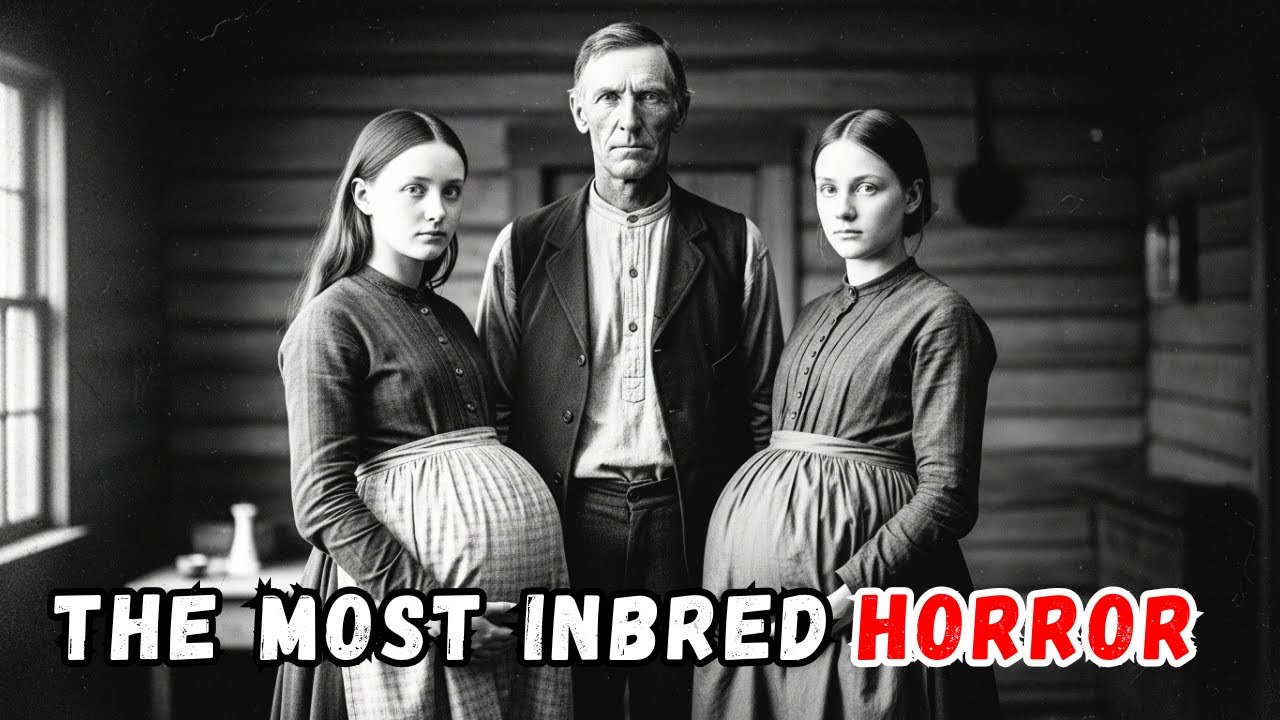
This death, recorded so briefly and then forgotten, was the beginning of one of the most disturbing family histories in the Ozarks. The Dowel homestead stood on a ridge far from town, a weather-beaten structure overlooking fields that had long since given up their yield. After Margaret’s death, neighbors noted that the shutters were drawn and voices seldom carried from the house. The sisters, Eliza and Clara, who had once walked to the one-room schoolhouse with their mother, vanished from the attendance rolls that same spring.
Their names appear no further in the district ledgers. Elias claimed he would teach them himself, but no evidence of lessons was ever found. The church lost sight of the family as well. Records at the Teny County Historical Society show that the Dowels’ pew went empty, their names absent from the baptismal and communion books after 1897.
In a rural community where faith and farming bound families together, such withdrawal was alarming. Some attributed it to grief, others to pride. As one neighbor’s diary later recorded, the Dowels closed their house and their hearts. The setting itself deepened the isolation.
Winters in the Ozarks were harsh, the roads impassable after storms, leaving the ridge house cut off for weeks. When Elias appeared in town to trade, he came alone, his daughters’ faces hidden from sight. Locals whispered that their pale figures moved only by lamplight. Without their mother’s presence, the sisters seemed bound entirely to the will of their father.
The United States Census of 1900 lists Elias Dowel as a widower, aged 45, head of household with two daughters under his roof. No occupation is given beyond farmer, though by then his land had grown thin and unyielding. The bare notation reveals little, but read alongside the recollections of neighbors and the parish minutes of Foresight Baptist Church, a picture of a man emerges—stern, insular, and jealous of his authority. Elias was remembered by townsmen as a figure who spoke little, his presence marked by the heavy silence that followed him into stores and taverns.
A diary kept by John Waynewright, a local storekeeper, records that Elias did not suffer inquiry into his affairs. When asked after his daughters, he answered only that they were well enough and quickly turned the subject. On Sundays, where once Margaret had led the girls by hand into the church pew, Elias appeared alone, muttering that grief was a private thing. It was in this atmosphere that whispers began to take root.
Farmers traveling the ridge road claimed they heard voices in the night, not joyous or sorrowful, but strange, urgent, and sometimes muffled by weeping. A sheriff’s deputy years later wrote that rumors of unnatural domestic practices circulated as early as the summer of 1901. Though no complaint was ever officially recorded, in rural Missouri, where family honor was guarded with fierce silence, the line between suspicion and evidence remained wide. The daughters themselves became figures of speculation.
They were seen only rarely, and when they appeared, their eyes were cast downward, their movements awkward, as if unaccustomed to the sun. A schoolteacher from a neighboring district, writing decades later in a memoir, recalled seeing two pale girls on the ridge path, walking as though in lock step, their faces alike as mirror images. He noted the oddity that no man courted them, nor did Elias seek suitors for them despite their passing into womanhood. The isolation deepened after the turn of the century.
Elias’s farm failed, yet he refused offers of assistance. When creditors pressed him, he bartered with livestock, never coin. The daughters remained hidden, their presence confirmed only by faint candlelight behind shuttered windows. It was in these years, the long stretch between Margaret’s burial and the first recorded suspicions of pregnancy, that later investigators would conclude the foundation of the Dowel tragedy was laid.
By the spring of 1902, the names of Eliza and Clara Dowel had disappeared from every public ledger in Teny County. The schoolhouse register lists their attendance up to the year of their mother’s death, then abruptly stops. Parish books likewise record no confirmations, no marriages, no communions. In a community where even the poorest families left some trace of their children’s passage into adulthood, the silence around the Dowel sisters was glaring.
The first outsider to remark on their absence was Reverend Amos Carter, who noted in his quarterly report to the Baptist Association that Brother Dowel had not permitted his daughters to partake in services for some years, a matter of increasing concern. His note was filed among routine correspondence and forgotten until unearthed decades later in denominational archives. At the time, it raised no alarm. Yet the community began to notice irregularities.
In the autumn of 1903, a midwife named Sarah Fields recorded in her ledger a nighttime summons to the Dowel homestead. She later testified that she was dismissed at the door by Elias himself, who told her the matter was already tended to. Still, in her neat script, she penciled a short line: “Child delivered, weak, not seen again. ” When interviewed in her old age, she recalled only a thin cry soon silenced and the sight of two pale girls hovering at the window as she departed.
More fragments followed. In the winter of 1905, County Coroner John Hensley investigated the shallow burial of an infant discovered by hunters near the ridge. His report, preserved in courthouse files, describes a child of defective formation, bones frail, features irregular. Though no charges were brought, the report was quietly filed under unknown parentage, though locals whispered the truth.
The sisters themselves seemed to fade into shadows. Those few who glimpsed them spoke of girls whose resemblance to one another grew uncanny, their figures thin, their complexions wan. They spoke to no one. In a community that measured time by weddings, births, baptisms, and harvests, the Dowel daughters marked no such milestones.
By the summer of 1906, the Dowel household had become a source of quiet fascination and unease in Teny County. Farmers driving their wagons along the ridge road claimed they sometimes heard cries in the night, sounds muffled, pained, and quickly silenced. The Springfield Daily Leader ran a brief notice of disturbances reported near the Dowel farm, but the matter faded from print without explanation. The strongest whispers concerned the children, or rather the traces of them.
According to a deposition preserved in county archives, a hunter stumbled upon a small grave near a creek bed in 1906. The coroner was summoned, and his notes described remains of a young infant, features markedly irregular, body frail. No parents claimed the child. The burial was recorded as paupers.
Yet in town, everyone assumed where the infant had come from. Midwives carried memories they dared not share. One, Anna Blevens, later told her granddaughter, who recounted it in a 1940s oral history, that she was summoned to the Dowel place twice but turned away at the door by Elias. She remembered seeing a pale girl watching through the slats of a shutter, her eyes large as if she wanted to call for help but could not.
Blevens wrote nothing down, fearing reprisal. But her story, passed in whispers, confirmed what others already suspected. Children were being born there, and those children did not survive. The whispers hardened into suspicion.
When poor house records from nearby Greene County began to list unclaimed infants of defective constitution taken in from Teny, physicians described them with the restrained but chilling language of the time—weak-minded, hydrocephalic, of irregular lineage. In one ledger, a physician scrawled what others would not: “Inbred stock beyond saving. ” Still, no sheriff came knocking. No judge convened a hearing.
In an era when family honor stood above evidence, even the most grotesque suspicions dissolved into silence. The first official traces of what had long been whispered appeared not in newspapers but in the margins of medical ledgers. In the spring of 1907, Dr. Samuel Whitaker of Springfield recorded in his case book a visit to a girl of unusual pallor, condition advanced, brought under cover of night.
He did not name her, but his description—”resides in Teny hills, father present, no mention of husband”—left little doubt to later readers. The patient delivered a frail infant who did not survive the week. Whitaker’s handwriting grows faint at the entry’s close, as though reluctant to mark the matter further. Other physicians recorded similar encounters.
Dr. Alden of Branson noted a series of consultations between 1908 and 1910, each involving a young woman from the Dowel Ridge. His notes describe congenital defects with clinical restraint: hydrocephalus, limb malformation, weakness of constitution. Though the names are absent, the pattern is unmistakable.
Each time the father, Elias, arranged the visits. Each time the daughters remained voiceless. Alms house ledgers tell the rest. Beginning in 1909, the Greene County Poor Farm admitted three infants described as of defective stock.
Two died before their first birthday. The third entered simply as Mary, no surname, lived until age four, her condition recorded as incurable. The matron of the alms house, interviewed years later, recalled the child’s face as strangely alike to both sisters, yet aged before its time. By this period, the words that neighbors whispered in dread had taken on documentary weight.
Coroners, doctors, and alms house matrons, each writing within the conventions of their time, circled the truth without naming it outright. Their careful phrases—unwholesome parentage, unnatural consanguinity—stand today as euphemisms for what the community knew but would not confront. In the autumn of 1911, the Dowel household, long shrouded in silence, was finally pierced by an outsider. According to minutes preserved in the archives of the Missouri Baptist Association, a traveling preacher named Reverend Silas Hargrove accepted an invitation to stay overnight at the Dowel farm while passing through the ridge country.
His written account, later submitted as part of a sworn affidavit, describes a house stifled by secrecy, daughters pale and withdrawn, children faint of breath and seldom heard. Hargrove wrote that he was given a straw bed in the loft but could not sleep. From below, he heard the soft cries of an infant, followed by the low voice of Elias, harsh and commanding. The preacher noted the presence of two young women moving silently through the dark, their faces strikingly similar, their demeanor subdued.
In the morning, he confronted Elias, asking after the children. Elias replied only, “The Lord chastens whom he will. These are mine to bear. ” Disturbed by what he had witnessed, Reverend Hargrove traveled directly to Foresight, where he filed a statement with Sheriff William Jennings.
His words, recorded in the sheriff’s log book, accused Elias of keeping his daughters in unnatural relation and producing offspring unfit for life. It was the first time such allegations reached the hands of law enforcement. The sheriff, however, faced a dilemma. The law in Missouri at the time recognized incest as a crime only with proof of confession or clear testimony.
The sisters, when questioned, said nothing. Witnesses could offer only rumor. Even the preacher’s affidavit, striking as it was, amounted to hearsay in a courtroom. The sheriff entered the complaint into the record but did not proceed with charges.
His final note in the log reads, “Without testimony, case cannot stand. Family returned to Ridge. ” Newspapers picked up fragments of the story but printed them in muted terms. The Springfield Daily Leader of November 1911 ran a two-sentence notice: “Allegations of unwholesome practices have been raised concerning a family in Teny County.
Officials report investigation concluded without action. ” Behind those brief lines lay an unspoken truth. Everyone knew which family was meant. But no one dared print the name.
When the Teny County grand jury convened the following spring, no witnesses appeared. The sisters, brought before the magistrate, lowered their eyes and answered only in monosyllables. To every question—whether children had been born, whether their father had stood in unnatural relation to them—they offered the same reply: no word to give. Without testimony, the case evaporated.
Court clerks entered the complaint as unproven and shelved the file. Years later, when historians sought those papers, they found only fragments. Much of the record was lost in the courthouse fire of 1916, an event that consumed thousands of pages and with them much of the official memory of the Dowel affair. What survived were stray notes, half-burned affidavits, a sheriff’s marginal scribble, the faded cover of a file labeled “Dowel matter, unsubstantiated.
”
The law had no purchase against silence. Missouri statutes of the period demanded confession, clear testimony, or irrefutable physical evidence, none of which the Dowel case could produce. The sisters’ silence became their father’s shield, and the burden of proof, impossibly high, collapsed the matter before it could stand in open court. For the community, this failure became a lesson in caution rather than courage.
Neighbors who once whispered now closed their mouths altogether, fearing reprisal or shame. The preacher who had raised the alarm left the county within the year. The sheriff, pressed by other duties, let the matter drop. By the close of 1912, the Dowel family had returned to obscurity.
Yet the children told a story the courts refused to hear. Alms house registers from Greene and Christian counties continued to list infants of irregular constitution taken in during these years. One dated 1913 describes a child blind from birth, of weakened frame, no known parentage, brought from Teny Ridge. Another entry the following year reads, “Male child, suspected consanguinity, deceased after 2 months.
” These spare notations, clinical and unembellished, were the real testimony. Silent infants carrying the evidence in their very bodies. By the second decade of the 20th century, the traces of the Dowel story no longer appeared only in whispers or affidavits. They were etched into the ledgers of alms houses, hospitals, and county relief boards.
Beginning in 1913, entries from the Greene County Poor Farm describe a series of children brought in from Teny County. Their parentage officially listed as unknown, though everyone understood the truth. One ledger records a girl, perhaps three years old, admitted with spinal curvature and weak constitution. Another child, a boy taken in the following year, is described as hydrocephalic, blind, not expected to live.
The matron of the alms house, interviewed in the 1930s, recalled them vividly. They bore the look of kin too close, faces alike to one another and yet aged before their time. Most died before their fifth year, their names erased from memory save for those few lines of ink. Medical reports, when they surfaced, speak with clinical restraint but leave no doubt.
A physician in Springfield noted in 1915, “The case of an infant born of consanguine stock, deformities extensive, survival unlikely. ” County burial registers for the same period show small graves marked only with initials or not at all, often listed as paupers’ interment. Locals who once whispered cautiously now referred to them as the cursed brood. Hunters claimed to find tiny mounds of earth near the ridge, hastily covered, while travelers along the creek road reported seeing Elias himself carrying bundles into the woods at night.
No proof was ever offered, but the rumors hardened into legend. The Dowel name, once merely peculiar, became synonymous with horror. For the sisters, there is little record beyond absence. They remained cloistered, their lives measured only by the children they bore and buried.
Census takers in 1920 listed Elias as still head of household, daughters still under his roof, no mention of grandchildren. The official silence stood in stark contrast to the unofficial truth that the Dowel homestead had produced what county officials privately called the most inbred children ever seen in these hills. By the 1930s, the Dowel name had nearly vanished from everyday speech in Teny County. The farm had fallen into ruin, Elias long dead, the sisters unrecorded in any parish or census.
Yet the story did not remain buried. It was resurrected not by living memory but by the patient work of archivists and local historians sifting through forgotten files. At the Teny County Courthouse, a clerk cataloging water-damaged papers uncovered a half-burned sheriff’s log from 1911. The surviving pages bore the name Dowel beside a single phrase: “Unnatural relation, no testimony.
” Around the same time, a graduate student at Drury College examined poor house registers and noticed repeated notations of defective stock and consanguineous parentage linked to children admitted from the ridge. When he traced the records backward, they all pointed to the same family. Letters too surfaced from private collections. In 1934, the Missouri Historical Society acquired a bundle of correspondence from Reverend Silas Hargrove, the traveling preacher who had once lodged at the Dowel home.
His letter to a fellow minister described sisters bound by grief and by something darker, children marked with the curse of their father’s blood. Though couched in biblical language, the meaning was unmistakable. The discovery of these fragments set in motion a wave of retrospective research. Oral historians interviewed elderly residents who recalled the whispers of their youth—the pale girls at the window, the tiny graves in the woods, the word inbred spoken in hushed tones around kitchen tables.
Though decades had passed, the memories still carried weight. When combined with the surviving documents, they formed a narrative more complete than any trial had ever recorded. What emerged was not a tale of sudden violence but of gradual hidden decay, of a household that turned inward, producing generation upon generation of children whose suffering embodied the price of silence. The Dowel sisters, once little more than shadows at their father’s side, were now remembered as the mothers of what scholars and locals alike began to call the most inbred children in Ozark history.
Through these archival resurrections, the story gained a permanence it had never had in life. What had once been rumor became evidence, layered across coroner’s notes, poor house ledgers, and yellowed correspondence. And though the Dowel farm itself had long since collapsed into dust and weeds, the documents ensured that the family’s silence would never again erase their history. When the last fragments of the Dowel record were gathered, a somber truth emerged.
This was not simply the story of a family’s misfortune but of a community’s silence. Margaret’s death in 1897 had closed the shutters on the ridge house. But it was the years that followed—the years of secrecy, of neighbors who looked away, of officials who demanded testimony that would never come—that allowed the Dowel sisters’ tragedy to unfold unchecked. The children’s brief lives, measured in frailty and early graves, bore the true testimony.
Their presence in alms house ledgers, their descriptions in physicians’ notes, and their absence in parish records all pointed toward the same reality. Inbreeding had not been an accident of a single birth but a pattern repeated and concealed until it etched itself into the very bodies of those born within that house. They became, as later historians called them, the most inbred children ever recorded in Teny County. For the sisters themselves, the record remains nearly blank.
They appear only in census rolls as women who never married, who never stepped beyond the ridge, who bore children that rarely lived to adulthood. Their silence, whether chosen or imposed, protected their father and preserved the secrecy of the homestead. When at last they passed from the record, no obituary marked their names. Their graves, if they were marked at all, have been lost to weeds and time.
Yet the story endured. Today the ridge stands empty, its fields overtaken by brush, its farmhouse collapsed into rot. But the documents remain—the sheriff’s notes, the medical case books, the oral testimonies of neighbors now long gone. They remind us of what can happen when grief hardens into secrecy, when silence becomes a shield, and when a community chooses to look away.
The Dowel story is in the end not just a tale of one family but of a society’s failure to confront what it could not bear to name. Its legacy lies in the lesson that silence does not erase truth. Truth waits in ledgers and diaries, in faded ink and brittle paper.
And when it emerges, as it did for the Dowels, it speaks with the full weight of the past.






