She got up from the head table and made her way toward the stage. The room had been laughing all evening, but now the laughter died, because the First Lady of the United States was doing something nobody had ever watched her do. She was cutting off the President. George W.
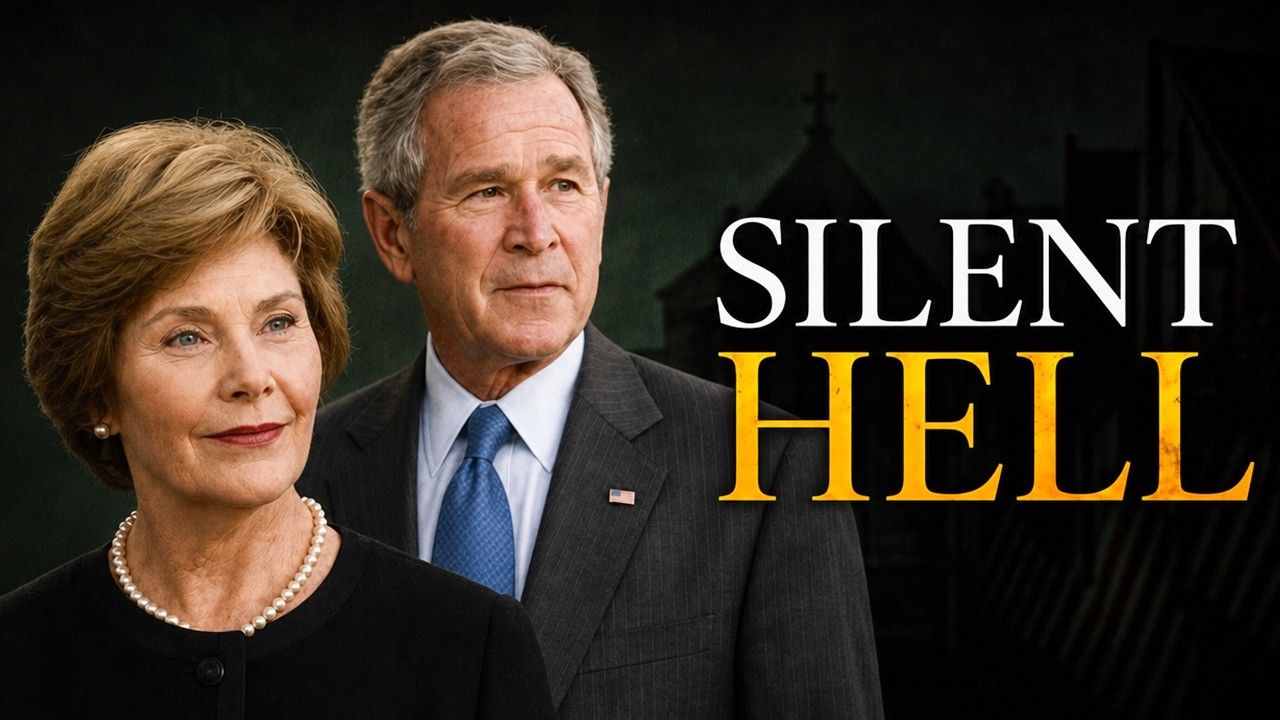
Bush moved aside. Laura Bush took her place in front of the seated president, turned to face several thousand journalists, and informed them that the President of the United States was in bed by nine o’clock, that he was the only member of the administration who could say the word “nuclear,” and that on the night they met, he had attempted to milk a male horse. She called herself a “desperate housewife.” She noted that at thirty-one, the president had never wed and had devoted his time to purchasing a ranch and engaging in activities with cattle that no boy in Midland should ever have attempted.
It drew the biggest laugh of the evening. None of it was off the cuff. The routine had been crafted with a professional speechwriter named Landon Parvin, who had spent years penning material for Republican causes. It had been rehearsed.
It had been signed off on. It was, in effect, a communications operation dressed up as a charming wife. And the timing of it revealed the real story. In the spring of 2005, the second-term agenda was falling apart.
Social Security privatization was stalled. Casualties in Iraq were rising. Gallup had the president’s job approval in the mid-forties and dropping. His wife’s approval stood in the seventies, higher in some polls that year.
There was precisely one person in that administration whose popularity had not suffered, and she had been called unwilling for twenty-eight years. The quiet had a cause, and that cause predated the marriage. Long before Laura Bush learned to speak before journalists, she had learned what a document could do to a life. On the night of November 6, 1963, seventeen-year-old Laura Welch was driving a Chevrolet on a dark road outside Midland, her friend beside her.
She came to the intersection of State Highway 349 and Farm Road 868. She did not stop. Her car hit a Corvair, and the driver of that Corvair, seventeen-year-old Michael Dutton Douglas, was ejected from the vehicle and killed. He was her classmate.
By various accounts, he was a boy she knew well and liked. No fine was levied. No charge was brought. The accident report was placed in a Texas file cabinet and remained there.
She never talked about it. Not in high school. Not at Southern Methodist University. Not during the years she taught second graders at Longfellow Elementary in Dallas, nor later at a predominantly Black elementary school in Houston in the early years of desegregation.
Not when she earned her master’s degree in library science from the University of Texas in 1973, nor while working as a school librarian in Austin. Her closest friends in adulthood said they had no idea. Her future husband found out during their courtship, and the campaign workers of 1978 knew nothing, because nobody asked. She stayed silent for thirty-seven years.
Then, in May 2000, in the middle of a presidential campaign, a Texas journalist obtained the report and the story went everywhere. She released a brief, careful statement. She did not write about it at length until her memoir, Spoken from the Heart, came out in 2010, in which she described losing her faith for a time afterward and admitted she had never contacted the Douglas family. That was her version, given thirty-three years after the wedding, on her own schedule, in her own book, in her own words.
Keep that sequence in mind. Everything she later did with her own story followed this pattern. There was something else that made her necessary, and this part got buried beneath the shy librarian image. She was the only child of a mother who had suffered one miscarriage after another.
Jenna Welch had gone through a stillbirth and multiple miscarriages, and Laura grew up in a small house in Midland where her parents’ emotions were expected to remain contained. Her father, Harold Welch, built houses. The family was comfortable, not wealthy, not politically connected, and entirely local. That last word mattered in 1977.
By the summer of 1977, Laura Welch was thirty, unmarried, living alone in Austin, and, by her own later description, watching her life narrow. She had a career, a small circle, a rent check, and a mother who had begun asking questions. She was remarkably matter-of-fact about the period. She was not waiting to be rescued.
But she was aware of the arithmetic. Meanwhile, the eldest son of George Herbert Walker Bush had a problem that no amount of family money could fix. In July 1977, he announced he was running for Congress from Texas’s 19th District. He was thirty-one, unmarried, an Andover graduate, Yale and Harvard Business School alumnus.
He was the son of a sitting CIA director, running in West Texas against opponents who would happily tell voters he was a carpetbagger with an Ivy League accent and a famous name. His campaign required one specific thing. Not money. Not staff.
It required a wife from Midland. Jan Donnelly O’Neill had grown up with Laura Welch. Her husband, Joe O’Neill, had grown up with George Bush. In August 1977, they hosted a barbecue in their backyard in Midland with the sole purpose of bringing the two together.
Both later confirmed the arrangement was deliberate. Both left the party early. By multiple accounts, including their own, they talked past midnight. Three months later, on November 5, 1977, they were married at First United Methodist Church in Midland.
About seventy-five guests. No bridesmaids, no best man present. The wedding was arranged quickly because the campaign schedule could not wait. She said her mother-in-law was astonished by the speed.
Everyone was astonished by the speed. This is where most versions of the story go soft, and where the real account is more interesting than either the romance or the cynicism. Both things were true at once. By every surviving account, he was genuinely smitten.
Friends from that period describe a man who talked about her constantly, who had been in long relationships that went nowhere, and who had reached an age in that social world where being unmarried was conspicuous. She, by her own writing, was drawn to a man who was funny, restless, relentlessly present, and entirely different from the men she met in Austin. There is no evidence of cold calculation on either side. And there is no honest way to pretend politics was secondary while looking at the calendar.
He announced in July. He met her in August. In November he married her. He had filed to run in a district where his father’s name carried some weight and his accent carried more.
The marriage was real. It was also the most effective act of the campaign. Then came the condition. She has told this story consistently for decades, in interviews and in writing.
She said yes to his proposal only on one stipulation: she would never be required to deliver a political speech. It wasn’t a private joke between them, nor a detail invented afterward to match what came later. It was a condition she set before the wedding, repeated so many times that it hardened into part of the couple’s accepted legend. Their honeymoon was the campaign.
They squeezed in a short getaway, then devoted their first year to crisscrossing West Texas, motel after motel, county after county, a stretch she recalled with real warmth and no romanticizing about what it actually was. In 1978, in Muleshoe, Texas, a town of roughly four thousand, she delivered her first political speech. She seized up. By her own telling, she lost her place, couldn’t recover the thread, and ended poorly.
Afterward, she said, sitting in the car, she reminded him of the pledge he had given her. He had already broken it, and both of them understood he would go on breaking it, since no version of his ambition involved staying silent. That November he lost to Kent Hance, a Democrat who campaigned squarely on the very vulnerability the marriage was meant to neutralize: the outsider with the pedigree and the Eastern education. So the first year of the marriage produced a broken promise, a public humiliation on a small stage in a small town, and a defeat.
What it did not produce was any renegotiation. She never publicly asked to have that term restored. She simply quit bringing it up and began improving. It was a choice, not a disposition.
And the decade that followed would reveal what she had truly committed to, because the man she wed in November 1977 was already drinking in a manner his friends observed, his family observed, and she married him regardless. The arrangement she entered came with rules, and not one of them was written down. The Bush family was less a family than a franchise with a compound. Summers meant Walker’s Point in Kennebunkport, where each day revolved around competition: tennis, horseshoes, speedboats, and a round of golf played at a sprint.
Barbara Bush controlled both the social sphere and the family narrative, and she controlled them with a dry ferocity that most in-laws would have done well to study. There was a right way to be a Bush wife. You produced children, you carried yourself properly in public, you did not air grievances to outsiders, and you never gave the press an account that rivaled the family’s own. Laura Bush did something in that setting that has been misread as passivity for the past forty years.
She declined to compete. When relatives tore into one another on the tennis court, she sat on the porch with a book. She made no effort to out-Bush the Bushes. Friends and staff from those years keep saying the same thing.
She was agreeable. She was guarded. She offered nothing unprompted. Which meant that within a family fixated on controlling its own story, she was the sole member who never leaked, never overstepped, never gave anyone ammunition.
Barbara Bush reportedly took to her almost at once. Naturally she did. Laura was the only daughter-in-law who conducted herself like a professional. The men surrounding them served double duty as staff.
Don Evans and Joe O’Neill were Midland friends who turned into campaign operatives, then cabinet members and fundraisers. The oil money behind the early efforts came from the same dinner-invitation phone lists. No boundary separated the social life from the political operation, and no neutral ground existed where she could stand. Her husband’s friends were his employees.
Her home was a campaign asset. Within four years of her wedding, her father-in-law would be vice president. She had married into a family that already possessed the story. It would take her twenty years to discover where the pen was kept.
Then came the drinking. This portion of the record is unusually solid, mainly because he made it solid himself. George W. Bush wrote and stated publicly that alcohol had grown into a problem, that he drank too heavily and too frequently, and that it was transforming him into someone he did not wish to be.
In Decision Points he described it flatly as a habit that started to compete with everything else in his life. The concrete details that survive from the late seventies and early eighties are the sort that get retold at dinner tables. Bar-hopping in Midland and afterward in Washington. A well-known episode at a dinner in Maine where, late at night, he asked an elderly friend of his parents what sex was like after fifty.
The 1976 drunk-driving arrest in Kennebunkport, kept hidden until five days before the 2000 election. Friends of the couple describe arguments. The celebrated line from the marriage falls into that narrow category. She supposedly confronted him and said, “It’s me or Jim Beam.
” The line turns up in multiple books, recycled for twenty-five years in profiles. It’s a great line. He has denied she ever said it, insisting repeatedly that she never issued an ultimatum, never nagged him about it, that the decision was his. She has never confirmed the quote either.
What she described was less dramatic and perhaps more corrosive: after one night of drinking, she asked him whether liquor had ever done a single good thing for his life. That account reveals more about the marriage than any ultimatum could. She didn’t threaten. To threaten, you needed the credible power to leave.
He stopped drinking in July 1986, the morning after his fortieth-birthday weekend at the Broadmoor Hotel in Colorado Springs, where he and a group of friends had celebrated as usual. He never drank again. Whatever the mechanism, it held for the rest of his life, and by every account she was part of it. Still, understand what the result meant for the balance of power.
It did not make her his equal. It made her his infrastructure. By 1986 she had also been through the experience that tied her permanently to that house. The couple could not conceive.
They tried for years. They went to the Gladney Center in Fort Worth, one of Texas’s best-known adoption agencies, and started the paperwork. She wrote about the process, the forms, the waiting, and about conceiving while the adoption application remained active. The pregnancy was risky.
She developed toxemia. In the final weeks she was admitted to Baylor University Medical Center in Dallas. On November 25, 1981, five weeks early, she gave birth by cesarean section to twin daughters. They were named Barbara and Jenna, after their two grandmothers.
She was thirty-four. Her husband was running an oil company that wasn’t profitable. Put the sequence together. Two premature babies delivered by the narrowest margin.
A husband drinking too much. A failing business. A father-in-law who had become vice president of the United States two months earlier. The twins were two months old at the inauguration, and the family had just acquired national visibility.
At thirty-four, she was a mother of newborns inside a family that had turned into a political institution. Walking away at that point was no longer a real choice, and the reason deserves to be spelled out. She had no money that was hers. She had given up her job as a school librarian.
Her professional qualifications were genuine, but that salary could not support the world she now inhabited. Her name had been absorbed into the family. Her children carried her mother-in-law’s name. Her social world was made up of her husband’s paid staff.
And by the mid-eighties, a divorce in Midland would not have stayed a private matter between two people. It would have become the story of the vice president’s son, and soon after, the story of a family gearing up for a presidential campaign. There is no proof she ever seriously pursued divorce. There is plenty of proof of how costly it would have been.
But turn the question around, because that is where the usual account reverses itself. What would he have lost if she had left? He was a man with a drinking problem, a business going nowhere, a famous father, and no record of his own. His whole political future rested on being seen as a reformed, settled Texan with a wife and twins.
Take her out of that picture in 1986, and there is no run for governor in 1994. No compassionate conservatism. No candidate at all. The reliance went in both directions.
His was the heavier. It took people fifteen years to grasp that. The nineties looked like a recovery, and in part it truly was. He was sober.
He bought into the Texas Rangers and became a public figure in Dallas on his own terms. In 1994 he ran for governor against Ann Richards, and Laura Bush, the woman who had frozen on the mule-shoe stage, campaigned. Not brilliantly, not yet. But she did it, and she did not have to be dragged into it.
Then in 1996, as First Lady of Texas, she did the thing that shifted her position in the marriage more than any speech ever could. She founded the Texas Book Festival. On its face, that is the least dramatic sentence in this story. A librarian starts a book festival.
Consider what it really amounted to. An annual event at the State Capitol in Austin that raised money for Texas public libraries. It carried her name, her authors, her board, her donors, her staff. In the first few years it brought in over a million dollars.
The people writing the checks wrote them to her. For nineteen years, every institution in her life had belonged to her husband or his family. This one did not. It was small.
It was literary. It threatened no one’s political ambitions, and it was hers. She had built a platform that could not be taken away by a bad election. She had learned from the mule-shoe speech, and the lesson was not to become a better speaker.
The lesson was to find a room of her own. By 1999, her husband was running for president, and she had gone from a woman who did not speak in public to a woman with her own donor list. The marriage was stable. The drinking years were a decade behind them.
The twins were teenagers, and the family had a plan. Then, in May 2000, a Texas journalist requested a thirty-seven-year-old accident report from a two-lane intersection outside Midland. The one thing she had kept to herself her entire adult life became campaign property. The story broke in the press in early May 2000.
Michael Dutton Douglas, seventeen, had been killed at the intersection of State Highway 349 and Farm Road 868 on November 6, 1963. The driver of the other car was the woman about to become First Lady of the United States. How the campaign handled it was telling. No long statement.
No interview. No tearful appearance. She confirmed the facts briefly, said it was the most horrible thing that had ever happened in her life, and stopped. Surviving members of the Douglas family told journalists they had heard nothing from her.
That news ran too. And then, within about a week, the story died, because there was nothing to push it forward. She had not spoken about the most tragic event of her life for thirty-seven years, and when it finally came into the open, the discipline she had built around it worked exactly as it always had. She gave the press the facts and nothing usable.
Three months later, on August 1, 2000, she walked onto the stage of the First Union Center in Philadelphia and delivered the opening-night address at the Republican National Convention. Read that sentence against the situation of 1977. The woman who married him on the promise that she would never give a political speech was given the opening night of the presidential nomination convention, not a cameo on the final night as the wife. Opening night, the slot the party uses to set the emotional frame for everything that follows.
She spoke about literacy, teaching, and her husband. The subject was education. The purpose was to make him safe. The whole story turns on that reclassification.
She was never shielded from politics. By 2000 she was the product, and she was better than he was at exactly the places where he was weakest. People worried about him. His temper, that dismissive smirk, his past behavior.
She was the balancer. Both internal polls and public surveys showed the same pattern all year. She moved suburban women. She reassured moderates.
She made the ticket look calm. The Bush operation understood this and used her accordingly. Then September 11, 2001, happened, and her political value shifted from campaign asset to something closer to an instrument of governance. On November 17, 2001, Laura Bush delivered the president’s weekly radio address alone.
No First Lady had ever done that. The subject was the treatment of women and girls under the Taliban, and the address was part of a coordinated push with a State Department report and a White House briefing. It aired on stations across the country. Two days earlier, the administration had wanted a messenger who could talk about Afghan women without sounding like war justification.
The messenger they chose was the librarian. She did it again and again. In the 2004 campaign, she was the most used surrogate for reelection, appearing alone in states where her husband’s presence was a liability. The Gallup numbers from those years are not ambiguous.
Her approval stayed consistently in the high sixties and low seventies, twenty to thirty points above his in the second term. And she never once said anything that produced a bad headline. The real thing is that almost no one noticed while it was happening. Alongside all that public power came an operational change at home, and it began before he became president.
In 1999, the Bush family bought about sixteen hundred acres near Crawford, Texas. The house built on that land between 1999 and 2001 became the Western White House. The physical proof of her influence. The place where he cleared brush in front of cameras for eight years.
That image came to define him. She was the one who shaped it. She picked the location. She brought in David Heymann, a University of Texas architect, and collaborated with him hand in hand on the plans.
Heymann remembered her as a client who listened closely, worked with precision, and knew precisely what she wanted. For a family with that kind of money, the finished house was intentionally unassuming. A single story, stretched out and low. Regional limestone, a metal roof, a rainwater cistern system, native plants rather than a lawn, deep porches and passive cooling.
The house drew praise from architects. In building terms, it was among the most environmentally thoughtful homes any president has ever occupied. Raised for a president whose environmental record was under relentless fire, the house cast George W. Bush as plainspoken Texas, and it was built to his wife’s specifications.
Its architecture was her self-portrait. She controlled far more, quietly and without wavering. She controlled press access, ran a very small operation in the East Wing, nearly eliminated unscripted interviews, permitted no rival leaks and no staff wars. She controlled how visible her daughters were, which is why the 2001 episode of two young women caught in Austin with fake IDs never grew into a rolling national story.
She traveled widely without him, which served as diplomacy and as distance, and at some point across those eight years she began gathering information. The 2005 Correspondents’ Dinner was that. A wife being charming. A calculated deployment of the administration’s most valuable communications asset at the precise moment the president’s numbers were falling.
Penned by a professional, delivered by a woman standing over a seated president. He was the punchline. The president got the coverage. It was the best press week the White House had that spring.
She was not the reluctant figure in that room. She was the one doing the work. So what was this marriage, in the end? Not a fraud.
And this needs to be careful, because the record does not support the fairy tale any more than it supports the cynical version. There is no credible evidence of infidelity on either side. No separate residences. No separation.
No written arrangement. Forty-eight years later they are still together. Their affection appears genuine and has consistently appeared genuine. Their daughters describe parents who liked each other.
What the record supports is that alongside the affection, they ran an institution. He held the office. She held the asset of reputation. And by the second term, she had taken possession of more of that asset than he had.
She knew exactly what she had been allowed to spend. Which brings the story to the part that is usually recorded as a mistake. In January 2001, a few days before the inauguration, she said at an event that she did not think Roe v. Wade should be overturned.
That is not a mistake. She was the incoming First Lady of an anti-abortion administration, opposing its policy on national television in inauguration week. She later expressed discomfort with embryonic stem cell research. She said publicly how difficult the death penalty was for her.
Each time, the White House accepted it, because there was no logic in fighting a woman who polled thirty points above the president. Then in May 2010, sixteen months after leaving Washington, she sat down with Larry King and said she supported same-sex marriage, that she believed it would happen, and that she had discussed it with her husband. Same-sex marriage had been the major social issue of his 2004 reelection. His campaign had supported a federal constitutional amendment defining marriage as between a man and a woman.
State ballot measures on the issue had driven turnout. In Ohio, the state that decided the election. Whatever her private views in those years, she said nothing publicly while the office was contested, and she said it plainly when it no longer was. That is not a change of mind on camera.
That is sequencing. The book came four months later. Spoken from the Heart. Scribner, May 2010, four hundred pages.
For the first time she wrote in detail about the 1963 accident. The intersection. The loss of faith. The fact that she had never contacted the Douglas family.
The fact that she and her husband discussed it and then largely did not. She wrote about the fertility years, the Gladney papers, the toxemia. She wrote about the drinking in her own restrained language but did not confirm the Jim Beam line that had been attributed to her for twenty-five years. She wrote about the physical reality of 1977 and the mule shoe.
Every version of this marriage now in circulation flows through that book. The portraits by Kessler, by Anderson, by Felix, the profiles, the memoirs, all have to contend with her account, and none of them has replaced it. She waited thirty-three years and then set the terms for all of it. She kept setting them.
She became co-chair of the George W. Bush Presidential Center at Southern Methodist University, which opened on April 25, 2013, and which houses her papers and her women’s initiative in the same building. She runs programs there under her own name. Barbara Bush, who had controlled the family narrative for half a century, died in 2018.
Laura Bush is now the family’s sanctioned narrator, and she got there by outlasting everyone and by not writing anything until she decided to look back at that correspondents’ dinner again. For twenty years, that clip has been shown as the moment America first learned the First Lady was funny. A wife taking the microphone, teasing her husband, humanizing him, the president laughing in his chair while the room erupted. It is charming, and that is exactly why it worked so well, and exactly why it told you nothing.
What you were actually watching was a live broadcast of the accounting of a marriage. The woman who in 1977 made a vow never to speak in public stood on the stage of the most powerful press gathering in the country, delivering a prepared performance, doing a job the president could no longer do as well, at the exact moment his political capital was running out. She sat. She didn’t sit.
He got the presidency. She got the record. The love story was real. It was also the most functional thing the two of them ever built.
And the decision about how it would be remembered was hers.
