In October 1778, far inside Shawnee territory, a man coated in black paint from head to foot sat awaiting his death. His face was so battered from blows that even his own mother would not have known him. The Shawnee had stripped him bare, bound him to a post, and the council had decided his fate with a war club—strike it against the ground and the prisoner dies. The club had hit the earth more times than it had been handed along.
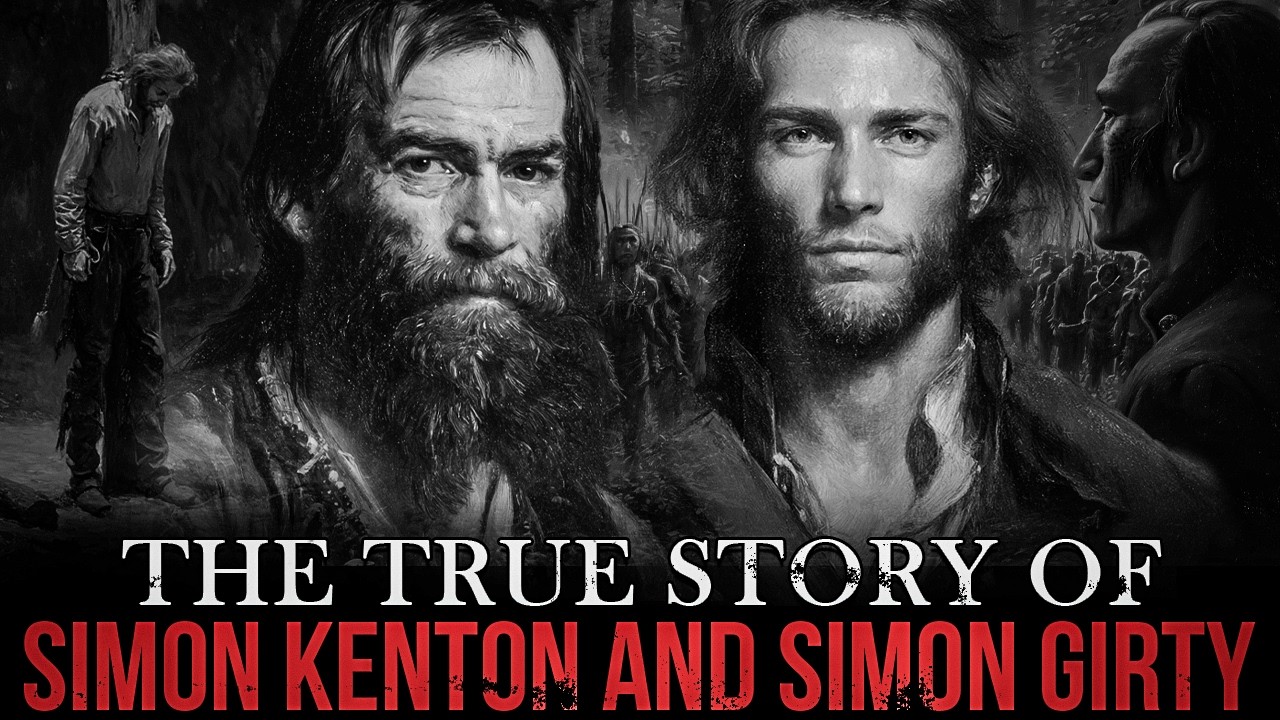
The verdict was death by fire at the stake, and the execution could come at any moment. Simon Kenton had served as a scout for the American side, a man who had once saved Daniel Boone’s life. Now he was twenty-three, shattered, and waiting to be burned alive in a village named Wapatomica. He had no idea that the man just ordered to translate his questioning was someone he had known for years.
He did not know that this man, another Simon, would soon throw himself into his arms and weep like a child. The tale of how the two Simons reached that instant starts more than twenty years before, in the summer of 1756, when an eleven-year-old boy named Simon Girty watched his stepfather burn to death. Simon Girty was born in 1741 in Pennsylvania, to an Irish father who died when Simon was small. His mother remarried a man named John Turner, and the family settled near the frontier.
When the French and Indian War rolled across the region, the family sought safety at a fort in Pennsylvania. The fort was taken. The victors lashed John Turner to a post and tortured him to death while his family looked on. Then they took Simon, his brothers, and his mother captive.
The captors split the family apart. Simon was handed to the Seneca. What came next was the gauntlet—two rows of warriors, each armed with clubs and sticks, and a boy forced to run between them. He made it through.
He was adopted into the tribe, and rather than plotting escape, he threw himself completely into that world. An elderly Seneca leader named Guyasuta became his teacher. Simon picked up the Seneca language, then Delaware, then Shawnee, then Wyandot, and others. By his early twenties, he spoke eleven Indian languages fluently.
When he came back to white society—accounts disagree on whether it was 1758 or 1764—he was no longer the boy who had been captured. He belonged partly to each world. On the far side of the mountains, another Simon was growing up. Simon Kenton was born in 1755 in Virginia, a tall, powerful boy who at sixteen made what he believed was the worst mistake of his life.
He was in love with a girl named Ellen Cumins, but she picked another man. Whether it happened right after the wedding or months afterward, the outcome was the same: Simon seized the groom by his long hair, tied it to a tree branch to pin him in place, and beat him until the man spat blood and lost consciousness. Kenton thought he had killed him. In Virginia in those days, that meant the gallows.
So he took the name Simon Butler, fled into the mountains, and spent thirteen years believing he was wanted for murder. He would not find out until 1784 that the man had lived. Across those thirteen years, he became a hunter and a scout, a man who could read the forest better than his own tracks. In 1774, during Lord Dunmore’s War—a conflict few recall today—the two Simons met at Fort Pitt.
Girty was serving as an interpreter. Kenton was brought in as a scout. They quickly became close friends, two men who knew the woods, spoke with the Indians, and understood that the boundary between civilization and savagery was thinner than city people cared to admit. They fought side by side, camped side by side, became brothers.
Then the American Revolution arrived, and everything came undone. When the war started, Girty swore an oath to the Americans. For a while he served as a recruiter and received a lieutenant’s commission. But something was not right.
Some claimed the officers treated him badly. Others said he was arrested on suspicion of being a loyalist, and even after he was cleared, they kept eyeing him with distrust. The truth, as far as anyone can tell, goes deeper. Girty looked at the war and saw it for what it was: Americans hungry for land—land the Indians occupied.
He had lived among those people, buried friends, learned their languages, understood their culture. He knew that if the Americans won, all of that would end. So one night in March 1778, Girty and a few other men left Pittsburgh and headed directly for Detroit, where the British still held control. They arrived in April, and the British deputy governor hired Girty as an interpreter.
Back in Pittsburgh, the Americans indicted him for treason, convicted him in his absence, and placed an $800 reward on his head—a fortune in those days. Simon Girty had become an enemy. But he had not betrayed the Indians. He had betrayed the Americans in order to stay with the Indians.
For him, it was a question of principle, of loyalty to the people who had raised him as a boy. History called it treason. Girty called it picking a side. In the meantime, Simon Kenton kept fighting for the Americans.
In 1775, he saved Daniel Boone’s life during an attack, shooting a Shawnee warrior who was about to kill Boone. Boone never forgot it. The two Simons were now on opposite sides of a war, but the friendship remained, hidden away, waiting. Six months after Girty’s desertion, Kenton would desperately need the friend who had become an enemy.
In the fall of 1778, Kenton decided to steal horses from the Shawnee. It was not his wisest decision. He and two companions went to spy on a village near where Xenia, Ohio, stands today. They spotted seven horses grazing and figured it would be simple.
It was not. They managed to seize the horses, but when they tried to cross the Ohio River to escape, the wind struck so hard they had to turn back. Instead of fleeing while they still could, they waited for the wind to fade. The Shawnee came after them.
Kenton and the others scattered. Kenton heard a shout and, rather than running the other way, went to investigate. He found three Shawnee on horseback, raised his rifle, and pulled the trigger—but the powder was wet. Only a flash.
The Shawnee sprang on him. One of Kenton’s companions tried to help and was killed. The Shawnee returned with the bloody scalp and shook it in Kenton’s face. They bound him between two stakes and beat him with rods until his body was raw.
That was only the start. They took Kenton to their village, a three-day journey. Each night they tied him spread-eagle on the ground. During the day, they put him on a wild horse with no saddle, bound with ropes, and let the beast run loose through the woods.
Branches lashed Kenton’s face, and he had no way to shield himself. Once they got to the village, they lashed him to a post. Roughly 150 people gathered, dancing around him for three hours, striking and yelling. After that they made him run the gauntlet—two rows of Shawnee, each one holding whatever weapon they chose to hit him with.
Kenton spotted two men gripping butcher knives and thought: If I stay in this line any longer, I’m a dead man. He burst through the row and bolted. Hundreds of Shawnee chased him. At the village’s edge, someone flung a blanket over him and brought him down to the ground.
Kenton was so battered he couldn’t even fight back. The council assembled and voted with a war club: hand it to the next person, and the prisoner lives; slam it into the ground, and it means death. Kenton didn’t understand Algonquin, but the thud of that war club striking dirt was unmistakable. Death was outpolling life.
The sentence was to be burned at the stake. Wanting to turn it into a spectacle, they moved him to another village. Along the way, a second council voted to kill him. In yet another place, they beat him so severely that when they finally left him alone, he tried to flee—covering nearly two miles before they caught him again.
As punishment, several young Shawnee hauled him through a creek, shoving his head into the mud until he was nearly suffocated. By the time they arrived at the final stop, a place called Wapatomica, they had painted Kenton entirely black. That was the signal. The execution was fixed.
A council convened, and a few British agents appeared. Among them were two brothers, Simon and James Girty. Some prisoners were present as well, but they were led away shortly after. Simon Girty was there to serve as translator.
He spread a blanket on the ground and told Kenton to sit. When Kenton didn’t move—he was so injured he could hardly follow what was being said—Girty seized him by the arms and forced him down. Then the questioning began. Where do you live?
Kentucky. How many men are there? Don’t know. What’s your name?
Simon Butler. Girty paused. He studied the man painted black once more, his face so swollen that any features were hard to make out. And then something registered.
Girty flung himself into Kenton’s arms and began to weep. One surviving account puts it this way: “His dear and esteemed friend.” Another says Girty “cried like a child and said he regretted taking sides against his countrymen, that he was good to Kenton.” And one line still lingers: “When we see our fellow men every day, we don’t care about them.
But it’s different when we find a man alone in the forest—in the wild and lonesome forest.”
Girty turned to the council and made a speech. He said he had never spoken on behalf of an American before and never would again. Still, he pleaded with them to spare Kenton’s life.
He reminded the Shawnee that he had never asked for anything in return for his service. The council relented. They handed Kenton over to Girty for twenty days. Girty looked after Kenton, providing food, clothing, and medicine from his own stores.
They moved from village to village while the wounds healed. It seemed headed for a happy ending. Then a Shawnee war party returned from a raid. They had been beaten, humiliated—and defeated warriors need someone to take it out on.
A messenger came and summoned Girty and Kenton to the council. The messenger shook Girty’s hand but refused Kenton’s. Not a good sign. The council restored the death sentence.
Girty tried to argue once more. It didn’t work. So he switched tactics. At the time, the British had a post where they paid their Indian allies.
Girty said, “Why don’t you take him to the British? They’ll pay a good reward.” Greed overcame revenge, and the council agreed. On the journey, Girty still had to win over others.
A Mingo leader named Logan—a man with every reason on earth to hate white people, since his entire family had been massacred—looked at Kenton and concluded the man didn’t deserve to die. He helped Girty negotiate. In the end, a French Canadian officer offered $100 in tobacco and rum in exchange for Kenton, promising to return the prisoner later. It was a lie.
But the Shawnee believed it. They brought Kenton to Detroit. The British interrogated him but learned nothing important. They allowed him to move about the city freely, only he couldn’t leave.
Kenton remained there for six months. In June 1779, with help from a woman who purchased supplies and concealed weapons in her garden, Kenton and two other prisoners escaped. It took thirty days of hunger and peril, but they made it to Louisville. Simon Kenton was alive, and he owed that to Simon Girty.
Four years later, Girty would be present at a scene that would define him forever—and not the way he wanted. In May 1782, an American colonel named William Crawford led an expedition against Indian villages on the Sandusky River with nearly 500 men. The plan was to strike the settlements and force the Indians to withdraw. It didn’t work out.
The Delaware and Wyandot were waiting. There were two days of fighting on a wooded hill. On the second day, Girty came toward the American lines asking to negotiate, asking Crawford to surrender. Crawford refused.
When Indian reinforcements arrived that afternoon, Crawford chose to retreat. The retreat collapsed into chaos. The Indians spotted the movement and attacked. Many Americans were killed or captured during the flight.
Crawford was among them. The Delaware decided to execute him. The reason: three months earlier, American militiamen had massacred a group of peaceful Delaware, including women and children, at a Moravian village called Gnadenhutten. The Delaware wanted revenge, and Crawford—though he had taken no part in that massacre—was going to pay for it.
They decided to burn Crawford alive. Girty was there. He translated the trial. When Crawford asked to meet with him, Girty went.
Crawford begged for help, offered military information in exchange for ransom. Girty promised to do what he could, even suggested Crawford try to escape the next morning, said he would leave a horse ready. But Crawford was too weak, couldn’t manage it. They took him to a clearing west of the village, tied him to a post, fired charges of gunpowder at his body, cut off his ears, pressed burning sticks to his bare skin, threw hot coals at his feet.
Crawford lost consciousness and was scalped, and died soon after. Throughout the torture, Crawford screamed for Girty to end his suffering, asked him to shoot him, finish it. And here the stories completely diverge. The first account comes from a surgeon who witnessed it all.
A man who detested Girty edited his account. In that telling, as Crawford cried out, Girty taunted the colonel that he had nothing to shoot him with, then spun toward an Indian behind him, laughed loudly, and with every gesture appeared to revel in the gruesome spectacle. The second version comes from Girty’s daughter. Decades afterward, the historian Lyman Draper interviewed her.
She recounted her father’s explanation that once the torture began, no one was permitted to intervene, and that her father had tried everything in his power to save Crawford. The third version comes from a woman named Elizabeth Turner. Captured by the Wyandot, she had watched the execution. According to her, Girty offered his horse, his rifle, even the servant he owned—everything—as ransom.
But they answered that Crawford would be spared only if Girty took his place. And she said Girty wept as Crawford died. The British officer who received the report wrote: “Crawford died a hero, never changed his countenance, though they scalped him alive and then put hot ashes on his head, despite every means having been attempted by an Indian officer present to save his life. ”
So where does the truth lie?
History picked the version it preferred—the first one, with the mockery and the laughter. From that point on, Simon Girty ceased to be a man and turned into a symbol. The white renegade, the savage, the monster. In newspapers, in books, in tales told around campfires, Girty became the demon of the frontier.
One biographer went so far as to write that the screams and groans of helpless women and children being massacred were music to his soul. On the other side, Simon Kenton remained a hero—the man who had endured three weeks of torture, the fearless scout, Daniel Boone’s faithful friend. In the years that followed, the two Simons stayed on opposite sides of the war. Simon Kenton became a legend.
He continued serving as a scout, explored lands in Ohio, laid claim to territory. In 1810, he relocated to Urbana and was elevated to brigadier general of the state militia. During the War of 1812, when the great Shawnee chief Tecumseh fell at the Battle of the Thames, Kenton was asked to identify the body. And here is one final twist that reveals the kind of man Kenton was.
He lied. He pointed to another dead warrior and named him Tecumseh. Why? Because he understood that if he identified the true body, the soldiers would chop it apart to carry off pieces as souvenirs.
Even after all of it—the torture, the years of war, the near burning alive—Kenton still held enough respect for the enemy to shield the body from a final indignity. Kenton died in 1836 at the age of eighty-one and was buried with honor. They called him a pioneer hero, and he was. On the far side of the frontier, Simon Girty was living a very different life.
In August 1782, he had been present at the Battle of Blue Licks. It was a devastating ambush. The Americans lost seventy-seven men that day. Among the dead were Israel Boone, Daniel’s son, and Thomas Boone, his brother.
Daniel Boone never forgave—and he never forgot that Simon Girty was there. But the worst defeat Girty helped inflict came in November 1791, in a battle that receives far less attention than it deserves. They call it the Battle of the Wabash, or St. Clair’s Defeat.
It ranked among the worst military defeats the United States ever suffered. A general named St. Clair led an ill-prepared army into Indian territory. They pitched camp on the banks of the Wabash River without constructing proper fortifications.
At first light, more than a thousand warriors fell upon them: Shawnee, Miami, Delaware, Wyandot, and others. Girty commanded the Wyandot contingent. It was a slaughter. Six hundred thirty American soldiers were killed.
The women and children traveling with the army were killed or taken captive. The camp was utterly destroyed. As a reward, Girty received three captured artillery pieces—and had to bury them, since he had no means of transporting them. For many Americans, that fixed his image for good.
He was no longer merely the man who supposedly laughed while Crawford died. He was the military leader slaughtering American troops. Yet other accounts exist as well: of Girty saving an eighteen-year-old boy the Wyandot intended to burn alive, persuading them to spare the boy and trade him for ransom; of women and children taken in raids, with Girty doing what he could to shield them. How do you square these two pictures?
The warrior who fights in massacres and the man who saves lives when he can. The answer is that you don’t square them. You simply accept that people are complicated, that war is ugly, that loyalty carries a cost. In 1794 came the last great battle, Fallen Timbers.
It was a devastating defeat for the Indian peoples. General Wayne had drilled a professional army, and they tore through the warriors. Girty, under orders not to take direct part, could only watch as everything collapsed. The warriors fled in panic toward a nearby British fort, believing they would find shelter.
But when they arrived, the gate was shut. The British had deserted them. A year later, in 1795, the Indian leaders signed a treaty surrendering nearly everything. The war was finished, and they had lost.
Girty left the Indian department that same year and settled on land the British had granted him on the Canadian side of the Detroit River. He had married a young woman named Catherine—a girl he had rescued from a Shawnee village years earlier. They had children. Girty attempted to farm the land, but he was never suited to it.
He paid men to do the labor, and he drank heavily. Remember that head wound from years before, when a drunken Mohawk leader struck him with a sword? Girty never truly healed. He endured dizziness and unrelenting pain.
In 1800, a fall broke his leg. In 1809, his sight began to fail. By the time the War of 1812 erupted, he was a blind and crippled old man. One of his sons, Thomas, enlisted in the militia during that war.
In a battle in August 1812, Thomas pulled a wounded officer to safety, came down with a fever, and died days afterward. Simon Girty buried his son and carried on—blind, lame, aged. He died on February 18, 1818, at seventy-seven years old, and was buried with military honors on his own farm. The British remembered his service, even if the Americans had turned him into a demon.
Two Simons. One buried as a hero, the other vilified for generations. And yet, on that day in October 1778, when one of them was painted black, waiting to die in a wild and lonely forest, it was the other who fell into his arms and wept. It was Girty who risked his reputation, negotiated, bribed, did everything to save his friend’s life.
History decided Girty was a villain. For over a century, writers called him renegade, white savage, monster. But when you dig deep, you find Girty’s daughter saying her father wept during Crawford’s death. You find records of prisoners he saved.
You find a British officer writing that every means were attempted to save Crawford. You find Elizabeth Turner saying Girty offered everything—horse, rifle, even his own freedom—to ransom the man. And you find Kenton saying Girty cried like a child and regretted it, that he was good to him. The truth, as always, is somewhere in the middle.
When a man painted black heard someone crying for him, it was the supposed demon doing the crying. And sometimes, in a wild and lonesome forest, that’s what matters.
