The warning traveled down the mountain along with the water: a log had wedged itself sideways in the flume, and behind it a hundred more were piling up fast. Crewmen seized their peaveys and plunged into the icy torrent, working at the jam while the pressure mounted. They understood exactly what a jam could do. A single stuck log might split a seam, break a support, or tear the whole channel apart in minutes.
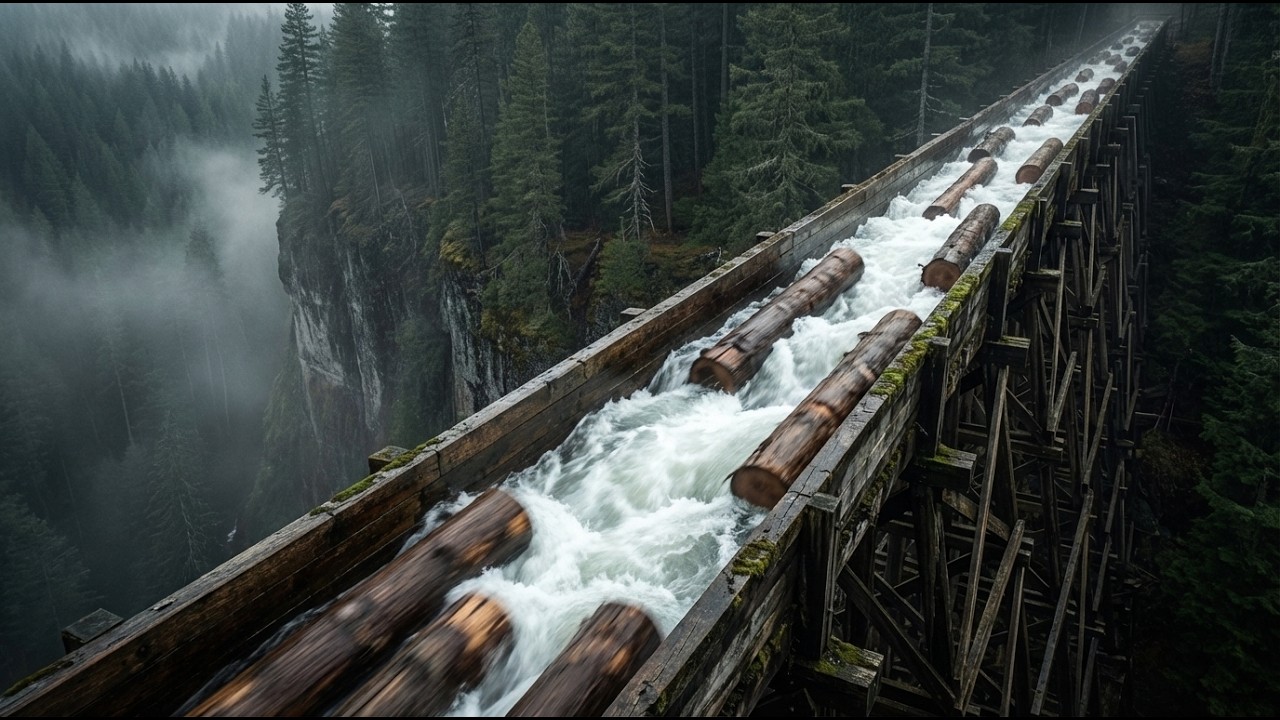
They had witnessed it before, and they would witness it again. During the 1880s, America raised rivers into the sky. Wooden troughs, a few of them running more than fifty miles, floated millions of board feet of timber down the Sierra Nevada and the Rocky Mountains using only water and gravity, beating the trains and costing a fraction as much. These flumes spanned hundred-foot ravines on trestles built by hand, clung to bare cliff walls, and were made entirely from the very material they transported.
It sounded close to impossible, yet the real question was not merely how they were engineered. It was what pushed a nation to try something so daring in the first place. That story started with a craving for lumber so fierce it was remaking the continent. By the late 1800s, America’s appetite for timber was insatiable.
Railroads sliced across the country, and every mile called for thousands of oak and pine ties, bridge timbers, and car frames. The Union Pacific and the Central Pacific alone used an estimated 30 million board feet of lumber each year just to keep their tracks running. In cities such as Chicago, San Francisco, and Denver, growing populations drove a building boom that swallowed nearly 40 percent of the nation’s timber output for framing, flooring, and finish work. After the Chicago fire of 1871 wiped out miles of wooden buildings, the rush to rebuild drove demand for Douglas fir and fire-resistant studs even higher.
Mining towns in Nevada, Colorado, and Montana consumed wood for shaft supports, headframes, and ore chutes. Company records from that era show contracts for 5 to 8 million board feet annually, with orders climbing whenever silver or copper prices jumped. Shipyards on both coasts, particularly in San Francisco and Portland, depended on West Coast fir and hemlock for hulls and decks, bringing in 2 to 3 million board feet every year to keep pace with the expanding merchant and naval fleets. All of that timber came from the broad belts of the Sierra Nevada, the Pacific Northwest, and the Rocky Mountains.
In the Sierra, firms like Union Lumber and San Joaquin Lumber cut 6 million board feet a year at their peak, supplying San Francisco’s endless hunger for construction lumber. In the Pacific Northwest, giants such as Weyerhaeuser and Herman Brothers shipped up to 25 million board feet annually, with logs floated down rivers or stacked at mill yards near deep-water ports. Even the Rockies, with their rough slopes and scattered mining claims, produced 4 million board feet a year, mostly ponderosa pine and lodgepole for nearby mines. As the easiest timber disappeared near rivers and rails, loggers confronted steeper, more isolated forests.
The old methods — horses, oxen, and sleds — could not keep up. The demand for faster, more efficient timber hauling grew urgent, paving the way for new solutions. The forests feeding the boom were anything but easy to reach. Thick stands of Douglas fir, ponderosa pine, and western hemlock spread across the Sierra Nevada, the Pacific Northwest, and the rugged Rocky Mountains.
These were not gentle woodlands beside wide rivers or city roads. The richest stands grew high on mountain slopes, wedged between granite ridges and deep canyons, sometimes at elevations above 5,000 feet. In the Sierra Nevada, the finest ponderosa pine grew on the western slopes, while Douglas fir dominated the steeper, cooler ridges. The Pacific Northwest held vast tracts of fir and hemlock, with some trees rising more than 200 feet tall and thriving in the rain-soaked foothills of Washington and Oregon.
The Rockies supplied ponderosa and lodgepole pine, but the terrain was even more broken, with narrow valleys, sudden cliffs, and snow that stayed well into spring. Reaching these trees was only half the struggle. Once felled, logs had to be moved out of forests miles from the nearest rail line or navigable river. In the early days, teams of horses or oxen dragged timber over rough trails inch by inch, sometimes using sleds on packed snow in winter.
Where the ground was too steep or broken, loggers laid temporary wooden roads or tried rolling logs downhill, risking splintered wood and runaway timbers. River drives worked in the Midwest, but out west, many mountain streams were too small, too rocky, or too dry for floating logs. Geography itself placed strict limits on how much wood could reach the growing cities and railroads below. The isolation of these forests drove engineers and lumbermen to seek new ways of moving timber.
The challenge was not only distance; it was the unrelenting pull of gravity, the constant risk of landslides, and the sheer remoteness of the supply. These realities narrowed the choices and set the stage for a bold answer: harnessing gravity itself to build wooden flumes that could carry logs for miles down the mountainsides. The next step was working out how to make such a system function on ground that offered no easy path, across terrain that seemed determined to keep its trees out of reach. Dragging logs out of mountain forests tested every method known to nineteenth-century lumbermen.
Teams of horses and oxen, the backbone of early logging, could hardly move massive Douglas fir or ponderosa pine over the rocky, uneven ground. Each animal could haul only a few logs at a time, and every trip meant hours of backbreaking labor for both beast and driver. In winter, sleds gave a brief advantage, gliding over snow-packed trails, but as soon as the thaw arrived those same paths turned to mud, halting operations for weeks. Even when the snow held, steep grades and sudden drop-offs made sledding a gamble, with runaway loads crashing down slopes or disappearing into ravines.
Temporary rail spurs promised speed, but building tracks through dense timber and across broken terrain cost a fortune. Narrow-gauge lines, like those in the Sierra Nevada, needed constant rebuilding as logging pushed deeper into the forest. Laying rails meant clearing land, hauling in steel, and paying for locomotives — expenses only the largest companies could afford. When the timber ran out in one patch, the rails had to be torn up and moved, burning through time and money.
In the Rockies, short rail lines often ran just a season or two before being abandoned, leaving twisted rails rusting in the brush. River drives worked wonders in the Midwest, where wide, gentle streams could float thousands of logs to distant mills. But the mountain west told a different story. Streams in the Sierra and Cascades ran too shallow or too wild, choked with boulders and snags.
Spring meltwater might float logs a few miles, yet summer dry spells could leave the channels utterly parched. Plenty of western forests stood far from any waterway deep enough to float a log, which ruled out river transport altogether. And even where a stream was usable, jams formed without warning. A single misstep could leave an entire season’s cut heaped into a snarled tangle.
Every one of these approaches had its ceiling: steep expenses, seasonal stoppages, hazardous gradients, and the plain unpredictability of mountain weather. The distance between the timber up high and the buyers down below kept stretching wider. By the 1880s, with lumber demand at a record peak and the finest stands pushed deep into the backcountry, the old methods plainly could not keep pace. A new form of engineering was needed.
It would put to work the very force that made mountain logging so hard: gravity itself. A mountain log flume started with a V-shaped channel, built from timber picked for strength and rot resistance. In the Pacific Northwest, Douglas fir was the preferred wood, valued for fast growth and its ability to stand up to water and weather. In the Sierra Nevada, ponderosa pine was the favorite, while western hemlock filled in wherever it grew in abundance.
Every plank was checked for soundness, frequently milled right on the spot, then shaped so it fit snugly against the boards beside it. Such careful fitting was no mere habit, it was a requirement. A single gap let water escape, and lost water left logs stuck. The channel’s V profile was deliberate.
With side walls angled between 30 and 45 degrees, the form held logs in the middle, letting water race fast enough to keep the timber gliding, yet not so fast that it slammed the wood against the walls. Planks were nailed to a framework of heavy wooden ribs, each one cut and fitted by hand. No two ribs came out exactly alike, since the flume wound along the mountain’s natural contours. At each joint, workers laid in strips of canvas or thin metal, then sealed the seams with hot pine pitch.
The smell of pitch drifted over the camps, tacky and sweet, while crews labored until dusk, trying to beat the next storm. Pitch alone was not enough. Along long or exposed sections, builders occasionally lined the channel with copper sheathing or canvas soaked in asphalt, particularly where the flume spanned open valleys or ran high on trestles. Every inch had to hold water.
Even a minor leak could bleed off the flow, leave logs stranded, or rot the supports underneath. Nails and bolts were picked with care. Iron corroded fast, so carpenters turned to galvanized fasteners, at times driving them at angles to pull the wood tight together. Joinery was a quiet craft.
Where two planks came together, the seam was usually beveled or shiplapped, not simply butted. This allowed water pressure to press the boards tighter, driving pitch into every gap. In spots where the flume turned sharply around a ridge or ran along a cliff, carpenters cut compound angles by hand, tweaking ribs as needed to keep the channel aligned. Each day, a lead carpenter walked the flume, tapping joints and listening for a hollow sound, the telltale of a missed seal or a warped board.
For all the crude tools and rugged ground, the finished channel was a wonder of fit and finish. Water entered at the top, sliding down the V-shaped trough in a smooth, glassy layer, hauling logs for miles. Without tight joinery and careful sealing, even the finest engineering could not hold water in or keep timber moving. Every rib, every plank, every dab of pitch was a craftsman’s reply to the mountain’s question: how to turn raw wood and gravity into a working highway.
Survey engineers confronted a challenge spanning nearly fifty miles: how to move thousands of tons of timber down a mountain using nothing but water and gravity, without shattering logs or wrecking the flume itself. Their answer started with figures, not lumber. Each route began with painstaking field surveys. Crews lugged heavy tripods and steel chains up steep ridges, measuring every rise and dip by hand.
They charted every contour, hunting for a path that would keep the water flowing just fast enough, never too sluggish, never too violent. The math was exact. For a flume to float logs over such distances, the channel needed to fall at a consistent grade, usually around 0. 35 percent, or merely 18 feet per mile traveled.
Too steep and logs would rush ahead, shattering at the curves. Too shallow and the water would stall, leaving timber stuck. Using the Manning equation, engineers aimed for a velocity of roughly 6 feet per second. That was quick enough to keep a 1,000-pound log afloat and gliding, yet slow enough to prevent chaos at every bend.
Across fifty miles, that meant a total drop of about 900 feet, a figure that lined up with the mountain profiles around places like Kings River and Madera. But gradient was only the beginning. The channel itself had to be wide and deep enough for both water and timber. Most flumes ran with a cross-section of roughly 4 feet wide and 5 feet deep, yielding a flow area of nearly 20 square feet.
With logs and water surging together, the system required a flow rate of at least 120 cubic feet per second, roughly the volume of a brisk mountain creek. Historical records from the Lake Coeur d’Alene diversion dam reveal that engineers guaranteed up to 150 cubic feet per second during dry months, creating a cushion for drought and heavy timber loads. Friction was a relentless foe. The roughness of wet wood, the seams between planks, and the curves in the flume all threatened to slow the water or snag logs.
To allow for this, surveyors built in a roughness coefficient of about 0. 05, a figure taken from government hydraulic tests on wooden channels. Each calculation allowed for the drag of pine pitch, the swelling of boards, and the debris that would inevitably gather in the trough. Controlling speed mattered just as much as managing water flow.
On long, straight stretches, logs could pick up dangerous speed. To hold things in check, engineers placed wooden baffles every couple of hundred feet. Each baffle acted as a brake, making water churn and shed energy before the next drop. Where the grade grew steeper, check gates could be lowered into the flow, pooling water and slowing the logs behind.
These simple devices, baffles, gates, and even splash pools, converted raw gravity into a controlled, predictable force. Survey notes from the Madera and Kings River projects are packed with such details: slope tables, flowcharts, and inventories of every baffle and gate. The numbers justified the risk and expense. With the right calculations, a wooden trough could haul logs for miles, spanning ravines and running along cliffs, never losing momentum.
The calculations demonstrated that water and gravity, carefully managed, could transport an entire forest to market even across the most forbidding country. Every long flume had to cross ravines and cliffs that lay directly in its route. Where the ground fell away, carpenters confronted the problem directly, raising wooden trestles that appeared to hover unsupported in the air. A few of these timber bridges climbed as high as 60 feet above the ground, exceeding a six-story building in height, and spanned gorges that would have halted any wagon, sled, or early railroad line outright.
Construction began with unprocessed logs cut close by, then stripped and squared using axes and pit saws. Every vertical support, known as a bent, was sunk deeply into the earth or fastened to bare rock. Using block and tackle, work crews raised these heavy frames into an upright position, after which they secured them with diagonal timbers, binding the entire assembly together like an enormous wooden jigsaw. The craftsmanship involved more than sheer muscle.
Hand-cut mortises and tenons, the joints of a skilled carpenter, were fitted tightly so they would hold against gravity, water, and the burden of thousands of logs passing overhead. Each cap beam had to rest exactly level to keep the flume above it running true. Rope was used to hoist the trough planks into position, where they were bolted onto the trestle and sealed with pitch so that not a single drop of water escaped. The tallest trestles on record, such as the Madera High Bridge at 62 feet and the Kings River Upper Crossing at slightly under 60 feet, tested the outermost limits of hand tools and locally cut timber.
Just the spectacle of a flume suspended in the air was enough to attract crowds of spectators and reporters. Bridge crews worked at a rapid pace, at times completing a bent within an hour. Yet the labor was never simple and frequently perilous. A storm arriving without warning might scour out newly set footings or bring an entire span crashing down.
During winter, ice sheathed the sills, and each hammer strike rang out along the canyon walls. These crews carried a fierce sense of pride. Letters sent home called the work hazardous yet exhilarating, and one carpenter described the effort as building a road in the sky. Their expertise is what made the whole flume network feasible, demonstrating that with the correct timber, the correct craftsmen, and a measure of deliberate risk, even the most untamed country could be crossed.
The trestles served as more than mere structures; they formed the spine of America’s timber highways powered by gravity. Flume camps hugged the mountainsides, collections of crude shacks and canvas tents set above the surging water. Daily existence in these camps centered on the unending needs of the flume. At dawn, flume tenders walked out along slender catwalks to inspect mile after mile of channel.
Their duties never stopped: they listened for the dull thud of a loosened plank, looked for leaks that might sap the current, and watched for the earliest indication of a jam. A single log wedged sideways could pile up a hundred others behind it, transforming a steady flow into turmoil. Breaking jams required wading into icy water, levering with six-foot peaveys, and occasionally risking a plunge into the chute itself. Winter introduced hazards of its own.
Snow piled high against the trestles, ice coated the boards, and each step turned into a risk. Crews hacked at the ice with axes and cleared snow from the trough, aware that a frozen stretch could bring the whole operation to a halt. The labor never let up. Flume tenders worked in rotating twelve-hour shifts, around the clock, typically in crews of two or three.
Records kept by the Kings River and Madera flume companies list twenty to thirty men for every ten miles of channel, sufficient to keep the water flowing, yet never enough to make the task light. The camps stood far from civilization, occasionally a full day’s walk from the closest town. Mail was delivered once a week, weather and trails permitting. In winter, supplies came in by mule or sled.
The cookhouse formed the center of camp life. Every evening, the cook, frequently the best-paid man in the camp, dished out beans, salt pork, and coffee sturdy enough to float an axe. Oral histories tell of cooks boiling 300 pounds of beans in a single batch, feeding men whose appetites matched the mountain air. Evening brought a brief respite.
By lantern light, the crews assembled to trade stories, repair boots, write letters home, or carve scraps of pine. But the rest never lasted long. At any moment the whistle could blow: a jam, a trestle knocked out of line, or a storm upstream. Mishaps happened often.
A misstep on a frost-covered catwalk, a log coming loose, a sudden surge of water. Still, pride ran strong. Letters from the period portray men who regarded themselves as shepherds of a moving forest, guiding millions of board feet down from the high country to the mills waiting below. Gravity flumes proved to be a practical solution to the difficulty of moving timber across rough country.
Yet their true strength lay in economics. During the 1880s, building a mile of flume ran between $300 and $500, with timber taken straight from the nearby forest and labor supplied by logging camps already in place. By comparison, even the simplest narrow-gauge rail line cost $1,200 to $1,500 per mile, and standard-gauge track, which called for heavier rails, extensive grading, and occasionally bridges or tunnels, could readily run past $2,500 per mile, particularly in mountainous terrain. The figures settled the question.
Flumes enabled companies to make their capital go further and push deeper into the forest. Running expenses followed the same pattern. Flumes drew on water and gravity, carrying logs with very little human effort. Once the channel was sealed and the current set, a small crew could watch over the movement of thousands of logs every day.
The cost of moving 1,000 board feet of timber by flume stayed near 2 cents, covering water rights, repairs, and the men who kept the trough clear. Railroads, in contrast, carried continuing expenses for fuel, bigger crews, and unending track upkeep. Moving the same amount by rail might cost four to six times as much. On top of that, every log had to be loaded and unloaded by hand.
Speed provided yet another benefit. Logs tipped into a flume at daybreak might reach a mill or railhead by noon, moving at three to six miles per hour without a pause. Trains, constrained by timetables and the need to load, haul, and return, advanced in stops and starts. At the height of harvest, one flume could supply 30 to 40 percent more timber than a comparable rail spur, keeping mills stocked while their competitors awaited the next train.
Across the Sierra Nevada and the Pacific Northwest, the size of these investments made sense. The Sanger flume ran 30 miles over canyons and ridges, constructed from local pine. The Madera Lumber flume, close to 19 miles in length, supplied the Southern Pacific railyard with no locomotive anywhere in sight. For these companies, every dollar saved on transport translated into quicker returns and more timber delivered to market.
Gravity-fed log flumes hit their biggest scale in the Sierra Nevada, where two storied systems established the benchmark for what such works could achieve. The Kings River flume, constructed in 1888, ran almost 30 miles from the high mountains down to the Sanger depot, winding through ravines and over more than 300 trestles. At its height, this channel moved 12 million board feet in a mere 4 months, supplying a sawmill that fed a large share of California’s Central Valley. Nearby, the Madera Lumber flume began operating in 1902, covering roughly 19 miles from the timber belt to the railhead at Madera.
Corporate records indicate it carried nearly 200,000 board feet each month, with certain stretches strengthened by concrete and faced with redwood planks to resist the churning water and relentless friction. Both flumes traced the Sierra’s contours, falling hundreds of feet in elevation and spanning ground that would have halted a wagon or a train. The channels wound past granite outcroppings, crossed valleys on timber bridges, and cut through thick groves of ponderosa pine and Douglas fir. Surveyors mapped out each bend by hand, adjusting the gradient so logs kept gliding without breaking loose.
Every mile demanded precise math and skilled woodwork, from the initial plank at the intake to the final plunge into the mill pond. These were no solitary trials. The Kings River and Madera flumes came to be celebrated as landmarks of American engineering, their names cited in trade publications and company account books throughout the West. Although certain later accounts inflated their lengths, occasionally asserting fifty miles or more, the verified main lines of thirty miles and nineteen miles still rank them among the lengthiest timber flumes ever constructed.
Their size and daring demonstrated that, given sufficient wood, water, and cleverness, even the most forbidding mountain terrain could be subdued by gravity alone. Each mile of log flume was a wager against catastrophe, no matter how carefully it was engineered. The whole system operated on a razor’s edge. Whenever a log wedged in the channel, the pressure building behind it could mount within minutes.
Workers rushed to clear jams using long peaveys, yet at times the combined force of trapped water and timber would split a joint or break a support. In 1893, a flash flood on the Nacimiento flume ripped out a 200-foot stretch in a single night. Men dove into freezing water, hurrying to close the gap before the whole line emptied out. Collisions remained an ever-present danger.
Should the gradient steepen without warning, logs might pick up hazardous speed. A 1,000-pound pine careening around a bend could smash into the sidewalls, shattering timber and scattering splinters. In spots where trestles stood 60 feet above a canyon, one runaway log could punch through the trough, showering debris onto the rocks far below. Curves and forks only multiplied the hazards.
A turn too tight, and the water’s momentum would hurl timber sideways, endangering the structure and anyone unfortunate enough to be close by. Flooding was hardly the sole threat. Torrential rains or spring snowmelt could exceed the flume’s capacity, driving water over the edges and washing away the very supports beneath it. A break meant far more than a repair cost.
It could trap miles of timber, halt the mill, and cut off a crew until the harm was repaired. Fire presented yet another danger. A single spark from a camp stove or a lightning bolt could set dry pitch alight, racing down the wooden channel and turning months of labor into cinders within hours. For the men tending the flumes, every shift carried fresh peril.
Slick catwalks, unexpected leaks, and the constant possibility of collapse turned safety into a matter of watchfulness and chance. Company records document accidents, tumbles from trestles, mangled limbs, close calls with drowning, and the steady strain these hazards placed on work crews. The very speed and efficiency that gave the flumes their worth also made them merciless. Any breakdown, whether mechanical or human, could cost not only timber but lives.
Water served as the lifeblood of every gravity flume, yet it carried a concealed cost. Every mile of channel required a constant flow, frequently above 120 cubic feet per second, merely to keep logs in motion. During dry summers, operators hurried to lock down adequate water, at times outbidding farmers or mining firms for rights. Account books from the early 1900s reveal yearly water charges for the Kings River and Madera flumes climbing steeply, occasionally surpassing $2,000 annually.
When drought struck or snowmelt ran scarce, whole operations slowed to a near halt, with timber stacking up in the woods and crews idling until the next rainfall. The expense of maintaining the flumes in working condition only mounted over time. Wooden troughs, pounded by water and weather, required continual repair. Company records from the Sanger operation show trestle repairs at $5,000 per year, with labor adding a further $1,500 every month just to keep men on patrol clearing jams and sealing leaks.
Every couple of years, miles of planking demanded replacement, and occasionally whole sections had to be rebuilt following a fire or flood. Blazes in 1917 and 1933 destroyed long stretches of both the Kings River and Madera flumes, requiring expensive reconstruction or, in certain cases, permanent closure. Even as income declined, costs never eased. Water rights, repairs, and wages consumed profits, transforming once-lucrative flumes into financial drains.
Railroads and trucks started rewriting the principles of timber hauling in the early twentieth century. Locomotives and rail lines became stronger and more dependable, despite having once been hampered by steep grades and the expense of laying track. Narrow-gauge lines pushed farther into the mountains, traversing ground that had formerly been the exclusive domain of flumes. Unlike water-driven channels, these rails could run all year, unaffected by drought, winter freezes, or the seasonal flow of mountain streams.
Trains moved logs in any weather, day or night, and could head back uphill carrying supplies, equipment, or replacement crews. Where a flume required a steady water source and a delicate slope balance, a locomotive merely consumed fuel and continued on. By the 1920s, trucks brought a fresh dimension. Early logging trucks, equipped with chain drives and solid rubber tires, rolled over rugged mountain roads, transporting timber directly from the cutting site to the mill or railhead.
These machines relied on neither gravity nor the course of a stream. They could climb, turn, and detour at will. Motorized transport shattered the old limits, reaching stands of fir and pine that flumes could never access. Companies no longer needed to construct miles of wooden trough or wait for the snow to thaw.
Rather, they put money into roads and vehicles, aware that trucks could haul other cargo once the timber was gone. The change went beyond machinery. Railroads and trucks offered speed, flexibility, and the capacity to keep operating through dry spells or winter storms. As the technology advanced and engine costs fell, the economic advantage of gravity flumes diminished.
The very qualities that had once made flumes remarkable—basic materials, local crews, and ingenious water use—now found themselves beaten by steel rails and the internal combustion engine. Wooden water highways were yielding to an age of iron and rubber, a turning point in the saga of American logging. The figures make it plain. What had started as a smart, inexpensive fix for a problem the size of a mountain turned into a weight few companies could carry.
By the time trucks and trains pushed into the high country, the old wooden flumes had already gone quiet, abandoned by the progress they themselves had helped create. Today, remnants of flumes such as Kings River and Madera silently commemorate a moment when American ingenuity transformed mountains into machines. Their seeming simplicity concealed daunting calculations, unrelenting labor, and genuine danger—solving a crisis that powered the growth of an entire nation.
