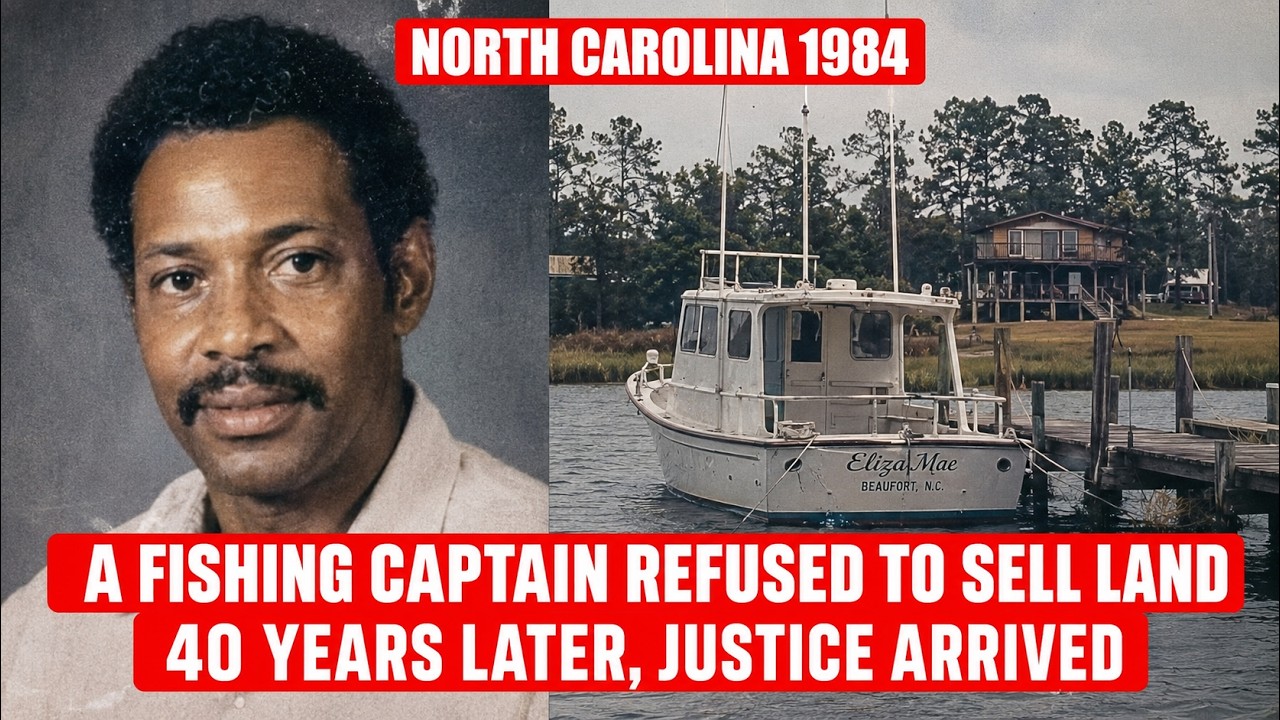
In October 1984, a charter boat captain in Carteret County, North Carolina, was discovered lifeless on the deck of his own vessel. He had turned down an offer to sell 14 acres of waterfront land his family had held for 63 years. Investigators ruled it a robbery. His wallet was gone. The inquiry ran 11 days and ended without a single arrest.
His daughter then devoted the next 40 years to becoming the sort of person capable of proving them wrong. And in 2021, a historian at a university in Greenville, North Carolina, drew a deed from a county registry that had sat in plain view for 37 years. A document forged so skillfully that it had deceived every set of eyes that crossed it until hers. What she detected in the paper stock, the ink, and the spacing of a notary stamp that sat 2 mm off from every other stamp in that registry would pry open a case the county had shelved as solved by misfortune—and would put a name to a man who had spent four decades seated at the head of public meetings, cutting ribbons, and assuring the people of Carteret County that he was one of them.
He was. That was precisely the trouble. James Earl Pridgen had been born in Beaufort, North Carolina, in 1926. The third child of a man named Ezra Pridgen, who had returned from the First World War with his body whole and a specific, clear-eyed notion of what he meant to do with the years he had been granted.
Ezra Pridgen had saved. He had worked the oyster beds and the crab pots, and he had set money aside with the particular discipline of a man who knows that opportunity does not come calling twice. And in 1921, when a 14-acre parcel on Core Sound came open through an estate sale, he had bought it. The land was not much to look at.
Low, brackish, cordgrass, and live oak. The kind of coastal ground that in 1921 no one had assigned much value to beyond whatever it yielded from the water. Ezra Pridgen had not bought it for what it was then. He had bought it because it belonged to his family, free and clear, and that was an entirely different sort of value.
Jimmy Pridgen grew up on that land. He swam in Core Sound from the age of five. He learned to read the tides the way other children learned to read the clock. When he returned from Korea in 1953, he never left Beaufort again.
He bought a second-hand boat, had it repaired and repainted at a yard in Morehead City, and named it for his mother, Eliza May, who had died the winter before. He ran charter fishing trips out of the Beaufort waterfront—red drum, flounder, bluefish, speckled trout—for 22 years, building a clientele that traveled from as far as Raleigh and Charlotte to fish with a captain who knew Core Sound the way only a man raised on it can. He was 58 years old in 1984. He had three children, nine grandchildren, and a mooring at his own dock on the 14-acre parcel Ezra Pridgen had purchased in 1921 for $640.
At People’s Chapel Baptist Church in Beaufort, Jimmy Pridgen served as a deacon for 19 years. He was the man people called when the church roof needed negotiating with a contractor. When a family in the congregation had fallen behind on a bill and needed it handled quietly. When the youth group needed transportation to a county fair and he had the truck to provide it.
He was known across Carteret County the way people of genuine substance are known. Not because he chased visibility, but because his presence in any situation made that situation more manageable. A white shrimper who had fished alongside him for 15 years told an investigator years after his death that Jimmy Pridgen was the most decent man he had known in 40 years of working the sound. He said it without qualification, which in 1984 Carteret County was itself a statement of some specificity.
The land had been coveted by others for a decade before Jimmy died. The Core Sound waterfront was shifting. Vacation development was creeping down the Crystal Coast in the early 1980s. Marinas and rental cottages and the particular architecture of leisure that follows money to the water.
A development consortium incorporated in Raleigh had singled out the Pridgen parcel in 1975 as the last piece of a planned marina complex on the sound. They had made three offers. Jimmy had turned down all three. His refusal was neither dramatic nor drawn out.
He simply said no. The way a man says no to something he has already fully weighed and settled within himself. The land was his family’s. That was the entirety of the answer.
The consortium’s third and final offer in August 1984 was for a sum that Jimmy’s daughter Celestine would later describe as insultingly reasonable. Enough to mean something. Not enough to mean what the land meant. Jimmy said no on a Tuesday.
He was dead 6 weeks later. His youngest daughter, Celestine, was 19 in October 1984 and enrolled at North Carolina Central University in Durham, studying business administration. She was home for fall break the weekend her father was found. She had spoken with him by phone the Thursday before about nothing in particular.
He had asked about her coursework. She had asked whether the red drum were running. They had talked for 20 minutes about ordinary things. She would say for the rest of her life that the last thing he told her was that the weather was going to turn and he needed to get the boat winterized before it did.
He sounded like himself. He always sounded like himself. The Eliza May was moored at Jimmy Pridgen’s private dock on the morning of October 23rd, 1984, when a neighboring property owner, walking his dogs at first light, noticed that the boat’s stern light was still burning. He went to the dock.
He found Jimmy Pridgen on the deck where he had lain since some time the previous evening. The neighbor ran back to his house and called the Carteret County Sheriff’s Department. Deputy Ronnie Hughes was first on the scene. He was 26 years old, 3 years with the department.
He noted the body, noted the position near the stern on the deck, and noted that Jimmy Pridgen’s wallet was not in his trouser pocket. He radioed the detail about the wallet within the first 15 minutes. That detail—the missing wallet—became the lens through which everything that followed was read. Robbery gone wrong.
A boat captain known to carry cash from charter trips, targeted on the water at his own dock on an evening when the dock was unlit and the road above it was quiet. It made a kind of sense. It was the kind of sense that closes a file. The SBI was called in to assist.
For 11 days, two agents worked the case side by side with the county sheriff’s investigators. They swept the waterfront. They talked to other boat owners, dock hands, regular charter customers. What they came away with was nothing: no witnesses, no physical trace of a robbery in progress, no one who had spotted a stranger hanging around the dock.
The death had come from one blow to the head, the kind delivered by a heavy blunt object that was never found. The SBI decided there wasn’t enough evidence to bring charges and handed the case back to the county. Sheriff Dale Macon opened it as an ongoing investigation with no active leads. By the spring of 1985, it was for all practical purposes closed.
Celestine raised the land dispute with the investigators exactly once. The week her father died she drove back from Durham, sat down across from Deputy Hughes at the county sheriff’s office, and laid out the consortium, the three offers, the final refusal in August. She was 19 years old, 3 weeks out from her father’s funeral, sitting in a county office in a county where her family had held land for 63 years, being told that the likeliest explanation for her father’s death was a robbery of opportunity. She told Hughes about the consortium. He wrote down, “Daughter reports prior land dispute, development company, Raleigh.
” He never followed up. No one contacted the consortium. No one pulled the deed records. Gerald Foss, register of deeds for Carteret County since 1979, was never interviewed.
His name appears nowhere in the investigation file. In the spring of 1985, the North Carolina NAACP filed a formal complaint with the state attorney general’s office, contending that the inquiry into Jimmy Pridgen’s death had been inadequate and that the inadequacy fit a pattern of indifference toward crimes against black residents of Carteret County. The complaint was received. It was acknowledged.
It was filed. The investigation stayed closed. Gerald Foss came to Jimmy Pridgen’s funeral at People’s Chapel Baptist. He signed the condolence book.
He exchanged a few words with Celestine’s mother, offering his sympathies. He stood in that room—the man who kept the county’s records, a post of some dignity and considerable trust. By then he had already drawn up the forged deed transfer documents that would have moved the Pridgen parcel to a shell company tied to the consortium, contingent on proof of clear title once Jimmy was dead. Those papers sat in a personal filing cabinet in his home office.
When the consortium fell apart in 1987, after a separate legal fight with another property owner, Foss had believed—had assumed, with the certainty of a man who controls the records—that the documents would never have to see daylight. He had not destroyed them. He would spend the next 37 years coming to understand that this had been a mistake, slowly, the way a man comes to understand something he cannot afford to fully admit. Celestine Pridgen Moore did not return to North Carolina Central after her father’s death.
She went back to Beaufort. She mourned, and then she enrolled at Pitt Community College to study paralegal studies, and she was not subtle about why whenever anyone asked. Her father, she said, had been murdered over 14 acres of land, and nobody had looked at the land. She said it in 1985, in 1990, in 1995.
She assembled a file—a physical one first, then a digital one, then both—holding the consortium’s incorporation documents, the three offer letters her father had kept in his desk drawer, the property records for every parcel the consortium had bought or tried to buy on Core Sound between 1975 and 1987, and every document she could get her hands on concerning the deed history of her family’s land. She was no lawyer. She was no investigator. She was a paralegal who knew documents, who knew what a chain of title was supposed to look like, and what it looked like once someone had tampered with it.
In 2019, she sent the file to the North Carolina SBI’s Cold Case Unit with a four-page cover letter listing specific document anomalies she had found in the Pridgen parcel’s deed history, checked against the county registry’s own index. The Cold Case Unit received the file. They assigned it for review. The review went into a queue, because cold case units work through queues, and because a 1984 homicide with no biological evidence and a 35-year-old file is not, by the internal arithmetic of resource allocation, an urgent case.
The file sat in that queue for 2 years. Jimmy Pridgen’s family kept the Eliza May at the dock. They had reached that decision together in the winter after Jimmy’s death. There was no extended debate; it was simply understood that the boat was part of what he had left behind, and that pulling it from the water would be a concession they were not willing to make.
Celestine’s brother ran charters with it for a season. Then it sat. Then a nephew learned how to maintain it. The registration was renewed every year.
For 40 years it sat in the water at the private dock on the 14-acre parcel on Core Sound. Gerald Foss was reelected register of deeds in 1988, in 1992, and in 1996. He ran for Carteret County Commissioner in 1998 and won. He served three terms.
He left public life in 2010, honored at a small ceremony at the county administration building where he was thanked for 31 years of service to Carteret County. He settled into retirement with the particular ease of a man who has decided that the thing he is not thinking about has ceased to exist. He was wrong. It had merely been waiting for the right pair of eyes.
And for what a historian turned up in a deed registry in 2021. Dr. Anita Broadnax was an assistant professor of history at East Carolina University in Greenville. Since 2018 she had been building a database of black land ownership in coastal North Carolina.
The project traced the acquisition, retention, and in many cases forced loss of black-owned waterfront property from Reconstruction through the late 20th century. The Pridgen parcel was in her database. In the spring of 2021, working through Carteret County’s historical deed records, she pulled the conveyance documents for the 14-acre parcel on Core Sound and started cross-referencing them against her database’s timeline. The document that made her stop was dated October 31st, 1984, 8 days after Jimmy Pridgen was found on the deck of the Eliza May.
It was a deed transfer handing the Pridgen parcel to a shell company called Coastal Sound Properties LLC, signed with a signature claiming to be James Earl Pridgen’s and notarized by Gerald R. Foss in his capacity as register of deeds. Broadnax read it twice. Then she pulled every other document notarized by Gerald Foss in the county registry between 1979 and 1996.
The notary stamp on the October 1984 document measured 2 mm narrower than every other stamp in the set. The ink was of a slightly different composition. The paper stock, which she determined through texture and light transmission characteristics, did not match the county’s standard supply for that period. She photographed all of it.
She telephoned the North Carolina State Archives. An archivist there verified her findings. A forensic document examiner engaged by the SBI verified them further. The October 1984 deed transfer was a forgery, executed on paper stock Carteret County did not use, bearing a counterfeit notary stamp.
The signature did not match Jimmy Pridgen’s authenticated signature on file from a 1979 mortgage document, and the SBI’s cold case unit checked the finding against Celestine Pridgen Moore’s 2019 submission, which had flagged the same document as anomalous, though Celestine had lacked the forensic capacity to say precisely why. Low copy number DNA analysis of the document’s surface recovered a partial profile consistent with handling. Consistent, the forensic laboratory confirmed, with Gerald Foss, whose DNA was in the national database after a minor medical procedure that had involved genetic screening through a hospital system linked to the federal registry. The SBI did not contact Celestine Pridgen Moore before the arrest.
They reached her the following morning. The agent who called said, “Miss Pridgen Moore, I need to tell you that we arrested a man last night in connection with your father’s death.” She said, “Was it about the land?” The agent said, “It was about the land.”
” There was a pause. She said, “My father knew. He always knew it was about the land.” The agent had no idea what to say to that.
There was nothing to add. Gerald Foss was arrested at his home in Beaufort on the evening of March 14th, 2024. He was 76 years old. He had been retired for 14 years.
He came to the door in a cardigan, his wife behind him in the hallway, and when the lead SBI agent identified herself and stated the charge, murder in the first degree, James Earl Pridgen, October 1984, Foss looked at her with an expression the agent would later describe as less like surprise than like the end of a very long wait. He said, “All right.” He said it quietly, without inflection. He did not ask about the evidence.
He did not ask about the warrant. He said, “All right,” and turned back to his wife and told her to call their son, and then he walked out onto the porch and let the agent place the cuffs. In Beaufort, the arrest did not arrive. It detonated.
Gerald Foss was no peripheral figure. He had served as register of deeds for 17 years. He had been county commissioner for 12. His wife had run the county fair bake competition for a decade.
His name was in the county record books in the most literal sense possible. It was on the documents. It was in the indices. It was stamped on thousands of legitimate conveyances that real families had trusted him to execute correctly.
The people who had known him longest found themselves performing the same sick audit every community performs when a trusted figure is exposed, going back through memory, searching for the moment they should have seen it, finding nothing. One former county clerk said she had worked alongside Foss for 11 years and that he had been, in her experience, meticulous and fair. She said it the way people say things they can no longer afford to mean the same way. Celestine Pridgen Moore drove to Beaufort from her home in New Bern the morning after the arrest.
She went to the dock. She stood on the deck of the Eliza May, which the family had kept in the water for 40 years, and she looked out at Core Sound, where the cordgrass was turning gold in the March light, and where the tide was doing what tides do, regardless of what men have done on shore. And she stood there for a long time. She did not say anything that she reported to anyone.
Some things are said to the water. Gerald Foss was tried in Carteret County Superior Court in the autumn of 2024. The prosecution presented the forged deed, the forensic document analysis, the DNA evidence, the consortium records, the three offer letters Jimmy had kept in his desk drawer, and the contents of Celestine’s 40-year file, which was entered into evidence as a body of supporting documentation the prosecution described, correctly, as the work of a person who had understood from the beginning what the investigation had failed to see. Foss’s defense argued that the DNA evidence from a document handled 40 years ago was insufficiently reliable, that the document forgery, while conceded, did not establish that Foss had committed murder, and that the link between the forged deed and the crime was circumstantial.
The jury deliberated for 9 hours. They convicted on all counts. Gerald Foss was sentenced to prison. He was 76 years old.
He had kept the county’s records for 17 years. He had attended Jimmy Pridgen’s funeral and signed the condolence book and told Celestine’s mother he was sorry for her loss. And then he had gone home and left a forged deed in a filing cabinet and spent the next 40 years running on the assumption that records only matter if someone looks at them. A historian looked.
Jimmy Pridgen was 58 years old. He learned to read the tides from the time he was 5 years old. He named his boat after his mother. He was the man the congregation called when something needed handling and he handled it without drawing attention to himself because substance is not the same thing as performance and he understood the difference.
He refused to sell 14 acres of land that his grandfather had bought in 1921 for $640 and he refused it because the land was his family’s and that was the whole of the answer. And someone decided that the answer was not acceptable. He was found on the deck of the Eliza May on the morning of October 23rd, 1984 and a deputy wrote down a detail about a missing wallet and the frame went on and the file went in a drawer and a forged deed sat in the county registry for 37 years under the name of the man who had forged it. Celestine Pridgen Moore spent 40 years building a file.
She was 19, just three weeks past her father’s funeral, when she first urged an investigator to examine the land. By the time she turned 60, a historian she’d never met retrieved the same document she had flagged back in 2019 and verified—through the width of a notary stamp and the makeup of an ink—that her father had been right about everything. The file she had assembled, with its offer letters, incorporation papers, deed irregularities, and cross-referenced indices, was submitted as evidence in a Carteret County courtroom in 2024 and helped secure a conviction against the man who had signed the condolence book at her father’s funeral. The Eliza May remains in the water.
The registration is up to date. The land on Core Sound—the 14 acres Ezra Pridgen purchased in 1921—still belongs to the Pridgen family because the forged deed was never recorded as valid and because Celestine spent four decades ensuring the chain of title held. That is what the land signifies. That is what keeping the boat in the water signifies.
That is what forty years of a file in a box signifies. This case forces certain questions. In 1985 the NAACP filed a formal complaint asserting that the investigation was inadequate and racially motivated in its indifference. That complaint was received, acknowledged, and filed without result.
The case sat for forty years. What does it mean that the breakthrough came not from law enforcement but from a university historian working on a project about black land loss in coastal North Carolina? And what does that reveal about where investigative pressure in these cases actually originates? Celestine flagged the deed irregularity in her 2019 submission to the SBI two years before Dr.
Broadnax found it independently. The cold case unit had the file in a queue. If Broadnax hadn’t pulled that deed when she did, how much longer? And Gerald Foss said all right at the door when he was arrested.
No surprise, no denial. Just two words that suggested he had been waiting for this. What does a man think about for forty years when he is living with something like this? And does thinking about it constitute its own form of punishment?
Or is that too generous? Jimmy Pridgen’s family kept the boat in the water for forty years. They renewed the registration every year. They kept the land.
That is not a small thing. That is a form of answer that does not require a verdict to be true. If you believe that a deed in a county registry and a historian’s eye and forty years of a daughter’s file can outlast the man who thought he had buried all three, subscribe so you don’t miss the next case. More solved cold cases are in the description below.
Thank you for watching.
