Across the great houses of England, there grew a quiet ritual of preparation for Queen Mary’s visits. The best silver was carried up to the attic. The finest chairs were hidden in distant rooms. Hosts smiled and said nothing, because the most admired queen of her age had a private appetite that no one in Britain was permitted to refuse.
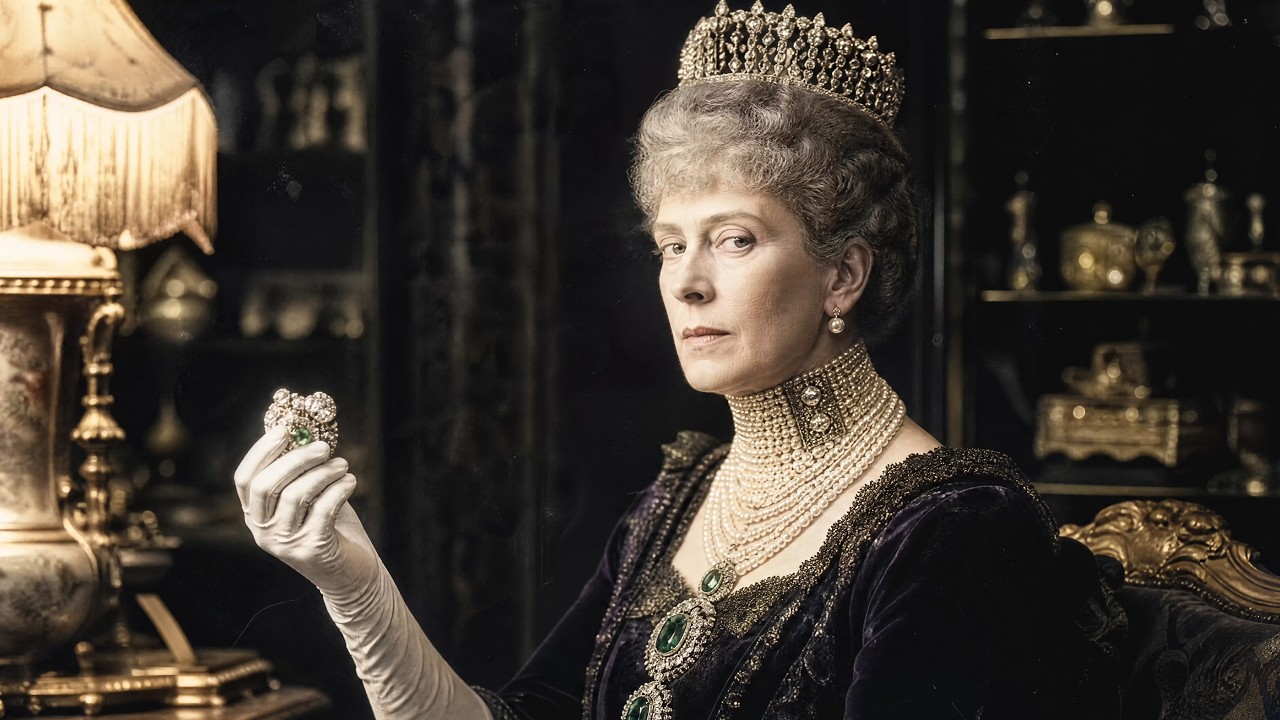
She would lift a small treasure, turn it in her gloved hand, and remark how well it would suit her own collection. Then she would wait. The same woman, however, had begun life as the poor relation of a family that had fled abroad from its debts. And the same woman would freeze out her own son and keep another hidden away from the world.
She was born in the very room where Queen Victoria had drawn her first breath, on the 26th of May 1867, at Kensington Palace. Christened Victoria Mary Augusta Louise Olga Pauline Claudine Agnes, she was called May for the month of her birth. Her mother, Princess Mary Adelaide, was a granddaughter of George III and a beloved, generous figure in London society, so stout that wits called her Fat Mary behind her back. Her father, Prince Francis of Teck, came of the royal house of Württemberg, but through a morganatic line.
His own father had married a Hungarian countess of lesser rank, and by the merciless arithmetic of royal blood, that made the entire Teck line suspect. In the marriage market of the European courts, that single fact governed everything. May was grand enough to be curtsied to, yet never grand enough to be wed as an equal. She grew up caught between two worlds, admitted everywhere and belonging nowhere.
What she felt most keenly, from childhood onward, was the steady and humiliating absence of money. Her mother could not hold a coin, spending beyond every income and sinking deeper each year beneath mounting bills. In 1883, when May was sixteen, the debts grew past the point of concealment, and the family fled England altogether, living cheaply on the continent. For a girl raised at the very elbow of the royal family, the shame was total and public.
They drifted through Europe and settled for a time in Florence. There, among the art and old churches, the great contradiction of May’s life was forged. Florence was a poor girl’s paradise of beautiful things she could not have. She taught herself to read paintings, to weigh porcelain, to tell the genuinely fine from the merely old.
She became a serious scholar of beautiful objects with not a penny to buy them. Those years planted in her a permanent hunger, and the private resolution that what she could not be given, she would find another way to hold. A beautiful object, once wholly hers, was a fortress against the poverty that had dissolved her family. It could not be frittered away.
It held its worth and often grew in it. In December of 1891, Prince Albert Victor, second in line to the British throne, knelt to the poor Teck girl and asked her to be his wife. The match was arranged by Queen Victoria herself, who had studied May closely and liked what she found. The old queen understood that a shaky throne stood in need of steadying, and that character could be worth more than pedigree.
For six short weeks, the whole ledger of May’s life seemed rewritten. Then, in the first days of January 1892, influenza reached Sandringham and turned with terrible speed to pneumonia. On the 14th of January, Prince Albert Victor died at twenty-eight. May, formally engaged for barely six weeks, stood outside every possible role at once.
The family did not let a useful girl slip away over something as ordinary as death. They moved her along to the next brother in the line. Prince George, Duke of York, was a very different man, precise, dutiful, and painfully shy, a naval officer who disliked fashionable society. George proposed in May of 1893, and they were married on the 6th of July.
Against all the long odds of the age, the arrangement produced something close to a real marriage. In an era when royal husbands kept mistresses as a matter of course, George wrote to May every day they were apart and never took a mistress. They were a pair of born cataloguers, happiest when a thing was named, dated, and set in its proper place. She was the Duchess of York, then Princess of Wales when Edward VII came to the throne in 1901.
On the 6th of May 1910, George became king, and the girl whose family had once fled its creditors was crowned queen consort. At the Delhi Durbar of 1911, she was proclaimed queen empress of India before the assembled princes of the subcontinent. From the moment she became queen, Mary set about the royal collection with a scholar’s discipline. Over four decades she added more than two thousand objects.
She combed the old inventories of the royal houses, treating every gap as a personal debt owed to her. When George IV’s long-lost accounts resurfaced in 1913, she went through them with a pencil, matching an entry to an object, an object to a room. When the trail led to pieces that had been lent out and never returned, she wrote directly to the holders and asked, in the politest terms, for their immediate return. The letters were very hard to refuse.
With her own family, she proved equally determined. When her brother Frank left the Cambridge Emeralds to his mistress, the new queen moved within months to reclaim them. Through her brother’s executors she bought them back from Lady Kilmore for £10,000, a sum close to three times what the stones were honestly estimated to be worth. Then she closed the whole story down.
She had her brother’s will sealed by the court, shutting the scandal away from public view. It stayed sealed for more than a hundred years, finally unsealed only in 2024. The emeralds themselves were reset and reworked to her own taste, and they passed down through the family to be worn by her granddaughter Queen Elizabeth II and later by Queen Camilla. One acquisition that looked most like plunder carried a clean receipt.
A Russian imperial tiara, the Vladimir tiara, had belonged to Grand Duchess Maria Pavlovna, a formidable woman who had kept a brilliant rival court before the revolution. When the revolution came, her jewels were hidden behind a wall in her palace. Her son and a British art dealer disguised themselves as workmen, found the safe, and smuggled the jewels out of Russia. The Grand Duchess died in exile in 1920.
In 1921, her daughter, Princess Nicholas of Greece, decided to sell some of her dead mother’s jewels to live. Queen Mary bought the Vladimir tiara and had it repaired. It remains among the most admired jewels in the royal collection. There were times when the acquirer met a woman she could not outrank.
Her eldest son, David, had become King Edward VIII in January 1936, and he was in love with Wallis Simpson, an American twice divorced with both former husbands still living. As supreme governor of the Church of England, he could not marry her and keep the throne. Mary had met Wallis Simpson exactly twice, both empty formal encounters. She refused to receive her again, judging her wholly unsuitable, calling her an adventuress.
When pressed, she snapped four words: because she is an adventuress. On the 11th of December 1936, Edward VIII signed away the throne of the largest empire on earth rather than give her up. He had reigned less than eleven months and never been crowned. The crown passed to his shy, stammering younger brother, who became George VI.
Mary threw the full weight of her will behind him. Asked whether her exiled son would ever come home, she answered, Not until he comes to my funeral. She kept that door shut for the rest of her life. The former king, now the Duke of Windsor, wrote to her more than once pleading for acceptance.
She answered each time with the creed of her life, that she had put her country before everything else and could not now change. The son who obeyed the crown received her loyalty. The son who chose love over the crown received a shut door. In 1939, when the second war came, her son the king urged his widowed mother out of London.
On the 4th of September she left Sandringham for Badminton House in Gloucestershire, arriving with a household of fifty-five servants and seventy pieces of luggage. She formed what the household called her ivy squad, tearing ivy down from the stonework and wooding the grounds, handing cigarettes to her dispatch riders at breaks and learning their birthdays so she could give presents. She collected scrap metal with such enthusiasm that her raiding parties swept up the farmers’ field tools, which had to be returned afterward. She gave lifts to servicemen along the country lanes.
During the air raids she sat bolt upright in a reinforced room doing crosswords, and in time simply stayed in her own bed. When she learned her son Prince George, the Duke of Kent, had been killed in an air crash in August 1942, she traveled to Windsor for the funeral. Through it all she kept shopping through the antique shops of Bath. The appetite did not pause for anything.
When the war ended, the London home she had trembled for, Marlborough House, was still standing. She returned in the summer of 1945 and took up again the burden of being Queen Mary. In 1952 her son George VI died before her, worn down and gravely ill. Mary, who had already buried a husband and three sons, outlived yet another king.
The crown passed to her granddaughter, Elizabeth II, a young woman in whose making Mary had taken a deliberate hand, teaching her that duty must always come before the self. Queen Mary died in her sleep at Marlborough House at 8:20 in the evening on the 24th of March 1953, at the age of eighty-five, ten weeks before her granddaughter’s coronation. Her last command had been that the coronation was on no account to be postponed or dimmed for her sake. She lay in state in Westminster Hall, and the long crowds filed past.
She was buried beside her husband in St. George’s Chapel at Windsor. Her estate was valued at just over £46,000. The objects outlived her, and so did the legend.
The fine things still went up to the attic before she came to tea. She was no thief, for nothing was ever proved stolen. She was no monster, for she loved in her own guarded way and grieved in her own iron one. She was the one person in all of England whom the whole structure of society had been built never to refuse, and she spent a long lifetime discovering how much that one fact would allow a determined person to hold.
She gathered treasures and a throne and a whole century. The only things that ever slipped through her grasp were the ones that could never be seized, only freely given. Having never learned to ask for them, she let them go one after another, and called the losing of them duty.






