On the 30th of April 1555, London’s bells pealed for hours and bonfires blazed in the streets, all in celebration of the birth of a healthy prince. But no prince existed. There had never been a child at all. Most people know Mary Tudor as Bloody Mary, the queen who dispatched nearly three hundred souls to the stake.
Yet the most brutal thing about her reign wasn’t the flames. It was unfolding within her own body. Mary Tudor was born on the 18th of February 1516 at the Palace of Placentia in Greenwich. She was the only child of Henry VIII and Catherine of Aragon to survive infancy.
Her mother had conceived at least six times—six pregnancies, one daughter who lived. The others were miscarriages, stillbirths, and infants who perished within weeks. Mary came of age amid the ruins of that record. Before she could read, she grasped the arithmetic that governed her family.
A queen’s body was a political tool. A womb that failed was a national crisis. And her mother’s failure was soon to strip her of everything. For a time, Mary was the most prized child in England.
Henry paraded her before ambassadors like a prize. He pledged her on paper to a French prince, then to the Holy Roman Emperor. In 1525, at nine years old, she was dispatched to Ludlow with her own household, treated as Princess of Wales in all but the official documents. She was petite, solemn, and gravely nearsighted—so badly that ambassadors were still commenting on it three decades later.
To read, she had to hold the page almost against her face. To make out a man across a room, she had to lean forward and fix him with a hard, squinting stare that foreign envoys found profoundly unsettling. They wrote about that glare. None of them realized they were describing a flaw in her eyes rather than her character.
And that same flaw would return at the close of her life in a far more alarming form. She had everything. Within eight years, she was a servant in her baby sister’s nursery. In 1533, her parents’ marriage was declared invalid.
Mary, aged seventeen, went from princess to bastard in one legal stroke. Her household was disbanded. Her title was removed. She was sent to Hatfield to attend the infant Elizabeth, and she was barred from seeing her mother—not once, not for a visit, not even a letter that wasn’t intercepted.
Her body responded first. The Imperial ambassador reported repeatedly that Mary was unwell: headaches, sleeplessness, crushing depression, and reportedly menstrual troubles severe enough that her physicians were consulted from abroad. She was a teenager whose cycles had already grown erratic. No one at the time considered that worth recording as anything but an annoyance.
Catherine of Aragon died at Kimbolton on the 7th of January 1536. Mary was denied permission to go to her. She lost her mother without a farewell, in a house she was not allowed to leave. Five months later, shattered and isolated, she signed.
She put her name to a document acknowledging her father as head of the church, her parents’ marriage unlawful, and herself illegitimate. She was welcomed back to court within weeks. She was never made legitimate again. And that single unresolved word—bastard—would still be hanging over her twenty-two years later, on the morning she had to name an heir.
In 1544, Henry restored her to the line of succession by act of parliament, behind Edward and behind any future legitimate children. He restored her place. He did not restore her legitimacy. She was legally a bastard who might inherit England.
Henry died on the 28th of January 1547, aged fifty-five. His nine-year-old son became Edward VI, and the boy’s Protestant council came for the one thing Mary had left. They ordered her to abandon the mass. She refused.
She wrote to her cousin, the Emperor Charles V. And in 1550, imperial ships were reportedly waiting off the Essex coast to smuggle her out of the country. She hesitated. She stayed.
Three years later, that hesitation handed her a kingdom. Edward VI died on the 6th of July 1553, aged fifteen, having signed his half-sisters out of the succession in favor of his cousin Jane Grey. Jane was proclaimed queen in London. Mary, dismissed for two decades as a sick, stubborn spinster, did the single most decisive thing anyone in her family did that century.
She raced for East Anglia, raised her standard at Framlingham, and dared the country to choose. The country chose her. Jane’s regime collapsed in nine days. On the 19th of July 1553, Mary was proclaimed queen in London, and on the 1st of October she was crowned at Westminster Abbey—the first woman ever crowned Queen Regnant of England, at thirty-seven years old.
She had seized a throne with almost no bloodshed. Every drop of blood in this story still lay ahead. Because thirty-seven was late. She needed a husband and she needed a son, and she needed both at once.
Her closest advisor in those months was Simon Renard, the Imperial ambassador—the Whisperer, a man whose task was to make Spanish interests sound like Mary’s own thinking. He pressed for a Spanish marriage. He also pressed, according to his own dispatches, for the execution of her cousin Jane Grey, who was already a prisoner and already harmless. Then came Wyatt’s rebellion.
In January 1554, thousands of Kentish rebels marched on London expressly to halt the Spanish marriage. Mary confronted them in a speech at the Guildhall, and the rising fell apart. But it gave the Whisperer his argument. Jane Grey was executed on the 12th of February 1554.
She was sixteen or seventeen—her exact birth date isn’t certain. Elizabeth was taken to the Tower on the 18th of March, then moved to house arrest at Woodstock. Mary had just imprisoned the sister she would eventually be forced to crown. She married Philip of Spain at Winchester Cathedral on the 25th of July 1554, two days after meeting him for the first time.
She was thirty-eight. He was twenty-seven. The marriage treaty was drafted with brutal English clarity. Philip received the title of king and almost none of the power.
And England was not to be dragged into Spanish wars. She fell for him almost at once. He reportedly felt nothing of the kind, and made little effort to pretend otherwise in private. When he was away, she sat up writing to him late into the night, letter after letter, in a hand that grew worse as the candles burned down.
There is no evidence he wrote back with anything like the same heat. Then in September 1554, her body gave her the one thing she wanted more than his affection. Her periods stopped. Her abdomen began to swell.
Her breasts changed. Within weeks, she reported feeling the child move. Her physicians examined the signs and agreed. On the 27th of November 1554, the Privy Council wrote formally to the bishop of London that the Queen was conceived and quick of child, and ordered thanksgiving services across the capital.
The bells pealed for that as well. From this point on, everything hinged on a child being born in the spring. And during that winter, Parliament brought back the old medieval heresy laws. The first Protestant was put to death at Smithfield on the 4th of February 1555.
By the time her reign ended, no fewer than 280 people had been burned alive—56 of them women, and roughly thirty more perished in prison while waiting for the same end. This was no personal pastime. It was a judicial apparatus operated through the church courts and the Privy Council, most intensely in London and Canterbury. Certain historians contend that Mary sincerely thought she was rescuing those souls, and that the image of her as a sadist is a later Protestant fabrication.
Either way, the bodies are on record. So is the timing. She was cleansing her realm ahead of a Catholic heir’s arrival. And each fire she kindled was, to her own mind, a gift being readied for a child.
In April 1555, she went into formal confinement at Hampton Court. The arrangements were remarkable. A carved cradle, intricate baby linens, wet nurses, rockers, and nursery attendants engaged, lodged, and paid. Letters announcing the birth were drafted in advance and left with gaps—a gap for the child’s sex, a gap for the hour, a gap for the date.
All that remained was for someone to fill them in. The expected month arrived. Nothing occurred. The physicians recalculated and issued a fresh due date.
That one slipped by too. By the close of May, they had shifted it twice, and the ambassadors hovering around Hampton Court had started writing home in a markedly different tone. In early August 1555, with no announcement whatsoever, Mary departed Hampton Court for Oatlands. The nursery staff were quietly let go.
The cradle was removed. Nearly eleven months had elapsed since the first whispers of the pregnancy. The Venetian ambassador, Giovanni Michieli, had already set down the sentence that would destroy her reputation throughout Europe. The entire affair, he said, would end in wind.
There was never any public correction. There was never any official explanation. The greatest humiliation of her life was dealt with by never speaking of it again. Philip departed for the Low Countries a few weeks later, in late August 1555.
He remained away for eighteen months. The fires continued. On the 21st of March 1556, Thomas Cranmer—the archbishop who had dissolved her mother’s marriage and declared Mary illegitimate—was burned at Oxford. He had recanted again and again under pressure and was supposed to repeat it in public.
Instead, at the stake he retracted every recantation and thrust his writing hand into the flames first. He was Mary’s most personal foe on earth, and his death gave Protestant England its mightiest martyr in one afternoon. Philip at last returned in March 1557. Not on her account, but to drag England into his war with France—precisely what her own marriage treaty had been drafted to forbid.
He obtained what he wanted and sailed off again in July. In January 1558, England lost Calais. It had belonged to England for 211 years. The celebrated line about Calais being found engraved on her heart surfaces only in later accounts.
It is not documented as anything she actually uttered. What is documented is that she forfeited the last English foothold in France, and that her husband’s war had cost it. And by then, her body had begun deceiving her a second time. The symptoms came back in late 1557 after Philip’s departure—the missed periods, the swelling, the certainty.
In December and January, she had Cardinal Pole write to Philip with the news. On the 21st of January 1558, Philip answered with an expression of his joy. In March, she drew up her will in terms that presumed a living child—a child who would require a regent since the mother might not survive the birth. By the summer of 1558, the court had quietly accepted that no baby was coming.
For the second time in three years, no one said it aloud. From August 1558, Mary was plainly and gravely ill. What those around her recorded was fever that ebbed and flowed, growing weakness, fierce headaches, and deteriorating eyesight. Although the precise course has been pieced together from later summaries rather than a daily medical log, the nearsighted queen who once had to press documents against her face was now, by most accounts, nearly blind.
And she was not alone in this. An influenza epidemic was sweeping England that autumn, filling parish burial registers in London and the counties. People in her own household were dying. On the 28th of October 1558, she appended a codicil to her will.
It conceded, in cautious legal phrasing, that there was no heir of her body. The crown would go to her next successor in law. She never wrote Elizabeth’s name. Everyone knew whose name it was.
In early November, she dispatched her lady-in-waiting, Jane Dormer, to Hatfield with jewels and two requests for Elizabeth: preserve the Catholic faith, and settle the Queen’s debts. That account derives from a biography written decades afterward by Dormer’s own chaplain, so the exact wording warrants caution. The result does not. Mary Tudor, who had spent twenty-five years refusing to recognize Elizabeth as legitimate, spent her final strength arranging Elizabeth’s inheritance.
On the morning of the 17th of November 1558, at some point between roughly five and seven o’clock, mass was celebrated in her bedchamber at St. James’s Palace. She was awake throughout. She made the responses.
Then she fell unconscious and died. She was forty-two years and nine months old, and she had reigned five years and three months. Later that same day, Cardinal Reginald Pole—her kinsman, her archbishop, her partner in the whole Catholic restoration—died of the same fever in his own bed at Lambeth. The regime was wiped out in a single twenty-four-hour span.
Philip was in the Low Countries. He learned of her death afterward and wrote to his sister that he felt reasonable regret. That was the eulogy. Two words.
And within months he was already bargaining for Elizabeth’s hand. Mary was buried at Westminster Abbey on the 14th of December 1558. Now return to the 30th of April 1555, the morning the bells rang. Mary had been shut inside her confinement chamber at Hampton Court for weeks, in the dark, stifling, shuttered conditions that royal childbirth required.
Somewhere in London that morning, a false report got out that the queen had given birth to a healthy son. No one has ever established who began it. It made no difference. The city had been primed for months by official thanksgivings, and it exploded.
Bells sounded throughout the parishes. Bonfires were kindled. Tables were hauled into the streets and strangers dined together. And the news supposedly reached the continent before anyone could run it down and set it right.
And all the while, the queen those people were drinking to was lying in a sealed room, still pregnant, still waiting, being assured by her physicians that they had merely miscalculated the date. So what was really inside her? The signs were genuine. They were recorded by hostile ambassadors who had every political motive to brand her a fraud.
And even those observers called the distended belly and the alterations in her figure real. Then, in the weeks that followed, it shrank back. The swelling subsided. The body that had mimicked a pregnancy quietly took apart its own evidence.
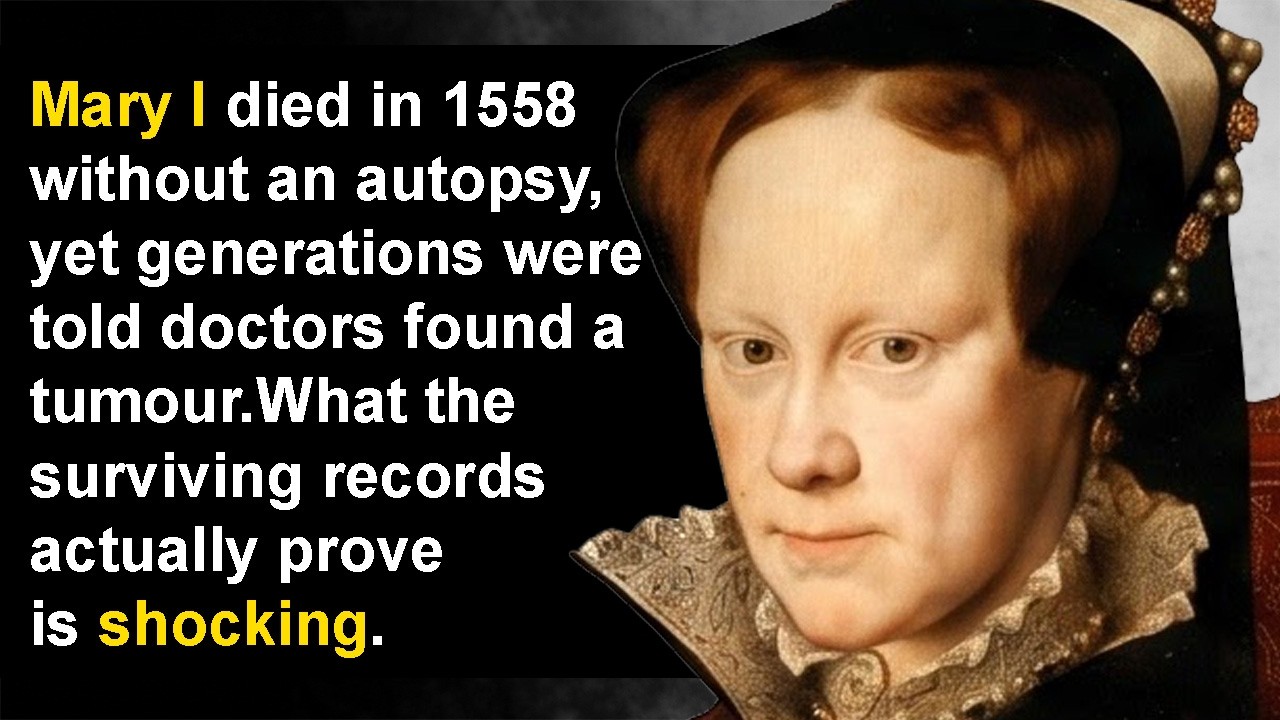
This is where popular history goes astray. There was no autopsy. No postmortem examination was carried out on Mary Tudor, and no surviving document names a tumor, an ovarian mass, or any other lesion. The celebrated tale that embalmers discovered a growth within her has nothing behind it.
Not a single primary source records such a thing. The tumor that gets repeated everywhere was never located, since no one ever searched for it. What we have instead is a theory. In 1987 and once more in 2000, two medical writers argued in academic journals that Mary had suffered from a tumor of the pituitary gland—a prolactinoma.
Such a growth would explain the entire set of symptoms: menstruation that ceased for years, lactation, abdominal swelling, agonizing headaches, mounting depression, and eyesight that deteriorated as the mass bore down on the optic nerve. It is an undeniably elegant account. It is also entirely impossible to prove. There has been no exhumation, no tissue, no DNA analysis, and no notes from any contemporary physician diagnosing anything.
Most likely we will never learn what was truly happening in her body. What we can state is what she believed. She died certain that she had been singled out to bring the true faith back to England, and that God had answered her twice with the physical, unmistakable signs of a son—and reclaimed him both times. In her will, Mary requested that her mother’s body be carried from Peterborough to rest beside her.
It never was. She lies in Westminster Abbey with no child, no husband, and no mother. And in 1603, the coffin of Elizabeth—the bastardized sister she had imprisoned and could not disinherit—was lowered into the vault straight down on top of her.
