The cold case of Springfield haunted investigators for thirty-one years, anchored by a single piece of evidence that science could preserve but not yet identify. On the morning of June 2, 1995, two men walking through Gertrude Park in Springfield, Massachusetts, discovered a body on a slope near Jessie and Warwick Streets. She was twenty-four years old. Her name was Celestina Perez.
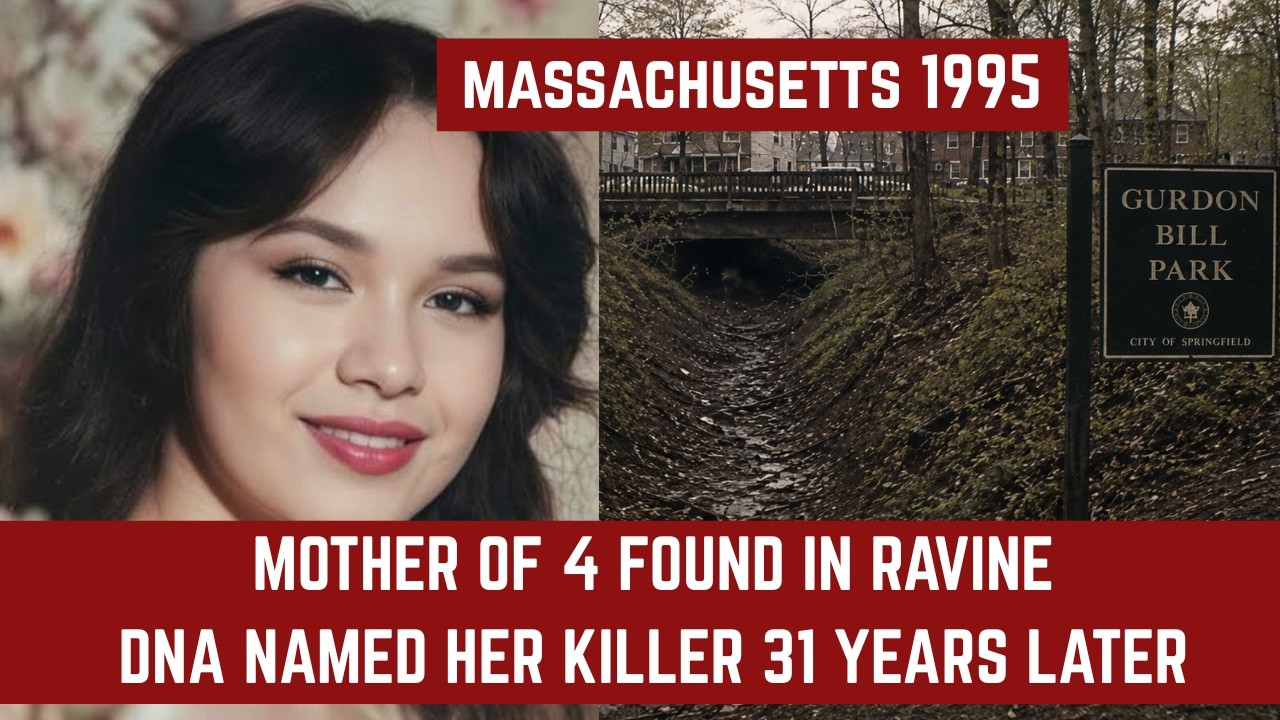
The autopsy ruled the cause of death as strangulation with blunt force trauma. At the crime scene, investigators reconstructed the sequence of events: a struggle began near the top of the slope and continued as the victim was dragged downward. Blood was collected from surrounding plants and soil. It did not match the victim.
Someone else had bled there, likely the attacker, wounded during the fight. In 1995, there was no way to attach a name to that blood. By evening, police had cordoned off the area and were knocking on doors in Lower Liberty Heights, asking residents what they had seen and heard. Investigators interviewed Perez’s known acquaintances.
Every name was checked. Every one was cleared. No arrest followed. No suspect was ever formally charged.
Celestina Perez was a young mother of four, three sons and one daughter, part of a large, close-knit Puerto Rican family in Lower Liberty Heights. She was the one who handled everything, feeding, clothing, and managing the daily lives of her children. Why she had gone to Gertrude Park in the early hours of that June morning was never known. It was not answered in 1995, and it remains unanswered today.
Even the district attorney who closed the case decades later stated plainly that this detail simply is not in the records. What is documented is what came after. Four children grew up without their mother. A family endured years of birthdays, holidays, and Sunday dinners without her, without explanation.
Community leaders refused to let her case disappear quietly into a filing cabinet. Her name was placed on a public memorial dedicated to women murdered in the community, specifically those whose killings had never been solved. For three decades, that memorial was all her family had. No name, no explanation, just a place where her memory and the unresolved reality of her death remained present.
But somewhere inside the Massachusetts district attorney’s office, a case file bearing her name still sat in a drawer, waiting to be pulled out again. The evidence collected in Gertrude Park in 1995 told investigators everything about what happened that morning, except who did it. On the slope, technicians found traces on surrounding leaves and soil. About four feet from where she was found lay her right shoe.
Buttons believed to be from her blouse were collected nearby. The physical picture was clear: the struggle began near the top of the slope and continued downward, meaning she resisted, moved, and kept fighting before she was overcome. One detail caught their attention immediately: the traces collected from the crime scene did not all point to her. Some belonged to the attacker, evidence that he had been wounded himself in the fight.
The crime scene had preserved part of the person responsible. In any other era, that might have been the moment the case broke. In 1995, DNA testing had a single limitation: it could match evidence to a suspect already identified, but it had no way to identify a person from nothing. No usable database existed for that purpose.
So investigators held evidence of the killer without the means to turn it into a name. What they did next mattered more than anyone realized at the time. Instead of treating the evidence as a dead end, they preserved it. Clothing, samples, everything was saved, waiting for forensic science to catch up.
With no criminal path forward, Springfield investigators worked the only leads available in 1995: people with documented records of violence in the neighborhood and anyone with a reasonable connection to Celestina. This distinction matters because it is the opposite of how most cold cases actually work. The investigators did not have a suspect and lack evidence against him. They had the evidence.
They simply had no suspect to match it to. Without a system capable of turning an unknown biological trace into an identity, the investigation had nowhere else to go. The case was officially recorded as unsolved and was passed from one investigator to another. Each inherited the same file, the same preserved evidence, the same unanswered question.
The case did not move again until the one missing piece arrived. Inside the Hampden County District Attorney’s Office, a dedicated unit for cold and unidentified cases had been created, overseen by District Attorney Anthony Gulluni. That unit pulled Celestina’s file and submitted a request: re-examine the clothing that had been in storage since 1995, her underwear and socks, items untouched for three decades. This time, it was different.
At the Massachusetts State Police crime laboratory, technicians discovered blood on her underwear. Using methods far beyond anything available in 1995, they developed a complete male DNA profile, detailed enough to enter into CODIS, the FBI’s national database designed for exactly this purpose. For the first time since 1995, the case was not just evidence in a box. It had something searchable, comparable, matchable against a national list of known offenders.
The DNA profile mattered only if the man it belonged to had been convicted sometime of a completely separate crime and had his DNA entered into the system for that reason. Solving Celestina’s murder did not depend on finding new evidence in her case. It depended on whether her attacker had crossed paths with that system before, for something else entirely. He had.
When the profile was run through CODIS, it returned a match. A name the case had never had: Joseph James Cavarello Jr. At the time of the crime, Cavarello was thirty-two years old and living in Springfield, within walking distance of Gertrude Park. He was not behind bars.
He was not in a hospital or treatment facility. He was free, and he was close. The state lab’s result was described as excluding 99. 99 percent of the population as a possible source.
But Gulluni’s office was not ready to close a three-decade-old case on a single test, especially since the man in question was no longer alive to answer for it. The state lab tested its own sample first, confirming what it had already found. Then Gulluni authorized a second independent lab, DNA Diagnostics, to test something completely separate: a bloodstain from the pocket of Celestina’s pants. That second sample, tested by a different lab using different evidence, produced the same profile.
Investigators estimated the odds of an unrelated random person matching at approximately 1 in 130 million. Two labs, two separate samples extracted from two different pieces of clothing. The same name twice. Investigators also stated that they found nothing connecting Cavarello and Celestina beforehand.
No relationship, no known link. Everything in the record suggests a stranger. Based on everything gathered, Gulluni’s office reached a single conclusion: Cavarello acted alone. This is the turning point of the entire case, not because a courtroom would ever hear it, but because the name finally settled beside the evidence after thirty-one years.
Court records show that Cavarello had a documented history dating back to 1987, a pattern of aggressive behavior that preceded Celestina’s murder by years. Only weeks after her death, he was arrested and convicted on a separate charge of domestic assault. At the time, there was no link between that case and hers. Investigators had no reason to suspect him.
He lived within walking distance of Gertrude Park in 1995. He was not detained anywhere the night she died. Cavarello was never charged with her murder, never tried, never convicted. He died of natural causes in 2013 at age fifty.
Twelve years passed before investigators connected his name to Celestina’s murder. For eighteen years after her death, he lived without facing any charges, without his name being mentioned, without a single public link between him and this case. There would be no trial, no jury, no sentencing. As Gulluni said directly, because Cavarello is deceased, there cannot be a judicial resolution.
He called this a painful limitation and acknowledged it is not the outcome Celestina or her family deserves. Justice sometimes comes quickly, he said, and sometimes it does not. Sometimes the truth takes years, sometimes decades. On July 22, 2026, District Attorney Anthony Gulluni stood before a room full of cameras and journalists to announce what the case had finally become.
Beside him stood Springfield Police Superintendent Lawrence Akers, alongside officials from Massachusetts State Police. Akers carried something into that room that most officials in his position do not. In 1995, as a young detective, he had been one of the officers who responded to the original crime scene. Three decades later, standing on the same platform, he turned to Celestina’s family and said simply, I am truly sorry.
Her nephew, Jose Reyes, then spoke on behalf of the family. He said they had never stopped hoping this day would come, and that even without a trial, even without a verdict, simply knowing the truth gave them something they had not had in thirty-one years: a way to finally move forward. Gulluni closed the announcement without any sense of triumph. He acknowledged that nothing said that day could bring Celestina back to her children, who grew up without her, or erase three decades of grief her family had carried.
There was no dramatic courtroom moment to end this. No verdict read aloud, no judge’s gavel. Just a room full of officials, a family who had waited longer than some of the journalists covering the story had been alive, and a name finally placed beside evidence that had sat quietly in storage since 1995. Celestina Perez’s name had remained on the memorial in Springfield for nearly thirty years, one of twelve names.
Six of those twelve belonged to women killed by Alfred Gaynor, a convicted serial killer already serving multiple life sentences for a series of murders in Springfield during the 1990s. Bishop Talbert W. Swan II had led efforts to build that memorial twenty-eight years earlier, at a time when the idea itself faced documented opposition from within the city. He has since stated that solving Celestina’s case renews his commitment to the other names still on that wall without answers.
According to Gulluni’s office, the same unit that solved her case is currently reviewing other unsolved names connected to the same memorial: Shawna Price, Corinne Lee, Lisa Delfa. Celestina’s file is closed, but theirs are not.






