The ground shook under their boots, and the men working a mile away felt it. The tree had come down at last, three days after the cutting began, and the impact of nearly four hundred tons of coast redwood hitting the forest floor registered through the soil like a slow, spreading wave. The crew that felled it had been paid five dollars a day each. They had used no machinery, no engine of any kind.
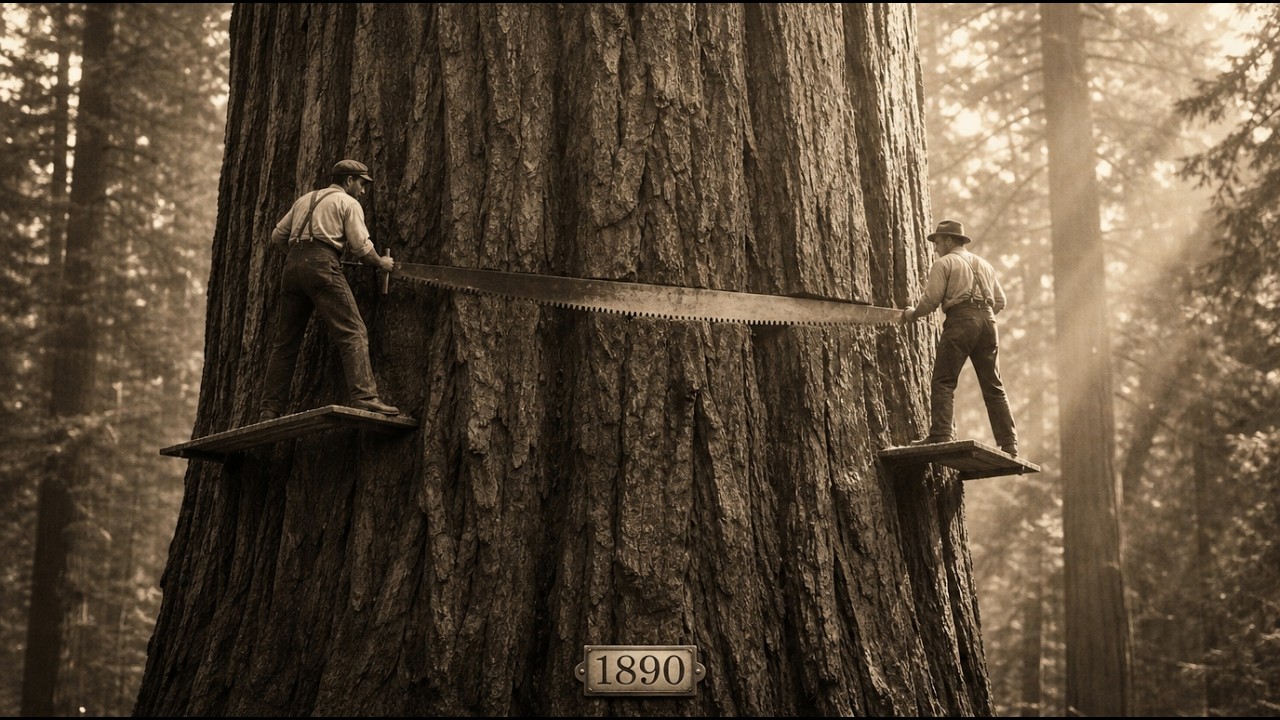
Into the forest that morning they had carried two long-handled axes, a fourteen-foot saw, six steel wedges, and a single hammer. Four men, hand tools, and a trunk fourteen feet across at the base, running two hundred and ninety-three feet from stump to top. How did they do it? The answer is one of the strangest and most forgotten pieces of engineering in American history.
The chainsaw did not exist in any practical form until 1929. Before that, every redwood, every Douglas fir, every Sitka spruce that entered the timber trade was cut by hand, two men pulling a saw back and forth between them for hours or days at a time. They called that saw the misery whip, and the men who used it were the highest paid loggers in any camp in the Pacific Northwest, because the work was expected to break them, kill them, or wear them out within a decade. In 1900, the old-growth forests of the Pacific Northwest and Northern California held trees that no living American has ever seen the equal of.
The coast redwood was the largest by mass, with the biggest specimens in the deepest valleys of the Humboldt and Mendocino coast running fifteen to twenty feet thick at the base and topping out at three hundred and fifty feet. Douglas firs in the Cascades and the Olympics ran six to twelve feet thick at the base and three hundred feet tall. Sitka spruce along the coastal strip from Washington to Southeast Alaska ran a little smaller in diameter but reached the same heights. A single working old-growth coast redwood could weigh four hundred tons, more than two fully loaded eighteen-wheel trucks, the weight of a small commercial airliner.
And there were millions of them. The lumber companies looked at those forests and saw money. The country was building. San Francisco was rebuilding after the fires of the 1890s.
Chicago was doubling in population every decade. The railroads needed ties, the mines needed timbers, the houses going up in every American city needed framing. The only timber large enough, clear enough, and strong enough to meet that demand was standing in those old-growth forests. So the loggers went in.
The tool they used was the crosscut saw: a long, flat steel blade twelve to sixteen feet from end to end, with raker teeth and cutter teeth alternating along its length and a D-shaped handle at each end. Two men stood on opposite sides of the trunk. One pulled; the other followed the pull, then pulled the saw back the other way. The teeth bit a small chip of wood out of the trunk on each stroke.
The chip fell to the ground. The next stroke took another chip. And again. And again.
For hours. They called it the misery whip not as a joke. A man pulling a crosscut saw at full pace burned the same calories per hour as a man rowing a competitive eight-oared boat, and the crews worked ten to twelve hours a day. They could not stop to rest until the cut was deep enough that the saw stayed wedged in the trunk; otherwise, the saw would fall to the ground and need to be hammered back in.
Breakfast came at four in the morning, the walk to the cut at five, sawing at first light, stopping at sunset. A two-man crew with a sharp saw and a six-foot-thick Douglas fir could cut through the trunk in two to four hours. A four-man crew working in shifts on a fifteen-foot redwood needed two to three days for the same cut. The men who did this work earned more than anyone else in camp.
A regular logger made two dollars a day in 1905. A faller, the man cutting the tree, made five or six. The wage was high because the work was hard and the men did not last long. Most fallers were broken in the back, the shoulders, or the lungs by the age of forty.
The lucky ones moved to ground crews. The unlucky ones were buried near the cut. The base of a coast redwood was not the cleanest place to cut. The bottom eight to ten feet of the trunk is swollen, full of root flare, riddled with the irregularities the tree built over centuries of growth, and that section of wood was useless for lumber.
So the loggers did not cut the tree at the ground. They cut it ten or twelve feet up, using a tool called a springboard: a flat plank about five feet long and six inches wide with an iron tip on one end shaped like a wedge. The faller chopped a horizontal slot into the trunk about eight feet up with his axe, drove the iron tip of the springboard into the slot, and the board stuck out from the trunk at right angles, supported by the wedge of iron biting into the wood. The faller climbed up and stood on it.
With a second board on the opposite side of the trunk for his partner, the two men could saw across the trunk above the swollen base. Every photograph ever taken of a two-man crosscut crew cutting down a giant redwood, the men standing on what looks like a wooden plank six feet up the side of the trunk, shows a working springboard. A piece of equipment any modern engineer would refuse to design and any modern worker would refuse to use. The board flexed under the men’s weight.
The iron tip could slip out of the slot. The men were not roped to the tree. If they fell, they fell onto whatever was below them, which was usually rocks, fallen branches, or the saw they had just been using. The technique for controlling where the tree fell was called the undercut.
The faller chopped a wedge-shaped notch with an axe on the side of the trunk facing the direction the tree was meant to fall, roughly a quarter of the way through the trunk. Then the saw crew started the back cut from the opposite side, working the saw across the trunk level with the floor of the undercut or slightly above it. As the back cut approached the undercut, the remaining wood between them became a thin hinge. The tree began to lean.
The hinge bent. The trunk pivoted on the hinge and fell. In theory, the tree fell exactly where the undercut had been pointed. In practice, the wind, the lean of the tree, the unevenness of the hinge, and a dozen other factors meant any number of things could go wrong.
The fallers learned to read every tree before they started cutting. They looked at how it leaned. They checked the prevailing wind. They studied the canopy for dead branches above the cut.
They examined the trunk for rot, because a rotted tree fell unpredictably, a leaning tree fell in the direction of its lean regardless of where the undercut pointed, and a tree with too much wind in the canopy fell early. The wedge man drove steel wedges into the back cut behind the saw. The wedges kept the cut from closing on the blade as the trunk’s weight settled, and in the right hands they could push a slightly leaning tree away from its natural fall line by an angle of a few degrees. A faller who could place a tree within a foot of his target was considered an expert.
A faller who could not was not employed long. The numbers, four men, three days, four hundred tons, five dollars a day, never told you what it cost. One of those fallers was a man named Olaf Lindstrom, pulled from a Humboldt County coroner’s docket of 1907 and cross-referenced against a Pacific Lumber Company payroll book that survived in the company archives in Scotia, California until the company entered bankruptcy in 2008. Lindstrom was thirty-one years old, born in Östersund, Sweden.
He came to America in 1898, worked the Minnesota North Woods for four years, then followed the work west when the eastern timber ran out. He had been working as a faller for Pacific Lumber in the Eel River drainage for two years when he was killed. He had a wife in Eureka and two small children. He was the senior faller on his crew.
The foreman’s notes described him as deliberate, quiet, and good with axes. On the morning of November 14, 1907, Olaf Lindstrom was working a coast redwood about fourteen feet across at the base. The tree had been studied the evening before. It had a slight lean to the southwest, and the undercut had been chopped to direct it that way.
Lindstrom and his partner, a man named Henrik Carlson, were on springboards eleven feet up the trunk. They had been on the back cut for about six hours. The cut was within four inches of completion when the tree began to move. What happened next was called a barber chair.
The trunk of the tree, instead of pivoting cleanly on the hinge as it was meant to, split vertically up the back of the trunk from the back cut to a height of about thirty feet. The lower portion of the split trunk kicked backward, away from the direction of fall. The springboard Lindstrom was standing on was attached to that lower portion. He was thrown backward and fell to the ground at a forty-five-degree angle as the trunk continued to split.
The trunk then completed its fall, but not in the direction the undercut had pointed. The upper portion of the tree came down across the line where Lindstrom had landed. He was killed instantly. Henrik Carlson, on the springboard on the opposite side of the trunk, rode the standing portion of the splintered trunk down to a height of about fifteen feet, jumped clear at the last moment, and survived with a broken collarbone.
The Pacific Lumber Company paid Lindstrom’s last week of wages, twenty-eight dollars, to his widow in Eureka. The company also paid for his burial in a small Lutheran cemetery outside town. His widow remarried two years later. The children grew up.
One of them, his son, went into the woods at sixteen and worked as a faller for thirty years. The barber chair was the most feared of the falling tree accidents, but it was not the only one. There was the widow maker, a dead branch falling from the canopy above the cut, sometimes weighing several hundred pounds, striking a man on the ground or on the springboard without warning. There was the kickback, a trunk that fell short and bounced backward off its own stump.
There was the butterfly, a tree that pivoted unexpectedly on a soft hinge and fell sideways instead of where the undercut had pointed. Each of these had killed loggers throughout the era. The combined fatality rate in Pacific Northwest old-growth logging through the 1910s and 1920s ran above one in one hundred and fifty working loggers per year. Not a lifetime rate.
Annual. The records of falling tree deaths in California, Oregon, and Washington between 1900 and 1930 are deeply incomplete, but the best historical estimate is somewhere between eight and twelve thousand men killed by falling trees in the old-growth era. The actual number is almost certainly higher. Small operations did not report.
Foreign-born workers were often buried without record. Camps in remote country sometimes lost a man and simply moved on to the next cut. The end of the whole system came faster than most people realize. In 1929, a German named Andreas Stihl built the first practical one-man chainsaw, a gasoline-powered tool weighing about ninety pounds that one man could operate alone.
The first commercial Stihl chainsaws reached the American logging market in 1935. By 1945 they had replaced the two-man crosscut saw in almost every major operation. The misery whip was retired. The springboard was retired.
The fallers either learned to operate the new equipment or they left the woods. By 1950, the two-man crosscut saw was a museum piece. The forests those crews cut are mostly gone now. Less than five percent of original American old-growth coast redwood remains.
The Douglas fir old-growth in the Cascades and the Olympics is gone in a similar proportion. The Sitka spruce of the coastal strip held on longer in the more remote drainages, but is also mostly cut. The biggest trees, the four-hundred-ton trees that astounded the early loggers and consumed three days of a four-man crew’s labor, are almost entirely gone. The few that remain stand in protected groves in places like Redwood National Park, Humboldt Redwood State Park, and the Olympic National Park rainforest.
You can walk among them. They are taller than any tree most people will ever see, and they are the ghost of a forest that used to cover the entire Pacific coast from San Francisco to Southern Alaska. The men who cut them, the Olaf Lindstroms and the Henrik Carlsons and the thousand others whose names did not make it into the coroners’ books, have mostly faded into folklore. The misery whips they used hang on the walls of small-town logging museums in places like Forks, Washington, and Scotia, California.
Most visitors walk past them and have no idea what they are looking at. But for fifty years, between roughly 1880 and 1930, those saws were the entire reason America had lumber to build with. Every wooden American structure built in the first third of the twentieth century stood on timber that two men had cut by hand.
The houses, the railroad ties, the mine timbers, the warehouses, the ship hulls, the wharves and the trestles and the bridges, all of it traced back to two men on a springboard with a fourteen-foot saw and an undercut they had chopped that morning.






