On the damp but mild evening of 13 November 1946, Walter Combs was walking home in Woldingham, Surrey, when he spotted what looked like a man lying in a hollow inside a chalk pit. He fetched his father, and the two returned for a closer look. There they found the body of a man in a blue pinstriped suit, with an overcoat wrapped upside down over his head and tied with a clothesline wound twice around the body in two slip knots. They hurried to fetch Police Constable Hearn from Oxted.
When Hearn loosened the rope and removed the coat, he found the clothesline wrapped around the man’s neck and a green rag stuffed in his mouth. In the fading light, Hearn called for his sergeant, and soon other officers arrived. A search of the area turned up an axe that appeared to have been used to dig the shallow trench where the body lay. But the trench was too small: the man’s feet stuck out.
Nothing had been done to cover the grave, and the chalk pit was clearly visible from the path, so discovery had been inevitable. In one of the man’s pockets, police found a card identifying him as John McMain Mudie, a barman at the Reigate Hill Hotel. Mudie had been born in Kinghorn, Fife, Scotland, in 1911. He had served with the Royal Army Medical Corps during the war, risen to the rank of corporal, and after his discharge in 1945 worked as a barman in Wimbledon and then, from the summer of 1946, at the Reigate Hill Hotel.
He was known to be fond of women, and colleagues had noticed several visiting him at his workplaces. During his time in Wimbledon in early 1946, he made the acquaintance of a married woman named Joan Leslie Brooks. The depth of that friendship would later be disputed, but the connection, however slight, would prove fatal. The post-mortem was conducted by the renowned pathologist Keith Simpson, along with Dr Eric Gardner, in consultation with Francis Camps of the Home Office.
The conclusion was that Mudie had been severely beaten and then strangled with a clothesline. The cause of death was asphyxia. Simpson judged that Mudie had been killed about four hours before being placed in the shallow grave. His shoes were clean, which meant he had not walked to the chalk pit, especially since the weather had been rainy and windy in the preceding days.
He had been killed elsewhere and dumped there. News of the discovery spread quickly, and two local gardeners came forward. Clifford Tamblin and Frederick Smith told police that on 27 November, three days before the body was found, they had been cycling past the chalk pit when they saw a car parked at its edge. The time was unusual, and they saw a man farther into the pit who looked panicked when he noticed them.
He ran back to the car, jumped in, and despite the slippery ground managed to reverse out and speed away. Neither man remembered the full number plate, but both agreed it contained the number 101. They also agreed it was a dark saloon car, possibly a Ford. The police now had a promising lead: a man behaving suspiciously at the exact spot where a body would be found three days later.
If, as one cyclist thought, the car was a Ford saloon, that narrowed the search considerably. Police appealed to the public for help. Three people came forward: John Buckingham, a car-hire firm owner and former wrestler who had deserted the army after Dunkirk in 1940; his son of the same name; and the son’s girlfriend, Lillian Florence Bruce, the wife of a bus driver. Their story was strange.
They said a man named Thomas Ley had recruited them, along with a carpenter working for him named Lawrence John Smith, to lure Mudie to Ley’s house at 5 Beaufort Gardens in Chelsea and detain him there. They insisted they had no part in the murder. Ley had told them Mudie was a blackmailer and that he wanted to force him to sign a confession about the extortion, then pay him 500 pounds to leave the country. Buckingham senior was later told by Smith that the plan had succeeded and Mudie had been dropped off in Wimbledon that same night.
When the three learned of Mudie’s murder, they panicked and contacted Scotland Yard. Buckingham senior said the plan agreed upon with Smith and Ley at a meeting in the Royal Hotel in Woburn Place was that Lillian Bruce would visit the Reigate Hill Hotel posing as a wealthy woman and hire Mudie as a waiter for the evening. On 28 November, Mrs Bruce collected Mudie, and Buckingham’s son, posing as her chauffeur, drove him to Ley’s house. When Mudie entered through a side door marked air-raid shelter, Lawrence Smith and John Buckingham senior were waiting.
They threw a mat over his head, wrestled him to the ground, tied him up, gagged him with a green rag found in the cellar, and sat him on a swivel chair. Mrs Bruce and the younger Buckingham then left. Their part in the affair, they said, was over. They went to the Crown and Sceptre pub nearby, soon joined by Buckingham senior, who had been paid 200 pounds for his role.
The police accepted this account. Their focus now turned to what happened to Mudie after the three left him with Smith and Ley. Both men were questioned. Smith largely corroborated the others’ statements.
He described himself as the head carpenter responsible for work on Ley’s property. Ley had confided that a married woman he knew had been seduced by Mudie while her husband was away and that Mudie was blackmailing her and her mother. Ley wanted to protect them by obtaining evidence against the man, luring him to the property and extracting a confession. Smith said he agreed to help and was paid 200 pounds.
He had hired a Ford 8 saloon with the registration FTP 101, which Ley paid for. When Mudie entered the house, Smith held his arms while Buckingham threw a covering over his head and pushed him along the passage into a side room, where they bound and gagged him and placed him on a swivel chair. This account matched the others in all important respects. But then Smith’s story began to unravel.
He said that after the Buckinghams left, he stayed talking with Ley for ten minutes and then left the house himself. He claimed he could not find the three at the pub, drove home, had a bath, and went to bed. He had no part in Mudie’s death. The problems with Smith’s story were numerous.
The car he had hired, with its distinctive 101 plate, had been seen at the chalk pit the day before the crime. One witness had identified him in an identity parade as the man seen at the chalk pit that day. If true, it was damning: it suggested he had reconnoitred the disposal site. Thomas Ley was sixty-six and in poor health, so the police considered it impossible that he had disposed of the body alone.
Smith had either killed Mudie or helped Ley, and together they had dumped the body. Moreover, although Smith claimed he went home to bathe and sleep, his landlady placed his arrival at around 11 p. m. That gave him no alibi for the probable time of Mudie’s murder and disposal.
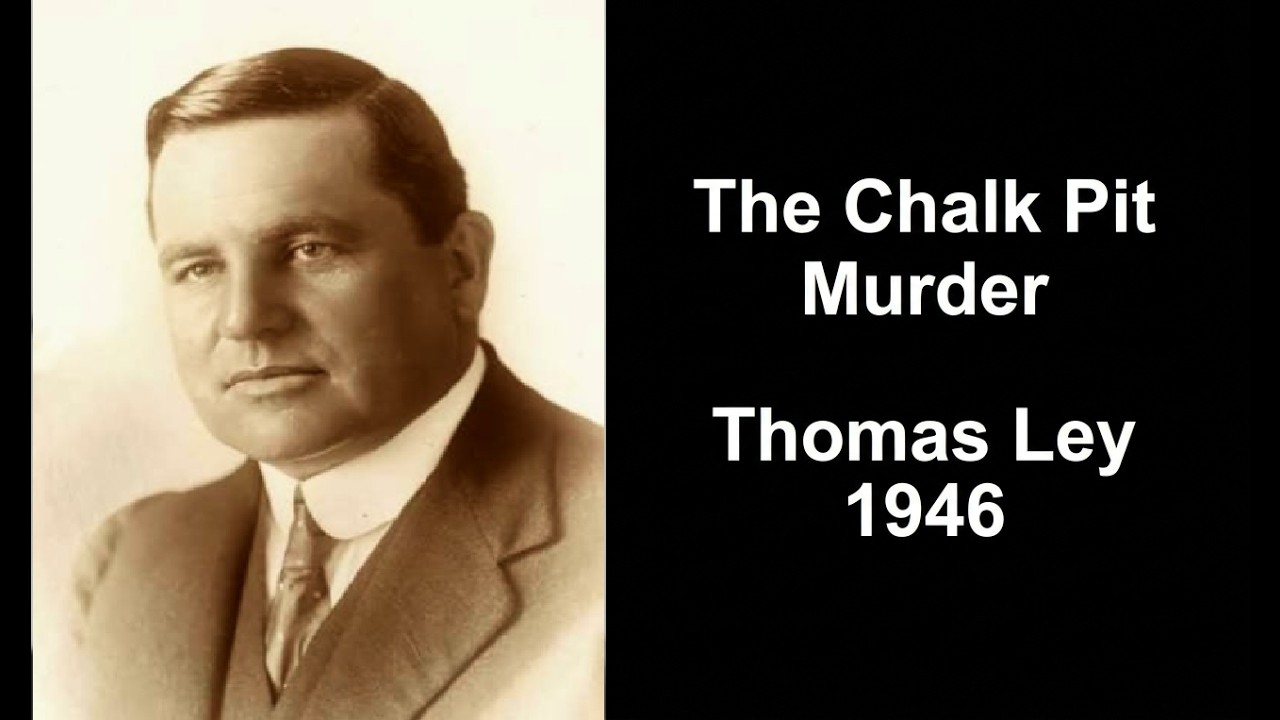
On 28 December 1946, Thomas Ley and Lawrence John Smith were arrested and charged with murder, along with John Buckingham senior. The case made sensational headlines because Thomas Ley had been, twenty years earlier, the Minister of Justice in New South Wales, Australia. Born in Somerset, England, in 1880, Ley had emigrated with his family to Australia in 1886 after his father died. He left school at ten, worked as a newspaper seller and then on a dairy farm, but taught himself shorthand in his spare time.
At fourteen he became a junior clerk to a solicitor. At eighteen he married Emily Louisa Vernon. He qualified as a lawyer in 1914 and entered politics, winning a seat on Hurstville Council and then, in 1917, a seat in the New South Wales Parliament. He cultivated the persona of a strict teetotaller, proud of the nickname “Lemonade Ley.
” In early 1922 he became Minister of Justice. Around that time, he met a woman named Maggie Evelyn Brook in Perth. She was married to a successful liquor merchant who also served as a magistrate, but her husband died suddenly on 1 April 1923. Ley escorted her to the funeral, installed her in a flat near Parliament House, and she became his mistress.
A series of scandals gradually undermined his standing. In 1928, after a fraud involving a company in which he had profited handsomely, Ley left Australia with Maggie Brook and moved to England. Unknown in Britain, he continued his fraudulent ways, running scams that enriched him. During the war he was known as a black-market trader.
His wife Louisa arrived in London in 1942, though Ley still lived with Maggie Brook. By the 1940s, Ley had moved to 5 Beaufort Gardens, with Mrs Brook in separate accommodation, though they met daily. The trial of Thomas Ley and Lawrence John Smith opened at the Old Bailey in London in March 1947 before the Lord Chief Justice, Rayner Goddard. Anthony Hawke prosecuted; Sir Walter Monckton appeared for Ley; Curtis Bennett defended Smith.
Both pleaded not guilty. The prosecution argued that Ley had become obsessively jealous of Mrs Brook, convinced she was having an affair with John Mudie, and that this drove him to recruit Smith and others to kidnap and kill him. The evidence was compelling. Ley’s obsession had led him to use various tricks to try to trap Mudie, telling acquaintances that Mudie was blackmailing Mrs Brook.
He enlisted Smith, a greedy man willing to follow orders for money. Ley contacted the doorman of the Royal Hotel, Joseph Minden, asking for a strong man who could keep secrets and was willing to do a job for a large sum. The doorman introduced him to John Buckingham senior. The plan to lure Mudie to 5 Beaufort Gardens with the pretext of a cocktail-waiting job was devised.
Smith had hired the Ford saloon, and he and the car had been seen at the chalk pit the day before the murder. Since the body was found there three days later, it was clear that Smith had been preparing the site where John Mudie’s body would be dumped. It was therefore obvious that their intention had always been to kill him. The defence faced an uphill task.
John Buckingham senior had turned King’s evidence in exchange for having charges against him dropped, and he now provided a detailed account of how Ley recruited him to lure Mudie to the house and kidnap him on the pretence of extracting a confession about blackmail. Lillian Bruce gave evidence, as did the younger Buckingham. Pathologists Simpson and Gardner testified about the injuries. Other witnesses confirmed seeing Smith and the distinctive car at the chalk pit.
The axe found there was shown to have come from 5 Beaufort Gardens. Kathleen Ingleston, Ley’s secretary, was so uncooperative that the prosecution obtained permission to treat her as a hostile witness. She stated that Ley was very concerned about Mudie getting money from Mrs Brook and her daughter and would stop in the middle of his work to complain about it. Maggie Brook testified with exceptional deference shown by the court: her address was withheld and the doors were closed during her testimony.
She spoke of Ley’s protective jealousy toward her and said Mudie never blackmailed her. She also mentioned that Ley had accused her of affairs with younger men. Lawrence Smith gave evidence exactly as he had in his initial statement. But the glaring flaws in his account—that he was alone in the house with Mudie after the others left and was the last person seen with him alive—were a serious problem for his defence.
His claim that another man no one had seen entered through another door and dismissed him after ten minutes was ridiculed by the prosecution. The fact that he had been seen reconnoitring the chalk pit before the murder was particularly damning, as it indicated he knew Mudie would not leave 5 Beaufort Gardens alive. He could not explain why Ley paid him to hire the Ford, nor why he had driven it the day before the kidnapping and on the day of the crime itself. His landlady could only confirm his return at 11 p.
m. , giving him ample time to dispose of Mudie’s body at Woldingham. Thomas Ley took the stand and denied everything. He said he was not at home when Mudie was there and had no role in any conspiracy.
He had paid no one. But the others’ accounts weighed heavily against him, and there was a clear financial trail. Smith and Buckingham each claimed Ley had paid them 200 pounds in one-pound notes. Investigators proved Ley had withdrawn 200 pounds on 16 November and 300 pounds on 26 November, all in one-pound notes.
Ley claimed it was for personal expenses. The denial was unconvincing. He also claimed he was not jealous of Mrs Brook but insisted she had been having an affair with her son-in-law, Arthur Baron, something she denied. One final witness appeared: a man named Cruickshank who claimed he was a thief who happened to be at 5 Beaufort Gardens at 9:15 p.
m. on the night of the kidnapping. He said he found a man tied to a chair in the cellar and began untying him but lost his nerve and fled, fearing he had accidentally pulled the rope around the man’s neck. His story was naive and absurd.
He admitted being in Switzerland at 4 p. m. that day and claimed to have taken an unauthorised flight to London, providing no details of the plane or route. His evidence was dismissed.
The strong possibility was that Ley had hired him to cast doubt on the prosecution’s case. On 24 March 1947, the Lord Chief Justice delivered a summing-up that lasted two hours. It was damning. The jury took under an hour to convict both men of Mudie’s murder.
Asked if he had anything to say before sentence, Ley said, “I am not surprised at the verdict after your biased summing-up. I am innocent. I have said so from the start and I say so now. ” Goddard donned the black cap and sentenced both men to death.
Appeals were dismissed, and execution was set for 8 May 1947. Petitions gathered a few hundred signatures. Newspapers noted that Ley, at sixty-six, was unlikely to be hanged, as executing the elderly was by then considered unacceptable. A medical committee of two doctors examined Ley and decided he had been insane when he planned the crime.
Three days before the scheduled hanging, his sentence was commuted to life imprisonment at Broadmoor for the criminally insane. It was deemed necessary to commute Lawrence Smith’s sentence as well, and he received life imprisonment. The deeper history of Thomas Ley emerged only after the trial. In 1922, the year he became Minister of Justice, he travelled to Perth, where he met Byron Brook and his wife Maggie.
He became infatuated with Mrs Brook. On 1 April 1923, her husband died, officially of heart failure at an Easter picnic on the Moore River. The circumstances were suspicious enough to raise doubts. Maggie became Ley’s mistress immediately and remained with him for twenty years, following him to Britain and managing his property company.
It was almost inconceivable she was ignorant of his activities. There were other scandals. In 1924, Ley insisted on the execution of Edward Williams, a man widely considered mentally ill, despite the jury’s recommendation of mercy and public sympathy. In 1923, he had ordered the early release of a man named Buddfoot, who had killed a five-year-old boy during a sexual assault, after only eighteen months of a three-year sentence.
In November 1925, Ley ran for the federal seat of Barton against the Labor politician Frederick McDonald. Four days before the election, McDonald accused Ley of offering him a 2,000-pound bribe to withdraw. Ley denied it and won. McDonald sought to overturn the result through the courts.
On 14 April 1926, McDonald left his wife after lunch to meet the Premier, disappeared, and was never seen again. His body was never found. A letter discovered in the 1970s, allegedly from McDonald, was examined by a handwriting expert and judged likely to have been written by Ley. Then came the Prickly Pear poison company scandal.
Ley took 5,000 shares in a company purporting to market a miracle weed killer for prickly pear, which had made vast areas of Australian land unusable. The public bought shares, but there was no patent, no profits, and no miracle poison. Ley sold his free shares at a profit and fled with Maggie Brook to Europe on a six-month holiday. When he returned, he faced outrage.
The most vocal critic was the politician Hyman Goldstein, who had himself been persuaded to invest and was leading an inquiry into the scheme. On 3 September 1928, Goldstein’s body was found at the foot of a cliff at Coogee, a known suicide spot. He had left no note, and the inquest concluded it was an accident. He had forgotten his glasses on one of his usual morning walks.
Many believed Ley had helped him fall. Within less than a decade, three men who stood in Ley’s way had met sudden, unexpected ends. Ley lost his seat in the 1928 federal election and left Australia for England with Maggie Brook and her sixteen-year-old daughter, Joan. The motive for Mudie’s murder was disputed at trial.
The prosecution maintained Ley was obsessively jealous of Mrs Brook, though they also insisted there was no factual basis for his jealousy. Ley accused Mrs Brook, then sixty-six, of affairs with younger men, including her son-in-law Arthur Baron. Then he became fixated on the idea that she was involved with John Mudie, aged thirty-five. Mrs Brook’s daughter, married to Baron, had a flat above Mudie’s in Wimbledon.
When the daughter was hospitalised in late May 1946, Mrs Brook moved in and stayed until 12 June. According to the prosecution, Ley heard Mrs Brook speaking to Mudie, made inquiries with the landlady, and wrongly convinced himself they were having an affair. On 12 June, Ley bombarded Mrs Brook with phone calls, refused to help her find other accommodation, then at 2:30 a. m.
took her to his house and found her new lodgings the next day. He sent Mudie two letters with blank cheques intended for Mrs Brook, but Mudie sent them to her son-in-law. Ley then visited Mudie at the Reigate Hill Hotel and accused him of forging cheques, an accusation Mudie easily refuted. Why Ley continued pursuing Mudie five months after he had moved away from Mrs Brook and her daughter remained unclear.
The possibility remains that Mudie was indeed blackmailing Mrs Brook and her daughter. Ley repeated the claim to several people: that Mudie had seduced the daughter, perhaps the mother, and was extorting them because of it. He never wavered from it. Mrs Brook described his jealousy as protective rather than sexual, an interesting distinction.
Mudie was a womaniser and lived well beyond his wages of four pounds ten shillings. He was seen trying to sell a watch for 80 pounds at the Reigate Hill Hotel on the night of his murder. Whether or not Mudie was blackmailing the Brooks, it did not change the nature of the crime: Ley and Smith killed John Mudie. Ley was never insane in the legal sense under the M’Naghten rules.
He knew what he was doing was wrong. The doctors who declared him insane had been persuaded by him in a plausible performance. He was not mad except in the sense that all killers are mad because their actions define them as such. He was ruthless, accustomed to getting what he wanted, unable to tolerate opposition.
Whether it was a seat in federal parliament or the wife of a Perth liquor merchant and magistrate, he got it. The respectable, principle-driven Lemonade Ley had no discernible morals at all. He was corrupt, fraudulent, deceptive, and a killer—probably several times over. But he was not insane, and he deserved the full application of the law like anyone else.
After his sentence was commuted, Ley was taken to Broadmoor and placed in the Gentleman’s Wing, which housed wealthy criminals convicted of the worst offences but deemed insane. Ronald True, the subject of an earlier case, was still there in 1947. In the Gentleman’s Wing, these men could employ lower-status inmates as servants, enjoy comfortable accommodation, and receive visitors at will. Ley’s time there was short.
On 23 July 1947, he suffered a severe stroke and died the next day. He was sixty-six years old.






