Inside the grand hall of Delhi’s Red Fort, on the evening of January 6, 1903, thousands of aristocrats and diplomats went completely still. Every wavering candle in the Diwan-i-Khas appeared to focus on one lone figure. Mary Curzon, the Vicereine of India, glided slowly across the room wearing a gown of champagne silk worked with gold thread and thousands of shimmering beetle wings. The dress weighed ten pounds, bearing down on a body already worn out by fever, heat, and years of imperial service.
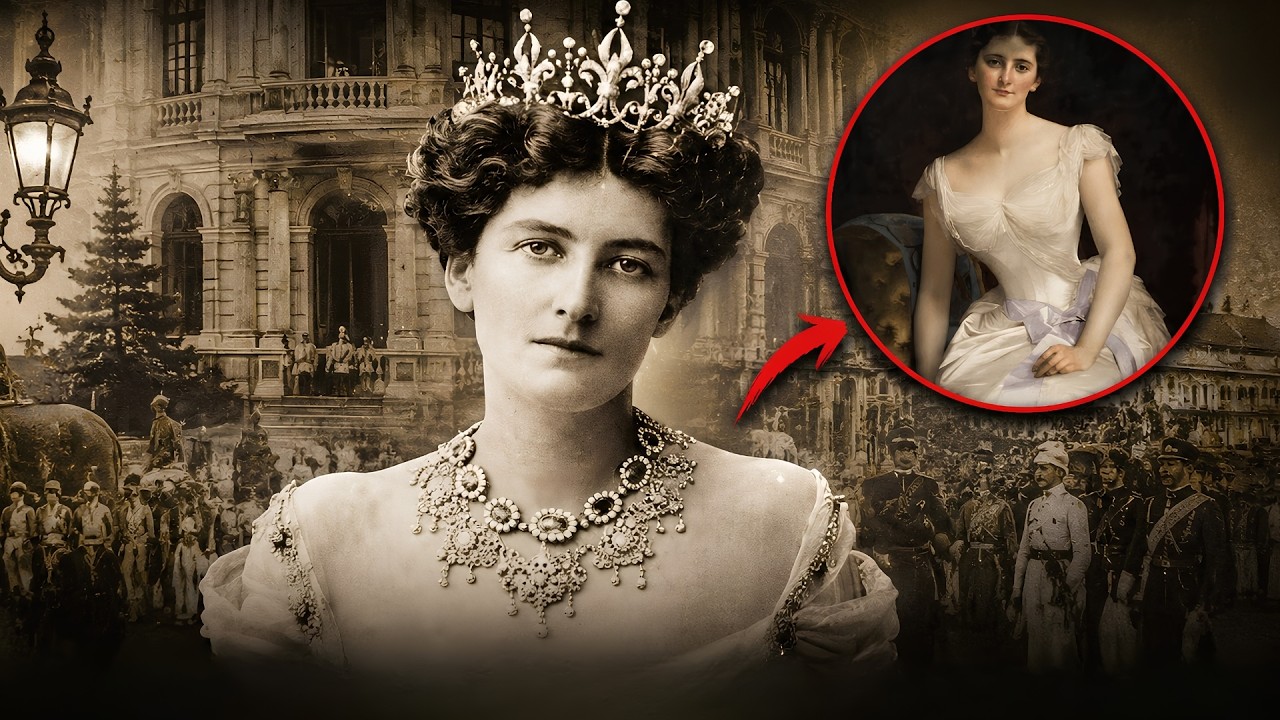
Diamonds from her Bouchéron tiara flashed in the candlelight as she commanded the room with flawless poise. From a shadowed corner, her husband George Curzon observed with chilly approval. He beheld a living jewel of empire. Nobody in that hall knew the reality: under the silk, a deteriorating body was paying a cost none of them could perceive.
Mary Leiter was born in Chicago on May 27, 1870, into a fortune assembled with remarkable speed. Her father had gone into partnership with Marshall Field years before the great Chicago fire, and once the city was rebuilt, his wealth grew even further. Newspapers and property records estimated his holdings in the tens of millions of dollars. Yet Mary was not born to the inherited silk of European dynasties.
Her grounding came from commerce, real estate, and the sharp instincts of a fast-rising America. Washington finished the education Chicago had begun. In the capital, money counted, but manners determined who remained in the room once introductions were over. Mary was raised in an opulent mansion on Massachusetts Avenue and moved through the same official social circles as Frances Folsom Cleveland.
She observed hostesses, diplomats, and political wives wield conversation as a means of ranking, and she picked up the technique swiftly. For her fiercely ambitious mother, though, mere capital was never the goal. Money was only a tool. It had to buy something more lasting: a place in history.
The American elite knew that genuine aristocratic authority could not be manufactured from nothing in one generation. It had to be secured across the ocean. Mary carried herself with a rare physical assurance. Tall for her time and difficult to overlook, she drifted through crowded ballrooms with a slow, measured calm, often lowering her lashes and listening instead of vying for attention.
The established elite anticipated a newly rich American girl to be noisy, to display heavy jewels, and to plead for social approval. Mary did the exact opposite. Her reserve made her harder to decipher, and in rooms where every family sized up every other, mystery proved more effective than ostentation. The Chicago Tribune commended her “engaging sympathy” and observed her notable absence of aggressive self-assurance.
She broke the mold of the new-money American heiress. During the late nineteenth century, the global elite ran on a harsh transactional formula. America held limitless bank accounts; Europe kept ancient aristocratic titles. Mary’s mother removed the bourgeois French nobility from her list of targets and insisted on the very highest tier of power.
Meticulously arranged invitations to British royal gatherings rested on a vanity table. Mary did not blunder into the old world like a desperate social climber. She performed a flawless curtsy before the prince and princess of Wales in London, formally announcing her arrival. Millions in financial backing secured the introduction, but she held her position through her own dignity, wit, and diplomatic instincts.
The famously snobbish London aristocracy first attempted to ignore her, then yielded to her presence. Around 1890, Mary met George Nathaniel Curzon. He was thirty-one, with cold eyes and an ambition vast enough to consume the world. Under his immaculately tailored suits, a rigid steel corset gripped his curved spine, forcing him to stand in painful straightness.
He had traversed the deserts of Persia, crossed into the borders of Afghanistan, and written weighty books on geopolitics. His arrogance was so renowned that Oxford students ridiculed him in verse. Yet his towering public stature was sustained only by concealing severe bodily agony every single day. Mary did not fall in love with an easy man.
Hundreds of private letters passed between them across two years of courtship. At formal dinners, she dissolved the icy atmospheres Curzon created with his boundless arrogance and absence of empathy. She did not buy him with her father’s fortune. She won him through steadiness, intelligence, and emotional discipline, supplying the warmth his austere rooms lacked and repairing the political relationships his sharp tongue cut apart.
It took Curzon two entire years to see her as the essential missing piece of his political path. They became engaged in 1893. On April 22, 1895, the twenty-four-year-old bride flashed a triumphant smile across the front pages of the international press before a Washington church altar. Behind the headlines lay a prenuptial agreement.
One decisive signature moved an enormous fortune from America to England, wiping out the groom’s debts and clearing a golden path for his future power. The public cast the union as a modern Cinderella story, but as biographer Nigel Nicolson later observed, this was a particular fairy tale in which Cinderella’s father happened to be worth twenty million dollars. Mary had secured the most brilliant, sought-after man in Britain. But the tragedy of her coming life began on that very day.
What Curzon wanted next was the highest imperial post he could attain. On January 6, 1899, the ship carrying the newly appointed viceroy anchored in Bombay harbor. Mary stood on deck, twenty-eight years old and pregnant with her first child. The instant the iron doors swung open, a stifling wave of tropical heat hit her face.
Blinding dust churned through air thick with spice, salt, and dry earth. Under a blazing sun, a deafening roar of human voices surged from the docks. Mary was not simply following her husband to a distant outpost. She was being delivered into the nerve center of the British Empire.
The title of Vicereine turned her into the visible consort of imperial authority in India, governing a subcontinent of three hundred million subjects. The role was public before it was personal. Every procession, greeting, and review made her body part of the state itself. As the royal train traveled toward Calcutta, hundreds of thousands of eyes turned toward the foreign woman inside it.
The colonial elite waited for the wealthy American heiress to make a disastrous social blunder. Mary declined to give them that satisfaction. Seated in an open-top state carriage, her posture stayed perfectly upright, her gaze moving over a crowd of more than one hundred thousand people lining the streets. Newspapers called her the most beautiful memsahib in Asia.
An Indian poet greeted her in court verse. But this public triumph held a cruel snare. To the empire, Mary was no longer an independent person with private frailties. She had been converted into a polished symbol.
An imperial symbol was refused the human right to be weak. She could not display fatigue. She could not acknowledge physical suffering. Behind the closed doors of the palace, far from the state dinners, she confronted an unrelenting schedule of official duties.
Mud frequently clung to her silk footwear as she covered long distances on foot to visit hospitals, village clinics, and schools. She oversaw budgets aimed at broadening medical education and professional instruction for Indian women. She worked alongside local weavers, weaving their embroidery methods into the court gowns she wore herself, which compelled the fashion houses of Paris and London to acknowledge indigenous craft. And yet her compassion polished the public image of colonial rule while leaving its framework untouched.
She had grown into one of the empire’s most conspicuous figures. That framework was already pressing its weight upon her weakening body. In 1903, hoping to mark the coronation of King Edward VII, Curzon staged an event with no historical parallel: the Delhi Durbar. Thousands of elephants, adorned in gold ornaments and jewels, crossed the plains.
Scores of ruling princes presented themselves before a vast crowd beneath the Delhi sun. The spectacle mirrored Curzon’s psychology without distortion—his grandiosity, his fixation on minute control, his craving to display absolute authority. To hold the center of the stage, he needed a flawless leading lady. Mary was placed to become the supreme emblem of imperial dominance.
To satisfy the pageant’s requirements, Mary helped design a garment that reached past the fashion of the day. Indian craftsmen in the Kishan Chand workshop in Delhi labored for long hours, driving thousands of needles through heavy champagne-colored silk, carrying out the ancient art of zardozi embroidery with true gold and silver thread. At the heart of the peacock feather patterns lay iridescent beetle wing cases, the elytra of the jewel beetle, giving off an eerie blue-green glow. The completed panels were sent to Paris, where the House of Worth finished the assembly.
The garment weighed ten pounds. It burdened the body that wore it. The night of the Durbar stood as the peak of Mary’s authority, the most luminous moment of her tragically short life. But the physical toll exacted by that single night of supremacy set off an agonizing descent into dark, isolated rooms.
Following the Durbar, her headaches grew severe and unrelenting. Heavy velvet curtains were pulled closed in the Calcutta palace. The only sound in her bedroom was the shallow breathing of a woman kept to her mattress for weeks on end. The blistering climate and a diplomatic calendar that made no allowance for weakness had finally trapped her.
In 1903, she was confined to bed again and again. She would not complain. Taught from childhood that silent endurance was the highest feminine virtue, she gritted her teeth and kept her silence, dreading that her failing health might block her husband’s rise. The couple’s sole refuge was a secluded retreat high on the windy slopes of Mashobra.
There, the stiff shells of their public existence eased. They slipped back into a quiet closeness, murmuring their private nicknames, Kinky and Papy, to each other. Curzon permitted his punishing steel corset to be briefly loosened. The historical record confirms that he truly loved her.
When her health compelled her to return to England alone, he wrote to her again and again, confessing that he felt adrift without her. But his love never grew strong enough to slow his ambition. He needed her to keep his balance, and he would not stop using her. By 1904, Mary’s private letters recorded her foreboding that going back to India would be a dreadful mistake.
Ignoring her warnings and her worsening condition, Curzon forced through an unprecedented second term as viceroy, placing his own legacy above the survival of the woman he claimed to cherish above all else. Her fears were borne out on English soil just before they were to return east. In autumn 1904, at Walmer Castle in Kent, medical specialists assembled as blood soaked through the bed linens after a severe maternity complication. Mary’s temperature plunged.
She was taken into emergency surgery, but a massive infection coursed through her weakened system. She barely survived, yet permanently lost her former physical health. Still, colonial duty and Curzon’s ambition hauled her shattered body back to the eastern furnace. By that time, imperial politics was turning against him.
Curzon had fought a bitter public bureaucratic battle with Lord Kitchener, the ruthless commander-in-chief of the Indian army, over administrative control of the colonial military. Curzon made precise arguments that were correct on paper, but he had driven away his allies. In August 1905, Prime Minister Arthur Balfour and the government in London backed Kitchener. Curzon was stripped of his governing authority and forced to resign.
His humiliation was carried across the empire. On November 18, 1905, the steam ship bearing the disgraced former viceroy left India. The docks stood empty. No honor guards stood at attention.
No brass bands played. Curzon stood rigidly on the deck, murmuring a line from his farewell speech, claiming he had written his name there and that the letters were a living joy. Mary had lost something harder to regain than office: her health and six vital years of youth, spent in supporting him. They sailed back toward the grim fog of London.
The polluted air gave her no chance of recovery. The summer of 1906 came down on London with oppressive heat. Inside her quiet bedroom at Carlton House Terrace, at forty minutes past five on July 18, the steady ticking of the pendulum clock gave way to permanent silence. The death certificate listed heart failure, described as the sequel of a serious illness two years earlier.
It was the endpoint of damage her body had carried for years, the final consequence of six relentless years inside imperial life. Mary died at age thirty-six. Curzon collapsed beside her deathbed. He commissioned sketches and plans for a memorial in white marble.
The effigy with closed eyes lay inside the ancient chapel at Kedleston Hall. The historical record demands acknowledgment of a complex truth: he loved her with genuine, agonizing intensity, and devoted seven years to building her memorial tomb. Yet within less than a year after the funeral, he began a new romantic relationship. He remarried and later became foreign secretary, helping reshape global borders.
In 1923, he came close to becoming prime minister. He was granted nineteen additional years to build his legacy. Society allowed the widower to continue a life of power and consequence. Mary lost that privilege forever.
She was frozen in white marble and sealed into a rural chapel. Her death left three young daughters suffocating under their father’s shadow. Little Alexandra was still a child when her mother died. Years later, the daughters were forced to sign legal documents and fight in court to secure their inheritance from their American grandfather, a fortune their own father had deliberately locked away.
When Mary vanished, no one remained to soften Curzon’s brutal tendencies. He restricted his children’s lives and wealth through psychological control. Irene, Cynthia, and Alexandra were cast into a scandal-ridden British society without a maternal compass. Cynthia would later marry Oswald Mosley and die at age thirty-four.
More than a century later, the dress remains behind thick glass at Kedleston Hall, still standing intact. The champagne silk has yellowed. The heavy gold threads have tarnished black. Yet those thousands of beetle wings continue to cast a cold, brilliant light.
History etched the proud viceroy’s name deep into lasting marble. Yet for the woman who gave her youth and body to light his way, the empire kept almost nothing. All that survived was a gathering of lifeless insect wings.
