On July 11, 1941, President Franklin Roosevelt signed a single directive that handed the entire intelligence future of the United States to one man: William Donovan. Across Washington, the reaction was immediate and hostile. J. Edgar Hoover of the FBI wanted him buried.
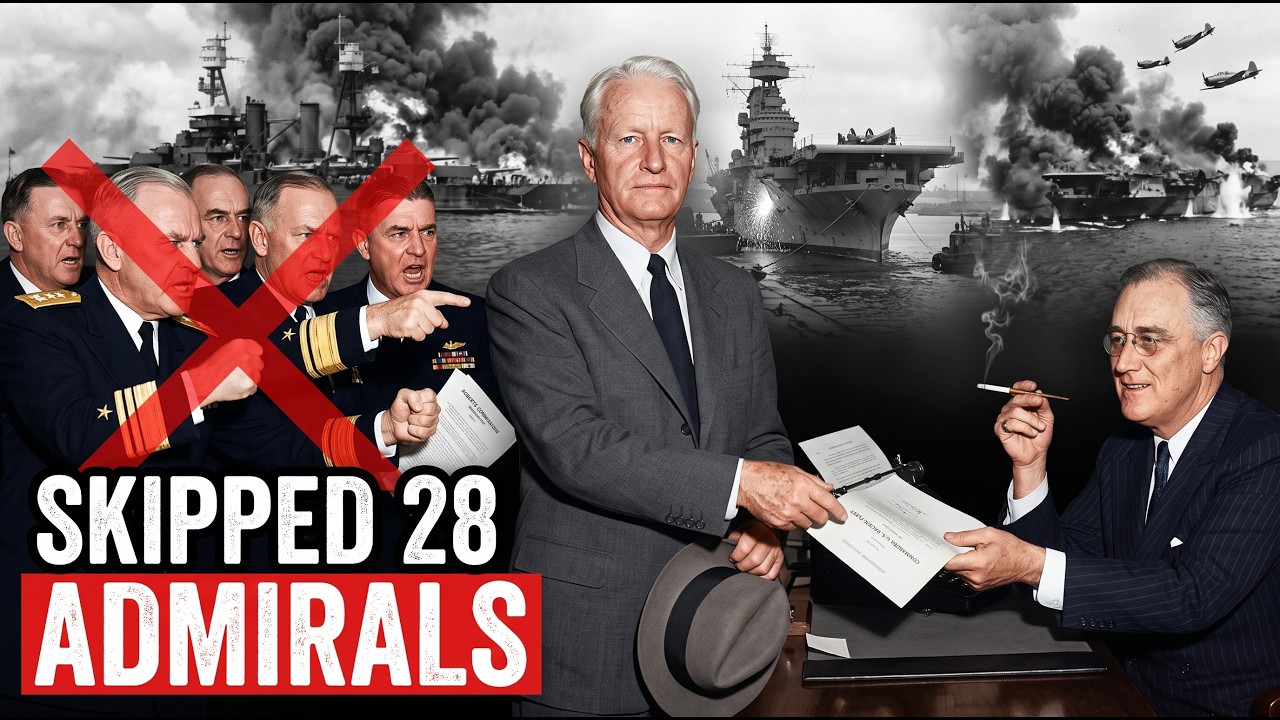
The Army and Navy fought to limit his authority. The State Department filed formal objections. Almost no senior official in the capital trusted the choice Roosevelt had just made. Less than three years later, in the darkness before dawn on June 6, 1944, the first three-man Jedburgh team parachuted into occupied France.
In the weeks that followed, one of Hitler’s most feared armored divisions began moving toward Normandy. It should have arrived quickly. It did not. Between southern France and the invasion beaches, rail lines vanished, bridges went down, radios came alive, and an army built for speed lost days it could never recover.
In the summer of 1940, the United States was watching the world burn from behind a locked door. In six weeks, the German army had done what four years of trench warfare in the First World War had failed to do. Poland was gone. Denmark and Norway were gone.
Belgium and the Netherlands collapsed in days. On June 22, 1940, France signed an armistice with Germany. British troops had been driven off the continent at Dunkirk. Across the Channel, Winston Churchill was preparing his island for invasion.
In Washington, Roosevelt sat with a problem that terrified him more than the fall of France itself. The most powerful nation on earth had no way to see. It had no central intelligence service, no single office where a president could ask what was actually happening in Berlin, Tokyo, Vichy, or Moscow. What America had instead was a scattered patchwork of small bureaus that guarded information the way misers guard coins.
The FBI handled domestic counterintelligence. Army intelligence, known as G2, ran its own network of attachés. The Office of Naval Intelligence did the same for the Navy. The State Department read diplomatic cables.
The Treasury had agents overseas. Even the Federal Communications Commission was intercepting foreign radio traffic. None of them shared. Reports were duplicated, contradicted, and sometimes deliberately withheld from rival agencies.
In an era of blitzkrieg and radio intercepts, the American intelligence system was still built for the age of the telegraph. Roosevelt needed a single trusted man who could go abroad, look at the wreckage of Europe, and bring back the truth unfiltered by any bureau chief with a budget to protect. That man could not be a career soldier, sailor, diplomat, or policeman. He had to stand outside every faction in Washington, be someone Roosevelt personally trusted, and someone the British would talk to honestly.
There was exactly one candidate. William Joseph Donovan was 57 years old in the summer of 1940. He was a Wall Street lawyer, a Republican, and a Catholic of Irish descent from Buffalo, New York. Born in 1883 into a working-class Irish neighborhood along Buffalo’s waterfront, he had worked his way through Columbia Law School, where a young man from a wealthy Hudson River family named Franklin Roosevelt sat in some of the same classrooms.
In the First World War, Donovan commanded the first battalion of the 165th Infantry Regiment, the old Fighting 69th of New York, in the trenches of France. He led a bayonet charge across open ground under artillery fire, was wounded twice, refused each time to leave the line, and received the Medal of Honor. His men gave him the nickname Wild Bill because he could outrun and outfight most of the twenty-year-olds under his command. After the war, he built one of the most successful international law practices in New York, served briefly as a United States Attorney and as an assistant attorney general under President Coolidge, and traveled constantly.
In 1932 he ran for governor of New York as a Republican and lost badly. That defeat mattered because it meant Donovan carried no partisan power base. He was a lawyer who happened to know more about the actual condition of Europe than almost any elected official in Washington. In July 1940, Roosevelt summoned Donovan to the White House and gave him a private mission: go to London, talk to Churchill, talk to the intelligence services, and come back and tell him whether Britain could survive.
Donovan sailed with no rank, no title, and no formal instructions on paper. He landed in a country under attack, met King George VI, spent long evenings with Churchill at Chequers, and was granted something no American had ever been given before: the British opened their intelligence services to him. He toured coastal defenses, radar stations, and Fighter Command operations rooms. He returned convinced that Britain could hold if it received American support.
Roosevelt sent him back. In December 1940, Donovan began a second, longer journey, traveling through the Mediterranean, the Balkans, and the Middle East, watching British desert operations, listening to Balkan leaders describe the growing pressure from Berlin, and seeing the raw material of a European resistance that did not yet know it would need American help. When he came home in the spring of 1941, the ideas had hardened into something concrete. On June 10, 1941, he sent Roosevelt a memorandum outlining a single new office that would collect and analyze strategic information for the president, coordinate the intelligence produced by the existing bureaus, and conduct propaganda and irregular warfare against Axis targets.
It was a short document. Its consequences would last for eighty years. When Donovan’s draft was circulated for formal review, the reaction from inside the government was immediate and hostile. Hoover wrote a private memorandum warning that Donovan’s proposal would create a rival secret police and began quietly feeding negative material about Donovan to journalists.
General Sherman Miles, head of Army G2, argued that a civilian agency would duplicate the work of Army intelligence and warned that placing sensitive military information in the hands of a lawyer with no uniform was a security risk. The State Department objected that intelligence gathered abroad was inseparable from diplomacy and belonged inside its own walls. By the summer of 1941, Donovan had managed to unite four of the most powerful institutions in Washington against him. Roosevelt was one of the few willing to publicly support the proposal, and Roosevelt was the only vote that counted.
The president understood something the bureaucracy did not. Every one of the agencies fighting Donovan had already failed to see what was coming in Europe. G2 had underestimated the Wehrmacht. Naval intelligence had misread Japanese naval expansion.
The State Department had trusted diplomatic assurances from Berlin and Tokyo that were worth nothing. The very men writing memos against Donovan were the same men whose reports had left the White House unprepared for the fall of France. On July 11, 1941, without consulting Congress, without a formal act of legislation, without asking permission from a single one of the offices arrayed against him, Roosevelt issued a presidential directive creating a new position in the executive branch: Coordinator of Information. The office would report directly to the president, collect and analyze information bearing on national security, and be authorized to conduct such supplementary activities as the president might direct.
That last phrase, deliberately vague, was the door through which every future covert operation would eventually walk. The directive named William J. Donovan as the first and only coordinator. He accepted without salary.
Donovan set up his office in the old National Institute of Health building in Washington. He had no staff, no budget approved by Congress, and no clear legal authority over anyone in another department. He began hiring anyway. He drew from Yale, Harvard, and Princeton.
He recruited Wall Street lawyers, foreign correspondents, professors of history and economics, businessmen who spoke foreign languages, and a scattering of adventurers and eccentrics who did not fit anywhere else in the American government. The Washington press corps coined a mocking phrase for the new agency based on the initials of its office: Oh, So Social. The name stuck. Then, on the morning of December 7, 1941, aircraft from six Japanese carriers struck the United States Pacific Fleet at Pearl Harbor.
The intelligence failure that had allowed the attack was the largest in American history. It was not primarily Donovan’s failure; his office had existed for less than five months and had almost no capability in the Pacific. But Pearl Harbor changed everything about the argument over central intelligence. The idea that America could fight a global war with a handful of uncoordinated bureaus was no longer defensible in public.
Through the first half of 1942, Roosevelt fought to protect his coordinator from being swallowed by the Joint Chiefs of Staff. The compromise came on June 13, 1942, when Roosevelt dissolved the office and replaced it with the Office of Strategic Services, the OSS. The new agency would answer to the Joint Chiefs rather than directly to the president. It kept the intelligence and covert action functions Donovan had built, but lost the propaganda branch.
Donovan was commissioned as a colonel in the United States Army, later promoted to brigadier general in March 1943 and major general in November 1944. The uniform gave him a rank his enemies could not easily strip away, but it also placed him inside a chain of command that included men who would spend the war looking for ways to limit his organization. General Douglas MacArthur formally closed his theater to OSS operations. Admiral Ernest King restricted OSS activity across most of the Pacific.
Hoover held the line in Latin America. Donovan had a charter, a rank, and a mandate, but he had not yet recruited an agent behind enemy lines or delivered a single piece of actionable intelligence from occupied Europe. Everything the Washington bureaucracy had said about him was still technically correct. He was untested.
His new agency existed largely on paper. The man nobody in Washington trusted now had to prove somewhere in the world that Roosevelt had not made the largest mistake of his presidency. In the summer of 1942, Donovan set about building the largest secret intelligence organization the United States had ever attempted, and he did it from almost nothing. The OSS charter granted him authority, but not people, tradecraft, radios, safe houses, forged documents, or any of the physical machinery of espionage.
All of it had to be invented, borrowed from the British, or improvised. Within two years, the agency would grow to a wartime peak of roughly thirteen thousand personnel. The OSS entered research and analysis, staffed with academics who applied social science, economics, and history to the problem of understanding the Axis. Special operations handled sabotage and cooperation with resistance movements.
Counterintelligence, called X2, was built directly on British foundations after London agreed to share the secret of the double-cross system. Morale operations produced forged German newspapers and false radio broadcasts. Operational groups were uniformed commandos organized along ethnic lines, ready to be dropped behind enemy lines to fight alongside partisans. A communications branch built the radio network that connected every OSS station from Bern to Chungking to Washington.
A field photographic branch led by film director John Ford recorded operations from Midway to Normandy. Donovan understood that intelligence was not simply the collection of secrets but the interpretation of them, and he wanted the finest civilian minds in the country to do that interpretation. He also built forward. He placed Allen Dulles, a lawyer from a family of diplomats and a future director of central intelligence, in Bern, Switzerland.
In November 1942, Dulles set up shop and became the most productive OSS station chief of the war, running networks into Germany itself. To silence the doubters, Donovan needed a battlefield victory that could be measured in enemy dead and downed American pilots recovered. He would find it in the malarial jungles of northern Burma, in a mission that became known as Detachment 101. The detachment made contact with the Kachin, a mountain people who deeply hated the Japanese occupiers, and slowly built an indigenous guerrilla force that eventually numbered close to ten thousand men.
Kachin rangers set ambushes on jungle trails at dawn and disappeared before Japanese reinforcements could react. They cut telegraph wires, poisoned wells, and left booby traps in abandoned villages. Their most important mission was the recovery of American aircrew shot down over the Hump, the deadly air route across the eastern Himalayas. Detachment 101 rescued more than 425 Allied airmen from behind enemy lines.
It was credited with about 5,500 confirmed Japanese dead and roughly 10,000 additional Japanese killed or seriously wounded. Twenty-seven Americans in the detachment were killed. General Stilwell, who had once threatened the unit’s commander with disappearance if he failed, later said Detachment 101 was worth a division to him in the field. But Burma was still a sideshow.
The main war was in Europe. By the autumn of 1943, planning for the invasion of France had reached a level of detail that included every foreseeable German response. Allied planners knew that once troops came ashore in Normandy, the German High Command would move armored divisions from all over France to throw the invaders back into the sea. Every day that reinforcement was delayed was worth thousands of Allied lives.
The answer was a joint program involving OSS, Britain’s SOE, and the Free French services. Jedburgh teams were normally three-man multinational teams composed of two officers and an enlisted radio operator, drawn from American, British, and French personnel, with at least one native French speaker on each team. They parachuted into occupied territory in uniform to link up with the Maquis, coordinate sabotage, arrange arms drops, and direct guerrilla attacks against German lines of communication. Nearly one hundred Jedburgh teams would be fielded during the European campaign.
Training took place at Milton Hall in England, where candidates learned parachuting, plastic explosives, radio operation, and how to survive interrogation. Among the American Jedburghs was twenty-four-year-old William Colby of Minnesota, a Princeton graduate who would later become director of central intelligence. Aaron Bank, a future founder of United States Army Special Forces, and John Singlaub, later a major general, also served in the program. Donovan himself was determined to be present when the invasion came.
He was sixty-one years old, a brigadier general privy to virtually every important Allied secret. Eisenhower had specifically forbidden him from going ashore, fearing his capture. Donovan went anyway, arriving on Utah Beach on June 7, 1944, the day after the landings. The first Jedburgh team, code-named Hugh, had jumped in the early hours of June 6.
Over the following weeks, additional teams landed across Brittany, the Massif Central, and the departments of central and southwestern France. The Maquis had been growing since 1943, when the Vichy regime introduced forced labor conscription that sent hundreds of thousands of young Frenchmen to work in German factories. Tens of thousands refused and fled into the countryside. By June 1944, the Maquis numbered in the tens of thousands, poorly armed, hungry, but ready.
What they had lacked was coordination, weapons, and direction. The Jedburgh teams delivered all three. In the forty-eight hours after the Normandy landings, French rail workers and Maquis fighters, guided in many places by Jedburgh and SOE teams, cut hundreds of rail lines across France. Telephone and telegraph lines were sabotaged.
Bridges were blown or damaged. Fuel dumps were burned. The German rail movement plan, which called for rapid reinforcement of Normandy by rail, was severely disrupted within days. The Wehrmacht was increasingly forced to move heavy units by road, where they were vulnerable to Allied fighter-bombers by day and Maquis ambush by night.
The German response was ferocious. Waffen-SS units launched brutal reprisals against villages suspected of harboring the Maquis. Entire hamlets were burned. Hostages were executed by tens and hundreds.
But the sabotage did not stop. Nowhere would this shift matter more than in a single catastrophic road march undertaken by one of the most formidable armored formations in the German army. The 2nd SS Panzer Division, known by its honorific name Das Reich, was garrisoned in the spring of 1944 near Montauban in southwestern France, refitting after brutal service on the Eastern Front. It fielded approximately fifteen thousand men and more than two hundred armored vehicles, including Panther and Panzer IV tanks.
The distance from Montauban to Normandy is roughly 450 miles by the most direct road. The division received its movement order on the night of June 7, 1944, and was expected to reach the front swiftly. It took roughly two and a half weeks to get there. Allied air interdiction had damaged railways and bridges on a scale that no single agency could have achieved.
Marshalling yards had been hit repeatedly. Rail lines had been cut in dozens of places. The division was forced to send its tanks north under their own power, consuming enormous quantities of fuel. Along the route, Maquis fighters ambushed columns, cut roads, and sniped at officers.
The division’s response was to treat the entire region as hostile territory and punish it accordingly. On June 9, soldiers of the division hanged 99 male civilians in the town of Tulle. On June 10, a company surrounded the small village of Oradour-sur-Glane, herded the population into barns and the parish church, and murdered 642 civilians, including 207 children. The village was then burned.
When Das Reich finally entered the Normandy battle, it faced an Allied position far stronger than it had been on D-Day. The division was thrown into the fighting around Saint-Lô and later against the American breakout at Operation Cobra, where it was ground down by superior Allied firepower and air supremacy. While the Jedburghs were transforming the ground in France, Allen Dulles was quietly transforming the war from a small office in Bern. In August 1943, a German foreign ministry official named Fritz Kolbe walked into the Bern station and offered Dulles thousands of pages of classified German diplomatic cables.
Over the next two years, Kolbe delivered more than 1,600 documents, providing one of the most valuable streams of intelligence the Allies received from inside Nazi Germany. In early 1945, Dulles opened a back channel with SS General Karl Wolff, the senior SS commander in northern Italy, to negotiate the surrender of German forces there. The talks, code-named Operation Sunrise, ran from February into April 1945 amid enormous political sensitivity. Stalin, learning of the negotiations, accused the Western allies of conspiring behind Soviet backs.
The negotiations continued in secret. On April 29, 1945, the German commanders in northern Italy signed a surrender that took effect on May 2, ending the fighting on that front six days before the general German surrender on May 8. In Washington, Donovan’s agency had in three years gone from a lawyer’s proposal opposed by every major bureau to a global organization whose officers had helped shape the decisive campaigns of Europe and Asia. But the war was not over, and the president who had made all of it possible had only ten months to live.
In November 1944, Donovan sent Roosevelt a detailed memorandum proposing a permanent civilian intelligence agency that would report directly to the president and combine under one roof the collection, analysis, and covert action functions the OSS had spent three years learning to perform. It was in effect an early blueprint for what would eventually become the Central Intelligence Agency. The memorandum reached Roosevelt’s desk in late November. It also, within weeks, reached the front page of the Chicago Tribune.
On February 9, 1945, an isolationist reporter published a leaked account of the plan under headlines calling for an American Gestapo. The article was picked up across the country by newspapers hostile to the New Deal. Editorial writers denounced the proposal. Congressional Republicans and even some Democrats warned that a permanent civilian intelligence agency answering only to the president would be incompatible with American liberty.
Within days, the plan collapsed politically. The source of the leak was never officially identified. Suspicion then and later fell on J. Edgar Hoover, who always denied it.
Roosevelt, forced onto the defensive, quietly shelved the proposal. He was also, by that winter, a dying man. On April 12, 1945, at his cottage in Warm Springs, Georgia, Franklin Roosevelt suffered a massive cerebral hemorrhage and died within hours. He was 63 years old.
Vice President Harry S. Truman, a former artillery captain from Missouri who had been kept almost entirely outside Roosevelt’s wartime inner circle, was sworn in that evening. He knew almost nothing of the atomic bomb, little of the details of the war in the Pacific, and nothing at all of the personal loyalty Roosevelt had extended to Donovan. What he did know about Donovan was that Donovan was a Republican, a Roosevelt intimate, and the head of an organization Truman had heard described in the harshest terms by officials he trusted.
Germany surrendered on May 8, 1945. Three months later, atomic bombs destroyed Hiroshima and Nagasaki. Japan surrendered on August 15 and signed formal instruments on the deck of the battleship Missouri on September 2. The war was over, and the machinery of American demobilization turned its attention to the wartime intelligence agencies.
On September 20, 1945, Truman signed Executive Order 9621, terminating the OSS effective October 1. Research and analysis were transferred to the State Department. The remaining functions were transferred to the War Department. Donovan convened his senior staff, drafted his own farewell letter, and on September 28 addressed the men and women of the OSS at a final gathering in the Riverside Skating Rink in Washington.
His remarks were brief and generous. He thanked his people, acknowledged the loss of those who had not come home, and told them plainly that they had built something no American had built before. He did not attack Truman. He did not defend the agency in political terms.
He simply thanked them and closed the door. On October 1, 1945, the Office of Strategic Services ceased to exist. But the clandestine capabilities Donovan had built did not vanish. They were compressed, hidden inside the War Department, and waiting.
They did not have to wait long. On January 22, 1946, Truman signed a presidential directive creating the Central Intelligence Group, a small coordinating body under a new position called the Director of Central Intelligence. In the summer of 1946, the CIG absorbed the surviving OSS clandestine networks. The world made the case Truman had refused to hear the previous autumn.
On March 5, 1946, Winston Churchill delivered his Iron Curtain speech. Soviet troops refused to leave northern Iran. A communist insurgency was fighting a British-backed government in Greece. Turkey was under Soviet pressure.
In February 1947, London informed Washington that it could no longer sustain aid to Greece and Turkey. On March 12, Truman addressed a joint session of Congress and announced what became known as the Truman Doctrine. Washington still lacked the permanent statutory central intelligence structure that Donovan had advocated in his 1944 memorandum. On July 26, 1947, Truman signed the National Security Act.
The law created the National Security Council, a unified military establishment, the United States Air Force as an independent service, and, in its most consequential provision for the story of American intelligence, the Central Intelligence Agency. The new CIA inherited important personnel and clandestine capabilities through the CIG and the former OSS strategic services unit. Its structure mirrored the general vision of the Donovan proposal of November 1944. Donovan was not appointed director.
Truman chose Rear Admiral Roscoe Hillenkoetter, who had been serving as the third director of central intelligence at CIG and now became the first director of the new agency. Donovan was informed of the decision privately and accepted it without protest. He was 64 years old. He had built the machine.
Others would run it. OSS veterans became extraordinarily influential inside the new CIA. Allen Dulles served as director from 1953 to 1961. Richard Helms served from 1966 to 1973.
William Colby served from 1973 to 1976. James Angleton ran CIA counterintelligence for twenty years. Frank Wisner built the covert operations directorate. The CIA was not simply the OSS restored under another name; roughly one-third of its early personnel were OSS veterans.
The blueprint had won. The blueprint’s author had been left in his law office. In 1953, President Eisenhower brought Donovan back for one final government service, appointing him United States Ambassador to Thailand. He served for a year before returning to New York.
By the late 1950s, his health began to fail. On February 8, 1959, William Joseph Donovan died. He was 76 years old. He was buried with full military honors in Arlington National Cemetery.
Eisenhower ordered flags at government buildings lowered. In a private message to the family, the president called him the last American hero of a certain kind, the kind who had built an institution the country would need for as long as it remained a great power. Today, in the lobby of the original headquarters building at the Central Intelligence Agency in Langley, Virginia, a bronze statue of William Joseph Donovan stands against the wall. The inscription is short.
It names him as the founder of American central intelligence and the leader of the Office of Strategic Services in the Second World War. Roosevelt made that choice quietly in a single directive in the summer before Pearl Harbor. It shaped the war in which the United States fought, and it shaped every war the United States has fought since.






