Long before the tabloids called her a traitor, before the seven husbands, the crash diets and the billion-dollar fortune, Barbara Hutton was a solitary little girl locked inside a golden cage. She was born in New York on November 14, 1912, the only daughter of Edna Woolworth and Franklin Hutton. Her mother passed away when Barbara was barely four, a tragedy the family concealed for years. But it was the small child who came upon her.
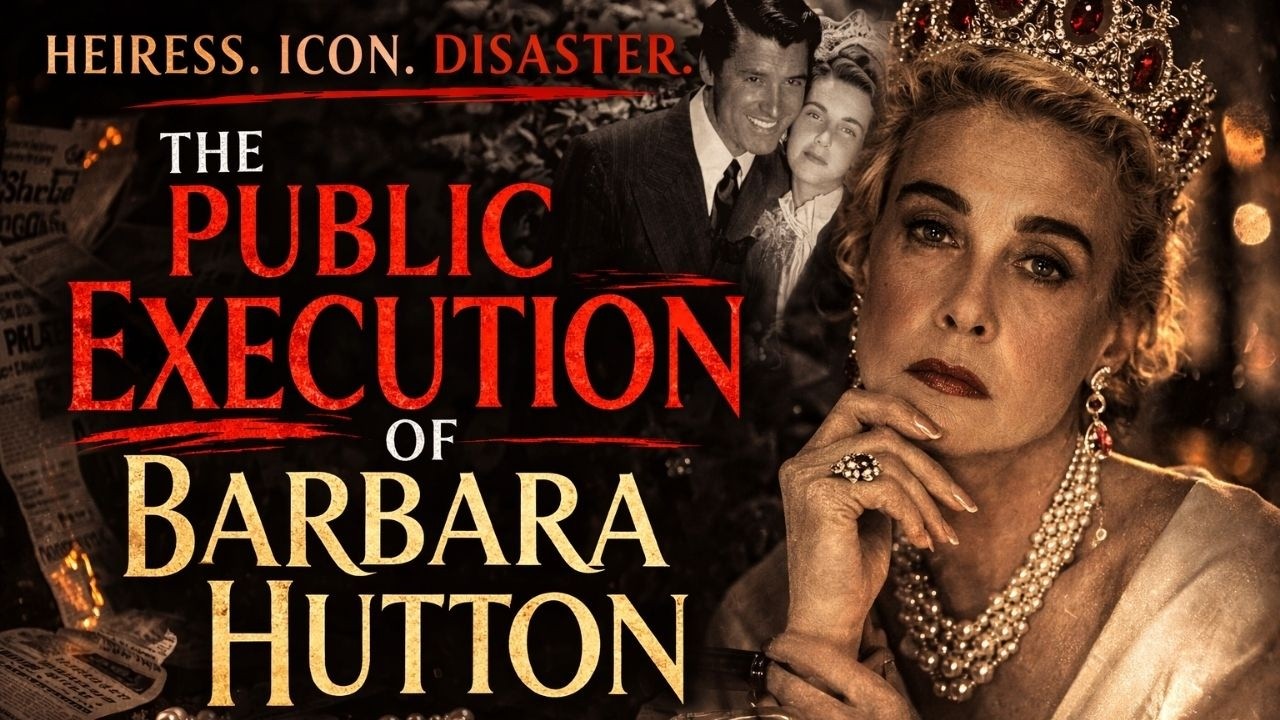
Governesses brought Barbara up, passing her from one grand residence to the next, and affection was something she never had enough of. Reporters hounded her through childhood, and the public didn’t watch with delight but with expectation, waiting for her to fall. At her debutante ball, orchids flown in for the occasion, champagne and an orchestra shipped over from Europe made it the costliest coming-out celebration of the season. As America went hungry through the Great Depression, she danced in diamonds.
Public sentiment swung against her with real venom. People called her crude, unpatriotic, a poisonous emblem of everything rotten about the wealthy. Strangers spat at her on the sidewalk, mocked her, and hurled stones at her car. When she put her fortune behind Britain’s war effort, she was labeled a warmonger and a traitor.
Her existence dissolved into a swirl of parties and empty marriages that ended in scandal. She woke in hotel rooms she had no memory of booking. Seven times she married; three of her husbands were princes, and one she simply purchased with cash. She handed diamonds to hotel employees, rode elephants to parties, and shared beds with legends such as Cary Grant and James Dean.
She battled for custody of her children across continents, forever hoping love could be won as effortlessly as attention. Yet the money seeped away, the tabloids tightened their grip, and the parties grew vicious. Friends disappeared into scandal, addiction and death. She slipped away quietly, getting by on punishing diets, sleeping pills, champagne at breakfast and vodka to fall asleep.
Her weight dropped and her bank accounts ran dry as predators gathered around her. Even so, she kept performing her part, coated in perfume and powder, completely alone. Her wealth traced back to her grandfather, Frank Winfield Woolworth, whose five-and-dime shops stood along nearly every main street in the country. Barbara’s father was an up-and-coming Wall Street broker, and her mother, Edna, was the delicate second daughter of the Woolworth dynasty.
Her parents’ marriage was a clash of opposite natures. Edna was timid and withdrawn; Franklin was restless, drank heavily and strayed. Their union fell apart in public when photographs of Franklin dancing with a young Swedish actress ran in the New York Sun. Edna gave up trying to rescue the marriage.
On the night of May 2, 1917, she put on her finest gown, looped pearls around her neck, and shut her door. The papers said a maid had come across her body. In reality, it was four-year-old Barbara who found her mother. No autopsy was ever carried out.
The coroner cited mastitis, which didn’t fit the circumstances. Most assumed Edna had ended her own life, and that the Woolworth family had paid to keep the truth buried. Barbara was sent to her grandparents at Winfield Hall, a sixty-room mansion of white marble. The house was organized by historical era, from Louis XIV to Marie Antoinette, and every bedroom door carried a plaque in gilded lettering.
Her grandfather, Frank Woolworth, once a titan whose stores stretched across continents, had grown paranoid and withdrawn, playing his pipe organ for hours on end until the walls seemed to vibrate. Barbara’s grandmother, Jenny, sat mute and unresponsive in a rocking chair all day. Meals passed in silence. Barbara understood early what it meant to be surrounded by everything and touched by nothing.
When her grandmother died in 1924, the estate was split up. At eleven years old, Barbara came into more than twenty-six million dollars, which made her one of the wealthiest children alive. She was still not a teenager, yet she belonged to nobody. Her mother was gone, her father was somewhere else, and her guardians were the household servants.
At sixteen, she fell for a tennis coach named Peter Story, a twenty-six-year-old man who showed her a gentleness she had never experienced. The affair was short and shattering. By seventeen, she had taken a sailboat and drifted fifteen miles out to sea before the coast guard caught up with her. Her father hushed it up and hired a bodyguard to keep watch over her; inside a week she was sleeping with him.
When her father learned of it, he was revolted and swapped the guard for a married chauffeur, adding the man’s wife to the household staff. Her official debut unfolded in three stages, ending with a ball at the Ritz-Carlton on December 21, 1930. A thousand guests, four orchestras, two hundred waiters, ten thousand roses and twenty thousand white violets. Maurice Chevalier welcomed guests dressed as Santa Claus, and the party favors were velvet boxes holding unmounted jewels.
Even by then, Barbara saw the way people regarded her, not with warmth but with calculation. She took to calling herself the Princess of Plague. She said all she had to do was glance at a respectable man and he would flee in the other direction. The next year, she was presented at the British court.
The Prince of Wales danced with her, though she called him buoyant, drunk and oddly frivolous. The press portrayed her as a reckless heiress out to purchase a title. She was already involved with Prince Alexis Mdivani, a Russian exile from Georgia whose aristocratic credentials were largely fabricated. He divorced his American wife while she was expecting, and Barbara’s family attempted to halt the marriage.
At nineteen, she asked the court to declare her legally of age. It was approved. They wed in Paris on June 20, 1933, in a civil ceremony, then a religious service in a Russian Orthodox cathedral. Eight thousand people packed the streets outside.
At the altar, Barbara set foot on the ceremonial carpet a moment ahead of Alexis. The priest had explained that whoever stepped first would rule the marriage. She gave him a yacht, pearl shirt buttons, polo ponies, and then a second set of polo ponies, because she had learned his first wife had given him the same. He gave her a jade necklace, paid for with her own money.
The marriage fell apart fast. On the train to Lake Como, he informed her she was too fat. She weighed 148 pounds and stood five foot four. By morning she had started what she called her Gandhi diet: three cups of coffee a day, cigarettes and no food.
He burned through her money, caroused and was arrested in nightclubs. When she finally requested a divorce, her father hired investigators to look into the new suitor, Count Kurt Reventlow. They turned up a Danish aristocrat with a dairy farm, a private railway and thousands of acres. Her father urged her to take her time.
But hours after her divorce from Alexis became final, she went ahead and married Reventlow regardless. The marriage proved a catastrophe. He insisted she give up her American citizenship to save on taxes for their son, Lance, born in 1936. The press exploded with cries of treason.
He became domineering, and then brutal. In Paris, he brought her to a clandestine club where children were put on display and abused on a stage, and later that night, within their suite, he attacked her. She escaped to London and filed charges. A judge remarked under his breath that he had known men who murdered their wives over far slighter provocations.
Yet she withdrew the charges, explaining that she wanted no scandal, only calm. Come 1939, war was looming across Europe. Barbara had renounced her American citizenship, but a British court would not return her small son to her. She escaped to America carrying her mother’s pearls and a great fortune, reaching New York on October 22 to a reception of scorn.
Demonstrators massed outside her hotel. Rocks struck her limousine. One woman vowed to fling acid into her face. Every day brought a hundred letters full of hatred and threats.
The city had judged her a dollar princess who danced while others went hungry. She struck back with cash and showmanship. She gave her yacht to the British navy, supported fifteen families, donated ten ambulances to the Red Cross, and handed fifty thousand dollars to the British war relief fund. The headlines grew gentler.
People began calling her as American as apple pie. In July 1942, she wed Cary Grant at Lake Arrowhead. He surrendered any claim to her wealth. For a while, she was content.
Yet she had already started taking pills, at first to sleep, later to steady her nerves. Grant, known for his thrift, took to tallying bottles of Coca-Cola and snipping buttons off shirts headed for the trash. She withdrew into private rituals, coloring in days with hues and speaking in riddles. They slept in separate bedrooms and existed behind a barrier of silence.
Their divorce arrived without fanfare. By 1946, she had fled to Morocco, purchasing a white palace and furnishing it with silk and crystal. She hosted lavish parties and quietly gave thousands to feed the hungry. Still, the emptiness remained.
She wed Igor Troubetzkoy, and then Porfirio Rubirosa, a Dominican diplomat who insisted on two million dollars handed over on the wedding day. She consented. The marriage survived seven weeks. Her son Lance drifted away from her.
He wed at nineteen; she was not there. He perished in a plane crash on July 4, 1972, when a friend lost control of a small aircraft. Barbara would not accept it. She shrieked, broke down, and raged.
She confessed that she had been a poor mother. Her wealth had been siphoned off for years by her own attorney, Graham Madison, who held five houses and two Rolls-Royces while she sank into debt. By the late 1970s, she lay confined to a hotel bed, unwilling to get up, pleading for men to sit with her for a thousand dollars a night. Her meals consisted of Coca-Cola and cigarettes.
She was certain she was being spied on, that her lawyer was scheming against her. On March 26, 1979, she was taken to Cedars-Sinai hospital suffering from cardiomyopathy. She rejected IVs and tore needles from her arms. On May 11, 1979, at 5:10 in the evening, Barbara Hutton died at sixty-six.
Her funeral was held at Woodlawn Cemetery in the Bronx. Ten people came. No priest was present. She had once remarked that she did not want a man she had never met droning over her grave.
A single poem was read. She was laid to rest beside her mother, and beside Lance. Barbara Hutton had spent a lifetime pursuing something that would never remain.
In the end, when nothing remained, she drifted quietly into the silence she had dreaded all her life.
