On a spring morning in 1792, a condemned highwayman named Nicolas Jacques Pelletier was led out to the Place de Grève in front of the Paris city hall, supported up the steps because his legs would not carry him, and strapped to a plank in front of a tall, red-painted apparatus the crowd had never seen. The blade came down in a single motion, and the head dropped into a basket in what witnesses agreed was a matter of moments. The huge crowd that had gathered for the usual spectacle—the struggle, the suffering, the long dying they were accustomed to—went home grumbling. It was too fast.
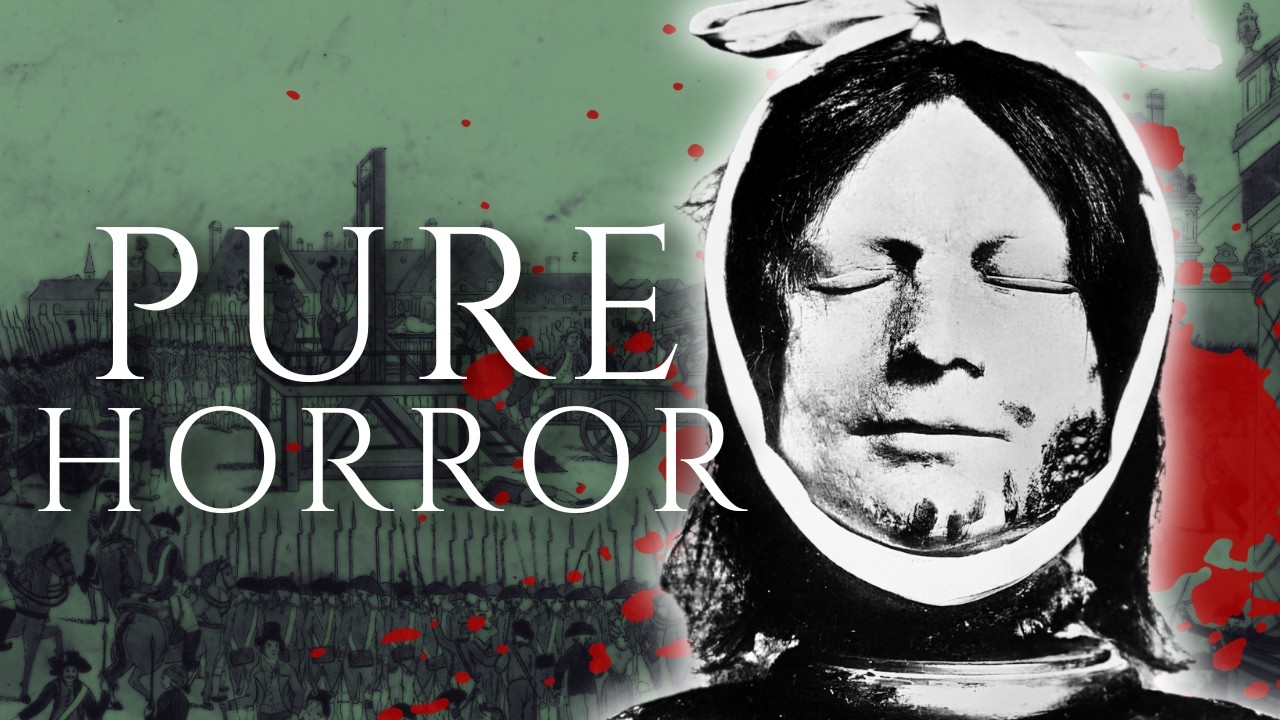
There was nothing to see. A little song began circulating in the streets, asking for the good old wooden gallows back. The machine designed to make death humane had committed the one unforgivable sin of public execution: it was boring. They would get over that.
The machine had been on its way for some time before Pelletier’s neck found it. The basic idea—a heavy blade dropped from a height onto a pinned human neck—had been quietly at work in Europe for centuries. In the English town of Halifax, from at least the 1200s, stood a device the locals called the Halifax Gibbet: a stone platform about four feet high, two wooden uprights fifteen feet tall with a groove cut down the inside of each, and between them a massive wooden block with an axe head bolted to its bottom. A rope ran through a pulley holding the block at the top; when released, the whole assembly came down the grooves and landed on whatever was underneath.
Halifax used it on thieves. Under the local memorial law, anyone caught in the district with stolen goods worth more than thirteen and a half pence could be summarily beheaded. Halifax was a wool town; cloth was left out on frames to dry, and cloth theft was the local plague. The first recorded execution there dates to 1286, the last to 1650, with close to a hundred people believed to have died under it.
The axe was reportedly never sharpened; the block was so heavy that the edge crushed through the neck rather than slicing it. The idea traveled. In 1564, Scotland built its own version in Edinburgh during the reign of Mary, Queen of Scots, calling it the Maiden—a strange, almost tender name for an oak frame with a heavy weighted blade. Between 1564 and 1710, it publicly beheaded over 150 people, criminals and political enemies alike.
The Earl of Morton, regent of Scotland, was beheaded by it in 1581, and a persistent tradition claims he was the very man who ordered the thing built after seeing the Halifax Gibbet. The Maiden still exists, standing in the National Museum of Scotland, dark old oak, the blade still mounted, museum visitors walking past it holding coffee. Italy had one too, the Mannaia, shown calmly in an illustration from 1539. A beheading machine of the same design even appears in a French romance text from the early 1200s, casually, as if the audience already knew what one was.
What nobody had done yet was hand it to a modern state during a period of political madness and let it run at full capacity. That part was coming. France in 1789 executed people in ways that are hard to say out loud. If you were a commoner convicted of a serious crime, you might be hanged—an eighteenth-century hanging meaning slow strangulation at the end of a short rope, legs kicking, sometimes for many minutes, while the crowd watched your face change color.
If your crime was worse, you might be broken on the wheel: executioners tied you to a cartwheel or wooden cross, took an iron bar, and methodically shattered the long bones of your arms and legs one by one, blow by blow, while you remained fully conscious, then threaded your broken limbs through the spokes and hoisted you up to die of shock and exposure over hours or even days. Burning at the stake still existed, and so did boiling for certain crimes, at least on the books. Beheading by sword, the privileged death, was reserved for nobles on the theory that a clean stroke was a dignity the well-born deserved—except the clean stroke was a fantasy half the time. Beheading a kneeling, trembling human being with a heavy sword is a skill, and the condemned rarely held still.
The most infamous botching involved a nobleman named Lally-Tollendal in 1766, whose execution took multiple hacking strokes while he was still moving, and that memory hung over the whole debate that followed. Into this walked a mild, round-faced physician and deputy of the National Assembly named Joseph-Ignace Guillotin, born in 1738 in the town of Saintes. The story told about his birth is almost too fitting: his mother supposedly went into premature labor after hearing the screams of a man being broken on the wheel near their home. Whether or not that story grew in the telling, the man it attached itself to spent his life horrified by cruelty.
He was against the death penalty entirely, but he was also a realist sitting in an assembly that was never going to abolish it. So in October of 1789 he stood up and proposed a compromise in six articles: if France must kill, then every condemned person, noble or commoner, should die the same way—by simple decapitation by means of a machine without torture. Equality in death; the same blade for a duke and a pickpocket. The assembly laughed at him.
He got carried away describing the speed of it, said something to the effect that with his machine the condemned would feel nothing but a slight coolness on the neck, and the chamber found that funny. Songs were written mocking him. But the idea survived the mockery, because underneath the laughter everyone knew the current system was indefensible, and in 1791 decapitation became the sole method of execution in France. Guillotin, the gentle abolitionist, had almost nothing to do with the design.
He proposed the concept and then watched in growing horror as his own name welded itself to the machine. He spent the rest of his life trying to pry it off. His family petitioned the government to rename the device; the government declined, so the family changed their own name instead. Guillotin died in his bed in 1814, an old man still haunted by the fact that the bloodiest object in Europe carried his signature.
The actual engineering fell to Antoine Louis, secretary of the Academy of Surgery, a serious anatomist who approached the problem the way a surgeon approaches anything: coldly and precisely. For a while the machine was even called the Louisette after him, a name that mercifully did not stick. Louis drew up the specifications, and the contract to build the prototype went to a man whose day job makes the whole story feel like dark fiction: Tobias Schmidt, a German craftsman living in Paris who built harpsichords—a maker of musical instruments. His workshop sat in the Cour du Commerce Saint-André, and in the spring of 1792, between orders for keyboards, he assembled the first guillotine for around 38 livres.
Schmidt knew exactly who his customer was too, in the most personal way possible, because he happened to be an old friend of Charles-Henri Sanson, the executioner of Paris, the very man who would pull the cord. Two friends, a craftsman and a headsman, working out the details of a decapitation machine over the same table where one of them designed instruments meant to fill rooms with music. One more figure allegedly leaned over those drawings. King Louis XVI was a tinkerer; he loved locks, mechanisms, precision metalwork, far more than he ever loved governing.
The story that comes down through the Sanson family memoirs says the design was shown to the king, that he studied the blade—then flat or crescent-shaped in the drawings—and suggested changing it to a steep diagonal, an oblique edge, so it would slice cleanly through any neck regardless of thickness rather than crushing down on it. The memoirs were published decades later and dressed up by an editor, so how much weight you put on the scene is up to you. But the oblique blade is real; it is on every guillotine ever built. And if the king truly drew that angle with his own hand, he was nine months away from feeling his contribution work exactly as intended.
Before it touched a living person, the machine was tested. In April of 1792, at the Bicêtre Hospital outside Paris, the prototype was set up in a courtyard and given a trial run—first on live sheep and calves, then on human corpses supplied from the hospital and the prisons, bodies of the poor and unclaimed. Officials stood around taking notes while dead men were strapped to a plank and beheaded to check the mechanism. The tests revealed problems: on thick-necked corpses, the early blade did not always go clean through.
Adjustments were made, the drop height raised, the blade made heavier, the angle refined, until the machine severed every neck they fed it in one stroke. Antoine Louis pronounced it ready. And in a cell somewhere in Paris, a man who had been waiting for months was about to become history’s first. Pelletier had been a highwayman; on an October night in 1791 he attacked a man on a Paris street, beat him, took a wallet with securities, and the victim died.
He was caught almost immediately and sentenced to death. Then France changed its execution method while he sat in his cell. The old penalty would have been the wheel or the rope; the new law said decapitation by machine, but the machine did not exist yet. So Pelletier waited through the winter, through the design meetings, the contract with the harpsichord maker, the corpse trials at Bicêtre—a condemned man kept alive essentially as inventory, waiting for his own execution device to finish development.
His lawyer actually used the delay to argue that the sentence should be commuted. It was not. The machine that finally took his head was simple enough. Two upright posts about fourteen feet tall, joined at the top by a crossbar, with grooves running down the inside of each post—later models lined with brass or metal after damp wood swelled and blades jammed partway down.
Riding in those grooves sat the business end: the angled steel blade bolted to a heavy metal block called the mouton. Together the falling assembly weighed in the neighborhood of 88 pounds, sometimes more, and dropped about seven feet before meeting the neck, arriving moving over twenty feet per second. The actual severing of a human neck—skin, muscle, windpipe, spine, arteries, everything—took roughly two-hundredths of a second. A blink takes about fifteen times longer.
The condemned never lay down voluntarily onto anything. At the front of the scaffold stood an upright plank, the bascule, hinged at its base like a seesaw. Assistants strapped the person to it standing up, chest against the wood, arms bound behind, then tipped the whole plank forward so it swung down flat, sliding the body horizontally into place with the neck arriving exactly under the blade. A two-piece wooden collar, the lunette, then closed around the throat, the lower half cradling the neck, the upper half swinging down and locking, so the head stuck out through a snug round window, held completely rigid, facing down into a basket.
From the condemned person’s side, the last sight was usually the inside of a woven basket, sometimes with the residue of everyone who had gone before them that day. From the executioner’s side, the back of a bare neck framed in wood. The executioner pulled a handle, and the blade came down with what witnesses described as a heavy rattling hiss down the grooves, followed by a wet thud, then a second thud as the head landed. The head dropped into the basket, or in later years a metal bucket, and the body, still strapped to the plank, was immediately tipped sideways into a large wicker basket or a waiting cart lined with sawdust or bran.
The sawdust was there for a simple reason: an adult human body holds roughly ten pints of blood, and a severed neck does not seep. The heart, for the moments it keeps beating, pumps the blood out of the open arteries under pressure in spurts, and even after the heart stops, the vessels drain. Multiply that by ten, twenty, fifty people in a single day, and you understand why the scaffold planks were scrubbed, why gutters were cut into the platforms, why buckets of water were thrown across the boards between batches, and why entire neighborhoods eventually rose up complaining about what was soaking into their streets. Speed was the machine’s whole identity.
During the busy years, the crews refined the choreography until it ran like a production line: strap, tip, lock, drop, tilt, clear, next. Witnesses timed the process at well under a minute per person, and on the worst days the teams worked through dozens of people in an afternoon. If you were tenth in line in a group execution, you stood at the foot of the scaffold and watched nine people die first, heard the blade nine times, saw the baskets fill and the boards darken, and then climbed steps that were now slick. Some accounts mention assistants strapping the more distraught prisoners to the plank behind a screen, or turning them so they would not see the blade on the way in.
Small mercies inside an unmerciful procedure. And the machine, for all its engineering, was not infallible. Blades dulled with use and had to be swapped and honed. In cold or wet weather, the mechanism could stick.
Sources across its long career record occasions when the blade failed to sever completely on the first drop, when it had to be hauled back up, dripping, and released a second time onto a person who had just survived the first attempt in some unthinkable condition. Rare, but documented, and every executioner lived in fear of it—partly out of professional pride, partly because a botched execution in front of a Paris crowd could turn into a riot aimed at the scaffold. The whole grim social contract of the machine rested on it working perfectly every time, and mostly, horribly, it did. Somebody had to operate it all, and in Paris that duty belonged to one family.
The Sansons were an executioner dynasty. The first of them, Charles Sanson, took the office of executioner of Paris in 1688, and the job passed down through the family for six generations, over 150 years. Executioner families were a real institution in old Europe: the work made you an outcast, so executioners could really only marry into other executioner families, and the trade concentrated in bloodlines—a closed caste of professional killers passing down technique like any other craft. How to tie the knots.
How to swing the sword. How to break a man on the wheel efficiently. The one this story cares about most is Charles-Henri Sanson, born in 1739, fourth of the line—and a genuinely tragic figure, a man who wanted no part of any of it. He was educated, refined, by every account a gentle person in private.
He played the violin and the cello, dressed elegantly, studied medicine informally, and used his anatomical knowledge to treat poor patients for free; a headsman quietly moonlighting as a healer. He was pulled out of school as a teenager when his father was paralyzed, because the office had to stay in the family and the family had decided he was next. He spent decades under the old monarchy performing the tortures the law required—the brandings, the wheel—and by his own accounts he found the wheel abhorrent. Society treated him as contaminated: at the bakery, his bread was set aside, turned upside down, so no honest customer would accidentally touch a loaf meant for the executioner’s house.
His children’s marriage prospects existed only within the executioner caste. He held one of the best-paid offices in Paris and lived in a fine house, and almost nobody would willingly shake his hand. Then the revolution arrived and performed one of its strangest tricks. The pariah became a civil servant.
The new order declared that the executioner was a functionary of the law like any other, addressed him as Citizen Sanson, and handed him a machine that removed the last personal element from his work. No more swinging a sword with his own arms; now he prepared, positioned, and pulled a handle. Then the revolution began feeding him work on a scale no executioner in European history had ever seen. Across his whole career, Charles-Henri Sanson carried out somewhere close to three thousand executions, and the overwhelming bulk of them came crushing through in a two-year window.
During the worst stretch, he and his assistants beheaded three hundred people in three days, and around thirteen hundred people inside six weeks in the summer of 1794. Try to put yourself inside that workload—not emotionally, just logistically: the strapping, the tipping, the baskets, the carts, the paperwork, the blade maintenance. Day after day, an office job where the office was a scaffold. The family paid its own price in blood along the way.
Charles-Henri’s eldest son, Gabriel, worked as his assistant and was set to inherit the office. Part of the job was holding the severed head up by the hair and walking the edge of the scaffold, showing it to the crowd on all four sides. In 1792, doing exactly that, Gabriel slipped on the wet boards, went off the edge of the platform, and died from the fall—killed by the blood on the floor of the family workplace, holding a stranger’s head. After that, the scaffolds got railings.
His younger brother, Henri, stepped into the succession instead—and Henri is the one who would eventually take over the office, and before that, take part in the single most famous execution the family ever performed. His father handled that one personally. In January of 1793, Charles-Henri Sanson received the assignment no executioner had ever been given in the history of France. The client was the king.
Louis XVI had been on trial before the National Convention through December of 1792, stripped of his crown, his title reduced to Citizen Louis Capet. On the seventeenth of January, the deputies voted one by one, out loud, on whether he should die. The count came out for death by a margin thinner than anyone likes to remember, and among those voting for the king’s execution was his own cousin, the Duke of Orléans, who had rebranded himself Philippe Égalité. Louis reportedly took that particular vote harder than the verdict itself.
The execution was set for the twenty-first of January, 1793, and Paris spent the intervening days preparing as if for an invasion, because the government was genuinely terrified of a royalist rescue attempt. On the morning itself, somewhere around eighty thousand armed men lined the route—drums, cannon, cavalry, the whole city under arms—to escort one heavy-set 38-year-old man across town. He said goodbye to his family the night before; his wife, his sister, his daughter, and his seven-year-old son were brought to him, and witnesses through the glass partition described the queen and the children clinging to him, the sounds of it carrying down the corridor. He promised he would see them in the morning.
He chose not to, deciding a second parting would be too cruel to all of them, and left instructions instead. Then he slept soundly, which his valet found remarkable. At around eight in the morning the carriage set out, and the journey to the scaffold took nearly two hours through streets packed with silent, armed Paris—shops shut, windows shuttered by order, tens of thousands of people, and by most accounts almost no sound beyond the drums and the wheels. The scaffold waited in the Place de la Révolution, the square known today as the Place de la Concorde, where tourists now photograph a three-thousand-year-old Egyptian obelisk standing almost exactly where the machine stood.
Charles-Henri Sanson was up there with his assistants, and by his own later account he was in quiet agony: a lifelong royalist about to behead his king. Louis stepped down from the carriage and objected to one thing only—they wanted to tie his hands. He refused angrily, this last small indignity after everything else, and for a dangerous moment on the scaffold steps it looked as if the execution might turn into a physical struggle. His confessor, an Irish priest named Henry Essex Edgeworth, leaned in and told him to accept it as a final resemblance to Christ, and Louis submitted.
Sanson, in a small act of mercy he made sure history knew about, bound the king’s hands with a handkerchief rather than rope. His hair was cut at the neck. He climbed the steps, and at the top he walked to the edge and tried to address the crowd, got out a few sentences—that he died innocent of the charges, that he pardoned those responsible for his death, that he prayed his blood would not fall back on France. Then General Santerre ordered the drums to roll, and the drummers drowned out the King of France midsentence.
The assistants took him, strapped him to the plank, tipped him forward. What happened in the next seconds depends on which witness you follow, and none of the versions are gentle. Sanson’s own published account, written to correct a newspaper story he considered slanderous, insists everything worked and praises the king’s composure in a tone approaching awe. Other witnesses, including a priest standing near the scaffold, describe something worse: that Louis was a big man with a thick, fleshy neck, that the blade did not pass through cleanly at the standard mark, that it caught, cutting through the back of the skull and jaw rather than the neck alone, and one account adds a scream, though others have pointed out that with the spine severed, a scream should not have been possible.
The blade came down either way, and a young guard, some accounts say a teenager, lifted the head from the basket by the hair and walked the perimeter of the scaffold, showing it to the square. The silence broke. People began shouting, then cheering. Hats went up on pike points, and part of the crowd surged forward to the scaffold itself, dipping handkerchiefs, papers, and pike tips into the king’s blood.
Some tasted it. One man reportedly flicked drops of it over the onlookers, and a story attached itself to that morning, impossible to verify and impossible to forget, of a figure leaping onto the platform, plunging his hand into the blood, and shouting that Jacques de Molay was avenged—a reference to the Templar Grandmaster burned by the crown almost five centuries earlier. Whether anyone truly said it, the story spread because it captured what the moment felt like: something ancient being paid off. Sanson went home and, by the family’s account, never fully recovered.
He had the day marked afterward as one of mourning in his household. The machine, meanwhile, had just demonstrated something with enormous consequences: it had killed a king exactly the way it killed a highwayman. Same plank, same collar, same basket. And after you have done that, nobody in the country is unkillable.
The revolution absorbed that lesson fast, and 1793 became the year the scaffold turned from an instrument of justice into a system of government. The numbers tell you what kind of system. Through the period called the Terror—roughly the autumn of 1793 to the summer of 1794—official revolutionary courts across France handed down over sixteen and a half thousand death sentences; Paris alone accounts for more than twenty-six hundred of them. Beyond the official sentences, historians generally add another ten to twenty thousand people who died without trial—shot, drowned, or simply destroyed by prison conditions while awaiting a hearing—and somewhere between three hundred thousand and half a million people were arrested as suspects.
Work through the occupations of the condemned, and the great majority turn out to be commoners: peasants, servants, seamstresses, wine merchants, soldiers, laborers. People went under the blade for hoarding grain, for saying something unwise in a tavern, for having the wrong relative, for a letter found in a drawer. A law passed in September 1793 made simply being a suspect grounds for arrest, and the definition of suspect stretched until it could cover nearly anyone. The machine that promised equality delivered it in the most literal way available.
The pace kept climbing because the legal brakes kept being removed. In June of 1794 came the Law of 22 Prairial. Defendants before the Revolutionary Tribunal lost the right to a lawyer; the court stopped calling witnesses in most cases; only two verdicts remained available—acquittal or death, nothing in between; and juries could convict on moral certainty alone, no evidence required beyond their own conviction. Executions in Paris, previously averaging around three a day, jumped roughly tenfold.
Batches of forty, fifty, sixty people went through the courtroom in a morning and under the blade in the afternoon, tried together in groups, strangers lumped into invented conspiracies. In the six weeks after that law passed, more people were guillotined in Paris than in the entire previous year of the tribunal’s operation. People called it the Great Terror, and the tumbrils rolling through the streets every afternoon became as regular as any delivery route. The tumbrils were open two-wheeled carts, the same ones used for hauling goods, with the condemned standing packed together, hands tied behind them, hair already cut at the neck, shirts already slit at the collar—all preparation happened back at the prison at a bench they called the toilette of the condemned.
The route from the Conciergerie prison to the scaffold ran through busy streets and took an hour or more, deliberately unhurried, and the crowds along it ranged from silent to savage. Some days people jeered and spat at the carts. Regulars claimed spots around the scaffold itself: the famous knitting women, the tricoteuses, working-class women who took seats near the platform like season ticket holders and knitted through the executions, counting heads as casually as stitches. Vendors sold food and drink to the crowd.
Parents brought children. A public execution had always been entertainment in Europe, but no city had ever been offered a daily program before, and Paris, to its lasting shame, largely kept attending. Upstream of the scaffold sat the Conciergerie, where the waiting happened—and the waiting stays with you longer than the square does. The old royal palace on the island in the Seine had been converted into the tribunal’s holding pen, packed far past capacity, hundreds of prisoners at a time churning through on their way to trial.
Money still worked in there: a prisoner with funds could rent a private cell with a bed and linen; the poor slept on straw in common rooms so crowded and foul that the straw itself became a health hazard. And the two classes of the condemned, the paying and the straw people, mingled in the corridors and the courtyard by day—marquises and laundresses on the same benches, all waiting for the same paperwork. The paperwork arrived every evening in the form of a ritual the prisoners came to know by heart: a clerk appeared with a sheet of paper and began calling out names. The prisoners, with the gallows humor that infects every death house, called it the evening newspaper.
If your name came off that sheet, you were transferred that night to the cells near the courtroom, tried in the morning, and in the Prairial months almost certainly on a cart by afternoon. Survivors described the sound of the courtyard during the calling of the names: the held breath of a few hundred people, the small collapses when a name landed, the terrible relieved exhalations of everyone else, and then, minutes later, card games resuming, because human beings cannot stand at the edge of a cliff for weeks without eventually sitting down and playing cards on it. Some prisoners staged mock tribunals as evening entertainment, rehearsing their own trials with friends acting as prosecutors. Others rehearsed dying: accounts from the era describe prisoners practicing walking with their hands behind their backs, practicing kneeling and placing their necks on the back of a chair, working on composure the way you would rehearse a speech, so that when their turn came they would not shame themselves at the machine.
One legal mercy survived amid all of it, and the condemned women of the Conciergerie knew it well: the law would not execute a pregnant woman. A declaration of pregnancy triggered a medical examination, and if confirmed, a stay of execution until the birth, after which the sentence resumed—the Republic being unwilling to kill an innocent in the womb, yet perfectly willing to kill the mother once the child drew breath. You can guess what followed. Women declared pregnancies they did not have, buying days or weeks while doctors argued, and some of the era’s small, wrenching stories live inside that gap: women bargaining with biology for one more week of existence in a straw-filled room, knowing the examination would eventually come back against them.
The ones whose declarations were genuine got to deliver their babies, hand them away, and then complete their appointment with the machine—mothers executed with their infants days old. The Terror had a paper answer for everything. All of that killing had a physical footprint, and Paris started to smell it. The scaffold in the Place de la Révolution stood on the same spot for months, and beneath it the blood went where blood goes: through the boards, into the gutters, between the cobblestones, into the earth.
Contemporary complaints describe the square developing a persistent stench of decay, worst in warm weather, strong enough that people crossing it covered their faces. A butcher’s district smelled of blood too, but a butcher’s yard is drained and managed; a public square is not. Accounts from the period mention the neighborhood dogs drawn to the scaffold at night, licking at the ground beneath it, and residents petitioning the authorities about the reek and the ruined square. The government’s response was to move the machine.
In the spring of 1794 it was shifted east toward the site of the old Bastille—where the local merchants complained almost immediately, on commercial grounds, that daily mass death outside their shops was bad for trade. So it moved again, further out, to the Place du Trône-Renversé, the square now called Place de la Nation, on the working-class edge of the city where the complaints of the residents carried less weight. That last location hosted the most concentrated killing of the entire Terror. Through June and July of 1794, the machine at the Trône-Renversé worked at a pace the numbers barely make believable, with peak days recorded at over fifty executions, and one stretch reportedly hitting seventy-one beheadings inside a single hour.
The logistics problem this created was disposal, and the solution was a garden. Behind a convent at Picpus, a few minutes’ cart ride from the scaffold, workers dug enormous pits, and every evening the carts came from the square carrying the day’s bodies and heads. The dead were stripped first—clothing being valuable—and the record notes the garments went toward paying the gravediggers and supplying state hospitals. Then the bodies went into the pits, layered, dusted with lime, left open for the next day’s delivery.
In about six weeks, those two pits at Picpus received over thirteen hundred people—princes and seamstresses tangled together. The site survives today as a quiet walled cemetery, and it holds among its later graves the Marquis de Lafayette, buried within sight of the pits because his wife’s mother, sister, and grandmother were all in them. The machine’s ledger from that summer includes some of the most famous dead in European history, and one at a time, their stories land harder than any total. The queen outlived her husband by nine months, and the revolution spent those months methodically taking everything from her.
After the king’s death, Marie Antoinette remained in the Temple prison with her children and her sister-in-law, and in July they came for her son, the eight-year-old who royalists now considered Louis XVII. The boy was removed from her custody to be raised as a proper Republican by a cobbler assigned as his guardian, and accounts of the separation describe the former queen physically blocking the door, refusing for over an hour while officials threatened to kill both her children, until she gave in. She could hear him crying in the rooms below for days afterward; she reportedly spent hours at a window hoping to glimpse him at exercise. That boy would die two years later, ten years old, alone, of tuberculosis and neglect in a filthy cell, his body examined afterward and found covered in scabies and tumors, and a doctor stole his heart during the autopsy.
That heart sat in various jars for two centuries until DNA testing in the 2000s confirmed who it belonged to, and it was finally buried with his ancestors. His mother went to the scaffold not knowing any of that was coming, and possibly that was the only mercy she received. In August she was moved to the Conciergerie, the grim antechamber of the tribunal, and lodged in a damp cell under constant watch—guards present even when she used the toilet, even as she bled through her clothes from what modern writers suspect was advancing uterine disease. She was 37, and witnesses describe a white-haired woman they took for 60.
Her trial in October lasted two days and included, among the political charges, an accusation of incest with her own son, extracted from the coached, frightened boy by his keepers. She declined to answer it at first, and when pressed, stood and appealed directly to every mother in the courtroom—and the room, packed with women who hated her, reportedly stirred in her favor. The one moment of the trial that went her way. The verdict had been decided before the first witness spoke: death, on the sixteenth of October 1793, the same day as the sentence.
She spent her last night writing a letter to her sister-in-law Élisabeth at half past four in the morning by her own dating, asking forgiveness for her son from anyone he may have compromised, sending love to her children. That letter never reached Élisabeth; it was confiscated and surfaced decades later. In the morning they cut her hair and bound her hands, and unlike her husband, who at least got the closed carriage of a former king, she rode to the scaffold in an open tumbril, backwards, through a jeering city for an hour. A famous sketch survives, made by the painter David from a window as she passed—a few harsh pen lines showing an upright old woman with a jutting lip.
And whatever you think of David—who voted for the king’s death and organized the revolution’s pageants—his cruel little sketch caught the one thing every witness agreed on: she sat straight the entire way. At the scaffold she climbed the steps quickly, by some accounts nearly rushing, and in her haste she stepped on the foot of the executioner, Henri Sanson, the son. Her last recorded words were to him: “Pardon me, monsieur. I did not do it on purpose.
” Whether she meant it as reflex courtesy or something with an edge to it, nobody can say, and either way, a queen of France spent her final breath apologizing to her executioner. The blade fell at 4:12. The head was shown to the square. The crowd shouted for the Republic, and the body went into a common grave with the head placed between the legs, quicklime on top, and stayed there until the restored monarchy dug through the pit in 1815, looking for her.
They identified what remained partly by a garter. She and Louis lie in the Basilica of Saint-Denis now, under formal marble, twenty-two years after she went into the quicklime. Three months before the queen, the machine had taken a 24-year-old from Normandy, and what happened at her scaffold ended up in the medical journals. Charlotte Corday was 24, a well-born, convent-educated young woman who had watched the revolution turn on itself and decided, alone, that one man was responsible for the bloodshed: Jean-Paul Marat, the journalist whose paper called daily for more heads.
In July of 1793 she traveled to Paris, bought a kitchen knife with a five-inch blade, and talked her way into Marat’s apartment by promising him names of traitors. Marat lived in his bathtub by then, a skin disease keeping him soaking in medicated water for hours a day, and he received her there, taking down the names she gave him with satisfaction. She drew the knife and drove it into his chest—one stroke, straight into the lung and the artery beside the heart. He shouted for help and bled out in the tub within moments.
The scene—the sallow man dead in his bath with the paper still in his hand—became one of the most famous images of the era. Corday did not run. She waited in the apartment to be arrested, calm through the whole thing, and told her interrogators, and then the tribunal, that she had killed one man to save a hundred thousand. Four days after the stabbing, on the seventeenth of July, she went to the scaffold in a summer thunderstorm, wearing the red shift the law prescribed for assassins, rain soaking it against her, and witnesses in the crowd left accounts of her composure that sound like unwilling admiration.
She looked at the machine with what one observer called curiosity, having never seen one. The blade came down. Then a carpenter named Legros, one of the workmen on the scaffold crew, lifted her severed head out of the basket by the hair, held it up to the crowd, and slapped it across the cheek. What multiple witnesses swore they saw next has been argued about for over two centuries.
The face changed. People near the scaffold said the cheeks flushed—both cheeks, by some tellings—and that the expression shifted into unmistakable indignation. A dead woman glaring at the man who struck her. An English writer living in Paris at the time recorded the crowd’s shock at the sight.
The audience—an audience that had just cheerfully watched a beheading—was outraged. Slapping the head was seen as a violation of something, and the authorities agreed, sentencing Legros to three months in prison for it. Two years later, a respected German anatomist named Sömmering published a letter seizing on the incident, arguing that if Corday’s face could express fury after decapitation, then the head must retain feeling and awareness after the blade, and that the guillotine, sold to France as instant and painless, might actually be delivering something monstrous: a conscious human head in a basket, experiencing its own death. Other physicians pushed back hard, insisting the movements were muscle spasm and the flush was blood settling or a trick of an excited crowd’s eyes.
Nobody could prove either side, and the argument never went away. The Terror had a way of coming for everyone in this story eventually, and the winter after Corday it reached a woman who broke every unwritten rule of the scaffold. Madame du Barry had been the mistress of the previous king, Louis XV—a stunning woman risen from poverty to Versailles—and by 1793 she was in her fifties, wealthy, apolitical, and doomed by association, convicted of treason on flimsy conspiracy charges. She was sentenced on the seventh of December and executed the next day.
And she did not go quietly. Almost everyone else in this story walked to the machine with the composure their era demanded—the aristocratic training that said you die well in public. Du Barry had never absorbed that training, and she responded to her death the way an ordinary terrified human being actually would. She collapsed.
In the cart, she wept and cried out to the crowd for rescue. On the scaffold, she fought physically, and the accounts describe several assistants needing minutes to wrestle her onto the plank while she screamed and begged the executioner. Her last recorded words have outlived almost everything else about her: “One more moment, executioner. One little moment.
”
The blade ended the sentence. Witnesses recorded that her screaming unsettled the crowd badly in a way the dignified deaths never did. The stoicism of the aristocrats had been protecting the audience, letting everyone pretend the daily beheadings were something other than what they were. Du Barry’s terror ripped that cover off, and more than one contemporary mused afterward that if every victim had screamed like her, the Terror might have choked on itself, because the crowds could not have kept watching.
Every brave death in this story made the machine easier to keep watching. Hers emptied the square of that comfort for an afternoon. By the spring of 1794, the revolution had fully turned cannibal, and the tumbrils started carrying the revolutionaries themselves. The Girondins, the moderate faction, had already gone in October: twenty-one of them tried together and executed together in under an hour, singing as the blade worked down the line, the chorus thinning by one voice per drop until it stopped.
One of them, Valazé, stabbed himself in the courtroom when the verdict came, and the tribunal ordered his corpse guillotined anyway, so his body rode the tumbril with his living friends and was beheaded dead. Then in April came Georges Danton, the giant of the revolution, the man whose voice had rallied Paris in its darkest year, now judged too moderate, too corrupt, too tired of killing. His trial was a rigged embarrassment, shut down when his bellowing started winning over the courtroom crowd. And he rode to the scaffold with his friend Camille Desmoulins, the writer whose pamphlets had helped start the whole revolution and whose recent pamphlets pleading for mercy had marked him for death.
Desmoulins came apart in the cart—days earlier his young wife, Lucille, had been arrested too on invented charges, and he knew what that meant. He struggled so hard they tore his shirt. Danton stood beside him in the cart like a rock, and as they passed the house where Robespierre lived, Danton roared at the shuttered windows that Robespierre would follow him on the scaffold, waiting his turn as his friends died. At the machine he gave the executioner the most famous stage direction in French history: “Show my head to the people.
It is worth seeing. ”
Sanson did. Lucille Desmoulins followed her husband under the blade a week later, 24 years old, reportedly serene, saying she was glad to rejoin him. She and Camille had a baby son; both parents guillotined inside eight days.
Danton’s prophecy at the shuttered windows took three and a half months to come true. And when the machine finally reached Robespierre, it took its time with him first. Maximilien Robespierre had presided over the Terror’s peak; the Prairial law was his faction’s work, and by late July of 1794 the remaining deputies understood that staying alive meant getting him first. On the twenty-seventh of July they shouted him down in the Convention and ordered his arrest.
That night, holed up with his allies in the city hall as troops closed in, a pistol went off and the bullet tore through the left side of Robespierre’s face, shattering his jaw. Whether he tried to kill himself and botched it, or a young gendarme named Merda shot him, has been argued from that night to this one, and both versions were being told before the blood dried. Either way, the man who had sent thousands to a machine famous for instant death spent his last night in prolonged agony, laid out on a table in the very room where the Committee of Public Safety used to sign death warrants, drifting in and out, his shattered jaw held together by a paper dressing and later a bandage knotted over his head, while people filed in to look at him and mock him. He did not speak; he could not.
He used scraps of paper when he needed anything, and mostly he lay there bleeding into his mouth for something like eighteen hours. While he lay on that table, the machine kept its schedule. On the very afternoon of his fall, with the city in open convulsion and everyone sensing the turn, a final procession of tumbrils rolled out toward the scaffold carrying more than forty condemned people. Along the route, the crowds—understanding that the Terror was dying that very day—actually tried to stop the carts, surrounding them, shouting for a halt, some begging the escort to wait just one day.
Armed force pushed the convoy through. Every person in those carts was executed on schedule, hours before the system that condemned them collapsed. Among them was the young Princess of Monaco, who had bought herself a single extra day by declaring a pregnancy she did not have, then calmly retracted the claim in writing once the day had served its purpose. She had used the time to cut off her own hair so the executioner’s people would not touch it, sending the locks to her children, and witnesses said she rouged her cheeks on the way to the scaffold so that no one could say she went pale.
Twenty-four hours in either direction, and every one of those people lives. The clerks processed them anyway. The next evening Robespierre went to the scaffold with twenty-one of his allies, back at the Place de la Révolution brought out of retirement for the occasion, and an enormous crowd turned out in a mood of open celebration—people who a week earlier had cheered his Republic of Virtue now cheering the cart carrying him. His brother Augustin, who had jumped from a window during the arrest and shattered himself on the pavement below, rode along dying.
Couthon, paralyzed from the waist down, had been thrown down a staircase during the arrest and lay mangled in the cart, and it reportedly took the executioners a quarter of an hour of manhandling just to arrange his broken body on the plank. Robespierre stayed silent through all of it, eyes mostly shut, the bandage holding his face together. At the machine, the assistant strapped him down, and then—to clear the neck for the blade—the executioner tore the bandage off. The jaw came loose, and Robespierre, silent for a day and a night, produced a scream that witnesses across the square described as inhuman: an animal sound of pure agony from a hanging shattered jaw, and it continued until the blade cut it off mid-note.
The crowd cheered for a long time. Some accounts say people danced. The head was shown, and the Terror, for most practical purposes, died with him. The men who brought him down had been killing to save their own necks, and once those necks were safe, the daily tumbrils quietly lost their sponsor.
Back up a few weeks, though, into the machine’s final months of full production. On the eighth of May 1794, the tribunal condemned twenty-eight of the old tax farmers, financiers of the former regime—and among them was Antoine Lavoisier. If the name is fuzzy, his work is not: this is the man who identified and named oxygen and hydrogen, established that matter is conserved in chemical reactions, helped build the metric system, essentially the founder of modern chemistry. His crime was having been a shareholder in the Royal Tax Collection Company—genuinely hated and genuinely corrupt as an institution—and the fact that Lavoisier had personally used his position to fund science and push for reforms counted for nothing.
A plea went up to spare him for his value to France, and the answer that echoes down from the courtroom, in the version passed along afterward, was that the Republic has no need of scientists. He was beheaded that same day, fourth in line, directly after his own father-in-law—meaning he stood at the scaffold and watched the old man die, knowing he was next. The mathematician Lagrange said afterward that it took an instant to cut off that head, and a hundred years may not produce another like it. Within eighteen months, the French government formally admitted the conviction had been baseless and sent his widow a note to that effect along with his confiscated belongings.
She got his lab notebooks back. He got exonerated into a common grave. A legend rides along with Lavoisier’s death, and you have probably heard it: that the great experimentalist arranged one final experiment, telling an assistant he would keep blinking after the blade fell for as long as awareness lasted, and that the assistant counted the blinks—somewhere between fifteen and thirty, depending on who is telling it. Nobody has ever located a contemporary source for this.
His serious biographers do not mention it. The assistant has no name, and the earliest tellings appear generations later. The idea of the severed head staying aware had sunk so deep into the culture that people needed the century’s greatest scientist to have measured it on the way out. The actual experiments, run by men with no such scruples, were coming.
Around the same weeks, the machine worked through a run of victims whose only common thread was that the Terror had stopped needing reasons. Malesherbes, the elderly statesman who had volunteered at 72 for the suicidal honor of defending Louis XVI at trial, was condemned along with his family, and the tribunal arranged the executions so that the old man watched his daughter and his grandchildren go under the blade before his own turn came—his granddaughter’s husband too. The line about him that survives says he stumbled on a stone walking to the scaffold and joked that a Roman would have turned back at such an omen. Days later came Madame Élisabeth, the king’s younger sister, who had refused every chance to emigrate and stayed with the family through everything, and who had been, by every account including her enemies’, harmless, pious, and kind.
She was executed with a batch of 24, made to go last, standing at the foot of the scaffold while the others died, and each of the condemned mounting the steps stopped to bow or curtsy to her—this pointless, beautiful protocol maintained at the door of a slaughterhouse. As the assistants strapped her down, her shawl slipped from her shoulders, and her last words asked the executioner, in the name of modesty, to cover her. Even the crowd stayed quiet at that one, and the story goes that people left the square without the usual cheers. June of that year produced the largest single batch the Paris machine ever handled, and the girl at the center of it was twenty years old.
Cécile Renault was a paper merchant’s daughter who one evening in May turned up at the house where Robespierre lodged and asked to see him. She waited around long enough to draw suspicion, was searched, and was found to be carrying two small knives—pen knives really—along with a change of clothes. Under interrogation she was strange and fatalistic, saying she had wanted to see what a tyrant looked like and that she had brought the spare clothing because she expected to be going to prison and then to the guillotine anyway. A twenty-year-old with two folding knives she never drew.
The government chose to receive her as an assassin, bundled her case together with an actual failed shooting attempt against another deputy from the same week, and then inflated the whole thing into a grand, foreign-funded conspiracy that eventually swept in over fifty people, most of whom had never met each other. Her father, her aunt, and her brother went into the net for the crime of being her family. On the seventeenth of June, 54 people were carted across Paris together and executed in a single session, all of them dressed by special decree in red shirts—the costume old French law reserved for parricides, because the court had decided that attacking Robespierre amounted to attacking the father of the country. The procession of red shirts took over an hour to cross the city; one witness compared the line of carts to a moving field of poppies.
At the scaffold, the session ran on toward two hours of continuous operation, the crew working through 54 people while the crowd stood in the summer evening. Cécile reportedly kept her composure the whole way. Robespierre, the man she had asked to see, had five weeks left himself. High summer brought the executions that people at the time could not process and honestly still cannot.
On the seventeenth of July 1794, the tumbrils carried sixteen Carmelite nuns from Compiègne to the scaffold at the Trône-Renversé. Their crime was continuing to live as a religious community after the revolution dissolved the convents, filed in the record as fanaticism. They had in fact quietly made a collective offering two years earlier—a vow among themselves to give their lives if it would end the killing and restore peace to France. Sixteen women aged 18 to 78.
They rode through Paris chanting the evening prayers, and at the foot of the machine they sang the Salve Regina and the Veni Creator, and one by one each sister knelt before the prioress, asked permission to die, received it, renewed her vows, and climbed the steps singing. The youngest went first. The singing thinned by one voice at each fall of the blade, the same terrible decrescendo as the Girondins—except this time the crowd made no sound at all. Witnesses described the square silent apart from the chant and the machine.
The prioress went last, having watched all fifteen of her sisters die. The eldest sister, Charlotte, 78 and unable to walk, had been thrown from the tumbril onto the pavement by a guard, and she raised herself up bleeding and thanked him for not killing her—since dying on the street would have cost her the scaffold she meant to share with her sisters. All sixteen went into the pits at Picpus. Ten days later Robespierre fell, and plenty of people then and since have connected the two dates in whatever way their beliefs allow.
The church eventually declared all sixteen saints. The machine’s last famous victim of the Terror was a poet, and his dates are worth watching closely. André Chénier was 31, arrested essentially by accident in March of 1794 when he visited a house that happened to be under watch. He spent four months in Saint-Lazare prison, and in that cell, on smuggled paper that went out with the laundry, he wrote the poems that would posthumously make him one of France’s great lyric voices, including verses about a young fellow prisoner facing death that generations of French students have memorized since.
On the twenty-fifth of July he went to the scaffold in the same cart as another poet, Roucher, and the tradition says the two of them passed the ride trading verses of Racine at each other—two writers filling their last hour with someone else’s better lines. At the scaffold, the account passed down through Chateaubriand has Chénier striking his own forehead and saying, “Still, I had something there. ” Two days later, Robespierre was arrested. Forty-eight hours.
If Chénier’s paperwork had sat at the bottom of a taller stack, he lives. And knowing that, his father had actually been petitioning officials for his release and had reportedly been assured the young man would be freed shortly. The same forehead line, by the way, is attributed in other tellings to Malesherbes, and old last words drift between famous heads like that all the time. Somebody said it.
The scaffold heard a lot of last sentences that summer, and the people writing them down were working from grief and rumor. Paris gets most of the attention, but the Terror out in the provinces makes the capital look restrained, and the guillotine’s role in it comes with a horrible caveat: in some cities, the machine was judged too slow. The Convention sent deputies out to the rebellious regions with essentially unlimited power, and two places show what that meant when the man holding the power stopped seeing people. Nantes first.
The city sat at the edge of the Vendée, the region locked in a savage civil war between the Republic and a peasant royalist uprising—a war whose own atrocities on both sides could fill three videos. By late 1793, Nantes held something like ten thousand prisoners packed into converted warehouses and ships, typhus burning through them. And the deputy on mission there, a lawyer named Jean-Baptiste Carrier, decided the backlog needed clearing. The guillotine in the city square was processing people daily, and firing squads were working through hundreds more at a quarry outside town—including, the parish records show, boys of 13, 14, and 15 swept up as rebel soldiers.
Carrier’s contribution was the river. On a November night, around ninety elderly priests who had refused the revolutionary oath were loaded onto a barge in the Loire, supposedly for deportation. The barge had been modified: carpenters had cut hatches in the hull. In the middle of the river, in the dark, the crew opened the hull and climbed off into boats, and the barge went down with the priests sealed aboard.
One man survived—a priest who happened to be a strong swimmer, was fished out, and was drowned properly in a later batch. Carrier reported the sinking to Paris with a straight face as an accident, then kept doing it. Boats went out at night for weeks. Prisoners were bound in pairs, stripped of valuables and often of clothes, tied to stones or to each other, and put into the winter river.
One documented night in December put 129 people into the water; another sent roughly 800. A report later filed with the Convention itemized one boatload: an old blind man, 12 women, 12 girls, 15 children, five of them infants at the breast. Stories from the Nantes drownings circulated across Europe, and the worst of them described men and women stripped naked and bound together face to face before going into the water—a pairing the perpetrators supposedly called a Republican marriage. That detail comes from the trials held after the Terror, where witnesses testified they had heard of it more than seen it, and one traced it to a drunken boatman’s joke; so how literally it happened stays open.
The drownings themselves are not open. Bodies came up in the nets of fishermen downstream for months; the river was declared unsafe as a water source, and the fish fattened on the dead were banned from sale. Totals for the noyades run from under two thousand to nearly five thousand, depending on the historian, on top of the thousands shot and guillotined in the same city. Carrier ended up recalled to Paris, tried after Robespierre’s fall, and guillotined himself in December of 1794—one of the very few actors of the Terror who managed to shock the other actors of the Terror.
Lyon got the other demonstration. France’s second city had risen against the Convention, held out under siege for two months, and surrendered in October 1793, after which the Convention passed a decree ordering the city’s very name abolished and its wealthy districts demolished, with a monument to carry the words: “Lyons made war on liberty. Lyons is no more. ” The deputies sent to administer the punishment, Collot d’Herbois and Joseph Fouché, found the local guillotine inadequate to their quotas, and their solution was grapeshot.
Condemned prisoners were marched out to the plain of Brotteaux, roped together in long lines—sometimes sixty at a time—and stood in front of cannon loaded with canister, essentially giant shotgun shells. The guns fired into the line at close range. Anyone the blast left alive—and canister at that range mangles more than it kills cleanly—was finished on the ground by soldiers with sabers and bayonets. The accounts from Brotteaux describe exactly the scene you would expect when artillery is used as an execution tool: the field carpeted with the roped-together dead and half dead, the soldiers walking the line doing the close work by hand.
The mass shootings ran alongside the guillotine through the winter, and the overall repression in Lyon took close to two thousand lives in about five months. Collot wrote back to Paris with numbers and pride—sixty-odd shot one day, over two hundred due the next, phrased like production reports. Fouché, the other name on those orders, went on to serve as minister of police under Napoleon and died wealthy in his bed decades later, one of history’s great survivors, with Brotteaux filed away in his past like an early job. Against all of that, ordinary life absorbed the machine completely, and the evidence sits in museum display cases today.
The guillotine became a consumer product. Parisian jewelers sold guillotine earrings—little gilded machines dangling from women’s ears, some models featuring the crowned heads of the king and queen beneath the blade. Fashionable dinner parties featured working tabletop guillotines used to slice bread or vegetables, or behead little dolls shaped as public enemies. The children’s version is better documented and worse to think about: a German study of historical toys records a surviving toy guillotine from 1794, and contemporary letters mention shops selling miniature working guillotines with which, in one writer’s phrase, little patriots could behead figures of aristocrats.
An English visitor described children in one town building their own model and using it on flies, then on small animals. A grandmother in Frankfurt wrote in 1793 refusing to buy her grandson the toy every child wanted that year, adding that if she had any authority, the things would be burned by the public executioner. The language of the street absorbed the machine along with the toy shops. People called the guillotine the national razor.
Dying on it was sneezing into the sack, or looking through the little window—a reference to the lunette framing your face on the way down. Prisoners spoke of trying on the necktie, of being shortened, of going to see the widow, and revolutionary orators, without a flicker of irony, invited their enemies to kiss her. An entire city developed a vocabulary of jokes for industrial decapitation. And you can take that as gallows humor keeping people sane, or as the sound of a population going numb; the two are hard to tell apart from this distance.
Survivors of the era coined a fashion afterward too: young people whose relatives had died under the blade held victims’ balls, admission restricted to the bereaved, where women wore their hair pinned up off the neck the way the executioner’s assistants had cut their mothers’, with a thin red ribbon tied around the throat at exactly the line the blade takes. Meanwhile, the question Charlotte Corday’s face had raised in 1793 refused to die, and after the Terror ended, France finally had the quiet to argue about it properly. The machine’s whole sales pitch had been instant death, painless, over before the nerves could report. Sömmering’s letter had put a crack in that, and in 1795 a full medical controversy broke open in the journals.
On one side, physicians like Jean-Joseph Sue argued that feeling could persist in the severed head, that the seat of consciousness did not necessarily go dark the instant the spine was cut, and that the guillotine might therefore be inflicting an agony with no equal in medicine: a mind alone with itself in a falling head. On the other side, doctors like Cabanis insisted that the violence of the severing, the instant collapse of blood pressure in the brain, the sheer shock of it, had to abolish consciousness immediately, and that the twitching faces were mechanical—muscles firing on residual signals like a headless chicken running the yard. Both camps had credentials. Neither had data.
The heads were right there, dozens a week during the busy years, and eventually people stopped debating in the abstract and started testing, with a coldness that says a lot about the era. The experiments span a century, and they do not get easier to hear about. Doctors and students began taking possession of heads in the minutes after executions. They pinched the cheeks and recorded whether the face reacted.
They held candle flames to the eyeballs and ammonia under the nostrils. They pricked the tongue with lancets. They shouted the dead person’s name into the ears and watched the eyes. The reports were unsettlingly mixed.
Many observers found nothing—a slack face, fixed pupils, meat. Others swore otherwise. One physician described pinching a cheek and receiving what he took for an irritated grimace. Another recorded the eyes of a freshly severed head turning toward the person who called its name.
A doctor observing the head of an executed criminal in the 1800s wrote that its eyes seemed to fix on him with a look of supplication, and that he had to step away from the table. In 1880, a French doctor went further than anyone, taking the head of a murderer named Menesclou three hours after execution and connecting its carotid arteries to the blood supply of a living dog. He reported the face flushing, the lips stiffening, the eyelids twitching, and pronounced that the head, in his judgment, had briefly been on its way back toward something—and his conclusion to the government was blunt: the guillotine was not the instant death it claimed to be, and the head, he believed, could hear the crowd around the scaffold in the seconds after the fall. All of it stayed anecdote, though, until 1905, when a physician named Gabriel Beaurieux got official permission to attend the execution of a murderer named Henri Languille and conduct one clean observation.
Languille was a violent career criminal; this was a public execution in the ordinary course of French justice, and Beaurieux positioned himself at the machine with a plan of almost unbearable simplicity: he would wait for the blade, then call the man’s name. His written report survives, and it is one of the strangest documents in medical history. The blade fell at 5:30 in the morning. For five or six seconds, he wrote, the eyelids and lips of the severed head worked in irregular contractions, and then the face relaxed, the lids half closed—exactly the look of the dying he had seen at a hundred bedsides.
Then he called out in a strong, sharp voice: “Languille. ” And the eyelids, he wrote, slowly lifted, with no spasmodic quality—the way eyelids lift on someone woken from sleep—and the eyes fixed on his, the pupils focusing, undeniably living eyes looking at him. After several seconds, the lids closed again, slowly, evenly. He called the name a second time.
Again the lids rose; the eyes found him, if anything, he thought, more piercingly than the first time. Then they shut once more. A third call brought nothing. The whole affair, by his measurement, lasted between 25 and 30 seconds.
You are free to make of that what you want, and people have been making things of it for 120 years. Skeptics point out real problems with the account: Beaurieux mentions the head landing upright on its cut surface, sparing him from handling it, and critics note that by 1905 heads dropped into a bucket, so the tidy staging he describes raises questions about how much is observation and how much is composition. Eyelids also open reflexively in the newly dead, and a startled reflex to a shouted noise sits well within what a dying brain stem might produce, with nobody home behind the eyes. On the other side of the scale, modern physiology gives the head more benefit of the doubt than you might hope.
The brain runs on continuous blood flow, and when flow stops completely, humans lose consciousness in seconds—but the key word is seconds, plural: estimates drawn from cardiac arrest cases and pilot studies of sudden blood loss suggest somewhere in the range of two to ten seconds of possible awareness after total circulatory cutoff. And researchers in 2011 who ran electrodes on decapitated rats measured organized, wakefulness-associated electrical activity continuing for roughly four seconds after the cut. Four seconds in a rat brain, with human brains generally holding out a little longer under oxygen starvation. A recent medical review of the whole grim literature landed where reviews usually land, concluding that consciousness after decapitation, if it exists at all, is lost within seconds—while admitting the honest flaw of the problem: nobody who could settle the question has ever been in a position to file a report.
Whatever the true number is—two seconds or ten or thirty—every single person in this story passed through it. And the machine’s great mercy, the thing it was invented to guarantee, remains after two hundred years unverifiable. The people with the most hands-on experience of severed heads, the executioners and their assistants, contributed their own testimony over the years, and their stories circulated through Paris like ghost tales. Assistants spoke of heads whose teeth ground audibly in the basket, of jaws working as if trying to speak, of eyes that tracked movement for a few seconds before settling.
One claim that surfaced periodically from scaffold crews described fingers bitten by heads being lifted from the basket—a workplace hazard no other profession has ever filed. And the Terror left behind one story so perfectly awful that it kept being retold for two centuries, whether or not anyone could stand behind it: two men who hated each other in life, condemned in the same batch, executed one after the other, their heads dropped into the same sack—and when the sack was opened, one head had its teeth locked into the other, gripping so hard, the telling goes, that the two could not be separated for burial. No contemporary document pins that scene down; the names shift between versions, and it has every hallmark of a tale improved by each teller. And still, physicians of the era discussed it seriously, since if a severed head could feel rage for even a few seconds, the bite was at least mechanically possible.
Across all these stories, credible and embroidered alike, nobody who worked around the machine ever seemed fully convinced that the heads were simply gone. And whether that tells you something about severed heads or something about what the work did to the minds of the men doing it, either answer is bad. The nineteenth century, in the middle of all this experimenting, kept the machine in steady employment, and its character changed. The revolution’s red-painted scaffold gave way to a plainer, blacker piece of state equipment.
Parisians nicknamed it the widow—the woman who takes every man eventually—and executions settled into a ritual with fixed staging: dawn, the prison gate, the machine assembled overnight on the pavement. No scaffold at all after 1870, just the frame standing at street level, so the crowd lost its sight lines. The condemned kept unaware of the date until the morning itself, woken with the traditional formula that their appeal had been rejected and courage was now required, given a cigarette and a glass of rum, and walked out. The executioner’s office professionalized too.
After the Sanson dynasty collapsed, the position passed through other hands into a new family firm, the Deiblers, father and son, who between them ran French executions from the 1880s deep into the twentieth century—respectable-looking men in overcoats and bowler hats, photographed beside their equipment like contractors at a job site. Anatole Deibler’s private notebooks, which surfaced at auction generations later, recorded the details of around four hundred beheadings in neat clerk’s handwriting: a career ledger of heads. France also exported the thing. Belgium kept a guillotine; so did Greece and Sweden, where the machine got used exactly once, in 1910, on a murderer named Alfred Ander, after which the country never executed anyone again and the blade went into a museum in Stockholm with a single name attached to it.
The French colonies received their own machines as standard administrative equipment, shipped out alongside the law codes, and they worked in Algeria, in the Caribbean, in West Africa, and in French Indochina, where the guillotine beheaded Vietnamese nationalists into the 1930s. Photographs from those executions circulate to this day, and they are hard to look at: the machine standing in tropical daylight, a line of condemned men in white, a crowd of colonial officials in pale suits arranged around it for the picture. One of the most reproduced sequences shows the mass executions at Yên Bái in 1930—thirteen men beheaded one after another for a failed mutiny against French rule, each of them, by the accounts, shouting the name of their country as they were pushed into the collar. The shout cut off thirteen times in a row.
Guillotines also stayed in service where you would least expect. Italy used one under papal authority in the Papal States for decades, and its most famous operator, a man named Mastro Titta, worked from the early 1800s through the 1860s and kept a personal register recording well over five hundred executions, along with the custom of offering each condemned person a pinch of snuff at the foot of the machine. Titta lived across the river from the execution grounds and had to cross a particular bridge to get to work, so Romans developed a saying: the executioner is coming over the bridge, meaning something bad was on its way. He kept his red cloak in a chest at home.
It is in a museum in Rome now, still stained. Public executions survived in France far longer than most people realize, all the way into the age of radio and cinema, and the machine’s last public performance turned into such a debacle that the government pulled the curtain permanently within days. The date is the seventeenth of June, 1939. The place is the pavement outside a prison in Versailles.
The condemned man is Eugen Weidmann, a German career criminal in his early thirties who had run a kidnapping and murder operation out of a rented villa near Paris, killing six people—among them a young American dancer named Jeanine Keller, 22 years old, visiting France for the first time, strangled for her traveler’s checks and buried in the villa’s garden. His trial had been a media circus of a distinctly modern flavor, complete with fan mail to the handsome murderer, and the execution was scheduled per custom for dawn in the street outside the prison. Nothing about the morning went to plan. Legal formalities pushed the hour late, so instead of the usual half-light that made public executions half-invisible, the blade was set to fall in full June daylight.
The crowd was enormous and had been drinking all night; cafes near the prison stayed open, people sang, and witnesses describe an atmosphere closer to a street festival than a legal proceeding. Weidmann was brought out at about 4:30 in the morning, pale, eyes reportedly closed for most of it, and hustled to the machine. The team tipped him onto the plank, and then even the machine misbehaved: he was positioned badly, and an assistant had to grab him by the hair and ears and haul him forward through the collar to set his neck, dragging out the seconds while the crowd watched a living man being adjusted like lumber. The blade fell, and the crowd surged.
Police lines bent. People rushed the machine, and men and women pushed forward to dip handkerchiefs, scarves, and scraps of paper in the blood on the pavement—souvenirs of the occasion, precisely as their great-great-grandparents had done at the foot of the king’s scaffold 146 years earlier. A century and a half of progress, and the instinct at the foot of the machine had not moved an inch. Photographers caught all of it.
The delay into daylight meant clean images, and someone in an apartment overlooking the prison had even set up a film camera, so the execution exists as silent footage shot from above—grainy, the crowd pressing at the barriers, the small cluster of men around the machine, the blade. The pictures ran in the press, the newsreels circulated before authorities seized them, and the public mood curdled fast: papers denouncing the disgusting, jostling, whistling crowd. The government of President Albert Lebrun, reportedly disturbed as much by the film as by the behavior, banned public executions in France within the week. From then on, the guillotine worked in prison courtyards behind walls at dawn, before a handful of officials.
Standing in that crowd was a seventeen-year-old English boy named Christopher Lee, the future horror actor—Dracula himself—taken along to watch by acquaintances. He described the sound of the crowd at the moment of the drop as a howling he never forgot. And decades later, in one of history’s odder castings, he played the executioner Charles-Henri Sanson in a French television production: a man who had stood at the real machine, portraying the man who ran it. While France was walling its guillotine off from public view, Germany was scaling the same device up past anything the revolution ever attempted.
The Nazi state executed by beheading, and the choice was less exotic in Germany than it sounds, since the German states had been decapitating their condemned all along—by sword in the old days, then by hand axe on a block, a method Prussia kept in service into the 1930s. An executioner in evening dress swinging an axe onto a man bent over a wooden block while officials in top hats observed: a scene straight out of the sixteenth century, playing out within living memory of people alive today. The southern German states had adopted guillotine-style machines back in the 1800s, and when the Third Reich centralized and industrialized its killing, it standardized on the machine. The Fallbeil, the German falling axe, was a squat, metal-framed cousin of the French machine—shorter, heavier, faster to reset, operated indoors—and the Third Reich installed them in execution rooms in prisons across Germany and the occupied territories.
Between 1933 and 1945, courts of the Reich handed down death sentences by the tens of thousands, and the machines worked through a conservatively estimated sixteen and a half thousand people—more beheadings than the French Revolution managed at its absolute peak. The victims were resistance members, dissidents, people caught listening to enemy radio, people who told the wrong joke—Poles and Czechs by the thousands. The tempo inside those rooms outpaced anything the Place de la Révolution ever saw, with batch nights at Berlin’s Plötzensee Prison processing dozens of people in a few hours, the condemned waiting in a row of cells within earshot of the machine while the blade worked toward them down the corridor. Then came the paperwork.
Families of the beheaded received an invoice: the state billed them for the execution itself—a flat fee of 300 Reichsmarks, plus a daily charge for every day their relative had spent in prison awaiting death, plus, in a touch that stands for the entire regime, the postage for mailing the bill. Executioners were civil contractors paid a salary and a per-head bonus. The busiest of them, a Bavarian named Johann Reichhart—third generation of an executioner family—personally carried out over three thousand executions across his career, the overwhelming majority in the Nazi years, traveling between prisons on a schedule with his equipment, so much work in the peak years that he was beheading more people annually than Charles-Henri Sanson managed during the Terror. Among the thousands who died under Reichhart’s machine were three university students from Munich: Hans Scholl, his sister Sophie, and their friend Christoph Probst, the core of the White Rose, a resistance circle whose entire arsenal was leaflets calling on Germans to wake up.
Sophie was 21, caught scattering pamphlets at their university. The three were interrogated, tried in a screaming show trial, and beheaded the same afternoon, the twenty-second of February 1943, within hours of the verdict. Prison staff bent the rules to let the three share a final cigarette. Sophie went first, and Reichhart—a man who had by then dispatched thousands—reportedly said afterward that he had never seen anyone die as bravely as she did.
Her brother Hans, at the machine, shouted into the room that freedom lives, and the blade came down on the sentence. After the war, the Americans hired Reichhart to help hang convicted Nazi war criminals, and the man spent his last years opposed to capital punishment, keeping bees, remarking that his hands had been the instrument of judges, and the judges had all changed their minds. France’s own machine through those same war years was busy in ways the country spent decades declining to discuss. The Vichy government used it, and among its victims was a washerwoman from Cherbourg named Marie-Louise Giraud, guillotined in July of 1943.
Her crime was performing abortions—27 of them—in a poor dockside neighborhood full of desperate women. The regime, obsessed with national rebirth and falling birth rates, had reclassified abortion as a crime against the state, effectively treason against the French family, and it wanted an example. Marshal Pétain, an old man famous for handing out clemency to actual murderers, refused to commute her sentence. And a mother of two was walked out at dawn in the courtyard of a Paris prison and beheaded for it.
One of the last women France ever executed. The executioner that morning was Jules-Henri Desfourneaux, the same man who had beheaded Weidmann, and his assistants later described him as increasingly haunted—drinking, breaking down over the work the occupation years brought him, including the beheading of resistance fighters he privately admired. The very last woman to go under the blade followed a few years after the war, in 1949, convicted of murdering her husband with a hatchet as he slept, and with her, the guillotine’s two centuries of killing women quietly ended—though almost nobody marked it at the time. The machine’s busiest postwar theater sat across the Mediterranean, in a chapter France took half a century to start discussing honestly.
During the Algerian war of independence, military tribunals condemned Algerian prisoners by the dozens, and the guillotine at the Barberousse prison in Algiers worked through them in batches at dawn, with the whole prison—thousands of men—chanting and hammering on their cell doors as each execution proceeded: a wall of sound the condemned walked through on the way to the blade. One case from that period reached forward and touched everything that came later. Fernand Iveton was a European Algerian, a communist factory worker who in 1956 planted a bomb in an empty shed at his gas works, timed for an hour when the building would hold nobody, as a gesture of sabotage. The device was found and defused.
It hurt no one; it was designed to hurt no one. And Iveton was guillotined for it anyway, in February 1957—the only European executed in the war. His clemency appeal was rejected by a council whose members included the minister of justice of the day, a rising politician named François Mitterrand. Mitterrand let it proceed.
He carried that morning with him for the rest of his career, rarely spoke of it, and a fair number of people who watched him stake his presidency on abolition 24 years later have wondered how much of 1981 was an old debt being paid to a man in a prison courtyard in Algiers. Postwar France kept the machine on staff, and the ritual it had settled into by mid-century was intimate, bureaucratic, and arguably crueler in its psychology than the public spectacle had ever been. Condemned men waited in special cells, sometimes for years, while appeals ran, and the man was never told his date. Executions happened at dawn, unannounced.
So every single morning for months or years, the condemned man lay in his cell listening for footsteps around four in the morning. If the corridor stayed silent, he had another day. If the door opened and the officials filed in—the warden, the prosecutor, the chaplain, the lawyer—then it was now, and the formula was recited: courage, your appeal has been rejected. He had perhaps half an hour left.
The cigarette, the glass of rum if he wanted it, the shirt collar cut away with scissors, the walk. Prisoners described the four a. m. listening as its own torture: a nightly execution rehearsed in the head hundreds of times before the real one.
The machine itself waited in storage between jobs and was trucked to whichever prison needed it, assembled overnight in the courtyard by the executioner’s team, tested with a bale of straw, and taken apart again by mid-morning, with the pavement hosed down so that other prisoners taking exercise a few hours later crossed wet stones and knew exactly why they were wet. Two executions in 1972 set the machine’s ending in motion, and the story runs through one lawyer. In 1971, two convicts at Clairvaux Prison, Claude Buffet and Roger Bontems, took a nurse and a guard hostage during an escape attempt, and when police stormed the block, both hostages were found with their throats cut. At trial it was established, and accepted by the court, that Buffet alone had done the killing; Bontems had held hostages but killed nobody.
And his young defense lawyer, Robert Badinter, argued the obvious: you cannot execute a man for murders the court itself agrees he did not commit. The jury sentenced both to death anyway. The appeal failed. President Pompidou refused clemency despite his own private misgivings.
And in November of 1972, Badinter stood in the courtyard of the Santé prison at dawn and watched his client—a man guilty of much, and of murder not at all—strapped to the plank and beheaded minutes after Buffet. Badinter wrote later that he walked out of that courtyard a different person—finished with theoretical positions, at war with the machine itself. He spent the following decade defending capital cases with the specific stated goal of starving the guillotine one client at a time. Then came the case that poisoned the whole institution in the public mind.
In 1974, an eight-year-old girl named Marie-Dolorès Rambla was lured away from her apartment block in Marseille by a man asking help finding a lost dog, and was found stabbed to death in the countryside hours later. A twenty-year-old salesman named Christian Ranucci was arrested after his car was connected to a nearby accident, and he confessed during interrogation, then recanted and maintained innocence from then on. The physical case had holes: a red pullover found near the scene fit neither the confession nor the defendant; identification testimony wobbled. And none of it mattered against the fury surrounding a murdered child.
Ranucci was sentenced to death. President Giscard d’Estaing declined to intervene, and on a July morning in 1976, at 22 years old, still insisting he had killed no one, Ranucci was beheaded at the Baumettes prison in Marseille. His reported last words, addressed to the officials in the courtyard, asked them to rehabilitate him. Two years later, a journalist published a book pulling the case apart thread by thread; it sold by the hundreds of thousands, and France spent the next decades arguing about whether it had used its ancient machine on an innocent 22-year-old—an argument the courts repeatedly declined to reopen and the public never resolved.
Whatever the truth of Ranucci, the doubt alone did permanent damage, since a beheading, whatever else you can say about it, offers no appeal after the fact. The machine had one more morning left in it. The last person guillotined in France—and therefore the last person judicially beheaded anywhere in the Western world—was a Tunisian laborer in Marseille named Hamida Djandoubi. Djandoubi had come to France for farm and warehouse work, lost most of a leg in a workplace accident in 1971, and in the years after slid into pimping.
A young woman named Élisabeth Bousquet went to the police when he tried to force her into prostitution, and in July of 1974 he took his revenge: he held her in his apartment and tortured her, beating her and burning her with cigarettes in front of two teenage girls he was also controlling, then drove her out of the city and strangled her, leaving her body in a shed where it was found days later. The girls eventually talked. At trial in early 1977, the defense pointed to his amputation, his pain, his drinking, and the jury returned death. President Giscard once again let the sentence stand.
He was executed at Baumettes prison on the tenth of September, 1977. And we know that morning in unusual detail thanks to a witness who took notes. A young magistrate named Monique Millet was assigned, by rotation and to her horror, to attend and observe, and she wrote a private account of the morning that she kept for decades and eventually passed to Robert Badinter, who gave it to the press after her death. Her pages describe the small hours in the prison: the officials smoking and making empty conversation, being brought to the cell where Djandoubi was woken.
The rum, the cigarettes, his strange composure—a man talking, asking for a last cigarette, then another. Small delays the officials granted while everyone in the room silently understood the transaction: minutes of life requested and granted like change. She describes him being carried and shuffled to the machine on his one leg, the practical indignity of strapping down a man with an amputation, the speed of the final seconds, and the sound. Her account ends in plain sentences about the body, the basket, and her own disgust—a state official writing privately that what she had witnessed was savagery dressed in procedure.
The blade fell at around 4:40 in the morning, and that was it. The last drop, though nobody present could know it. The machine was taken apart, trucked back to storage, and oiled for a next time that never came. Politics finished what disgust had started.
François Mitterrand ran for president in 1981 and did something politicians almost never do: he stated plainly, on television, weeks before the vote, that he opposed the death penalty—in a country where polls showed a clear majority in favor of keeping it—and he asked to be judged on his convictions. He won anyway. He made Robert Badinter, the lawyer from the Bontems courtyard, his minister of justice. And in September of 1981, Badinter stood before the National Assembly to present the abolition bill and gave the speech of his life, telling the chamber that tomorrow, thanks to them, French justice would no longer be a killing justice; that the fault-ridden human institution of the courts could not be trusted with an irreversible penalty; and that the guilt belonged to a fear France needed to outgrow.
The Assembly passed it. The Senate followed. And on the ninth of October 1981, the death penalty in France was gone. The men on death row listening to their radios had their sentences commuted.
In 2007, the ban was written into the Constitution itself, locked in past the reach of any future majority. Badinter lived until 2024, long enough to see the machine he hated become a museum piece—and when he died, France buried him in the Panthéon. As for the machines themselves, the actual wood and steel, their afterlife is suitably strange. The office of executioner was never formally abolished.
The last chief executioner, Marcel Chevalier, a printing worker who had inherited the role from his uncle by marriage and performed exactly two executions, simply had nothing further to do, and the position lapsed with him—unfilled, technically vacant to this day. The state’s remaining guillotines went into government storage, and one of them now stands in the National Prison Museum at Fontainebleau, fully assembled, where school children on field trips look up at the fourteen feet of it. The Sanson family’s own machine—the one from the pawn shop at the start of all this—was eventually sold off and ended up in London, in the collection of Madame Tussauds. The blade a harpsichord maker built, that soaked the Place de la Révolution and was still taking heads while men walked on the moon, sits behind glass now.
People line up, pay admission, and photograph it—the same crowd it always drew, standing at the same respectful distance, still looking.






