In the summer of 1596, the government of England issued a warrant to pursue portraits. Not weapons, not banned books, but pictures of the queen’s own face. Eighteen years later, a courtier wrote that those images had been smashed and burned on her orders. Elizabeth I is remembered as Gloriana, immortalized in her pearls.
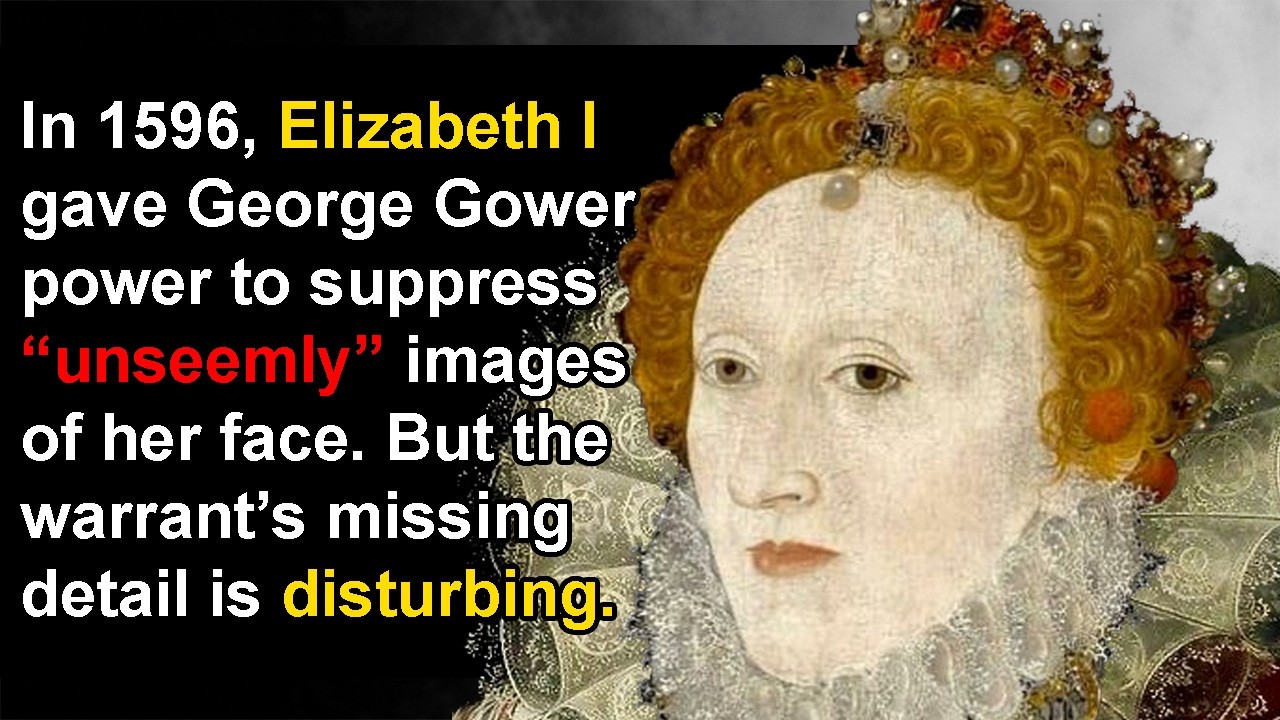
But the truth beneath the layers of paint is darker than that. There is a reason art historians call her face in its final decade “the Mask of Youth. ”
She was born on September 7, 1533, at Greenwich Palace. Her father, Henry VIII, forty-two years old, desperately wanted a male heir.
Her mother, Anne Boleyn, about thirty-two, was the most hated woman in England. Three days later, the infant was baptized amid enormous ceremony. That was nearly the last time anyone could be certain of her mother’s features, because on May 19, 1536, Anne Boleyn was executed at the Tower of London. Elizabeth was two years and eight months old.
Then something quieter happened. Henry’s system set to work erasing the memory of his dead wife. Her royal badges were removed. The copying of her portraits stopped, as did the hanging of them and the commissioning of new ones.
Today, scholars accept only a small handful of Anne Boleyn’s portraits as close to her own time. Most of the famous images were painted long after her head was cut off. That was the environment in which Elizabeth grew up: a place where a woman’s face could be erased by administrative decision. Parliament declared the child illegitimate and demoted her to Lady Elizabeth.
Her half-brother Edward arrived on October 12, 1537, and his mother Jane Seymour died within twelve days. Step-mothers came and went through the palace. The one who mattered was Catherine Parr, who married Henry on July 12, 1543, and pushed the girl toward serious study in Latin, Greek, French, and Italian under Katherine Ashley and the scholars William Grindal and Roger Ascham. Elizabeth was intelligent, alert, and almost pathologically cautious.
At fifteen, she was about to learn how quickly a reputation could be destroyed, and exactly who could stop it. Henry VIII died on January 28, 1547. Elizabeth was thirteen. Her nine-year-old brother became Edward VI, and the widow Catherine Parr quickly married Thomas Seymour, the Lord Admiral, brother of the Lord Protector—a man who completely lacked any sense of personal boundaries.
Elizabeth was living in his household. What happened at Chelsea and Hanworth over the following months survived in the worst possible form: interrogation records. Seymour was arrested on January 17, 1549. The government summoned Kat Ashley and the treasurer Thomas Parry and subjected them to harsh questioning.
Their depositions describe early-morning visits to the girl’s bedchamber and rough caresses that everyone recognized as inappropriate. What the records do not contain is evidence of anything beyond that. Popular accounts fill that gap with certainty, and there is no honest way to do so. Catherine Parr died on September 5, 1548, after childbirth.
Seymour’s head was cut off on March 20, 1549. And a fifteen-year-old girl sat down and wrote to the Lord Protector. The letters were cold, precise, and entirely controlled. She denied the conspiracy point by point and asked the government to publicly put down the rumors circulating about her body in England.
That is the first documented moment when Elizabeth tried to make the English state correct what England believed about her. It would not be the last. Then survival became harder. Edward VI died on July 6, 1553.
After Jane Grey’s nine days, Mary took the throne, and Elizabeth—nineteen years old, Protestant, and the obvious alternative—became the most dangerous person in the kingdom. Wyatt’s Rebellion broke out in January 1554. On March 18, at twenty years old, Elizabeth was taken to the Tower of London. No contemporary evidence ever proved her involvement beyond geographic proximity and the contacts of some servants.
She was held for about two months, then moved to Woodstock under Sir Henry Bedingfield’s watch and kept confined for another year. In that year she learned something that would shape the rest of her life: being misperceived could cost you your life. Mary I died on November 17, 1558. Elizabeth became queen at twenty-five years and seventy-one days old.
She was crowned at Westminster Abbey on January 15, 1559. Within months, her government pushed through the Acts of Supremacy and Uniformity. She had a country, a church, and a problem nobody mentions in school: nobody could paint her. The earliest portraits of the new queen were genuinely bad—rigid, flat, barely resembling each other, let alone her.
She rarely sat for painters. The scholarly consensus is that throughout her forty-four-year reign, there were only a few genuine sittings. Everything else was copied from copies. Meanwhile, the woman herself sat at the center of the most toxic scandal of her early reign.
Amy Robsart, wife of Robert Dudley, was found dead at Cumnor on September 8, 1560. An inquest concluded the death was accidental, and marriage to Dudley became politically impossible. Elizabeth was thriving. Then, at twenty-nine, her face came under attack from something no proclamation could stop.
On October 10, 1562, at Hampton Court Palace, Elizabeth felt unwell. It was treated as a cold. By October 16, the illness was diagnosed as smallpox, and the Privy Council genuinely believed she would die. She asked that Dudley be made Lord Protector if she died and told them that nothing improper had ever happened between them.
By the twenty-third, the fever broke. What happened next tells her whole life story in a single detail. The Spanish ambassador de Quadra reported that once she was out of danger, the queen’s attention fixed on one thing only: the marks on her face and how to keep them from disfiguring her appearance. Months later, in February 1563, he recorded that she told her lords that the marks they saw were not wrinkles but smallpox scars.
She wanted to be clear about what kind of damage she had suffered. Others were less fortunate. Lady Mary Sidney nursed her through the illness and caught the disease herself. Her husband, Henry Sidney, later wrote that he left a beautiful woman and returned to find, in his words, “a woman in the worst state that smallpox could bring her to.
” Mary Sidney withdrew from court and largely stayed away for the rest of her life. How bad Elizabeth’s own scarring was remains genuine debate. English reports play it down, while the Spanish ambassador hints at worse, and no one can now settle it. What is not debated is the cosmetic that followed.
Venetian ceruse—white lead ground with vinegar and painted on the skin to give it an immaculate, luminous, inhuman whiteness—was already royal court fashion across Europe. So it is an exaggeration to say she adopted it only to hide smallpox scars. But the timing is hard to ignore. Here is the part that sends a chill.
Lead is corrosive. Dermatologically, lead-based cosmetics are known to damage the skin with continued use. A number of historians argue that the paint she used to display perfection was steadily destroying the surface beneath it, forcing her to apply thicker layers as the decades passed. No one ever examined her body, so we will likely never know how far that went.
But the logic of it is brutal: the mask was eating the face. Within months, her chief minister was drafting something extraordinary. In 1563, William Cecil, her secretary and the man who solved problems with paperwork, wrote a draft proclamation about the queen’s portraits. His complaint was direct and blunt.
The proclamation said no one had yet been able to accurately express the natural features of Her Majesty. Cecil proposed a pause. No drawing, painting, engraving, or portraying of her face for a time, until a standard model could be adopted, with disfigured images banned until they were corrected. The draft also noted that the queen herself was not at all willing to sit for painters.
England nearly made it illegal to paint the queen badly with a single signature. But it did not happen. The draft was revised, filed away, and never issued. It never became law.
It was a worried memorandum, and it remained the most misused document in this entire story. What the government did instead worked more effectively than any ban: it standardized her image. From about 1572, Nicholas Hilliard became the dominant painter of the royal face. A miniaturist who wrote explicitly about working in clear, open light and refusing shadows.
A painter who does not paint shadows is a painter who does not paint hollows, folds, or lines. Around 1575, with Federico Zuccaro in England, the workshop settled on what is now called the Darnley face pattern. It was copied, reused, and given new clothes for years afterward. Technical analysis at the National Portrait Gallery has since found underdrawings proving it.
The same face was transferred mechanically from panel to panel while the woman it belonged to grew older. The queen’s image became a production line. In 1584, George Gower and Hilliard went further and requested a monopoly on painting her. Elizabeth refused to grant it outright.
She wanted control of her image, but apparently she did not want to own it. Meanwhile, the political reality grew darker. Mary, Queen of Scots, arrived in England on May 16, 1568, and was held for eighteen years and eight months. The Rising of the North came in 1569.
The pope excommunicated Elizabeth in 1570. The Ridolfi Plot came in 1571, and the Duke of Norfolk lost his head on June 2, 1572. Then came the Throckmorton Plot in 1583 and the Babington Plot in 1586. Each was an argument that the woman on the throne was mortal and replaceable.
On February 8, 1587, aged fifty-three, she signed away her cousin’s life. Mary was executed at Fotheringhay, and Elizabeth spent the aftermath blaming her secretaries for sending the execution warrant. Eighteen months later came the Armada, and at fifty-four she was painted as a goddess with her hand on a globe. The famous Tilbury speech of August 9, 1588—“the heart and stomach of a king”—reaches us through texts published later, not through a verbatim record.
So quoting it as though someone wrote it down that day overstates what survives. The Armada portraits are not real portraits at all. They are pearl-studded propaganda. Then time did what the plots could not.
Around 1592, Marcus Gheeraerts the Younger painted the Ditchley portrait for Sir Henry Lee. Elizabeth, about fifty-nine, stands on a map of England with storms behind her. Look closely and you will find she is not a girl. Around the same time, the realist Isaac Oliver managed to get her in front of him and painted what he saw.
That unfinished miniature still survives in the Victoria and Albert Museum. Roy Strong believed it was drawn from life. It shows an aging woman with unflattering features, heavy eyelids, and a long, thin face, without any idealization. A Gheeraerts studio painting from about 1595, now in North Carolina and publicly discussed in 2013, offers something similar: wrinkles, sunken eyes, aged skin, wearing the same court jewelry found in the radiant copies.
Oliver never became the official royal painter. That position stayed with the man who did not paint shadows. From about 1594 onward, the approved face simply stopped aging. Hilliard’s late miniatures show a schematic young woman with no wrinkles, bearing no relation to the sixty-year-old in the presence chamber.
Strong called this the “Mask of Youth” and dated a deliberate political shift to around that year. It should be noted that the visual change is undeniable, while no dated official order from the council survives demanding she be painted as a woman of twenty-five. About sixteen copies of that late face pattern still exist. They were distributed as gifts, including to ambassadors—men who had just watched her struggle to chew, returning home with a locket of a woman in her mid-twenties.
Then came 1596 and the warrant. The Privy Council commissioned George Gower, the Serjeant Painter, and ordered public officials across the realm to assist him against the work of unskilled craftsmen engaged in painting, engraving, and printing the person and face of Her Majesty in an unseemly manner. It had caused Her Majesty great offense. It was to be suppressed.
Elizabeth was sixty-two. Gower died that August, only months after being given authority over her face. In the meantime, descriptions of her were about to come from people the crown could not control. In 1597, the French ambassador André Hurault de Maisse sat with her repeatedly and recorded everything.
He noted that her face seemed very aged, long and thin. Her teeth were yellow and uneven, and many were missing, so that when she spoke quickly, she was hard to understand. A year later, the German traveler Paul Hentzner watched her walking at Greenwich and described a wrinkled, oblong face, small dark eyes, black teeth he blamed on English sugar, and a red wig. Two foreigners, independently, at ages sixty-four and sixty-five.
Neither saw an idealized image. They saw the real woman. Her supports were collapsing too. William Cecil, the problem-solver who had drafted that worried memorandum in 1563, died on August 4, 1598, after four decades at her side.
Fourteen months later, the illusion was breached in person. On September 28, 1599, Robert Devereux, Earl of Essex, returned from Ireland in disgrace and rode straight to Nonsuch Palace, bursting into the queen’s bedchamber without warning. She had just woken up and was not wearing her wig or her cosmetics. Contemporary correspondence describes her state as having just risen, with her hair about her face.
The precise wording matters, because popular accounts escalate it to a bald head, which the best contemporary texts do not support. He had ridden halfway across England through the mud to get there. He did not knock. He was not executed for it on the spot.
Essex was beheaded in the Tower Green on February 25, 1601, aged thirty-three, after leading an armed revolt in London on February 8. The bedroom and the scaffold are both facts. The line between them is a modern invention. She was sixty-seven, and by then she had outlived nearly everyone who remembered her mother.
Her final portraits are the strangest artifacts of her reign. The Rainbow Portrait, usually dated to 1602 and associated with Robert Cecil at Hatfield, shows a smooth-faced young woman in her late sixties. Her last winter came, and courtiers reported her in deep melancholy. The coronation ring she had worn constantly since January 1559 had grown into the flesh of her finger, and they had to cut it from her hand.
Reports from her ladies and from Robert Carey describe a queen who remained standing for hours and refused to sit, apparently convinced that if she sat down she would never rise again. She ended up indicating her wishes about the succession with her hands because she could no longer speak. This information comes from memoirs written later rather than an official record, so the details differ between accounts. She died at Richmond Palace between two and three in the morning on March 24, 1603.
She was sixty-nine years and 198 days old, in her forty-fifth year on the throne. John Manningham wrote in his diary that she departed mildly and easily like a ripe apple falling from a tree. No autopsy was permitted. No cause of death was ever recorded.
Everything said since about pneumonia, heart failure, infection from the swollen hand, or chronic lead poisoning is nothing but inference about a body that was never examined. The tabloid claim that her makeup killed her is speculation dressed in a lab coat. Her coffin was carried down the Thames by night barge to Whitehall, with a carved wooden effigy of her placed on top. A final approved face riding above the real one.
She was buried at Westminster Abbey on April 28, 1603, thirty-five days after her death, amid well-documented public mourning. In 1606, James I moved her to the Henry VII Chapel beneath a monument he paid for. He placed her in a shared vault with Mary I—the sister who had sent her to the Tower. The monument above her was funded by the grandson of the cousin she had executed, and James did not attend her funeral.
So what about the burning portraits story? Here is what the 1596 order actually says. It mentions unskilled craftsmen. It mentions unseemly and improper painting, engraving, and printing.
It mentions offense to the queen. It does not mention wrinkles. It does not mention age. It does not mention old portraits.
It does not order the destruction of anything already hanging on walls. No list of confiscated portraits has ever been found. What the surviving intervention records show is cheap reproductions. William Rogers’s engraving after Oliver’s aging drawing ran into trouble.
When Crispin van de Passe reissued that face after her death, the features came out softer. The evidence points to mass-produced commercial prints, not the oil paintings in the great houses. The fire story comes from one man alone. In 1614, eleven years after Elizabeth was buried, Walter Raleigh published a preface complaining about bad writers, using painters as a comparison.
He wrote that portraits of the late queen made by unskilled and common painters, and by her own order, were broken and cast into the fire. That is the entire evidentiary basis. One sentence. No date, no place, no list, no claim that he witnessed it.
The headline claim that Elizabeth burned her aged portraits ever since connects that phrase to a 1563 memorandum that never became law and a 1596 order that never mentions age—while the evidence sits in front of us. Oliver’s aging drawing still exists. The Ditchley portrait still exists. The wrinkled Gheeraerts studio face still exists.
Two ambassadors’ descriptions of the lined mouth and missing teeth still exist. A thorough purge that leaves the evidence intact is not a purge. But Elizabeth’s faces were indeed destroyed—just not by her. National Portrait Gallery research into the artwork, tree-ring dating, X-rays, and the making of art in Tudor Britain found panels of Elizabeth that had been painted over the original image to make her look younger, rounder, fresher, with fashionable locks of hair.
The taste being served was that of the late seventeenth and eighteenth centuries, not the Tudor era. One panel’s wood was cut in 1604, a year after her death. When Royal Museums Greenwich restored the Armada Portrait in 2016 and examined its chemical composition, that face too showed later overpainting to make her look younger and paler. X-ray analysis of one painting in the National Portrait Gallery revealed that someone had earlier violently scratched out the queen’s eyes and face on the panel before repainting it.
Elizabeth I spent her last decade accused of erasing her aging features. The people who actually did it were her admirers. A century later, they were quietly improving her features until she faded, while everyone kept blaming the dead woman for hiding. Was she a vain old queen who bent the machinery of state to her reflection?
Or a ruler who understood that in a kingdom with no declared heir, a single honest wrinkle was a weapon she could not allow her enemies to hold?






