It is April 1867, and a Comanche woman is kneeling beside a lodge of buffalo hides, lifting a ten-year-old girl onto her back. The camp sits on the Canadian River in Indian Territory, in what is now Oklahoma. The girl has long blonde hair and three small holes burned into one ear. Seven months earlier, on September 14th, 1866, Comanche raiders killed this girl’s mother in a raid in Wise County, Texas, and carried the girl away.
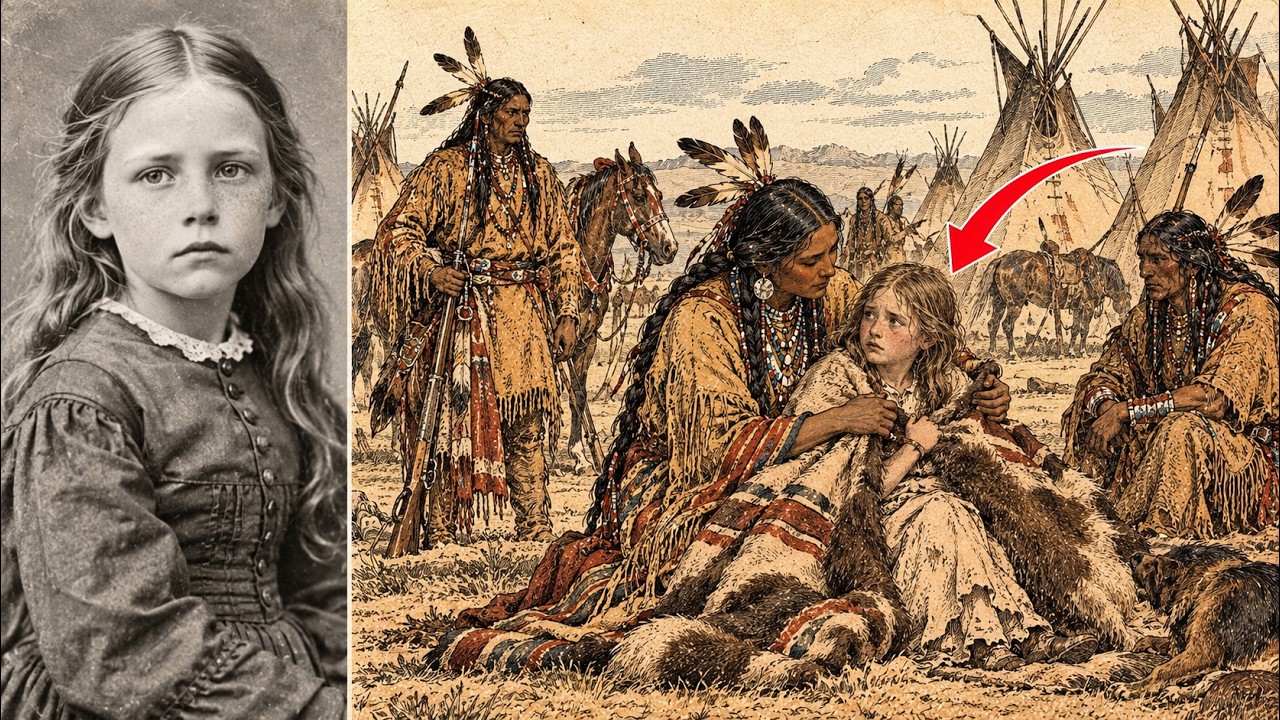
Now the woman carries her out of the camp and into the brush, and keeps walking. She is not hiding the girl from soldiers. She is hiding her from two visitors who have ridden in to take the child home. The raiders did not just carry this girl away.
They gave her a new mother. The woman with the girl on her back is that mother. She has fed her, dressed her, taught her to swim. Now she is afraid of losing her.
And the girl has a choice to make, one she will carry until she is an old woman. The girl’s name was Bianca Babb. She lived to be ninety-three, and in the 1920s she wrote down what happened to her. One sentence in that memoir still stops readers cold.
And there is a second story: her brother Doc, fourteen years old, taken on the same afternoon, who within days would be tied to a tree with a rawhide rope while warriors piled dry grass around his feet and took out flint and steel. Two children, two memories. They did not even remember their mother’s death the same way, and their accounts still disagree. The cabin stood on Dry Creek in Wise County, east of the present town of Chico, northwest of Dallas.
In 1866 this was the edge of settled Texas. Past it, to the north and west, lay hundreds of miles of open grass that belonged to the Comanches and the Kiowas. The Civil War had ended the year before, and the frontier was raw. Doc Babb later wrote that the settlements had lost most of their protection during the war.
From the governor’s office in Austin, the reports kept coming in, county by county, and they were bad. On November 5th, 1866, Governor James Throckmorton wrote to the Commissioner of Indian Affairs in Washington. “The depredations upon our border,” he wrote, “have been of the most appalling character. Quite a number of women and children,” he added, “have been carried into captivity.
”
The Babbs were one of those border families. John S. Babb had brought his wife and children down from Wisconsin in 1854. They settled first near Sherman, then moved west to Dry Creek.
Two other families lived within a few hundred yards. In September 1866, John Babb was away on a trading trip with his oldest son. Left at the cabin were his wife, Isabel, their two younger children, a baby girl, and a house guest. Nothing about that arrangement was unusual.
On the Texas frontier, men left home for weeks at a time. The riders coming to Dry Creek were Nokoni Comanches, one of the bands that ranged the plains between the Red River and the Arkansas. To them, the Texas settlements were enemy country, full of horses and full of people who had been fighting Comanches for a generation. They also needed people.
Disease and war had been thinning the Comanche bands for decades. The historian Scott Zesch, who studied these captivities, says the raiders preferred children young enough to be retrained, children who would grow up thinking of themselves as Comanche. A man could be killed. A grown woman could be made a servant.
But a child could be turned into a son or a daughter. At the Babb cabin there were two children at exactly the right age. The girl at the center of it all was ten, born in 1856 in a covered wagon in Kansas while her family was on the move. Her full name was Bianca Luella Babb.
She had long fair hair and a stubborn streak her captors would notice before the first day was over. Her brother was Theodore Adolphus Babb, but everybody called him Dot. He was fourteen, born in Wisconsin, and old enough to think of himself as the man of the house while his father was gone. That idea would earn him a beating before the hour was out.
The baby was Margie, about eleven months old. Isabel Babb was in her thirties. The house guest was a young widow named Sarah Jane Luster. Five people at the cabin, and not one grown man.
It is September 14th, 1866, sometime between three and four in the afternoon. Dot and Bianca are outside under the brush arbor in front of the cabin. Out on the prairie, about half a mile off, riders are coming fast. Dot looks once and knows.
“They are Indians,” he tells his mother. Thirty-five or forty of them in war paint, and they are not riding past. They are riding straight at the house. The children run inside.
Isabel shuts the doors, but the doors have no bars. Sarah Jane Luster climbs up into the loft. In Dot’s telling, he takes an old gun down from the wall and stands there holding it in a room with two women, a girl, and a baby. He has maybe a minute to decide what to do with it.
The warriors are already off their horses and at the doors. The first warriors walk into the cabin uninvited. One takes Dot’s gun out of his hands, and others beat him over the head with their quirts. Then they start taking things: clothing, bedding, anything that can be tied onto a horse.
Isabel Babb does something that sounds strange today. She tries to make peace. Both of her children remembered it. Dot wrote that she was shaking hands with the warriors.
Bianca remembered more. In her words, “Mother shook hands with him and asked him to have a chair. ”
It was not foolish. It was a frontier hope: treat them as guests, and maybe they will act like guests.
It does not work. The warriors drag Sarah Jane Luster down out of the loft and tie her. Then they reach for Bianca, and her mother pulls the girl against her and will not let go. From here, the two children’s memories split apart.
In Bianca Babb’s memoir, one warrior shoots her mother in the back with an arrow. Another drives a long lance into her throat, and another scalps her. In Dot Babb’s book, a warrior stabs her four times with a big butcher knife, and later another puts an arrow into her side. Dot’s version goes on.
He helps his mother onto the bed and pulls the arrow out with his own hands. He wrote it plainly: “I pulled the arrow out and sat upon the bed by her. ” Then a warrior aims an arrow at Dot and orders him outside. Isabel can see what will happen if he refuses.
Her last words to her son, as he remembered them, are simple. “Go with him and be a good boy,” she tells him. He walks out, and the last time he sees her, she is still holding the baby. Dot remembered his mother dying in a mass of blood, he wrote, “with my baby sister enclasped within her arms.
” That baby, Margie, survived. The raiders left her there, alive, in the arms of a dying woman, and neighbors found her later. Outside, a warrior drags Bianca toward the horses. She grabs a post of the brush arbor and holds on with both hands.
He pulls until the bark tears her palms open. “The rough bark on the post,” she wrote, “tore the flesh from the inside of my hands. ” She does not cry. In her words, “I did not cry.
Had made up my mind I would not cry, even if they killed me. ” Years later she learned that if she had cried, he would have killed her then. “An Indian,” she explained, “does not like a coward. ”
Then the raiders ride.
Bianca sits behind a warrior who holds both of her hands around his waist with one of his, because she keeps slipping off. Dot rides the same way. Somewhere behind them, their father’s cabin is full of torn bedding and blood. They ride northwest all night, then all the next day.
Bianca remembered three days and nights with only a few minutes of rest at a time. On the trail, the warriors kill an old steer the wolves had crippled and eat it half raw. By now Bianca is starving. “I was so hungry,” she wrote, “that I begged for some of the raw meat.
” When she reaches for a second piece, a warrior hacks at her finger with his knife. A ten-year-old learns the first rule of the camp: take what you are given. They reach the Red River near the mouth of the Peace River. The river is swollen into three channels, and the horses swim them one after another, drifting downstream in the current.
On the far bank, the warriors relax. They are out of Texas. For the children, crossing that river means something else: every mile north is a mile their father will have to cover to find them. The worst night of the trail is still ahead, the night Sarah Jane Luster decides to run.
The war party makes camp. One man is left to guard the three prisoners, and Sarah Jane Luster has been planning something for days, in whispers with Dot. Historians who studied the raid say she had been raped on the trail. Tonight she is going to run, whatever it costs her.
Dot remembered the exact light. “The moon in the east was 2 hours high,” he wrote, “and the Indians all were sleeping soundly. ” Earlier he had tied one of the horses with its knot caught between two limbs, so it could not wander far. Now Mrs.
Luster slips a bridle onto that horse. Dot tries to bridle a mare for himself and wakes a sleeping warrior. He throws the bridle away and lies back down as if nothing happened. Mrs.
Luster is already gone. Bianca, lying in the dark, heard only one thing. “I heard the horse running,” she wrote, as she left. In the morning, a warrior who had claimed Mrs.
Luster rides after her. She loses him in the quicksand bed of a wide, shallow stream. Back in camp, someone has to pay for her escape, and the warriors are looking at the boy. The warriors line up twenty or thirty yards from Dot with bows and arrows and some old cap-and-ball pistols.
By signs, they tell him they are going to shoot him full of holes. Bianca falls to the ground wailing and sobbing with her face in the grass. Dot talks to her quietly. Then the warriors tie him to a cottonwood with a rawhide rope and pile long dead grass and dry brush around his feet.
Someone takes out a flint and steel. This is the moment the whole story could have ended. Dot does not beg. He makes signs telling them to go ahead, light it, and get it over with.
The warriors look at each other. Then they walk up saying “Heap wano you” and untie him. Dot took the words as praise, and later he understood why they spared him. It was, he wrote, “my seeming total lack of fear and utter defiance of the most painful of deaths.
” Bianca put it more simply: they thought he was brave enough to make a good warrior. That is not mercy. That is recruitment. The fire was a test, and the boy passed it.
When it is over, his little sister throws her arms around him and cries. It is one of the last times they will see each other for months. Soon after, the war party splits. Dot goes with one group, Bianca with another.
Neither knows where the other is being taken. Bianca’s group rides on for days, and then she sees it: “a camp,” she wrote, “of at least 1,000 Indians. ” The people crowd around the blond girl and touch her hair. She kicks several of them in the face.
Dogs are everywhere. “I don’t believe,” she wrote, “there ever were as many dogs in one place at one time. ” Then she understands where she is. “I soon found that these were to be my people,” she wrote.
Here, finally, the first question gets its answer. The warrior who carried Bianca off did not keep her. He gave her to his sister. Historians name him Corno and her Techquashana.
Bianca never wrote her name. She wrote that the woman had no children of her own. And she wrote one more thing: the woman’s husband had been killed by white men the morning before the raid on the Babb cabin. Lost a husband, gained a daughter.
In the Comanche world, a family that lost someone could fill the empty place, and Bianca was the person brought home to fill it. That is why the same people who killed her mother made her a daughter. Not out of guilt, and not out of kindness alone. A widow had an empty lodge, and a brother brought her a child.
Now that child had to survive her new life. The usual picture of a captive is a prisoner in rawhide ties. Bianca got a feast in her honor on her first night. Her new mother, Bianca wrote, seemed to care as much for me as if I was her very own child.
They slept together in the lodge, a tent of buffalo hides stretched over cedar poles. On cold nights, the woman stood her by the fire and turned her slowly, “turning round occasionally,” as Bianca put it, so she could get good and warm. Then she laid her on a bed of dry grass and robes near the outer edge against the wall of the lodge. The woman made her a Comanche, one step at a time.
She heated a large needle red hot, Bianca wrote, and burned three holes in one ear. When they washed their dresses in the river, she walked the girl into deep water and let go. Bianca’s verdict was short. “On my part, it was sink or swim.
” She swam. She became an expert swimmer. She carried water, gathered wood, and packed for the moves every three or four weeks along the Canadian, the Cimarron, and the Washita. The family’s herd numbered as many as three hundred head of horses.
She got a new name, too. “My Indian name was Tejana,” she wrote, “meaning Texas. ”
Her brother, wherever he was, had been given a less flattering name: Nadder Numape, which she said meant “tired and give out. ” But a daughter of the camp was still a stranger to some of it.
One day Bianca took a stick from another family’s wood pile. An old woman came running at her with an axe raised over her head. A young Comanche girl ran between them and took the blow that was meant for Bianca. The girl died.
One account of Bianca’s story says the camp’s leaders later had the old woman put to death. The memoir does not name the girl who stepped in front of the axe. She is one of the people in this story whose names nobody kept. There were smaller cruelties, too, some of them jokes.
When a colt broke its leg in a stampede, Bianca begged to save it. The man who had captured her said, laughing, that if the colt died, they would kill her. The next morning the colt’s head was hanging in a tree, and the family laughed at her. Winter came down hard on the plains.
On one move, by noon it was sleeting and very cold, and Bianca thought she could not stand it. She froze to her saddle. Three or four of the women pulled her off and rubbed her hands and feet before they let her near the fire. Dot’s group rode for ten days to a camp on the Arkansas River.
The man who claimed him was named Pernuerney, the brother of a Nokoni chief called Horseback. Dot called him one of the most daring, fierce, and desperate Indians that ever lived. The women put Dot to work carrying wood and water. The Comanche boys told him that was women’s work, so he refused it and spent the winter breaking wild horses.
Then Pernuerney tested him with an old revolver, riding at him behind a buffalo hide shield. “I shot at him six times,” Dot wrote, “and hit the shield each time. ” Peta Nocona told him he would make a trustworthy warrior. Later, Dot rode with a war party of fifteen to the Washita, where it met seven Caddo hunters.
Peta Nocona gave the order: “Kill all of them. They are Caddos. ” Seven Caddos died, and six were scalped. A big war dance followed, and Dot described it without flinching.
A fourteen-year-old from a Texas cabin was becoming useful to the people who had killed his mother. Far to the south, his sister was about to make a wish toward the rising sun. One morning, Bianca’s mother pulled a loose tooth for her and told her to throw it toward the rising sun and make a wish. Bianca threw it.
“I wished my father would come and get me,” she wrote. Her mother told her she should not have wished that. The wish, it turned out, was already on its way. John Babb had come home to a grave and an empty cabin.
He went looking for his children the only way that worked in 1867: the ransom. He rode north into Indian Territory to Fort Arbuckle, a post built of hewn logs where captives were ransomed. There he found a government interpreter named Horace P. Jones.
Jones knew the bands and their languages, and he began asking among them about a ten-year-old white girl with a Comanche name. “Jones got trace of her,” Bianca wrote, “through an old Indian man. ” The old man and his wife rode to her camp on the Canadian. Bianca understood at once why they had come, and she asked to go with them.
This is the scene from the start of this story. Bianca’s Comanche mother hears what the girl has asked, and she is hurt. In Bianca’s words, she said, “If I wanted to leave her, it was because I did not love her. ” Then the woman does the only thing she can think of.
She tells Bianca they will go away and hide until the old man and his wife give up and leave. Bianca remembered it exactly: she took her on her back and carried her into the brush, away from the camp, with the girl’s blonde hair over her shoulder. Hold that picture. A Comanche widow carrying a Texas child she had known for seven months, hiding her from her own father’s money.
That is not a captor guarding property. That is a mother trying to keep a daughter. It does not work. The next day the visitors take Bianca anyway, to a trading store where Horace Jones is waiting.
She never saw the woman again. In her memoir, the price was horses, saddles, blankets, calico, beads, and flannel paid by her father. Historians who traced the payment records found a cash figure, too. In April 1867, $333 changed hands for Bianca Babb through Jacob Sturm, an agent working out of Fort Arbuckle.
For a family the army itself described as very poor, it was a fortune. Bianca meets her father at the Chandler place on the Washita, near what is now Paul’s Valley. “He was overjoyed to see me, and of course I was tickled to death,” she wrote. Then she opens her mouth to speak to him, and the words come out in Comanche.
“I had been with the Indians so long,” she explained, “I had forgotten how to speak English. ” Seven months, that was all it took. The girl who would not cry on the first day came back talking like a Comanche daughter, because that is what she had become. On May 14th, 1867, Lieutenant Mark Walker at Fort Arbuckle reported that the Nokoni chief Horseback was holding a captive white boy by the name of Babb and wanted to be paid for his trouble.
“The father of the child,” Walker wrote, “is a very poor man. ” The letter went up the chain of command all the way to General William T. Sherman, the most powerful soldier on the plains, a man who had marched through Georgia three years before. His answer was written on the file in June 1867.
“There must be no ransom paid,” he wrote. The boy was to be handed over, or the army would make war on Horseback’s band. That is the army’s version. Dot’s version is about people.
A Peneteka Comanche leader, Chief Esserhavvy, a friend of the Texas governor, rode to Horseback’s camp with two of his wives to plead for the boy. The councils went on for about five weeks. In the end, the band let Dot decide for himself. “My decision,” he wrote, “was instant and unalterable to return as quickly as possible to my father and kindred.
” Horseback was paid in horses, saddles, and blankets, and the record put the cash at $210 plus clothing. The goodbye was harder than he expected. Horseback’s sister, who had cared for him, cried, and so did her son. Someone gave him a necklace of red mescal beads with a gold Catholic medal and a small medicine bundle tied to it.
He kept it for decades. Dot never forgot it. “Their kindnesses to me had been lavish and unvarying,” he wrote. On the ride out, he raced horses for Esserhavvy against a Cheyenne band.
Out of six races, they won six horses. Then, at the Washita, Dot sees his father waiting on the south bank with his back turned. John Babb has turned away on purpose to surprise him. Then he turns around and holds his son.
“This is my long-lost darling boy,” he says. At the Chandler place, Dot and his sister were together again, months after the war party had split them up. Two children came home from the plains in the spring and summer of 1867. But one person from that cabin is still missing from this story: the young widow who rode off into the dark on a stolen horse with the moon two hours high.
What came after was a treaty. On October 21st, 1867, Comanche and Kiowa leaders met American commissioners on Medicine Lodge Creek in Kansas and put their marks on a treaty. One article promised that they would never capture or carry off from the settlements white women or children. The promise did not hold.
Within months, raiding parties were carrying off children again. Captive taking stayed part of life on the southern plains until the last free Comanche band surrendered in 1875. The Babb children were two names in a very long list. And Sarah Jane Luster?
Her escape did not end her captivity. Both Babb children later wrote that she was caught again on the plains, this time by Kiowas, and held for about a month. Dot wrote that a Kiowa chief made her his consort. Consort is the polite word of 1912.
It means she was taken as a wife by force. She escaped a second time on a dark and stormy night. When she finally ran into American soldiers, it nearly went wrong again. In Dot’s words, the soldiers mistook her for an Indian and gave lively chase.
They caught her and took her to Council Grove, Kansas. In December 1866, the postmaster at Council Grove wrote to the governor of Texas about a woman living with him. She had been taken prisoner, he wrote, in Wise County, Texas, by a band of Comanche Indians, but he called her Mrs. Sarah J.
Roberts, not Luster. Was Mrs. Roberts the same woman? The story fits almost perfectly: the county, the Comanches, the escape into Kansas.
The name does not. Dot believed she later married a man named Van Noy and died in Galena, Kansas, in April 1904. Nobody has confirmed it. She is the one survivor of that cabin whose ending is still a question mark.
Life on Dry Creek never came back together. John Babb eventually took his daughters to relatives in Wisconsin. Bianca returned to Texas in 1881 and the next year married Jefferson Davis Bell. They raised a family and moved constantly.
Her relatives blamed the seven months of moving camp. Dot Babb stayed in Texas, drove cattle, and became a rancher near Amarillo. He kept up with his old captors. When the Comanche reservation was being divided, Quanah Parker himself urged him to claim a share as a member of the tribe.
In 1912, Dot published his book. In the 1920s, years after Dot’s book, Bianca wrote her own account. Describing her new life in that camp, the life of a captive taken from beside her dying mother, she wrote this: “Every day seemed to be a holiday. ”
She did not write it about being free.
She wrote it about the camp of the people who killed her mother. She lived in a world of horses, rivers, and children who came to play with her, and part of her, it seems, never stopped missing it. The people who made those days are mostly nameless: the girl who stepped in front of the axe, the woman she called mother whose name she never wrote down, the seven Caddo hunters on the Washita. The record kept the Babbs.
It kept almost nobody else. So why did the Comanches make her a daughter? White men killed a Comanche husband. Comanche raiders killed a Texas mother, and a brother brought his widowed sister a child to fill the place.
To them, a captive child was not loot. She was a replacement. And then, somehow, she was family. One last fact changes the whole picture.
Taken in 1866, ransomed in 1867, and then, in 1897, a claim. Between 1897 and 1900, Bianca Babb Bell asked the government for a share of the old Comanche reservation lands as an adopted member of the tribe. She also asked to be paid for her mother’s death. Both requests were rejected.
Think about what she was asking: to be counted as a Comanche, and as the daughter of a woman the Comanches killed, both at once. She and her brother were among the very few people alive who could honestly claim both. And no office in Washington had a form for that. In February 1939, at eighty-two, Bianca sat in the audience in Denton for the premiere of an opera about Cynthia Ann Parker, another Texas girl the Comanches took and raised.
Afterward, she said, “It was good. It was real. It was almost like a dream. ” Dot died in Amarillo in 1936.
His gravestone calls him author and folk hero. His necklace is in the Panhandle Plains Historical Museum. Bianca died in Denton on April 13th, 1950, at ninety-three, often called the last of Texas’s Indian captives. Go back one last time to a riverbank in the spring of 1867.
A Comanche widow is walking into the brush with a ten-year-old girl on her back, trying to hide her from her own father. The girl will go home the next day. She will live eighty more years, most of them in Texas, and some part of her will never leave that lodge.






