On March 23rd, 1946, not even a year after escaping the ruins of Hitler’s alpine retreat, Gerda Bormann passed away in a hospital bed at the age of 37. The cancer had been found during Allied interrogations, when the wife of the most powerful man in the Nazi party chancellery faced her captors and had nothing useful to reveal about Martin Bormann’s whereabouts. She left behind nine living children, scattered and concealed, the youngest of whom would die before the year ended. Her body was laid in grave number 610 at the military cemetery in Merano, sharing the plot with a German soldier named Hans Burger.
Eventually, her remains were exhumed, cremated, and dispersed into the sea, obliterating even the grave. The woman who had been the wife of Hitler’s shadow slipped from the world leaving scarcely a trace. It had not always been that way. Born Gerda Buch in 1909, daughter of Walter Buch, chairman of the Nazi party court, she had wed Martin Bormann in 1929 at the age of nineteen.
Hitler and Rudolf Hess stood as witnesses. Across fourteen years she gave him ten children, earning the Cross of Honor of the German Mother in Gold. She embraced Nazi ideology wholly, so committed to the cause that she actively backed her husband’s infidelity, accepting the notion that genetically superior men should father children with multiple women. She reportedly asked her husband to guarantee that either she or his mistress was pregnant every other year.
His lover, the actress Manja Behrens, spent more time with him than Gerda did, and Gerda displayed no jealousy, only ideological devotion. Martin treated her appallingly in public, frequently humiliating her. Witnesses recounted him whistling for her as one would a dog. Hitler’s valet reported that everyone knew Bormann terrorized his family, resorting to physical violence in his rages.
He allegedly whipped his children and kicked one for falling into a puddle. Yet at home he reportedly showed warmth, creating a bewildering dynamic in which brutality and tenderness coexisted. April 1945. The Reich was dying.
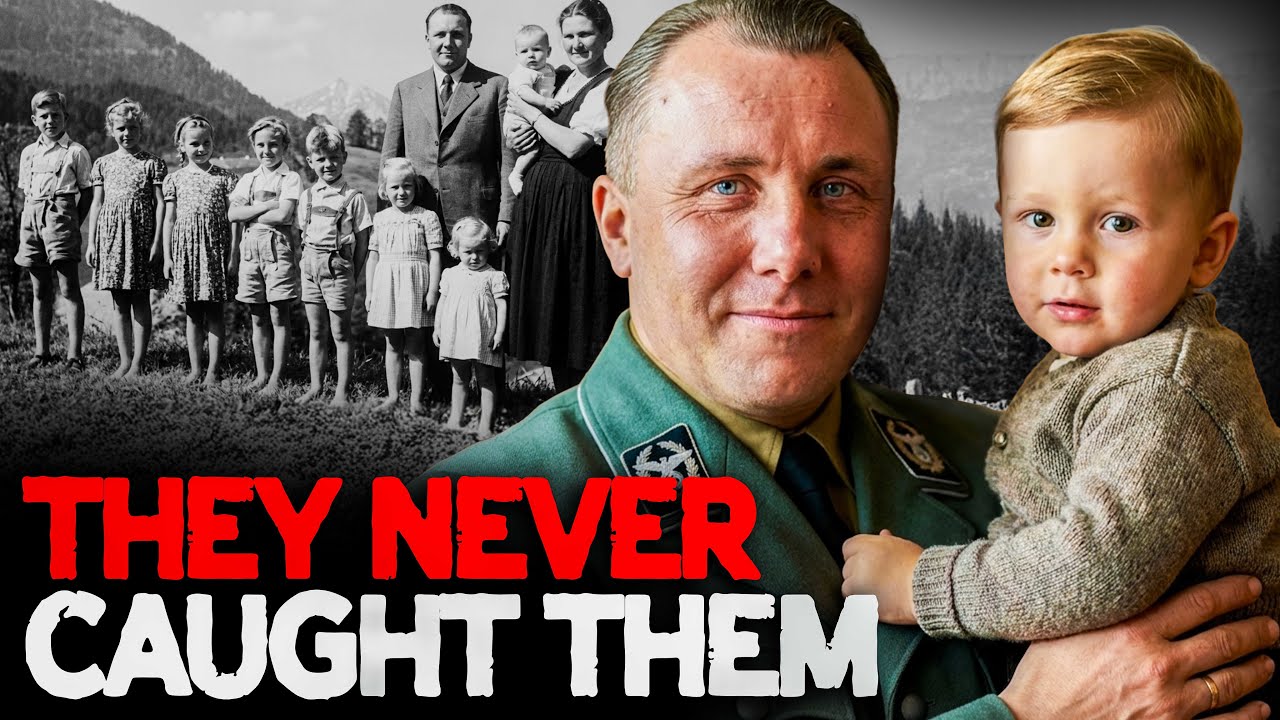
Allied bombers hammered Germany while Soviet and American armies closed in from both directions. At Obersalzberg, Hitler’s mountain retreat in the Bavarian Alps, the end was near. On April 25th, following an Allied air raid, Gerda Bormann gathered her children and fled south toward Italy, away from the advancing Red Army that would show no mercy to Nazi families. She traveled with eight of her ten children.
The eldest, Martin Adolf, was away at the Nazi party academy in the Tyrolean Alps. The youngest, Volker, was not yet two years old. Between them were Ilse, known as Eika; Ehrgard, called Helmut after Hess’s disgrace; Heinrich Hugo, nicknamed Heiner; Eva Uta; the younger Gerda; and Fritz Hartmut. One other child, Armin, had died shortly after birth in 1931.
Each child carried a name heavy with Nazi significance. Martin Adolf’s godfather was Hitler himself. Ilse had been named for Ilse Hess, wife of Rudolf Hess, until Hess flew to Scotland in 1941, after which her name was changed to Eika. Ehrgard became Helmut after the same disgrace.
Heinrich Hugo bore the name of Heinrich Himmler, architect of the Holocaust. These children were woven into the very fabric of the Nazi elite, marked from birth as the next generation of leaders. Gerda led them south through collapsing Germany, into Italy, making for the village of Völlan in South Tyrol, twenty kilometers northeast of Bolzano. The journey through war-torn territory with eight children was harrowing.
They traveled with other fleeing Nazi families, part of a desperate exodus of those who knew what awaited them if they fell into Soviet hands. They carried what they could, abandoning most of their possessions, the material wealth accumulated through Martin Bormann’s position of power. That wealth had been considerable. Bormann had controlled Hitler’s finances, administered a vast fund of forced contributions from German industry, and enriched himself and the party elite.
Now it meant nothing. Martin Adolf made his own journey. When the academy closed on April 15th, he traveled alone through the chaos to reach his mother. By the time he arrived, circumstances had changed.
In autumn 1945, Gerda was arrested and interrogated. The Allies wanted information about her husband. She could tell them nothing useful. The interrogations revealed she was seriously ill, and doctors discovered cancer.
Martin Adolf learned of his mother’s death a year after it happened, when he read about it in a local newspaper. He had been taken in by Catholic priests after reaching Italy. The priests, seeing a lost teenage boy, offered him shelter and guidance. They did not know initially who he was, or if they did, they chose compassion over judgment.
The boy who had been raised as a crown prince of Nazism, nicknamed Kronprinz for crown prince, who had worshiped his father and the regime, now found himself alone, questioning everything he had been taught. The other eight surviving children were placed in foster homes, scattered across Germany and Austria, their identities hidden. A clergyman named Theodor Schmitz reportedly took in several of them. They grew up separated from each other, losing not only their parents but also their siblings.
The foster care system did what it could with limited resources. Schmitz showed moral courage in caring for them, despite criticism from those who believed the Bormann family deserved no kindness. For Martin Adolf, Catholicism became his refuge. He converted, and in 1958 he was ordained as a Roman Catholic priest.
He became a missionary in the Congo, working in African missions, living a life of service that contrasted starkly with his father’s pursuit of power. He remembered his father as stern and demanding. Later he would say there had been no connection or human warmth between them. Yet as a boy he had loved Martin Bormann and believed in Nazi ideology.
The break came gradually. Living in Africa, confronting poverty and suffering directly, ministering to people the Nazi regime would have classified as subhuman and marked for enslavement or extermination, Martin Adolf began to understand what his father had been. He read books and historical documents. He studied the Holocaust in detail.
He learned the full scope of the war crimes for which his father had been convicted at Nuremberg. He came to distinguish between the father he had known personally, a man who provided materially for his family and ensured they had what they needed, and the politician whose actions facilitated genocide, whose administrative skill made the Holocaust possible. He served the people his father’s regime would have deemed inferior and disposable. He embraced Christianity while his father had worked systematically to undermine the churches and replace Christian morality with Nazi ideology.
He lived in poverty and hardship while his father had accumulated immense wealth through corruption and exploitation. In 1969, Martin suffered a nearly fatal injury and was nursed back to health by a nun named Cordula. He left the priesthood in the early 1970s. They married in 1971 and had no children.
Martin went on to teach theology and stepped away from his career in 1992. Those years brought healing and a renewed sense of direction. Come 2001, he was traveling through schools across Germany and Austria, recounting the atrocities of the Third Reich. He also made a trip to Israel, where he met with survivors of the Holocaust.
Then, in 2011, allegations surfaced. One former student claimed that Martin had raped her when she was just twelve years old, an incident said to have taken place while Bormann was serving as a priest in the early 1960s. Other former students came forward with claims of serious physical abuse. By then, dementia had taken hold of Martin, leaving him unable to respond.
No court case ever materialized, though an independent commission granted compensation to a number of the victims. Martin Adolf Bormann passed away on March 11th, 2013, at the age of eighty-two. With his death came the loss of the most publicly recognizable of Martin Bormann’s offspring. The remaining siblings kept far quieter lives than their oldest brother.
Ilse, whose name was changed to Eika following Rudolf Hess’s fall from grace, passed away in 1958 at just twenty-six. What exactly happened to her is still uncertain, and it remains unknown whether illness, an accident, or something more sinister ended her life. She had been old enough when the war ended to recall it all. Born in 1931, she was fourteen by the time the conflict was over.
She had spent the most pivotal adolescent years witnessing her family’s world fall apart. Her premature death spared her from ever having to bear the full burden of being a Bormann in post-war Germany. She never had to account for herself to employers or prospective husbands, never had to sit through documentaries about her father’s atrocities or field questions from colleagues who learned who she was. The remaining siblings, Ehrgard, Rudolph, Helmut, Heiner, Eva Uta, the younger Gerda, and Fritz Hartmut, all lived into adulthood, yet information about them stays maddeningly thin.
They granted no interviews to reporters, penned no memoirs delving into their impossible legacy, and avoided public attention in any form. They wed, perhaps raised children of their own, held down everyday jobs in offices, stores, and schools, and grew older without calling attention to their lineage. They embraced anonymity with clear intent, probably altering their names through marriage or legal means, and melted into the texture of post-war German and Austrian society. They became shopkeepers, teachers, clerks, regular people leading regular lives, their extraordinary weight borne in quiet solitude.
That silence carries meaning in itself. Consider Gudrun Himmler, who never once flinched in defending her father Heinrich Himmler and rose to prominence in far-right circles, showing up at SS reunions and backing war criminals. Or take Niklas Frank, who forged an entire career out of denouncing his father Hans Frank and speaking openly about inherited guilt and what children of perpetrators owe the world. The younger Bormann children, by contrast, simply vanished into ordinary existence.
They issued no public declarations either defending or denouncing their father. They sat for no interviews with historians or reporters. They produced no memoirs. For them, the ideal result was to be forgotten.
To let the Bormann name slip from public awareness. To live as ordinary citizens, free from endless questions about their father. It amounted to a survival strategy built on invisibility. Yet the mystery of what became of Martin Bormann tormented the children for years.
He had slipped out of the Führerbunker on May 2nd, 1945, attempting to flee Berlin. His departure was chaotic, and speculation trailed him. Over the years, people reported spotting him in Argentina and Spain. Many were convinced he had made it to South America, as other Nazis had done.
That conviction shaped lives and hopes alike. In 1972, building work near Lehrter Station in Berlin turned up two bodies. One belonged to Hitler’s physician, Ludwig Stumpfegger. The other was eventually determined to be Bormann’s.
In 1998, DNA analysis put the matter to rest, confirming the remains were those of Martin Bormann. The evidence pointed to suicide by cyanide capsule as he tried to escape Berlin. He had perished within days of Hitler, never having left Germany at all. The confirmation delivered closure, yet offered no solace.
For decades the children had lived without knowing whether their father was alive or dead. Learning he had died back in 1945 felt almost like a letdown. He had simply died, carrying off with him any possibility of explanation or accounting. For the children, that meant living with questions that would never be answered.
What had gone through Martin Bormann’s mind as he fled Berlin? Did he feel remorse for his part in the Holocaust? Did his wife and children cross his thoughts? They would never find out.
His death in 1945 spared them the prospect of a confrontation but left them locked forever in uncertainty about his inner world, his motives, his humanity or absence of it. The youngest children, born during the war, had entirely different experiences. Eva Uta, born in 1938, was seven when the war ended. The younger Gerda and Fritz Hartmut were even smaller.
These youngest children held few memories of their father or of Obersalzberg. They knew their father only as a monster from history books, tied to him by biology alone, lacking the emotional bonds that memory creates. They were made to bear guilt for a man they never truly knew, to answer for crimes committed by a stranger who happened to be their father. The children had been raised amid every privilege while millions suffered and died to make that privilege possible.
They lived in luxury at Obersalzberg, dined on fine food while others went hungry, played in gardens kept by forced laborers, and wore clothing bought with plundered wealth. Material advantage marked them before historical shame ever did. The older children, Martin Adolf and Ilse among them, were teenagers when the war ended. They had been schooled in Nazi ideology at Hitler Youth gatherings and party rallies.
They had genuinely believed in their father’s cause and their nation’s destiny. As Germany’s reckoning with its Nazi past shifted over time, each new wave of attention brought fresh scrutiny. The 1961 trial of Adolf Eichmann in Jerusalem drew unprecedented focus to the Holocaust. The Frankfurt Auschwitz trials, running from 1963 to 1965, compelled Germans to face the truth that ordinary citizens had taken part in mass murder.
Television miniseries such as Holocaust in 1979 reached millions and ignited fierce public debate. Universities rolled out extensive courses on the Nazi era. Memorials and museums went up. The culture of silence started yielding to a culture of remembrance and education.
The Bormann children, largely unknown in foster care, may have escaped some of that public scrutiny. But Martin Adolf, who kept his birth name and became a priest, could not entirely avoid it. Every documentary on the Nazi leadership gave his father a prominent place. Every history book listed Martin Bormann among the chief architects of the regime’s crimes, the man who controlled access to Hitler and kept the machinery of genocide running smoothly.
Martin Adolf had to steer through that constant attention all his adult life, finding ways to acknowledge his father’s criminality while also asserting his own distinct identity and moral decisions. These days, the Bormann name lives on through historical study. Martin Bormann stands as an example of the banality of evil, the ordinary man who carries out extraordinary crimes through loyalty to duty and unthinking obedience. He was no raving ideologue.
He was a bureaucrat who happened to be running mass murder. His children are mere footnotes to that history, people whose lives were shaped by forces beyond their control. They inherited his infamy but not his power. His legacy but not his choices.
They had to account for offenses they never committed, to bear a disgrace they never deserved. In this era of internet search engines, outrunning one’s family history is practically impossible. Anyone tracing their lineage will stumble upon the link. For every generation, the challenge becomes what to make of that knowledge, how to press ahead while reckoning with the past.
Martin Bormann’s legacy is one of bureaucratic evil, of power exercised without conscience. His children’s legacy is one of endurance, silence, and sporadic efforts at redemption. They lived through the fallout of his decisions, carried the burden of his crimes, and sought to build lives in the shadow of history.
