The strike came from the darkness with no warning at all. Sandra Rivet had just reached the foot of the basement steps at 46 Lower Belgrave Street, carrying a tray of used teacups, when the lead pipe came down. There was no cry, no demand, no instant to turn. The first blow landed on her head and she went down, the cups smashing across the linoleum.
The man did not let up. He swung again and again until the only sounds left in the kitchen were his own harsh breathing and the ticking of the clock. Then he started folding her body into a canvas mail sack. Minutes later, up in the first-floor drawing room, Veronica Lucan glanced at the clock.
Ten minutes had gone by, maybe fifteen. Making tea did not take that long. From the basement came nothing but silence. She called Sandra’s name.
No answer. She rose, walked to the head of the stairs, and called again. Still nothing. She started down into the gloom, a slight woman in a dress and heels, heading toward the dark that had just swallowed the young nanny.
She felt movement before she saw it. A shadow peeled away from the deeper shadows. The pipe struck her forehead, splitting the skin and sending blood running into her eyes. Veronica screamed, a raw animal sound, and fell back, stunned but still conscious.
The adrenaline of survival surged through her. She understood, with a horror that defied all reason, that she was being murdered inside her own home. The shadow lunged once more. “Shut up,” a voice hissed.
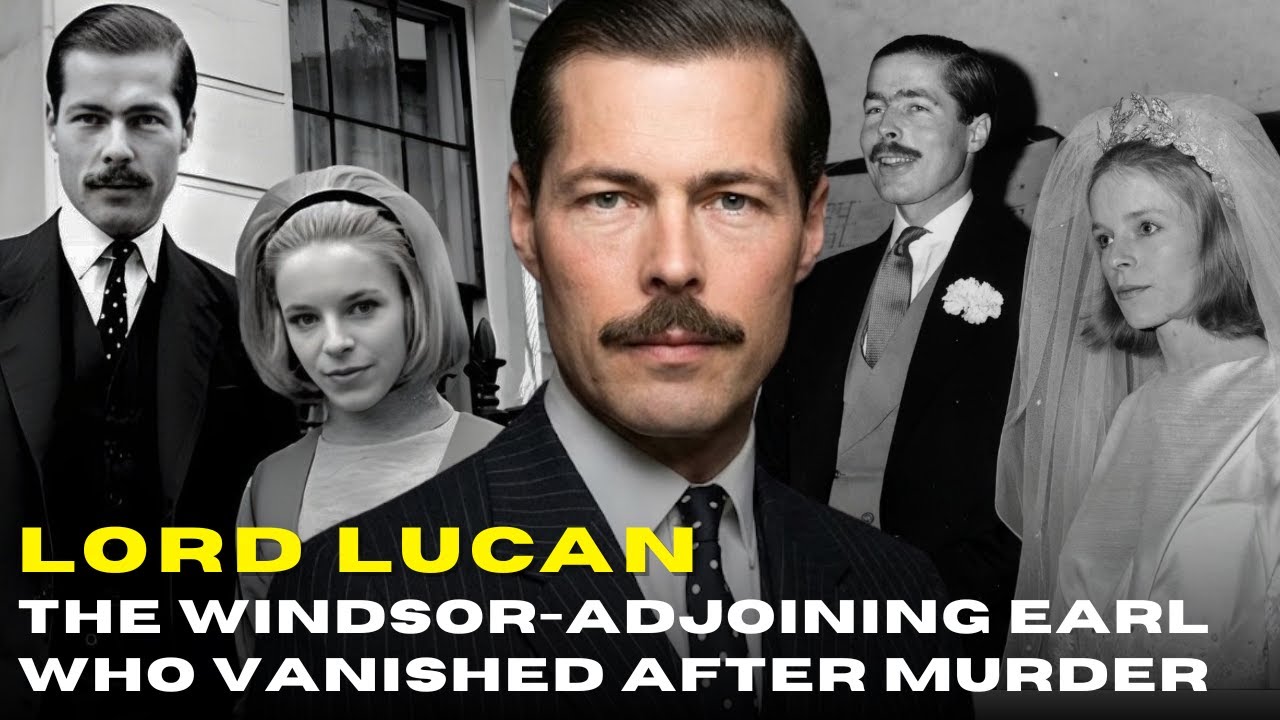
It was her husband’s voice. Richard John Bingham, the seventh Earl of Lucan, had come home to kill his wife. The man standing in that dark basement was no stranger to violence. Born in 1934 into one of the oldest families of the Anglo-Irish aristocracy, he had grown up utterly certain that his will was law and that his bloodline put him beyond the reach of any consequence.
By nature he was a gambler, a man of rigid routine, known among his circle as “Lucky Lucan” for his improbable winning streaks at the backgammon table. His marriage to Veronica, a beautiful young woman he had swept into his world in 1963, had soured over the years into a bitter fight over money, custody, and control. The courts had refused to bend to him. A divorce settlement had stripped him of his fortune and his children.
In his own mind, he had been wronged, and he had resolved to restore the natural order by wiping out the source of his ruin. For weeks he had laid his plans. On the morning of November 7, 1974, he made telephone calls, putting his affairs in order with a strange, detached finality. He took lunch at the Clermont Club but did not stay long.
He borrowed a dirty, unremarkable Ford Corsair from his friend Michael Stoop, saying his own Mercedes — as recognizable in Belgravia as a bus — was having battery trouble. Into the boot he put a heavy canvas sack and a length of lead piping bound in tape. The tape was for grip. A smooth lead pipe turns slippery once it is wet with blood.
That was the reasoning of a practical man, not a madman. That evening, darkness swallowed London in the damp grey of an autumn Thursday. At 46 Lower Belgrave Street, the air was thick with the static of a family under siege. The household was run by Veronica and the 29-year-old nanny, Sandra Rivet, a young woman with a son she had given up for adoption years before, a boyfriend named John Hankins who drove a cab, and a fondness for spending Thursday nights out with him.
That night she was tired. The strain of the household had worn her down. On a fatal and tragic whim, she chose to stay home instead. Around 8:55 p.
m., the most British of impulses set the tragedy in motion. Sandra said she would go downstairs and make tea. “Would you?
Thank you,” Veronica replied. Those were probably the last words Sandra Rivet ever heard. She gathered the cups, left the drawing room, and began her descent into the basement, which was unusually dark. The light that was normally left on had been put out.
To the predator waiting in the corner, she was only a silhouette. Lucan had let himself in with the key he had sworn to the courts he had lost. He stood in the shadows, breathing shallowly, the pipe heavy in his gloved hand. He was waiting for a woman of a certain height, a certain build — the mother of his children.
But in the gloom, shapes deceive. Sandra Rivet was about the same height as Veronica, and she wore her hair short. He struck the wrong woman, and he did not stop striking until he had beaten her to death. Upstairs, Veronica was fighting for her life.
In the desperate struggle at close quarters, slipping on the blood-slicked floor, she got her hand between his legs and twisted with every ounce of strength she had. Lucan gasped. The pain shattered his frenzy. He drew back, panting.
The violence ceased as suddenly as it had started. “John,” she gasped. “Don’t hurt me.”
“I’m not going to hurt you,” he muttered, the pipe still in his hand.
For a moment they stood in the dark, two ghosts in a ruined marriage. Veronica knew she could not outrun him. She had to outthink him. She asked where Sandra was.
“She’s dead,” he said flatly, as though remarking on the weather. “I’ve killed her. She’s in the sack.”
She did not scream.
She knew that if she screamed again, she would end up in a sack beside Sandra. She changed tactics. “I can help you,” she whispered. “We can work this out.
But I need to clean my face. I’m bleeding.”
Lucan hesitated. The adrenaline was draining away, leaving him confused.
The plan had gone wrong. He had killed the wrong woman, and the right woman was standing before him offering to help. His gambler’s mind could not work out the odds of this new situation fast enough. “All right,” he said.
“Go upstairs.”
Together they climbed the carpeted stairs, murderer and victim, into the ground-floor cloakroom. Veronica looked in the mirror. Her face was a mask of crimson, the cuts deep.
She said she would fetch a towel from the bedroom. Lucan stood in the doorway, the pipe still in his hand, watching her. She knew this was the only chance she would ever get. If she let him think, if she let him regain his composure, he would finish the job.
She moved toward the bathroom, saying she would wet a towel, and then, seizing that brief moment apart, she bolted. She ran for the front door with the desperation of a hunted animal, her blood-slicked fingers fumbling at the brass latch. The door gave way. The cold night air struck her face.
She burst out onto Lower Belgrave Street and ran toward the lights of the Plumber’s Arms pub on the corner, screaming, “Murder! Murder! He’s murdering me.”
Within the pub, the usual crowd were quietly sipping their beers in the cozy, hazy warmth.
The door burst open with a crash. A woman stood in the entrance, her clothing ripped, her face covered in blood. “Help me,” she screamed, crumpling to the floor. “My children.
Save my children. He’s in the house.”
Meanwhile, at number 46, Lucan remained in the hallway. He heard the door slam shut.
He heard the screams growing fainter down the street. He understood, with the icy certainty of a gambler who has staked everything on red and watched the ball settle on black, that it was finished. He made no attempt to follow her. There was no purpose in it.
He did not climb the stairs to look in on his children asleep in their beds. He did not gather any belongings. He merely turned, stepped out the front door, got into the Ford Corsair, and eased away from the curb, driving slowly and without haste past the pub where his wife was being cared for by shaken strangers, out into the night, a man who had stopped being an earl and had turned into a ghost. The journey from Belgravia to the quiet town of Uckfield in East Sussex covers about 42 miles.
On an ordinary night the trip might take an hour. In a worn Ford Corsair with a weak engine, it took longer. Lucan headed south, abandoning the wailing sirens, the blood-drenched basement, and the wife screaming in the pub. He drove into the dark, silent countryside, an odd and chilling calm coming over him as he started to shape the story that would safeguard his legacy.
He started to construct the lie. At roughly 11:30 p.m., the car drew into the driveway of a large, comfortable house named The Grants, the residence of Ian and Susan Maxwell-Scott, longtime friends from high society circles.
Ian was not there, but Susan was. She opened the door to discover Lord Lucan standing before her, rumpled, his hair unusually untidy, with a damp patch on his trousers, probably blood he had attempted to wipe away. His demeanor was surprisingly ordinary. “Hello, Susan,” he said.
“I’m in a terrible mess.”
She asked him inside. She had no idea that a murder had occurred in London or that every police officer in the capital was searching for the man now standing in her hallway. She simply saw a friend in trouble.
She brought him into the drawing room, kindled the fire, and mixed him a scotch and water. Lucan sat, took a sip, and with the composure of a man describing a minor traffic accident, recounted the story he had assembled during the drive. He said he had been passing 46 Lower Belgrave Street, happened to look through the basement window, saw a man assaulting Veronica, let himself in with his key, hurried down the stairs, and frightened the intruder away. He conceded that he had slipped in a pool of blood, that Veronica was hurt, and that she had then begun screaming hysterically that he was responsible.
Convinced he would be framed, he had panicked and run. It was an absurd tale, resting on impossible coincidences. Susan Maxwell-Scott listened. She was a woman of her class and era, raised to believe the word of a peer of the realm.
She expressed sympathy. Lucan understood the story would never survive a courtroom, but he was not telling it to persuade a jury. He was telling it to persuade his own world. Once the tale was finished, he requested pen and paper.
He seated himself at a small writing desk in the Maxwell-Scotts’ drawing room, the fire crackling, and wrote letters laying out his account of events, among them one addressed to his brother-in-law, Bill Shand Kidd. These documents would become the most unsettling relics of the whole case. In the first letter, he restated the intruder fabrication, then allowed the hero’s mask to fall away and the cold realist to surface. “The circumstantial evidence against me is strong in that V says it was me,” he wrote.
“V has demonstrated her hatred for me in the past and would do anything to see me accused.” Then came the sentence that has tormented investigators for fifty years: “I will lie doggo for a while.”
Lie doggo. An old-fashioned public school expression meaning to hide, to remain silent, to go to ground.
The most troubling element of the letters was what they left out. There was no reference to Sandra Rivet. He had beaten a young woman to death hours earlier and crammed her body into a sack, yet in his final correspondence she did not merit one word of remorse, compassion, or even recognition. To Lucan, she was not a human being.
She was simply a prop in the drama of his own life. In the second letter, the financial wreckage of his ruin spilled onto the page. He wrote about the sale of the family silver at Christie’s, gave directions on which creditors to pay, and asked Shand Kidd to watch over the children and see that they were raised with the proper values. “When they finish with my wife,” he wrote, “I will be condemned.
” He was not afraid of justice. He was afraid of judgment. He completed the writing in the small hours of Friday, November 8th. He sealed the envelopes and rose.
Susan Maxwell-Scott asked what he meant to do. “I must get back,” he said vaguely. “I must sort things out.” He stepped out into the cold night, got back into the Ford Corsair, and drove down the driveway.
She watched his tail lights vanish into the darkness. She was the last credible witness to see Richard John Bingham alive. He drove south once more, toward the coast, toward Newhaven, a ferry port that offered a way to France. At some point in the early hours, the Ford Corsair turned into Norman Road.
Lucan parked, switched off the engine, and sat for a moment. In the boot lay the bloodstained lead pipe. The interior was smeared with evidence. He left the car unlocked.
What followed is the void into which a thousand theories have been poured. Did he walk to the ferry terminal and board a boat to France on a false passport supplied by his powerful friends? The Clermont set had the resources. Did he walk to a nearby private airfield where a light aircraft waited to carry him to Africa?
Or did he do the one thing his code of honor demanded? The most plausible and grimmest theory is that he walked toward the harbor. The English Channel is cold and unforgiving in November, the currents around Newhaven strong. If he grasped that the lie doggo strategy was a fantasy, that the shame of a trial, the loss of his dignity, was unavoidable, he may have chosen the gentleman’s way out.
No body was ever recovered. No article of clothing washed up on shore. He simply ceased to exist. Back in London, the police stormed into 46 Lower Belgrave Street.
Inside the sack lay the body of Sandra Rivet, and there was the blood, and upstairs the children, physically untouched but asleep in a house turned into a chamber of horrors. The inquiry, headed by Detective Chief Superintendent Roy Ranson, quickly ran into a barrier of upper-class aloofness. When the detectives went to question Lucan’s circle — Aspinall, Goldsmith, Shand Kidd — they encountered haughtiness and stonewalling. “He’s an Earl,” one of them reportedly informed a detective.
You can’t simply treat him like some common criminal. The murder of the nanny did not appear to horrify them. What seemed to irritate them was the inconvenience. They kept repeating the intruder story, even though they surely knew it was false.
They gathered privately at the Clermont Club, plotting and combining their resources. Were they arranging his flight, or containing the public-relations fallout? The police were outmatched, accustomed to handling street criminals rather than men who played backgammon with MPs and dined with royalty. By the time a warrant for Lucan’s arrest was issued, he had already been gone for days.
The Ford Corsair was discovered deserted at Newhaven, but its driver had vanished. The trail was going ice-cold. John Aspinall, the zoo proprietor whose philosophy glorified the predatory strength of the elite, emerged as the leader of the defense. He told reporters outright that had Lucan come to him, he would have helped him.
“If a close friend of yours comes to you and he’s in a mess, you help him,” he said. “You don’t hand him over to the police. That’s the morality of the betrayal.” Detectives suspected that a pool of money had been collected to finance Lucan’s escape.
There were whispers of chartered private planes to France, safe houses in the Scottish Highlands, contacts among the South American Junta. But rumors are not proof, and the Clermont circle took care to leave none behind. In June 1975, seven months after the murder, an inquest opened at the Westminster Coroner’s Court. The courtroom was filled with journalists from around the world.
Veronica, the Dowager Countess of Lucan, took the witness stand. For years her husband had told the world that she was mad. Now she stood before that world, the marks of his assault still visible on her forehead, and recounted her story in a quiet voice — the darkness of the basement, the blow to the head, the struggle for her life, and the terrifying realization that the man trying to kill her was her own husband. She was calm, clear-headed, and devastatingly convincing.
The inquest jury came back quickly with a verdict that made legal history: murder by Lord Lucan. To name a member of the aristocracy outright in a murder verdict was unprecedented. In the eyes of the law, the case was closed. But a verdict cannot put handcuffs on a ghost.
The sightings now began in earnest, transforming Lucan into a recurring figure of modern legend. A hiker said he saw him on a mountain in Colombia. A tourist caught sight of him in a bar in Mozambique. He was said to be living as a monk in India, a sheep farmer in New Zealand, a waiter in San Francisco.
The Metropolitan Police were compelled to chase thousands of leads across five continents. One of the most stubborn theories focused on Africa, where Lucan had spent time in his youth and where his friends had deep ties. Detectives flew to Cape Town, pursued leads in Botswana, found men who resembled him — tall, mustached, aloof — but never the man himself. Aspinall fed the ghoulish speculation by joking darkly that the surest way to dispose of a body was to feed it to his tigers.
It was probably a cruel joke meant to mock the police. Yet it added another layer of horror to the case. While the world played a parlor game of Where’s the Earl, a genuine tragedy kept unfolding in London. The real victim of the Clermont set’s protection racket was not the police.
It was Veronica Lucan. The clique that shielded her husband turned its collective rage upon her. In their twisted reasoning, she was the one who had caused the tragedy. Had she not been so difficult, had she not fought for custody, poor John would never have been driven to snap.
She was shunned. Friends stopped calling. Invitations ceased. The press, at first sympathetic, turned against her, painting her as cold, strange, and reclusive.
In 1982, with a bitter irony, custody of her children was handed to Bill Shand Kidd — the very man to whom Lucan had addressed his letters. He had asked him to make sure the children were raised with the right values, values that apparently included the conviction that their mother was a monster. Veronica was left alone in the house on Lower Belgrave Street, the house where the murder had taken place, surrounded by the ghosts of that Thursday night. She became a recluse, seldom leaving the property, serving out a long, silent sentence for a crime she had not committed.
The legend of Lucky Lucan grew more ridiculous with each passing year. In 2003, a book asserted that he was living in Goa, India, under the name Barry Halpin, a banjo-playing hippie nicknamed “Jungle Barry.” The British press erupted. Photographs were scrutinized, facial-recognition specialists brought in.
It proved to be precisely what it appeared to be: a banjo-playing hippie from St. Helens who simply happened to have a mustache. But the fact that the tale made front-page news almost thirty years after the murder showed the lasting pull of the Lucan name. He had come to stand for the ultimate escape — the notion that with enough wealth and enough connections, you can literally get away with murder.
As the 21st century arrived, the wall of silence started to develop cracks. The men of the Clermont set began to die off. Aspinall and Goldsmith passed away, and the fear they had commanded faded with them. A secretary who had worked for Aspinall came forward to say she had been told to book flights for Lucan’s children to travel to Africa to meet their father in the late 1970s — a trip that was suddenly cancelled.
A former detective disclosed that police had known Lucan made a phone call to a friend hours after the murder, a call that was never officially recorded. The investigation had gone cold, but the file was never shut. For the family of Sandra Rivet, the endless speculation meant the wound was constantly reopened. Her son, Neil Berriman, who had been given up for adoption and only discovered his true identity years later, started his own search for justice.
He cared nothing for the Earl or the glamour. He wanted to know where the man who killed his mother was hiding. As the 40th anniversary of the murder drew near, the Lucan family sought closure. They wanted the title to pass to the son, George Bingham, and they needed a death certificate.
That demands a presumption of death, and where Lord Lucan is concerned, presumption is a perilous matter. On a dull February morning in 2016, within London’s High Court, Lord Lucan’s ghost was at last formally put to rest. No coffin, no corpse, no weeping — only a paper battle waged between two middle-aged men joined by the brutality of a night forty-two years before. On one side was George Bingham, convinced his father had died long ago, most likely by his own hand in the Channel within hours of the murder.
On the other was Neil Berriman, who held with unshakable certainty that Lucan had fled and enjoyed a life of riches in Africa. The judge, Mrs. Justice Asplin, was left with no alternative. For four decades there had been no evidence he was alive.
Invoking the presumption of death act, she delivered her ruling: Richard John Bingham was presumed dead. Outside the court, the new eighth Earl faced the cameras. “Our family has no idea how our father met his own end,” he said, his tone careful. “Whether he did so at his own hand or by the hand of others remains a mystery.
” For Neil Berriman, and for the fixation of the British public, a piece of paper altered nothing. You cannot legislate a legend out of existence. The real tragedy of the Lucan affair is not the Earl’s mystery. It is the slow, quiet ruination of the countess.
Veronica had lived through the lead pipe, yet she did not live through the peace. For more than forty years she had stayed in the house on Lower Belgrave Street, refusing to be forced out — an act of stubborn, perhaps self-punishing defiance. She was cut off from her children, cut off from her sister. The high society that had once praised her beauty had utterly shunned her.
In 2017, a year after her husband was legally declared dead, police broke into the house after worries that she had not been seen for days. They found her dead. Fearing the loss of independence as her health declined, she had swallowed a quantity of pills and alcohol and lain down to die alone in the house that had been her prison for half a century. She was the one who had told the truth.
She was the one who had fought back. Yet she died alone, branded mad to the last by the very people who shielded her attacker. In her final television interview, given months before her death, she said she believed her husband had escaped and had been watching her from a distance. “I don’t know if he is dead,” she said.
“I never knew.”
Since the death certificate was issued, claims have periodically emerged suggesting Lucan may have lived abroad, Australia among them, but none have been substantiated and police have not confirmed them. The trail went cold once more. Fifty years have gone by.
The Clermont Club is gone, remade into a different luxury venue. The central figures — Aspinall, Goldsmith, Shand Kidd, Veronica, Sandra — are all dead. The Ford Corsair was reduced to scrap metal decades ago. But somewhere, perhaps in the deep silt of the English Channel, or perhaps in an unmarked grave beneath an African acacia tree, the truth lies buried.
Richard John Bingham, the seventh Earl of Lucan, carried out what some have called the perfect crime — not because he was clever, but because he was shielded. He wagered his life on his friends’ silence, and for fifty years that wager has paid off. The water at Newhaven is dark and deep, and it guards its secrets well.
The man who stepped into the night simply never returned.
