The salad bar was the thing. More than fifty ingredients lined up in a long refrigerated row—romaine, cherry tomatoes, shredded cheese, house-made croutons, sunflower seeds, pickled beets, a full lineup of dressings. You could go back as many times as you liked, and for roughly three decades, that garden bar was the quiet anchor of the entire Ruby Tuesday brand. At its peak in 2007, the chain operated around nine hundred locations across the United States, one of the largest sit-down restaurant companies in the country.
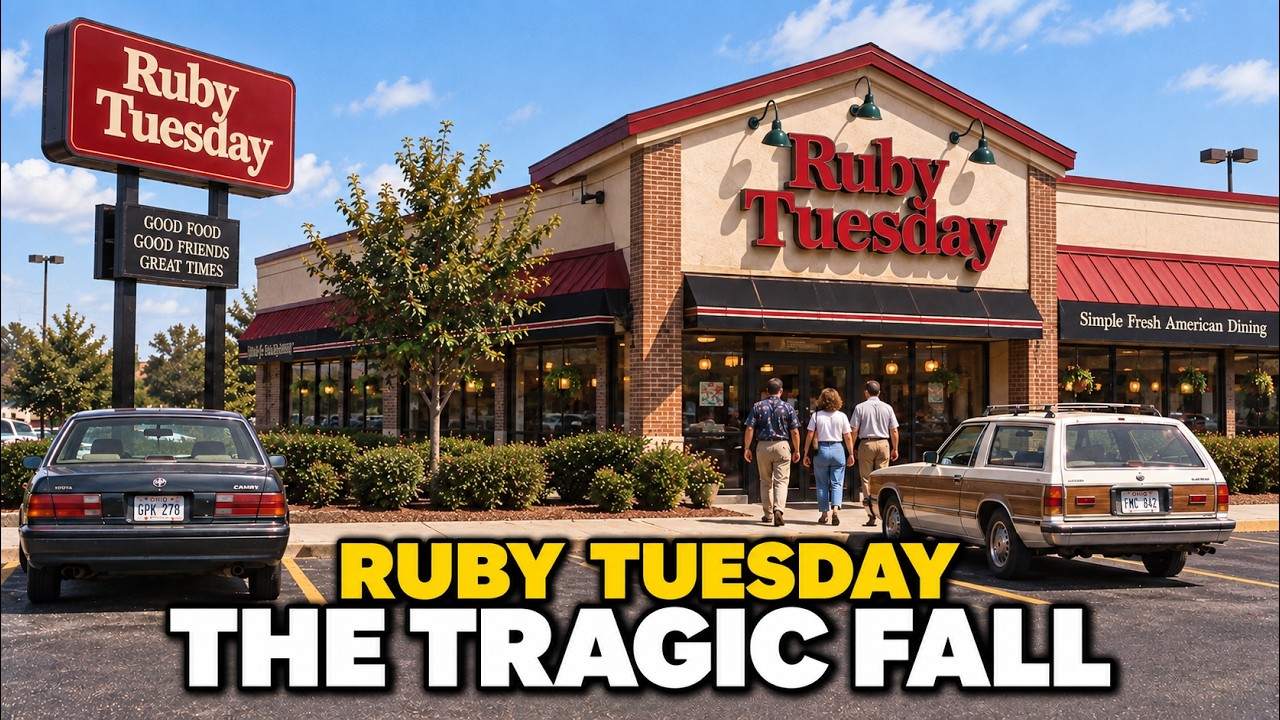
Today, depending on the month, it has somewhere around 175 to 200 locations, concentrated mostly in the Southeast and Mid-Atlantic. An entire generation of strip mall buildings that used to house a Ruby Tuesday now holds a nail salon, a furniture liquidator, or a Planet Fitness. The simple answer—that the pandemic did it—is only about a quarter of the story. The more honest answer involves a decision made around 2007 that pulled the chain away from what made it work, a reversal that came too late, years of accumulating debt, a private equity sale that could not fix the fundamentals, and then a pandemic that hit an already weakened business at the worst possible time.
The whole thing started at the University of Tennessee in 1972. Sandy Beall was twenty-two years old, studying finance and working on the side for a local Pizza Hut operator. According to accounts told and retold over the years, Beall and four of his fraternity brothers combined their money, a partner contributed $10,000, and they pooled another $10,000 to open a burger bar near the UT campus in Knoxville. They named it after the Rolling Stones song released in 1967.
The first Ruby Tuesday was not a family casual dining concept. It was a college hangout—burgers, beer, affordable food, a lively atmosphere. What Beall understood early was that the appeal was the combination of fresh ingredients, reasonable prices, and an atmosphere a notch above a dive bar without tipping into anything formal. Over the following decade, Beall expanded.
By the early 1980s, Ruby Tuesday had grown to somewhere between a dozen and twenty locations, primarily in the Southeast. In 1982, Beall sold the chain to Morrison Inc. , a large Alabama-based food service company, for $15 million in cash and stock. Beall stayed on to run the restaurant division.
Morrison’s strategy was to grow Ruby Tuesday through company-owned units rather than franchising. That meant consistent food quality and experience, but it also meant that all the risk, real estate obligations, and lease costs sat on the company’s balance sheet. In the 1980s, the dominant footprint strategy for casual dining was mall placement, and Ruby Tuesday expanded heavily into shopping centers. The restaurants had a look people remember with genuine warmth: wooden tables and booths, retro-style stained glass light fixtures throwing warm amber and green tints, big menus, generous portions, a lively bar along one side.
The food centered on what Ruby Tuesday became known for: thick half-pound burgers, slow-cooked baby back ribs, double-dipped chicken tenders, coconut shrimp. Entrees ran from roughly $7 to $15 through most of the 1990s. And then there was the salad bar—more than fifty ingredients refreshed regularly, with a variety that genuinely surprised people who expected something perfunctory. The house-made croutons accumulated a near cult following.
By 1992, Morrison had restructured itself to emphasize restaurant operations, renaming itself Morrison Restaurants Inc. and generating more than $1 billion in revenue that year. Beall became CEO. In 1996, Morrison split into three separate publicly traded companies, and Ruby Tuesday Inc.
became its own stand-alone public company with Beall still in charge. The late 1990s and early 2000s were very good years. The company pushed past seven hundred locations, revenue climbed, and the stock at one point traded above $33 a share. The first location outside the United States had opened in Hong Kong in 1995.
But a complication was building. Expansion through the 1990s had shifted from a mall-heavy footprint toward free-standing suburban restaurants, which came with long-term operating leases that would sit on the balance sheet for years regardless of traffic. By the mid-2000s, Ruby Tuesday was running more than eight hundred restaurants, the vast majority company-owned, every one with a lease obligation. The economics worked as long as enough customers came through the door.
Same-store traffic started declining in 2006. The competitive pressure was structural. From below, fast-casual chains like Chipotle and Panera offered fresh, customizable food at prices close to fast food. From above, chains like The Cheesecake Factory pulled customers toward more premium experiences.
Ruby Tuesday was caught in the middle. The chain’s response made things considerably worse. Around 2007 and 2008, Beall and leadership decided the answer was to move upmarket. The menu shifted emphasis away from burgers, ribs, and the salad bar toward more ambitious and expensive fare.
The salad bar was scaled back or eliminated at many locations. The warm, woody tavern aesthetic was replaced by something more modern: leather booths, cooler lighting, servers in all-black uniforms instructed to suggest wine pairings. The stained glass lamps came down. The friendly script logo was replaced with a stark, clean typeset.
There was a coherent strategic argument. The casual dining middle ground was genuinely crowded. The company invested over $100 million in the rebranding. But Ruby Tuesday was already known for something—the salad bar, the burgers, the ribs, the comfortable family tavern atmosphere.
The upmarket version asked customers to trade a genuinely liked product for a more expensive version of something the chain wasn’t known for. And the timing made it worse: the rebranding coincided almost exactly with the 2008 financial crisis. When families became more deliberate about spending, Ruby Tuesday was moving toward higher check averages and a more formal atmosphere. Traffic fell.
Same-store sales declined for most of the years between 2007 and 2012. By 2012, the average unit volume had dropped from around $2. 1 million to roughly $1. 6 million.
Across more than eight hundred company-owned restaurants with long-term leases, that was a very large number. Beall retired as CEO in 2012 after forty years. His successor, J. J.
Buetgen, moved quickly to reverse the upscale repositioning. The all-black uniforms went away. Hand-breaded chicken tenders came back. The salad bar was restored to its prominent place.
Kids ate free on Tuesdays. The reversal was the right instinct, but reversing a rebranding doesn’t automatically restore the customer relationships that were interrupted. People who had stopped going in 2009 or 2010 had found somewhere else. Buetgen also tried to diversify, acquiring the fast-casual Mexican chain Lime Fresh in 2012.
It never found scale, and by 2015 the eight remaining locations were sold. The core brand kept losing locations. In 2016, the company announced it would close around ninety-five underperforming restaurants, roughly 13 percent of the system. Buetgen resigned under pressure that September.
In October 2017, NRD Capital, an Atlanta-based private equity firm, acquired Ruby Tuesday for approximately $335 million in total enterprise value. At the time, the chain had 596 locations, 541 company-owned and 55 franchised, in 41 states and 14 foreign countries. The stated thesis was that the brand had differentiated value through the garden bar. The chain still had hundreds of long-term lease obligations, and same-store sales had never returned to peak levels.
NRD closed underperforming locations steadily from 2017 onward. When the pandemic arrived in early 2020, Ruby Tuesday had roughly 450 restaurants and relied almost entirely on dine-in traffic. There was no drive-thru infrastructure. By May 2020, more than 150 locations had closed.
In October 2020, the company filed for Chapter 11 bankruptcy, citing approximately $62 million in debts to lenders, landlords, and suppliers, and announced the permanent closure of 185 restaurants that had shuttered during the pandemic. In February 2021, a Delaware bankruptcy judge confirmed the reorganization plan. The chain emerged with about 209 locations and substantially reduced debt. The garden bar is still there, with fresh greens, a rotating selection of toppings, house-made croutons, and a choice of dressings.
The ribs, burgers, chicken tenders, and coconut shrimp are still on the menu. But the chain is now much more of a Southeast and Mid-Atlantic regional concept than the national brand it once was. Of the roughly 174 to 200 locations operating as of mid-2026, the largest concentrations are in Florida, Georgia, and North Carolina. The chain’s last verified advertising activity was in October 2024.
New locations are not being opened. What happened to Ruby Tuesday is a story about timing and sequencing. The core product genuinely worked. The garden bar was a real differentiator.
When the competitive environment shifted around 2006, the chain could have doubled down on value and freshness, or it could have genuinely moved upscale, accepting a smaller location count. Instead, it tried to move upscale while keeping most of its locations—spending money on a repositioning it couldn’t execute consistently, while making existing customers feel like something they liked had been taken away. The return under Buetgen was well-intentioned, but it arrived after the customer base had been disrupted for years. The accumulating lease debt left the chain with almost no financial flexibility.
When sales declined, the fixed costs didn’t. The company-owned model had allowed consistent quality on the way up, but it meant that on the way down, every closed location still had a lease to deal with. There’s a reason so many people remember Ruby Tuesday specifically and warmly. The salad bar gave a restaurant trip a quality of abundance and participation.
You weren’t just ordering from a menu; you were building something. Children got to make choices. The ribs communicated generosity. Families visited so regularly they knew which booths they preferred.
That kind of routine doesn’t get built around mediocre food. When the chain changed what it was in 2007 and 2008, it didn’t just lose customers. It lost the occasion and the routine. The salad bar is still there.
The croutons are still there. What’s no longer there is the room those things need to matter—the seven hundred, eight hundred, nine hundred locations that once put them within an easy drive of tens of millions of American families. That’s the distance between what Ruby Tuesday was and what it is now.






