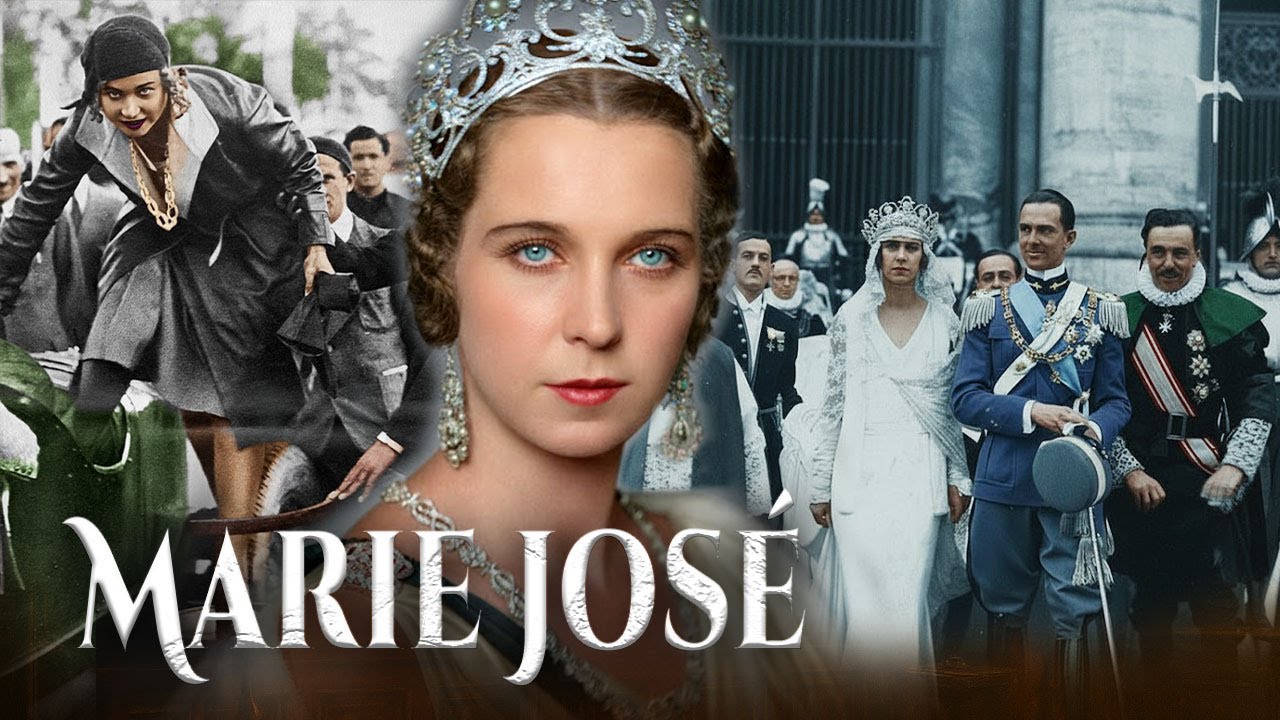
On a July afternoon in 1943, a woman leaned over a forbidden radio in a hunting lodge at the foot of the Alps, listening to reports that would decide the fate of the kingdom she had married into. Marie José of Belgium, Princess of Piedmont, had spent three years warning her husband and her father-in-law that this day was coming. She had pleaded, argued, and conspired. She had been silenced for it, exiled from Rome under the pretense of safety.
And now the Allies had landed in Sicily. The invasion of Italy had begun. She was not surprised. That was the tragedy.
None of them had listened. To millions, the story of Marie José is a story of failure, the simple tragedy of a lost throne. But the woman at the heart of that storm was never a passive victim. The one who became known as the May Queen was, in fact, the only member of her family of powerful men who saw the storm coming, who screamed a warning, and who was silenced for her courage.
This is not the story of a queen who lost a kingdom. It is the far more tragic story of a fighter forced to marry the enemy: a proud Belgian princess who despised fascism and found herself trapped inside the very royal family that had enabled it. The House of Savoy in Italy. She was not a footnote in history.
She was Italy’s Cassandra. This is the story of the woman who tried to stage a coup against Mussolini from inside the palace walls, who became a sworn enemy of her own in-laws, and whose greatest tragedy was not losing the throne after thirty-three days, but enduring sixteen years of hell to get there. The roots of Marie José’s tragedy were not planted in Italy. They cannot be found in the chaos of Rome or the fall of fascism.
They were planted in the clear air of Belgium, thick with duty and heroism. To find the essence of Marie José, you cannot begin in a suffocating Italian palace. You have to begin in Brussels, in a world that was burned by war and then reborn. She was born in 1906, Princess Marie José of Belgium, Belgian to the bone.
Her blood came from a different place than the tangled Anglo-German web of Queen Victoria’s descent. Her father was King Albert I, the Knight King. He was not a distant monarch on a throne. He was a national hero, the man who refused to flee when German armies invaded his country in the First World War.
He fought in the trenches alongside his men, while his wife, Queen Elisabeth, a Bavarian duchess, worked as a nurse at the front. Marie José grew up in a family where royalty meant courage. It meant duty. It meant resisting tyranny, not compromising with it.
Her family was not a suffocating cocoon. It was an intellectual laboratory. Her mother Elisabeth was a patron of the arts, a sculptor, a musician. She turned the palace in Brussels into a salon for the greatest scientists, artists, and writers in Europe.
The young Marie José, known affectionately as May, grew up amid conversations with Einstein and Cocteau. She received a rigorous education, learning piano and violin to a high standard. She was intelligent, strong-willed, athletic, and modern. She was raised to be a queen, not merely an ornament, but a partner, a woman of will and thought.
When she was twelve years old, the great powers of Europe decided her future. She was pre-selected. She was to marry the heir to the Italian throne, Prince Umberto of Savoy. It was a classic political marriage, an alliance between Belgium, the rising constitutional monarchy, and Italy, one of Europe’s oldest ruling dynasties.
On paper, it was perfect. But in the eighteen years between her childhood betrothal and her actual wedding, Italy changed. It rotted from within. In 1922, a noisy, boastful socialist journalist named Benito Mussolini organized his March on Rome.
The King of Italy, Victor Emmanuel III, Marie José’s future father-in-law, had two choices. He could summon the army, crush the Blackshirts, and save Italy’s democracy. But the king hesitated. Afraid of civil war, or perhaps afraid of losing his throne, he did the unthinkable.
He surrendered. He appointed Mussolini prime minister. By the time Marie José was to marry in 1930, Italy was no longer a kingdom. It had become a fascist dictatorship in disguise.
Mussolini was no longer just a prime minister. He had become Il Duce, the Leader. This was the world the intelligent twenty-four-year-old daughter of the hero King Albert was about to enter. She was marrying into the heart of the very family that had opened the door to the beast.
The wedding took place in January 1930 in Rome. It was the event of the decade. The radiant Marie José married Umberto, Prince of Piedmont, heir to the throne. And here lies her central personal tragedy: Umberto.
He was tall, stunningly handsome, and dangerously charming. He was the beloved prince, courted by all of Europe. He was the man she would love, or at least try to love, with desperate fidelity. But Umberto was a broken man.
He was utterly subservient to his father, King Victor Emmanuel III. The king, a small, bitter, jealous man, despised his son for his popularity and his good looks. He kept Umberto in a golden cage, granting him no real power or responsibility, treating him like a boy. There was another secret, one Mussolini knew well and allegedly used for blackmail: persistent rumors that Umberto was homosexual or bisexual.
In the hyper-masculine, toxic world of fascist Italy, this was a fatal weakness. As a result, Umberto lived his entire life in a state of paralyzing fear. He was afraid of his father. He was afraid of Mussolini.
He was trapped. And Marie José was trapped with him. Their marriage was catastrophic from the start. The relationship was cold, distant, and formal.
They were strangers bound by the shackles of duty. She later told a close confidant that she was never happy. Marie José, Princess of Piedmont, began her life in the Quirinal Palace in Rome. She immediately discovered she was not a princess.
She was a prisoner. This was her cocoon, but it was not like the one others built for themselves to avoid the world. This one was built by others to prevent her from changing the world. The House of Savoy was one of the most conservative, rigid, and suffocating royal courts in Europe.
Women were expected to be seen and not heard. They were to remain silent, appear beautiful, and produce heirs. Marie José did the exact opposite. She was Belgian.
She had been raised on the ideas of Einstein. She would not stay silent. She began to rebel, not with politics, not yet, but with culture. She refused the suffocating court protocols.
She drove her own car, fast. She cut her hair in a modern, chic bob. She wore trousers in public, a shocking act at the time, and she smoked. Worse, she began to do what her mother had done.
She started a cultural salon. She sought out intellectuals, artists, and musicians. She turned her apartments into a unique oasis of free thought in fascist-crushed Rome, and figures like Italo Calvino and other anti-fascist thinkers found a patron in her. For King Victor Emmanuel and Mussolini, this was unacceptable.
She was a foreigner. She was a dangerous liberal. She could not be trusted. She also hated Mussolini from first sight.
She saw him for the crude, boastful man he was. She mocked him openly behind his back, imitating his arrogant stance with his jutting chin and puffed chest. Mussolini, whose spies were everywhere, knew all about it. He considered her a personal enemy.
His secret police began watching her around the clock. Her phone was tapped. Her letters were read. Her servants were spies.
Every word and every meeting was reported to the Duce. One of the strangest and most unsettling controversies of her life emerged here. Decades later, Romano, Mussolini’s son, wrote in his memoirs that Marie José had a brief, light affair with his father at a seaside resort. Her family furiously denied it, and her son filed a lawsuit.
What is the truth? We will never know. But if it happened, it was certainly not a love story. Some historians speculate it may have been a desperate, calculated seduction attempt to influence him and find a crack in his defenses.
Others believe it was a final desperate act of a young, lonely woman locked in a loveless marriage, seeking power or connection wherever she could find it. Whatever the truth, it only highlights the tragic complexity of her golden prison. She was surrounded by men she could not trust, in-laws who hated her, a powerless husband, and a dictator who watched her every move. Then, in 1934, her lifeline was cut.
Her father, the hero King Albert, was killed in a climbing accident. Her moral compass and guiding light was gone. She was finally completely alone. In 1935, Mussolini’s troops, armed with tanks and poison gas, invaded Ethiopia, a medieval kingdom, in a brutal colonial war.
Marie José, raised on her father’s example of protecting small Belgium, was horrified. This was not a war. It was a massacre. But her family, the House of Savoy, did nothing.
In fact, they profited from it. King Victor Emmanuel III, in exchange for his silence, received a new, grotesque title: Emperor of Ethiopia. This was the family she had married into, a family that accepted crowns stolen from the oppressed. Her relationship with her husband Umberto shattered completely.
It entered a new glacial phase of polite public performance and bitter silence in private. Umberto, the May Prince, was now past thirty, but his father still treated him like a child, and Mussolini like a useful tool. He had no real loyalty and no real power. He was a man drowning in his elegant uniform.
Marie José, with her direct Belgian sense of duty, could not understand his paralysis. She saw the world in her father’s clear, bright moral colors. You are either brave or you are a coward. You either resist or you collaborate.
She pushed Umberto to act. She argued. She begged. She tried with her tremendous willpower to make him a king, to make him the man her father had been.
It was a futile effort. He was terrified. He was terrified of his father, the one man whose approval he craved and would never receive. And he was terrified of Mussolini.
The rumors of the blackmail file, documenting his private life and kept in a safe in the Duce’s office, hung over every interaction. A single word from Mussolini could destroy him, not just as a prince, but as a man in the hyper-masculine fascist culture. So Umberto did what he always did. He withdrew.
He retreated into the details of military uniforms, royal protocol, and fleeting secret pleasures. He left Marie José to face the shark-infested waters of the court alone. The sharks were circling. Mussolini’s spies, the OVRA, were no longer content to watch her.
They were actively trying to damage her reputation. Her Belgian identity was used as a weapon against her. She was the foreigner, the liberal, the unreliable element. But the deep, defining hatred was reserved for Mussolini’s new favorite friend, Adolf Hitler.
She despised the Nazis. It was not ordinary dislike. It was primal, physical disgust. They were the brutal military force that had destroyed her childhood home and turned her father into a soldier in the trenches.
For her, they were not a political party. They were apes in uniforms, a plague of vulgar barbarians, and she said so openly. The peak of this personal war came in 1938 during an official visit to Germany. A trip she dreaded, but as Princess of Piedmont, she was ordered to go.
Picture the scene: the vast, neo-classical halls of Hitler’s new chancellery in Berlin, banners of crimson red with black swastikas, an atmosphere of arrogance and the metallic smell of polished leather. And here enters Marie José, tall, elegant, radiating an aura of pure, flawless contempt. She was forced to meet Hitler. The Führer, often awkward and dazzled before members of royal families, tried to charm her.
He clicked his heels. He bowed. Perhaps he even tried to kiss her hand in his famous, clammy manner. Marie José, as the stories tell, was magnificent.
She did not smile. She did not flinch. She looked at him not as a head of state, but as something she had found stuck to the sole of her shoe. She gave him the coldest, most curt nod, her back straight as a sword.
She was her father’s daughter in every sense. But the trip was not just about public insults. In the lion’s den, her political rebellion truly began to take shape. Many claim, including her son in his memoirs, that Marie José used the official schedule as cover.
She slipped away for secret, shocking meetings with members of the German opposition, that informal network of generals and aristocrats who were already planning to overthrow the man she had just publicly insulted. We do not know the details. We do not know who she met or what was said. But consider the audacity.
The wife of the Italian crown prince in Berlin on an official visit, secretly meeting the men who wanted to assassinate her host. She was no longer just a cultural rebel. She had become a conspirator. When she returned to Rome, the atmosphere was darker than ever.
The Pact of Steel was signed, formally tying Italy’s fate to Nazi Germany. Racial anti-Semitic laws were enacted in Italy, a pathetic imitation of the Nuremberg Laws. For Marie José, this was unforgivable. It was one thing for Mussolini to be cynical.
It was another to import that vile, systematic hatred from Northern Europe. She, raised in a world of intellectual tolerance, was now a member of a royal house that was officially and actively persecuting its Jewish citizens. She did what she could, which was little. She began using her few remaining contacts and her dwindling influence to help her Jewish friends, trying to secure exit visas, passing messages.
She was walking a tightrope in the dark without a safety net. Then on June 10, 1940, the world ended. From the balcony of the Palazzo Venezia, Benito Mussolini, with his jutting chin and eyes bulging with pride, declared war on crumbling France and defiant Great Britain. Italy was entering the Second World War.
For Marie José, this was not just a political catastrophe. It was an intimate, personal, agonizing betrayal. Her homeland, Belgium, had been invaded and brutalized by the Nazis only weeks before. Her brother, King Leopold III, was a prisoner of war.
The Belgian people were starving under a brutal occupation. And now Italy, her adopted country, was the official and active military ally of her homeland’s rapists. It was a desecration. It was a moral horror.
And this was the moment the princess broke. The polite lies, the cold dinners, the silent arguments were over. While the rest of the royal family, including her husband, put on a brave public face for their grotesque new alliance, Marie José locked herself in her rooms and wept. But her grief quickly turned to anger.
She did something that was tantamount to high treason for a member of a royal family under a dictatorship. She sat down and wrote a letter. It was not a diplomatic note. It was a scream of rage.
Through secret channels, she smuggled the message to her imprisoned brother in Brussels. She told him she denounced Italy’s actions, that they were a crime and a shame, that her heart was with Belgium, and that she was ashamed of the uniform her husband wore. It was a declaration of war, not against the Allies, but against her own government. From that moment, she became an active, full-time internal enemy of the fascist state, using the only tools she had left: her royal status.
She immediately joined the Italian Red Cross. It was a traditional role for royal women. Her mother-in-law, the quiet Queen Elena, did the same in a very quiet, devotional, distant way. But Marie José did not follow her mother-in-law’s example.
She followed her mother’s. She did not wrap bandages in a Roman palace. She went to the front. She went to the hospitals, the real ones, on the front lines and in bombed-out cities.
She demanded to be taken to the places where suffering was most acute. And she saw it all. She saw teenage boys, sent by Mussolini to fight his foolish, catastrophic war in Greece, returning without legs, with faces disfigured by frostbite. She saw soldiers dying of malaria and dysentery in the deserts of North Africa, cursing the name of Mussolini and the king.
She smelled gangrene and the smell of fear in the ether. She held the hands of dying men who, in their delirium, thought this tall, elegant angel was their mother. But these humanitarian journeys were also the perfect disguise. The fascist authorities, despite their suspicions, could not prevent the Princess of Piedmont from doing her national duty.
Yet on these trips, she was not only bringing comfort. She was making contacts. After leaving the hospital wards, her car would take a wrong turn, ending up at a private villa, a quiet church, or a university library. There she would meet the men who formed the nucleus of the other Italy.
She met Ivanoe Bonomi, the pre-fascist prime minister. She met the great philosopher Benedetto Croce, whose works were banned. She met disgruntled generals who knew the war could not be won. She met bankers and industrialists who saw their fortunes vanishing in Hitler’s inferno.
She became the connection, the only royal figure with the courage, intelligence, and freedom of movement to link the scattered and terrified cells of internal opposition. And then she did what her husband and father-in-law were too afraid even to think about. She tried to contact the Allies. This was the most dangerous game of all.
Grumbling about Mussolini was one thing. Committing high treason by negotiating with the enemy in wartime was another. She used every channel available to her. She used the Vatican, meeting secretly with a high-ranking priest named Giovanni Battista Montini, a man who would become Pope Paul VI decades later.
She used the neutral embassies. She sent messages through the Swiss. She met with the Portuguese ambassador, a country known as an intelligence hub for the British. Her message was always the same.
The House of Savoy is the key. Help us. Give us a signal. If we overthrow Mussolini, will you grant Italy an honorable separate peace, or will you treat us as a defeated enemy?
She was effectively trying to negotiate Italy’s surrender from inside her Red Cross ambulance. And here is the most painful irony of her entire life. No one believed her. The Allies, the British and Americans, listened to these probes and rejected them.
Who was this woman? She was the daughter-in-law of the king who had stood by Mussolini for twenty years. She was the wife of the heir who dutifully inspected fascist troops. To them, she was a trick, a trap, a fascist princess trying to lure them into a snare.
They saw her as part of the problem, not the solution. They did not want to negotiate. They wanted unconditional surrender. And at home, her own family was her worst enemy.
She was playing this deadly international spy game while her husband and father-in-law actively worked against her. King Victor Emmanuel knew what she was doing, his spies and Mussolini’s spies told him, and he was furious. It was not just that she was committing high treason. It was that she, a woman and a daughter-in-law, had dared to act, usurping a role that he and his son were too cowardly to fill.
And Umberto. Oh, Umberto. He was the deep wound at the heart of her life. He knew what she was doing.
In his weak moments, perhaps he gave her his muffled, tacit approval. But in the daylight, he was his father’s son. He was a Savoy. The motto of the House of Savoy was “Forward, Savoy.
” It was about the dynasty first and foremost. Marie José was not working for the dynasty. She was working for Italy. She was working for her conscience.
It was a distinction Umberto could not, or would never, make. Their quarrels became historic. They were no longer about personal coldness. They were about the fate of a nation.
She would return from a hospital, her eyes blazing with what she had seen, to find him studying the buttons of his uniform. She would scream at him: “Don’t you see what is happening? We are allied with monsters. Your father is a fool and Mussolini is a criminal.
You must act. You are the heir. You must be a man. ” And he would beg her, no doubt: “Be quiet, May.
You don’t understand. It is complicated. You are reckless. You will get us all executed.
You will destroy the monarchy. ” In a legendary, possibly unconfirmed confrontation, she finally gave him an ultimatum: if you do not arrest that man, pointing at Mussolini, she allegedly told him, I will do it myself. I will lead the coup. It did not matter.
The war was changing. By 1942, it was a catastrophe. Italian armies were being annihilated in Russia. They were being defeated in North Africa.
The first Allied bombs were falling on Italian cities. The people were starving. The soldiers were broken. Everyone knew it.
Marie José’s plots became frantic, desperate. She was a woman racing against time, trying to save a house that was already on fire. She was now the only rallying point for the opposition. They did not trust the king.
They did not trust Umberto. They trusted her. La Belgica. In late 1942 and early 1943, she was the most dangerous woman in Italy, a shadow government operating from her Red Cross car.
And the king and Mussolini knew it. They had to stop her. In the spring of 1943, as the Allies prepared to invade Sicily, the order came. It was not an arrest warrant.
That would be too chaotic, and it would make her a martyr. It was far more cunning and cruel. The king and the Duce informed her that for her safety and the safety of the children from the Allied bombing of Rome, she would be relocated. She was ordered to leave the capital.
She was to pack up and move with her four small children to a secluded villa in the Piedmont region at the foot of the Alps. Her connection to her contacts was severed. Her connection to the embassies was severed. Her connection to the entire plot she had painstakingly built was severed.
It was house arrest, a polite internal exile. They had removed her from the chessboard entirely just as the bloody endgame was about to begin. The villa at Sarre in the Aosta Valley was beautiful. It was a royal hunting lodge set among the towering green hills of the Alps.
It was a place of oppressive, unsettling silence. And for Marie José in the spring and summer of 1943, it was a prison. She was thirty-seven years old, in the prime of her intellect and vitality, and she was effectively frozen. The king and Mussolini exiled her under a flimsy security pretext.
The official story was that she and her four young children, Maria Pia, Vittorio Emanuele, Maria Gabriella, and Maria Beatrice, were being protected from the Allied bombing of Rome. It was a lie, and Marie José knew it. She was being protected from politics. They were trying to silence her.
Her days, once a frantic, secret whirlwind of Red Cross missions and coded conversations, now stretched out in suffocating, surreal monotony. The spies were still there. Her staff and her guards all filed reports. But she had nothing left to report.
She was a queen bee whose wings had been clipped, locked in a glass jar while her hive was set on fire. But they made one fatal mistake. They isolated her, but they did not blind her. In the dead of night, in her room, Marie José would bend over a forbidden object: a radio, not a fascist-controlled radio blaring Mussolini’s propaganda and military music.
She listened to the BBC. She listened to Radio Switzerland. She received the truth in French and English from a world her jailers pretended did not exist. And the truth was that the end was coming like a freight train.
She listened, her heart pounding, as the reports came in: the final catastrophic collapse of the Axis armies in North Africa, the surrender of a quarter of a million starving, demoralized Italian and German soldiers. She knew what this meant. The Allies were no longer just in Africa. They were now looking north across a narrow strip of water to their next target: the soft underbelly of Europe, Italy.
On July 10, 1943, the news surged over the forbidden airwaves. It was the sound of doom. Operation Husky. The Allies, Americans, British, and Canadians, had landed.
They had landed in Sicily. The invasion of Italy had begun. For Marie José, it was a horrifying, nauseating moment of vindication. The day she had warned them about for three full years had finally arrived.
The war was no longer something happening in the deserts of Africa or the plains of Russia. It was here. It was on Italian soil. The news from the front was catastrophic.
The Italian coastal divisions, corroded by fascism and exhausted, were collapsing within hours. The people of Sicily were welcoming the Americans not as invaders, but as liberators. The rotten structure of twenty-one years of fascism was crumbling from within. And in Rome, the men who had ignored her were in blind panic.
Her husband Umberto was still powerless, still trapped in his father’s inertia. But the other rats on the ship, the fascist leaders, the generals, the industrialists who had grown fat under the regime, realized the game was over. They had a choice: sink with Mussolini, or butcher him and try to save themselves. They chose betrayal.
On the night of July 24, 1943, the Grand Council of Fascism met for the first time in years. It was a meeting called by the fascist leaders themselves, men like Dino Grandi and Mussolini’s own son-in-law, Galeazzo Ciano. It was a hot, suffocating Roman night. The Palazzo Venezia.
Mussolini, pale, ill, and delusional, sat at the head of the table, expecting a routine vote of confidence. Instead, his followers stood up one by one and spat in his face. Grandi delivered a two-hour fiery speech accusing the Duce of leading Italy to destruction. He proposed a motion to strip Mussolini of his war powers and return them to the king.
It was a coup. The heated argument lasted nine hours until the early morning of July 25. They smoked and sweated and screamed at each other. Finally, they voted, 19 to 7.
The motion passed. Mussolini, the man who had been the terrifying, absolute master of Italy for twenty-one years, had just been deposed by his own gang. He staggered out of the meeting in a daze, unaware of what had happened. He thought he could go to the king, explain it, and have them all arrested.
He did not understand that the king was part of the plot. At her villa in Sarre, Marie José was listening to the radio. She heard the first panicked, coded reports. Something had happened in Rome.
There was a special announcement coming. And then the king moved. The king who had done nothing for twenty-one years finally moved. King Victor Emmanuel III, the man who had created Mussolini, saw his chance to destroy him, and hoped to save himself.
At noon on July 25, Mussolini, arrogant and tired, went to the Villa Savoia for his regular meeting with the king. He intended to tell the king about that ridiculous vote and demand the arrest of the traitors. He was met by a king he had never seen before. The small, timid man was cold as ice.
“My dear Duce,” the king began. “It can’t go on any longer. Italy is in pieces. The soldiers no longer want to fight.
The Grand Council has voted. You are certainly the most hated man in Italy. ” Mussolini was stunned. He began to stammer, but the king cut him off.
He was dismissed. A new prime minister was being appointed, Marshal Pietro Badoglio. Mussolini walked out of the villa defeated, his reality collapsing entirely. He was a man of sixty.
His power had evaporated. He expected his car. Instead, he was met by a captain of the carabinieri. “Duce, I have received orders to protect you,” the captain said.
Mussolini was arrested, gently and politely. He was not led to his own car, but to a Red Cross ambulance. The doors were closed and locked, and the ambulance sped away, carrying the man who had ruled Italy to an unknown prison. The news hit Italy like a thunderbolt.
Fascism was over. At her villa, Marie José must have been stunned. It had actually happened. The very thing she had been planning, the idea for which she had been exiled, had been stolen from her.
The king, her father-in-law, had taken her plan and executed it, not for honor, but for survival. The joy must have been overwhelming. And so was the bitterness. She was free.
Her exile was over. She was allowed to return to Rome. She rushed back to the capital, to her husband, to the center of power, believing her moment had finally come. Now they would listen to her.
Now they could make an honorable peace. But she arrived in Rome to find a new, even more terrifying layer of delusion. This was the great fatal mistake of the king’s coup. This was the period of the forty-five lost days that would destroy Italy.
Mussolini was gone, but the Germans were not. The king and his new prime minister, Marshal Badoglio, were in a panic. They had arrested Mussolini, but they were trapped in an alliance with Hitler. And Hitler was not a man who tolerated betrayal.
So they lied. They lied to the Italian people. They lied to the world. And they lied to Hitler.
Badoglio went on the radio and made his infamous, catastrophic statement: “Fascism is over. ” The crowds in Italy went insane. They poured into the streets celebrating, tearing down fascist symbols, kissing Allied prisoners of war. But then Badoglio said the fatal words: “But the war continues.
Italy remains loyal to its alliance with Germany. ” It was a cowardly, impossible contradiction. He was trying to please both sides at once, appeasing the Allies in secret while satisfying the Germans in public. Marie José, now in Rome, was horrified.
She saw the madness of this position. She argued that they had to choose. They had to surrender to the Allies openly now and fight the Germans. There was no other way.
She was once again the only one seeing the truth. Because Hitler was not a fool. He knew exactly what was happening. He knew the “the war continues” statement was a lie.
He knew Italy was trying to betray him. And he began to prepare his revenge. He launched Operation Achse. While the Badoglio government clumsily tried to secretly negotiate surrender with the Allies, Hitler was pouring hundreds of thousands of his best, most battle-hardened divisions into Italy from the north over the Alps.
He was not sending them to help Italy. He was sending them to occupy it. Marie José, who had just come from the north, knew that border. She knew how easily it could be crossed.
She watched in sheer terror as her new government wasted forty-five precious days. Forty-five days of summer. While the German war machine positioned itself, occupying airfields, mining harbors, and surrounding Italian army barracks, the country was turning into a trap. And the king and Umberto did nothing.
They just waited. Finally, on September 3, 1943, the secret armistice with the Allies was signed, but it was not to be announced until the Allies were in a position to protect Rome. But the Allies made mistakes too. On September 8, General Eisenhower, driven by impatience, announced Italy’s surrender to the world over the radio.
The Badoglio government, caught off guard, was forced to confirm it. And that night, the Italian people were told over the radio that Italy had surrendered. The war was over. But it was not over.
That was the beginning of the real war. The announcement was made without any follow-up orders. The Italian army, millions of men, received no orders, nothing. They were not told to fight the Germans.
They were not told to join the Allies. They were not told to go home. They were told nothing. And into that vacuum, the Germans struck.
At 2 a. m. on September 9, 1943, hours after the announcement, Operation Achse began. The German army, the betrayed ally, became the occupying enemy.
All over Italy, Greece, and the Balkans, German forces surrounded the panicked, leaderless Italian barracks. They gave them an ultimatum: surrender your weapons and become prisoners, or face execution. The Italian army did not just surrender. It evaporated, vanishing in a single night of panic and confusion.
And in Rome, German tanks were heading toward the city. The king, Badoglio, and Umberto were at the War Ministry in a state of complete paralytic panic. The Germans were coming. What were the orders?
What was the plan? There was no plan. There was only flight. This was the moment that would destroy the House of Savoy forever.
It was an act of cowardice from which they would never recover. While German forces fought and killed Italian soldiers just outside Rome, King Victor Emmanuel III, Queen Elena, Prince Umberto, and Marshal Badoglio made their decision. They would not fight. They would not resist.
They would not be heroes like Marie José’s father. They would flee. In the pre-dawn darkness of September 9, a convoy of dark cars sped away from the capital. The king, the crown prince, and the prime minister were abandoning their city.
They were abandoning their army. They were abandoning their people. They were fleeing for their lives, heading south to the coastal town of Pescara, where a ship was waiting to take them to the safety of Allied-held Brindisi. Marie José’s husband, the May Prince, the man she had tried to mold into a king, was in one of those cars.
Marie José was not with them. In the chaos and panic of the escape, they forgot her. Or perhaps they never intended to tell her. She was at the Quirinal Palace with her four children.
She was not at the War Ministry where the decision was made. She woke up that morning to discover that her husband, her father-in-law, and the entire Italian government had vanished. She was alone in a city about to be seized by the Nazis. And she was not just any woman.
She was the dissident crown princess. She was the wife of the man who had just fled. Most terrifying of all, she was known for her anti-Nazi stance, for her outspokenness, and they hated her for it. She was, at that moment, the most wanted woman in Italy.
The Gestapo and the SS would be looking for her, and she had her four children with her. Her husband had fled south toward safety. She was trapped in the north in the lion’s mouth, and the lions were coming for her. Her first exile, to the villa at Sarre, was a political maneuver.
This second exile was a chase. What happened next was not a royal escape. It was a desperate, primitive refugee flight. She could not go south.
Her husband’s flight had cut off that route. The Germans were everywhere. There was only one option, the one place she knew, the place she had grown up loving: the mountains. She had to reach Switzerland.
She was no longer at Sarre. She was in Rome, inside the palace. She had to get out. We can only imagine the cold, absolute terror of those hours.
There was no royal motorcade. There was no army. She gathered her four children, the oldest not yet ten, the youngest not yet three. She found a few loyal members of her household.
They got into an ordinary car, a civilian car, and headed north, toward the German lines, toward the Alps, in a desperate gamble for escape. She was driving back to the very region she had just been exiled from. For days, she lived in flight, making her way through a country that had collapsed into chaos. The roads were crowded with panicked, demobilized soldiers, German patrols, and fleeing civilians.
She was a mother with her children in the back seat, trying to disappear, while her face was one of the most famous in the country. She finally reached the Aosta Valley, the region she knew. But now it was teeming with German troops. She reached the Swiss border.
And here the stories turn to legend. Some say she walked for miles through the snow. The truth is probably more disordered, and just as dramatic. She arrived at a border checkpoint, a small crossing in the Alps.
The Swiss guards looked up and saw a well-dressed woman and four terrified children in a car. They asked who they were. “I am the Princess of Piedmont. These are my children.
The Germans are chasing me. You must let us in. ” The Swiss guard stood stunned, facing a difficult choice. Refusing her would mean handing her over to the SS, who were only hours behind.
Letting her in would mean violating their neutrality. They let her in. On September 19, 1943, ten days after her husband had fled Rome, Marie José crossed the border into Switzerland. A refugee with nothing but her children and a small suitcase.
She had reached her third and harshest exile. She was safe, but she had become a non-person. She was the wife of a king, an ally, but she was a refugee with no money, no country, and no power. The Swiss, with their characteristic neutrality, treated her with polite coldness.
She was placed under surveillance. She was alone. Her husband was in the south, playing at being king under Allied control. Her father-in-law was in the south too.
Her country was being torn apart by a brutal civil war, the German-occupied north and the Allied-liberated south. And she was in a small rented apartment in Switzerland, listening to it all on the radio, just as she had in her first exile. But this time she was not a prisoner. She was a survivor.
She had lost her title. She had lost her palace. She had lost her husband. She had lost her country.
But she had done what the daughter of the Knight King was supposed to do. She had saved her children and preserved her honor. Her husband and father-in-law had saved their lives, but they had lost their kingdom forever. In that single act of flight, Marie José lost her kingdom.
But she saved her soul. And the final tragic chapter, the thirty-three-day reign, had not yet come. Life in Switzerland was not a comfortable, privileged exile for a deposed royal. There were no palaces waiting for her, no retinue of servants, no diplomatic deference.
The Swiss, always neutral and practical, treated her with bureaucratic formality. She was a refugee, prominent no doubt, and a financial and political burden. But a refugee nonetheless. She and her four children settled in Montreux, a town on the shores of Lake Geneva.
They lived in a rented, isolated villa. Her world, which had already shrunk from the palaces of Brussels and Rome to the hunting lodge at Sarre, now shrank to a few rooms. Her state of mind, once a furnace of anger and frustration, cooled into a solid, intense, deeply depressed anxiety. She had succeeded in her one primal maternal mission.
Her children were safe. But that was the only victory. In every other way, her life was in ruins. She was an abandoned wife.
She was a princess of a country that no longer existed in the form she knew. And she was a daughter whose moral code had been completely vindicated in the most catastrophic way imaginable. She was haunted. Haunted by the faces of the soldiers she had comforted in the Red Cross hospitals.
Haunted by the arguments with Umberto, by his weakness, and by her own inability to do anything. And she was haunted by the news. Just as she had at Sarre, she lived on the radio, the BBC and Radio Switzerland. It was her only lifeline, her only window onto the inferno.
Her family had survived while her country descended into the abyss. And the news was catastrophic in every sense of the word. The Italy of September 1943 to April 1945 was not just at war. It was in an apocalyptic, three-way nightmare.
In the south, there was the Kingdom of the South, the legitimate government that her father-in-law and husband had fled to. They were safe in Brindisi and then Salerno, under the full and contemptuous protection of the Allies. They were a government without a country, a king without subjects, puppets in the hands of Allied generals who despised them for their cowardice and their fascist past. In the north, there was the Republic of Salò.
In a final chapter of the grotesque drama, Hitler had rescued Mussolini from his prison. German paratroopers had snatched the sick and pathetic Duce and installed him as a puppet dictator of a new Italian Social Republic based in the town of Salò on Lake Garda. It was not a government. It was a Gestapo client state.
Its only purpose was to hunt down partisans, deport Italian Jews to Auschwitz, and squeeze the last drops of blood and wealth from the corpse of northern Italy for the German war machine. And then, in the mountains, in the cities, and in the shadows, there was the third Italy, the real Italy: the Resistance. Partisans, ordinary men and women, communists, socialists, catholic monarchists, and simple patriots who took to the hills. They fought and died in a brutal, secret civil war against the Germans and their fellow Italians who were fascists.
Marie José now lived on the edge of this war zone. The mountains she saw from her window in Montreux were the same mountains where the partisans were hiding. The border she had crossed to safety was now the escape route for thousands of others. And here, the May Queen found her purpose.
Here began her third and most important rebellion. She was no longer a conspirator. She became a humanitarian activist. She could not stay idle.
She was not like her husband. She was a refugee, but she still had a name. And she began to use it. She activated every contact she had ever made.
She became a one-woman relief organization. Her villa in Switzerland became a known sanctuary and way station. Escaped Italian soldiers who had slipped through German hands found their way to her. Jewish families smuggled over the Alpine passes arrived at her door.
Downed Allied pilots, guided by partisans with the message “if you make it to Switzerland, find the princess,” came to her. She met them all. She listened to their stories and worked for them. She had no real authority.
The Swiss government watched her every move, fearful she would compromise their neutrality. But she did not care. She was her father’s daughter, and these were her people. She worked through the Red Cross, channeling what little money and influence she had.
She smuggled letters, passed information, and helped coordinate relief for the thousands of Italian refugees flooding into the country. She became, in effect, the queen of the partisans. She was running her own shadow reign, a reign of compassion from a small apartment, while her husband ran his own shadow government of political impotence in the south. What about her husband?
Umberto, the May Prince, was in Brindisi, then Naples, serving as Lieutenant General of the Realm. This was the compromise imposed on his father by the Allies. The detested, old Victor Emmanuel III was too poisonous, too tainted by Mussolini and fascism for the Allies to deal with. But the king, stubborn and delusional, refused to abdicate.
So a very Italian compromise was reached. The king would retire from public life, but he would not give up the throne. His son Umberto would be named Lieutenant General, acting as the de facto king. It was a farce.
Umberto was a king without a crown, a ruler without power, a son still under his father’s control, and a general taking orders from the Americans. He and Marie José were now separated by an entire country and an even wider moral chasm. They were the King and Queen of two different Italies. He was the leader of the Italy that had failed.
She was the symbol of the Italy that was fighting. This painful impasse lasted for nearly two years. Two years she lived as a refugee, two years her husband lived as a puppet, two years Italy tore itself apart. Then, in the spring of 1945, the dam broke.
The Resistance rose in a general insurrection. The German lines in the north collapsed. On April 25, the partisans liberated Milan. Three days later, on April 28, they captured the fleeing Benito Mussolini.
Dressed in a German greatcoat, he was trying to escape to Switzerland, the same country Marie José had fled to. The partisans did not give him a trial. They did not hand him to the Allies. They applied street justice.
They shot him, his mistress, and his entourage. The next day, their bodies were taken to Milan’s Piazzale Loreto and hung upside down from the girders of a petrol station for the whole world to see. The war was over. Fascism was dead.
And Marie José could finally go home. In July 1945, she and her four children boarded a train. They crossed the border back into the country she had fled. She returned to Rome.
It was not the city she had left. It was no longer the capital of a fascist empire. It was a city of rubble and hunger. But it was also a city charged with a new, chaotic, violent freedom.
And she was not returning as a prisoner. She was returning as a heroine. As her car drove through the streets, people cheered her. They threw flowers.
They called her name. Viva la Regina, Viva Marie José. She was the only one, the only one. She was the princess of the Resistance.
She was the queen of the partisans. She was the only member of the House of Savoy with a clear conscience. She was the only one who had opposed fascism from the beginning. She was the only one who had not run away.
After surviving the war, Marie José faced one final, impossible battle: saving the monarchy itself. She was the royal family’s only asset, their last public relations campaign. In interviews, she spoke the truth, calling Mussolini a clown and pitying Umberto as a victim. She was magnificent.
She was modern, brave, anti-fascist. She represented the future. But she could not escape the past. She could not erase twenty years of fascism.
And she could not erase one act of cowardice: la fuga, the great escape. The Savoy legacy was too heavy for her to carry alone. On June 2, 1946, Italy voted. The results were close but decisive: 12.
7 million votes for the republic, 10. 7 million for the monarchy. The House of Savoy, one of Europe’s oldest dynasties, was finished. The reign of the May Queen was over.
The new government ordered the family to leave Italy immediately. And they added a cruel condition: all male descendants of the House of Savoy were forever banned from setting foot on Italian soil again. On June 13, 1946, after thirty-three days as queen, Marie José packed her bags once more. She and Umberto boarded a plane and flew to Portugal to begin their new life: exile.
They never returned. The marriage, which had been a political contract, had lost its only reason to exist. Almost immediately, Marie José separated from Umberto. He, the May King, lived out his exile in Portugal, haunted by memories of what was lost, still calling himself King of Italy.
But Marie José was different. She was done with Italy. She was done with the House of Savoy. She was tired of playing a role.
She reclaimed her life. She moved to Switzerland, to Merlinge near Geneva. And she returned to being the person she had been before it all began. She returned to being Elisabeth’s daughter, the patron of the arts.
She devoted the next fifty-five years of her life, half a century, to her true passion: music. She became a respected musicologist. She wrote authoritative scholarly books on the history of music and on composers. She founded a prize for young musicians.
She built a new life, a purposeful intellectual life, entirely disconnected from the tragedy of her past. She rarely spoke of her years in Italy. She rarely spoke of Mussolini or the king. It was a door she closed completely.
She outlived them all: her husband, her father-in-law, and Mussolini. She watched them all turn to dust while she simply endured. She was not allowed to return to Italy except once. It was in 1983, when her husband Umberto was dying of cancer in a hospital in Geneva.
The Italian president, as a humanitarian gesture, said he could return to Italy to die there. It was too late. He died before he could make the journey. She lived her quiet, honorable exile until 2001, when she died at the age of ninety-four.
The Italian government finally allowed her to come home. Her coffin, draped in the Savoy flag, was taken to Italy, but she was not buried in Rome. She was buried beside her husband in the Savoy family cemetery in France. Even in death, Italy kept her at a distance.
So what is the legacy of Queen Marie José? It is easy to dismiss her as a footnote, the thirty-three-day queen, a failure. But that is a profound misreading of history. Marie José was not a failure.
She was a warning that was ignored. She is a timeless lesson in the difference between power and courage. For sixteen years, she was surrounded by three of the most powerful men in Europe: a despotic king, a ruthless dictator, and a weak heir to the throne. They all had power.
But she alone, the woman with no formal power, had the courage. Her tragedy is not that she lost the crown. Her tragedy is that she was the only one in her family who ever deserved to wear it. She was raised by a hero who taught her to fight.
She married into a family that taught her to run. She was not the Queen of May. She was the only one who acted like a real queen.