In an estate sale on Meeting Street in Charleston, in the damp April of 2024, Dr. Samuel Chen was looking for Civil War documents. He found death instead. The frame was small, wooden, tucked inside a box of miscellaneous household goods among the accumulated generations of a pre-war house being emptied onto tables.
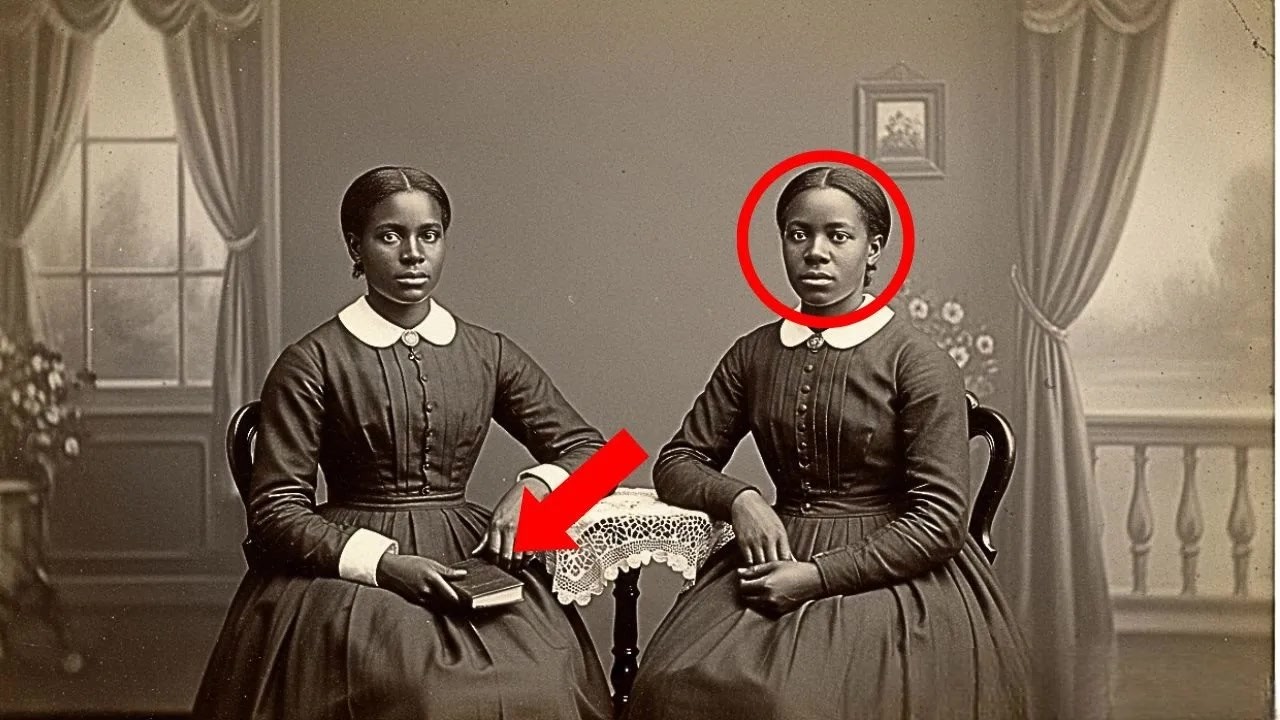
In it, two young Black women sat side by side in what appeared to be a modest studio. Their dresses were plain but carefully kept, dark fabric with white collars, the style of the mid-1880s. Both looked directly at the camera with expressions that seemed to carry stories never told. The woman on the left was older, perhaps mid-twenties.
Her hand rested on the shoulder of the woman beside her in a gesture of protection and deep connection. The second woman looked younger, around twenty or twenty-one, with delicate features and an expression of profound calm. Samuel turned the frame over. On the back, in faded ink: *Rose and Lily, sisters, May 1885, Charleston*.
He studied it longer. His trained eye caught details most observers would miss. The lighting was carefully arranged, the composition formal and deliberate. This was taken in a professional studio, which would have been a significant expense for Black women in Charleston in 1885, only twenty years after the end of the Civil War, in the heart of the Jim Crow South.
But something disturbed him. He could not say precisely what. Just an instinct developed over years of examining historical photographs. He paid the fifteen dollars the estate sellers asked, and placed the frame carefully in his shoulder bag.
Back in his office at the College of Charleston, he prepared his equipment. He had access to high-resolution scanning technology and image enhancement software capable of revealing details invisible to the naked eye. He scanned the photograph at maximum resolution and displayed it on his computer screen. That is when he saw it.
The shadows. Both women cast shadows on the background, as natural in the studio lighting of that era, but the shadows were different. Rose’s shadow on the left was clear and pure, falling naturally according to the angle of the light source. Lily’s shadow, on the right, was strangely distorted with odd lines that did not match the curves of her body.
Samuel magnified the image further, and his heart began to race. Behind Lily, partially hidden by her dress and the careful composition, he could see what appeared to be the edge of a metal stand, of the type used in Victorian photography to hold subjects perfectly still during long exposures. But these stands had another use. A use that made Samuel choke.
They were used to hold the dead. This was a post-mortem photograph. Lily was already gone when the picture was taken. The shadow revealed what the careful pose had tried to conceal.
She was not sitting alone. She was propped up by a hidden brace behind her, and the metal frame had created those strange lines in her shadow that natural light could not explain. Samuel leaned back in his chair, absorbing what he was seeing. This was not merely a photograph of two sisters.
It was a final photograph, a last moment captured together, taken by Rose before she buried Lily forever. He could not stop thinking about them. He had seen post-mortem photographs before in his research. They were common in the late nineteenth century, a way for families to keep a final image of a loved one in an era when photography was relatively rare and expensive.
But something about this image was particularly moving. Two young Black women in Charleston in 1885, one alive and one dead, seated together in a moment frozen in time. The first step was to learn who they were. Rose and Lily were common names, and without a surname, the search would be difficult.
But Samuel had resources and expertise in tracing historical records, especially those concerning Black communities in the post-war South. He began with death records. The Charleston County Register of Deeds kept death certificates from the 1870s onward, though records of Black people were often incomplete or poorly preserved. He requested the records for April and May of 1885, reasoning that if the photograph was dated May, Lily had likely died shortly before.
The records room was in the basement of the county building, a climate-controlled space filled with leather-bound ledgers and papers. A middle-aged clerk named Mrs. Patterson, who had worked there for thirty years, helped him find the right volumes. She asked as she set the heavy books on the table whether he was looking for something specific.
A young Black woman who died in April or May of 1885, he answered. Her first name was Lily. Mrs. Patterson nodded as if she understood.
The records are sparse, she said. Many Black deaths were not properly documented then. Sometimes only a first name was recorded, sometimes nothing at all. It was a way of erasing people, making them invisible even in death.
Samuel began turning pages, reading every entry carefully. The records were arranged by date with separate sections for white and Black deaths, a stark reminder of the segregation that defined every aspect of life and death in the Jim Crow South. April 1885 yielded nothing. The Black death records for that month included many children, a few elderly people, two middle-aged men, but no young woman named Lily.
Then, on May 3, 1885, he found her. Lily, colored, female, about 21 years old, died May 1, 1885. Cause of death: complications of childbirth. Informant: Rose, her sister.
Address: 47 Coming Street. A chill ran through Samuel. May 1, 1885. The photograph was dated May 1885, likely taken only days after Lily’s death.
The cause was complications of childbirth, meaning Lily had died in labor. The records listed Rose as the informant, confirming she was indeed Lily’s sister. And there was an address, 47 Coming Street, in the upper peninsula of Charleston, an area that was home to a large Black population in the post-war years. But no surname was recorded for either sister, and nothing about what happened to the child.
Samuel stood on Coming Street looking at the address where Rose and Lily lived in 1885. The building at number 47 was long gone, replaced by a modern housing complex built in the 1970s. But the street itself still existed, cutting through what was once a thriving Black neighborhood in the years after the Civil War. He had spent the previous night researching the area’s history.
In 1885, Coming Street and the surrounding neighborhoods were home to freed slaves and their descendants, many of whom worked as domestic servants, laundresses, dockworkers, and artisans. It was a community forged in the crucible of emancipation, where people denied even the recognition of their humanity built lives, established families, and insisted on their right to live with dignity. He walked through the neighborhood trying to imagine how it looked nearly 140 years ago. The grand houses on the lower portion of the street must have existed then, though likely in better condition.
The upper neighborhoods, where number 47 stood, were more modest. Wooden houses, some single-family, others divided into multiple dwellings where several families shared cramped quarters. At the Charleston County Public Library, the local history section contained city directories, maps, and property records. The 1885 Charleston City Directory listed addresses and residents, though coverage of Black residents was inconsistent at best.
Samuel found Coming Street in the directory. Number 47 was listed as a boarding house owned by a white proprietor named Herbert Ashford, with no mention of its residents. This was common; Black tenants were often not individually listed in city directories. Their presence was referenced only as anonymous occupants of buildings owned by white landlords.
But Samuel knew that their absence from official records did not mean they were absent in reality. He needed other sources, church records, burial records, personal accounts, anything that might tell him more about Rose and Lily. His next stop was the Avery Research Center for African American History and Culture, located on the campus of the College of Charleston. The center held extensive collections relating to Black life in the coastal lowcountry, including church records, organizational documents, and oral histories.
The director, Dr. Patricia Monroe, a colleague of Samuel’s, greeted him warmly and asked what had brought him there. He showed her the photograph and explained what he had discovered. Patricia studied the image carefully, overcome with sadness.
A post-mortem. The sister died in childbirth. She said quietly, how many similar stories have been lost? Samuel said that was what he was trying to prevent.
He wanted to know who they were, what happened to the child, what happened to Rose. Could she help him search the church records? Patricia nodded. Most Black people in Charleston in 1885 belonged to one of the Black churches, such as Emanuel AME, Old Bethel Methodist, or Morris Brown AME.
They would start there. They spent the afternoon reviewing carefully preserved church records. These documents, kept by congregations that understood they preserved not only religious history but also evidence of their members’ existence, were often more complete and accurate than official city records. They found what they were looking for in the records of Emanuel AME Church.
A burial record dated May 4, 1885. Lily Thompson, age 21, died in childbirth on May 1, 1885. Survived by her sister, Rose Thompson. Her infant daughter survived and was named Lily Rose Thompson.
Buried in Magnolia Cemetery, Section G, in an unmarked grave. The discovery that Lily’s child had survived changed everything. Samuel sat in his office that evening staring at the photograph with a new understanding. Rose had not only lost her sister, she had suddenly become responsible for a newborn infant in an era when survival was a daily struggle, especially for Black women in the Jim Crow South.
The name chosen for the baby, Lily Rose Thompson, honored both the dead mother and the aunt who would raise her. It was an expression of love and remembrance, ensuring the child carried the names of both women. Samuel realized that finding records of what happened to Rose and the child would be difficult. Black women and children in Charleston in 1885 left few paper trails.
They were not property owners, rarely appeared in newspapers except in cases of crime or tragedy, and were not listed in most business or social directories. But they were present in other records, census data, church membership rolls, school records, burial registers. He would have to piece their story together from scattered fragments. The 1890 census was his logical next source, but most of it was destroyed in a fire.
He turned to the 1900 census, hoping that Rose and the young Lily Rose had survived the fifteen intervening years. He searched the 1900 census records for Charleston County for Rose Thompson and her daughter Lily Rose. The search was painstaking, reviewing hundreds of entries, many with spelling variations or recording errors. Then he found them.
Rose Thompson, colored, age 38, laundress, widow, residing at 124 Smith Street. The household included Lily Rose Thompson, daughter, age 15. Daughter, not niece. Rose considered Lily Rose her daughter, granting her not just a home but full recognition as her child.
The census also recorded Rose as a widow. Sometime between 1885 and 1900, Rose had married and then lost her husband. Lily Rose’s survival into 1900 was significant. Many children did not live to age 15 in that era, especially in poor communities with limited access to healthcare.
Rose had managed to keep Lily Rose alive and raise her for fifteen years as a single mother working as a laundress, one of the most physically demanding and lowest-paid occupations available to Black women. Samuel felt profound admiration for Rose. She lost her sister in the most tragic way possible, inherited an infant to care for, somehow found a husband, then lost him too. And despite all of that, she kept Lily Rose alive and with her.
He continued through the records. In the 1910 census, he found them again. Rose Thompson, 48, laundress. Lily Rose Thompson, 25, seamstress, living at 89 Nassau Street.
Both were working. Both had survived. And Lily Rose had learned a skilled trade. Seamstress work paid better than laundry work and was less physically demanding.
Rose had managed to improve her niece’s situation. But Samuel still wanted to know more about that photograph. Why did Rose commission it? Post-mortem photography was expensive, and Rose must have been in financial distress in 1885, suddenly responsible for a newborn while mourning her sister.
Yet she found the money to take this photograph. He had to know who took it. Charleston in 1885 had several photography studios, but most served white clients only. Black Americans seeking photographs had limited options, usually relying on the few Black photographers who had managed to establish businesses in the post-war years, or the rare white photographers willing to serve Black clients.
Samuel searched business directories and newspaper advertisements from 1885 and found three studios that appeared to serve Black clients. One name appeared repeatedly in small advertisements in the *Charleston Messenger*, a short-lived Black newspaper of the era: George Russell, photographer for all people, with a studio on King Street. Samuel found Russell’s business license records in the city archives. George Russell had established his photography studio in 1882 and operated it until 1894.
The records classified him as “colored,” meaning he was either Black or of mixed race. In Charleston’s complex racial hierarchy, the term carried both meanings. More importantly, Samuel found Russell’s name in the records of the Freedmen’s Bureau, the federal agency that helped former slaves transition to freedom after the Civil War. Russell was born into slavery in Charleston in 1855, gained his freedom at age ten with the end of the Civil War, and somehow apprenticed with a photographer during Reconstruction.
By age twenty-seven, he had opened his own studio. The real discovery came when Samuel found a small archive at the Charleston Museum: a collection of George Russell’s business papers donated by his granddaughter in the 1960s. The collection included several account ledgers recording Russell’s clients and services. Samuel requested the ledgers and spent the afternoon carefully turning their fragile pages.
Russell’s handwriting was clear and precise, each entry recording the client’s name, the type of service, the date, and the amount paid. On May 3, 1885, he found the entry he was looking for. Memorial photograph of Rose Thompson with her deceased sister Lily, one photograph, $3. 50, paid in full.
Samuel did a quick calculation. In 1885, that amount was equivalent to roughly $100 today, a significant sum for a woman working as a laundress, perhaps earning only a few dollars a week. Rose spent what amounted to a full week’s wages, perhaps more, to take this photograph. It was a great sacrifice, indicating how much this final image of her with Lily meant to her.
But there was more in Russell’s ledger. In the margin beside Rose’s entry, Russell had written a note: “Sister died in childbirth, child survived. R. took photo to send to mother in Alabama.
This is the only photo of Lily that exists. ”
Samuel caught his breath. Rose had the photograph taken to send to their mother in Alabama. The sisters were migrants to Charleston, having come from Alabama before 1885.
And somewhere in Alabama, their mother was waiting for news, unaware that her daughter Lily had died. The revelation that Rose and Lily came from Alabama, and that a mother was waiting for them there, revealed another layer of tragedy. Samuel imagined Rose holding that photograph, knowing she would have to send it to Alabama with the devastating news. He expanded his search to include Alabama records, aware of the difficulty without knowing the area the family came from.
He would have to search widely. He began with migration records and newspaper announcements from the early 1880s, looking for patterns of migration from Alabama to Charleston. The period from 1880 to 1885 saw significant internal migration among Black Americans in the South. Some moved from rural areas to cities seeking better opportunities.
Others moved to escape the violence and persecution that intensified as Reconstruction ended and white supremacist “Redeemer” governments took power across the South. At the South Carolina Historical Society, Samuel found a collection of letters written by Black people in Charleston to their family members in other states. These letters, preserved by chance, offered a window into the lives of people whose stories were largely erased from official historical records. In a box labeled “1880s Correspondence,” Samuel found a letter that made his heart pound.
It was dated March 1883, written in precise but somewhat unsteady handwriting: “Dear Mother, we arrived safely in Charleston after a journey of four days. The city is large and noisy, but we found a room on Coming Street. Lily works in a large house doing laundry, and I have found work too. We are together and well.
We miss you and James and everyone, but mother, we could not stay after what happened to father. Here we can start again. Please write to us at 47 Coming Street. Your daughters, Rose and Lily Thompson.
”
Samuel felt tears filling his eyes. There they were. Rose and Lily writing to their mother explaining why they left Alabama. And the reference to what happened to their father suggested violence or tragedy that drove them away.
Samuel searched for more letters from Rose or Lily but found none. However, he found a letter dated June 1885 in different handwriting. Addressed to Mrs. Sarah Thompson, Rural Route 2, Montgomery, Alabama: “Dear Mrs.
Thompson, I write to inform you that your daughter Lily passed away on May 1, 1885, from complications during childbirth. Lily gave birth to a daughter who survived, and Rose is caring for her. Lily was buried in Magnolia Cemetery on May 4 in a proper funeral. Rose enclosed a photograph taken before the burial so that you could see Lily one last time.
Rose wanted you to know that Lily did not suffer much, and that her last words were for you. I am sorry to convey this sad news. Reverend Joshua Williams, Emanuel Methodist Church, Charleston. ”
The letter was never sent.
Someone, perhaps Reverend Williams or a member of his family, had kept it, and it eventually reached this archive. But the existence of the draft indicated that Rose had indeed tried to send the photograph and the news to her mother in Montgomery, Alabama. Samuel now had a location, Montgomery, and could search Alabama records for the Thompson family, for Rose and Lily’s parents, and for what happened to their father that drove the young women to leave. He traveled to Montgomery, Alabama, and spent a week at the Alabama Department of Archives and History.
He was looking for the Thompson family, especially any records of violence or death that might explain why Rose and Lily fled to Charleston. Montgomery in the early 1880s was a hotbed of racial violence. The end of Reconstruction in 1877 had led to the systematic dismantling of Black political and economic power across the South. White supremacist groups used violence, intimidation, and murder to enforce the new order.
Samuel searched newspaper archives for any mention of the Thompson family. Most newspapers of that era either ignored crimes against Black people or reported them in racist, victim-blaming language. But sometimes even biased sources contained facts that could be extracted. In the *Montgomery Advertiser* from January 1883, he found a brief news item buried on page six: “Negro Man Shot Dead.
A negro man named Thompson was shot and killed Saturday night near the railroad yards. Authorities say he was involved in a dispute over wages. No arrests have been made. ” The report was frustratingly vague.
No first name, no details of the circumstances, nothing about his family. But the timing was right. If this was their father, killed in January 1883, it would explain why Rose and Lily left for Charleston shortly after, as indicated in their letter dated March 1883. Samuel searched for more information and found it in another source: a report compiled by the Freedmen’s Bureau during its final years.
The report documented violence against Black people in Montgomery County from 1880 to 1883. It included: Samuel Thompson, age 47, railroad worker, shot and killed on January 21, 1883, by the foreman at the railroad yard after demanding unpaid wages. No charges were filed. He left behind his wife, Sarah Thompson, and four children: daughters Rose, 23, and Lily, 19, and sons James, 16, and Samuel Jr.
, 12. There it was, the full picture. Samuel Thompson was killed because he asked for the wages he had earned. Two months later, his eldest daughters, Rose and Lily, fled to Charleston, leaving their mother Sarah and their two younger brothers, perhaps because staying would have exposed them to the same violence that killed their father.
Samuel felt sick reading the matter-of-fact description of this injustice. Samuel Thompson had likely worked backbreaking labor in the railroad yards, earned money, and was killed for merely asking for his pay. The man who shot him was never held accountable. Rose and Lily were refugees, fleeing racial violence.
They found work in Charleston and began building their lives. Then, only two years later, Lily died in childbirth at age 21, leaving Rose alone with a newborn, hundreds of miles from their mother. And Rose, somehow, found the strength, resources, and determination to take that photograph. Not only as a memorial, but as a way to send a final image of Lily to their mother, knowing Sarah Thompson would never see her daughter again in this life.
The photograph was no longer just a post-mortem image. It was a message of love that transcended distance and death, a final gift from one grieving woman to another. In Charleston, Samuel arranged for the photograph to be analyzed by a forensic imaging specialist in the archaeology department at the College of Charleston. Dr.
Lisa Washington had equipment capable of revealing details invisible to the naked eye, including layers beneath the surface of old photographs. Samuel explained what he had discovered about Rose and Lily and their family. Lisa listened attentively, then examined the photograph under special lighting. She said, pointing to Lily’s distorted shadow on her computer screen, “The shadow is definitely the main anomaly.
See those lines? That’s the metal stand they used to keep her upright. But there’s something else. ” She adjusted the image, enhancing the contrast and bringing out fine details.
“Look at Rose’s hand on Lily’s shoulder. See how tightly she’s gripping? You can see the tension in her fingers, even through the fabric of Lily’s dress. And look at her other hand.
Why? ” Lisa focused on Rose’s left hand, resting on her lap. She was holding something small. Samuel had noticed it before but assumed it was a handkerchief or a small book.
Lisa said, “Let me enhance this. ” She applied several filters, and the object gradually became clear. It was a small photograph, worn and creased, showing two people, a man and a woman. Samuel said quietly, “She’s holding a photograph of her parents.
Her father who was killed, and her mother in Alabama. ”
Lisa said, “There’s more. ” She focused further on an area near the bottom of the image that appeared to be part of the studio floor, but with enhancement, faint writing emerged, scratched into the floor itself, perhaps invisible to anyone viewing the original photograph without magnification. The words read: “Baby Lily Rose, born May 1, 1885, lived.
” Samuel said, his voice thick with emotion, “Rose asked the photographer to document that. She wanted there to be a record. The baby was born and lived. ” Rose had ensured that was preserved in the photograph, even though it was not visible.
Lisa nodded. “That’s very clever. Hidden information preserved within the image itself. Rose wanted to make sure that even if all other records were lost, this photograph would carry the truth that Lily’s daughter survived.
”
Samuel thought about the layers of meaning in this photograph. On the surface, it showed two sisters, one alive and one dead, in a final portrait. But it also carried the shadow that revealed Lily’s death, the photograph of their parents that Rose clung to as a link to her family, and the hidden message about the child. All of it encoded in silver and paper, waiting over a century to be fully understood.
Lisa said, “Post-mortem photography was often the only way families could afford to preserve memories. But this is beyond that. Rose created a historical document. She recorded multiple generations.
Her parents through the photograph she holds, herself and Lily in the main image, and her niece through the hidden text. It’s a family archive in a single frame. ”
Samuel spent the next few weeks trying to trace what happened to Rose and Lily Rose after 1910, the last census in which he found them alive. The 1920 census records showed Rose Thompson, now 60 years old, still living in Charleston, still working as a laundress despite her age.
But Lily Rose was no longer listed in her household. Samuel expanded his search and found Lily Rose under her married name: Lily Rose Williams, age 35, living on St. Philip Street with her husband Marcus Williams, a carpenter, and their three children. Lily Rose had survived, married, and had children.
The baby born the day her mother Lily died had lived to become a wife and mother, carrying the names Rose and Lily into the next generation. Samuel found Rose’s death certificate from 1923. She died at age 63, the cause of death recorded as pneumonia. The informant was Lily Rose Williams, the niece Rose raised as her daughter, who stayed close to her and was with her until the end.
Rose was buried in Magnolia Cemetery in the same section where Lily was buried, though neither grave retained a marker to this day. But the most important discovery came when Samuel searched for living descendants. Through census records, marriage certificates, and birth records, he traced Lily Rose’s lineage four more generations. And in a small apartment in North Charleston, he found Evelyn Thompson, age 78, the fourth-generation granddaughter of Lily Rose Williams, and thus the fifth-generation descendant of Lily, who died in 1885.
Samuel called Evelyn and explained who he was and what he had found. There was a long silence on the phone, then Evelyn’s voice. She said, trembling, “We have a picture of our great-grandmother. We always heard stories about her, but we never had any pictures.
We had no proof of anything before about 1920. ” They arranged to meet. Samuel brought the photograph, carefully preserved in a protective sleeve, along with copies of all the documents he had found: death certificates, census records, church records, the unsent letter to Alabama. Evelyn’s apartment was small but perfectly maintained.
Family photographs covered one wall, pictures of descendants from different generations, all connected, without knowing it, to that single photograph from 1885. Evelyn took the photograph in trembling hands, tears streaming down her face. “That’s them,” she whispered. “That’s Lily Rose.
” Her grandmother, Lily Rose’s daughter, used to tell them about them. She said Rose was the strongest woman she ever knew, that she raised Lily Rose alone after Lily Rose’s mother died. She said Rose had a precious photograph, but it was lost after her death. They thought it was gone forever.
Samuel explained everything he had discovered: the murder of Samuel Thompson in Montgomery, Rose and Lily’s flight to Charleston, the baby born at the moment of Lily’s death, the hidden message in the photograph, and Rose’s determination to document and preserve their story. Evelyn listened, wiping her tears and nodding. Now she understood. Her grandmother always said violence drove them from Alabama, and that Lily Rose’s grandfather was killed.
She said Rose never remarried after her husband’s death, devoting everything to raising Lily Rose. She said Rose worked until her hands were calloused and her back could no longer straighten. Samuel said, “Rose paid a full week’s wages for this photograph. She had it taken to send to her mother in Alabama to tell her what happened to Lily.
” Evelyn asked, “Did the photograph reach Alabama? ” “I don’t know,” Samuel admitted. “I found a draft of a letter, but no evidence it was sent. Communication was difficult.
Mail was unreliable, especially for Black families, and Rose’s mother may have been illiterate. That was common for many in that era. ”
Three months later, Samuel organized an exhibition at the Avery Research Center titled “Shadows of History: A Hidden Story in a Photograph. ” The exhibition centered on the photograph of Rose and Lily but expanded to tell the broader story of Black women in the post-Civil War South, post-mortem photography as both art and documentation, migration and survival, and a family separated by distance and death.
The photograph was displayed with high-resolution enlarged copies showing the details Samuel and Lisa had discovered: the shadow that revealed Lily’s death, the small photograph Rose was holding, the hidden text about baby Lily Rose, and the tension in Rose’s grip on her sister’s shoulder. Alongside the photograph, Samuel arranged the documents he had found: death certificates, church records, census data showing Rose raising Lily Rose, and the draft of the letter to Alabama. He also added historical context: the racial violence in Montgomery, the challenges faced by Black women in Charleston, infant and maternal mortality rates, and the practice of post-mortem photography. But the most powerful element of the exhibition was Evelyn’s contribution.
She brought family photographs spanning five generations after Rose and Lily: Lily Rose as a young woman, her children and grandchildren, and finally Evelyn herself with her own children and grandchildren. This was what Rose’s sacrifice had produced, as the exhibition text explained: raising Lily Rose, keeping her alive despite poverty and hardship. Rose had ensured that Lily’s lineage continued. Today, more than fifty descendants of Lily Thompson live in South Carolina, Georgia, and beyond: teachers, nurses, business owners, artists, and students, all existing because Rose refused to let her sister’s death be the end of the story.
The exhibition opened on May 1, 2024, exactly 139 years after Lily Thompson died giving birth to Lily Rose. Evelyn attended with more than twenty family members from four generations. They stood together before the photograph, tears in many eyes, all connected to that timeless moment. Samuel gave a brief speech, explaining how he had discovered the photograph and traced its story, but he ended by yielding the floor to Evelyn, who spoke about what it meant to finally see these ancestors, to hear their stories, to have proof of their existence and their love.
Evelyn said, “Our history was always just oral stories, stories that people outside our family did not believe or care about. But this photograph is proof. Proof that they existed, that they mattered, that they loved each other. Rose and Lily were real.
They had parents, they had dreams, they survived violence and loss, and they built a family that still exists today. ” She gestured to the family members gathered around her, saying, “We are Rose’s legacy. Every one of us exists because she looked at that infant and decided to fight for her survival. She could have given Lily Rose to an orphanage.
She could have given her up. But she didn’t. She embraced her, raised her, sacrificed for her. And because of that, we are all here.
”
The exhibition ran for six months and became one of the most visited exhibitions in the history of the Avery Research Center. People stood before the photograph for long minutes, studying its details, reading about the lives of Rose and Lily, understanding that every person has a story worth preserving. Samuel worked with Evelyn and her family to place proper markers on the graves of Rose and Lily in Magnolia Cemetery. On a warm spring morning, they gathered there: descendants of Lily Rose, along with members of Emanuel AME Church, representatives from the Avery Research Center, and Samuel himself.
The new markers were simple but elegant. Rose’s read: “Rose Thompson, 1860-1923. Daughter, Sister, Mother, She Kept Her Promise. ” Lily’s read: “Lily Thompson, 1864-1885.
Daughter, Sister, Mother, Her Love Endures. ”
As Samuel stood at the graves, he thought about the photograph that had started this journey, and the shadow that revealed the truth of Lily’s death, which in a broader sense had illuminated an entire hidden history. He had brought Rose and Lily out of obscurity, connected the past to the present, and returned to the family their heritage. Evelyn donated the photograph to the Avery Research Center, where it would be preserved and displayed for generations to come.
Before donating it, she had a copy made so that every family member could have one. She told Samuel, “It belongs to everyone now. Rose made sure this photograph survived because she wanted people to remember. And now they will.
” Rose and Lily would never be forgotten. Samuel had also made a copy for his office. Sometimes, when overwhelmed by the sheer volume of lost history, all the stories that would never be recovered, he would look at it and remember that every person has value. Every life leaves a mark.
And sometimes, if you look closely at the shadows, you can find truths hidden for over a century. The shadow in the photograph, that distorted shadow that first caught his attention, became for Samuel a metaphor for historical research itself. Shadows reveal what is hidden. They show us where to look and what questions to ask.
They remind us that the surface of any image, any document, any story, may conceal depths not yet explored. Rose and Lily Thompson were no longer anonymous faces in an old photograph. They were known. Their struggles, their love, and their determination were documented, honored, and remembered.
And through that photograph, taken in a photography studio in Charleston in May 1885 as a final gift from one sister to another, preserved across generations through chance and care, their story became immortal. In the shadow that changed everything, Samuel found not only death but life: life that continued, love that endured, and courage that echoed across a century to inspire everyone who encountered it.






